Archives For November 30, 1999

Stirring the Waters

After three years of declining baptisms, SBC leaders are calling it what it is—an evangelism crisis.

What happened to evangelism in the Southern Baptist Convention?”

The question, posed by SBC President Ronnie Floyd, came after the Annual Church Profile reports completed by Southern Baptist churches showed a third consecutive year of declining baptisms.

In fact, the total for 2014 (the most recent year for which national statistics are currently available) is the lowest number of baptisms since 1947. Southern Baptist churches baptized 305,301 people, a 1.63% decrease from the previous year. An in Illinois, the annual number of baptisms, which has hovered around 5,000, dropped to 4,400 in 2015.

“Deplorable” is how Floyd described the reality that even though there are more SBC churches than ever, and an ever larger population to reach with the gospel, it’s simply not happening—at least, not according to the baptism numbers.

Recently, Floyd and other SBC leaders have been increasingly vocal about how the numbers reflect an even bigger problem: an evangelism crisis.

“Lostness in North America is having a bigger impact on Southern Baptists than Southern Baptists are having on lostness,” New Orleans Theological Seminary President Chuck Kelley said at a recent chapel service.

The picture is bleak, but all is not lost, SBC leaders seem to agree. A turnaround is dependent on renewed appreciation for and dedication to evangelism in the Southern Baptist Convention and in individual churches. Church members need models, leaders who are soul winners themselves and can train people in the pews to share their faith.

“Let’s not be paralyzed,” Floyd wrote on his blog, urging Baptists to action. “Do something. Do more than you are doing now. Take a risk.

“Return to the importance of reaching and baptizing people.”

Mission drift

One reason some leaders cite for the SBC’s decline in baptisms, and overall in evangelism, is a culture that sidelines those things. In an address to the SBC Executive Committee in February, Floyd spoke about a critical shift that has brought the denomination to this point:

“Years ago, something happened where pastors and churches that reached and baptized people effectively came under the microscope of other Baptists who oftentimes did not have a heart for evangelism themselves. A culture of skepticism about evangelism began to creep into our convention. Evangelism began to die.”

Even the way we talk about evangelism is different, said IBSA’s Pat Pajak. The weekly opportunity to go out “soul winning” has been replaced with more politically correct titles such as outreach, or more often the practice has been lost altogether. “In the process, born-again believers have lost the passion and emphasis on reaching into the pagan pool and bringing the lost to Christ,” said Pajak, who leads the Church Consulting Team.

Recent research supports this: A 2012 study by LifeWay Research found that while 80% of Protestant church-goers believe they have a personal responsibility to share their faith, 61% hadn’t told anyone how to become a Christian in the previous six months. Nearly half (48%) hadn’t invited an unchurched person to attend a church event or service in six months.

LifeWay Research President Ed Stetzer broke down the research this way: “…The typical churchgoer tells less than one person how to become a Christian in a given year. The number for more than half of respondents was zero. The second most frequent answer was one.”
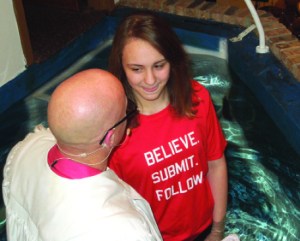
The shirt says it all -- Emily Zimmer is baptized by Pastor Tracy Smith at First Baptist Church in Mt. Zion.

The shirt says it all — Emily Zimmer is baptized by Pastor Tracy Smith at First Baptist Church in Mt. Zion, one of many congregations in Illinois that experienced large increases in baptisms in 2015.

To right the ship, SBC leaders have pointed first to the need for spiritual awakening—first in churches, then in the culture at large. But there are also solutions to be found at the denominational level and in local churches, starting with leaders.

Floyd recalled a time when only preachers who led strong evangelistic churches were invited to speak at the SBC Pastors’ Conference and annual meeting. Those leaders were also the ones nominated for denominational offices. In his November blog post about the state of evangelism in the SBC, Floyd seemed to call for a return to those principles.

“Quite honestly, I am not impressed by how many books a pastor sells, how many Twitter followers he may have, at how many conferences he speaks, how great of a preacher he is, or how much his church does around the world if he pastors or is associated with a church that has a lame commitment to evangelizing and baptizing lost people and reaching his own community with the gospel of Christ.”

At the local level, too, leaders can help reverse the decline by creating an environment that is conducive to evangelism, said IBSA’s Mark Emerson.

“The pastors who are effectively reaching people for Christ are creating an environment of evangelism in their churches,” said Emerson, whose Church Resources team equips churches in evangelism.

“They are making sure every ministry has an evangelistic purpose, they are designing their worship services to communicate the gospel and offer an opportunity for people to make a decision. These churches are training their members to effectively enter into gospel conversations.”

Modeling evangelism

Scott Foshie is one pastor currently training his congregation to have those gospel conversations. Steeleville Baptist Church will start evangelism training in April, based on the “Can We Talk?” program created by Texas pastor (and FBC Pastors’ Conference President) John Meador.

“When it’s time to bridge a conversation from small talk to gospel talk, that’s an awkward transition for people to make,” said Foshie, who has pastored the church since early 2015. The six-week curriculum combines training with practical experience; teams of three people go out into the community, visiting neighbors and practicing gospel conversations.

Foshie’s personal stake in the training goes beyond the fact that it’s happening at his church. As a student of the F.A.I.T.H. evangelism training tool, he led his future wife, Audra, to faith in Christ.

“Personal evangelism training is very important to me because it changed my life. So, I want people to experience that. Personal evangelism training unleashes the army of the Lord, (it’s) what God has called us to do.”

But first, people have to face down a common obstacle: fear. The pastor likened sharing the gospel to someone handing you the keys to their sports car and telling you to take it around town.

“What we need to teach them is, hey, you step out in faith, you begin to learn to share, you simply share, and the Holy Spirit’s going to help you,” Foshie said.

“Once people learn to share the gospel, it changes their life completely.”

Top 10

“I feel like in some ways, after 10 years, I’m just figuring things out,” Nate Adams told the Illinois Baptist State Association Board of Directors last month during a celebration of his service as executive director.

Adams offered some reflection on IBSA’s victories over the last ten years, and a few challenges ahead, all in the form of a “top ten list.”

10. Goals and measurements. IBSA now has a consistent, annual pattern of evaluating churches’ needs (surveys), measuring churches’ progress (ACP), setting focused, organizational goals, and measuring effectiveness through multiple, strategic metrics. Our goals are based on facts and feedback, not programs or preferences. Everything from annual budgets to the Annual Meeting theme are driven by purpose and strategy.

9. Strong church participation. Over the past 10 years, IBSA churches baptized 49,584 people and planted 242 new churches. Mission trip participation is up 23% to more than 24,000. Nearly $90 million was given to missions, including more than $64 million through the Cooperative Program (CP). This growth in church participation is in spite of fewer total churches and members.

8. Financial frugality, stability, and health. Over the past 10 years, annual income over expense has averaged $395,000 or around 5% (in 2006 it was $36,608). IBSA’s Cooperative Agreement with the Baptist Foundation of Illinois (BFI) has helped it to grow and for the CP subsidy of BFI to be reduced from a peak of $153,000 to $35,000 in the 2016 IBSA budget.

While 2015 CP giving was $411,000 less than 2009 and NAMB revenue was $252,000 less, IBSA has avoided involuntary lay-offs, and modest compensation increases have been possible each year.

7. Updated and renewed facilities. In 2012, IBSA completed a $1.9-million renovation of its Springfield building and grounds, debt-free and on schedule. The building now hosts groups of up to 250. In 2014, Lake Sallateeska expanded and renovated its dining hall and two other buildings.

6. Staff efficiency and strength. IBSA has trimmed, restructured, and right-sized its staff to adjust to available resources, increased personnel costs, and the evolving needs of churches. Part-time zone consultants are the most notable example. Today, the IBSA staff is not only more diverse, but far more field-based and closer to churches than it was 10 years ago.

5. Effective change management. IBSA has weathered significant economic and social change, from the secular culture, to the national SBC, to local associations and churches themselves. Many organizations and state conventions in particular have had traumatic adjustments to these changes. By acting early, budgeting conservatively, and an “elastic” restructuring, IBSA has for the most part been able to manage a gradual altitude adjustment with minimal negative consequences to IBSA churches. Changes at both the national SBC and local association level present IBSA with new opportunities and challenges for the future.

Those are the victories of the past 10 years. Now the challenges ahead:

4. IBSA churches’ relatively low net impact on lostness in Illinois. While 242 churches have been planted, the net IBSA congregation count has dropped from 1,032 to 957. IBSA churches baptized 4,400 in 2015, yet dropped 3,352 in Sunday School attendance.

3. Reversing health and growth trends among churches. Annual baptisms are down 18% from the 2009 level. Overall worship attendance is now basically the same in 2016 as 2006, though it rose as much as 9.3% (in 2008). Overall Sunday school attendance in 2016 was 17.4% lower than in 2006.

2. Rekindling the passion and renewing the power of cooperation. Some younger leaders and those without Baptist backgrounds do not always understand or buy in to the cooperative missions model. After dropping to 6.8% in 2013 and 2014, the CP giving percentage rebounded to 7.1% in 2015. Nationally, the average is 5.5%. “Engagement” is key for IBSA’s future.

1. Raising the bar of leadership. Most of the challenges and problems with which IBSA churches struggle are rooted in leadership issues. As the 2015 Midwest Leadership Summit and 2016 Illinois Leadership Summit demonstrated, there is a hunger for leadership development among IBSA churches and leaders.

Lessons from Tom Adams

ib2newseditor —  March 31, 2016
Tom Adams

Tom Adams

It still surprises and moves me that so many people in Illinois Baptist churches fondly remember my father Tom Adams, or at least his writing. Dad entered his eternal life with the Lord ten years ago, just one month after I began my role here as IBSA’s executive director. Yet more often than not when I visit a church, one or more of its members will tell me how much my dad or his writing meant to them.

In fact, it’s not uncommon for one of those older church members to reach into their Bible and pull out a yellowed clipping of one of his columns because it met a particular, deep need in their lives. Dad wrote for the Illinois Baptist for 34 years, through columns such as “Problem Corner,” or “Ask Tom Adams.” So he became a sort of corresponding counselor to many.

Frankly, I thought I would have my dad’s counsel for a few more years here in Illinois.  Instead I have needed to rely on the years I had to observe him as father, pastor, and associational leader. With his memory in my heart, here are some of the lessons I learned from Tom Adams.

1. Writing broadens and lengthens influence.
Dad never pastored a large church, nor held a position of great stature. But because he wrote down carefully considered thoughts at least every couple of weeks for decades, he touched tens of thousands of people he wouldn’t have otherwise.

2. Few words can be more impactful than many words.
Dad was a man of few words interpersonally, and the format of his columns gave him only a little room to express an opinion or idea in writing. But he demonstrated both in speech and writing that a few, carefully considered words can have great impact. Apparently they also fit better in your Bible.

3. Readers are better leaders.
My dad would be the first to admit that his wisdom didn’t come from his own deep intellect or extensive formal education. But he was one of the more widely read men I have ever known. Just ask my mom, whose house is still filled with an incredible variety of books, even after giving many away. I’ve never been the avid reader my dad was. But I’ve rarely gone in to a serious meeting or problem without doing my homework.

4. Face your fears with faith.
I didn’t know it until years later, but my dad was scared to death to move our family from Southern Illinois to the Chicago area. My mom tells me he became physically ill over the decision to follow God’s call there. What was very hard for him became very good for me, and in their own ways for the rest of our family. For reasons I can’t go into here, I doubt very much if I would be at IBSA today if he hadn’t made that move when I was fourteen. But his example helps me face my fears with faith, even today.

5. Invest fully where you are.
Dad was never a self-promoter, or a ladder-climber. I know he dreamed of another position or two in his life, but he always chose to invest fully where he was called, until God through others beckoned him elsewhere. Me too.

I jotted down some other lessons I learned from Tom Adams: Do what you know is right, and trust God with the consequences. Marry well and let your spouse be herself.  How you say something can be just as important as what you say.  Some burdens are best borne privately.  Leaders come in all personality types.

A few years ago my mom and I helped my dad organize some of his Illinois Baptist columns into a book, titled after one of his columns, “Speaking Out.” If you don’t have a copy and will write me, I will be glad to send you one. He would be pleased for you to have it.  And I will be pleased for his influence to touch your life, as it deeply has mine.

Nate Adams is executive director of the Illinois Baptist State Association. Respond at IllinoisBaptist@IBSA.org.

Smart phones make smart disciplesMy faith was greatly impacted in college by a church that challenged me to be a student of the Bible. That love for personal Bible study has motivated me to become an advocate for biblical literacy—a need highlighted by a recent Lifeway Research study that found only 45% of regular church attenders read the Bible more than once a week.


Before becoming a pastor, I always viewed the main responsibility as preaching. But now I understand why the role isn’t called “Senior Preacher.” As a pastor, I have a responsibility to build stronger disciples in Jesus Christ, and that’s an impossible task apart from the Bible.

To help combat biblical illiteracy at our church, we have turned to an app called YouVersion. I think of it as an example of what Paul meant when he wrote in 1 Corinthians 9:22: “I have become all things to all people, that by all means I might save some.” YouVersion is a 21st century response to Paul’s approach.

With over 200 million downloads, the app is a helpful tool that any church can easily use. It’s free, can be carried on any smart phone or tablet (or accessed by a computer at bible.com), and offers valuable opportunities for biblical accountability and community.

A long-time church member stopped by my office last month and said, “I want to grow closer to the Lord.” After listening to his testimony of faith, I inquired about his personal devotional times. He admitted to not reading the Bible much, and so I asked him to pull out his phone. We quickly downloaded YouVersion, and got him started on a daily reading plan through the Gospel of John.

He texted me later that night to tell me he finished the entire book of John! “Should I just go onto Acts?” he asked. Since then, he has not only finished Acts for the first time, but is now re-reading it to gain a better understanding of the story. He credits his success to the ease of YouVersion.

We’ve used YouVersion with recent converts to Christ. I helped them get the download and choose a reading plan. This has provided these brand new believers with a clear plan and goal for their Bible reading.

As with other forms of social media, you can “friend” others through YouVersion. As you do, your homepage fills up with news of their progress through Bible plans or verses they highlighted. So I not only learn from my own Bible reading, but that of others in my church. And anytime one of my friends has been offline for a while, I know to check in with them.

Two weeks in a row, highlighted Scriptures from members of my church made their way into the messages I had been working on for that week. They were thrilled to know their personal study of the Bible had influenced my own.

Even my 10-year-old daughter switched to YouVersion on her Kindle last year and I use it to monitor and comment on her reading.

I also use my YouVersion newsfeed as a prayer list. As I see the names of friends and passages they’re studying, I pray for their study and usually let them know I’m praying. And watching comments between our members regarding a particular passage is a great encouragement to me as their pastor.

We as a church also use the YouVersion live component. This allows us to create “events” for each upcoming sermon. People can read the Scripture passage and interact through polls, or by posting comments or questions. And again, it’s 100% free.

I should tell you, YouVersion doesn’t pay me for my advocacy. I’m merely sharing how this Bible app has had an impact on our church. Like many churches, we’re often slow adopters when it comes to technology. And while a digital Bible is no better than a traditional Bible, it’s time we used every opportunity available to us in building biblically literate believers in Jesus Christ.

Heath Tibbetts pastors First Baptist Church, Machesney Park.

Pastor combats violence

Lisa Misner —  March 24, 2016

Takes to airwaves to save kids and streets

An IBSA pastor appeared on the “Steve Harvey Show” last month to bring attention to rampant gun violence in his city. Corey Brooks, who pastors New Beginnings Church on Chicago’s South Side, was part of a four-person panel on Harvey’s Feb. 15 episode, the whole of which was dedicated to violence in Chicago.

Chicago pastor Corey Brooks (right)

Chicago pastor Corey Brooks (far right), “The thing that will change and solve the problem of violence is the gospel.”

It’s a problem Brooks has been fighting for years, most notably during his 2011 campaign on the roof of a motel across the street from his church. “I was just tired of it,” Brooks said of the crime that riddled the motel. With only a tent to protect him from the Chicago winter, Brooks spent 94 days on the roof, until he had raised $555,000—enough money to buy the hotel and tear it down. His church is now raising money to build a community center in its place.

In 2015, Chicago had 468 homicides, the Chicago Tribune reported, the most of any U.S. city. More than 2,900 people were shot. Already in 2016, there have been 467 shooting victims in Chicago.

Brooks’s church sits in a neighborhood that one newspaper labeled in 2014 the city’s most dangerous. But when New Beginnings moved in to the location, they were looking for a place they could make a difference.

“We wanted an area that really needed the gospel, an area that really needed a lot of help,” Brooks told the Illinois Baptist. “God has really been good to us, and we’re doing the best we can do in that area. It’s difficult, but we’re working really hard.”

The church started a non-profit called “Project HOOD” that focuses on mentoring initiatives. It was Brooks’s time on the motel roof that first introduced him to talk show host Steve Harvey, who gave the pastor his Best Community Leader Award in 2012. Harvey’s foundation has since partnered with Project HOOD.

On the Feb. 15 episode of Harvey’s show, which tapes in Chicago, Brooks’s fellow panelists—a former school principal, a journalist, and a Catholic priest—came from very different walks of life than his own. But to solve the problem of gun violence, Brooks said, people are going to have to work together.

In fact, that’s why his church affiliated with the Illinois Baptist State Association in 2015. “I realized that this issue is a lot bigger than what an independent church can handle,” Brooks said. “You need to be aligned and partnering and collaborating with other groups that believe what you believe” so that you can bring needed resources into communities, he said.

“The thing that will change and solve the problem of violence is the gospel.”

Meredith Flynn is an editorial contributor to the Illinois Baptist.

Politics and religion

Bloomington, Champaign, Decatur, Peoria, Springfield – these Illinois cities were all visited in the last few days by candidates vying for the U.S. presidency. As the March 15 Illinois primaries loomed so did the candidates.

I had the opportunity to attend one of these rallies, where I was packed into an auditorium with other would be voters. It wasn’t my first political rally, but I was struck as always by the sense of camaraderie displayed by the participants. You may not know anyone there, but you know you belong. You can speak freely with total strangers who won’t shout you down for your beliefs.

As we waited for the candidate to take the stage, organizers led us in enthusiastically chanting the candidate’s name. A local pastor came to the platform and lead a prayer for the nation. Then it was time to recite the Pledge of Allegiance. I almost said “amen” at its conclusion.

The candidate finally appeared on stage to much cheering and applause. As the speech continued the candidate’s voice fell into a rhythm as any good pastor’s would. Elderly women could be heard shouting, “Amen,” when something was said that they agreed with strongly. Soon they were joined by others. A few men even held their hands in the air as some do during worship services on Sunday mornings.

I realized then that for many, this was something akin to a religious experience and wondered if the churched and unchurched in the room knew it too. It frightened me in a way, and saddened me too. When was the last time I had been in a church service filled with such excitement? When had I last experienced such a sense of camaraderie and acceptance among fellow Christians?

There has been much debate lately about how Christians should behave as citizens of this nation and as citizens of heaven. Such debate is good and should take place. But what I’ll continue to ponder is how to be more loving and Christ-like to others inside and outside the walls of the church.

Lisa Sergent is a contributing editor to the Illinois Baptist.

Monochrome reality

Artist Andy Rains shows Christ’s humble beauty in simple black and white.

In our self-centered era, many people think the humble are losers and only the proud win. The Suffering Servant disagrees.

These aren’t humble times. So far, 2016 has produced as much bluster and blow as any year in memory. Not the meteorological kind, rather the political kind.

It is increasingly evident that ours is a land that no longer appreciates the humble man. In most every news report in this election cycle, humility as a value is trounced by pride, promises, and vainglory. Not the videogame Vainglory produced by Super Evil Megacorp (really, that’s the actual name of a game manufacturer); but the inordinate pride in one’s self and one’s accomplishments condemned in the Elizabethan English of the King James Version of the Bible as “vainglory” (Galatians 5:26, Philippians 2:3).

Prior to the 2008 election, a book was published that proposed “Jesus for President.” In it, the authors took a familiar concept from Charles Sheldon’s famous 1896 book “In His Steps” that first asked the question “What would Jesus do” and applied it to American politics: What would Jesus do—if he ran for president?

Probably lose. At least that would appear to be the answer in 2016.

Let’s face it: the humility platform would not prove popular today. The humility platform is not high and lifted up, it doesn’t have room for boasting. Its candidate doesn’t make empty promises. He doesn’t exalt himself, even though in the case of Jesus he rightfully could. He does nothing at the expense of others. And he’s interested in only One endorsement.

How could he possibly win here in Braggadocio?

Still, there is much the Humble One can tell the candidates—and the electorate.

A better example

Four passages in the book of Isaiah have been identified as the Servant Songs. The Ethiopian eunuch reading Scripture while sitting in a royal vehicle asked Philip, “Who is the prophet talking about?” He was reading from Isaiah:

“He was led like a lamb to the slaughter, and as a sheep before its shearers is silent, so he did not open his mouth. By oppression and judgment he was taken away. Yet who of his generation protested? For he was cut off from the land of the living…”  (Isa 53:7-8).

“Who is the prophet talking about, himself or someone else?” the servant to a queen asked Philip (Acts 8:34).

Definitely someone else.

He was talking about the Lord’s servant, the Suffering Servant. Jewish interpreters say the passage refers to the nation Israel, since in most of the book God speaks to Israel. But the verses describing an utterly humble servant and his sacrificial and redemptive work cannot be about a proud and unrepentant nation. They are clearly about the Messiah.

The Suffering Servant is Jesus.

In the Gospels, we see his humility in living tableau. He touches the unclean—lepers, lame, and blind people—and heals them as Isaiah predicted he would. He shows willing descent as he assumes the place of the lowest slave in the house and kneels to wash the feet of his followers. Then he stands with the condemned on the killing hill.

In Philippians, Paul sings a little song of the early church that puts Jesus’ humility into theological perspective.

“Who, being in very nature God, did not consider equality with God something to be used to his own advantage; rather, he made himself nothing by taking the very nature of a servant, being made in human likeness.

“And being found in appearance as a man, he humbled himself by becoming obedient to death—even death on a cross!” (Philippians 2:6-8).

Jesus’ humility was not only a matter of location but also of position. He let go of all the things God deserves in terms of dominion and stooped down to his own creation. He subjected himself to his own created beings, even though he knew beforehand they would murder him.

He never sought to justify his actions. He never came to his own defense. Neither did anyone else.

Was there ever a clearer picture of humility.

The mirror cracked

Today our concept of humility is corrupted. “Lord, it’s hard to be humble, when you’re perfect in every way,” songwriter Mac Davis wrote. Even our contemporary examples become more idols than icons as our culture converts them into celebrities.

Mother Teresa is rushed to sainthood so her musky humility sharpened in Calcutta ghettos can be perfumed for the ages. Pope Francis, hailed for his (relatively) simple lifestyle chides a woman in a parade line. “Don’t be selfish!” he snapped when she pulled him away from a handicapped man he was praying over. Our selfish generation demands something more grand from those who willingly would be lowly. Humility is not fashionable; it’s barely tolerated.

Could it be that Billy Graham sitting in a rocker on the porch of his Blue Ridge mountain cabin out of the glare of the Crusade spotlight is the last example of humility in our egotistical age?

The times are louder. The boasts are prouder. And the rhetoric of its claimants is so overblown that their platforms cannot support it. If only our national leaders could learn a few lessons from the Humble One. If only our countrymen would accept from their icons true servant leadership.

A humble servant is silent

“There is a time to speak,” the Preacher says in Ecclesiastes, “and a time to be silent.” The Suffering Servant is more often silent, so much so that silence has become one of his chief characteristics. When he speaks, it is to the glory of God and to the benefit of others; it is rarely if ever on his own behalf.

The word picture drawn by Isaiah is of a lamb about to be slaughtered. The lamb knows something is coming, from its perspective something bad. And yet he offers not a bleat in protest. If silence is consent, then the lamb is offering his tacit acceptance. Likewise, Christ before his accusers offers no defense of himself. His defense could rightly be that he is God and has done all to the glory of his Father. But he keeps his rebuttal to himself and leans in to his mission with the same humble spirit that has characterized his whole life on earth. The day of his exaltation will come, but there before Pilate, Herod, and the Jewish supreme court, it’s still about three days away.

Andrew Murray says, “Humility is perfect quietness of heart.” In this way, a humble servant stands in stark contrast to the leading figures of our time who exhibit little quietude.

In his little book Humility, Murray describes the inner working of this outward silence: “It is to expect nothing, to wonder at nothing that is done to me, to feel nothing done against me. It is to be at rest when nobody praises me, and when I am blamed or despised. It is to have a blessed home in the Lord, where I can go in and shut the door, and kneel to my Father in secret, and am at peace as in a deep sea of calmness, when all around and above is trouble.”

Oh, how we need that room, that door, that peace.

He is not vain

Isaiah’s prophetic description of the Messiah says there was nothing particularly attractive about him. Even before he was “marred,” “pierced” and “crushed” at Golgotha, the Servant was a plain man with “no beauty” and a king with “no majesty.” He is not a pretty flaxen-haired Jesus as painted in Sallman’s Head of Christ over grandma’s mantelpiece.

Our generation has bought the Kardashian concept of beauty that requires everyone in the public eye to be “carved out of cream cheese.” By this standard, Abraham Lincoln couldn’t get elected to office today. He was tall enough, but homely people don’t win elections. Nor would Cleveland, Taft, or Teddy Roosevelt. Too fat, bald, or bespectacled.

Appearance is not only about outward beauty. There is the vanity of money, stature, power, and position. The desire for reputation is a form of the vanity of fame. The proud person is concerned about the opinion others have of him. “Pride must die in you,” Murray warned, “or nothing of heaven can live in you.”

This is the dying to self Jesus called for, the laying down of his life.

“Men sometimes speak as if humility and meekness would rob us of what is noble and bold and manlike,” Murray said. The humble are rarely exalted in our times, nor do they win elections. But a wise generation doesn’t judge on outward appearances. To the extent it is possible they follow God’s standard when he sent Samuel to anoint lowly shepherd boy David to replace the high but corrupted Saul: He looked on the heart.

And what does he see there?

As a “man of sorrows,” the Suffering Servant is serious about serious things. Oh, sure, he can be great fun, but he is also sober minded. Jesus enjoys a good time in good company (remember the wedding at Cana), but he handles serious subject matter with the gravity deserved. He is “acquainted with grief.” One charged with so great a task as carrying our sorrows to the cross surely feels them deeply.

The same must be true of those who claim him as Lord: “Then Jesus told his disciples, “If anyone would come after me, let him deny himself and take up his cross and follow me” (Matt. 16:24).

“Humility, the place of entire dependence on God, is the first duty and the highest virtue of the creature, and the root of every virtue. And so pride, or the loss of this humility, is the root of every sin and evil,” Murray said.

For those who follow in the way of Christ, there is an inverse relationship between vanity and a quiet spirit. “Pride must die in you,” Murray warned, “or nothing of heaven can live in you.”

He serves needs over wants

The word “populist” has returned to the American vocabulary, driven largely by the large crowds showing up at campaign rallies. By definition, a populist candidate is concerned with the interests of common people. He seeks the involvement of ordinary folks in the political process and welcomes into the discourse issues drawn from ordinary lives. But by recent example, populism involves stirring up the desires of the people, then promising to fulfill them whether they are right (and righteous) or not.

A humble servant may be populist by its original definition. He is concerned about the people, but he doesn’t play to the crowd as is the current practice. At times the crowds were with Jesus; at times they were against him; but Jesus never played to the crowds. He never healed to curry favor. He did not feed the 5,000 to increase his poll numbers.

A humble servant doesn’t dispense treats to get public approval. Or health benefits or government subsidies or campaign promises. He accepts the hard job and does the hard work to its completion, even if that causes everyone to turn away.

The challenge for Americans today is to show some maturity by supporting a leader who will do what the nation needs, not necessarily what the people want. That may sound paternalistic, but isn’t God’s kingdom paternalistic? The Father is always doing what is best for his children, even when they don’t understand it or like it.

He lives with the end in mind 

A humble servant may live and work from a lower position, but that somehow gives him a higher perspective. Isaiah’s picture of the Suffering Servant is paradoxical: he is lowly but he will be exalted; he is oppressed, yet he is the strong arm of the Lord; he is wounded for the sake of our healing. And there’s this paradox concerning “the will of the Lord”—

Yet it was the will of the Lord to crush him; he has put him to grief; when his soul makes an offering for guilt, he shall see his offspring; he shall prolong his days; the will of the Lord shall prosper in his hand (Isaiah 53:10).

It was the will of God that the Suffering Servant be crushed, yet the will of God only prospers when this is done. Crushing and prospering would seem to be opposites. One destroys while the other creates. One shrinks and the other grows. One is an ending, but the other is unending.

And in all of this the humble Servant knows there is a higher purpose than his momentary affliction. The purpose in his dying is to make possible our living—forever. His offering is our ransom. His ending is our beginning. In it all he does not object, because the Servant knows that his grief will become our source of joy and our salvation.

There, between the Lord’s will that the Servant be crushed and the prospering of the Lord’s will in the Servant’s hand is the great promise: this lowly Servant will have offspring. That’s us, his children, his followers, his redeemed.

Isaiah, 700 years before hand, describes the centerpoint of history, the cross, where the crushing intent of the Lord’s will is met by the prosperous outcome of the Lord’s will in the salvation and multiplication of his progeny. This is only possible because the lowly Servant is willing to submit to the Lord’s will that he die and that he rise again, that we believing may be born again to new life.

Rising from that moment in history is the way for all who will follow the Suffering Servant. “Here is the path to the higher life: down, lower down!” Murray said. “Just as water always seeks and fills the lowest place, so the moment God finds men abased and empty, His glory and power flow in to exalt and to bless.”

Eric Reed is editor of the Illinois Baptist


Eleven Portraits

Lisa Misner —  March 7, 2016

Eleven_portraits

In some ways I’m just getting started and just beginning to figure some things out.

Visitors to the IBSA office building in Springfield sometimes take note of eleven portraits displayed there, acknowledging the men who have served IBSA as executive director since its formation in 1907. Those portraits used to hang in the entrance lobby, and since our building renovation a few years ago they have been on display in our first floor Resource Room.

While it’s hard for me to believe, by God’s grace I have just celebrated 10 years in that executive director role. That milestone recently led me to a few reflective moments in front of those portraits. Four of those men are simply historical figures to me, but I’ve had the privilege of meeting the other six personally. They each served in different times and faced different challenges, but together they form the legacy of leadership on which I now gratefully stand.

I’ve been told by others around the Southern Baptist Convention that 10 years seems to be about the typical length of service in the state executive director role. Since years of service are noted on a little plaque beneath each of the IBSA portraits, I did the math and learned that indeed the average term of service here in Illinois has been just over nine years.

There are, however, two distinct groups of IBSA executive directors among my 10 predecessors. Six men served less than seven years, and four served 12 or more. The smaller, longer-serving group were four of the first five executive directors, all of whom completed their service by the 1970s. The larger, shorter-serving group represent the more current trend. And at 10 years’ service, I now stand in the middle.

There are many reasons why leaders stay in roles for a short time, including some which are beyond their control. So I wouldn’t second guess the Lord’s leadership or providence in any of the shorter terms of service. But after investing 10 years here at IBSA, I have a new appreciation for the men in the longer term group.

It takes time to establish relationships, and to build trust. It takes time to learn the many systems and traditions and landmines inherent in a thousand diverse churches working together. It takes time to learn the regional and ethnic and generational uniqueness of churches and their leaders. It takes time to take necessary risks and make unavoidable mistakes, and then to recover and learn from them. And I’m now discovering that it takes time to do it all again and again, as new pastors and leaders come on the scene.

After 10 years, I feel in some ways I’m just getting started and just beginning to figure some things out. Yet by the law of averages I’ve already had as many years as most executive directors ever get. It makes me admire the men who stayed 12, or 17, or 19 years.

And it makes me want to sprint right past this 10-year mark and see what might be possible in the company of these long-tenured men that preceded me.

It’s certainly possible to overstay your welcome, or to outstay your effectiveness. And it’s always best when a leader can recognize that time long before anyone else does. But for the most part, it can be very good for an organization and its mission when a leader finds favor and stays.

So if you are wondering whether to stay and persevere where you are, let me encourage you to do so if at all possible. One day you will take your place among the portraits of former leaders in your place of service. It may be less and less common for leaders to stay long in one place. But if God gives you grace and favor to do so, I believe you will find a unique influence that only comes with time.

Nate Adams is executive director of the Illinois Baptist State Association. Respond at IllinoisBaptist@IBSA.org.

Crossover makes a difference in host city and back at home

Uptown_Crossover

COLUMBUS – Mission volunteers from Uptown traveled to Columbus, Ohio in 2015, where they worked for two days training and encouraging local believers in prayer walking and evangelism.

The words of an old praise chorus aptly describe the effect missions can have in a local church:

“It only takes a spark to get a fire going…”

Once church members who have engaged in missions start “passing on” their experiences to their friends, it can ignite a missions fire of sorts, causing a church to look in their own neighborhood and beyond for ways they can reach more people with the gospel.

That’s how IBSA zone consultant Steven Glover describes the impact of Crossover, an annual outreach event held prior to the Southern Baptist Convention. This year’s Crossover initiative in St. Louis is planned largely for Saturday, June 11, although some projects start earlier (see planning checklist below).

Last year, Glover and his family participated in Crossover with a team from Uptown Baptist Church in Chicago. The volunteers worked with a church in urban Columbus, Ohio, to prayer walk their community and share the gospel with people they met. Glover and the team also helped train the Ohioans in prayer walking and evangelism, equipping them for the ministry they did together.

Once they got back to Chicago, they shared with the rest of the congregation what had happened in Columbus. As with any mission trip, the resulting benefits could have stopped there, Glover said.

“But if you have people who have participated in and are excited about it, they’ll continue to talk about it,” he said. That’s why the key is getting as many people involved as possible.

This year, Uptown will take a team to St. Louis to work with a church in a similar ministry setting as their own inner-city church. In Columbus, said Uptown’s missions coordinator Doug Nguyen, the church worked with “an urban congregation that ministered to Muslims and immigrants, as well as families around the neighborhood in downtown Columbus.
“And we’re looking to do the same in St. Louis.”

Uptown_Crossover_2014

BALTIMORE – Members of Uptown Baptist’s Crossover team share the gospel prior to the 2014 Southern Baptist Convention.

 
After Uptown partnered with a Baltimore church for Crossover in 2014, they were able to pray for the congregation specifically when rioting broke out in the city the next spring. “We’re all praying for them right now, for churches to really step up and be the salt and light in that community,” Nguyen told the Illinois Baptist at the time.

When mission volunteers help other Christians reach their community, they’re bearing each other’s burdens, Glover said. They’re energized by helping fulfill the Great Commission, by doing what God has called his people to do.

They’re also more likely to come back home and find ways to do the same in their own city.

“It’s a good investment,” Glover said, “because it’s an ongoing thing.” Iron sharpens iron, he said, referencing Proverbs 27:17. “Getting next to someone who has gone out and done that has such an impact.”

Crossover checklist

Making plans to join Uptown and hundreds of other churches at Crossover prior to this year’s Southern Baptist Convention? Start now by working through this checklist of questions:

Who’s going?
As you recruit volunteers for your Crossover team, think about who they are. What are their ages, ministry skills, and spiritual gifts?

View the list of Illinois Crossover projects at meba.org/crossover-st-louis- 2016, and look for those that fit your team. For example, if you have Spanish speakers in your group, consider joining Iglesia Bautista Maranatha in Granite City for prayer walking and door-to-door evangelism in their community.

Interested in sports outreach? Help Sterling Baptist Church host a 3-on-3 basketball tournament.

What time can they give?
Most Crossover projects happen the Saturday before the Convention begins—this year, that’s June 11. But some initiatives cover a longer span of time:

  • A church plant in Fairmont City needs help with a home makeover
    project June 6-11.
  • Two congregations in Hartford and East Alton are working together on a week-long canvassing project, capped off with a community block party.
  • A new church in Collinsville will utilize volunteers for community surveying and sharing the gospel on  Saturday, and then will host a preview worship service Sunday.
  • Check the full project list at meba.org for more multi-day opportunities.

What’s next?
Start thinking now about how to share your ministry experiences with the congregation back at home.

Which stories best illustrate how God worked through your team to increase your partner church’s influence and favor in their community? Did anyone accept Christ? What spiritual needs can your church pray for over the next year?

Also, how might you extend the relationship with your Crossover partner church? Uptown kept in touch with Baltimore pastor Ryan Palmer, who they worked with in 2014. He visited Uptown when he was in Chicago the next year. As you plan your Crossover project, consider how it might spark a ministry partnership that goes beyond one day.

ACP tallies reveal challenge

Lisa Misner —  February 29, 2016

Good attendance tempered by fewer baptisms

For IBSA churches, 2015 was a year of ups and downs: giving and attendance were up, but baptisms were down.

“It seems clear to me that being a Baptist here in Illinois, indeed being a Christian in America, is becoming increasingly counter-cultural,” IBSA executive director Nate Adams said. “We no longer reach people and grow churches simply by opening the doors on Sunday morning.”

A rebounding economy and continued emphasis on missions giving may be behind a 1.53% increase in Cooperative Program giving to $6,230,082 (reported prior to completion of the annual audit) and a 10% hike in the Mission Illinois Offering last year at $403,595, according to the tallies of the Annual Church Profiles submitted by IBSA churches.

Total membership is up by more than 1,000 in IBSA churches (to 193,972), and worship attendance is up by almost 5,000 (7.3%) over the previous year. But baptisms declined by 2.4% to 4,400. That’s down 105 from the previous year, and down from recent averages around 5,000 per year.

On the positive side, the number of churches reporting baptisms was 591, up 29 churches from the previous year; and the number reporting zero baptisms was down by 25 churches to 366.

“The need has never been greater to live out 1 Corinthians 9 and become all things to all people to reach some, while also living out Romans 12 and refusing to be conformed to the culture in which we find ourselves,” Adams said.

Another bright spot in the 2015 ACP report is participation in missions and leadership development: Just under 24,000 volunteers from IBSA churches were mobilized for missions projects in Illinois and worldwide. And IBSA trained 8,932 leaders from 592 churches in a variety of ways, for a total of 20,203 personal training sessions.

And in a new reporting category, IBSA set a goal for 2015 of at least 100 new Bible study groups; churches blew past that goal and started 229 groups.

“One way to summarize those two contrasting pictures of our mission here in Illinois might be to simply say that fewer people are doing more with less,” Adams concluded. “Another way might be to say that some churches are doing well, while others are struggling. My primary concern is that, in total, our churches’ cumulative statewide impact on lostness in Illinois is not growing, at least not numerically.”

And with at least 8 million people in Illinois who do not know Jesus Christ personally, there’s plenty of room for improvement.

IBSA has targeted five areas for kingdom growth in 2016, rolled out at the Annual Meeting in November: evangelistic prayer, witness training, outreach events, expanded VBS, and new groups. A study in the Midwest showed that churches engaging in these activities were more likely to lead people to faith in Christ and to grow disciples. The IBSA Church Resources Team is assisting all churches that want equipping in these areas.

Look for a full report on baptisms and the evangelistic activity of IBSA churches in a future issue of the Illinois Baptist.

– Staff