Archives For November 30, 1999

Ministering to Students

ib2newseditor —  September 12, 2016

Mission Illinois Offering Week of Prayer Devotion Day 2

MIO-box-smallTeens and college students today are seeking an authentic faith that leads to real life change. Through discipling events and campus ministry, IBSA missionaries and churches are doing their part to help kids understand that they are loved by God.

The biggest IBSA evangelism effort each year is Youth Encounter, held simultaneously at three locations on Columbus Day weekend. Junior high and high school students listen to well known bands, hear the gospel presented by dynamic speakers, and have the opportunity to respond to Christ. At YE 2015, more than 1,500 students attended, with 109 salvation decisions at the Decatur location alone. “My hope is that next year we would be able to have even more people,” said Erin Willis at the Chicago location.

Learn more about the Mission Illinois Offering

Pray for Mark Emerson and the Church Resources team who lead this work. Pray for the salvation of young people in your church and statewide.

Youth Encounter 2016 is Sunday, October 9, 2016 from  3 – 9 p.m. in Chicago, Decatur and Marion. Find out more at www.IBSA.org/ye2016.

Watch the slideshow below to see photos from YE 2015.

This slideshow requires JavaScript.


Investing in churches

ib2newseditor —  September 5, 2016

MIO-box-smallNow is the time of year when most Illinois Baptist churches are preparing to promote and receive the annual “Mission Illinois Offering,” which is devoted to advancing the gospel among more than eight million lost people, right here in our state.

Most of the time when we describe our mission priorities here in Illinois, we talk about the desperate need for new churches, especially in northern Illinois, and in large, lost cities like Chicago. And indeed, the MIO is helping start about 25 new churches every year.

And many times we talk about the vast and strategic mission field of Illinois college campuses, where thousands and thousands of tomorrow’s American and international leaders are being trained, often with little or no exposure to the gospel. The MIO supports collegiate ministries too, on more than two dozen campuses.

MIO supports our greatest missionary asset: the local church.

Your gift through the Mission Illinois Offering also helps support the Christian Activity Center in East St. Louis, and human need ministries like disaster and hunger relief, and IBSA-coordinated mission trips from Illinois to the ends of the earth.

But I received a promotional e-mail the other day that reminded me we often don’t talk enough about one of the most important ministries that the MIO makes possible—the ongoing investment of our missionaries and staff in the health and evangelistic growth of IBSA churches. Local churches are our greatest missionary asset as Illinois Baptists, and our investment in their health, growth, and leaders is as important as planting new churches, reaching college campuses, or meeting human and spiritual needs.

Watch the video, “Turn on the Light,” to learn more about why Nate Adams supports the Mission Illinois Offering.

The e-mail was from a church consulting firm. It offered training over a 3-day period on topics like church health models, conflict resolution, overcoming barriers to church growth, and individual church leader development. I thought to myself, ‘That’s what our staff does all the time!”

IBSA carefully measures our staff’s time investment in training and consulting with local churches. Consistently we have had direct consultation with 750-800 churches each year. Considering that ministry is delivered primarily by about 20 traveling staff, that means each staff member is serving an average of 40 churches, all year long!

But what really caught my attention about the church consulting firm’s letter was the cost of its 3-day training—$950 per student, with a minimum of 15 students. That would be over $14,000 for three days of help. To do that for 800 churches would cost more than $11 million. Our Mission Illinois Offering goal this year is $475,000.

I realize that’s not a precise apples-to-apples comparison, since Cooperative Program giving also funds our state mission work, and since IBSA does far more than training and consulting. But I hope it makes the point for you that it made for me. Every IBSA church has a staff of church health and growth consultants at its disposal, and their help is valuable! Your church’s gifts through the MIO and CP enable that staff to be available for your and hundreds of other IBSA churches—week in and week out.

Sometimes it’s awkward to ask for financial support. And maybe it’s a little easier to ask churches to support church planting and missions than to point to the “return on investment” that churches also receive through training and consulting. But if you stop and think about the value of what your church both receives and provides for other churches through your state missions giving, I hope it will make you want to give a truly generous gift through the Mission Illinois Offering this year.

Learn more about the Mission Illinois Offering and Week of Prayer September 11-18 at MissionIllinois.org.

Nate Adams is executive director of the Illinois Baptist State Association. Respond at IllinoisBaptist@IBSA.org.

My spiritual blind spot

ib2newseditor —  August 29, 2016

Reaching the unreached in Illinois

unreached

I’ve lived in Illinois my entire life. I was born and raised in the capitol and attended college at ISU (Illinois State University). I’ve visited family each year in southern Illinois and taken countless road trips to Chicago and the northern suburbs. I’ve also been an Illinois Baptist my entire life.

MIO-box-smallHaving grown up here and very involved in the church, I know well the Baptist beliefs, as well as the spiritual state of this mission field we call home. What I didn’t know, though, is that there are 83 unreached people groups right here in the U.S… and almost 10 in our own backyard!

One (or both) of two barriers typically define what qualifies as an unreached people group: understanding and acceptance.

The issue of understanding largely comes down to language. And where many may think this is only a problem in third world countries and isolated jungles, you may be surprised to learn as I was that in Illinois, we have 9 official unreached people groups that fall into this category. Then there are many more who fall into the latter—those who are unengaged and simply refuse to accept the truth of the Bible.

Watch “Reaching the Unreached” to learn more about the unreached people groups in Illinois.

Combined, the total adds up to more than 8 million here who are lost.

And I’m sure it comes as no surprise to anyone that many of these unreached, unengaged people reside in the greater Chicagoland area—a region where approximately 70% of our state’s population lives. It’s not only the biggest, most diverse region in Illinois, but one of the nation’s largest cultural melting pots. Which is why the work of church planters there is as crucial as ever.

In this one city are millions of people from all walks of life and backgrounds. Isolated neighborhoods that look and function as if you were in a completely different country. Unreached people groups hiding among the throngs.

The potential reach of the gospel in Chicago is astounding. But the message of Jesus Christ is only going to go forth there as long as there are generous, prayerful people and willing church planters willing to support this Great Commission endeavor. To bridge the gap and meet these lost and searching individuals where they are, we must pray, give, and go.

Read the Sept. 12 edition of the Illinois Baptist to learn more about one Chicago church planter, Kenyatta Smith, and his mission to reach unbelievers and give people another chance in Christ.

My eyes have been opened to the unreached. What’s in your spiritual blind spot?

Learn more about the Mission Illinois Offering and Week of Prayer September 11-18.

– Morgan Jackson is an editorial contributor for IBSA and freelance writer living in Bloomington, IL.

Save

Save

South_Asia

An mission team member teaches girls at a missions center in South Asia last March.

The best kind of advertising is free advertising, I’m pretty sure I heard in my college “Introduction to Public Relations” class. When it comes to missions, I think my professor knew what he was talking about.

Have you ever talked to someone who just got back from a mission trip? It’s like the old joke (that has been given new life with modern phenomena like veganism and CrossFit):

How do you know someone just got back from a mission trip (or is a vegan, or does CrossFit)?

MIO-box-smallDon’t worry, they’ll tell you about it.

And isn’t that a good thing? To share missions stories and try to help the people who weren’t there understand why you felt compelled to go—and probably go back? Even better, talking about a mission trip gives you an opportunity to challenge them to go.

Mark Emerson recently described a mission volunteer as a “living brochure.” The woman he was talking about, Lindsay McDonald, is a pastor’s wife from Casey, Ill., who went to South Asia in March with a small team from Illinois. The group shared the gospel in villages  where more than 90% of the population is Muslim.

Watch the Mission Illinois Offering video, Mobilizing Volunteers Worldwide, to learn more about Lindsay McDonald’s South Asia trip

They also visited community centers where women are learning job skills and Bible stories.

When the team got back to Illinois, they started telling their stories. The group is contagious, Emerson said, but in the best possible way. And people are catching what they have.

When the team got back to Illinois, they started telling their stories. The group is contagious, but in the best possible way.

I went to Haiti with an IBSA GO Team in 2013. When I got back to Illinois, it was all I talked about for a few weeks. My husband was on the team too, so we talked about it at home. I wrote about it in the Illinois Baptist. We shared with our community group and local church about the trip.

Haiti was constantly on our lips and on our hearts.

Before you get too impressed, I should confess that a weekend spent binge-watching Downton Abbey has had the same effect on me. Without meaning to, I start using the cadence and accent of early 1900s Britain. That’s what an immersive experience does: We adopt the passion and language of the experience that has captivated us.

We become living brochures. And in the best cases, what we’re advertising is the call to sacrifice time, money, energy, comfort, even safety, for the sake of taking the gospel to a place and a people deeply in need of it.

Free advertising, for a really great product.

Learn more about the Mission Illinois Offering and Week of Prayer September 11-18.

– Meredith Flynn is an editorial contributor to the Illinois Baptist

ChicaGO Week mobilizes youth to missions—and inspires me deeply.

Chicago Week Group

Photo op | Part of the group from First Baptist Church O’Fallon poses for a picture before starting the daily commute back to Judson University.

Two summers in a row now I have been completely immersed in the world of the Mission Illinois Offering – helping provide churches with state missions Bible studies, crafting guides for Illinois Baptists to prayerfully walk through with one another, and working to prepare hearts for giving and supporting missions right here in our own state.

MIO-box-smallThere is one area, though, which Mission Illinois giving supports that has become especially near and dear to me: ChicaGO Week.

I have had the opportunity to cover a number of incredible stories about work that IBSA churches are doing across the state – a small, rural congregation feeding thousands of people each month, urban church planters gathering together for mutual encouragement and solidarity, children whose Christlike actions have touched the lives of adults and entire communities.

Watch the MIO video, “Students on Mission in Chicago.”

But when I reflect on which stories have had the most impact on me personally – which testimonies and experiences have managed to stand out above all the rest – hands down they revolve around the selflessness and joy I’ve had the privilege to witness during ChicaGO Week.

As you can read about more in the upcoming August 22 edition of the Illinois Baptist, ChicaGO Week offers youth a unique opportunity to travel to this huge mission field and partner with local church planters whose goal is to reach the 9 million Chicagoland residents with the gospel, a large majority of whom don’t have a relationship with Jesus.

And trust me when I tell you that these students don’t take this partnership lightly.

Chicago Week Bubbles

Sports Camp | Local kids came to Transformation Church each day during ChicaGO Week as IBSA youth partnered with them to put on a sports camp — complete with bubbles and chalk drawing galore.

Last summer I watched as kids braved the summer heat and accomplished more yard work in a few hours than that church planter and his family could have gotten done all week. I thanked God for a young group of girls as they bravely talked to strangers and told others about Christ in this huge city they’d never even been to before. And this summer I couldn’t help but be filled with joy as 30+ students poured their time and energy into simply playing games with kids in the local community – eating ice cream together and showing them the love of Jesus.

Letting them know that they matter.

And the planters. The students during ChicaGO Week only get a brief glimpse into the daily lives of these church planters – seeing just a peek into the challenging, sometimes grueling and heartbreaking, yet oh so rewarding world of starting a new congregation. But getting to speak to these men and their families gives youth the opportunity to see the need for the gospel in our state, and it has given me such a greater appreciation for where my MIO dollar is going.

So I encourage you to give to the Mission Illinois Offering, and give generously. Because I’ve seen firsthand the life change and the souls that are won for the Lord when these planters have the resources they need to fulfill the mission that has been placed on their hearts.

Learn more about the Mission Illinois Offering and Week of Prayer.

– Morgan Jackson is an editorial contributor for IBSA and freelance writer living in Bloomington, IL.

Save

Sandy WM outdoors

Sandy Wisdom-Martin during her tenure as IBSA’s women’s missions and ministries director.

The news spread quickly among Illinois Southern Baptists that one of their own daughters was named to serve as executive director/treasurer of Woman’s Missionary Union, SBC. Sandy Wisdom-Martin, an Illinois native who grew up near the small southern Illinois town of Marissa, was unanimously elected by the WMU executive board at a special-called meeting July 29-30 in Birmingham, Ala.

“My commitment has always been to walk where God leads,” Wisdom-Martin said in a press release from National WMU, “yet this has been a difficult process because I am in a very good place. I love the assignment God has given us (in Texas). This certainly caught my family by surprise and was not a part of our plan, but we believe God is sovereign and all the details of our lives are in His hands. I trust Him completely for the future.”

In the release she said what excites her most about this opportunity is to put total trust in the Father, serve Him with reckless abandon and see where the adventure leads.

“I don’t do what I do because of my employment,” Wisdom-Martin continued “I do what I do because I believe in the restoration of brokenness through hope in Christ. Through WMU, the only reason we do what we do is because he is risen and we must tell the good news.”

Evelyn Tully, IBSA WMU Director from 1985-2000, told the Illinois Baptist, “I am thrilled beyond words in Sandy’s selection as Executive Director of WMU, SBC.  Her missions commitment, her ministry lifestyle, and her exemplary relationships have uniquely prepared her for this tremendous responsibility.  I know Illinois missions-minded women will be her strong prayer supporters.”

Wisdom-Martin was the first recipient of the Darla Lovell Scholarship from Illinois WMU while studying at Southern Baptist Theological Seminary in Louisville, KY. While growing up she also served served on the state Acteens Panel, lead five Acteens Activator Teams, and was a seminary intern.

Wisdom-Martin served as IBSA women’s missions and ministries director from 2001-2010 before becoming executive director of WMU of Texas in 2010 through the present. While at IBSA she also served as president of Mississippi River Ministries and led the first international WMU Habitat for Humanity Team, which traveled to Ghana to build houses.

She and her husband Frank, who grew up in Sandwich, IL, are the parents of daughter Hannah.

Prior to coming to IBSA, she served as a Cooperative Program Missionary with the Arkansas Baptist State Convention from 1991-2001.

– Lisa Sergent with additional reporting from National WMU

South Loop of Chicago

South Loop of Chicago.

My wife, Cindy, and I have moved to a new home in a mid-rise building in Chicago’s South Loop. Relocating from the Uptown neighborhood where we lived the past two years, this feels like a new mission field. We’re approaching the community as missionaries.

Our seven-year old Australian Shepherd, Yabbo, has proven an effective missionary in his own right. He provides the opportunity to initiate conversations easily. In keeping with the breed, Yabbo is well mannered, charming, and appreciates attention. With Yabbo’s help, Cindy and I have begun to meet the wide variety of people in our mission field and to engage them in conversation. We’re learning what is important to them, how they think, and who they are.

Among our new neighbors are a 60-something couple who moved in a week after we did from a nearby condo. They waited two years for the right place in this building to hit the market. We’ve met a cautious 60-something mother and her hard-charging adult daughter who live together. One woman is single-again in her 40s and has an energetic, vocal small dog. Another couple, in their early 30s, has daughters who are ages three years and four months.

“Who are the people in the neighborhood?” Engage them in conversations. Common ground becomes an opening for the gospel.

If the condo association permits us, we’ll host monthly Sunday brunches as a means of getting to know our neighbors and develop relationships with them. Our objective is to bless our neighbors. We believe, deeply, that the place we live should be better because Jesus-followers are here. We seek to add value to their lives.

The relationships we develop will provide conduits for the gospel and opportunities for disciple making. We’re confident that some will hear the gospel for the first time. Others may have heard the gospel, but have never understood how it applies to their daily lives.
Our hope is that a new community of believers—a church—will emerge from the new believers and those who seek to grow in Christ-likeness.

Regardless of whether we’ve lived in the same place for decades or just moved some place new, we all have the opportunity to listen and learn. Ask as they do on Sesame Street, “Who are the people in the neighborhood?” Engage them in conversations. Common ground becomes an opening for the gospel. And we can begin to make disciples while going about our daily lives.

Dennis Conner is IBSA’s Church Planting Director for the Northeast Region.

Bald Cypress horizontal

The sheltering bald cypress tree.

My parents have a large bald cypress tree in their front yard. Its branches extend to the street and over the house. The bird feeder under the tree is popular place for robins, sparrows, cardinals, blue birds, and many others. Rabbits and squirrels come around eat the seed that falls from the feeder.

Stepping away from my everyday life, I recently went back home to northeast Missouri and spent a few days with my parents where the room I sleep in is next to the tree. Early in the morning I would awaken to the sounds of the birds singing happily as they gathered under the tree for their morning meal.

Buddy the squirrel

Buddy eats a piece of bread.

Later in the morning, I’d take time to relax on the front porch and watch not only the birds, but the rabbits and squirrels that would come to the tree. My mother regularly feeds them, and has even named the regulars. There’s Buddy, a squirrel who was very thin and appeared to have some kind of back injury when he first came to the tree, but has been fattened up with Sunbeam bread and now bears little trace of his injury. He’s been joined by Big Nose Kate (Doc Holiday’s girlfriend in Tombstone), Spot (named for the white spot on his chest), Roddy (the Rodent), and a few other squirrels. My family jokes that Buddy has invited his friends and family to come eat at the “best restaurant in town.”

My mother calls the tree a “happy place.” And it is. Sitting there, watching these small creatures take refuge under the shelter of the tree as they enjoy the available provisions, reminded me to slow down and take time to marvel at God’s creation. I could not help but bring to mind Matthew 6:25-26, “For this reason I say to you, do not be worried about your life, as to what you will eat or what you will drink; nor for your body, as to what you will put on. Is not life more than food, and the body more than clothing? Look at the birds of the air, that they do not sow, nor reap nor gather into barns, and yet your heavenly Father feeds them. Are you not worth much more than they?” How much I could learn from these little creatures.

Watching them as they moved about without a care in the world caused me to think how complicated I have a habit of making things, and about the lesson the little birds and squirrels were teaching me.

One day, a storm came through town in the early morning hours and several limbs were blown from trees blocking roads and causing power outages. But the bald cypress remained strong and provided shelter in its branches. When the storm had passed, everyone was back under the tree’s sheltering shade. Oh, how God is so much more to us than that tree!

As David wrote long ago in Psalm 91:1-2, “He who dwells in the shelter of the Most High will abide in the shadow of the Almighty. I will say to the Lord, ‘My refuge and my fortress, My God, in whom I trust!’” The entire chapter is a reminder of the peace and security only God provides.

The tree is my mother’s thinking place, a respite from the stress of life. It was the same for me in my time there. A place to slow down and delight in God’s goodness.

– LMS

We all matter to God

As Americans we look forward to summer with excitement and nostalgia for summers’ past. For many, the summer of 2016 will be one they’ll most likely want to forget.

So far we’ve seen multiple terrorist attacks overseas and even in our own country, with the killing of 49 Americans in Orlando, FL in June. In the most recent attack in Nice, France, at least three Americans, including a father and son, were among the 84 people killed.

Our own country is also being torn apart from within by racial strife. The killings of two black men, one in Baton Rouge, LA, the other near Minneapolis, MN, by police. In seeming retaliation, five police officers were assassinated in Dallas, TX, followed just more than a week later, by the assassinations of three officers in Baton Rouge.

One of the Baton Rouge officers slain was Montrell Jackson, a 32-year-old who had been married only a few years and recently become a father. Jackson was also black.

The Washington Post reported his sister, Joycelyn Jackson, learned of her younger brother’s death while sitting in a Sunday worship service at her church. According to the Post, “She understands the anger behind the movement Black Lives Matter but that ‘God gives nobody the right to kill and take another person’s life…It’s coming to the point where no lives matter whether you’re black or white or Hispanic or whatever.’”

Jackson is expressing what many feel. As a society we argue over the semantics of whose lives matter, while the killing continues. It should hardly be a surprise that life has so little value in a culture where more than 56 million infants have been aborted since the U.S. Supreme Court legalized abortion in 1973. Earlier this month, the Supreme Court struck down a Texas law that tightened abortion clinic standards. The ruling, which made access to abortion clinics in that state and others with similar laws even easier, was celebrated by many Americans.

As summer temperatures heat up, so are tensions. A spirit of evil and chaos seems to have taken hold. But we need not despair, God is with us and he is merciful and just.

Joycelyn Jackson knows this and so should we.  When the Post asked Jackson what she would say to her brother’s killer or anyone considering violence, she replied, “If I could say anything to anyone, it is to get their lives right with God. Hell is a horrible, horrible place to be.”

– LMS

Fractured alliances

ib2newseditor —  July 11, 2016

Fractured alliances

As the national political conventions approach, it’s time for evangelicals to decide. For some, it’s a choice they’d rather not make.

With the national conventions for both major American political parties just days away and the nominees all but a foregone conclusion, the only remaining question is how voters in November will react to this most unusual presidential election.

Christian voters in particular have yet to coalesce behind either candidate, although a June meeting between presumptive Republican nominee Donald Trump and nearly 1,000 evangelicals signaled things may be changing, at least for some conservative leaders.

And Trump’s announcement of an evangelical advisory committee, including several Southern Baptists, reverberated around the Twitter-sphere, shaking the unified front Baptists had shown just days before at the 2016 Southern Baptist Convention in St. Louis.

The divide is growing between conservatives who support Trump over Hillary Clinton’s liberal ideals, and those who say they won’t vote for the businessman-turned-reality TV star with a penchant for saying whatever is on his mind. Along with the differences among Christians, some pundits see a growing split between the traditional “religious right” and the Republican party.

“In the coming weeks, we are going to be learning a great deal more about the presidential candidates,” forecasted Southern Seminary President Albert Mohler in a recent edition of his Briefing podcast. “But it’s also increasingly true that we’re going to be learning a great deal about ourselves as evangelical Christians in America.

“Perhaps we’d better brace ourselves for what we’re going to learn.”

Meeting the Donald

On June 20, Donald Trump met in New York City with nearly 1,000 Christian leaders, including immediate past president of the Southern Baptist Convention Ronnie Floyd and newly elected president Steve Gaines, along with several other Southern Baptists.

The gathering, emceed by former Republican candidate Mike Huckabee, included a Q&A time with Trump, who has won over conservative voters in the primaries even as Christian leaders have decried his volatile speaking style and confession last year that he wasn’t sure he had ever asked God for forgiveness of his sins.

Following the meeting, Trump named a 25-member evangelical advisory board, which includes Floyd and at least seven fellow Southern Baptists. Floyd is among the members of the board who say their participation doesn’t constitute an endorsement of the candidate, rather “as an avenue to voice what matters to evangelicals,” he told The Christian Post.

Floyd also cited several key issues that compelled him to participate on Trump’s advisory board, including Supreme Court appointments, the sanctity of human life, religious liberty, Israel and the Middle East, and racial tension.

But many Christian and conservative leaders took issue with the meeting and the participation of those appointed to the advisory board. Russell Moore, president of the Ethics and Religious Liberty Commission and a recent Trump target on Twitter, took on the seeming divide between Trump’s public persona and his coziness with evangelicals:

“If you wondered why younger, theological, gospel-centered evangelicals reacted (negatively) to the old guard Religious Right, well, now you know,” Moore tweeted June 21, following up with, “If character matters then character matters.”

Moore wasn’t the only voice to question the authenticity of Trump’s relationship with Christians. Writing for The Federalist online, film critic Rebecca Cusey described reading through the meeting transcript, “thinking maybe Trump might exhibit some charm, some thoughtfulness in a smaller setting that is lost on the large stage, something that would explain why people who profess to believe in Jesus would be so taken in by Trump.

“Sadly, no. The transcript is shocking in its pandering: of Trump to evangelicals, yes—we expected that—but also in their pandering to Trump.”

Floyd acknowledged the widespread criticism, blogging a few days after the meeting that his short time out of the office of SBC president had been in some ways more difficult than leading the denomination for two years. He listed several Bible characters who had opportunity to speak into the lives of national leaders, including Old Testament prophet Daniel.

“What if Daniel had refused to acknowledge King Nebuchadnezzar and acted like he was too righteous to relate to him?” Floyd asked.

Similarly, Richard Land, who preceded Moore as president of the ERLC, asked critics of the Trump meeting what they would have the advisory team do instead of participate when asked.

“Would they really have us spurn the opportunity to give spiritual counsel and advice to Mr. Trump and his team?” Land wrote in a column for The Christian Post. “How would that be obedience to our Saviour’s command to be the salt of the earth and the light of the world?”
Fractured alliances 2

 Weighing other options

Some evangelicals are looking to Democratic candidate Hillary Clinton as an alternative to Trump, in spite of her policies on abortion and LGBT issues that run counter to traditionally-held conservative views.

Thabiti Anyabwile, in a column for The Gospel Coalition, said in May he planned, for the time being, to vote for Clinton. “…However we might evaluate her as a leader or her platform as a vision for America, we could say more or less the exact same things about Trump—with one glaring exception,” wrote Anyabwile, pastor of Anacostia River Church in Washington, D.C.

“We have no way of predicting Trump’s behavior from one hour to the next. None. Except to predict that the behavior will be vile and repulsive for any person who cares about civility, truth, and the dignity of the office.”

Deborah Fikes, executive advisor to the World Evangelical Alliance, gave Clinton her endorsement in June, saying of Trump, “…I worry that allowing religious and ethnic intolerance here in America will undermine our ability to have a prayer of fighting it around the world.”

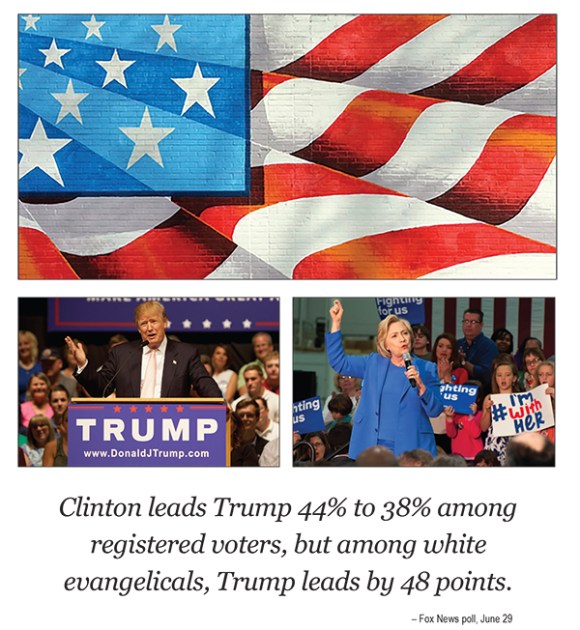
Still, Trump has branded himself as the candidate most invested in religious liberty and other Christian concerns. So far, a majority of voters agree: A June poll by CBS found Trump leads Clinton among evangelical voters by a margin of 62% to 17%.

However, as Religion News Service’s analysis of the poll pointed out, Trump’s 62% is lower than the percentage of white evangelical voters who favored George Bush (79%), John McCain (73%) and Mitt Romney (79%) in the last three elections.

Gallup polling from May found the two candidates neck and neck among those who identify as “Protestant” or “Other Christian”—36% had a favorable opinion of Clinton, and 38% had a favorable opinion of Trump. Both candidates’ numbers were slightly lower among the “Highly religious”—35% for Clinton and 37% for Trump.

For those voters who don’t foresee an appealing option for November, Christian and conservative leaders have floated other ideas, including third-party candidates, write-in voting, and abstention. Alan Noble, a professor at Oklahoma Baptist University, wrote for Vox that “unless a third-party candidate with broad appeal emerges, evangelical Christians would be better served by abstaining from that vote and shifting their energy toward electing people to Congress and local and state governments who have the opportunity to restrain whichever candidate is elected as needed.”

But many Christian leaders have been vocal about getting out the vote, even for candidates that are less than ideal. On his tour of state capitals, evangelist Franklin Graham has urged Christians to vote, but hasn’t endorsed specific candidates. Graham has instead warned against inactivity, citing a statistic that reports 20 million evangelicals did not vote in the 2012 presidential election.

In Springfield, Graham told several thousand gathered in front of the Capitol, “Our job as Christians is to make Christ felt in every [area] of life—religious, social, economic, political.”

Keep the lines open

No matter who believers support in the election, said Wheaton College’s Ed Stetzer, the rhetorical tone should be loving.

“In years past, I generally had to encourage evangelicals to avoid scorning fellow evangelicals who voted Democrat. Now, perhaps we need exhortation to avoid scorning those who vote for Donald Trump….Rather than looking down with scorn on evangelical Trump supporters, perhaps we should sit down with them, listen to them, and hear their concerns.”

Mohler prescribed similar action in his June 22 podcast, urging Christians to think through the issues at hand.

“In this difficult political season, evangelicals must not demonize one another as to how we’re thinking through these issues, but I must plead with all evangelicals that we must indeed think through these issues carefully and faithfully, and think very biblically and candidly.”

To fail to remember oneness in Christ and fall instead into factions and camps could result in a loss of the unity achieved during the recent Southern Baptist Convention, wrote Pastor Ted Traylor following the meeting with Trump, which he attended. At the June 14-15 convention in St. Louis, Baptists united around one presidential candidate, Steve Gaines, after another, J.D. Greear, bowed out prior to a second run-off election.

Now, as Baptists consider another election, Traylor, pastor of Olive Baptist Church in Pensacola, Fla., advised them to think carefully in a blog post titled, “What I learned from a conversation with Donald Trump.”

“There has been much vitriol on social media about the Trump meeting within the tribe of Southern Baptists. We left our convention last week in unity. Demonizing each other over secular politics will quickly destroy what we saw and hailed as God-given unity. We are in the Gospel business.

“However, as we render to Caesar what is his we must be wise, kind and discerning.”