Archives For November 30, 1999

Talking with kids…about race

ib2newseditor —  September 18, 2017

Parenting conference takes on serious discussions
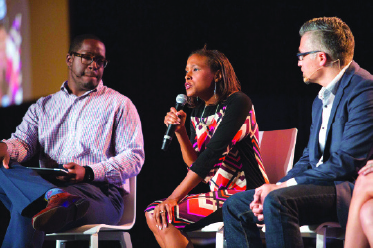
parenting panel

Steven Harris (left) moderates a panel including the ERLC’s Trillia Newbell and Texas pastor Jason Paredes on how to help children view diversity like God does. Photo by Kelly Hunter

Is it ever too early to talk about race with your children? Panelists at the Ethics and Religious Liberty Commission’s Aug. 24-26 conference on parenting said no, resoundingly.

“You should not wait,” said Rachel Metzger, an educator and mother of two. “Because waiting seems like a secret, or something you don’t want to talk about.” Metzger joined four other parents and church leaders for a panel discussion on how to raise children with a biblical view of racial unity.

Coming less than a month after deadly protests in Charlottesville, Va., the panelists addressed the topic at a time when America’s racial divides are glaringly apparent. But, “this is not just something that we need to be talking about because something in the culture happened,” said Trillia Newbell, director of community outreach for the ERLC. “It’s something the church needs to be on top of, ahead of, because it is ultimately a biblical topic.”

Newbell is the author “God’s Very Good Idea,” a new children’s book about the diversity inherent in God’s creation. The book calls families to celebrate differences because they are, after all, God’s doing.

“That’s what’s missing in our culture—we don’t celebrate our differences; we politicize them,” Newbell said during the panel. “And we should celebrate. This is God’s good plan. It’s his idea.”

With kids, celebrating differences means acknowledging them. Newbell told the audience in Nashville that her son identified early on the difference between his mom’s skin color and his own. As her children have gotten older, open conversations about skin color have evolved into discussions about the realities of racism, division, and ethnic pride.

“It is heartbreaking, but it’s something that we have to be talking about,” Newbell said. “But even with that, we are sharing the full picture of the gospel that unites.”

The panelists shared several suggestions for fostering in children a biblically-based appreciation for racial diversity and unity:

1. Educate yourself. Dive into what the Bible says about the nations and the image of God, said Byron Day, pastor of Emmanuel Baptist Church in Laurel, Md., and president of the National African American Fellowship of the Southern Baptist Convention. “You need to know for yourself first of all what it is that you believe, and why you believe it, so that you can better then explain it to them.” Day noted two helpful Scripture passages: Genesis 10 and Revelation 7.

2. Point to real-life examples. Adoption is such a part of the culture on his church staff, said Pastor Jason Paredes, that if an outsider were to try to match parents with kids based on skin color, it would be impossible. In that environment, said the pastor of Fielder Church in Arlington, Texas, identity is based less on looks and more on family bonds, giving parents a real-life way to talk to their kids about God’s view of racial unity.

3. Lay a biblical foundation. Pastor Afshin Ziafat recalled seeing an interview with a white nationalist in the aftermath of protesting in Charlottesville. The man’s angst, Ziafat remembered, seemed ultimately to be about protecting himself.

The root of racism is the sin of self, said Ziafat, pastor of Providence Church in Frisco, Texas. “With our children, I want to teach them that all are made in God’s image, but I also want to make sure I’m teaching them that life isn’t about you. Philippians 2 is what I want to teach them: Count others more significant than yourselves; put the interest of others before yourself.”

4. Invite people in. Get to know your neighbors, Newbell advised. Ask God to give you eyes to see color and culture, and invite the people around you into your family’s life.

Ziafat said mission trips have motivated his church members to get to know the people around them. “As we’ve gone on mission trips and our people have gone to other cultures and come back home, I’ve seen them have a heart to now want to go meet my Indian neighbor who I’ve never even talked to, because I just got back from India. I think tharat’s been a huge thing for us too.”

5. Start now. Newbell acknowledged some listeners probably feel the guilt of not having had these kinds of conversations with their kids. “It’s never too late to talk about the glory of God and Imago Dei. If you’re listening and thinking, ‘Well, I didn’t do that,’ start today.”

The Illinois Baptist’s Meredith Flynn was there. Watch for more articles from Meredith from the conference.

Why evangelism is needed now

ib2newseditor —  September 11, 2017

The ‘blue map’ tells our story

The blue mapThis map is becoming familiar around the Illinois Baptist State Association. We call it ‘the blue map.’ With just a few brush strokes, it clearly illustrates the need for evangelism in Illinois.
The map shows the percentage of people in each county who self-identify as Southern Baptist.

Our strength as a denomination is in the southern half of the state, where in most counties at least 5% of the population is SBC. In some places, the percentage is higher than that, but with so little of this map shaded dark blue, it’s easy to understand why Southern Baptists—and evangelicals overall—are in the minority in Illinois.

The farther north we travel, the less ‘Baptist’ the state is, even as the population explodes. The gray circles show our most populous places. And in stark contrast, the white and lightest blue-shaded counties show places where there are few or no SBC churches.

The need is great all across Illinois, but especially in the cities and Northwest Illinois.

“In many parts of Illinois, Baptists are outnumbered by Muslims, Mormons, eastern religions, and people with no faith at all,” Nate Adams, executive director of the Illinois Baptist State Association said. “In fact, at least 8-million of our 13-million neighbors in Illinois do not know Jesus Christ.”

That’s why at IBSA, we often say, “Evangelism is the point of the plow.” As a ministry-support and missions-sending organization, IBSA’s missionaries and staff are engaged in many activities that assist local Baptist churches in Illinois.

The partnership we share with almost 1,000 churches, mission congregations, and church plants is vital to strengthening Baptist work in Illinois. But whatever the ministry activity, the reason behind it is equipping IBSA churches, leaders, and members to share the gospel with people who do not yet know Jesus as their personal savior.

The missionaries whose photos appear in this prayer guide each have different specialties. Church planting, age-graded discipleship, and missions mobilization are just a few. But their work has the same chief purpose: advancing the gospel.

For example, when Illinois Baptist Disaster Relief teams are cutting trees felled by storms and digging out mud-packed houses after floods, somewhere nearby a trained DR chaplain is sharing Jesus with a suffering homeowner. And many times, they find Christ in their crisis.

Who trained the chaplains? Who organized the volunteers?

You did.

By giving through the Mission Illinois Offering, you enable state missionaries to do their work in Illinois. You provide supplies for VBS training and children’s camps. You send expertise to churches in need of stronger leadership. You recruit and equip church planters to start congregations where they are desperately need. And the list goes on and on.

Your gifts through the Mission Illinois Offering stay here in Illinois: teaching students, equipping leaders, planting churches, and, at all times, advancing the gospel.

Won’t you give through the Mission Illinois Offering? Your partnership in advancing the gospel in Illinois is needed now, more than ever.

Learn more about the Mission Illinois Offering.

Marci Coble

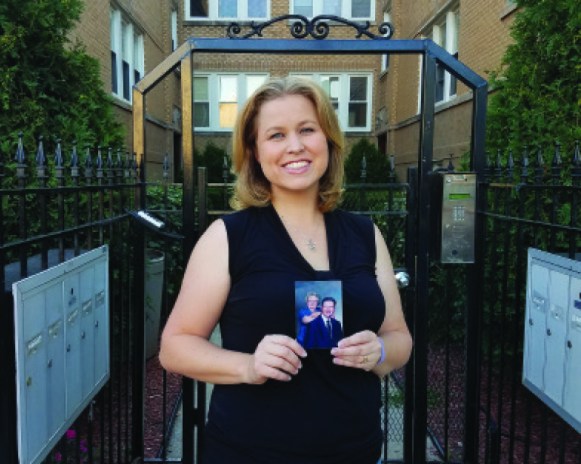
Standing outside their Chicago condo, Marci is holding a photo of her grandparents. Her grandfather, Maurice Swinford, led church development for IBSA and ultimately served as executive director.

The strategy is simple. Lost people know lost people. They hang out with lost people. If you lead one lost person to faith in Christ, suddenly you have broken into a whole new circle of people who need Jesus. And the most effective witness to the gospel is someone whose life has been changed by salvation in Jesus Christ—especially if it’s happened recently.

That’s why the Illinois Baptist State Association continues to invest in church planting as an important and effective strategy for evangelism. There are lots of places in a state of 13 million people where there is little or no evangelical witness.

IBSA is identifying 200 places and peoples that need Jesus. With at least 8 million lost people living just next door, it won’t be hard to put those pins on the map. For Bryan and Marci Coble, that pin landed in the Irving Park area of Chicago, far away and far different from her small hometown in Chatham.

Marci Coble was raised near Springfield under a strong Baptist influence. Her grandfather, Maurice Swinford, was on IBSA’s staff 15 years and served as executive director from 1988 to 1993. “He was always making sure I knew who Jesus is,” Marci says with a tear in her eye. She was a GA and Acteen, and worked one summer at Lake Sallateeska Baptist Camp.

“I was allotted a lot of opportunities and a lot of blessings that I probably wouldn’t have had without his influence and without being his granddaughter—even my call to missions.”

She is almost as emotional describing Chatham Baptist Church. “I grew up there, I was baptized there,” Marci says. “Bryan and I were married there. They shaped me and molded me and I’m blessed to call that my home.”

So when Marci’s husband, Bryan, suggested when he finished his seminary studies that they move to Portland, Ore., to plant a new church, Marci’s brows furrowed. She was willing to go wherever God led them—in fact, they visited the Pacific Northwest on a vision tour—but might God lead them to Chicago?

“Bryan had set up an appointment in Portland. And we received a note from my grandmother with an article from IBSA letting us know they need church planters in Illinois too.” Marci laughed. “And we were like, ‘Oh, that’s so sweet. I love Grandma.’” But the message stuck.

“I didn’t want to come to Chicago,” Bryan readily confesses. “I was raised 60 miles south of St. Louis and grew up a St. Louis Cardinals fan. When we started to pray about Chicago, God actually told me—this may sound crazy,” he says as an aside, “to get a Chicago Cubs hat and wear it for 30 days.”

Bryan shifts the Cubs hat on his head, as if he’s adjusting to the fit.

“My heart started to change,” the Missouri transplant says as a smile breaks out. “My love for this city and my burden for this city started to grow. We love this city so much. We love the people of this city so much,” he says.

A similar feeling started growing back in Chatham, Marci’s home church in suburban Springfield. The town of 11,000 is one-seventh the size of the Cobles’ new neighborhood. And for the church members there, Chicago has seemed like someone else’s responsibility.

“To be honest with you, Chicago has always seemed very distant to us,” says Pastor Milton Bost. But having a hometown girl serving as a missionary in the big city has changed things.

“I think Bryan and Marci are kind of pioneers for us,” Bost says.

Chatham has become heavily involved in the Cobles’ planting work 200 miles away. “Folks from Chatham came up to help us do this,” Bryan says on a rainy Saturday morning in April. A children’s playground in the center of their neighborhood is also the epicenter of their planting work. “(We) hand out flyers, hand out cookies, talk to people, build relationships.” The park is covered in people wearing green T-shirts declaring their love for the area.

“We want the community to know that we love them, we’re here to invest in them first and foremost,” Marci says.

The couple moved their two boys there last year—in time for the Cubs’ World Series win. They began surveying the city and seeking God’s direction. In the spring the Cobles bought a small condo in a pre-war three-floor building, and started meeting the neighbors—Hispanics, Anglos, and some Asian people. Their goal is to launch a Bible study, then a church, in the recreation building at the park.

“Chicago is a world city. It has high influence not just within the state of Illinois, but in the world,” Bryan says. “We need to be able to reach these people with the gospel. We do it in love, so that they will hopefully come to know Christ and be changed by the gospel. And the world with them.”

Learn more about the Mission Illinois Offer and Week of Prayer September 10-17 at www.MissionIllinois.org.

Watch the video, “A Heart for the City.”


The Mission Illinois Offering and Week of Prayer is September 10-17, but there are plenty of opportunities for prayer ahead of that week. In fact, all of September is a good time to focus on God’s work through Baptists in Illinois.

Devote time to prayer every Sunday or Wednesday in September. Share mission facts and videos on the mission stories. Our main focus is evangelism and church planting in Illinois. Review the statistics about lostness in Illinois. These are not just numbers, they are people.

Pray for salvation. Check Wikipedia for the population of your county or town. According to the experts, more than two-thirds (say 65%) of those people do not know Jesus Christ. Do the math. Pray for their salvation. While you’re at it, make a list of people you know who need Jesus.

Pray for the missionaries by name. Use the daily devotions as brief prayer prompts in worship services and in personal prayer. They are in the MIO Prayer Guide/bulletin insert, online, and printed in the special Illinois Baptist wrapper on the outside of the Aug. 14 issue.

Schedule a special prayer meeting for state missions. Some churches use the Wednesday during the Week of Prayer, others use Sunday morning or Sunday night. Or pick another time, day or night.

Spread the responsibility. Ask Sunday school teachers and small group leaders to focus prayer on state missions during September. Ask the missions team or WMU or men’s group to pray for state missions in their September meeting.

Focus on Romans 10:14.
“How, then, can they call on him they have not believed in? And how can they believe without hearing about him? And how can they hear without a preacher?” (CSB)

Pray each section of the verse:
• For the Holy Spirit to open hearts to believe;
• for the gospel to be shared; for the church planters;
• for gospel witnesses to respond to the call to
missions and evangelism, especially in Illinois.

We could plant so many more new churches and reach so many more lost people in Illinois if there were more future leaders in the pipeline.

Learn more about the Mission Illinois Offering at MissionIllinois.org.

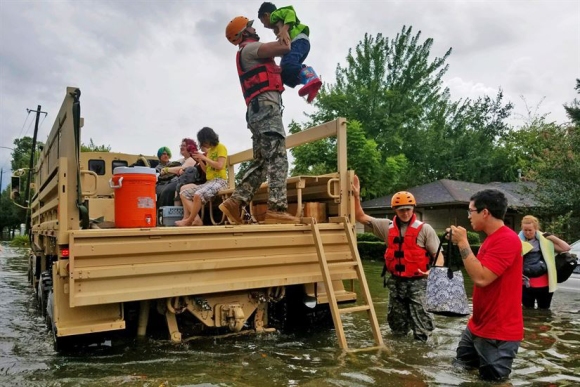
Harvey-National-Guard-rescue

Texas National Guard soldiers rescue residents in heavily flooded areas of Houston after Hurricane Harvey on Aug. 27. National Guard photo by Lt. Zachary West

Trained disaster relief volunteers representing the Illinois Baptist State Association (IBSA) are preparing to respond to victims Hurricane Harvey. Disaster Relief volunteers are taking kitchen trailers where they can prepare between 10,000-20,000 meals a day to the Houston area.

Illinois Baptist Disaster Relief State Director Dwayne Doyle said, “While the rain is still falling, we are preparing to go, both for immediate response and to provide long term assistance to flood victims. The immediate needs for people in shelters are food service and child care. Southern Baptists prepare the meals that other national relief agencies distribute.”

Two teams of child care workers departed for Dallas Wednesday (Aug. 30) to care for children in shelters, which allows parents to work with FEMA and other agencies. “We provide the service so parents can work on getting their lives back together,” Doyle said.

Southern Baptists’ response to this unparalleled disaster will continue for months, perhaps years. “We have three central Illinois training sessions planned and we are arranging training sessions in Chicagoland and southern Illinois for volunteers who will stay long term and assist flood victims,” shared Doyle.

Illinois Baptists have 1,600 trained disaster relief volunteers belonging to 37 teams based around the state. The teams include mobile kitchen, child care, chaplaincy, chainsaw, flood recovery, laundry and shower units along with a disaster relief command and communications trailer, and a search and rescue unit. Southern Baptist Disaster Relief is the third largest relief agency in the United States.

To learn more about disaster relief training opportunities, visit www.IBSA.org/DR.

###

If you’d like more information or to schedule a phone or radio interview, contact: Lisa Sergent at (217) 391-3119 or LisaSergent@IBSA.org. Later, we should be able to provide onsite interviews with leaders in various parts of the state and a list of departure times for volunteer relief teams heading to Texas.

The Illinois Baptist State Association is comprised of nearly 1,000 member churches and 35 local associations. Headquartered in Springfield, it is affiliated with the Southern Baptist Convention.

John Mattingly

John Mattingly

Lost people matter to John Mattingly, especially those who live in the northwest quadrant of Illinois. John served as a pastor in Joy, Ill., then as director of missions for Sinnissippi Baptist Association, and now serves as IBSA’s church planting director for the region that includes Peoria, Rockford, and the Quad Cities. John takes his role as a strategist for church planting seriously. John and his wife, Jacki, sold their home so they could be unencumbered and mobile.

“A pastor’s got to come and be part of the community,” Mattingly said. Currently, that’s in Sterling, where the couple has helped restart a faltering congregation.

“John and Jacki are just a unique couple,” said Van Kicklighter, IBSA’s associate executive director of church planting. “I think part of their passion for people in northwestern Illinois comes from a deep sense that God has planted them (there).”

Mattingly is one of eight IBSA church planting catalysts working with more than 80 church planters across Illinois. Last year, IBSA and ministry partners started 16 new churches. IBSA has identified more than 200 places and people groups in Illinois that need a church. (Their work is supported, in part, by the Mission Illinois Offering.)

New churches are needed because in some places, there simply aren’t enough. Of 102 Illinois counties, 10 counties have no Southern Baptist church, and another 12 have only one. There are large sections of the state with little evangelical witness, especially in northwest Illinois and in the cities. And new churches are needed in other places too, because new congregations are effective at reaching unchurched people.

“If we are going to reach northwest Illinois, I really believe that we’re going to have to develop an appetite for risk,” Mattingly said. “Risk means that we don’t know what’s going to happen.” And that makes the northwest corner “a frontier area.” Part of his job is finding church planters who will come to this mix of cities and rural communities.

“People in northwest Illinois deserve every opportunity to hear the good news of Jesus just like someone on the other side of theglobe,” Kicklighter said of the area where factories once booming have closed, and churches once common have dwindled.

“Our communities are open to the gospel of Jesus Christ,” Mattingly concurred. “All we need are some people who will come and take some risks.”

The Mission Illinois Offering and Week of Prayer is September 10-17. Learn more about the Mission Illinois Offering.

Eclipse through glasses

As eclipse-watchers turned their eyes to the skies Monday, Aug. 21, much of the attention in Illinois was focused on the southern part of the state, where several communities laid in the eclipse’s “path of totality.” In Carbondale, just north of the point of longest duration for the total eclipse, churches worked together to share the gospel with thousands of people who traveled to the region for the event.

“As we see this amazing event today that God has made, let’s point people to see the Son who paid for our sin so that we can have eternal life!” Pastor Scott Foshie posted on Facebook. Foshie, pastor of Steeleville Baptist Church and an IBSA zone consultant in southern Illinois, helped facilitate an area-wide evangelistic effort to hand out 50,000 eclipse-themed gospel tracts.

The churches of Nine Mile Baptist Association, working in partnership with IBSA, had the tracts printed and mobilized volunteers to get them into the hands of eclipse-viewers in a multi-day outreach effort. The tract was designed to serve as a souvenir of the eclipse experience. “This is going to be the easiest thing you’ve ever passed out in your life,” Lakeland Baptist Church Pastor Phil Nelson said in a video promoting the outreach.

“They’re coming to see this eclipse, but God wants them to meet his son Jesus…I can’t think of an easier way to tell somebody about Jesus,” Foshie said. “All you’ve got to do is smile, walk up to them, and say, ‘Would you like to have this souvenir? God bless you.’ I mean, it’s that simple, and then we’ve planted a gospel seed.”

In addition to the tracts, pray-ers were stationed at four points in Carbondale—Lakeland, Murdale Baptist Church, FBC Elkville, and the Baptist Student Center at Southern Illinois University. The volunteers, standing next to six-foot crosses, prayed for cars as they entered the city. It was estimated around 90,000 people would be in Carbondale for the eclipse.

Many churches in the region partnered together for the outreach, Foshie said. “It was encouraging to see so many jump in and respond to our call to partner with us to share the gospel. This kind of partnership to reach the lost is what led Southern Baptists to join together in cooperation, and it is what keeps our ties strong.”

Foshie had heard of a young woman in Goreville who gave her life to Christ after receiving the tract, and reported volunteers had also handed them out to crowds that gathered in Carbondale, Pinckneyville, Chester, Ellis Grove, Steeleville, and other places in southern Illinois.

“It has been so encouraging to see so many churches and pastors pull together to plant gospel seeds in this way. I think God has used this ministry to bring us closer together. No doubt, he will continue to use this increased cooperation and closeness to reach the lost for Christ in more ways in the future.”

-Meredith Flynn

Sharing Jesus everywhere

ib2newseditor —  August 21, 2017

Pat Pajak praying

Pat Pajak will make you cry. Why? Because he cries.

Whenever there’s talk about how many people in Illinois don’t know Jesus, you can count on Pat to get choked up. And whenever Pat tells how he had the privilege of sharing the gospel with someone—and that someone accepted Jesus as Savior—tears will flow. His shoulders shake up and down. His voice cracks. And for a moment, the story stops. But he catches a breath, and continues.

And invariably, the person he’s witnessing to agrees that they need Jesus, and prays to receive him as Savior.

The biker. The nurse. The couple at the gas station on the way to North Carolina. “I believe in witnessing opportunities wherever you’re at,” Pajak said.

Pat Pajak has a gift. Some would say his gift is evangelism, but that’s only part of it. Pat makes lostness in Illinois—vast, unfathomable, and seemingly almost too big to tackle—become real, and personal, and up-close.

“Lostness” is people, and Pat knows them personally. Even if he doesn’t, he’ll sidle up to them and ask if they go to church anywhere. And that leads to real conversation about knowing—and believing in—Jesus Christ.

Whether it’s 8 million people in a state of 13 million, or the nurse at the Decatur hospital where he had heart surgery, lost people matter to Pat, because they matter to God.

After three decades as a pastor of growing evangelistic churches, and another leading church strengthening in Illinois, Pat today serves as associate executive director of evangelism for IBSA.

Winning Illinois, one by one
For some people, simply walking across the room to start a conversation feels like taking a risk. Taking the next step—turning a conversation toward the gospel—may feel even riskier. But that’s what we’re all called to do. Share the gospel.

And for many IBSA churches and their members, that’s where Pat Pajak comes in.
Pat will train more than 200 churches in soul-winning this year. And through IBSA’s Pastor’s Evangelism Network, Pat will help mentor more than 100 pastors. Encouraging pastors who encourage their churches in faith-sharing is Pat’s specialty.

“The easiest way, I think, to impact lostness in Illinois, is to build friendships with people where they begin to trust you,” he said.

For Pat and his wife, Joyce, that level of trust was established in a crisis more than 30 years ago, when a house fire claimed their infant son and a pastor soon led them to Jesus. Not every conversion comes after crisis, but Pat finds opportunity to share Christ in tough times, even his own.

“After Memorial Day last year, I had a heart attack…and quadruple bypass surgery,” he said. And since he believes in sharing Christ wherever you happen to be, that included the ICU and later the cardiac rehab unit. Eventually, he led eight nurses to faith in Jesus Christ in a three-month period.

“I said, ‘Will you allow me to pray with you?’” he recalled from an encounter with Gina. “So I shared the Romans Road with her and asked if that made sense to her. She said yes, and she prayed and asked Jesus Christ to come into her heart.”

Pat wells up when he tells the story. “I saw her today and she hugged me and said, ‘I love you.’”

From complete stranger to sister in Christ.

“What a difference it would make if our church (members) decided, ‘I have the responsibility of sharing Christ, not just my pastor,’” he said.

With support from the Mission Illinois Offering and Week of Prayer, IBSA is equipping pastors, church members, and church planters to share the gospel. “Now is the moment,” Pajak said, because people in Illinois need Jesus Christ. “We just need to capture that.”

In other words, now more than ever.

Learn more about the Mission Illinois Offering at MissionIllinois.org.

totaleclipsecolumbiasc.com

totaleclipsecolumbiasc.com

When the sun goes dark Aug. 21, southern Illinois will be one of the best places to catch the first total solar eclipse visible from the U.S. since 1979. Churches in the region, along with others across the country, are planning to use the event as an opportunity to share the gospel.

Everyone in the contiguous U.S. will be able to see at least a partial eclipse, but the 70-mile-wide “path of totality,” in which a total eclipse will be visible, will pass through 14 states, including Illinois. Makanda, Ill., located just south of Carbondale, has been cited as the “greatest point of duration,” or the place where the eclipse will be visible the longest—2 minutes and 38 seconds, according to a city website devoted to sharing eclipse information.

Lakeland Baptist Church in Carbondale hosted an area-wide prayer and worship rally Aug. 14 to spiritually prepare for the influx of people. And Nine Mile Baptist Association, through a partnership with IBSA, plans to distribute 50,000 gospel tracts during the weekend prior to the eclipse. Additionally, people will be stationed at each of Carbondale’s four entry points to pray over every car that enters the city. “We want to cover our city in prayer,” said Lakeland Pastor Phil Nelson.

Elsewhere in the eclipse’s path, churches are utilizing the unique ministry opportunity to meet spiritual needs in their community—whether it’s inviting eclipse viewers to use their parking lots, or using the event to launch future ministries.

In Casper, Wyo., Mountain View Baptist Church and College Heights Baptist Church have partnered with Child Evangelism Fellowship of Central Wyoming to purchase copies of a DVD titled “God of Wonders,” which explains how creation reveals God and how salvation is available through Jesus Christ. Church members will distribute the DVDs during the eclipse along with 3,000 evangelistic bookmarks.

“Additionally,” Mountain View pastor Buddy Hanson said, “if our parking lot is utilized for eclipse watchers, we will take that opportunity to try and share the gospel.”
In Lincoln, Neb., the launch of Hope City, a North American Mission Board church plant, is set to correspond with the eclipse. The congregation’s first service is slated for Aug. 20. That day and during the eclipse, the church will distribute 2,000 “college survival kits” at the University of Nebraska-Lincoln.

First Baptist Church in Hendersonville, Tenn., will host a gospel concert on Sunday, Aug. 20, and is inviting people to watch the eclipse from their parking lots the next day. “We have already handed out over 4,000 eclipse viewing glasses and have several hundred more for those needing them,” said Executive Pastor Bruce Raley.

Beginning just after 10 a.m. local time in Lincoln Beach, Ore., the total eclipse will take approximately an hour and a half to pass over Oregon, Idaho, Wyoming, Montana, Nebraska, Iowa, Kansas, Missouri, Illinois, Kentucky, Tennessee, Georgia, North Carolina, and South Carolina. Viewers are strongly encouraged to wear eclipse glasses or other protective eyewear.

– From Baptist Press, with additional reporting by the Illinois Baptist

The stand

ib2newseditor —  August 14, 2017

Surrounded by a Forest of Tall Golden Aspen Trees

Over the years, I’ve grown to love Aspen trees. They’re not that common in Illinois, growing in only about a third of the state’s counties, mostly in the north. But in cooler or higher-altitude climates such as central Colorado, they grow abundantly, often covering the mountains like wildflowers.

It was while vacationing there with my family this summer that I started asking myself why I find Aspen trees so beautiful and interesting. Is it the “quaking” leaves, which so freely alternate their green and silver sides in the breeze, and then turn bright yellow in the fall? Or is it that those leaves are mounted on a beautiful white tree trunk, crisscrossed with black bands, that grow up to a hundred feet tall?

Perhaps it’s that these striking trees always appear so plentifully. Aspens grow in clusters or “stands” and multiply rapidly. Individual trees are actually part of a larger, singular organism that spreads rapidly in the form of new trees from a common root system.
As a result, one Aspen stand in Utah is considered by many to be the world’s oldest living organism. It’s more ancient than the massive Sequoias of the West, or even the famous Bristlecone Pines, some of which are said to be 5,000 years old. It appears that individual trees like those are not quite as enduring as the spreading organism of Aspens, which presents itself as many trees, yet underneath shares a unified root system that results in each unique tree being a genetic replicate of the others.

Inspiration for Baptists from the mighty and prolific Aspen trees

As you might guess, I find in these beautiful Aspen trees an encouraging metaphor for the equally creative work I believe God desires to do among Baptist churches here in Illinois. Like the diversely colored leaves that “quake” at the slightest breeze, our lives, stirred and filled by the Holy Spirit, should attract the attention of those we meet and invite them to know Jesus as Savior.

The bright, white-and-black banded trunk that holds us together is the local church that beautifully reflects the light of Christ and his word, not just one at a time, but in diverse sizes and shapes. Yet our churches should be united by a common root system of both doctrine and cooperation, one that makes us resilient and also allows us to multiply rapidly and spread throughout our region and the world. Aspens are the most widespread tree in North America, and there are varieties of Aspens found throughout Europe and Asia.

This year, September 10-17 is the week our “stand” of churches here in Illinois has set aside to pray for mission work here, and to receive a special offering called the Mission Illinois Offering. This offering is like a refreshing rainfall on our cooperative work as Baptist churches, work that takes place in a culture that can be as harsh on Baptist churches as mountain winters on a stand of Aspens.

But with that offering, we train leaders and church members in evangelism. We strengthen churches in multiple ministries that help them make more disciples and grow. And we provide the network of doctrinally sound cooperation that gives you confidence that the 20 or so churches being started in Illinois each year, though unique, are doctrinally united with all the churches in our “stand.”

Aspens grow all the time, even in winter. But many feel they are most brilliant and beautiful in the fall, when their golden leaves paint the mountainside with the glory of God.

This fall, when you and I give a generous offering through the Mission Illinois Offering, I believe we have an opportunity to do the same.

Learn more about the Mission Illinois Offering.

Nate Adams is executive director of the Illinois Baptist State Association. Respond at IllinoisBaptist@IBSA.org.