Archives For November 30, 1999

Leadership developers

ib2newseditor —  February 27, 2018

MENTORING sketch on notebook

I don’t recall aspiring to be a leader. I do have childhood memories of realizing that I was one of the fastest on the playground, or that I got better grades than my friends. But the moments when I realized that I might be able to lead were different. Almost always, those moments involved the recognition and encouragement of someone else.

Mr. Showers asked me to consider joining my high school’s student council. Mr. Hsieh encouraged me to apply to be a resident advisor in the college dorm. My parents and then Pastor Oliver assured me that I could lead youth ministry on a church staff.

I would not have considered myself ready for any of those challenges. I believed in their value, and I respected those who were already leading in those ways. But in each case, it wasn’t until someone told me I was ready, and told me they believed in me, and gave me an opportunity, that I was willing to try leading in those areas.

It’s a pattern that I now see looking back over my career and ministry too. Keith told me I was ready to be a manager. Roy told me I was ready to be a director and then a vice president. Tim told me that I could help lead a new church plant.

Churches only stay healthy when they intentionally develop and enable new leaders.

Each of those leadership encouragers in my life were also leadership developers. They not only told me I could do it and gave me an opportunity. They also came alongside me to show me how to lead in those areas, and to support me, both as I grew, and when I failed.

In most cases, they were able to stay nearby until I didn’t need their help anymore. By then, they often had moved on to something else, because my development as a leader actually enabled their own development and opportunities.

In fact, as I look back, not many of my leadership developers had my development as their primary goal. In almost all cases, they were people who had some larger goal, some important job to get done, some mission about which they were passionate. It was their passion to advance that mission that led them to enlist help. And along the way, they discovered that additional leaders are the best kind of help for a mission.

Every healthy church needs leadership developers. In fact, churches only stay healthy and have opportunities to grow when they intentionally develop and enable new leaders. It always involves some risk, and it always requires patience with mistakes. It always demands that current leaders be willing to let go, even in areas where they are leading effectively, because there is always something else that needs to be done.

The “something else that needs to be done” is so important, too, because leaders are not just needed in each local church, but also in the state, national, and international mission fields of that church. One pastor I know has a “preaching school” within his church, where he develops pastors to help other churches in the area. Another pastor I know is intentionally developing church planters and campus pastors so that their church’s witness can expand to other communities.

If you are in any way a leader in your church, or in other settings, you too can probably list the leadership developers in your life, those who encouraged you and gave you opportunities. They are probably among the most respected people of your life. Let me encourage you, in your church setting in particular, to be one of those leadership developers. New leaders are desperately needed to advance the gospel, both in your church, and the mission fields of the world.

Nate Adams is executive director of the Illinois Baptist State Association. Respond at IllinoisBaptist@IBSA.org.



Fundamental change

ib2newseditor —  February 19, 2018

church pews hymnals

Church planting changed me. It was a fundamental change that has continued to influence not only the way I think and feel about church planting, but also the way I think and feel about churches in general.

Before planting, I saw the church as an organization that primarily served its members. It was the group of people that employed my dad, and later me as a youth minister. Our job was to lead worship services and classes, plan programs and activities, and nurture positive relationships. The church membership’s job was to participate, learn more about the Bible, and relate to one another with love and service. Sometimes new people visited and considered joining us.

During and after planting, I saw the church as those who seek and save the lost, and help nurture them into maturing believers who also seek and save the lost. As disciples, we worshiped and studied the Bible and enjoyed fellowship and served. But those weren’t the primary focus; they were things we did along the way as we pursued the mission of seeking and saving the lost.

How can we prioritize the lost and unchurched?

When we left our church plant in the hands of its first full-time pastor and moved to Georgia, we were fortunate enough to find a church that was still behaving like a church plant. Frankly, we had to visit several churches before finding it, and it was a half hour from our home. But it was worth it.

Though this church had its own building, full-time staff, and basic programs, it was clearly focused on engaging and serving its community, more than its members, and on being an inviting environment that expected guests every week. It created multiple entry points for the unchurched, and trained its members to engage them with relationship and with the gospel.

It doesn’t seem right to characterize my before-planting view of church as self-serving, because other church members and I often served each other selflessly. Sometimes we would even invite unsaved friends to what we were already doing, and sometimes we would go on mission trips to look for unsaved people. But we didn’t re-order our thinking and plans and resources toward the lost and unchurched. So, as a church, we were basically self-serving.

This fundamental change in my own life is on my mind and heart right now, because 2017 Annual Church Profile reports have just been totaled. They tell us that total baptisms reported by IBSA churches were lower by more than 11% for the second consecutive year. And about 40% of reporting IBSA churches did not record a baptism.
I love our IBSA churches, including the ones that didn’t see a baptism in 2017! I see so many positive ministries and sacrificial servants in every church I visit, and I recognize that churches are in different situations and settings, and have different strengths. If the gospel is proclaimed faithfully and the Lord Jesus is worshiped sincerely, and believers are maturing and serving, then there is much to celebrate.

At the same time, I would invite us all to simply ask whether a fundamental change is needed in our perspective. Many, many good things happen in a church where the members worship God and serve one another. But the best thing happens when the lost are saved and welcomed into the family of God. And that happened almost a thousand times less in our churches over the past two years.

For me, planting a church brought fundamental change to my heart and mind, that the church should seek and save the lost as its first priority. That’s now what I look for, and long for, in every church I enter. I believe it is the fundamental change that is needed in many churches, to reach the millions of lost people that live in our Illinois mission field.

Nate Adams is executive director of the Illinois Baptist State Association. Respond at IllinoisBaptist@IBSA.org.
Leaning into the challenge

ib2newseditor —  February 12, 2018

Amid decline, churches called to new commitments

Pioneering Spirit

Throughout 2018, Southern Baptist churches in Illinois are invited to accept challenges in four key areas: evangelism, church planting, missions giving, and leadership development.

The challenges, focused on the “pioneering spirit” needed to advance the gospel among more than 8 million lost people in Illinois, were laid out last November at the Annual Meeting of the Illinois Baptist State Association. Their urgency was reinforced by new data based on the 2017 Annual Church Profile reports completed by 95% of IBSA churches.

“The 2017 ACP data from IBSA churches tells us that, while some churches are thriving, many are struggling,” said IBSA Executive Director Nate Adams. “For example, about 40% of IBSA churches didn’t report a baptism in 2017. And the sum total of information from all churches shows flat or steadily declining dynamics in many key indicators, including baptisms, worship attendance, Bible study participation, and church planting.

“This doesn’t do justice to the many bright spots where effective ministry and growth is happening, but it does give an overall picture.”

In 2017, IBSA churches baptized 3,441 people, a 13% decrease from last year’s total of 3,953. Other measurements also were down, including professions of faith, church membership, and missions giving. Giving through the Southern Baptist Cooperative Program totaled $5,924,029 in 2017, compared to $6,032,407 the previous year.

A highlight of 2017 was growth in the area of missions participation, as 21,607 people engaged their Acts 1:8 mission fields through projects and partnerships.

“It was studying last year’s ACP numbers, and really the last several years’, that led us to the important theme for the 2017 IBSA Annual Meeting,” Adams said. “Advancing the gospel through Baptist churches in Illinois has, and always will, require a ‘Pioneering Spirit.’ That means continuously engaging new people, developing new leaders, making new sacrifices, and going new places with the gospel.

“Churches that are not intentionally and effectively reaching out into their communities with a pioneering, missionary spirit, face inevitable decline.”

The lower numbers in Illinois reflect national trends, according to the most recent data available. (National ACP data for the previous year is released in the summer, prior to the annual Southern Baptist Convention.) In 2016, baptisms in SBC churches decreased by 4.9% from the previous year, and worship attendance declined 6.8%.

“I would encourage any church that is struggling or simply desiring assistance to invite IBSA, its local association, or perhaps another like-minded church to come alongside and help,” Adams said. “Often another trusted leader’s perspective can make all the difference, along with the experience and resources that others can bring.

“For our part, IBSA is eager to bring training, consulting, and resources in any of these areas, and to any IBSA church. That’s why we’re here, and we really want to help.”

The power of ‘one’
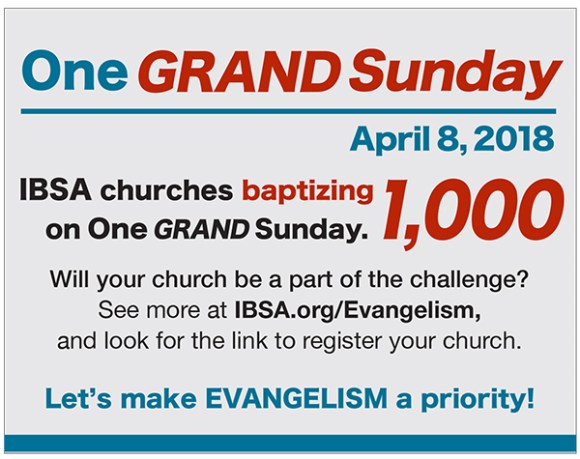
A decline in baptisms over the past decade is behind this spring’s “One GRAND Sunday” emphasis, which calls IBSA churches to participate in baptizing at least 1,000 people on April 8, the Sunday after Easter.

Last year, 352 IBSA churches reported zero baptisms. The churches that did report baptisms had an average of 6.4 baptisms per church.

The ‘GRAND’ goal is lofty, IBSA’s Evangelism Director Pat Pajak has acknowledged, particularly amid the current downward trend. But he’s urging church members to focus on the “one” part of the challenge, and to pray for one person to come to Christ and be baptized. That idea was recently echoed by prayer leader Phil Miglioratti.

“And as my ‘one’ is added to your ‘one’…as their church’s ‘one’ is matched by that church’s ‘one’…as a Sunday class prays for ‘one’ and is joined by a fellowship group asking for ‘one’…a youth group in a southern association, a seniors’ class in the center of the state, a planting team up north, a children’s ministry along the eastern border, and a WMU along the western border, each claiming, petitioning, pleading for ‘one’…one plus one equals two. But in God’s mathematics, ‘one’ plus ‘one’ times prayer could equal ‘One GRAND Sunday!’

“Even the smallest church among us can ask in faith for ‘one,’” Miglioratti said.

Sign up for the “Pioneering Spirit” challenge at pioneeringspirit.org. Register for One GRAND Sunday at IBSA.org/Evangelism.

Summit gathers 1,000 church leaders for learning, encouragement, and reminder of shared mission

MLS main session

Springfield | Ministry in the Midwest has ups and downs, successes and struggles. The work of advancing the gospel in a diverse, large region requires creativity, perseverance, and a willingness to sacrifice personal preference.

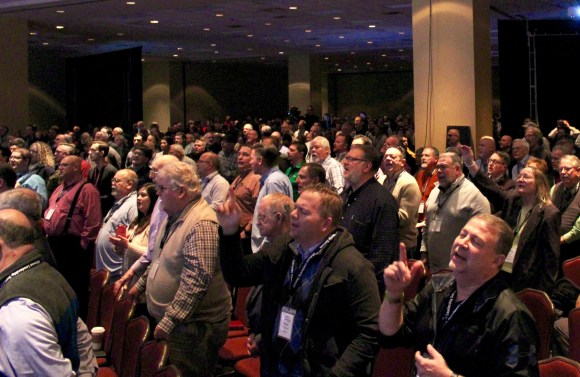
With their common calling in mind, more than 1,000 leaders from 13 Midwest states gathered in Springfield Jan. 23-25 at the Midwest Leadership Summit, a meeting organized every three years by Southern Baptist state conventions in the region.

“We share the same love for our communities and vision to see people come to Christ,” said Tim Burgess, a pastor in Mt. Vernon, Mo., “and getting together is a great reminder that we are not working at this alone.”

The large-group sessions and more than 90 breakouts tackled specific ministries—college campuses, church planting, missions, women, youth, and Disaster Relief, to name a few. Underlying each session was the need to advance the gospel in a culture that’s moving farther away from biblical truth. In our culture of change, one thing has stayed the same, said Detroit’s Darryl Gaddy.

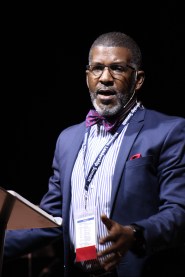
“You look around and notice that nothing stays the same,” said the urban church planting specialist in his keynote address to open the Summit. “Nothing is as it was ten, five, or even two years ago.

“But actually there is one thing that does stay the same. Sin. Oh, the consistency of brokenness. It never takes a vacation. But friends, we are the church. And we, like Peter who raised the lame man up in the name of Jesus Christ, are called to speak into the brokenness.”

Gaddy urged Midwest leaders to be “agents of change” in their communities, which will require obedience when it’s not convenient, becoming less so others can become more, and giving up their rights to someone else—Jesus.

“We have received information for our heads, inspiration for our hearts, and implementation for our hands,” Gaddy said. “Let’s not leave here the same way we came.”

God at work
Like the Midwest itself, leaders in Springfield for the Summit represented a wide variety of contexts, including places where new churches are making inroads into previously unreached communities. North American Mission Board President Kevin Ezell facilitated a discussion with four planters who took to the main stage to talk about strategy, cooperation, and the power of prayer.

“There is a quote that I always go to when I think about our church,” said David Choi, pastor of Church of the Beloved in Chicago. “When men work, they work. But when men pray, God works. The great church planter is the Lord. Recruit prayer warriors to lift up your ministry because that’s truly the secret sauce.”

In a few years, Choi’s church has grown from one—himself—to encompass hundreds meeting for worship every weekend. He credited God for the growth, and the prayers of people who live far from his city but have made it a point to lift up Church of the Beloved.

Ezell also introduced Paul Sabino, pastor of Candeo Church on the campus of the University of Northern Iowa in Cedar Falls. Sabino is part of The Salt Network, a family of next-generation churches working together to plant churches in major university cities.

“We are seeing the power of God on us and it’s like holding a Dixie cup; it’s overflowing and we can’t contain it,” Sabino said. “Jesus said he would make us fishers of men. The fish are on college campuses and they are hungry. They are crying out for the living God to impact their lives.”

The focus on church planting was encouraging for Christine Watkins, who came to the Summit as a member of Jachin Baptist Church, a 10-month-old church plant in Flint, Mich. Her husband, Derrick, is pastor of the church named for a word found in 1 Kings 7:21. Jachin means “the Lord will establish,” Watkins said.

“I think attending this summit and hearing all the great knowledge and stories of how God has blessed young church plants is part of how God is opening doors and giving direction in how he is going to establish our church.”

‘Pray bigger prayers’
Jeff Iorg, President of Gateway Seminary in Ontario, Ca., understands what it means to advance the gospel in difficult environments.

“Much of what you are experiencing now in the Midwest we experienced 30 years ago in California,” he said during the Summit’s final session. “It seems like an impossible task with formidable obstacles…Yet, I’m here to tell you the gospel is advancing on the West Coast, and healthy churches are growing with denominational influence and cooperation.”

Iorg said the reason for the gospel’s advancement, especially in a hostile cultural environment, can be found in John 14.

“Jesus said in verse 12, ‘I assure you: The one who believes in me will also do the works that I do. And he will do even greater works than these, because I am going to the Father.’

“‘And he will do even greater works than these’—that is quite a sober declaration of Scripture,” Iorg said. “Do you believe the word of God? Do you believe Jesus meant what he said?”

Iorg encouraged leaders to pray and ask God for what is worthy to be asked for in Jesus’ name and to surrender control to the Holy Spirit.

“Confess your powerlessness and ask the Holy Spirit for the filling, guiding, and directing,” he said. “So often, we start to rely on our own strategic plans. That’s not going to work. We must depend on the filling of the Holy Spirit to get the mission done.”

The last step to advancing the gospel in this cultural environment is to teach people to read, understand, and obey the Bible. Iorg said the only time he has seen people transformed is when they engage God’s Word.

“No games, no gimmicks,” Iorg said. “Pray bigger prayers in the name of Jesus. Work in the Holy Spirit’s power and trust him to do supernatural things in you. And find a way to teach people to internalize the Word of God. That’s it. Now let’s go home and do it.”

Kayla Rinker is a freelance writer living in Missouri.

Table Grace

It starts with a simple invitation.

“Have dinner with us.”

In a world where people tend to isolate themselves from their neighbors, Chad Williams and his family are recapturing an old-school concept to make a gospel difference in their community.

The family of five has a vision for biblical hospitality. They’re on a mission to bring people into their home and around their table to hear the gospel.

“They need Jesus, so we want them to come over to our house and see what it looks like to be a family that follows Christ,” said Williams, former family pastor at Tabernacle Baptist Church in Decatur and the new senior pastor of Rochester First Baptist Church.

“All of our flaws, all of our issues, our dirty house,” Williams said. “This is who we are.”

The Williamses try to designate one night a week to invite people to their home for a meal. It’s not fancy—tacos or chili. And it’s not necessarily reciprocated. But the family has been able to sow seeds of the gospel, and they’ve seen results. Recently, they invited a family from church to dinner. The father, not yet a Christian, engaged in several hours of conversation with the Williamses.

“If we really want to make an impact and get to know our neighbors, we’ve got to start engaging them in a way that they’re not expecting.” – Chad Williams, Rochester FBC

“He had a perception of who Christians were…as he got to spend time with us, there became this openness,” Williams said. A few weeks later, the man decided to follow Christ.

Asked if the commitment to spend time with others each week impinges on their family time, Williams said no, because it’s a shared commitment. The family is still at home, still sharing a meal together. They’re just inviting another family to join them. “We see this as part of our mission,” he said, “and we want to be on mission as a family.”

How can we help?
Chris Merritt and his wife, Alyssa, moved to Blue Mound, Ill., seven years ago. Both raised in central Illinois, the couple knew they wanted to live in a smaller town. Blue Mound, a community of around 1,200, is where they’re raising their two pre-teen sons.

Their church, Tabernacle Baptist in Decatur, sponsors two small groups in the region where the Merritts live. Along with their fellow life group members, the family is invested in building relationships in Blue Mound through community activities and by simply looking for opportunities to meet needs.

About a year ago, the Merritts approached their local school to see how they could help out. When the principal identified mentoring as an area of need, the couple and others from their church started a mentoring program.

“If I’m going to dedicate time for our children to be at these things, it’s logical for us to be there not just to support our children, but to build relationships in our community too.” – Chris Merritt, Tabernacle BC

“It’s just a regular, consistent positive influence of adults into kids’ lives who maybe need an extra positive influence,” said Merritt, who serves as church administrator at Tabernacle. The 12 students in the mentoring program have lunch every other week with their mentors. For that hour, he said, someone is asking them questions, encouraging them, and helping them make good decisions.

Outside of the mentoring program, the Merritts also are involved in Blue Mound through community sports leagues—the kids as players, and Merritt as a coach. He said being involved in the community through their kids’ activities is a natural choice. And they try to be intentional about making the most of their opportunities.

“If I’m going to dedicate time for our children to be at these things, it’s logical for us to be there not just to support our children, but to build relationships in our community too.”

Faith in action
Erica Luce credits her husband’s upbringing for her children’s willingness to serve their neighbors. “Dan spent his life serving others because his parents were so others-focused,” said the member of Delta Church in Springfield. That’s why their three children can often be found raking or shoveling to help a neighbor, or baking a welcome present for neighborhood newcomers.

“It’s given us so much room to speak truth into other people’s lives that are not really even seeking God,” Luce said. “They see faith in action, whether they want it or not.”

“It’s given us so much room to speak truth into other people’s lives that are not really even seeking God.” – Erica Luce, Delta Church

It’s been contagious on their block too, she said, recalling a time when her 12-year-son was shoveling a neighbor’s driveway and another neighbor came out to help.

Seeing the family home as missionary tool—whether it’s a place to invite people to, or a place missionaries are sent out of—is something Christians needs to recapture, Chad Williams said. Too often, we’ve lost the idea that our neighborhoods and workplaces are mission fields. Instead of seeing people’s need for Jesus, we see our co-workers and neighbors simply as people we interact with—and, if they’re hurting, we often don’t know it.

Rather than backing away from a culture that seems increasingly far from the gospel, Christian families have an opportunity to lean in closer, Williams said.

“If we really want to make an impact and get to know them, we’ve got to start engaging them in a way that they’re not expecting.”

IMG_5178 (1)

Church leaders from 13 Midwestern states gathered in Springfield, Ill., this week to share success stories and struggles—and to encourage each other through both—at the Midwest Leadership Summit, a meeting organized every three years by Southern Baptist state conventions in the region.

“We share the same love for our communities and vision to see people come to Christ,” said Missouri pastor Tim Burgess, “and getting together is a great reminder that we are not working at this alone.”

Watch the Midwest Leadership Summit recap video.

Over three days at Springfield’s Crowne Plaza Hotel, around 1,000 people heard from their Midwestern neighbors on a wide range of topics: collegiate church planting, urban ministry, church revitalization, women’s ministry, and a host of others presented in more than 90 breakouts.

In large-group sessions, North American Mission Board President Kevin Ezell interviewed four Midwestern church planters who have seen God grow their congregations from as few as one, into churches that welcome hundreds of worshipers each week. Jeff Iorg, president of Gateway Seminary, spoke on advancing the gospel in the current culture. And church planting specialist Darryl Gaddy shared from his experience in Detroit, calling leaders to be agents of change.

IMG_5013“Being a change agent means you have to give up your rights to someone else,” said Gaddy (right). “That someone else is Jesus Christ.”

At a luncheon for Illinois leaders following the summit, participants reflected on the most helpful, encouraging, and challenging things they heard.

Gary West, pastor of North Benton Baptist Church and director of missions for Franklin Baptist Association, said he gained new insight into how to extend the gospel to Millennials, the generation generally categorized as people born between 1981 and 2000.

“I’m re-looking at the dynamics of church and the things you used to do that don’t work anymore,” West said. “It’s not about religion, it’s about relationships.”

Look for more from the Midwest Leadership Summit in the Feb. 5 issue of the Illinois Baptist, online at ibonline.IBSA.org.

The Midwest Leadership Summit Recap (2018) from IL Baptist State Association on Vimeo.


Churches challenged to baptize 1,000 on one day

One Grand social

One thousand baptisms on a single Sunday. That’s the challenge behind One GRAND Sunday, an initiative designed to help IBSA churches train church members in evangelism, share the gospel, and follow-up with believer’s baptism.

One GRAND Sunday is scheduled for April 8, one week after Easter.

“Easter is normally a high attendance day, and the strategy of scheduling April 8 as One GRAND Sunday is to encourage people to return the following week to witness an historic event—their church being a part of 1,000 people being baptized on one day!” said Pat Pajak, IBSA’s associate executive director of evangelism.

The baptism-focused Sunday is part of a series of “Pioneering Spirit” challenges put before IBSA churches at the 2017 Annual Meeting. The evangelism challenge is for 200 or more IBSA churches to baptize 12 or more people each year, or to baptize more than the church’s previous three-year average. In other words, the commitment is for IBSA churches to become “frequently baptizing churches.” So far, 57 churches have accepted the challenge to engage new people with the gospel.

“Unfortunately, baptisms across our state have been declining over the past several years, and I would like to see One GRAND Sunday serve as a reminder that the church exists to evangelize and baptize those in the communities where God has planted them,” Pajak said.

The One GRAND Sunday emphasis coincides with a North American Mission Board-sponsored effort to promote gospel conversations, or opportunities to share the gospel. NAMB is urging Southern Baptists to have one million gospel conversations by next summer’s Southern Baptist Convention in Dallas. At gcchallenge.com, people can upload videos of themselves sharing about gospel conversations they’ve had, and get more information about gospel-sharing resources, like the “3 Circles” guide.

With just under three months left until April 8, Pajak suggested this timeline for churches preparing for One GRAND Sunday:

January: Collect your church’s baptism numbers for the past three years. Prayerfully set a new goal for this year.

February: Announce the baptism event and launch gospel conversations. Register your goal at IBSA.org/Evangelism. Conduct the training for church members. Consider teaching the “3 Circles” method.

March: Promote One GRAND Sunday. Personally follow-up with prospects and new believers. Teach about baptism, either personally or in a group setting.

April 8: Baptize!

April 9: Start over again.

One thousand is a large number, but Pajak put the goal in perspective. “What may look like a very lofty goal can easily be accomplished if every one of our 1,000 churches simply committed to baptizing one person.”

For more information about One GRAND Sunday and evangelism resources, or to register to participate in the April 8 emphasis, go to IBSA.org/Evangelism.

Back to basics

ib2newseditor —  January 15, 2018

The recent holiday season gave me a little more time than usual to watch football on TV. As the regular season gave way to playoffs and bowl games, it seemed pre-game analysts spent increasing amounts of time discussing “what it will take to win” the next, tougher game. The more serious the consequence of the game, and the fewer games that remain, the more critical it seems to be able to think, and not just play.

Yet as I’ve listened to experts talk again and again about what it takes to be successful, it seems they often come back to the same basic advice. Focus on fundamentals. Block and tackle well. Everyone do your assignment. Establish the ground game. Everything else you need for success will flow from there.

In these big games, will there be an occasional trick play, or a key turnover, or a missed call that influences the game? Probably. But everyone seems to agree that the best you can do to prepare for victory is simply get back to the basics.

Now is the time to consider what it takes to be truly effective in our mission.

I found myself wondering if there is a reminder, even an exhortation, for churches to consider here. Among the most “basic” practices of Baptist churches as we follow the Lord and pursue his mission are celebrations of the Lord’s Supper and believer’s baptism. Yet these can sometimes seem like occasional, even rare, ceremonies, rather than the very blocking-and-tackling basics on which the rest of church life is built.

More than an occasional or routine ceremony, the Lord’s Supper was given to us to be a time of frequent, intimate church fellowship and worship, one that draws each participant to introspection and confession of sin, and to a carefully considered reminder of the price Jesus paid for that sin. The Lord’s Supper is, in itself, a symbol-rich proclamation of the gospel message, one that should, each time, lead us to humble worship and gratitude, and fresh motivation to live out our salvation and to share Jesus with others.

What if we got that “basic” right, every one of us, in every church, every time we celebrated the Lord’s Supper?

If we did, I think it would have a dramatic effect on the other, more neglected, “basic” of baptism. Think of it this way: What if a church were to schedule baptism celebrations as often as it scheduled Lord’s Supper celebrations? More importantly, what if that church adjusted all its other priorities with the goal of seeing at least one person baptized by that time?

In fact, what if the church filled its baptistery on that date, no matter what? If no one was ready to be baptized, the church would simply pray in lament over the unstirred waters, and ask the Lord to guide them to a different result next time.

If the core, blocking-and-tackling tasks of the church are to remember the redeeming sacrifice of Jesus, and continue his mission of seeking and saving the lost, then maybe we need to get back to the basics of the Lord’s Supper and baptism. Maybe we need to let them drive our churches’ priorities and resources and schedules more than the things that drive them now.

As the football analysts remind us at this time of year, the closer we get to the end, and the fewer days that remain, the more critical it is to reflect carefully on what it takes to be truly effective in our mission. That careful reflection will almost always lead us back to the basics, and then forward to victory.

Nate Adams is executive director of the Illinois Baptist State Association. Respond at IllinoisBaptist@IBSA.org.

Beloved camp integral to spiritual growth for current church leaders, and those yet to come

Every summer, Judy Halter takes a busload of elementary schoolers from Anna, Ill., to Lake Sallateeska Baptist Camp, where they spend a week learning about Jesus and what it means to tell other people about him.

She even got her commercial driver’s license so she could drive the bus. Halter understands well the value of investing in young lives.

“I was saved when I was six years old,” said Halter, a member of Anna Heights Baptist Church. “But finally, at eight or nine years old, after I came to Lake Sallateeska and the missionaries came and spoke to us, I finally got it. I understood the Great Commission, and that we were called to go, and not just stay when we follow Christ.

“And it was life-changing at that point for me.”

Halter’s “favorite place in the world” turns 75 this year. As Lake Sallateeska marks the milestone anniversary, children and students and adults across Illinois continue to stream to the IBSA-owned retreat. They go for the scenery, the activities, the friendships, and the opportunity to grow closer to Jesus and his mission.

“This place has housed missionaries. This place has birthed missionaries,” Halter said. “And hopefully it will continue to birth tomorrow’s missionaries and send them out into all the world as our Lord commanded.”

Lake Sallateeska dining hall

Volunteers completed much of the work during a recent round of renovations at Lake Sallateeska that included a new façade for the game room.

Transformation place
In 1928, Illinois Woman’s Missionary Union (WMU) began holding youth camps at a lake outside of Pinckneyville owned by Dr. F.B. Hiller. In 1942, WMU bought the 40-acre property for $4,800.

The camp was dedicated on July 7 of that year, and later renamed after a visiting missionary from Oklahoma explained the meaning of her name, “Sallateeska.” The word, which means “keep looking up,” gave the camp its name.

Over the past 75 years, the camp has expanded to 163 acres. Cabins on the campground can sleep 200 people, and the Sallateeska Inn, added in 2000, offers 16 rooms of hotel-style lodging. More recent renovations nearly doubled the size of the dining hall, among other improvements.

Lake at Lake Sallateeska

Long-time camp attenders and staff speak of the camp’s value as a retreat, a place to get away from distractions and get closer to God.

“I think the camp is a place where you can get away from your normal routine,” said Mark Lee, pastor of Beaucoup Baptist Church in Pinckneyville and a former manager of Lake Sallateeska. “You just get to come out here, and your thoughts are a little different, because you’re not thinking about everyday pressures, and everything that’s going on around you. And you can focus on the Lord, your relationship with him.

“You generally sit under preaching every night and teaching. There’s singing. There seems to be more freedom to worship sometimes here [for] kids. I think it just gets people away from that normal routine, and gives [them] an opportunity to get closer to God.”

Conference Center

For many campers who experienced a getaway at Sallateeska, the camp is where they first met Christ.

“I remember being a little girl, and for the first time going to camp being really, really nervous,” recalled Lyndee Joe. “That was the year when I was 10 years old that I was saved.”

Joe, who grew up at Chatham Baptist Church, later served at Lake Sallateeska as a counselor, a program manager, and a camp missionary. She guided others as they made the same commitments she made at camp. She remembered one such story of transformation that happened in Sallateeska’s swimming pool. A young girl came up to her and said, “I need Christ in my life.”

“And she was saved at that pool, right there on the spot,” Joe said. “She didn’t care that we were all swimming around and the kids were goofing off around her.”

Nate Adams attended Royal Ambassador (RA) Camp at Lake Sallateeska when he was eight or nine years old. “It was a week of transformation,” said IBSA’s executive director, who credits his church RA leader, Ray, with getting him to go to camp.

“It was all the things we had been talking about week after week—missions and spiritual growth and what it means to be a godly Christian boy and man,” Adams said. “And in that week at Lake Sallateeska, it all came together, and it was a time of spiritual change for me.

“And I think Lake Sallateeska has been a place of spiritual transformation for many, many, many people like that since then.”

Just the beginning
For many campers, the initial commitment to Christ made at camp is just the beginning. Philip Hall has managed Lake Sallateeska since 2008, but his experience with the camp started years ago. The son of an RA leader, Hall grew up going with his dad to take the big kids to camp.

When he became a big kid and camper himself, God used Sallateeska to confirm his call to ministry. Now, he’s deeply invested in running the camp in such a way that the next generation of pastors and missionaries and Sunday school teachers can hear from God while they’re at camp.

Boating

“I don’t get to be the one sharing the gospel every time,” Hall said. “I’m not necessarily the one preaching every time. But our ministry is just to clear the path of distractions. It’s the whole purpose that they come out to the country anyway.”

Lake Sallateeska is hallowed ground for those who have experienced a new understanding of God, and have sensed a call to join him in his mission. Judy Halter’s days as a camper sparked a missions calling that has taken her on short-term trips to Botswana, Jamaica, and the Dominican Republic. For Lyndee Joe, her time at Sallateeska has helped her come full circle in her walk with Christ—from meeting him, to learning to love his Word, to learning to share it with other people.

“We’re seeing people come from this camp who are giving their life to Christ, giving their life to go on the mission field,” said Joe, who served as an International Mission Board Journeyman missionary to South Africa. “We’re seeing people who are going to this camp as a child, and then turning around, getting to high school age and starting Christian clubs in their schools.

“I think [Lake Sallateeska] is vital in the life of Southern Baptists in the state of Illinois because it’s giving our students a passion for the gospel. And they’re taking that passion and they’re running with it.”

As the Lake Sallateeska team embarks on their next season of ministry, Hall said their goal is to continue the commitment and legacy that started 75 years ago.
“My hope for the future is that we just continue to hear from the Lord [and] be faithful with what we have. It’s a stewardship, a talent,” he said, referencing Jesus’s parable in Matthew 25.

“I truly hope, when my time is over, to pass on a facility and a ministry that’s better than it was when I got it, to the next runner, to carry out this race.”

Sylvan-Kathy-Knobloch-Mark-Emerson

Mark Emerson (right) led prayer for Sylvan Knobloch and his wife, Kathy, during a retirement celebration in November. Knobloch said he’s not certain exactly what shape life after retirement will take, other than he “wants to be a good grandparent.” The Knoblochs have two adult children and six grandkids.

Sylvan Knobloch, currently the Illinois Baptist State Association’s longest-tenured employee, will retire at the end of this year after 38 years in the areas of campus ministry, church health, and leadership development.

Knobloch was honored at a Nov. 27 retirement dinner in Springfield, where friends and co-workers celebrated his work over the years—and the nearly one million miles he has traveled as a consultant for IBSA churches.

Bob Dickerson, pastor of First Baptist Church, Marion, and a one-time co-worker of Knobloch’s at IBSA, spoke during the dinner and cited the familiar passage in Matthew—“Well done, good and faithful servant.”

A native of Waterloo, Ill., Knobloch was working as a pastor and volunteer campus minister in Bowling Green, Ohio, when he met then-IBSA campus ministry director Bob Blattner at a missions conference. A few months later, Blattner asked him to consider leading student ministry at Eastern Illinois University. Knobloch, who had been looking for a full-time campus ministry position, sensed God was opening a door.

He worked in Charleston from 1979 until 1988, when he moved with his wife, Kathy, and their two children to Carbondale to direct ministry at Southern Illinois University. In 1993, then-IBSA Executive Director Maurice Swinford offered Knobloch the opportunity to join the Springfield-based staff as director of discipleship, singles ministry, and senior ministry, a job move that later morphed into a long stint in the areas of church/minister relations and church health. In those capacities, Knobloch helped churches and pastors navigate conflict, negotiation, and reconciliation.

He helped establish a severance process by which churches can ease a difficult transition for their pastor. He also aided individual ministries through Rekindling the Call retreats designed to refresh and renew pastors and their spouses.

In 2016, he took on the area of leadership development and helped IBSA continue to establish processes to help churches identify emerging leaders and equip current leaders by making available a spiritual gift and personality profile.

On the eve of his retirement, Knobloch talked to the Illinois Baptist about the joys of 38 years of ministry, the challenges still facing Illinois Baptists, and the journey toward true understanding between pastors and churches.

Illinois Baptist: What have been the greatest joys of your years of ministry in Illinois?

Sylvan Knobloch: One of the most significant joys from my years of campus ministry has been seeing the numerous students from the Baptist Student Union continue to serve faithfully in their respective churches across Illinois.

Another great joy is witnessing church growth and renewal in congregations that I worked with over the years. It is gratifying to know I played a small part in their transition.

IB: How have you seen churches and communities in Illinois change over the past 38 years, as far as how churches do ministry?

SK: There is more diversity in both the types of pastoral leadership and the types of churches. A growing number of pastors today simultaneously serve two churches, while other churches have more than one campus.

The single-staff pastor is not a new phenomenon, but many of these pastors today are serving in declining and aging congregations. Often these churches are resistant to the changes needed to reach younger families.

IBSA is meeting this challenge by encouraging ministers to build relationships with other pastors and to support each other through cohorts.

IB: What are some other challenges facing IBSA leaders today?

SK: Pastors need relationships. Pastors and staff today often are not going away to one of the six SBC seminaries for education like they did 38 years ago. Today’s minister often chooses to take advantage of online seminary degrees; a decisive advantage is the minister remains in Illinois serving their churches. But on the negative side, these pastors miss out on the relationships that develop naturally on the seminary campus.

IB: If you could tell church members one thing about their pastor, what would it be?

SK: I would ask search committees to spend time getting to know their pastoral candidate before calling him. He will be doing life with you; therefore, consider the iceberg. Don’t merely look at what is above the waterline, but consider what is below, the unseen: character, ministry goals, and dreams. Church leaders should ask the new pastor how they can help him succeed.

IB: If you could tell a pastor one thing about his church, what would it be?

SK: I would encourage him to spend time with church leaders to understand their dreams and goals, both for their church and for their own lives. Pray for ways you can enable each leader to become all he/she is called to be.

The prerequisite for this is for the pastor to have self-awareness, to understand his emotions and their impact on others. In this way, he will become an effective leader.