Archives For November 30, 1999

By Chaplain (Major General) Douglas Carver, U.S. Army, Retired

small American flags in the background

The Bible commands us in Romans 13:7 to “give honor to whom honor is due.” Ultimately, all honor and glory and power belongs to our great God and Savior Jesus Christ. But it’s also appropriate, as we celebrate our nation’s independence, to remember and honor a special group of people — our veterans — who for 243 years have protected and preserved our freedom.

Whenever the nation has called — in times of distress or danger, chaos and confusion, peace and prosperity — our veterans have always been there, faithfully answering the call to duty. Our soldiers, sailors, airmen, marines, coast guardsmen and veterans — men and women, active, guard and reserve — have done one of the noblest things a person can do with their life, which is to support and defend our great country with their lives and make a better world for our children and for generations.

Since leaving their bloody footprints at Valley Forge, making disease-infested trenches their homes during World War I, charging the beaches of Normandy, suffering crippling frostbite from three cold Korean winters, wading through booby-trapped rice paddies of Vietnam and traversing dangerous roads and terrain in southwest Asia, our troops have always been counted on to defend the American Dream of life, liberty and the pursuit of happiness and to worship Almighty God freely in peace.

Looking back through our nation’s history:

We honor our post-9/11 veterans for their patriotic response after the terrorist attacks on our nation 17 years ago. Since then, 2.77 million men and women have served in the armed services on 5.4 million combat deployments. Their average age is less than 30. Half of them are married with children. Over 225,000 of our troops have three combat deployments or more.

We honor our Vietnam veterans who served during one of the longest wars in our nation’s history. Fifty years ago, in 1968, they experienced the bloodiest year of the war with nearly 17,000 killed in action beginning with the Tet Offensive in January 1968. Our Vietnam veterans never gave up, gave in, never quit, in spite of our country giving up on them.

We honor our Korean War veterans who fought and died in extremely difficult conditions, where the country’s mountainous terrain and the unrelenting cold of winter were bitter enemies in themselves. As one veteran put it, “on the other side of every mountain was another mountain.” At times the winter cold froze the oil in GIs weapons so they couldn’t fire, and thousands suffered from crippling frostbite. After the war, our troops spearheaded the effort in rescuing over 100,000 Korean orphans whose parents were killed in the war. Let’s remember our Korean War veterans today as we’re on the verge of declaring an end to the Korean War after 65 long years.

We honor the undaunted courage of our World War II veterans who stormed the beaches of Guadalcanal and Normandy, fought valiantly against unrelenting kamikaze attacks and torpedo strikes in the Coral Sea, and liberated the world from the grip of tyranny in Europe and the Pacific Rim. The Greatest Generation of Americans paid a staggering price for war, suffering more than 400,000 killed in action while advancing the cause of freedom throughout the world.

Finally, we honor the courage of our World War I veterans who were drafted to fight “the war to end all wars”. They fought from cold, muddy trenches while for the first time facing machine gun fire, deadly bombs and poisonous gas, enduring all this “to make the world safe for democracy.” This year the nation is commemorating the 100th anniversary of Armistice Day, marking the end of World War I on Nov. 11, 1918.

One hundred years ago, 6,105 Southern Baptist messengers gathered for the 63rd session of the Southern Baptist Convention, May 15-20 in Hot Springs, Ark. Senior leaders felt that the denomination was at a critical point in its 70-year history. Evangelism efforts were at an all-time low, baptisms were down, seminaries were struggling with student population levels due to the war, and fewer men were answering the call to pastoral ministry.

At the same time, the War Department was almost begging churches and denominations for military chaplains. One man who answered the call was George W. Truett, pastor of First Baptist Church in Dallas, who, at the personal request of President Woodrow Wilson, left his pulpit for six months to serve as a chaplain with our troops in England and France.

Rev. Truett said he “would have gladly crossed the ocean and braved all the dangers and hardships for the privilege of preaching to vast multitudes of soldiers who came to the side of our great Saviour and King.”

At that same convention 100 years ago, Southern Baptists made a vow, “pledging their lives, their resources, and their sacred honor to the nation for the war effort, [to] press the saving Gospel of Jesus Christ into the hearts of young men in the flower of their youth.” Southern Baptists agreed that, regardless of how bad things looked in the denomination and the world, their primary focus in supporting our troops and the war effort was to ensure we kept the freedom to share the Gospel of Jesus Christ.

E.Y. Mullins, president of Southern Baptist Theological Seminary, said that the best way we could support our troops was to strengthen their moral and spiritual life, making every effort to preach the Gospel, especially to those from Baptist homes and Baptist churches who were laying their lives on the altar of their country.

A.T. Robertson, professor of New Testament at Southern Seminary in his book, “The New Citizenship: The Christian Facing a New World Order,” said, “If we truly want to honor our troops and the Nation, we must clean up our house and keep it clean if we are to lead the nations of the earth in the path of peace to God and righteousness. We must make Christ king in our homes, schools, stores, factories, railroads, ships, military, city halls, state capitols, and national capitol. We must have men and women who live under the authority of Jesus as Lord and follow His teachings. The world has yet to see a Nation where Christ reigns with honor in the hearts of his people.”

As we honor our veterans and the nation, let us begin by honoring the Lord with our lives and giving thanks to Almighty God for the blessings of liberty, especially the freedom that we have in Christ Jesus. Let us give thanks to and pray for our veterans and their families who have given so much for the earthly freedoms we enjoy. And may we be faithful stewards of the freedom we’ve been granted by the men and women who have, through their selfless and sacrificial service, kept America the land of the free and the brave.

Chaplain (MG) Doug Carver, USA-Retired, is executive director of chaplaincy for the North American Mission Board. This article is adapted from his address honoring veterans on the opening day of the June 12-13 Southern Baptist Convention in Dallas.

By Daryl C. Cornett for Baptist Press

Old Holy Bible and the American Flag

Independence Day is my favorite holiday — an occasion to celebrate our country’s existence and have some mandatory fun!

There is nothing particularly religious about it, and that’s just fine. I like the family gatherings, cookouts, parades and fireworks. I like all the red, white and blue. It is an uncorrupted holiday that is exactly what it is supposed to be.

However, I believe that this secular occasion affords us the opportunity for important spiritual perspective and reflection.

First, Independence Day is an occasion to express thankfulness for God’s gift of our American government and its perseverance. This year we celebrate the passing of 242 years since a small group of men, representing 13 British colonies, asserted that the time had come to declare their independence. They made a long list of grievances against England and declared that independence was necessary and right. After winning a war that few thought possible, the confederation of the new states decided to unite under a federal government with its own constitution.

Christians throughout history have lived within a variety of governmental arrangements — monarchies, dictatorships, communist states and democratic republics of various forms. It is fitting to celebrate that in God’s gracious providence He has blessed us with government that guards against abusive power. The design of three separate branches has proven to be a practical check against the consolidation of too much power in one place. Christians can give thanks that God has graciously allowed our context to be a democratic republic in which we get to participate in the election of our own leaders and enjoy the privileges and protections of a constitution with a primary view toward preventing oppressive government.

Additionally, we can give thanks that by God’s grace we are still here. Every nation takes for granted its own existence. Human pride causes us to believe that the United States will always be just as it is today — powerful, prosperous and blessed. No empire thinks in its days of dominance that a time could come when it wouldn’t exist. Romans 13:1 reminds us, “… For there is no authority except from God, and those that exist have been instituted by God.” We should be thankful for our Founders — Adams, Franklin, Jefferson, Washington, Madison, Hamilton, and many others. However, we should acknowledge that our country’s existence originates from the hand of divine providence. The signers of the Declaration of Independence acknowledged this in its closing words: “And for the support of this Declaration, with a firm Reliance on the Protection of divine Providence, we mutually pledge to each other our Lives, our Fortunes, and our Sacred Honor.” As we celebrate with our material comforts and security, let’s be careful to give thanks to the One who has given these good gifts and who has preserved our nation.

Second, we should remember to pray for our leaders. The apostle Paul instructed Timothy, “First of all, then, I urge that supplications, prayers and intercessions, and thanksgivings be made for all people, for kings and all who are in high positions….” It doesn’t matter if you voted for him or even if you like him, your Christian political stewardship is to pray earnestly for him. She may be the antithesis of all your political views, but God has seen fit to put her in that position of leadership. Pray for her.

Third, Independence Day is an occasion for the church to renew its commitment to the proclamation of the Gospel. Because God has continued to bless us with a free society, the door for the sharing of the Gospel remains wide open. Our culture has always had sin problems. Where sinful people exist in a fallen world, the enemy is always at work challenging God’s design. Spiritual darkness pushes back against God’s good news.

In America we have incredible freedom to proclaim our faith. We should be thankful that the first of the amendments to the Constitution provides every individual with freedom for personal religion. The first phrase promises this freedom. “Congress shall make no law respecting an establishment of religion, or prohibiting the free exercise thereof.” Since this was adopted in 1791, we have periodically fussed about what constitutes an establishment of religion but never questioned that each of us has the right to our own personal faith and the right to share it with others. We may receive some rejection, but no one is arresting us for telling others about Jesus.

We would do well to be mindful that our American freedom must not be squandered on selfish individualism. We have all the freedom we could ever ask for to live out our faith with boldness and share it with others without fear of persecution.

On this Independence Day, let our hearts be full of gratitude for what God has established, pray for those God has seen fit to put into leadership, and remember that God continues to give us the freedom to be salt and light to our neighbors and impact our communities with the hope of the Gospel.

Daryl C. Cornett is pastor of First Baptist Church in Hazard, Ky., a chaplain in the U.S. Air Force Reserve and former associate professor of church history at Mid-America Baptist Theological Seminary in Cordova, Tenn.


Wasted moments in Dallas

Lisa Misner —  June 21, 2018

2018-am-pre-reg-open

By Eric Reed

We could have talked about how SBC entities and churches handle allegations of sexual abuse. We could have talked about the value of women in the culture and their role in our churches and denomination.

We could have talked about the direction of international missions, the SBC Executive Committee’s guidance of missions giving, and the future of Southwestern Seminary after the departure of Paige Patterson.

And certainly we could have talked about the report from Steve Gaines’s evangelism task force, their recommendations, and the crying need to share Christ worldwide and to turn the decline in baptisms and membership in the SBC. 

But instead, we gave two hours of valuable floor time at the 2018 Southern Baptist Convention to non-Southern Baptist interests, parachurch leaders, and panel discussions. 

These were wasted moments.

Don’t get me wrong: We’re glad the ERLC hosted a panel outside the convention itself on the #metoo movement, and the seminary presidents said their schools are concerned about sexual harassment and proper reporting. But in the convention itself, there was no dedicated time for consideration of this critical matter.

A focus on stewardship is important and we appreciate the work of financial advisor Dave Ramsey. The Illinois Baptist runs his column in every issue. But did Ramsey and this topic really deserve so much attention when other issues have arisen in recent months?

The same is true for Ravi Zacharias. Apologetics are important in our era, and every believer should be prepared to share his beliefs with clarity and conviction. But is the platform of our denomination the right venue to tackle so great a subject? And at the loss of time from our meager two days together to address the matters decried online for weeks and in the hallways for days at the convention center?

And the issue of welcoming Vice President Mike Pence to speak can be argued from several angles. Given the comments by incoming SBC President J.D. Greear and others of his generation (and younger), it seems less likely that the platform of the SBC will be the place for a speech that too quickly turned from evangelical political interests to mid-term campaigning. That’s valuable time we won’t get back.

We missed the opportunity to really, deeply, and meaningfully address the renewal of evangelism, the seachange coming at SBC entities currently without presidents, and women—more than half our constituency—their role and our respect for them. The whole event ran late, and the time for helpful discussion was eaten up by outside interests. Almost all of the resolutions were passed without comment because there simply wasn’t time.

Surely the planners of the 2018 convention had no idea their well-intentioned focus on stewardship and issues not exclusive to Southern Baptists would be swamped by headline-making events within the denomination. But when that happened, some shift in the focus of the meeting would have been appropriate.

With all that’s happening within the SBC these days, our short time assembled together needs a laser focus. The rest can wait.

Eric Reed is editor of the Illinois Baptist newspaper.

By Eric Reed

Red BishopWe might feel sorry for the next president of the Southern Baptist Convention. Three of our leading SBC entities are without presidents, and the incoming convention president will find himself leading in the aftermath of a firestorm. At least we hope it’s the aftermath.
One resigned because of personal moral failure (Frank Page of the Executive Committee). One was removed for inappropriate comments about women and alleged inaction to protect abuse victims (Paige Patterson of Southwestern Seminary). Only one was not under a cloud (David Platt of the International Mission Board). Yet, his departure leaves a great gap in representation by the younger and reformed generation. A lot of people had pinned their hopes on Platt.

Here’s what the next SBC president faces: The EC, IMB, and SWBTS all need new heads. Their presidential search committees operate independently of each other and, officially, free from outside direction and pressures. Yet, with three major vacancies at the top, the SBC seems particularly vulnerable right now, and the next president will be expected to offer whatever assistance he can to stabilize the ships in the fleet. The new heads of those entities will just be getting their feet under themselves during the next SBC president’s first term. Helping them all is a tall order for the next guy.

What kind of leadership is needed in a season of change and uncertainty? How can he lead after this firestorm?

The next SBC president must be public. Past presidents Fred Luter and Ronnie Floyd were very public, both in mainstream media and Baptist press. Steve Gaines was less public, appearing rarely in the national media, especially in his first term. The new guy must be available to the press, write for publication often, and make effective use of social media.

The next guy must be winsome. In this era of failure and the resulting distrust, it will be up to the next SBC president to bolster public opinion of Baptists with thoughtful apologetics and likeable presentation. It won’t hurt to have a good personality.

The next guy must understand the times. Like the leaders in Issachar (1 Chronicles 12:32), he must be wise and culturally aware. He must take action befitting the age, bringing biblical response to today’s needs. Southern Baptists have been characterized as “tone-deaf” on the subjects of women and abuse. The next guy shouldn’t aim for political correctness, but he must rightly assess the needs of the people in the pews and the watching world.

Indeed, that’s a tall order.

Eric Reed is editor of the Illinois Baptist newspaper.

By Eric Reed

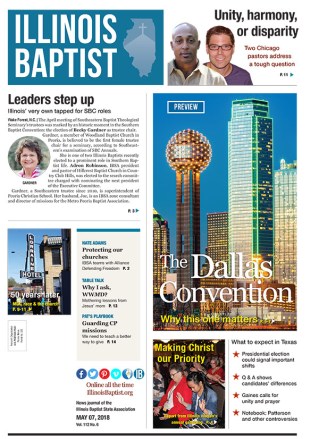
5-07-18 IB cover lgAfter our last issue of the Illinois Baptist went to press, we remembered what we left out of the article, “Why this one matters.” Our collection of items to look for at the Southern Baptist Convention in June should have included the forthcoming report on evangelism in the SBC by Steve Gaines’ blue ribbon committee. The panel, which includes Illinois’ own Doug Munton, pastor of FBC O’Fallon, is scheduled to present its study on the declining rate of baptisms in SBC churches and several key proposals to turn that around.

The report, by seminary presidents, SBC entity heads, and megachurch pastors, was to be Gaines’ parting word to the convention as he concludes two years as president. It is a very important word at crucial moment in the life of our denomination. We meant to say that in our May 7 issue previewing the Dallas convention.

We didn’t.

We forgot.

Gaines’ important prescription for recapturing the SBC’s evangelistic fervor got muscled out by breaking news about abuse of women and the argument over inappropriate statements by statesman Paige Patterson two decades ago.

The same appears likely to happen again at the convention in June.

Any one of these stories could be the headline coming out of Dallas:

“SBC shifts generation and theology in top leadership vote.”

“Proceedings slowed as messengers argue diversity among nominees.”

“Messengers debate ERLC leadership and another round of resolutions repudiating racism.”

“SBC speaks on abuse, women, and their place in the denomination.”

“Patterson announces retirement, takes final lap before exiting SBC stage.” Or, “Patterson unseated as convention’s keynote; denied final sermon after controversial comments.” (A special called Board of Trustees meeting May 25 at Southwestern Seminary may determine if either of last two headlines proves true.)

But the headline will likely not be: “SBC adopts new plan for evangelism to turn decline in baptism and refocus churches on leading the lost to faith.”

Why?

Because the overwrought news cycle of the current era has overtaken the SBC too. If only we could come out of Dallas writing stories about a fresh wind of God’s Spirit and our renewed commitment to share the gospel. If only we could file reports of our people falling on their faces in repentance for failing to share salvation with lost people, then hitting the streets to tell the good news.

Yes, all these news stories are very important. As a people, we must deal faithfully with women and our treatment of them in the church as well as the larger culture. But while we are doing that, we must remember what brought us together as a denomination in the first place. The world needs Jesus. And all today’s headlines are evidence of that great need.

Eric Reed is editor of the Illinois Baptist newspaper.

hands patterned with the US flag

This year marks the 30th anniversary of the National Day of Prayer. Many of us pray for America on a regular basis, but each time this year, we are able to join together across the nation and pray together in unity.

Whether you are joining a prayer gathering for the event or praying on your own throughout the year, here are some ways you can pray for America.

1. #PRAY4UNITY in America.

“Making every effort to keep the unity of the Spirit through the bond of peace” (Ephesians 4:3).

The present spiritual crisis in America is calling us to pray for and take all necessary actions to come together in our nation. God is the only One who can do this, so we call upon Him to empower us to make every effort to live in unity.

2. #PRAY4UNITY in the church of America.

“Now I urge you, brothers and sisters, in the name of our Lord Jesus Christ, that all of you agree in what you say, and that there be no divisions among you, and that you be united with the same understanding and the same conviction” (1 Corinthians 1:10).

God is calling His Church in America to unify upon the authority of the Bible and centrality of Jesus Christ, the only Savior of the world. We must come together to make Christ known to the world by advancing the Gospel to every person in the world. Ask God for local churches to unify as one body of Christ and walk together in unity, harmony and oneness.

3. #PRAY4UNITY in the families, workplaces, communities and cities in America.

“Also, the power of God was at work in Judah to unite them to carry out the command of the king and his officials by the word of the Lord” (2 Chronicles 30:12).

God’s power upon us is the only source to unite our families, workplaces, communities and cities in America. Ask God to call families, workplaces, communities and cities to look to the only One who can unify us.

4. #PRAY4UNITY among all ethnicities and people in America.

“For he is our peace, who made both groups one and tore down the dividing wall of hostility” (Ephesians 2:14).

Since each of us are made in the image of God, we bear His image regardless of the color of our skin or uniqueness of our ethnicity. Through the death of Jesus, He has torn down the wall of division among all people. In God alone, we unify and live in peace with one another, standing against all racial and ethnic division, denouncing it as sin.

5. #PRAY4UNITY for the security of our nation and for our schools, churches, and all public venues.

“The one who lives under the protection of the Most High dwells in the shadow of the Almighty” (Psalm 91:1).

Ask God to protect our schools, churches and all public venues. Plead with God to restrain all evil and secure our nation from all enemies. Ask God to move upon our government officials to work together to secure our schools, churches and all public venues.

6. #PRAY4UNITY that we agree clearly, unite visibly and pray extraordinarily for the next great spiritual awakening in America.

“They all were continually united in prayer” (Acts 1:14).

Ask God to convict the church of America to wake up spiritually, unite visibly and pray extraordinarily for the next Great Spiritual Awakening in America to occur in our generation and shape the future of America.

EDITOR’S NOTE: May 3 is the National Day of Prayer.

Ronnie Floyd is senior pastor of Cross Church in Northwest Arkansas and president of the National Day of Prayer. This article first appeared at LifeWay’s Facts&Trends (factsandtrends.net).

Missionary heroes

ib2newseditor —  April 26, 2018

Dr. Doug Munton, Senior Pastor of First Baptist Church of O’Fallon, Illinois

We need heroes. The true hero of our story, of course, should always be the Lord Jesus. No earthly hero can do what He did or give what He gave. But there is something to be said for the example of a fellow Christian who has followed the Lord in a way we can emulate.

The apostle Paul said, “Imitate me, as I also imitate Christ” (1 Corinthians 11:1). He served the church of Corinth as an example of a sinner following the Savior. He was a model, an example — a hero if you will — for other Christians to follow. He reminded them to follow him only as he followed Jesus. But he showed them how it was done in the real world by a real sinner who was following a real Savior.

Career missionaries serve as models for Christians back home. They might not like the tag “hero” but they serve as models and examples for the rest of us who follow Christ.

Missionary heroes may not leap tall buildings in a single bound or be faster than speeding bullets. But they point us to the Ultimate Hero.

We see their example of sacrifice and learn something of what it means to “die to self” amid the joys of a calling often tempered by loneliness, isolation and illness. We see what “take up your cross daily and follow Jesus” is all about. We learn from them. We “imitate them as they imitate Christ.”

Having missionary heroes doesn’t mean we think they are perfect. Only Jesus is. It doesn’t mean we don’t know they have feet of clay like all the rest of us.

It just means that we have seen people who followed Jesus even when it was hard. And we learn that we can follow Jesus through hard times as well. We learn that we can sacrifice, we can value the eternal over the earthly and we can be obedient to our Lord. They serve as models of the kind of heart we need as we follow the Lord wherever He leads us.

We don’t put missionary faces on bubble gum cards like we used to do with baseball players. Not many movies feature missionaries saving the day. But career missionaries ought to be a special kind of hero to us. We should honor them, pray for them and love them. We should tell their stories. We should follow their examples.

Maybe you will never be called by God to serve as a career missionary far from family and home. But every missionary can serve as an example to you of how to follow Jesus where you are. Missionaries can be spiritual heroes who point you to the greatest hero — the Lord Jesus who loves you and calls you to follow Him.

Missionary heroes may not leap tall buildings in a single bound or be faster than speeding bullets. But they point us to the Ultimate Hero. And that is better than being more powerful than a locomotive any day!

Doug Munton, online at dougmunton.com, is senior pastor of First Baptist Church in O’Fallon, Ill., and a former first vice president of the Southern Baptist Convention. He is the author of “Immersed: 40 Days to a Deeper Faith.” This column appeared at BPnews.net.

Difficult golf ball in the mud

A friend of mine told me about a strange experience he had while on a mission trip in Africa. Some of the folks there wanted to play golf one afternoon at a course on the edge of a large city. He was not a golfer, but just to have some fellowship with them, he went along.

He got out on the golf course and saw signs that said, “Play the Ball Where the Monkey Throws It.”

He asked what it was about, and later he found out what it meant. The golf course had areas around it that had monkeys everywhere — just regular, wild monkeys that lived in that area.

The monkeys would come out on the golf course and were fascinated with the little white ball that came flying through the air and landed near them or on the green. The monkeys would run and grab the golf ball and throw it somewhere.

The people who kept up the golf course had tried several things to get rid of the monkeys, including a large fence and noise makers, but to no avail. Many of the people who played golf there got upset because where they hit their ball was not where it was when they had to hit it the next time. The monkeys would run out there, get the ball, throw it to the other side of the fairway or off the golf course.

When things don’t go as planned, God may be redirecting your life towards an unexpected blessing.

Failing to keep the monkeys away, the golf course managers just conceded that they built the course in the monkeys’ domain and they changed the rules to accommodate what happens on the course. So the sign said, “Play the Ball Where the Monkey Throws It.” It’s hard enough to play golf when you are playing against the elements or the wind or the frustrations of just trying to hit the ball fairly straight, but when you’ve got to deal with the monkey population, it’s even more difficult. The people who played the course that day as every day would just begin with the understanding that they would have to hit their ball from wherever the monkey throws it.

The fact is that for nearly all of us, life is somewhat like that. Every one of us is going down the fairway of life and suddenly realize that something has affected the steps ahead and the next shot in life. Sure enough, the monkeys have been on the course.

Yet there are some amazing things that can take place when God changes the course in your life each day. Things that can either frustrate you or bless you. Things that can change the twists and turns of your road of life and take you down a path that is filled with new sights, new joys, new people and new opportunities.

Some people may never see those things. Some of you may never come to enjoy the monkeys of life throwing your ball around on the course, but would choose just to be frustrated about it, angry about it, upset because somebody, something, some monkey pitched your golf ball off in a ditch, and you can’t get over it.

I often think of James in his little book toward the end of the Bible where he said, “Come now, you who say, ‘Today or tomorrow we will go to such and such a city, spend a year there, buy and sell, and make a profit’; whereas you do not know what will happen tomorrow. For what is your life? It is even a vapor that appears for a little time and then vanishes away” (James 4:13-14).

James reminds us that the will of God is not always fully known when the sun comes up every morning, and what you plan for the day may not be in God’s plan and purposes for you. Things get shifted around and about mid-morning you realize, yep the monkeys in life have been at work again in my daily routine. Go with the flow. Go with God in the midst of what He has in store for you. Watch carefully and you may see a bright and shining blessing just ahead.

Jim Futral is executive director-treasurer of the Mississippi Baptist Convention Board.

This article first appeared on Baptist Press at BPnews.net.

2018-am-pre-reg-open
When the Southern Baptist Convention comes to Dallas this summer for its annual meeting, it will do so for the second time since 1985. That 1985 meeting was the largest convention meeting ever, the high water mark of our movement to return the SBC to its commitment to biblical authority.

I’ve attended SBC meetings regularly since 1982. I was 27 when I started and the convention was run by guys my dad’s age. It took a while to figure out how things work but I was part of a movement unique in church history for its scope and impact on American Christianity.

Adrift as I was, and surrounded by people twice my age, I’m glad I was there as my denomination turned from its support for abortion (the reason I was most likely to leave the SBC) and took another hard-fought step toward biblical integrity. Since then, small and large issues have arisen during the business and hall talk at the convention, but something important happens every year — even when the important things are predictable and tedious.

Here are a few reasons you should make it a priority to attend the SBC’s annual meetings:

Ownership
This is not the most fun reason for attending but it is the essential reason we meet every year. The messengers from the churches, gathered during two days each June, have authority over everything our institutions and missionary boards do for the remaining 363 days. We approve their budgets, assign them trustees and give instructions though motions to those who serve our churches. It’s not easy to make a big impact but I have seen it done over the course of decades; I helped it happen.

Education
If you’re a Southern Baptist, you learn things at our annual meeting that you won’t learn elsewhere. Sure, you’ll hear good preaching and even get some free books if you plan your week right, but also you’ll see some things that will challenge you.

The reports of our institutions are the stories of people — pastors, church planters, missionaries, Sunday School teachers, choir members, widows and others enriched and trained by the work you support. The Cooperative Program is not just a boring fundraising effort in this narrative; it is the lifeblood of a broad and effective missionary enterprise.

You’ll also see, as I did at my first meeting, a fellowship of pastors and church members who are diverse racially, culturally and generationally. Few niche meetings you attend will hit all those marks. It’s hard to maintain some prejudgments of your brother and sister Baptists after seeing us together. There are a lot of meetings you can attend where your particular affinity or interest is the entire agenda. I find it enlightening to occasionally hang out with people I don’t understand very well.

Encouragement
This is a big reason for most conferences. The SBC always features solid preaching, chances to talk with ministry specialists and even a health screening station to encourage you avoid Tex-Mex and barbecue. It’s hard to come back from the SBC without being spiritually and professionally challenged at least once.

Fellowship
Hallway meetings, alumni meetings, side meetings, luncheons — we have those in abundance. I always see friends from my former ministries as well as people who live across town but whom I see only at the convention. This benefit is not unique to our Southern Baptist meetings, but you won’t miss out on chances to make and renew friendships as you attend our meetings. This aspect has grown in recent years with the addition of different affinity group meetings and meals. For many of us, fellowship is the most memorable aspect of Southern Baptist meetings.

Do you find other Southern Baptists, or the general collection of us, uninteresting? I get it; most of us are not very cool. But do you love the seminary that trained you or your pastor? For most of you, that seminary wouldn’t/won’t be here without the SBC. Do you love the International Mission Board more than you do the rest of the convention? Not even the IMB would/will be around without the SBC.

You can be conservative, an expository preacher, missional as all get out and lead your church well without being a Southern Baptist, though it would be hard. But you probably are a Southern Baptist if you read this column. Join us in Dallas on June 10-13 or some portion of those days — especially if you’ve never been before. You’ll come away understanding a bit more of what “Southern Baptist” means for your ministry; I guarantee it.

Gary Ledbetter is editor of the Southern Baptist TEXAN (www.texanonline.net), newsjournal of the Southern Baptists of Texas Convention, where this column first appeared.

Growing up, letting go

ib2newseditor —  April 5, 2018

Growing up“I have to go to work.”

The 2-year-old in our house pushes her hair away from her face, shoulders a miniature pink backpack, and starts trudging to the back door.

“Don’t go!” we say. “Stay here with us. It’s almost time for dinner.”

She replies, dutifully, “No. I have to go.”

She’s growing up—fast. And she’s not the only one. Everywhere you look, young people are taking on big responsibilities previously reserved for people older than they are. High schoolers take college courses. Tweens have detailed social calendars, and the mobile devices to manage them. There is a 6-year-old who made $11 million last year marketing toys on YouTube.

Some kids are tackling the most pressing issues of our day, the most recent example being the Florida teens campaigning for an end to school violence like the shooting that devastated their community earlier this year.

As an adult, especially as a parent, it’s easy to want to lock the doors, pull down the shades, and resolve to just make life work inside our house for the next 15 years.

At Children’s Missions Day this month, I saw evidence that many parents aren’t parenting like that. Hundreds of mini-missionaries worked in 16 locations across Illinois, baking cookies, tending yards, delivering care packages, and visiting nursing homes—all in the name of sharing God’s love with people who might need to hear about it.

My 2-year-old went with me to take photos at one of the sites that day, and I watched her watch the older kids. On the way home, I heard her voice from the backseat: “When I get older and bigger, can I do projects?”

Her question begs an answer—and a commitment—from her parents. To let her grow up and exercise the faith we pray she’ll make her own one day. To trust that God has a plan for her life that may include going somewhere we’ve not been, and can’t go along.
In a scary world, it’s a heavy commitment. We have time to get used to the idea, but not as much as we once did. They’re growing up fast.