Archives For November 30, 1999

IBSA's Mark Emerson (left) and Harold Booze from Woodland Baptist in Peoria (right) stand with a village chief in West Africa.

IBSA’s Mark Emerson (left) and Harold Booze from Woodland Baptist in Peoria (right), with a village chief in West Africa.

COMMENTARY | Mark Emerson

My wife recently downloaded and played for me Scott Wesley Brown’s classic song “Please Don’t Send Me To Africa.” It brought back memories of college chapel services and the annual mission challenge to take the Gospel to the ends of the earth. Tammie played the song for me because as I write this, I’m getting ready to join four Illinois Baptist pastors on a mission trip to the very continent Scott Wesley Brown was praying God wouldn’t send him.

Among missiologists there is a growing debate on the effectiveness of such short-term trips. Should we really go to Africa? Here are a few insights God has laid on my heart.

First, I’m going to Africa because God commanded me to go. Some would say there really doesn’t need to be another point. God has said it and that settles it. When the Lord shared that we should “go into all the world and take the Gospel to every creature,” He wasn’t directing the challenge only to a small group of disciples at that particular time. He was including you and me. God was declaring that we are the instruments He has chosen to take the Gospel to the world.

The second reason I’m going is because there are people who need the Gospel. In Africa our team will visit UUPG’s – “Unreached, Unengaged People Groups.” These groups are less than 2% Christian and do not have an indigenous church planting strategy. Simply put, there are few believers and no churches. I have never been to a place where the Gospel hasn’t been. The privilege of being able to share the story of Jesus around the village fire to those who will hear it for the first time has captured my heart.

And finally, I’m going to Africa because it may help others to go! Many groups are unreached in our world because it is hard to get the Gospel to them. I have led numerous groups to fairly easy locations, many have gone, but we followed multitudes that had already been there.

Going to West Africa is hard. Inoculations are expensive; airfare is expensive, travel conditions are difficult, living conditions are outside our comfort zones. But millions are dying without Christ. If I go, maybe someone would be willing to go with me, or better yet, see going as not so difficult. Pastor Kevin Carrothers from Rochester First Baptist Church is going with me in hopes of helping volunteers in Capital City Association engage an unreached people group. He is going so others can go.

I may have returned by the time you read this article. If so, I would love to share with you how God opened doors and used our team to share the Gospel. I would also love to share with you how your gifts through the Cooperative Program have provided full-time IMB missionaries who are working on your behalf to take the Gospel to the ends of the earth. I will get to work alongside several of our missionaries during this trip. They are anxiously awaiting the opportunity of working alongside you in Africa and all over the world. Consider going!

Mark Emerson is IBSA’s associate executive director of missions.

Baltimore_blogCOMMENTARY | Eric Reed

The calendar says the season is winter, and the snow bank outside your house would seem to confirm it, but there’s another we must consider: it’s SBC presidential nomination season.

Somewhere today in a church office or study, there’s a man praying about nominating his friend for the presidency of the Southern Baptist Convention. And somewhere else, that possible candidate is asking God whether he should allow his friend to make that nomination public. Rarely does one nominate himself to run for SBC President. It is the work of prayerful men, considering the needs of the convention, and the qualifications of their closest friends to lead to meet the needs of the time. As with the committee that selected Paul and Barnabas (“It seemed right to the Holy Spirit and to us”), nomination is a work of the Holy Spirit and prayerful men.

It’s also a function of geography.

For example, Fred Luter was elected SBC president in his hometown, New Orleans, in 2012. Orlando’s Jim Henry presided over a convention in Orlando. And in Houston, favorite son Ed Young, Jr., was re-elected to a second term.

Consider the location of the 2014 Southern Baptist Convention. It’s in Baltimore.  Not since 1910 has the annual convention been held in Baltimore.

On the East coast, 40 miles from Washington D.C., a Baltimore convention is likely to draw a different crowd of messengers than if it were held in Texas or Florida. For one thing, there’s no “Six Flags over Baltimore” to draw the messenger who likes to pair the convention with a vacation. The serious-minded will travel to Baltimore. (Forgive us, Baltimore, if we underestimate the drawing power of crab cakes and historical sites, but without Shamu, how shall we entertain the children?)

And consider the nearest neighbors to Baltimore: the closest SBC seminaries are Southern in Louisville, Kentucky, and Southeastern in Wake Forest, North Carolina. Many of the churches in the region surrounding Baltimore have their pastors and leaders supplied by these schools. They are likely to be very well represented at the meeting in June.

While we don’t know yet who will run, we should note that it has been three years since there was a contested election for SBC president. Any match-up that pairs a Reformed candidate against one who identifies himself as a “traditionalist” – the labels used in the Calvinist theology debate of recent years—will likely test the peace loosely stitched by leaders of those camps just before the 2013 convention.

A cursory tour of the blogosphere shows no suggestion that Baltimore 2014 will be for Calvinists what Houston 1979 was for Conservatives – opportunity to bolster their leadership role in the denomination with thousands of close-by voters. But with strong centers of Reformed theology in neighboring states and many adherents in the region, Baltimore may be the best location for a Reformed candidate to mount a campaign.

Study kits are great tools, but they don’t make disciples

COMMENTARY | Heath Tibbetts

Discipleship doesn’t come in a box. Lessons come in boxes, neatly packageHeath_Tibbettsd with DVDs and participant guides. And for years, discipleship to me was the newest lessons from great teachers. It was all I had ever known, until God called me to a church outside the Bible Belt.

Our Southern Baptist church in Pennsylvania was mainly comprised of former Catholics, Methodists, or unchurched people. Many in our congregation
came from a background where they had never been encouraged to read the Bible. One former Catholic who joined told me, “Our priest said if we ever needed to know something from Scripture, he’d tell us.” It became quickly apparent that doing discipleship the same old way wasn’t going to work.

And then I began to ask myself a tougher question: Did it ever work?

Much of our discipleship today fails because of a lack of biblical literacy. We have assumed for so long that those within our congregations are having a personal devotional time of some sort because they’re Christians. The reality is that many lack this important time with the Lord, not because they don’t love God, but because they were never discipled on how to do it.

So we scrapped our random discipleship efforts in Pennsylvania. We canceled all the classes, not because the subjects or teachers were bad, but because there was no fruit. Our pastoral staff and wives established discipleship groups. We didn’t promote them in the bulletin, but as individual leaders we identified potential future disciple makers. We established these as regular groups, meeting at least on a monthly basis. We prayed together, ate  together, and studied the Bible together. As group leaders, we did this to make disciples who would make disciples.

When God called our family to northern Illinois this year, I had the opportunity to step back and look at my group. Corey had been silent and plagued with guilt over his lack of depth as a believer. He’s now the leader of the group, and a new deacon in the church. Matt was becoming serious about studying the Bible, but often unwilling to commit. He’s now leading the youth ministry since my departure and learning to be a doer. And after two years, another man finally left the comfort of those friends to invest in a new group, where he will pass along the lessons of personal discipleship he learned.

Jesus’ earthly ministry over a three-year stretch was marked by twelve disciples. That ministry would barely register a blip on the radar of many church leaders today because of its humble beginnings. But as a result of Jesus’ personal investment in those men, churches were started, the Gospel spread, and many were saved. Jesus gave us a simple model: love them then lead them. This is the lesson I am now living out.

Here at First Baptist Church in Machesney Park, Ill., there are many dreams I have for our church. I dream of a church that is debt-free. I dream of a church that is focused outside of our walls. I dream of a church where our people live in a passionate relationship with their Savior. And all those dreams are tied to personal discipleship.

Disciples will give, disciples will go, and disciples will grow. But for these dreams to become reality, I must set the example as pastor. So I will invest in the lives of our people, finding those who can be grown not only as disciples, but disciple makers. It will grow our First family closer to God and each other.

Christ called us in Matthew 28:19 to “Go therefore and make disciples.” Andy Stanley and Beth Moore are great teachers, but they can’t make disciples for you. Discipleship requires personal investment that a box cannot provide. I challenge you to examine discipleship in your church. How can you personally invest in the lives of your church family such that you will make disciples who make disciples?

Heath Tibbetts is pastor of FBC Machesney Park, Ill.

Be it (still) resolved

Meredith Flynn —  January 1, 2014

Scott_Kelly_blogCOMMENTARY | Scott Kelly

At this time of year, it’s likely that someone may ask us this question: “Do you have any New Year’s resolutions?” And when asked, we usually answer: “Lose weight,” or “Read the Bible more,” or something like that. Our culture’s common thinking on resolutions tends to be individualized thinking about our own personal goals. That’s normal, right?

Not if you’re an Illinois Baptist. Our family of churches makes resolutions together. We make these resolutions not as individuals, but as a gathering of Christians from hundreds of Illinois Baptist churches. And we make these large-group resolutions at a strange time, in early-to-middle November, not on January 1. These resolutions are part of our Annual Meeting every year.

My dear Illinois Baptist family, now that the New Year has come, I must gently ask: Do we even remember our resolutions from our annual meeting this past November? The messengers from our churches enthusiastically approved resolutions about marriage, religious freedom, human trafficking, and state-sponsored gambling. As we gather in our churches for our first prayer meetings of 2014, let’s remember our resolutions and keep praying about these things that we were so resolved about on those days in November.

I left our annual meeting very encouraged by what God is doing through our Great Commission work in Illinois. As I boarded the last Amtrak train out of Springfield a few hours after our last meeting session had ended, I was still affected by the last-minute resolution that one of our brothers proposed regarding repentance and evangelism.

The wording of the resolution was both convicting and inspiring – and repentant. We resolved we should “repent of our unfaithfulness to God and beg for His mercy, grace and forgiveness because at times we have all failed to faithfully and regularly share the Gospel.”

Furthermore, we said, “All members of Illinois Baptist State Association churches are encouraged to regularly pray for God to give His people the ability to speak HIS message with boldness and clarity by the power of the Holy Spirit, and regularly pray for all to receive Jesus Christ as their Lord and Savior.”

Illinois Baptists, let’s keep repenting and sharing the Gospel in 2014, so that we may truly grow as churches together advancing the Gospel.

And may God receive all the glory!

Scott Kelly is pastor at Evanston Baptist Church and director of the Baptist Collegiate Ministry at Northwestern University.

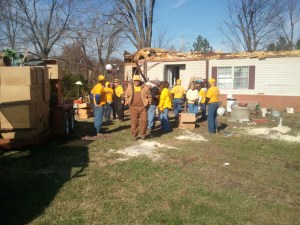
Disaster Relief volunteers served across the state after several tornadoes Nov. 17, including one in Brookport in southern Illinois.

Disaster Relief volunteers served across the state after several tornadoes Nov. 17, including one in Brookport in southern Illinois.

COMMENTARY | Eric Reed

When Time magazine announced the new pope as its person of the year, we were reminded that sometimes the publication has not chosen an individual, or even a person.

Time named “the computer” as its entity of the year in 1982, and in 2011, following the Occupy movement and the “Arab spring” uprisings in the Middle East, the “honor” went to “the protester.”

So it’s not surprising that the village of Sturgis, South Dakota, chose not a single person to receive its annual Volunteer of the Year award, but a group. And that group is Southern Baptist Disaster Relief Volunteers.

When Sturgis was hit with a winter storm in October, SBDR sent 110 relief workers in five teams to help them dig out. About 50 of those volunteers were from Illinois.

The town council noted in their announcement last week that many of the people receiving assistance were elderly or disabled, and the time given amounted to 576 days of work. Sturgis is grateful.

So are many others.

“Thank God for you all showing up to Mary Lou’s house in Rapid City, SD, to help with all the trees and branches due to the snow storm,” one couple who look after their elderly neighbor wrote to the Illinois team that aided them. “We are praising God and thanking Him for each one of you who made it all possible to come out to South Dakota and serve God.”

And when Rex Alexander, IBSA’s DR mobilization director, summed up the recent response to tornadoes in Illinois, he said there were more volunteers and offers of assistance than he had ever seen. Just before Christmas, 250 relief workers finished up their service in Washington and other communities laid waste by twisters in mid-November.

A new NAMB video shows Illinois residents picking through the remnants of their homes, weeping not so much at their loss, but in gratitude for the aid of strangers in yellow shirts.

“It’s raining, it’s cold, it’s nasty,” said a tearful Melissa Helfin outside her home. “And all these people – they’re here with chainsaws and pulling limbs and – it’s amazing…. I don’t know what we would have done, honestly. And it’s such a blessing.”

If we offered a “Person of the Year” award, it would be to the whole group who share Jesus Christ with a Bible in one hand and a spatula, mop, or chainsaw in the other.

Red and green and blue

Meredith Flynn —  December 12, 2013

200371625-001For many at Christmas, ‘merry and bright’ doesn’t come easy

COMMENTARY | Meredith Flynn

“I think there must be something wrong with me, Linus. Christmas is coming, but I’m not happy. I don’t feel the way I’m supposed to feel.”

Charlie Brown is in a holiday funk. By the end of his half-hour special, his spirit is lifted by a spindly tree
and a retelling of the Christmas story by his friend Linus, with blue blanket in tow of course.

It’s not always that easy, or that quick. For millions struggling with the holiday blues, Christmas joy is hard to find. But there is hope, David Jeremiah wrote in a column titled “Wonderful Counselor.”

“Our Lord Jesus is the Christ of Christmas present, and He wants to deliver you from the Christmas blues, too.”

Thanksgiving at Christmas
Holidays are difficult for people for a number of reasons, Christian counselor Molly Ondrey said. Some may be overwhelmed by busyness or the financial pressure of the season. Others who have lost loved ones face a “new normal” at Christmas. Unmet expectations of what the holidays should look like can bring on the blues.

“They think back to a happier, merrier time,” said Ondrey, who works at Pathways Counseling in central Illinois. If the usual traditions of gathering around the Christmas tree or opening gifts together have changed, she added, people ask, “Now what?”

And it may not be obvious that someone is struggling.

“A lot of times, what people do is isolate when they’re depressed,” Ondrey said. They might need a
friend to reach out. A church family can help with the loneliness of the holidays by creating new
memories. Offer to be a listening ear, or to help someone put up a Christmas tree, or invite someone to
be part of your Christmas celebration, she advised.

Some churches plan a “Blue Christmas” or “Longest Night” service as a time to remember loved ones they’ve lost, and to focus on the hope Jesus brought into the world.

Finding a new focus is important in combating holiday depression, Ondrey said. Falling into “automatic
negative thinking” happens frequently when people are feeling down. Focusing on the blessings God has given, new memories that can be made, and the birth and hope of Christ might help improve a perspective.

I’m just stressed
Charlie Brown’s complaint – “I don’t feel the way I’m supposed to feel” – can result from holiday busyness too. The American Psychological Association reported in 2011 that up to 69% of people feel strapped for time and money during the holidays, and 51% feel pressure about the gifts they give and receive.

Create memories that are cost-effective, Ondrey advised. Watch a Christmas movie, go caroling, read
the Christmas story in Luke 2, go on a drive to check out holiday lights, or attend a special church service.

She also gave some practical tips for fighting off the holiday blahs. For example, eat healthy and stay active. And take charge of your schedule by saying no when needed.

Consider reaching out for extra help if holiday depression is interfering with your normal, everyday functioning at work or home, Ondrey said, if your depression occurs for an extended period of time, if you have thoughts of self-harm, or if your support system is limited.

For more information about Pathways, a ministry of Illinois Baptist Children’s Home and Family Services, call:
• (618) 624-4060 | Metro East
• (217) 483-2222 | Central Illinois
• (618) 382-3907 | Southeastern Illinois

Our moral minority

Meredith Flynn —  December 6, 2013

pull quote_ADAMSCOMMENTARY | Nate Adams

On November 5 our Illinois state legislature voted to legalize same-sex marriage, effective next June. Much could be written about how and why that happened, and what its consequences will be for churches, in the culture, and within families. Right now, however, none of those lamentations are as important as the need for individual churches to get prepared for the future under this new law.

To begin with, churches that haven’t already done so need to review their bylaws and written policies to make sure they protect their beliefs and practices as much as possible. At http://www.IBSA.org/ssm, you can find some recommended language, as well as other resources, and further information on the legislation that was just passed.

Churches would also be wise to clearly and intentionally communicate to their members the biblical reasons for their position on same-sex marriage. During last month’s IBSA Annual Meeting, messengers unanimously approved a resolution concerning “The Preservation of Biblical Marriage and Affirmation of Religious Liberty of Illinois Churches and Faith-based Organizations.”

This resolution is also available at http://www.IBSA.org/ssm, and presents a brief, biblically supported rationale for opposition to same-sex marriage that can be used as a teaching tool or handout for church members.

At the same time, churches also need to prepare themselves and their members to minister in a culture where LGBT (lesbian, gay, bisexual, transgender) citizens more openly assert themselves. I’ve read several good articles on this recently that challenge churches to stand firmly on biblical conviction, but also to look for opportunities to reach people in this new environment, and to recognize the double standards that may unwittingly exist in the church related to other sinful behaviors.

Like it or not, churches also need to recognize that in surveys, a majority of Americans now appear to have an accepting or at least apathetic attitude toward same-sex marriage and individual sexual expression.

That means that even professing Christians may disagree or have varying opinions on what the church’s posture should be toward the changing culture. Nurturing a balanced, biblical unity in the church will mean equipping and encouraging members to neither condemn people, nor to condone sin.

During this fall’s convocation at Golden Gate Baptist Theological Seminary President Jeff Iorg, referring to the moral decline described in Romans 1:32, said, “Sexual sins are not the final step on this downward spiral. The last step of rejecting biblical morality is when people applaud or celebrate those who legitimize immoral practices. We have reached that point in America.”

Iorg went on to refer to 1 Peter 4:1-11 and stated, “As a result of your unwillingness to affirm their choices, unbelievers will slander you. I predict that today’s slander is a precursor to more serious social, legal and physical opposition coming in the next few years.”

Dr. Iorg concluded his warning, however, with an exhortation to a loving Christian response: “Believers cannot become preoccupied with opposing immoral behavior; instead, they must realize that moral choices come from a person’s spiritual condition. Unbelievers act like unbelievers. While we uphold our moral convictions, expecting unbelievers to model Christian behavior is a misplaced hope.

“Your first and best response to immorality in your community is to preach, teach, share, witness and live the Gospel. The greatest need of every person in the world – lesbian, gay, bisexual, transgender, adulterer, fornicator or straight-laced puritan is still the Gospel.”

After November 5, we as Bible believing Christians may feel like a moral minority. But so did the early Christians, and most of the Old Testament prophets, and certainly Abraham when he pled for the city of Sodom. Our shifting culture simply makes our own pursuit of holiness as believers more important, and our advancement of the Gospel here in Illinois more urgent.

Nate Adams is executive director of the Illinois Baptist State Association.


COMMENTARY | Meredith Flynn

For something that we talked about for so long, the debate over same-sex marriage seemed to end so quickly. Tuesday’s vote in the Illinois House was preceded by two hours of debate, sure, but the feeling inside the Capitol was that this decision was a foregone conclusion.

The legislation – officially titled Senate Bill 10 – passed narrowly through the House and zipped back through the Senate and onto to Gov. Pat Quinn’s desk, where presumably it will be signed soon. If all goes according to the bill, same-sex marriage is legal in Illinois effective June 1, 2014.

Supporters of the bill stood in line outside the House gallery, hoping to get inside before the vote. As discussion dragged on inside the chamber, they huddled around iPads and cell phones, listening to a live stream of the debate. Eventually, they struck up conversations about what a yes vote would mean.

“It’s a no-brainer,” a young woman in an ILove T-shirt told me. She was polite and hopeful about the day, probably college-age. We chatted for a few minutes about what we thought about the issue, and I told her church leaders are most concerned about redefining something originally defined by God.

“But not everyone believes in God,” she said. For her, religion and the matter at hand were completely separate. And after five or ten minutes, I realized I didn’t have answers to counter her argument.

Before the vote, we heard that people on the pro side of the same-sex marriage won’t be persuaded by debate based on the Bible. In other words, our defense of marriage is rightly grounded in biblical truth, but our arguments need oomph – sociological, philosophical and yes, theological, oomph.

How true that is now that we’re facing a new normal in Illinois. As I continued to think about what I could have said in that line, I realized this is a new day for Christians too. We have to pray harder for our culture, study God’s Word more faithfully, and be more diligent in our thinking. Unlike my friend in line, this has to be a “brainer” for us.

Above all, we have to be more loving. This months-long debate has been divisive. Relationships are frayed between conservative Christians and those who advocated a new definition of marriage. We have to love intentionally in the days ahead. We’ll do that by thinking deeply and compassionately, and with discipline. And letting our words so follow.

Meredith Flynn is managing editor of the Illinois Baptist newspaper.

plateCOMMENTARY | Michael Allen

Editor’s note: Check with your doctor before beginning any kind of fast.

Forty days without food sounds extraordinary to most of us. Who can live without food for that long? You might hurt yourself; you might even die.

But after 40 days without food, I’m sure the discipline of fasting is part of God’s design for those who know Him. And it’s necessary if we’re going to see revival in our churches, our state, our country, and our world.

Last fall, I sensed God moving me toward fasting. Our church was in the middle of a capital campaign – Project Elevate – to make the building accessible for the 3,000 wheelchair-bound people in our immediate vicinity. We had a clear vision: Enabling the disabled to see and hear Jesus at Uptown Baptist Church. But we only had about 20% of what we needed to add an elevator to the building, and I was very discouraged.

But I began to sense God saying, “Michael, if you want something you’ve never had before, you’ve got to do something you’ve never done before.” I felt like God wanted me to do a 40-day fast and trust Him with the results. I told my congregation so they could fast and pray along with me.

Around that same time, the nationwide crime statistics were released, and Chicago was named the “murder capital of the U.S.” after a particularly violent year. Our city became another focus of the fast, and some sister churches in our neighborhood joined in.

On January 2, 2013, I stepped out to do something I’d never done.

I engaged in a complete food fast, drinking only liquids – water, juices, coffee and tea. In the evening, I heated up a bowl of V8 and drank it like soup. After day four or five, the light-headedness went away, I stopped feeling the hunger pangs, and I was really able to focus.

What I found is that your body actually feels better when you’re fasting, at least after those initial few days. Your mind is clearer and alert, and you’re calmer. My prayer habits changed too. My normal mode of prayer is to pray silently, but during the fast, I felt the Lord prompting me to pray out loud. Throughout the fast, I had a greater expectation of God answering my prayers, and a greater closeness and communion with Him.

I saw Him work in our church too. A few days after I started the fast, Uptown received an anonymous donation that put us over the halfway mark in our capital campaign.

When the first and second quarter crime statistics were released, we rejoiced that gun crime was down 90% in our community, and had decreased all over the city. The numbers rose in the summer, as they often do, and you may have read recently about a drive-by shooting near our church steps. A few weeks after the Aug. 19 shooting, there was another incidence of violence a block away. Both were too close to home.

But our church has responded.

So far in 2013, we have received more people in membership and baptized more than we have in any of the eight years I’ve been pastor at Uptown. We’re seeing God add to the church in greater numbers than we’ve ever seen before.

Throughout the fast, I found myself personally renewed as well. I noticed I had a hyper-sensitivity to the Word of God and the work of God around me. I tended to listen more carefully to situations that came to my attention, whether it was dealing with my children, my wife, our extended family, or issues that came up in the church.

There was a sense of incredible peace and objectivity to listen, to analyze, to empathize, and to respond with wise counsel or with whatever was appropriate for the moment. There wasn’t the usual anxiety or exhaustion that sometimes comes from dealing with those things. I felt like I was responding in the Spirit and not in the flesh.

Fasting isn’t a magic formula to fix whatever’s ailing you, your church or your city. It doesn’t ensure financial favor or less violence or personal happiness. But it does create more time margin for you to pray and seek God, for who He is and what He would have you do. And He’s faithful to provide.

Michael Allen is pastor of Uptown Baptist Church in Chicago.

pull quote_adamsCOMMENTARY | Nate Adams

Earlier this summer, I wrote about my desire to worship in every Illinois Baptist church. Even though it would take years and years of attending a new church every week, I can’t think of a better way to invest my Sundays than to meet, and listen to, and worship with, as many Illinois Baptists as possible.

Since writing about that desire, I’ve already been invited to worship in eight new churches for the first time on a Sunday morning. Some have been invitations to come and speak, and some have been invitations to simply join the church for worship, which I enjoy just as much. But I am so grateful for each of these churches that responded to my simple question, “May I come to your church?” with the same gracious answer: “Sure, we’d love to have you.”

It’s made me wonder how many people are asking that same question every week about your church or mine. They probably don’t ask it directly of us. In fact, they probably don’t even ask it out loud. But they drive past, or read about, or perhaps hear someone talking about our church. And they wonder what it would be like to go inside.

Of course, their question is really multiple questions. What exactly happens in there on Sunday mornings? How would I know where to go and when to do what? Would I know anyone, and do they know anything about me? How would I be treated? Would I like it? Would I want to go back? Do I know anyone who would go with me? What about my kids?

I think we would all like to answer the simple question, “May I come to your church?” positively and warmly. Of course we want new people to come to our church! But if we really expect it to happen, we have to realize that these “questions behind the question” reveal potential barriers that may be keeping people from taking the first step.

For example, my sons tell me that most people their age will not seriously consider attending a church that does not have a decent web site. It’s not necessarily that they are looking for a technologically sophisticated church. It’s just that their generation gathers information that way. Whether they’re trying to answer a trivia question or shop for the best price or consider attending a church, they usually go to the web first, to check things out.

An effective church web site can be a wonderful tool for helping people anonymously answer their questions about your church in advance. But some people are going to look to the newspaper, some to the phone book, and some are going to want to call the church on Saturday night. In other words, an effective, inviting church is going to do everything it can to answer the questions behind, “May I come to your church?” before they are ever asked out loud.

Of course, just as important as answering these questions in advance is answering them on site at the church, especially on Sunday. A first time guest to your church needs all kinds of help that your regular attenders don’t need.  That would seem obvious, but I am sometimes surprised at how difficult it is to find a church’s service time, or address, or directions. And even if the church is easy to find, it can be unclear where to park, or what door to enter, or where to go once you’re inside.

Fortunately, almost all of the churches I attend, even for the first time, do a great job of communicating in advance, and welcoming warmly when I arrive. And if I’ve not yet been to your church on a Sunday morning, I would still love to come and join you in worship. But far more important than my asking this question are the many people in your community who may be asking it silently every week: “May I come to your church?”

Nate Adams is executive director of the Illinois Baptist State Association.