Archives For November 30, 1999

Walking

One thing I love about summer is the opportunity for long walks. Beth and I have a three-mile circuit that takes us from our house down to a nearby lake and back. Usually we walk it after dinner, but before dark, with our blind dog Willy. Our nest of three sons is empty now, and so we have just this one furry kid to follow us around.

It’s not really the walk itself that I value, though. It’s what happens there. By the time we walk, Beth and I have usually taken dinnertime to catch up with one another on the day’s events, and what arrived in the mail, and what we each heard from friends or family that day.

The walk is for deeper talk. That’s when we tend to discuss longer term plans for the future, or longer view reflections on where we’ve been. We talk not just about our kids’ activities, but about their well-being and their life decisions. We talk not just about short-term purchases, but about long-term investments. We talk not just about our church routines, but about our spiritual lives.

It usually takes a while to get past perfunctory, obligatory prayers I tend to settle for when time is short.

Sometimes our local son, Caleb, and his wife, Laura, walk with us. Those are rich times. Often Laura will walk alongside Beth and engage in one conversation, while Caleb and I will pair up a few steps behind them. Sometimes the two conversations will blend, and mix, and then separate again. We all like to hear as much as possible.

But these aren’t the 10- or 20-word texts we exchange with our kids during the day. These are often significant conversations about problems, and dreams, and life decisions, and dilemmas. Long walks encourage deeper talks.

And then there are the long walks I take by myself, to have deeper talks with God. Sometimes I make time for them during the regular routine of life. But often I need a vacation or a few days off or a different setting in order to pull away.

During the regular rhythms and busyness of life, my prayer times can grow so brief, so repetitive, so lightweight. Like the chitchat of a dinner conversation or the insufficiency of a text, I can settle for such trivial communication with God. But when I walk for a while with him it’s easier to remember that he really knows and loves me in my deepest, innermost parts, and that he longs to meet me there too, and not just in the shallows of a busy life.

Over a few recent days of long walks and deep talks this summer, I remembered again that it usually takes a while just to get past the perfunctory, obligatory prayers that I tend to settle for when time is short. I know there’s nothing wrong with those prayers, just like there’s nothing wrong with catching up over dinner on the day’s activities. It’s just that there are so many more significant things to talk about. But you only seem to get there when you take the time.

This past week I walked and talked to places of deep confession, and pleading, and worship, and peace. Once the lighter weight stuff was off my chest, there were several minutes and miles of silence as I looked for the right words to tell God things I then remembered that he knows already. Yet when those words came, they were cathartic and soothing to my soul.

Long walks can lead to deep talks, with our spouses, our kids, and yes, our God. May you find time for the long walks you need this summer.

– Nate Adams is executive director of the Illinois Baptist State Association. Respond at IllinoisBaptist@IBSA.org.

It’s time to speak up

ib2newseditor —  August 3, 2016

Adron RobinsonThe week of July 4, 2016, was a very dark week in America. It began with my wife and me celebrating Independence Day with our family and watching the local fireworks display. But there would be a different type of fireworks in the days to come.

On July 5, a Baton Rouge police officer pinned down Alton Sterling and shot him several times while he was on the ground, killing him in front of witnesses.

The very next day in Minnesota, Philando Castile was pulled over in a routine traffic stop and shot multiple times by a police officer. Castile’s girlfriend videotaped the aftermath of the shooting and broadcast it live on Facebook for the world to see.

If those incidents weren’t enough, on July 7, at the end of a peaceful protest of these killings, an armed gunman ambushed Dallas police officers, killing five and wounding seven others.

How can the church remain silent when the sin of racism is screaming so loudly?

It truly was a dark week in America. As I sat at my desk praying about how to process these events and address these issues with my congregation, God led me to Matthew 5:13-16.

We live in a dark and decaying world, and the darker the world gets, the more it needs the church to be salt and light. Light shines brightest in darkness, and God has providentially placed the local church in the community to shine the light of the gospel to a world that desperately needs that light.

The killings of African Americans at the hands of police officers, and the denial of justice to the families of those slain, reveal the high level of personal and institutional racism in America.

The truth of the matter is that an encounter with the police is a life or death matter for many people of color in America. We pull over praying. Praying that the officer who stops us will uphold the law and not manipulate it to cover up his own racial prejudice. Praying that we will be treated the same way every other citizen of this country is treated. But most of all, we are praying that we are not killed by the very people our taxes pay to serve and protect us.

This is not the experience of my non-minority brothers and sisters. And it should not be the experience of anyone created in the image of God.

My question is, how can the church remain silent, when the sin of racism is screaming so loudly? How can we stand by as injustice continues against those we say are our brothers and sisters in Christ?

We cannot remain silent. In order for there to be change in our culture, the church must stop being silent and step up and be the church. In Matthew 5:13-16, Jesus calls us to be counter-cultural Christians. This means the church is called to influence our culture with the gospel of Jesus Christ.

Christians and only Christians are the salt of the earth. Christians and only Christians are the light of the world. Christians and Christians alone are responsible for stopping corruption and slowing down the decay of this world.

Notice Jesus did not say “you and the government,” “you and the police department,” or “you and the Supreme Court.” There is only one hope for this world, and that hope is in people of God preventing decay and penetrating darkness.

We need to stop making excuses, stop being divided, stop being deceived by the darkness of this culture, and begin shining the light of righteousness and loving our neighbor as ourselves. We will never overcome a hateful world unless we learn to love one another.

Dr. Martin Luther King Jr., said, “Darkness cannot drive out darkness; only light can do that. Hate cannot drive out hate; only love can do that.” If we love our neighbor as ourselves, we cannot remain silent as our neighbors are being slain in the streets. And we must address the racism in our world, even if it is in our own hearts.

In Acts 10:34, Peter says, “Truly I understand that God shows no partiality.”

I pray that soon and very soon, the church would do the same.

– Adron Robinson is senior pastor of Hillcrest Baptist Church in Country Club Hills and vice president of IBSA.

Faith-based Veeps

ib2newseditor —  July 29, 2016

Presidential nominees choose running mates with more evangelical appeal

Pence and KaineHeading into the Republican and Democratic National Conventions, one unanswered question was how—and if—Donald Trump and Hillary Clinton would seek to galvanize the support of evangelical voters. Both candidates’ picks for vice president, made immediately before their parties’ conventions, could be seen as a way to reach out to Christian voters who have felt under-represented this campaign season.
Trump named Mike Pence, the governor of Indiana, as his running mate. Taking the stage in Cleveland, Pence declared, “I’m a Christian, a conservative, and a Republican, in that order.” He peppered his acceptance speech with phrases familiar to Christians: “I have faith that God can still heal our land” and “Pray daily for a wise and discerning heart.”
The governor, who grew up Catholic, gave his life to Jesus Christ as a college student in 1978, he told CBN News in 2010. He and his wife, Karen, attend College Park Church in Indianapolis, and Pence describes himself as an “evangelical Catholic.”

Pence came under fire last year when he signed the Indiana Religious Freedom Restoration Act into law. Critics claimed the bill discriminated against the LGBT community, while supporters claimed it protected the rights of religious believers to practice their faith. Corporations, major sporting events, and individuals threatened to boycott the state. A few days later, Pence signed an amendment to the bill which also protected sexual orientation and gender identity rights, causing some conservatives to question his commitment to religious freedom.

At the Republican National Convention, in what some saw as an appeal to evangelicals, Trump pledged he and Pence would do away with the Johnson Amendment, which became part of the U.S. tax code in 1954. Then-Senator Lyndon Johnson proposed the measure, which restricts tax-exempt religious organizations, including churches, from endorsing or opposing political candidates under penalty of losing their tax-exempt status.

The Democratic nominee for President, Hillary Clinton, also introduced her running mate prior to her party’s national convention. Virginia Senator Tim Kaine has attended St. Elizabeth Catholic Church in Richmond for nearly 30 years, and also has done mission work in Honduras. The former Virginia governor sings in the choir at his predominately African-American church.

Kaine has used biblical terminology to express his displeasure at the Senate’s recent failure to pass stricter gun laws. He told 60 Minutes, “The chamber was ringed with the family members from Sandy Hook, with Virginia Tech family members sitting with them and helping them. There’s a phrase in the letter to the Hebrews that talks about being surrounded by a great cloud of witnesses. We were surrounded by a great cloud of witnesses, but we couldn’t do the right thing.”

Kaine’s stance on abortion could be troubling to Christian voters. He told CNN in July that his view on abortion is traditionally Catholic, meaning pro-life, “but I am very strongly supportive that women should make these decisions and government shouldn’t intrude. I’m a strong supporter of Roe v. Wade and women being able to make these decisions. In government, we have enough things to worry about. We don’t need to make people’s reproductive decisions for them.”

Uneasy alliances
With just four months until the general election, a new Pew poll shows Trump has a commanding lead among white evangelicals, 78% of whom say they will vote for him, compared to 17% who support Clinton.

Black Protestant voters overwhelmingly say they support Clinton—89%, compared to 8% for Trump. Hispanic Catholics also support Clinton (77%) over Trump (16%).
Pew found voters in general are not pleased with their choices for president: 42% said it would be difficult to choose between the candidates because neither one would make a good president.

Voter motivation is also a key issue in the 2016 election, Pew found. Of the 78% of white evangelicals who support Trump, 45% said their decision was “mainly a vote against Clinton,” compared to 30% who said it was “mainly a vote for Trump.”

The survey comes after Trump’s meeting in June with nearly 1,000 evangelicals, including many Southern Baptists. At least eight Southern Baptists now serve on his evangelical advisory panel.

– Lisa Sergent

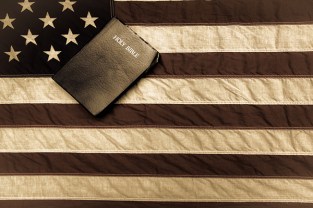
Sepia Bible and flagHouse Speaker Paul Ryan introduced the Republican nominee for vice president, Mike Pence, as a “man of faith” at the party’s national convention July 20. When the Indiana Governor took the stage he declared, “I’m a Christian, a conservative, and a Republican, in that order.”
Pence peppered his acceptance speech with phrases familiar to Christians: “I have faith that God can still heal our land” and “Pray daily for a wise and discerning heart.”

Is Pence the man evangelicals have been looking for this election cycle?

In 1994, Pence told the Indianapolis Business Journal, “I made a commitment to Christ. I’m a born-again, evangelical Catholic.” While that may sound odd to Baptist ears, it’s not as rare as some may think.

When Republican candidate for president Donald Trump announced his selection of Pence as his running mate, Trump pledged he and Pence would do away with the Johnson Amendment. The Johnson Amendment became part of the U.S. tax code in 1954 when then Texas Senator Lyndon Johnson, later president, successfully restricted tax-exempt religious organizations including churches from endorsing or opposing political candidates under penalty of losing their tax-exempt status.

It’s said Johnson’s fervor for the amendment came from is desire to silence pastors in his state who were opposing his re-election bid. Many believe the amendment is a violation of citizens’ First Amendment rights

In his speech, Trump said he “could not have won this nomination” without the support of evangelical voters. He called them “unbelievable.”

Referring to the Johnson amendment, he stated, “You are just absolutely shunned if you’re evangelical, if you want to talk religion, you lose your tax-exempt status.We put into the platform, we’re going to get rid of that horrible Johnson amendment. And we’re going to let evangelicals, we’re going to let Christians and Jews and people of religion talk without being afraid to talk.”

After sharing about amendment’s history, Trump stated, “We’re [he and Pence] going to undo it, so that religious leaders in this country, and those unbelievable people, and not because they backed me in such large numbers, but so that religion can again have a voice, because religion’s voice has been taken away. And we’re going to change that. OK? All right.”

Delegates to the Republican National Convention approved a platform, which some are calling the party’s most conservative ever, that includes this promise.

Will evangelicals who oppose Trump get on board because of this promise or the Pence addition to the ticket? Some are saying not so fast.

Pence was under fire last year when he signed the Indiana Religious Freedom Restoration Act into law. Critics claimed the bill discriminated against the LGBT community, while supporters claimed it protected the rights of religious believers to practice their faith. Corporations, major sporting events, and individuals threatened to boycott the state. A few days later, Pence signed an amendment to the bill which also protected sexual orientation and gender identity rights. Some viewed Pence’s actions as a betrayal and questioned his commitment to religious freedom.

A recent Pew survey showed the majority of white evangelicals now support Trump because they dislike presumptive Democrat nominee for president Hillary Clinton.  Whether Pence will win over the #NeverTrump evangelicals who say they will leave the checkbox for president blank or write in a name won’t truly be known until November.

We all matter to God

As Americans we look forward to summer with excitement and nostalgia for summers’ past. For many, the summer of 2016 will be one they’ll most likely want to forget.

So far we’ve seen multiple terrorist attacks overseas and even in our own country, with the killing of 49 Americans in Orlando, FL in June. In the most recent attack in Nice, France, at least three Americans, including a father and son, were among the 84 people killed.

Our own country is also being torn apart from within by racial strife. The killings of two black men, one in Baton Rouge, LA, the other near Minneapolis, MN, by police. In seeming retaliation, five police officers were assassinated in Dallas, TX, followed just more than a week later, by the assassinations of three officers in Baton Rouge.

One of the Baton Rouge officers slain was Montrell Jackson, a 32-year-old who had been married only a few years and recently become a father. Jackson was also black.

The Washington Post reported his sister, Joycelyn Jackson, learned of her younger brother’s death while sitting in a Sunday worship service at her church. According to the Post, “She understands the anger behind the movement Black Lives Matter but that ‘God gives nobody the right to kill and take another person’s life…It’s coming to the point where no lives matter whether you’re black or white or Hispanic or whatever.’”

Jackson is expressing what many feel. As a society we argue over the semantics of whose lives matter, while the killing continues. It should hardly be a surprise that life has so little value in a culture where more than 56 million infants have been aborted since the U.S. Supreme Court legalized abortion in 1973. Earlier this month, the Supreme Court struck down a Texas law that tightened abortion clinic standards. The ruling, which made access to abortion clinics in that state and others with similar laws even easier, was celebrated by many Americans.

As summer temperatures heat up, so are tensions. A spirit of evil and chaos seems to have taken hold. But we need not despair, God is with us and he is merciful and just.

Joycelyn Jackson knows this and so should we.  When the Post asked Jackson what she would say to her brother’s killer or anyone considering violence, she replied, “If I could say anything to anyone, it is to get their lives right with God. Hell is a horrible, horrible place to be.”

– LMS

I did not grow up a Southern Baptist. In fact, I only stumbled into the denomination 12 years ago. But every year I become happier and happier to be associated with this great tradition and organization. And this year’s Southern Baptist Convention in St. Louis made me more pleased than ever before to be a Baptist.

Maybe I am set up for future disappointment. I hear that these meetings are not always as eventful. This year, attendance was up. Emotions were high. We gathered in the immediate wake of the mass shooting in Orlando, the worst in our country’s history. We remembered the tragic shooting in Charleston one year earlier and acknowledged the racially charged atmosphere reflected in nearby Ferguson. “Election” also loomed large. The theological understanding of the term was a subtext for the hotly contested SBC presidential election. And the upcoming U.S. presidential election was in everyone’s mind.

One of the most memorable moments for me, though, came amid a flurry a motions presented to convention messengers. One brother from Arkansas had requested the removal of Southern Baptist officials or officers who support a right for Muslims in America to build mosques. The next day, after the Ethics & Religious Liberty Commission’s report, the same brother pressed ERLC President Russell Moore on the issue, likening the defense of the right to construct mosques to Jesus endorsing the erection of temples for Baal in ancient Israel.

As our culture unravels, we must remember our hope is in Christ, not country.

Dr. Moore’s response was sharp and received by the majority of messengers with applause. “The answer to Islam is not government power,” he said. “The answer is the gospel of Jesus Christ and the new birth that comes from that.”

In defending the idea of soul freedom for every individual, he illuminated a critical theological concept that lies at the heart of being Baptist. I am referring to religious liberty—the belief that no religion should be established by the state, but all faiths should be free to win adherents through the power of persuasion and not the sword.

In our history, Baptists have been persecuted by the government for non-conformity. We have seen the damage done by state churches to true religion. We do not baptize babies, in part, because we believe you cannot be born a Christian. Everyone must be genuinely converted without coercion. This should compel us to a radical witness to our Muslim neighbors and refugees, not to seek political action against them.

Recently there was a debate between a Christian and an atheist at the university near our church. It was sponsored by an evangelical campus ministry. To get there, you took the escalators to the third floor and turned left to find a small room with perhaps 100 mostly Anglo attenders. That same night, in the large room to the right of the escalators, there was a banquet for Islam Awareness Week with hundreds of Muslims from places like the Middle East and South Asia.

The lesson is this: We can wring our hands at the growing influence of Islam in the U.S., or we can get to work witnessing in new ways. Now is not the time for fear, but for bold faith.

In the New Testament era, the church is an altogether different institution than the state, with distinct ends and means. The two cannot be confused. So today, the proper analog to Baal altars in Israel is not Islamic Centers in Wheaton. It is idolatry in the corporate worship of the Church.

Patriotism definitely has its place, but perhaps one appropriate application would be to examine whether nationalism has crept into our Christianity. There are many forms of syncretism. As former SBC President James Merritt eloquently said in favor of a resolution to cease display of the Confederate battle flag, “Southern Baptists are not a people of any flag. We march under the banner of the cross of Jesus and the grace of God.”

As our culture continues to unravel and even the Bible Belt unbuckles, we must remember that our hope is in Christ, not country. His kingdom is unshakeable. And in many ways the dismantling of cultural Christianity that fused God and country is a good thing for the cause of the gospel. We Baptists want real believers that worship Christ alone, even if they are persecuted by a secular state or Islamic State.

– Nathan Carter is pastor of Immanuel Baptist Church in Chicago.

Braveheart screengrab via YouTube

Braveheart screen grab via YouTube

The great experiment in democracy is in trouble.

We have only to look at the presidential election to see the truth in that statement. Apparently anyone can become president.

It is hardly believable that same-sex marriage was legalized in the U.S. only one year ago. In the brief time since, the moral ground beneath us has shifted with the force of tectonic plates in quake.

Not since William Wallace painted his face blue and led his native Scotland to a rousing victory over England has the world so needed someone to raise his fist and shout “freedom!”

On Broadway, the most popular show lauds our founding fathers (who, little did we know, were hip-hop artists!). But the freedom today’s culture celebrates is license, not liberty. In a few short decades the nation has abandoned the very principles on which it was founded.
Our founding fathers established this nation with a few basic understandings: individual rights are derived from a Creator and our civil laws are based on “the laws of nature and Nature’s God.” The great experiment in American democracy is also built on the presumption of an educated electorate, culture with a conscience, and society with a solid moral foundation. Tocqueville observed that in a democratic republic, education about the constitution and morality must remain inseparable.

Yes, our founders were sinners: ambitious, schemers, slaveholders, adulterers. But knowing the wickedness of the human heart, they crafted a system they hoped would hold those wills and ills in check. They held high the rights to “life, liberty, and the pursuit of happiness,” and more specifically, the basic freedoms of religion, the press, peaceable assembly, and the redress of grievances against the government.

Good luck with that. We can’t even get the Social Security Administration to answer the phone without a three-month appointment.

Congress is in gridlock, the Supreme Court issues endless rulings irrespective of morality, and the Administration makes edicts that endanger the psychosexual well-being of our children—all in the name of freedom. All in violation of basic common sense.

Not since William Wallace painted his face blue and led his native Scotland to a rousing victory over England has the world so needed someone to raise his fist and shout “freedom!” But it’s not freedom to have our own way that we need. What America needs is a fresh understanding that true freedom is liberty to be and do what God intends. Freedom that truly respects human dignity doesn’t allow people to destroy themselves and the nation by liberty gone wild.

Whom the Son sets free is free indeed.

The rest is just illusion.

– DER

Almost a thousand evangelical Christian leaders gathered in New York City Tuesday to meet with presumptive Republican presidential nominee Donald Trump. Among them were a number of prominent Southern Baptists. Eight were among the 25 leaders appointed to Trump’s evangelical advisory panel.

They are: Ronnie Floyd, immediate past president of the Southern Baptist Convention and pastor of Cross Church in northwestern Arkansas; Jerry Falwell Jr., president of Liberty University; Jack Graham, pastor of Prestonwood Baptist Church in Plano, Texas, and a former SBC president; Robert Jeffress, pastor of First Baptist Church in Dallas; David Jeremiah, pastor of Shadow Mountain Community Church; Richard Land, president of Southern Evangelical Seminary and former Ethics and Religious Liberty Commission president; James MacDonald, pastor of Harvest Bible Chapel in Chicago, which only recently joined the SBC; and Jay Strack, motivational speaker and founder and president of Student Leadership University.

Being on the advisory board does not amount to a full public endorsement (Falwell, Jr. is the only one who has publicly endorsed Trump) , however to many it does imply a tacit endorsement. Some have been critical of the leaders’ action, to which Land replied via an editorial in the Christian Post. “What would our critics have us do?,” he asked. “Would they really have us spurn the opportunity to give spiritual counsel and advice to Mr. Trump and his team? How would that be obedience to our Savior’s command to be the salt of the earth and the light of the world? (Matthew 5:13-16). After all, as Evangelicals we all believe that the heart of the king “is in the hand of the Lord . . . He turneth it whithersoever He will” (Proverbs 21:1).”

Current ERLC president, Russell Moore, has been a vocal opponent of Trump, tweeting Tuesday afternoon, “If you wondered why younger, theological, gospel-centered evangelicals reacted neg to the old guard Religious Right, well, now you know.”

And, a few minutes later, “Forget the politics. Forget the country. An unrepentant lost person pronounces himself to be a believer. And you stand there and applaud?”

At last week’s Southern Baptist Convention, in the President’s message, Floyd stated, “Our nation is divided. We are known more for being the divided states of America than the United States of America. The national political races we have observed over this past year personify the fractured, dysfunctional condition in America relationally.”

Floyd also led a panel on Pastor’s and Politics at the convention. He introduced the panel saying, “Disagreement doesn’t have to result in a strained relationship with brothers and sisters in Christ…This presidential panel is an attempt to address this conversation.”

Graham, who was one of the panelists urged Southern Baptists not to sit at home but to get involved in the process. “One concern we should all have 30-40 million stayed home and did not participate…This is a critical election for the future of America,” he said.

He pointed to three primary issues Christians should be looking at when voting for a presidential. They are choosing Supreme Court justices, belief in the sanctity of life, and maintaining religious liberty. Graham noted, “We must not abdicate our responsibility to pray and to vote.”

There words appeared to be at odds with other convention leaders. At the B21 Luncheon during the convention, Moore and Albert Mohler, president of the Southern Baptist Theological Seminary were among the panelists speaking. Replying to a question about the 2016 U.S. presidential elections, Mohler said, “I find myself in a situation I’ve never found myself in as a Christian. I’m going to find myself unable to vote for either candidate.”

Moore agreed and said he plans to write in a name on his ballot.

One thing is certain, there will be continued disagreement regarding the presidential election. Another thing is also certain, many in the U.S. appear to be having flashbacks to 1976 and having their own Howard Beale, “Network” moments in this election cycle.

– Lisa Misner Sergent

Brandon McNeely, Sean Morecraft, Phil Nelson, and Dalton Sharro

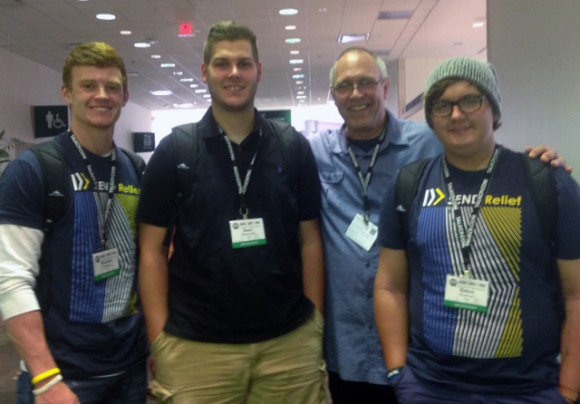
Lakeland Baptist Church, Carbondale, SBC messengers: Brandon McNeely, Sean Morecraft, Phil Nelson, and Dalton Sharrow.

The world is currently experiencing its largest refugee crisis since the second world war with more than 65 million people displaced by war. The majority of these refugees come from the Middle East and Africa and are Muslim. It’s an issue that’s fraught with controversy

Last September, President Barack Obama pledged to bring 85,000 refugees to the United States with 10,000 coming from Syria. Southern Baptists took a stand on the issue, which has become a political hot potato in the race for U.S. president, at their annual meeting held this year in St. Louis June 14-15.

Resolution 12: On Refugee Ministry acknowledged the suffering refugees endure and Baptist’s historical role in refugee care, calling upon them to “minister care, compassion, and the Gospel to refugees who come to the United States.”

The resolution also called on the government to “implement the strictest security measures possible in the refugee screening and selection process.”

Phil Nelson, pastor of Lakeland Baptist Church in Carbondale, came to the convention as a messenger, bringing with him three young men from his church, Dalton Sharrow, Sean Morecraft, and Brandon McNeely. Resolution 12 (scroll down to read the full text of the resolution) in particular, caught their attention, said Nelson. “We saw the resolutions and we saw what’s going on with the Confederate flag and some others, and we thought that’s awesome the walls have come down, but we need to communicate to the world outside the ports of America that when our government and society is saying, ‘No, don’t come,’ we represent a different Kingdom.”

Together, the four wrote and proposed an amendment to further strengthen the resolution. Their amendment encouraged, “Southern Baptist churches and families to welcome and adopt refugees into their churches and homes as a means to demonstrate to the nations that our God longs for every tribe, tongue, and nation to be welcomed at His Throne…”

The resolution received immediate support from the leaders of evangelical refugee relief organizations.

“I applaud the Southern Baptist leaders who have urged their churches and members to demonstrate Christ’s love to refugees, perhaps the most unwanted, unwelcome and unloved people in our world,” said Richard Stearns, the President of World Vision U.S.

Stephan Bauman, President of World Relief, expressed his gratefulness and said, “We believe that the biblical mandate for welcoming those fleeing persecution is clear. We see the arrival of refugees as a remarkable opportunity for the Church to live out our faith.”

Speaking with the Illinois Baptist shortly after the amendment was approved, Nelson explained, “Our citizenship is in a different place. We want to communicate clearly we belong to a different Kingdom. It’s not an American Kingdom, it’s the Kingdom of God.  We want to tell all those who are orphans and refugees you’re welcome here. I don’t care what religion, what background, you’re welcome because we believe the gospel can rescue and save everyone.”

“When we first heard David Platt give his story about the refugee issues in Somalia and Syria and other places, I couldn’t stop weeping,” Nelson said, his voice breaking. “I started seeing the kids that had no place to go. All of a sudden I thought, we have 46,000 Southern Baptist churches, what would happen if each one of those churches said we’ll take a refugee. We’ll take a family.”

Nelson shared how another Southern Baptist pastor was part of their inspiration. As they were writing it, a friend of Nelson’s who is originally from India stopped to say hello. The friend, now a pastor in South Carolina, “came over here in 1990 as a Hindu, had his gods in a suitcase,” described Nelson.

That friend was a refugee when he came to the United States and learned about Christ. “It was a Baptist family that adopted him, let him come and live with them, where he saw the gospel lived out, and as a result gave up his Hindu background, gave up his Hindu gods,” Nelson told the Illinois Baptist. “Now he’s going back to India every year planting churches. I thought if we’re going to reach the nations, and we’re going to convince the world that the gospel is for everybody, we’ve got to set the standard and say, ya’ll come.”

Nelson encourages Christians to reach out to refugees settling into their communities. “We’ve got homes, we’ve got hearts, we don’t do bombs and bullets we do hearts and homes,” he said.

– Lisa Misner Sergent


RESOLUTION 12: ON REFUGEE MINISTRY

WHEREAS, The world is facing the largest refugee crisis since World War II, with over sixty million people displaced throughout the world and considered refugees; and

WHEREAS, War, violence, genocide, religious persecution, and other forms of oppression have contributed to massive people movements across the globe, as millions flee for their lives; and

WHEREAS, Southern Baptists have a long record of caring for and ministering to refugees throughout our history; and

WHEREAS, This history of refugee ministry includes the sponsoring of almost 15,000 refugees from 1975–1985, resulting in the starting of 281 ethnic churches and a 1985 resolution commemorating this decade of ministry; and

WHEREAS, There are expected to be 85,000 refugees coming into the United States in 2016 from four continents and the Caribbean; and

WHEREAS, Scripture calls for and expects God’s people to minister to the sojourner (Exodus 22:21–24; Exodus 23:9–12; Leviticus 19:33–34; Deuteronomy 10:17–22; Deuteronomy 24:17–22; Deuteronomy 26:5–13; Psalm 146:8–9; Matthew 25:35–40); now, therefore, be it

RESOLVED, That the messengers to the Southern Baptist Convention meeting in St. Louis, Missouri, June 14–15, 2016, encourage Southern Baptists to minister care, compassion, and the Gospel to refugees who come to the United States; and be it further

RESOLVED, That we encourage Southern Baptist churches and families to welcome and adopt refugees into their churches and homes as a means to demonstrate to the nations that our God longs for every tribe, tongue, and nation to be welcomed at His Throne (Revelation 5:9; Revelation 7:9-12; Psalm 68:5; James 1:27; Leviticus 25:35; Leviticus 19:33-34); and be it further

RESOLVED, That we call on the governing authorities to implement the strictest security measures possible in the refugee screening and selection process, guarding against anyone intent on doing harm; and be it finally

RESOLVED, That we affirm that refugees are people loved by God, made in His image, and that Christian love should be extended to them as special objects of God’s mercy in a world that has displaced them from their homelands.

Floyd_presidents_message

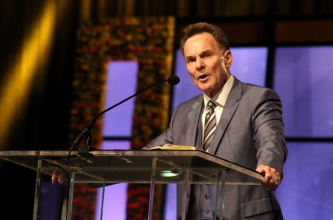
SBC President Ronnie Floyd at the 2015 SBC Annual Meeting in Columbus, Ohio.

When Ronnie Floyd was elected president of the Southern Baptist Convention, the denomination was coming to grips with the truth. After several years of describing many churches as “plateaued or declining,” leaders started speaking in frank terms about why, year after year, key measures like church membership, worship attendance, and baptisms were down denomination-wide.

“We are clearly losing our evangelistic effectiveness,” one Baptist leader said in 2014, the year Floyd was elected to his first term.

Things looked bleak, and for the first time in a while, the pressure wasn’t coming from outside opposition or controversy. Rather, the SBC seemed to be at an impasse.

Before his presidency, Floyd was already established as someone who could provide direction. As the pastor of a Southern megachurch, he led his congregation to a regional, multi-campus strategy and a new name—from First Baptist, Springdale, to Cross Church of Northwest Arkansas.

That is perhaps Floyd’s greatest legacy: He has reminded us that revival starts with prayer, and prayer starts with humility.

As chairman of the Great Commission Resurgence Task Force, Floyd helped lead Baptists to renewed commitment to a unified purpose—albeit with some difficult adjustments and plenty of debate over proposed funding changes between national agencies and state conventions.

But when Floyd was elected as SBC president, he looked not to drastic measures or sweeping changes—but to prayer. Unified, solidified, corporate prayer. Prayer that asked Baptists of all stripes to set aside differences for something greater than themselves: pleading with God for a great spiritual awakening.

Putting greater emphasis on the SBC annual meeting, Floyd called Baptists to Columbus, Ohio, in June of 2015 for a special prayer meeting to together confess sin—like racism and evangelism apathy—and to move forward as a humbled Convention that prioritized the work and mission of God.

In advance of the prayer meeting, which will happen again this summer in St. Louis, Floyd kept everyone in the loop through regular blog posts and columns distributed via Baptist Press and state Baptist newspapers. Throughout his presidency, he hasn’t hesitated to use the power of the pen (and keyboard) to inform, encourage, and challenge Baptists about the state of the SBC and our desperate need for spiritual awakening.

At the Southern Baptist Convention next weeek in St. Louis, the Tuesday evening session of the meeting will again be devoted to prayer. That is perhaps Floyd’s greatest legacy: He has reminded us that revival starts with prayer, and prayer starts with humility. For calling us together for that purpose, he deserves our thanks.