Archives For November 30, 1999

IMG_4145 (1)

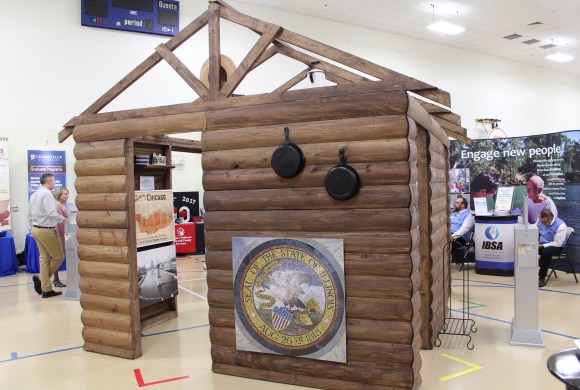
A log cabin stood in the exhibit hall at the 2017 IBSA Annual Meeting, surrounded by displays showing the current challenges of taking the gospel to people in Illinois.

Decatur, Ill. | Illinois Baptists were urged to remember their pioneering ancestors as they take the gospel to the more than 8 million people in the state who don’t know Christ.

One year before Illinois’ bicentennial celebration, the 2017 Annual Meeting of the Illinois Baptist State Association focused on “Pioneering Spirit” and asked churches to make four commitments: go new places, engage new people, make new sacrifices, and develop new leaders.
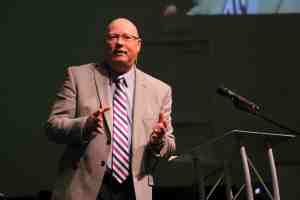
Kevin Carrothers web“We can’t be satisfied with the status quo, because the status quo is decline,” said IBSA President Kevin Carrothers (left) during his president’s message. The commitments are designed to help churches on the “uphill climb” to get the gospel to more people.

Preaching from the book of Numbers, Carrothers said no one remembers the names of the naysaying Israelites who didn’t want to go into the Promised Land. Instead, the real legacy of pioneering spirit was left by Joshua and Caleb, the two spies who trusted God to provide.

“They recognized the will of God was more important to obey than the whims and the desire of men, even if the majority won,” Carrothers said.

During a Wednesday evening worship service, church leaders put commitment cards on the altar—a symbol of their decision to take the gospel to new places, or to engage new people with the Good News, or to make new sacrifices of their resources, or to invest in new ways in the next generation of pastors, church planters, and missionaries.

The urgent need to get the gospel to more people was a driving theme of the meeting and Pastors’ Conference that preceded it, which started two days after a mass shooting at a Texas church. Southern Baptist Convention President Steve Gaines was slated to speak during both the Pastors’ Conference and Annual Meeting, but instead traveled to Sutherland Springs, Texas, to minister to the church that lost 26 people in the attack.

Tom Hufty webTom Hufty (right), pastor of First Baptist Church, Maryville, Ill., filled in for Gaines at the Annual Meeting, outlining the 8-year journey his church has been on since Pastor Fred Winters was shot and killed in his pulpit in March of 2009.

“These tragedies remind us there’s an urgency to share the gospel,” Hufty said. The pastor told meeting attenders he remembers exactly where he was and what he thought when he heard the news about Winters: What must it be like to have been in that building that day, and how difficult it would be to lead the church through the aftermath.

“Even in that shape,” Hufty said, speaking of churches that have endured tragedy, “the church is still the heartthrob of the bridegroom”–of Christ. Ministry isn’t rocket science, Hufty said. “It’s loving God. It’s loving people. It’s making disciples.”
Sammy Simmons webIn the meeting’s final session Thursday morning, Pastor Sammy Simmons (right) offered encouragement for those who are weary from a difficult season of life and ministry. Rely on the Lord, said the pastor of Immanuel Baptist Church in Benton. And keep taking bold steps for the sake of the gospel.

“The conditions are too rough, the lostness is too great, for us to continue to do business as normal,” Simmons preached. “The cause of the gospel causes us to make bold sacrifices for King Jesus.

“I’m all in for this pioneering spirit. Oh, how much our church needs it. Oh, how much I need it. Oh, how much our state needs it.”

Decatur, Ill. | Two days after a mass shooting at a Southern Baptist church in Texas, Illinois pastor Randy Johnson urged pastors to preach every message like it could be their last opportunity to deliver the gospel.

Johnson, pastor of Tabernacle Baptist Church in Decatur, filled in at the IBSA Pastors’ Conference for Southern Baptist Convention President Steve Gaines, who was slated to preach during the conference but is in Texas ministering to First Baptist Church, Sutherland Springs. On Sunday, Nov. 5, a gunman killed 26 people at the small church outside San Antonio.

Preaching from the book of 2 Timothy, Johnson encouraged pastors to check their measure of gospel urgency. Preach like it could be your last message, he said, and also like it could be your hearers’ last opportunity hear the gospel.

“As a preacher of the gospel, your highest calling is to preach the word,” he said. “It is your responsibility to stand before your people in your church and tell them what is right, what isn’t right, and how to get right.”

Johnson exhorted pastors to not only remember that every message could be their last, but also that every hearer will have a last moment.

“Preach like it’s their [the congregation’s] last moment. They don’t know when it’s going to be… You’re going to have people who don’t want to hear what you’re going to say. Consider their last moment. What are you leaving them with? What are you turning their hearts toward?”

On Wednesday morning, Ed Stetzer (below) spoke to Pastors’ Conference attenders about working for and journeying toward the long view of ministry. Stetzer, executive director of the Billy Graham Center for Evangelism at Wheaton College, urged pastors to have an eternal perspective and to recognize the contrast between life now and eternal life in heaven.

Ed Stetzer web

“It’s a long hard slog sometimes in ministry,” Stetzer said, “and we’re going to see Jesus one day.” That sounds very “old-school Baptist,” he acknowledged, but Baptists a few generations ago talked about heaven a lot more than we do now.

Christians have a confident hope, he said, because they walk by faith and not by sight.

“The afterlife is a sighted life, but life now is not. You don’t know everything. But you have a confident hope, because you know Jesus does.”


Curtis Gilbert 2 webDecatur, Ill. | The IBSA Pastors’ Conference began Tuesday with an impassioned plea for leaders to heed the apostle Paul’s words in Titus 1:5-9:

“The reason I left you in Crete was to set right what was left undone and, as I directed you, to appoint elders in every town: one who is blameless, the husband of one wife, having faithful children not accused of wildness or rebellion. For an overseer, as God’s administrator, must be blameless, not arrogant, not hot-tempered, not addicted to wine, not a bully, not greedy for money, but hospitable, loving what is good, sensible, righteous, holy, self-controlled, holding to the faithful message as taught, so that he will be able both to encourage with sound teaching and to refute those who contradict it.

Curtis Gilbert (above) warned pastors not to miss four areas of needed assessment evident in Paul’s words. First, how’s your love for Jesus, asked Gilbert, pastor of The Journey in Belleville. Don’t get used to Jesus, he told pastors.

“If you’re bored, the reason is you’ve gotten your eyes off him, and onto yourself and onto your ministry,” he said. No matter how long you’ve walked with Jesus, Gilbert told conference attenders, you still have as much need for the gospel and for Jesus as when you first confessed him as Lord.

The Metro East pastor asked pastors to assess their lives and ministries in three more areas: how well they love the gospel, their families, and God’s people.

He reminded pastors that as shepherds, they have as much need of their people as their people do of them. “If they keep putting a cape on you, and you keep letting them, then you need to be rebuked,” Gilbert warned pastors. “Because you are nobody’s Superman.”

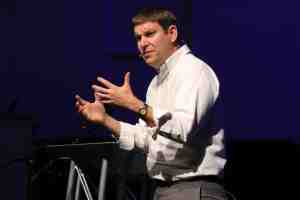
Joe Valenti webJoe Valenti (right) spoke after Gilbert and urged pastors to fall in love with the gospel. “Everything else comes out of that,” said the student and missions pastor from Cuyahoga Valley Church in Broadview Heights, Ohio.
There are more than 11,000 people groups in the world, Valenti said, and more than 7,000 are still unreached with the gospel. That’s not a problem for the International Mission Board or for missionaries or for the Cooperative Program, he said. Rather, “We need to see the completion of the Great Commission as a personal problem.”

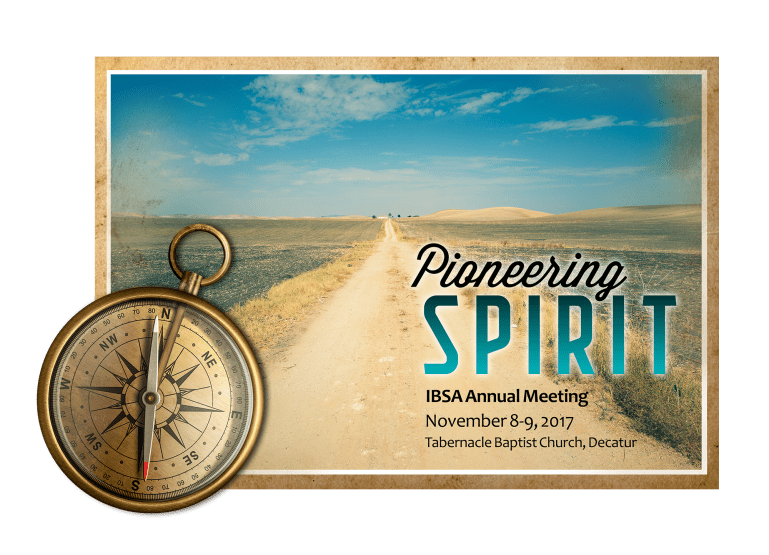
Postcard artThe IBSA Annual Meeting and Pastors’ Conference kicks off today at 1:30 from Tabernacle Baptist Church in Decatur. Belleville pastor Curtis Gilbert and Joe Valenti, a student and missions pastor from Ohio, will speak during the first session of the Pastors’ Conference, an annual gathering that this year is focused on the spiritual health of leaders, their families, and their churches.

Ed Stetzer, the Billy Graham Distinguished Chair of Church, Mission, and Evangelism and executive director of the Billy Graham Center for Evangelism at Wheaton College, will speak twice on Wednesday.

Check up Pastors ConferenceConference attenders also will have the opportunity to choose from several breakout sessions, including making your church more evangelistic, and developing healthy leaders in variety of roles.

On Wednesday afternoon, the IBSA Annual Meeting starts at 1:15 with music from This Hope, an Atlanta-based worship quintet. They will lead worship throughout the meeting, which is focused on the “Pioneering Spirit” needed to reach Illinois with the gospel.

During the Wednesday evening worship service, churches will be challenged with four “Pioneering Spirit” commitments in the areas of missions, evangelism, giving, and leadership development.

Check back here and at IllinoisBaptist.org for news and updates from Decatur.

The Briefing

Happy Reformation Day! As Christians around the world celebrate the movement’s 500th birthday, go to IllinoisBaptist.org for our coverage of the anniversary, including:

  • Baptists’ roots in the Reformation,
  • the continuing theological debate, and
  • a list of the ‘new Reformers.’

Pence promises help for persecuted Christians
U.S. Vice President Mike Pence said in October that the federal government will shift funds away from United Nations programs and toward faith-based and private organizations to better aid persecuted Christians and other religious minorities in the Middle East.

“We will no longer rely on the United Nations alone to assist persecuted Christians and minorities in the wake of genocide and the atrocities of terrorist groups,” Pence said at the annual summit for the group In Defense of Christians. Critics of the U.N. projects have said they have not been effective in helping Christians in the region who have been displaced due to war and the rise of ISIS.

Ahead of rallies, Baptists denounce racism
Counter-protestors far outnumbered white supremacists at two “White Lives Matter” rallies in Tennessee on Oct. 28. Prior to the protests, Southern Baptists in Tennessee joined other faith groups to take a public stand against racism and the white supremacy movement.

Church removes historical markers
A church in Alexandria, Va., is removing plaques that mark where President George Washington and Confederate General Robert E. Lee sat when they attended services there. “For some, Lee symbolizes the attempt to overthrow the Union and to preserve slavery,” reads a letter from the Christ Church board. “Today our country is trying once again to come to grips with the history of slavery and the subsequent disenfranchisement of people of color.”

The church initially considered taking out only Lee’s plaque, but later added Washington because he owned slaves, reports The Christian Post.

House of prayer
A federal judge reaffirmed the constitutionality of legislative prayer with her Oct. 11 ruling against an atheist who filed suit against the U.S. House of Representatives and its chaplain when he wasn’t allowed to deliver a secular invocation.

Major league visibility
With the Houston Astros still in the hunt for a World Series Championship, the city’s First Baptist Church is gaining notice for its prominent sign in right field.

Illinois Baptist, Christianity Today, The Tennessean, Baptist Press, The Christian Post

The Briefing

New rules protect abortion mandate objectors
Christian organizations are celebrating what they deem a win for religious liberty after the Trump administration released new rules Oct. 6 that allow institutions and corporations not to include abortion-inducing drugs in their employee health insurance plans.

A 2011 “contraceptive mandate” included in the Affordable Care Act had been the subject of legal challenges from more than 90 religious nonprofits, including GuideStone Financial Resources of the Southern Baptist Convention and four Baptist universities, Baptist Press reported.

House approves late-term abortion ban
The U.S. House of Representatives voted 237-189 last week in favor of the Pain-capable Unborn Child Protection Act, which prohibits abortions on babies 20 weeks or more after fertilization. The bill, which now goes to the Senate, is based on evidence that a child is able to experience pain in the womb after 20 weeks.

The House previously passed a pain-capable bill in 2015, but it was voted down in the Senate.

Princeton U. ministry drops “evangelical” from name
“There’s a growing recognition that the term evangelical is increasingly either confusing, or unknown, or misunderstood to students,” said Princeton Christian Fellowship’s Bill Boyce. That’s why the 80-year-old ministry at the Ivy League institution has changed its name, reports Christianity Today.

Higher education: College offers ‘marijuana degree’
Northern Michigan University’s four-year degree in medicinal plant chemistry combines chemistry, biology, and business classes—and could gain even more traction if a petition drive succeeds at getting full legalization of marijuana on Michigan’s ballot next fall.

Survey: Suicide still taboo topic in church
The majority of churches say they’re equipped to help someone threatening to take his or her own life, but a new study from LifeWay Research found only 4% of people who have lost a close friend or family member to suicide said church leaders were aware of their loved one’s struggle.

Sources: Baptist Press, Christianity Today, USA Today, LifeWay

Judge Neil Gorsuch

Supreme Court Justice Neil Gorsuch

New Supreme Court Justice Neil Gorsuch continued his first week on the bench with what many Court watchers have said could be the most important case of this term. The justices heard oral arguments April 19 on “the Playground Case,” which involves a church-owned preschool’s fight to participate in a state grant program.

Trinity Lutheran Church in Columbia, Mo., sued the state after its preschool was denied participation in a program that funds safer recreation spaces for kids. (Trinity’s playground is gravel, but operators wanted to replace it with a rubberized surface made from recycled tires.)

The preschool was denied funding, even though it ranked fifth out of 44 applicants, and 14 of those applicants received grants the year the school applied, USA Today reported. At issue is a Missouri provision that prohibits religious institutions from receiving public money.

But multiple media outlets reported that opening arguments before the Supreme Court favored the Missouri church, with even some liberal-leaning justices appearing to side with the preschool’s right to participate in the program.

According to USA Today, concerns raised by Justices Elena Kagan and Stephen Breyer during the oral arguments could result in a 7-2 decision (should conservatives John Roberts, Anthony Kennedy, Clarence Thomas, Samuel Alito, and Neil Gorsuch move in the expected direction). However, the newspaper reported, the Court will perhaps rule “on narrow grounds, so as not to set a broad, nationwide precedent on public funding for religious institutions.”

It’s also possible that the Court could rule the case moot, since Missouri Governor Eric Greitens recently instructed the state’s Department of Natural Resources to allow churches to apply for and receive funding from state grant programs.

Prior to Tuesday’s arguments, the case was thought to be an issue on which Gorsuch would help shift the Court toward the school’s side. The former appellate judge previously ruled in favor of Hobby Lobby in the company’s fight over the Affordable Care Act’s requirement that corporations cover birth control—including drugs such as Plan B and Ella—in their employee health care plans.

The Playground Case has been in a holding pattern for more than a year since the death of Justice Antonin Scalia, and a subsequent Senate hold on former President Barack Obama’s Supreme Court nominee, left the Court with only eight justices.

Judge suspended in same-sex marriage case
The Alabama Chief Justice who instructed the state’s probate judges not to issue marriage licenses to same-sex couples has been suspended without pay for the rest of his term. Judge Roy Moore told 68 probate judges in January that they had a duty not to issue the licenses until the Alabama Supreme Court could clarify the relationship between state law and the U.S. Supreme Court’s ruling to legalize same-sex marriage.

A 9-judge panel didn’t get the unanimous vote needed to remove Moore from office, but the suspension has the same result, Moore’s attorney, Mat Staver, said. They plan to appeal the ruling.

Some fear Internet change could threaten religious liberty
As of Oct. 1, the Internet Corporation of Assigned Names and Numbers, a non-profit organization that oversees domain names, is now governed by an independent board rather than the U.S. Department of Commerce. The shift has been seen by some as dangerous to religious liberty.

But while the change likely doesn’t pose a big threat to religious liberty, says a Baptist software engineering professor, it could allow people with an anti-religion agenda to block some websites with Christian content.

‘Free Speech’ act would loosen guidelines for churches
Two Republican Congressmen have introduced legislation that would make it easier for churches and non-profits to speak in favor of political candidates. The Free Speech Fairness Act is designed to counteract the 1954 Johnson Amendment, which limits political speech by churches and other organizations that receive tax-exempt status. Republican presidential nominee Donald Trump has promised to repeal the Johnson Amendment if he’s elected.

Split down the middle
Americans are evenly divided on two key religious liberty issues, according to a new study by Pew Research. 48% of Americans say businesses that provide wedding services should be able to refuse to provide those services to same-sex couples based on religious conviction, while 49% disagree. Americans are similarly divided on whether transgender individuals should be allowed to use the bathroom of the gender with which they currently identify.

Publisher changes its mind on ESV
A Bible publisher has reversed its decision to make the text of the ESV Bible permanent. Crossway had previously announced that after tweaks on 29 verses, the ESV translation would “remain unchanged in all future editions.”

“We have become convinced that this decision was a mistake,” President and CEO Lane Dennis said in a Sept. 28 release. “Our desire, above all, is to do what is right before the Lord.”


9-12-16-ib-cover-art-part-2Editor’s note: This is part two of a round table discussion between four Illinois pastors. Read part one here.

Illinois Baptist: What kinds of sacrifices have you had to make over the years to reach across cultures?

John Yi: Part of Bethel SBC wanting to become a community church means we really have to become less Korean. In Korean churches, it is almost a universal practice to have a lunch fellowship after worship service and it is almost always Korean food. When I first proposed not doing Korean food anymore, there was an uproar. I’m like, “Why can’t we just do sandwiches or order pizza once in a while or do spaghetti and meatballs?” That’s how it was at the beginning, but now I can’t remember the last time we had a Korean meal at church. Our members have really taken to this idea that we have to make it more accessible. We want to get rid of all the barriers.

When you weigh the value of the gospel and the kingdom of God, I think sometimes those things that seemed so important to us start to lose their luster.

IB: What victories have you seen as you’ve navigated these issues?

Marvin Del Rios: We are a predominately or all Hispanic church in a community that has changed in the last seven to ten years; a lot of young professionals are moving in. They always saw us as a Hispanic church. But because we’ve asked the second-generation people we’re reaching to invest back into their first-generation parents and grandparents, we are now seeing where we can come out of our comfort zone in ministering to those young professionals.

We have tried to make our church a hub for the community. We are housing an AA meeting for families and a lot of contemporary culture kinds of programs. In a nutshell, they know that we are there to serve.

9-12-16-ib-panel-photo

Kevin Carrothers, Marvin Del Rios, John Yi, and Adron Robinson discuss cross-cultural ministry challenges and opportunities.

IB: Are there questions you ask yourself about particular ministries or outreaches to keep from trying to do everything all the time?

Kevin Carrothers: I think it’s okay to say we are a small church. As a small church, we can’t do what a megachurch does. That doesn’t mean we can’t still have influence. We have to say, and I think John used the word niche earlier, what is the niche? What are going to be the definable core values of the church?

Yi: We cannot be all things to all the needs. One response to that is that we pray for more laborers, but I think God really has given us more laborers in the field than we are recognizing. In Mt. Prospect, there are folks that speak 10 different Eastern European languages near us, a whole bunch of folks from various parts of India, Central and South America, Asians; we can’t learn all those languages to speak to them, but we know there are people in our community that do know those languages and are believers, and there are churches that have some of those people groups in their congregations already.

That’s one of the reasons we try to partner with our neighboring churches, even if they are not all Southern Baptist. We have to appreciate that those are Gospel-preaching brothers too, and we are going to spend a lot of time with them in the kingdom of God, so we better start doing it.

Del Rios: There’s the key word right there, kingdom. It’s God’s kingdom.

IB: Have you ever failed at a cross-cultural ministry attempt?

Yi: I can think of one particular failure that was really my preconceived notions about what would be okay or acceptable or most relevant for our community. We don’t see a lot of it in Illinois, but in the South there are a lot of churches that still have youth choirs. I remember the first youth choir that called us and wanted to come as a mission team to Maywood. I was really reluctant to even take them, because they really wanted to do a show in Maywood and they were from an affluent, white suburb. I’m thinking, “Well, okay, we need the help.” They arrived and did a show at Navy Pier one night. I went out there to check them out and one of the elements of their show was a rap. I’m thinking, “Oh, no. I hope they don’t do the rap in Maywood because we have serious rappers in our town and if they try to do it, they might get laughed out of there.”

I had this preconceived notion that it was going to totally fail. But they did it in public in a park with 300 people in the community out there, and everybody was going crazy. They just loved it. The failure was my preconceived notion that I know what black people want or what my neighbors want and this is not it, but they thought it was the most awesome thing they ever saw.

Carrothers (laughing): If you invited me to rap, they would laugh me out of there.

IB: What from your ministry experience would you say to encourage pastors and churches who are seeking to cross cultures for the sake of the gospel?

Yi: Now I love having youth choirs come because of the variety of things they do to be creative and it’s just fun. I’ve never had a youth choir that was a fail.

Del Rios: Food is a big link in the Hispanic community. And it is more that they want to show you, especially the first generation. They want to show you their culture. They want to show you their homemade food. That means fast all day and go over there, and then they will start making a plate for you to take home.  That’s one thing that has worked very well. I just go in there and let them show me everything, not just go in there and preach.

Adron Robinson: Whatever culture you’re going to engage, it’s going to begin with relationships. Start a relationship with a pastor in a different culture. Talk to him about how to engage his culture. Also, it has to be done in love. You have to lead in love. Everybody wants love and needs love. Going back to John 13:35, when people see love, it will break down barriers.

There’s nothing that can’t be reconciled at the cross. You don’t have to agree on everything as long as we agree that the gospel comes first.

Read the Illinois Baptist online ibonline.IBSA.org.

Charlotte churches pray for peace
“Now is the time for heartfelt and sincere prayers, not political and personal-agenda driven rhetoric,” Pastor Phillip R.J. Davis posted on his church’s website in the wake of violence and protests in Charlotte, N.C.

His Southern Baptist congregation, Nations Ford Community Church, and others in the community held prayer meetings as their city continued to feel the aftermath of the police shooting of Keith Lamont Scott, and subsequent protests that turned violent, resulting in the death of another man, Justin Carr.

Film recounts race to save missionaries
Samaritan’s Purse and Executive Producer Franklin Graham will release “Facing Darkness” next spring, a documentary recounting the race to save missionaries Kent Brantly and Nancy Writebol after they contracted the Ebola virus during a 2014 epidemic that killed 11,000 people. The film, which includes interviews with those on the frontlines of fighting the virus, will be shown in select cities for one night only on Thursday, March 30, 2017.

Most not hopeful about election outcome
With the presidential election just over a month away, only a small percentage of Americans say Donald Trump or Hillary Clinton would make a “great” or “good” president, according to new polling from Gallup.

Up from the grave
Christian in Southeast Asia witnessed a seemingly miraculous event when a village leader believed to be dead came back to life as they prayed over him. International Mission Board President David Platt recently recounted the story to Southern Baptist Convention leaders, adding that God’s work in the region has continued, as people have come to know Christ and have burned their idols.

Creature comfort
Mourners at a New York funeral home receive an extra measure of comfort from Lulu, a therapy dog who “prays” with grievers by putting her paws on them and tilting her head down. The goldendoodle is an “added source of comfort” and “a calming presence” to people who are grieving, says her owner, Matthew Fiorillo.