Archives For November 30, 1999

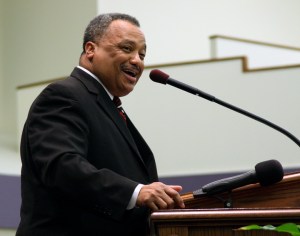
Fred Luer, president of the Southern Baptist Convention, spoke to IBSA staff during their weekly chapel service on Wednesday, April 17.

Fred Luer, president of the Southern Baptist Convention, spoke to IBSA staff during their weekly chapel service on Wednesday, April 17.

By Lisa Sergent

SBC President Fred Luter spoke to Illinois Baptist State Association staff in their Wednesday, April 17 IBSA chapel service urging them to, “Listen to the challenge of Jesus. Pray for the Lord of the harvest to send more laborers.”

A day after meeting leaders from around the state at the Meet the President Event, Luter spoke from Matthew 9:35-38, telling staff to ask themselves, “What would Jesus do? What’s it going to take to reach our nation? What’s it going to take to reach our community? What’s it going to take to reach our state?

“If we really want to talk about changing lives, we need to talk to somebody who has experience changing lives. Jesus always had a word for every question, every circumstance. Jesus always had an answer no matter who the person was, no matter what the question was.”

There were three things Jesus would always do, said Luter: Be concerned, be compassionate and give a challenge.

Contrasting today’s society with the past, Luter said this generation doesn’t have a respect for the Lord or the church like previous generations. “What would Jesus do to reach this generation, to reach this society? I have no doubt in my mind, He would meet them. He would be concerned about people.  That’s why if you really want to impact Illinois you must be concerned about the lost and the unchurched. We must be concerned about their hurts, their struggles, their addictions, and their pain. We must be concerned about their eternal destiny.”

Luter said Christians need to remember what their lives were like before they were saved to better identify with the lostness around them. “We weren’t always born again.  God brought us from somewhere.

Yesterday, the SBC president shared how he had been raised in a fatherless home, hung-out with a tough crowd, and had suffered life-threatening injuries in a motorcycle accident in his youth. While still in the hospital, a deacon from his local church told him he needed to accept Jesus as his savior.  The former street preacher, now pastor of the thriving Franklin Avenue Baptist Church in New Orleans, and first African-American president of the Southern Baptist Convention, is never far from his roots, always remembering how far Jesus has brought him.

“Those of us who are still amazed by God’s amazing grace, those of us who never got over being saved who never got over the grace of God, those of us who never got over the fact that we could be in hell today but thank God for the grace of God.  We must show compassion for this generation.”

He implored, “Brothers and sisters listen to the challenge of Jesus. Illinois, listen to the challenge of Jesus.  The harvest is plentiful, but the workers are few. Listen to the challenge of the master.”

Then, Luter emphasized Jesus did not give that challenge to the government or to politicians. “The challenge was given to the church.”

He cautioned all Christians against complacency. “We need people who want to take up the challenge of Jesus Christ and share the Gospel with everybody. We’ve got enough church folks; we need laborers who will take up the challenge. Will you take up that challenge today?”

Finishing his message, Luter offered one last thought for Baptists in Illinois, “What would Jesus do for this iPod, iPad, iPhone, tattooed, baggy pants, underwear showing generation? He would be concerned. He would show compassion. He would set out the challenge, because the harvest is plentiful, but the laborers are few.”

Lisa Sergent is communications director for the Illinois Baptist State Association.

Luter_blogTHE BRIEFING | Meredith Flynn

Southern Baptist Convention President Fred Luter is in Springfield today to meet with Illinois Baptist pastors and leaders at the Illinois Baptist State Association building. Luter also is preaching a three-day “Festival of Hope” at Union Baptist Church, a congregation affiliated with National Baptists. David Howard, director of missions for the Capital City Baptist Association invited Luter to Springfield in an effort to build bridges with African American churches in the city. The SBC president will engage in a Q&A time later today, and speak in the IBSA chapel service tomorrow morning. Check back here and on Facebook.com/IllinoisBaptist for more throughout the day.

Warren shares grief, faith on Twitter
In the days following his son’s death, Rick Warren’s personal Twitter feed told at least part of the story of how he and his family dealt with their grief. “Kay and I are overwhelmed by your love, prayers, and kind words. You are all encouraging our #brokenhearts,” Warren tweeted April 7, two days after Matthew Warren, 27, committed suicide.

He also responded to comments from Christians and non-Christians alike who took to social media to criticize and speculate about the Warren family. “Grieving is hard. Grieving as public figures, harder. Grieving while haters celebrate your pain, hardest. Your notes sustained us,” Warren wrote April 8.

He also offered forgiveness to the person who sold his son an unregistered gun, citing Matthew 6:15, and wrote about God’s faithfulness in trouble. Citing Psalm 34:1, Warren wrote, “The Lord is close to the brokenhearted and saves those crushed in spirit.”

Read more about Warren’s Twitter reflections on BPNews.net.

Pro-life advocates use tweets to force media’s hand on Gosnell trial
U.S. Senators Ted Cruz and Marco Rubio, Florida Governor Jeb Bush, and actress Patricia Heaton were among those who participated in a TweetFest last week to force the media to cover the trial of Kermit Gosnell, the Philadelphia abortionist charged with killing seven babies after delivery. He also is charged in the death of Karnamaya Monger, who died after she was given a Demerol overdose at Gosnell’s West Philadelphia Women’s Medical Society.

The trial has received virtually no media coverage from many major outlets, so pro-life activists Bryan Kemper and Andy Moore decided to use social media to get the word out. Read the full story at ChristianPost.com.

Pope Francis speaks out against church’s hypocrisy
A month into his papacy, Pope Francis called out the Catholic Church on the inconsistencies between what is taught and what is lived. “Let us all remember this: one cannot proclaim the Gospel of Jesus without the intangible witness of one’s life,” he said at a Mass at St. Paul’s Basilica in Rome on April 14. “Those who listen to us and observe us must be able to see in our actions what they from our lips, and so give glory to God!” Read more at ChristianPost.com.

‘Not Today’ movie sheds light on human trafficking
A new feature film, released Friday, April 12, tells the tragic story of human trafficking. “Not Today,” produced by Friends Church in Yorba Linda, Ca., chronicles a young man’s struggle to rescue a girl sold into slavery, and to overcome his own apathy. The movie was filmed on location in India, but producer Brent Martz told Baptist Press that human trafficking is an issue everywhere. “I wish we could say that it didn’t exist here. It is easy maybe to put our head in the sand and say, that’s a problem that is halfway around the world, but it is happening here.” Read more about the movie at BPNews.net, and check the film’s website to find out where it’s showing near you.

Turtle on a fence post

Meredith Flynn —  April 15, 2013

Turtle on Fence Post[3]HEARTLAND | Nate Adams

There is an old saying that if you ever see a turtle sitting on a fence post, you can be sure of one thing: It didn’t get there by itself.

As I begin my eighth year with IBSA, I identify very much with that turtle. On one hand, seven years is a long time, long enough for me to write more than 170 columns for The Illinois Baptist. On the other hand, my father Tom Adams wrote at least 850 columns here, over the course of 34 years. Like many of you, I read his insights on church life, Baptist life, and life in general for decades. So I still feel indebted to my dad for whatever perspective and service I have to offer IBSA churches.

It’s hard for me to think about my early days at IBSA without thinking about my dad. My mom tells me he was so excited about my coming back to Illinois, and to IBSA in particular, that he would fall asleep in his recliner with the Illinois Baptist in his lap, open to the article about my selection to serve here. And yet a month to the day after I started at IBSA, Dad passed away.

During these years since then, I have often thought how nice it would have been to have my dad around. He loved IBSA, and the Illinois Baptist, and the pastors and members of IBSA churches. Though he was basically quiet and introverted, he knew many, many people through his writing and ministry roles. He understood a lot about people and churches, how they work together, and why they sometimes don’t. Many times I have wished I could pick up the phone and ask him a question.

But it’s not like I’ve been without his help. Though my dad’s been gone for seven years now, I still rarely go into a church for the first time without someone telling me how much he or she appreciated his wisdom and his writing. Often they have a favorite column or two clipped and in their Bible. One dear lady told me she still has one framed and hanging over her desk at work. As often as not, these folks say they never met dad personally. But frequently they will say they felt as if they knew him.

Of course, if my dad ever heard anyone praising his writing, he would quickly point to Dr. Robert Hastings, who edited the Illinois Baptist for many years, and who was a wonderful writer as well. Dad frequently said that if Dr. Hastings hadn’t “taken a chance” on him as a young writer, he would never have had the opportunities or influence that he did.

And dad wouldn’t want to stop there. He would want me to point out that every column he scribbled by hand on a yellow pad of paper was typed up for publication by my mom, who added her own skilled editing and insight to the final product.

Of course my mom would want to point to her parents, and how they sacrificed for her education, and how their support of her made it possible for her to support my dad with her skills. And if my grandparents were here, well, I trust you get the point.

We are all turtles on our own fence posts, aren’t we? Whether it’s our parents, or the pastor or leader that served before us, or the faithful families that founded or sustained our church or that brought the Gospel to our area, none of us arrived at our places of service and opportunity without the help of others. We would do well to thank them when we have a chance, and to pledge to them that we will do the same for others. From my fence post today, thanks Dad.

Nate Adams is executive director of the Illinois Baptist State Association.
pull quote_MIGLIORATTICOMMENTARY | Phil Miglioratti

About halfway through my 19 years pastoring a small congregation, we had a fresh-wind experience of the Holy Spirit that changed everything.

We had spent years trying to replicate the success I had seen at a previous church. Attendance skyrocketed as people responded to what were then cutting-edge methods we borrowed from the innovative megachurches. But when nothing worked to the degree we hoped, our small church got on its knees.

We soon learned that, until our church developed leaders who championed prayer for each ministry’s strategies and activities, our results will be more about what we can do for God than what God can do through us.

As we had done repeatedly over the years, we changed many things. But only God could guide us into lasting change that would ultimately help the hurting, save the lost, and draw us all into deeper relationship with Himself and each other.

Our worship of God was the first to change, but soon our expectations of the leadership team changed too. Every person who took on a role of serving must exhibit a “first-of-all-pray” default mode when leading our ministries and activities (1 Timothy 2:1).

Until that time, our directors and workers had always prayed, but it changed from “Lord, bless what we have planned in the past hour,” to “Lord, bless us in this next hour that we may hear your voice and discern your direction for us.”

Our leaders soon had the expectation that God would guide our change, not the other way ‘round. Through prayer, we repented from thinking we had authority; we yielded to the work of the Holy Spirit, seeking the mind of Christ, then allowing Him to actually preside.

Letting the Lord lead required several shifts in our approach:

  • Everyone needs to participate. Leaders must to find ways to invite and involve the entire group into the praying, even those who say their spiritual gift seems miles away from intercession.
  • Praying means listening to the voice of the Spirit. Telling God what we desire is not adequate.
  • Leaders become active listeners to what others are praying, because it may be in one of those prayers that the Lord is speaking.

We found that the Word of God became dear to us as we often prayed through Scripture. Participants read verses as they felt led, and we received encouragement or discerned direction. God often spoke, and we weren’t pursuing our change, but His.

The changes in our ministry did not result in meteoric growth, but through prayer we did receive clear and compelling assignments, and a strong sense we were fulfilling our mission in Christ.

Phil Miglioratti heads the National Pastors’ Prayer Network and serves as IBSA’s prayer ministries consultant. This column first appeared in the Summer 2013 issue of Resource. Read it online at http://resource.ibsa.org.

Tuesday_BriefingTHE BRIEFING | Meredith Flynn

Cindy Winters didn’t set out to write a book. But as she journaled about her grief and pain after her husband’s death four years ago, she realized how healing the writing process could be. And she wanted to share that with others on a similar journey.

Pastor Fred Winters was killed at First Baptist Church, Maryville, Ill., on March 8, 2009, when a gunman entered the Sunday morning worship service and shot him where he stood in the pulpit. Media outlets immediately descended on Maryville, and the story made national headlines. Just days afterward, Cindy Winters extended forgiveness to the shooter on CBS’ Early Show.

“We have been praying for him,” she said. “…We really firmly believe that he can find hope and forgiveness and peace through this, by coming to know Jesus.”

Hope, forgiveness and peace are some of the themes running through Winters’ new book “Reflections from the Pit,” available now on www.amazon.com. Her writing process started simply, when she sat down with pen and paper to express some of the emotions that were overwhelming her.

“I would leave that writing experience with a sense of renewed strength,” Winters said. “Oftentimes, peace would sweep in over me, and then hope. And just a sense of, ‘Ok, you know what, I’m going to be able to make it through the rest of the day.’” Read more at BPNews.net.

Other news:

Rick and Kay Warren grieve son’s suicide
(From Baptist Press) Saddleback Church pastor Rick Warren and his wife Kay lost their son Matthew, 27, on Friday, April 5, to suicide. Rick Warren released an emotional statement to Saddleback’s staff, which has since been broadly published:

“Over the past 33 years we’ve been together through every kind of crisis. Kay and I’ve been privileged to hold your hands as you faced a crisis or loss, stand with you at gravesides, and prayed for you when ill. Today, we need your prayer for us.”

Among those expressing compassion for the Warrens was Frank Page, president of the Southern Baptist Convention’s Executive Committee and a former SBC president.

Page and his wife Dayle lost a 32-year-old daughter, Melissa, to suicide in 2009.

Page stated via Twitter the day after Matthew Warren’s suicide: “My heart is broken as I’ve heard the news about Rick Warren’s son. Please pray. Unfortunately, I understand that which they experience now.” Read more at BPNews.net.

Haircuts and clean feet in New Orlenas
A team of 24 women traveled to New Orleans last week to minister in partnership with the Baptist Friendship House and missionary Kay Bennett. They served the city’s homeless population with a free health fair, where they offered haircuts, feet-washing stations, and listening ears. The day after they returned to Illinois, volunteer Kim Evrard said she woke up with a heavy heart. “This morning, I wake up and realize I barely slept because I can’t stop thinking about the people I met, and tears won’t stop this morning,” Evrard wrote in an email.

“I am so blessed. My heart is so heavy for the people I met.” Read more in the April 15 issue of the Illinois Baptist, online at ibonline.IBSA.org.

Nearly 9 in 10 Americans own Bible
As History Channel wrapped up its well-watched miniseries on the Bible, Barna and American Bible Society released their “State of the Bible” report, which found the book is still a staple in most households. Of the 1,005 American adults surveyed, 88% own a Bible and 80% said the Bible is sacred; 61% said they wish they read it more. Read more at Barna.org.

SBC’s non-Calvinists host ‘John 3:16’
The recent John 3:16 Conference in suburban Atlanta gathered more than 350 people and several prominent Southern Baptist leaders for a discussion of Calvinism in the SBC. The conference speakers, brought together by Jerry Vines Ministries, focused on the differences with those who identify with Reformed theology, but also emphasized cooperation and unity, reported Baptist Press. Steve Gaines, pastor of Bellevue Baptist in Memphis, Tenn., said Calvinists are not his enemy. “I can work with them,” he said. “There is no need for a takeover. We need to live together.” Read more at BPNews.net.

remote controlHEARTLAND | Meredith Flynn

At most workplaces, the Bible would be an unusual topic for water cooler conversation. But that was exactly the idea behind History Channel’s recent miniseries “The Bible,” at least according to producing spouses Mark Burnett and Roma Downey.

“The best-case scenario for us is that there’s an opportunity here for people to be discussing the Bible at the water cooler the day after this has aired,” Downey told LifeWay.com before the premiere. “You know that seems so exciting that it just will stimulate conversation.”

The miniseries debuted last month to more than 13 million viewers, and seemed to keep most of that audience throughout its five-week run. But if it did provide water cooler conversation in offices around the country, it likely wasn’t the only topic that had people buzzing. The country is still embroiled in a same-sex marriage debate, heightened by the Supreme Court’s proceedings in March and with potentially landmark action on the docket for this summer.

Gun control is also at the forefront of our national consciousness, along with North Korea, the economy, political stalemate, college basketball and a royal baby (some are obviously more sobering than others). But all these concerns competed for our attention in the days leading to Easter, along with the urging – from Hollywood, of all places – to once again be amazed and energized by the Bible’s glorious narrative.  And by Jesus!

And yet, it’s likely that at most water coolers, talk of gun control or North Korea or a horrifying basketball injury weren’t connected to Jesus or the Bible, even if they shared headline space in some newspapers.

Consider one critic’s assessment of “The Bible” prior to its final episode. USA Today’s Robert Bianco wasn’t a fan of the series, and attributed its viewership only to a lack of religious programming on Easter Sunday. There’s an audience that wants faith-driven content, Bianco wrote, even though, “We’re a secular nation and no one is arguing for turning the entire weekend over to the celebration of one religion’s holiday.”

Because a whole weekend, even one that includes Good Friday and Easter Sunday, would be too much for one topic, one emphasis, one somber meditation.

It’s not just our “secular nation” that falls victim to a jumping bean-like attention span. Christians do, too. How often do we let an opportunity pass to inject biblical truth into a conversation about a current issue? How easy is to compartmentalize our conversations into “politics” and “religion” and “pop culture,” without talking about how our faith affects them all?

May God remind us to connect the dots. Let’s not be swept up in our channel-changing culture.

pull quote_BUCHANANCOMMENTARY | Joe Buchanan

Robbie was a young man who grew up in the first church I pastored. His name has been changed but his story is true. Robbie came forward to “give his life to Jesus” and be baptized for the first time during a fall revival service when he was 10 years old. At first, he began to show spiritual fruit and experience the joy of his salvation. But within six months, Robbie started to wonder whether he was really saved.

The next spring, Robbie again came forward to “ask Jesus into His heart.” Once again he showed some initial change, but eventually began to doubt his salvation. When he came to me ask me what to do, I did what I had been taught to do since I was a kid: I shared the Gospel with him and asked if he wanted to pray the sinner’s prayer to be saved. Robbie said yes, and the next week we baptized him.

This cycle continued for the 10 years that I was his pastor. Does this sound familiar?

The sad reality is that Robbie was not the only person going through this cycle in our church. In fact, it’s being repeated in churches all across the Southern Baptist Convention, and has become so familiar that we almost think it’s normal and just part of being a believer. But in his new book, “Stop Asking Jesus into Your Heart,” J.D. Greear writes the problem may actually be the unbiblical language we use in describing how people should respond to the Gospel.

Specifically, Greear notes some ways we couch our response to the Gospel (using phrases like “ask Jesus into your heart,” or “accept Jesus as Lord and Savior,” or “give your heart to Jesus”) are not biblical. He writes, “These phrases may not be wrong in themselves, but the Bible never tells us, specifically, to seek salvation in those ways.  The biblical summation of a saving response towards Christ is ‘repentance’ and ‘belief’ in the Gospel.”

Greear continues, “Repentance and faith are heart postures you take toward the finished work of Christ. You might express the beginning of that posture in a prayer. But don’t make the mistake of equating that prayer with the posture. The sinner’s prayer is not a magic incantation or a recipe you follow to get a salvation cake. The real stuff – that stuff that matters – is the posture of repentance and faith behind the words you speak. The prayer is good only insofar as it verbalizes the posture.”

Make no mistake, Greear is not telling us to stop doing evangelism. In fact, he is inviting us to return to a biblical approach of sharing the Gospel. He reminds us that how we invite people to respond to the Good News of Jesus must be firmly grounded in the Scripture, not in tradition or pragmatism. In doing so, Greear upholds the noblest aspirations of those who hold to the authority and inerrancy of the Bible.

After reading and thinking about this book, it has occurred to me that my presentation of the Gospel is largely at fault for Robbie’s struggles. My intentions were good, but I had inherited an unbiblical and unhelpful method of explaining the response to the Gospel. This is a difficult pill to swallow, but it can go along way toward returning our churches to a healthy method and mindset of evangelism.

If I were to counsel with Robbie today, I would want to make sure that his assurance of salvation is securely grounded in the Scripture. The best way I know to do this would be to take him to some of the Scriptures that demonstrate specific changes that occur as a result of salvation. Does he love the other members of Christ’s family (1 John 2:9 and 3:14-16)? Has he experienced the desire to stop sinful behavior and obey God (1 John 2:29 and 3:6)?

And I would urge him to ask other members of the church if they have witnessed these changes in his life. This combination – Scripture and the people of God – is the best way of helping Robbie and others like him to come to the full assurance of his salvation, or to see the need to repent and believe.

Dr. Joe Buchanan is pastor of First Baptist Church, Metropolis, and author of the upcoming book “Cultivating a Gospel-Shaped Attitude”.

THE BRIEFING | Meredith Flynn

An estimated 60,000 people gathered around video screens and computer monitors on Good Friday for Secret Church, an annual event hosted by Alabama pastor David Platt. Speaking from The Church at Brook Hills in Birmingham, Platt delivered nearly six hours of teaching on heaven, hell and the end of the world.

“We need to pause,” and consider the big questions related to what comes next, Platt said, because we are “continually blinded by the temporal, subtly numbed by the trivial, and we desperately need to contemplate the eternal.”

Platt covered biblical truths about heaven and hell before turning his attention to controversial questions in the book of Revelation. Speaking in rapid-fire sentences, he worked through a 190-page, fill-in-the-blanks notebook while viewers around the world scrambled to keep up, some with the help of a live Twitter feed that provided the answers.

Questions related to heaven, hell and Jesus’ return have always intrigued Christians, and often have been a source of disagreement. A 2010 survey by the Pew Research Center found nearly half of U.S. Christians believe Jesus will definitely (27%) or probably (20%) return to earth in the next 40 years, while 38% disagreed.

In the first few minutes of the Secret Church simulcast, Platt urged his listeners to “leave room for disagreement over secondary (and tertiary) doctrines while celebrating agreement on primary doctrines.” And to live with urgency. He quoted 18th century preacher Jonathan Edwards:

“Resolved, to endeavor to my utmost to act as I can think I should do, if I had already seen the happiness of heaven, and hell torments.”

Read more about Secret Church here.

-David Platt quotes from Secret Church study guide

Other news:

Kerry advocates for Iranian pastor’s freedom
(From Baptist Press) U.S. Secretary of State John Kerry late Friday (March 22) called for the release of pastor Saeed Abedini, a U.S. citizen of Iranian descent who is suffering in a notoriously brutal Tehran prison because of his Christian faith. The American Center for Law and Justice, which represents Abedini’s wife and two young children living in the United States, called Kerry’s statement “a tremendous step forward in our government’s involvement in securing Pastor Saeed’s freedom.” Read more at BPNews.net.
Piper preaches final message at Bethlehem Baptist
Pastor John Piper ended his pastoral ministry at Minneapolis’ Bethlehem Baptist Church over Easter weekend by preaching during the church’s holiday worship services. Christian leaders went online to honor Piper, blogger Justin Taylor. “When all is said and done, John Piper will be remembered for many things. But apart from his own relationship to God and his relationship to family, his most important vocation will remain serving as a faithful, worshipful, prayerful shepherd to a local body of believers,” Taylor wrote at thegospelcoalition.org.
Russell Moore elected next ERLC President
(From Baptist Press) Russell Moore, currently dean of the school of theology at Southern Baptist Theological Seminary, has been elected the next president of the Southern Baptist Ethics and Religious Liberty Commission. Moore, 41, a native of Biloxi, Miss., will be the eighth president of the entity charged by Southern Baptists with addressing moral and religious freedom issues. “I pray for God’s grace to lead the ERLC to be a catalyst to connect the agenda of the kingdom of Christ to the cultures of local congregations for the sake of the mission of the Gospel in the world,” Moore said. Read more at BPNews.net.
In sculpture, Jesus takes on ‘dirt’ of mankind – literally
A Wheaton College art professor has meticulously covered a sculpture of Jesus with dirt and dust collected from all over campus, in an effort to artistically express how Christ took on the sin of mankind through his death and resurrection. David Hooker’s Corpus will be displayed in the college’s biblical and theological studies department, Christianity Today reports. The magazine talked to Hooker about the inspiration and method behind his work.

pull quote_KINGHEARTLAND | Claude King (From Baptist Press)

In 1995 a Texas pastor called and asked me to pray for his church and give some counsel. From the evidence of love and unity in the congregation, the pastor believed the church had experienced a revival – not a series of services but a return to right relationships with God and one another. The church had two concerns: first, they wanted to become more of a people of prayer; and second, they wanted tPraying Up To Pentecost_Final o be part of a spiritual harvest.

This Texas congregation began 50 days of prayer starting Easter Sunday and continuing through Pentecost Sunday. Families were given a 50-day calendar with a Scripture for each day. They were asked to gather as a family to read and discuss a Scripture each day, decide what they needed to do to apply the truths to their lives, and pray. With a focus on reaching lost people, they began making a list of people in their circles of relationships who were not Christians. Families (some praying together for the first time) faithfully lifted these names to the Lord in prayer.

The church also held a six-week study of prayer in all their Sunday School classes from sixth grade through senior adults. They used a workbook now titled “Growing Disciples: Pray in Faith.” Participants were learning to pray during the week, and then they conducted prayer meetings in their classes to practice what they were learning. One lesson each week helped them learn how to pray together more effectively. During the worship services, they collected prayer request cards. A team of intercessors prayed during the services for the spiritual needs of the people present.

Following the model for “Pentecostal Prayer Meetings” described by Andrew Murray of South Africa (in “The Prayer Life”), the church conducted 10 days of corporate prayer meetings on the days leading up to Pentecost. One night they commissioned a mission team that left for Russia. Another night they invited the other Baptists in their small county to join them for prayer. They invited other denominations to join them one night in praying for their town. Other corporate prayer experiences included cottage prayer meetings, prayerwalking around town, prayer-driving in the county, and other kinds of corporate prayer.

For a free reproducible guide for “Praying Up To Pentecost” click here.

I had the privilege of joining this church for their celebration of Pentecost, including wonderful testimonies and a Baptist feast (dinner on the grounds). They even received a special “first fruits” offering to provide ministry to needy people outside of the church membership. I was amazed at the quality of corporate prayer I observed.

People were expecting a huge response at invitation time, but only one young boy made a public profession of faith. Their enthusiasm for a spiritual harvest seemed to burst. Only one other “first fruit” of spiritual harvest happened that afternoon as a woman from the community came to seek counsel from the pastor. She had seen the service on the local cable channel. She wanted to know God the way people described their experiences in their testimonies that morning. I returned home a bit discouraged.

But three months later, I received a follow-up report from the pastor that reignited my heart. Their mission team to Russia had led more than 400 people to the Lord. Additionally, although the church had been involved in prison ministry for many years, that summer they saw nearly 300 prisoners accept Christ. And in their small community, 25 of the lost people for whom they had prayed between Easter and Pentecost professed their faith in Jesus Christ! Many members said, “Pastor, we can’t go back to the old way of doing things.”

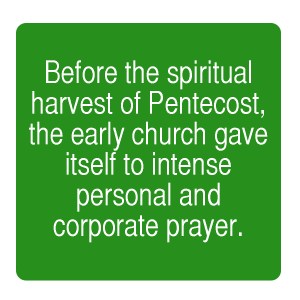
Jesus instructed his disciples, “Open your eyes and look at the fields, for they are ready for harvest” (John 4:35). The early church experienced a great spiritual harvest on the Day of Pentecost described in Acts 2. But, like the church in Texas, the Jerusalem harvest was preceded by a period of intense personal and corporate prayer.

Claude King is discipleship and church health specialist at LifeWay Christian Resources. He is coauthor of “Experiencing God, Fresh Encounter, The Mind of Christ, Pray in Faith,” and other resources.

Step by Step: Following Jesus from the Palms Parade to the Resurrection

EasterDay 8: Easter Sunday, March 31
The Resurrection (Matthew 28:1-10)

They held him by the feet, Scripture says, of the faithful women who first came to the tomb after the Sabbath to tend the body of Jesus. Finding him alive, as the angel on duty had announced, they fell at his feet, those feet still bloodied, still pierced by the great nails from the cross.

In moments, the reality of Jesus’ resurrection from death would take over, and there would be much running and telling, weeping and fearing, hugging and shouting, doubting and cheering.

But for this moment, they held on.

Lord, rekindle in us the sheer joy of finding you alive this morning and every morning. May we always be moved by the sight of your pierced feet and hold tightly to you.

Devotion by Eric Reed, artwork by Kerry Jackson