Archives For November 30, 1999

Coming home

Meredith Flynn —  August 26, 2013
Kids in Haiti crowd around to see themselves in a camera’s tiny screen.

Kids in Haiti crowd around to see themselves in a camera’s tiny screen.

HEARTLAND | Meredith Flynn

Re-entering my everyday life American life after a week in Haiti, I was reminded of

something Mark Emerson said: “We’re pretty good at going away on mission. We may not do as well with coming home.”

Emerson, who leads IBSA’s missions team, said we need a how-to about coming back from a short-term mission trip. Because the emotions run so high during a week in Haiti or inner city Chicago or Bulgaria or East St. Louis, it’s inevitably an adjustment to come back to our normal houses, routines and lives.

It’s not just mission trip participants that are prone to a letdown. Any spiritual mountaintop experience is wonderful when you’re in the middle of it, but it’s hard to come back down to earth. On our last night in Haiti, our team leader Bob Elmore talked about how to come home well. He and others who had been on previous international mission trips cautioned us newbies about the challenges we might run into, and how to counteract a bumpy re-entry. Their counsel focused mostly on how we should interact with people who weren’t on the trip.

One volunteer laughingly told the team about a message she’d received from her parents, gently reminding her that they were going on family vacation the day after she returned to the States and that they would like her to be in a better frame of mind than last year – when she got back, walked into the house, and promptly burst into tears.

The lesson is that others who weren’t on your particular mountaintop may not full grasp the emotional connections you formed with a place and a people in just a week or two. We ought to be patient, speak well, and remember God gives us unique experiences so that we can magnify how great and creative He is.

When we come down from the mountaintop, we also have to be responsible in the stories we tell. It’s tempting to focus on the spider you saw, or how hot it was, or how delicious soda is when it’s made with cane sugar. Say those things – details help people remember and pray – but say them quickly. Get them out of the way so you can talk more about how God worked to transform you and your team, and how He’s at work in parts of the world you rarely or never thought about before.

Make Him the main character in your stories – after all, He’s the one who took you to the mountaintop.

Everything grows together

Meredith Flynn —  August 22, 2013

pull quote_ADAMS_NEWCOMMENTARY | Nate Adams

Editor’s note: This column is the second in a three-part series, interpreting IBSA’s 2013 state mission offering theme statement: Mission Illinois – Churches Together, Advancing the Gospel. Read Nate’s first column here.

Throughout September, and during the September 15-22 week of prayer in particular, churches across our state are joining together to focus on our Illinois mission field, where at least 8.2 million people don’t yet have a personal relationship with Jesus Christ. In addition to praying, most churches participate in the “Mission Illinois Offering,” all of which goes to work right here in our state to push back lostness, and to assist missionaries and churches in disciple-making evangelism and church planting.

The theme statement we’ve chosen to describe Mission Illinois is “Churches Together, Advancing the Gospel.”

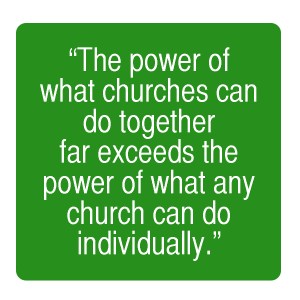
The second word of that theme – together – speaks of the multiplied strength, impact, and growth that happen when churches embrace cooperative missions. The power of what churches can do together far exceeds the power of what any church can do individually.

Individually, an Illinois church might work for years to help establish one new congregation somewhere else in the state. But last year, Illinois “churches together” started 28 new congregations.

Individually, an Illinois church might be too far away from a college campus to have a meaningful ministry, even to its own students there. But Illinois “churches together” provide Baptist collegiate ministries on dozens of college campuses.

Individually, an Illinois church might be able to equip a handful of its members to go on an annual mission trip or two. But Illinois “churches together” sent more than 27,000 missions volunteers last year, a 34% increase over the previous year.

Individually, an Illinois church might baptize five or ten new believers, or even a hundred if it were one of our larger churches. But Illinois “churches together” welcomed more than 5,000 new believers into the Kingdom of God last year.

Those kinds of results go beyond mere cumulative totals. They are the synergistic result of us believing together, praying together, giving together, and working together as a Baptist family of churches here in Illinois. But let me cite another noteworthy example, or rather examples, of what “together” means.

Individually, an Illinois church might be flooded, or lose its pastor, or be divided in conflict, or be confronted with a lawsuit. That church might simply not know how to respond to a crisis or traumatic event, or it might need help improving its Sunday School, or evaluating its facilities, or hosting its first Vacation Bible School in years.

Illinois “churches together” provide one another with our statewide staff and resources so that each church is only a phone call, e-mail, or visit away from getting whatever kind of assistance each one needs to remain strong, or in some cases, to survive.

One of the many catchy tunes embedded in my memory from childhood days of watching “Mister Rogers’ Neighborhood” is the song, “Everything Grows Together.”  Mr. Rogers taught us that: “Your toes grow as your feet grow as your legs grow as your fingers grow as your hands grow as your arms grow as your ears grow as your nose grows as the rest of you grows, because you’re all one piece.”

How does everything grow, even in the ministry of our churches? Together. Why?  Because we’re all one piece. We know the joys and benefits of interdependence. As you consider your gift to the Mission Illinois Offering this year, I hope it will be in part because you see the amazing value of what can only be done by churches together.

Nate Adams is executive director of the Illinois Baptist State Association. Respond to his column at IllinoisBaptist@IBSA.org.

THE BRIEFING | Five men were shot yesterday outside Uptown Baptist Church on Chicago’s north side. The shooting, thought to have resulted from a dispute between two gangs, occurred while the church held a prayer service inside the building. Uptown hosts the service and a weekly meal on Monday evenings for their neighborhood’s homeless population.

“A few of us went outside to see what happened,” Pastor Michael Allen told DNAinfo.com. “We found several people on the ground bleeding profusely, and they were screaming.”

The church plans to hold a prayer vigil Wednesday evening at 6:30.

Read the Chicago Tribune’s story here.

Other news:

Pastors to pray in Dallas
Senior pastors from Southern Baptist churches of all sizes are invited to gather in Texas this fall to pray together 24 hours. The event, scheduled for Sept. 30-Oct. 1 at the Hilton Dallas/Southlake Town Square, “is not a ‘come and go’ event or a place to ‘come and be seen,’ nor is it a denominational or political meeting,” said Arkansas pastor Ronnie Floyd (left) in a written statement. “It is a serious spiritual experience of prayer with pastors nationally.” Read more at BPNews.net.

Group advocates pulpit freedom
A 14-member commission recently recommended relaxing restrictions on political speech in church services, Baptist Press reports. The group, created at the request of Sen. Charles Grassley (R.-Iowa), found “a member of the clergy should be permitted to say whatever he or she believes is appropriate in the context of a religious worship service without fear of government reprisal, even when such communications include content related to political candidates.” Read the full story here.

Abortion is moral issue for most
Most Americans still view abortion as either morally acceptable or morally wrong, but they’re less likely to view other birth issues in those terms, according to a survey by Pew Research. The study found 49% of people believe having an abortion is morally wrong, but far fewer respondents were morally opposed to embryonic stem cell research (22%) and in vitro fertilization (12%). According to Pew, only 23% of people believe abortion is not a moral issue, compared to 36% for embryonic stem cell research and 46% for in vitro fertilization. Read more at PewForum.org.

Parenting advice that’s truly inspired
Mother of 19 Michelle Duggar learned how to settle sibling disputes from the Bible. “I thought I’m going to go nuts if all I’m doing all day long is refereeing these little ones,” the matriarch of TV’s “19 Kids and Counting” says in a video on The Learning Channel’s website. But she looked to Matthew 18 for help. “If you have a problem you talk sweet to your brother or sister,” Duggar says, paraphrasing the passage for her little ones. “If they came up and took your dump truck away from you, you talk sweet to them and try and turn their heart to God saying, ‘Brother don’t take that truck away.’” Read the full story at ChristianPost.com.

EgyptHEARTLAND | Charles Braddix, on Baptist Press 

Christians and churches in Egypt need prayer this week, as violent protests continue in the country in response to the ousting of President Mohammed Morsi.

Egypt’s government cracked down on protestors last week; so far, nearly 700 people have died and 3,700 more are injured. And nearly 70 churches, Christian institutions and businesses have been attacked, burned or destroyed.

Beni Mazar Baptist Church in Minya, a city of 250,000 people 150 miles south of Cairo, was burned last week. No casualties or injuries were reported, although the pastor and his family live on the premises.

Months earlier, John Amin*, pastor of the Beni Mazar church, had said, “We live here at the church, so if someone attacks our church, they attack our home. The kids are afraid.”

Many in the community around the church are afraid, Amin said, but he still had a vision to see the church packed with those seeking Christ. “We want the community to see us and come and grow the church,” he said.

Minya reported the country’s highest number of attacks against churches, totaling 14. One of Egypt’s oldest Coptic Christian churches, the fourth-century Church of the Virgin Mary there, was torched and burned Wednesday.

In addition, the Egypt Bible Society bookstore in Minya was destroyed.

“Fear is a part of life in Egypt,” said a Christian worker who serves in the region. He encourages believers in Egypt not to give in to fear. “The enemy is strong here. He makes people afraid.”

Spiritual oppression is real, the worker said, stressing that boldness to share the Gospel, especially in difficult times, must come from the Holy Spirit.

*Names changed.

For Charles Braddix’ full story, go to BPNews.net.

pull quote_BRIDGES_augCOMMENTARY | Erich Bridges, from Baptist Press

The backlash against striving to be a “radical” follower of Jesus started earlier this year.

Giving your all for Christ – including your life – goes back to the earliest Christian disciples and has been one of the marks of true faith throughout church history.

“Radical” living, however, has a more specific meaning in this controversy, stoked by several articles in Christian publications. It refers to the commitment young evangelical leaders, particularly Southern Baptist pastor/author David Platt, have urged American Christians to make.

In a popular series of books and teachings beginning with “Radical: Taking Back Your Faith from the American Dream” (2010), Platt has challenged American believers to forsake the comfortable, materialistic, watered-down Christianity many of us practice. In its place, he calls for the kind of sacrifice and obedience that might lead some to give up possessions, go to risky places to proclaim the Gospel, maybe even suffer and die for Christ.

He’s been joined by evangelical voices such as Francis Chan (“Crazy Love”), Kyle Idleman (“Not a Fan”) and others calling for a faith that looks more like the one found in the New Testament than the one commonly seen in suburban American churches.  

Hold on, respond the critics. You’re setting up an elite category of super-sanctified commando Christians, leaving the rest of us feeling like inadequate, second-class believers. What about everyday folks who quietly go about their lives and provide for their families, while faithfully worshipping God and serving others? Are they failing the test of basic discipleship if they don’t leave their homes and families and do something “radical” for Christ?  

“The heroes of the radical movement are martyrs and missionaries whose stories truly inspire, along with families who make sacrifices to adopt children. Yet the radicals’ repeated portrait of faith underemphasizes the less spectacular, frequently boring, and overwhelmingly anonymous elements that make up much of the Christian life,” wrote Matthew Lee Anderson (founder of the influential Christian blog “Mere Orthodoxy”) in a March cover story for Christianity Today magazine.

“[T]here aren’t many narratives of men who rise at 4 a.m. six days a week to toil away in a factory to support their families. Or of single mothers who work 10 hours a day to care for their children. Judging by the tenor of their stories, being ‘radical’ is mainly for those who already have the upper-middle-class status to sacrifice,” Anderson wrote.

Anthony Bradley went a step further in a commentary for the Acton Institute, reprinted in WORLD Magazine in May. He called the push to be “radical” – and the “missional” church movement generally – manifestations of a “new legalism” among evangelicals.

Bradley, a well-known commentator and professor at The King’s College in New York, said he reached that conclusion after a long conversation with a Christian student struggling over what to do with his life.

“I continue to be amazed by the number of youth and young adults who are stressed and burnt out from the regular shaming and feelings of inadequacy if they happen to not be doing something unique and special,” Bradley wrote.

“Today’s millennial generation is being fed the message that if they don’t do something extraordinary in this life they are wasting their gifts and potential. The sad result is that many young adults feel ashamed if they ‘settle’ into ordinary jobs, get married early and start families, live in small towns, or as 1 Thessalonians 4:11 says, ‘aspire to live quietly, and to mind [their] affairs, and to work with [their] hands.’

“… The combination of anti-suburbanism with new categories like ‘missional’ and ‘radical’ has positioned a generation of youth and young adults to experience an intense amount of shame for simply being ordinary Christians who desire to love God and love their neighbors (Matthew 22:36-40)…,” Bradley wrote. “Why is Christ’s command to love God and neighbor not enough for these leaders?”

This supposed “shaming” of young Christians sure is news to me.

I seldom pass up a chance to challenge young people to get involved in local and international missions – and I’m regularly inspired by their responses.

Ask counselors who work with young missionary candidates and campus ministers who mentor students, and they’ll tell you the same thing: Millennial Christians want to make a difference in the world. They want to serve the poor and fight injustice. They want to act on Christ’s command to take the Gospel to the nations. Sometimes they get impatient with parents and other elders who try to hold them back. And they’re willing, even eager, to go to some of the toughest places on earth.

True, not everyone is equipped by God to go to such places. Those who do go need to demonstrate a clear calling from God; otherwise they’ll never make it when the going gets hard. But everyone can participate in the task through awareness, prayer, support and local church mobilization.

The old division between “regular” church folks and the special few who go to the mission field has been bridged by the vast new opportunities for participation afforded by modern travel, technology and networking – and the rediscovery of the biblical truth that reaching all peoples is the mission of the whole church and everyone in it.

The only non-negotiable requirement is obedience.

One of the young people profiled in Platt’s “Radical” is Genessa Wells. The Texas Baptist teacher lived and served in Egypt for two years – and died there at age 24. She wasn’t a martyr; she was killed in a bus accident in the Sinai just one day before the terror attacks of Sept. 11, 2001. I never met her, but I had the privilege of attending a memorial service for her a few days later in Cairo.

Wells, who had an angelic singing voice, had planned to pursue her study of music in seminary after she came home from Egypt. She never made it back, but she packed enough passion for several lifetimes into her brief life.

Shortly before she moved to the Middle East in 1999, she wrote: “I could give up (on overseas service) and get married and become a music teacher. All of this is very noble and to be quite honest, sounds good to me! But in my heart, I want to change my world – more than I want a husband and more than I want comfort. I need this opportunity to grow and to tell others about Jesus. One of my favorite praise songs says, ‘I will never be the same again, I can never return, I’ve closed the door.'”

Two years later, in her last email home, she quoted another praise song: “‘Open the eyes of my heart, Lord, open the eyes of my heart, I want to see you … shining in the light of your glory….’ It seems that everything we do comes down to one thing: His glory. I pray that all our lives reflect that…. It seems like a floodgate has been opened in my heart . I have a passion for it I never knew God had given me. He’s given it to me for His glory.”

She shared her passion for God with Egyptians, with Palestinians in refugee camps, with Bedouin in the desert. If she had lived, she might have gone home to Texas, gotten married, started a family, become a music teacher. Or she might have opted to serve long-term overseas. Either way, she had one grand purpose in life: to love God and praise Him wherever she went and in whatever she did.

Erich Bridges is an International Mission Board global correspondent. Visit Worldview Conversation, the blog related to this column.

Tuesday_BriefingTHE BRIEFING | Meredith Flynn

A majority of Americans don’t want to be centenarians (plus 20 years), but they think their neighbors might, according to a new study by Pew Research. The survey of 2,012 American adults found 56% of them said they wouldn’t choose to undergo medical treatments in order to live to 120. But 68% expected most people would.

According to the survey, 69% of people place their ideal life span in the 79-100 range.

Pew also asked leaders from a variety of religious groups about their views on radical life extension. Jeffrey Riley, a professor at the Southern Baptist seminary in New Orleans, said evangelicals’ acceptance of life-extending technology and methods would depend on how those strategies are framed.

“If this was being advertised as never dying, I think a lot of people and the leadership of my church would be opposed,” Riley said in an article on Pew’s website. “However, if this was incremental and was seen as a way for people to continue flourishing, my church would more readily accept it.”

To read more about religious leaders’ responses and the study itself, go to PewForum.org.

Other news:

Judge orders new name for baby “Messiah”
A judge in Tennessee has ordered the parents of 7-month-old Messiah DeShawn Martin to change his first name because, “The word Messiah is a title and it’s a title that has only been earned by one person and that one person is Jesus Christ.”

According to ChristianPost.com, Child Support Magistrate Lu Ann Ballew first met the parents when they appeared in her courtroom to argue over the child’s last name. Judge Ballew helped settle that dispute, but may find herself in the middle of another, as the baby’s mother plans to appeal her ruling. Christian Post reports more than 700 babies were named Messiah last year in the U.S., making it the 387th most popular baby name.

Read the full story at ChristianPost.com.

Warren returns to pulpit after son’s death
Rick Warren, pastor of Saddleback Church in Lake Forest, Ca., stood in his church’s pulpit July 27 for the first time in 16 weeks. Warren, the author of the bestseller “The Purpose Drive Life,” took a leave of absence after his son, Matthew, committed suicide in April following a long struggle with mental illness.

Warren received a standing ovation that Saturday evening, and thanked Saddleback staff, members, his family and local pastors who supported him. Then, with comments from his wife, Kay, he shared the first message in a series titled, “How to Get Through What You’re Going Through.”

Read writer John Evans’ full story on BPNews.net.

Carmen Halsey to lead IBSA mobilization, WMU
Carmen Halsey will serve as the Illinois Baptist State Association’s new director of Missions Mobilization beginning this month. As part of the role, she also will give IBSA staff leadership to Illinois Woman’s Missionary Union (WMU), and serve on the national WMU board along with Illinois WMU President Gail Miller.

Read more in the new issue of the Illinois Baptist, online now at http://ibonline.IBSA.org.

Breath of life

Meredith Flynn —  August 12, 2013

From Acts 17:22-27

“Then Paul stood in the middle of the Areopagus and said: ‘Men of Athens! I see that you are extremely religious in every aspect. For as I was passing through and observing the objects of your worship, I even found an altar on which was inscribed:
TO AN UNKNOWN GOD

Therefore, what you worship in ignorance, this I proclaim to you. The God who made the world and everything in it – He is Lord of heaven and earth and does not live in shrines made by hands. Neither is He served by human hands, as though He needed anything, since He Himself gives everyone life and breath and all things. From one man He has made every nationality to live over the whole earth and has determined their appointed times and the boundaries of where they live. He did this so they might seek God, and perhaps they might reach out and find Him, though He is not far from each one of us.'”

God’s role as creator of all things demands our praise. Worship artists All Sons and Daughters speak to this truth in their song “Great Are You Lord.” Take a minute to listen and pray, and have a great Monday!

From YouTube.com, All Sons And Daughters- “Great Are You Lord” LIVE (OFFICIAL)

pull quote_BURKCOMMENTARY | Denny Burk

Editor’s note: This column is reprinted with permission from www.dennyburk.com.

After the Presbyterian Church U.S.A decided to drop the hymn “In Christ Alone” from their hymnbook, I posted a note about the decision on my blog. Reports say that the song’s reference to “the wrath of God” was just too much for those making the decision. The songwriters refused to give permission to amend the language, so the PCUSA decided to leave it out.

I have to say that I have been quite surprised at the response to this short post – a response that is still ongoing. I am not surprised, however, that the topic still provokes strong responses from people – strong reactions on both sides of the issue.

In some ways, how one feels about the wrath of God reveals almost everything that’s most important about a person. How one feels about God’s wrath defines a person’s view of hell, of the nature of God, and even of the meaning of the cross itself. Thus to get God’s wrath wrong means to get almost everything else wrong as well.

On Sunday, I preached a sermon in my church about hell and the wrath of God. In this message, I make the case that every true Christian will one day lift up his voice in celebration when God bares His arm in judgment against His enemies (Rev. 18:20). In other words, your ability to rejoice in God’s wrath will one day define whether or not you know Him at all.

What we believe about God and about His Son Jesus is the most important thing about us. And yet countless people recoil at the God of the Bible and turn instead to a god of their own imagination. Any formulation of deity that excludes God’s justice and wrath against sin is not the God of the Bible.

A wrathless god shorn of His justice is no god worth worshipping. Nor is he a god able to convict and save sinners. When wrath is taken away, so is the gospel. And that is why this discussion matters.

Denny Burk is associate professor of biblical studies at Boyce College, the undergraduate arm of Southern Seminary in Louisville, Ky. Listen to his message on the wrath of God at www.kenwoodbaptistchurch.com.

LifeWay_storeTHE BRIEFING | Meredith Flynn

LifeWay Christian Stores opened its third Illinois location August 1 and will celebrate with grand opening festivities throughout the month. The Wheaton store, located in the Town Square Wheaton on South Naperville Road, is formerly a Johnsen & Taylor Bookstore operated by Tyndale House Publishers.

“I’ve heard from many individuals and churches who are excited about LifeWay Christian Stores being here,” said store manager . “We are grateful to see the continuation of the ministry started by Johnsen & Taylor.”

LifeWay also operates stores on the campus of Moody Bible Institute in Chicago and in Carterville, Ill.

Other news:

‘Wrath of God’ too much for hymnal
The Presbyterian Church USA chose not to include the song “In Christ Alone” in their new hymnal, all because the song mentions the “wrath of God.” On ChristianCentury.org Mary Louis Bringle, chair of the committee that made the decision, wrote that the song propagates “the view that the cross is primarily about God’s need to assuage God’s anger,” and that view could be harmful to future generations of worshippers.

Southern Baptist leaders, including Ethics and Religious Liberty Commission President Russell Moore, have weighed in on the decision. Read his commentary on The Washington Post’s On Faith blog here.

Most churches still do VBS
A Barna study found 68% of churches held a Vacation Bible School last year, including 91% of Southern Baptist churches. The research also found that churches in the South are most likely to host VBS, along with churches with larger budgets and more adult worship attenders. And churches with “Buster” pastors, those aged 30-48, are the most likely to participate in VBS, according to Barna. Read more findings here.

Street preaching resumes on Bourbon St.
The city of New Orleans has revised an ordinance that prohibited street preaching on Bourbon Street, ChristianPost.com reports. The ban, enacted in 2011, controlled preaching from sunset to sunrise and forbade individuals or groups from gathering “for the purpose of disseminating any social, political or religious message…” Several preachers are suing the city after being arrested or threatened with arrest for preaching during last year’s Southern Decadence Festival, an annual pro-gay event. Read the full story at ChristianPost.com.

Graham calls for prayer for Abedini

Franklin Graham is urging people to pray for Pastor Saeed Abedini (right), an American imprisoned in Iran since last September. Graham, the son of evangelist Billy Graham and president of Samaritan’s Purse, spoke to FOX News about Abedini’s plight and the prayer vigil scheduled for Sept. 26 – the one-year anniversary of his captivity. He also questioned President Obama’s response: “President Obama has been silent on the issue as an American Christian endures the horrors of Evin Prison,” Graham said.

“Many in the international community are expressing outrage over this blatant example of religious intolerance,” he said. “I ask that our government do the same and demand that Pastor Saeed Abedini be released and allowed to return home to his wife and family in the United States.” Read more on reporter Todd Starnes’ FOX News page.


HEARTLAND | By Joe McKeever, on Baptist Press

Pastor, have you ever had a meltdown in the pulpit?

pull quote_MCKEEVERIn the news recently, two Atlanta radio jocks were fired for the on-air mocking they did of a New Orleans icon, former Saints football player Steve Gleason who has ALS (Lou Gehrig’s) and lives in a wheelchair and speaks through a computer.

They made fun of him, parodied his situation, and someone role-played Steve speaking of his coming death and such.

It was the ultimate in offensive.

In the article which ran here in New Orleans, one of the terminated men said, “What were we thinking?” The jocks apologized, and in a subsequent story, Gleason said he accepted their apology.

One of the men called it “a moronic two minutes.”

No argument.

I have had a few moronic two minutes in my long lifetime, and expect some of our readers have also.

I know a pastor who was so exasperated with his small congregation that in a Sunday morning sermon, he berated them for their laziness and unresponsiveness and, working himself up into a lather, stalked out of the service, leaving his people sitting there.

The deacons — I think the church had three — went to him that afternoon to try to bring him to his senses.

Later that day, in the evening service, the pastor apologized to the church and kept on talking. Big mistake. The more he tried to explain why he did what he had done, he slipped into that same rant and once again, walked out of church, leaving the members stunned.

You will not be surprised to learn he was fired that week.

An uncontrolled display of the flesh by an undisciplined minister has aborted many a ministry.

Impulsive humor is often repulsive humor.

Impulsive anger has caused a zillion problems. (Just the other day, I heard of a man who owned racehorses growing exasperated because a prize stallion kept fading in the stretch and failing to win. In a burst of anger, the owner took a shotgun and killed the horse on the spot.)

Impulsive buying by a husband or wife has ruined many a marriage.

“But the fruit of the Spirit is … self-control” (Galatians 5:22-23).

When Margaret and I were young marrieds, we moved 350 miles with our 1-year-old son to enroll in seminary. This was the first time Margaret had ever lived away from her hometown and I was trying to learn subjects like Hebrew and Greek while holding down a part-time job. The stress on our marriage was considerable.

On one occasion during one of our frequent arguments, I was so angry, I put my fist through the wall. Granted, it was only sheetrock and that’s not hard to do, but the sight of that — and the humiliation of having to go to the campus housing office and report it so it could be repaired — got my attention.

More and more, as I prayed about my temper, Galatians 5:22-23 kept returning to my mind. The solution to my anger, I realized, was not working on anger issues. It was to be filled with the Spirit and let Him bear His fruit through me.

As I grew in Christ, the temper — and everything else — came more and more under His control.

What to do after your moronic two minutes

I apologized to Margaret for the display of the flesh. She forgave me, then said, “I was goading you into it.” Her taking part of the responsibility helped me deal with it.

When any of us have such a meltdown, there is no substitute to the basic Christian steps all of God’s people are asked to do when they sin:

1) Repent.

2) Confess.

3) Apologize to our victims and the spectators.

4) Restore or repay, to the extent you can.

5) Learn from it.

6) Now, get up and try again. Do not park by your failures, do not grovel in your failings and do not camp out on your weaknesses. You can do all things through Christ who strengthens you, including overcoming this failing.

7) Put it behind you now and be proactive for the future. Anticipate moments and situations that could be stressful, and prepare. Pray!

You are not perfect and never will be in this life. But the Lord deserves servants who strive to please Him in all we do.

“Set a guard upon my mouth, O Lord. Keep watch over the door of my lips” (Psalm 141:3).

Uncontrolled and undisciplined anything is always unworthy of Christ-followers.

Joe McKeever, on the Web at http://www.joemckeever.com, is a Baptist Press cartoonist and columnist, a former longtime pastor and former director of missions for the New Orleans Baptist Association.