Archives For November 30, 1999

Illinois lawmakers returned from their spring break poised to introduce legislation to legalize marijuana use for adults. The legalization effort is supported by Gov. J.B. Pritzker, who advocated it throughout his campaign and in his inaugural address.

Pritzker and other legalization supporters say marijuana would bring beneficial revenue to the state, including up to $170 million in fiscal year 2020. But others say the costs—financial and otherwise—would be much greater.

“Too many people are shrugging and saying, Will it really do any harm? Yes. Absolutely, it will,” wrote two Illinois law enforcement associations in a joint statement last year. The Illinois Chiefs of Police and Illinois Sheriffs’ Associations pointed to increased marijuana-related traffic deaths and more teens being treated for marijuana use in Colorado, which legalized recreational marijuana in 2013.

Other opponents, including Illinois’ six Roman Catholic bishops, cite moral grounds for their disagreement. “As lawmakers consider this issue it is important to remember they are not only debating legalization of marijuana, but also commercialization of a drug into an industry the state will profit from,” the bishops said in February.

“In seeking the common good, the state should protect its citizens.”

Flag of Illinois State, on cannabis background

Currently, recreational marijuana is legal in 10 states, and 22 others, including Illinois, have legalized medical use of the drug. The legislators writing the Illinois law—Sen. Heather Steans (D-Chicago) and Rep. Kelly Cassidy (D-Chicago)—hoped to unveil it during the General Assembly’s first week back. A shell of the bill, SB 7, was filed in January, but details weren’t made available prior to legislators’ spring break.

The legislation would reportedly remove previous misdemeanor marijuana convictions, the Chicago Sun-Times reported, and would provide support for minority-owned businesses within the state’s future marijuana industry. The General Assembly’s Black Caucus is a key component of the legalization push, Politico reported, but in March, the Illinois president of the NAACP spoke against the measure.

“Just because something is legal doesn’t make it right and it doesn’t mean it’s healthy for our communities,” said Teresa Haley. “It hurts our community.”

Supporters of legalization also face opposition from some fellow lawmakers. Prior to the General Assembly’s spring break, 60 members of the Illinois House—a majority—signed on to a resolution to slow down the legalization process. The resolution’s sponsor is Rep. Martin Moylan (D-Des Plaines).

“I believe more research needs to be done on the topic of legalization including hearing from experts, such as physicians,” Moylan told the Sun-Times last year, prior to his election. “I am worried about underage use as we’ve seen with alcohol. I do not want ‘normalization.’”

Other bills to watch
Mandated reporters
SB 1778, sponsored by Sen. Julie A. Morrison (D-Deerfield), amends the Abuse and Neglected Child Reporting Act to add clergy to the list of mandated reporters of abuse and neglect.

Status: The bill passed in the Senate April 10, and was assigned to the House Adoption & Child Welfare Committee April 30. Its chief sponsor in the House is Rep. Bob Morgan (D-Deerfied).

LGBT-inclusive curriculum
In March, the Illinois House passed HB 0246, which requires public schools to include in their curriculum the roles and contributions of lesbian, gay, bisexual, and transgender people. The bill’s chief sponsor in the House was Rep. Anna Moeller (D-
Elgin).

Status: The bill, sponsored by Sen. Heather Steans (D-Chicago), was assigned to the Education Committee April 24.

Sports gambling legalization
The House Revenue and Finance Committee held a second hearing April 25 on legalizing sports gambling in Illinois. Rep. Michael J. Zalewski (D-Riverside) filed a shell bill in February, but lawmakers haven’t yet introduced details of the legislation. Gov. Pritzker proposed a budget in February that includes revenue from sports betting, which is currently legal in seven states.

– State Journal-Register, Chicago Sun-Times, Politico

By Meredith Flynn

The announcement that LifeWay Christian Resources will close its brick-and-mortar stores by the end of the year dismayed many Southern Baptists who have long shopped the shelves for books, music, and Lord’s Supper wafers. The reaction was predictable—it’s sad to lose a trusted source of information and resources. What some seem to be missing even more, though, is a unique service LifeWay offered customers: vetting.

“I think one of the greatest competitive advantages LifeWay could have had, and had in some ways, was being trustworthy, where pastors could tell their congregations, ‘You can go into the store, and anything you buy is trustworthy,’” Indiana pastor Tim Overton told Baptist Press.

LifeWay, he said, “was unique [among bookstores] in holding very high standards and not simply allowing a profit to motivate all choices.”

In the weeks since LifeWay announced the closures, that quality has been celebrated by pastors like Overton, and lamented by some authors whose books weren’t sold in LifeWay stores. Others, though, praised the organization’s principled stand, even while not agreeing with its actual principles.

“I genuinely respect them (or any company) that is driven by principles other than profit alone,” tweeted Tish Harrison Warren, an author and Anglican priest whose book LifeWay declined to sell. “My book has sold well. LifeWay likely lost $ by not selling my book. Props for being willing to.”

When LifeWay stores close their doors this year, books and Bible studies and curriculum resources will still be available online. In fact, LifeWay plans to invest more in digital strategies to meet the needs of online customers. One aspect of the shopping experience they should consider is how to communicate to the buyer that the resources they’re scrolling through are held to the same standard as what was previously on LifeWay shelves.

In a world full of online bookstores, it may be hard to distinguish a sell-anything-that-sells mentality from a thoughtfully curated collection. The end of LifeWay stores puts more responsibility on readers to judge carefully what books are worthy of a place on their own shelves.

LifeWay stores weren’t controlled by profit, but as a Baptist Press article pointed out, finances were ultimately what brought the publisher to the decision to close. The stores lost money while LifeWay’s digital channels grew.

Faced with the numbers, the publisher made what they deemed to be the wisest choice. Now, smart phone in hand, it’s up to readers to do the same.

– Meredith Flynn

By Nate Adams

During the years when our sons were younger and still at home, one of them asked me one evening, “Dad, what do you do all day?” No doubt I was distracted with whatever work I was doing at the time, and I glibly replied, “I attend meetings, talk on the phone, solve problems, and write e-mails.”

While a little sarcastic, my answer was not inaccurate. Administration is not just a big part of my job, it’s one of my spiritual gifts from God, so I accept it gratefully.

But some weeks, administration can feel more tedious than purposeful or personal. That was the case this past week, and in the midst of that drudgery, God sent me several unexpected guests.

One guest was a man I have known for years, though we have often not seen things the same way. The last time we talked by phone was months ago, and our conversation then had ended professionally, but not cordially. The only thing that surprised me more than seeing him at my office door were his immediate apology and his request for forgiveness when he sat down. I gratefully accepted and reciprocated, sorry that I had not taken the initiative. We prayed together sincerely and parted, brothers again. And I remembered that my work is often administrative, but my real priority is people.

They reminded me of my real priority.

A second guest came to me via both phone and e-mail. He was brokenhearted and concerned for the church where he grew up, and where some of his family still attend. He described the problems, and sources of conflict, and the impasses. He asked for counsel, and for information and resources to help, and I did the best I could on the spot, offering to come or send others from our staff when the time was right. There was despair in our first exchange, and optimism and hope in our last. And I remembered that my work is often administrative, but my real priority is people.

My third unexpected guest just dropped in while she was in the area. I didn’t know her personally, though I knew her church. She quickly and quietly told me that she didn’t want to take much of my time, but her mother had recently died, and she found in going through her things documents from several Baptist meetings that were over a hundred years old. Rather than throw them away, she wondered if they might be as important to us as they were to her mother. I reverently paged through them with her, talking about what it must have been like to attend a Baptist association meeting in 1894, and why her mother would have treasured them. I gratefully agreed to receive them into our historical archives. And I remembered that my work is often administrative, but my real priority is people.

Other unexpected guests came into my life this week. One had been deeply hurt by his church, another by her pastor. Neither plan to return to their lifelong churches, but both were looking for reasons not to give up on church entirely. I know why one of them contacted me, but I have no idea why the other one did. But by the time they did, I remembered again that my work is often administrative, but my real priority is people.

What do I do all day? There are indeed a lot of meetings, and phone calls, and e-mails. But God used at least five unexpected guests this week to remind me, in the midst of my administration, that real life and ministry and purpose is found in people.

Nate Adams is executive director of the Illinois Baptist State Association. Respond at IllinoisBaptist@IBSA.org.

Roadside assistance

Lisa Misner —  May 2, 2019

By Adron Robinson

Read: Acts 8:26-40

Everyday is an opportunity to introduce someone to Jesus Christ, because everyday God allows us to be ambassadors of the Kingdom of God. In Acts 8, Philip was such an ambassador. When led by the Holy Spirit to go on what must have seemed an illogical journey, he immediately obeyed.

Because of his obedience, he was in the right place at the right time to tell someone about Jesus. The Holy Spirit led Philip to a high-ranking Ethiopian official who had been in Jerusalem to worship but left still searching for the living God. Despite the official’s power and prestige, he had a vast emptiness in his soul.

Will you share the gospel with one person and pray for them to be saved?

This Ethiopian man is like many of our friends, family, and co-workers today. They are socially successful and culturally religious. Sometimes they even read the Scriptures and seek the truth, yet they do not have saving faith in Jesus Christ. And each of them needs someone to show them the way. On the journey of life, they need roadside assistance!

They need a Philip to obey the Holy Spirit’s leading and come alongside them on the road of life to have a gospel conversation with them. They need someone who will help them understand the Scriptures, and they need someone who will tell them the bad news about their sin and the good news about our Lord and Savior Jesus Christ. And when they believe, they need someone to baptize them and then disciple them so they can go out and make other disciples.

Will you be like Philip and follow the Holy Spirit’s leading? Will you share the gospel with one person and pray for them to be saved? On the road of life, we all need roadside assistance.

Prayer Prompt: Father God, we were lost and you found us; we were broken and you healed us; we were dying and you rescued us. Help us to follow in your footsteps and look for daily opportunities to share the gospel with those in need.

Adron Robinson pastors Hillcrest Baptist Church in Country Club Hills and is president of IBSA.

Ronnie Floyd, president-elect of the Southern Baptist Convention’s Executive Committee, is the current president of the National Day of Prayer Task Force. This year’s National Day of Prayer is Thursday, May 2.

Many Christians are so disappointed and fed up with matters about America that they struggle even to pray for our nation. Is this right? Is this justified?

Absolutely not!

And many Christians struggle to truly love one another, while many are uncertain about our future as a nation and even the future of our churches.

On the National Day of Prayer this Thursday, May 2, let’s be sure to join together in fervent prayer because:

#1: Christians need to pray for America

Where America is today is the reason we need to pray. If all was perfect and unity abounded across our nation, we may enjoy praying for America more regularly, but whether we enjoy it or not, it is needed.

Praying for America should be our first choice, not our last choice.

God is our hope — our last, great and only hope. Therefore, we need to pray like we believe this with all we are.

The alarm clock is going off in our nation and this is not the time to push the snooze button. America needs to experience the next great move of God.

That is why we pray. That is why we will prioritize praying for America on our upcoming National Day of Prayer. Will you join us?

Prayer precedes every great movement of God biblically and historically. Therefore, we need to pray and ask God for a mighty, great spiritual awakening across America. That is why the National Day of Prayer is a nationwide movement of prayer for America.

#2: Christians need to love one another

Christians need to follow Jesus’ teaching of loving one another, in obedience to Christ’s command: “Love one another, just as I have loved you” (John 13:34). This what we are calling our nation to do on Thursday, May 2.

We need a Love One Another movement that begins in the church of Jesus Christ. Christians should never take pride in being filled with skepticism or criticism of other people. We should love all people just like Jesus did and does: willfully, sacrificially and unconditionally.

Love One Another needs to become a movement that also infiltrates every part of American life when the church is experiencing this movement within their own fellowship.

Followers of Christ need each other more than ever before. While certain secondary doctrinal differences will exist, we need to unite around our belief that:

— The Bible is God’s infallible Word; it is truth without any mixture of error.

— Jesus is the Son of God and the hope of the world; therefore, salvation is by faith alone in Christ alone.

— We must focus our lives, churches and futures on taking the Gospel of Jesus Christ to every person in America and across the world.

In our confessional statement, the 2000 Baptist Faith and Message, we as Southern Baptists believe, “Christian unity in the New Testament sense is spiritual harmony and voluntary cooperation for common ends by various groups of Christ’s people. Cooperation is desirable between the various Christian denominations, when the end to be attained is itself justified, and when such cooperation involves no violation of conscience or compromise of loyalty to Christ and His Word as revealed in the New Testament” (Article 14).

We need to stop fighting over secondary issues and rise up together to become the spiritual light in this darkening America and world. The church needs to model loving one another or we forfeit our right to speak into the future of our nation. It is time to come together in unity.

#3: Prepare for the future

What will the church become in the future of America? Will we lose our freedom or have it affirmed?

We need to prepare for the future realistically, but also with great hope. Regardless of the present cultural tide that is rising in direct opposition to the ways of God, we are a Gospel people committed to Christ alone.

Our future is not in the hands of the United States government; our future is in the hands of our sovereign God. Yes, our times are in His hands!

We need to prepare future generations spiritually and vocationally for what God wants them to be and how He wants them to live for Him.

That is why I believe our greatest hope lies only in Jesus Christ, His Gospel and the advancement of this Good News message reaching every corner of America and across this world.

While we call out to God for His church to be revived by the Spirit and to love one another, resulting in coming together in unity, we need to simultaneously pray extraordinarily for the next great spiritual awakening in America, which is our greatest hope.

– Ronnie Floyd, reposted from Baptist Press

Briefing

‘Gospel above all’ as theme for SBC Birmingham
Keeping the “Gospel Above All” is Southern Baptist Convention President J.D. Greear’s main goal going into SBC’s annual meeting. Greear noted there will be other issues demanding attention – among them, confronting sexual abuse. Greear also will be promoting the “Who’s Your One?” evangelism campaign in partnership with the North American Mission Board. Other meeting highlights will include racial reconciliation panel discussions and “The Value of Women in God’s Mission.” The annual meeting in Birmingham, Alabama is set for June 11-12.

One GRAND April: churches report baptisms
IBSA churches baptized nearly 500 people during the first three weeks of April, according to reports from congregations around the state. The number is expected to increase as churches share their stories from One GRAND Month, a month-long, statewide emphasis on evangelism and baptisms. Pat Pajak, IBSA’s associate executive director of evangelism, encouraged churches to share their baptism reports and add to the statewide celebration.

Churches eager to evangelize, but distractions abound
A 2019 LifeWay Research survey found that despite Protestant churchgoers’ excitement and eagerness about the idea of evangelism, few actually engage in the practice on a regular basis. More than half of churchgoers (55 percent) say they have not shared with someone how to become a Christian in the past six months. A majority (56 percent), however, say they pray for opportunities to tell others about Jesus. In the study, Hispanics (36 percent) and African Americans (29 percent) were more likely to offer those prayers compared to whites (20 percent) or other ethnicities (17 percent).

Christian adoption agency to accommodate LGBT community as part of settlement
The largest Christian adoption and foster agency in the United States, Bethany Christian Services, will begin placing foster children with same-sex couples for the first time after a legal battle in its home state of Michigan. This comes after the agency was sued for refusing to work with same-sex couples. The agency insists that its mission and Christian beliefs have not changed but did announce it will start placing children with LGBT families as part of a settlement with the state, opting to change its longstanding policy rather than lose the opportunity to help find homes for the thousands of vulnerable children who live in the state.

NC governor vetoes ‘born alive’ abortion bill
North Carolina Gov. Roy Cooper vetoed a bill that would have required doctors to try to preserve the life of any infant born alive during an attempted abortion‘G. Under the proposed law, health care practitioner would be required to preserve the life and health of a child born alive during an abortion attempt. The “Born-Alive Abortion Survivors Act” bill was passed by the state April 22. Cooper vetoed the bill for reasons that laws “already protect newborn babies.”

Sources: Baptist Press (2), Illinois Baptist, Christianity Today, CNN

Why preach on money?

Lisa Misner —  April 29, 2019

By Nate Adams

A pastor friend of mine recently told his congregation that he has preached on money, either an individual message or an entire series, at least once a year throughout his 30 years of ministry. When asked if he could tell whether it made a difference in giving to the church or not, he had to admit he didn’t really know. After all, that’s not why he did it.

Why does this pastor, and why do many effective pastors, speak regularly on the subject of money? Because money, and the effect it can have on people, is one of the most prominent subjects in the Bible, and one of the most important topics a true disciple of Jesus must consider.

Jesus talked more about stewardship, or the management of resources that God entrusts to us, more than heaven, or hell, or faith, or prayer, or a lot of other things. Over half of Jesus’ parables are about stewardship, and one out of every six verses in the Gospels has to do with stewardship.

Understanding stewardship is one of the keys to understanding the Christian life. If we don’t understand that God owns everything, that we are uniquely created in God’s image to be stewards of his creation, and that how we manage the resources God entrusts to us personally is a test of our faith in him, we will allow those very resources to tempt us into selfishness and even self-destruction. Money and possessions can quickly become the focus and goal of our lives. In fact, as the Bible says, the love of money is the root of all evil.

Generosity is the antidote to materialism.

No wonder The Baptist Faith and Message (2000) speaks so clearly to the biblical doctrine of stewardship in its Article 13:

“God is the source of all blessings, temporal and spiritual; all that we have and are we owe to him. Christians have a spiritual debtorship to the whole world, a holy trusteeship in the gospel, and a binding stewardship in their possessions. They are therefore under obligation to serve him with their time, talents, and material possessions; and should recognize all these as entrusted to them to use for the glory of God and for helping others. According to the Scriptures, Christians should contribute of their means cheerfully, regularly, systematically, proportionately, and liberally for the advancement of the Redeemer’s cause on earth.”

When our boys were young, my wife, Beth, always gave them their weekly allowance on Sunday mornings, along with their church offering envelope. She made sure to give them dollar bills and some loose change, making it easier to calculate a tithe of 10%. As our own parents modeled for us, tithing is best taught at an early age.

One Sunday morning we noticed our youngest son, Ethan, placing all five dollars of his allowance in his offering envelope. “Son, you don’t need to give your entire allowance to the offering,” his mom assured him.

Ethan smiled and said, “I know. But you and Dad always give me everything I need. So this week I thought I’d just give it all.”

Generosity is the antidote to materialism. I think that’s why my pastor friend, and many effective pastors, choose to preach about money regularly. Some people will misunderstand and feel those pastors are simply seeking more money for the church. But avoiding sermons on money for fear of that perception would be a disservice to the congregation. Disciples that are growing to be more and more like Jesus are learning to loosen their grip on money, and thereby money’s grip on them. They are finding in generosity the true freedom from materialism that God desires for his people.

Nate Adams is executive director of the Illinois Baptist State Association. Respond at IllinoisBaptist@IBSA.org.

By R. Albert Mohler Jr

It began as an assignment. It ended as a milestone in my Christian life. My church history professor assigned the class to memorize the Apostles’ Creed. Obediently, I began to memorize this historic affirmation of the Christian faith word by word, phrase by phrase, truth by truth. Within a few hours I had committed the Apostles’ Creed to memory, ready when called upon in class to recite it. But even at that time I knew that something else had happened.

As a young man I realized that this ancient confession of faith is Christianity. This is what Christians believe—what all Christians believe. The Apostles’ Creed collapses time and space, uniting all true believers in the one, holy, and apostolic faith. This creed is a summary of what the Bible teaches, a narrative of God’s redemptive love, and a concise statement of basic Christianity.

All Christians believe more than is contained in the Apostles’ Creed, but none can believe less.

Ancient Christians honored this creed. Martyrs recited this creed. The Protestant Reformers continued the use of the Apostles’ Creed in worship and the teaching of believers. There is such power in knowing that when we confess the Apostles’ Creed, alone or in corporate worship, we are declaring the truth of the Christian faith with the very words that gave early Christians hope, sent martyrs confidently to their deaths, and have instructed Christ’s church throughout the centuries.

The Apostles’ teaching counteracts counterfeits.

It was the most important class assignment I ever had.

“I believe.” These two words are among the most explosive words any human can utter. They open the door to eternal life and are the foundation of the Christian faith. Belief stands as the very center of Christian faithfulness and is where Christianity begins for the Christian. We enter the faith and find eternal life in Christ by responding to the truth with trust—that is, with belief.

But Christianity is not belief in belief. It is belief in a propositional truth: that Jesus is the Christ, the Son of God, and savior of sinners. We do not believe in a Christ of our imagination but in the Christ of Scripture—the Christ believed in by every generation of true Christians. Furthermore, beyond belief in Christ stands belief in everything Jesus taught his disciples. Matthew recorded that Jesus instructed his disciples to teach others to observe all that he had commanded them (Matt. 28:18–20). Therefore, there is no Christianity without belief, without teaching, and without obedience to Christ.

But where do we turn in order to know how to believe and what to believe? We turn first, of course, to the Bible, the very Word of God. The Bible is our only sufficient source and unerring rule of faith, and the Christian reflex to turn to the Bible is always right. The Bible is without error, totally trustworthy and true. It is the verbally inspired Word of God. Nothing can be added to it or taken from it. When we read the New Testament, we find the faith handed down from Christ to the apostles, those who were taught by Christ himself. Any form of belief that does not agree with the teaching of Christ to the apostles is false—a religion that cannot save.

The New Testament refers to authentic Christianity as “the faith that was once for all delivered to the saints” (Jude 3). Real Christianity is Christianity resting on truth—a faith of definite beliefs cherished by believers throughout the ages and once for all given to the church.

This is one of the great wonders of Christianity and explains why all true Christians hold to the same essential beliefs and have done so for two thousand years: as Christians, we believe what the apostles believed. And we want to hand that same faith to the next generation.

Further, we want to worship like the apostles and preach and teach like them. To do so, we turn first to the Bible, but we also turn to the historic and faithful summaries of the Christian faith, the most honored, historic, and universal of which is the Apostles’ Creed.

From its earliest beginnings, the church has faced the dual challenge of affirming the truth and confronting error. Over the centuries, the church has turned to a series of creeds and confessions of faith in order to define and defend true Christianity. The confession of faith we know as the Apostles’ Creed is one of the most important of these confessions. For long, unbroken centuries, it has stood as one of the most crucial teaching instruments of the Christian faith—along with the Ten Commandments and the Lord’s Prayer.

R. Albert Mohler Jr. is president of Southern Baptist Theological Seminary in Louisville, Ky., and author of the new book “The Apostles’ Creed” (Nelson Books, 2019).

New beginnings

Lisa Misner —  April 22, 2019

Streator churches merge for the sake of their town

By Andrew Woodrow
New Start

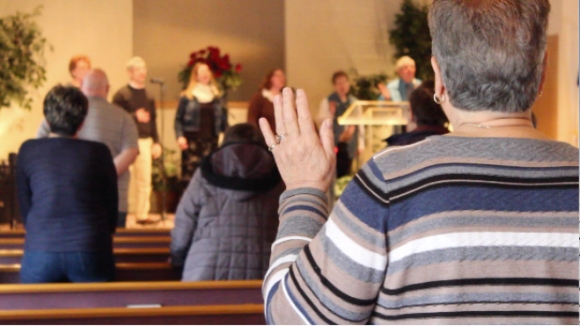
The members of two Streator churches credit God with uniting their congregations under a new name: New Beginnings.

When Mike Young first laid eyes on Streator in 2016, he saw a small prairie town in the midst of vast farmland. But he also saw a community in great need of the gospel. Young, who moved to town to manage IBSA’s northern Illinois camp facility, soon discovered that much of Streator was still unchurched. He started praying God would raise up a church to fill that void.

Mike Young

Mike Young

When Young started looking for a church to join, there was one that caught his eye every time he’d go into town. “I would pass a church right on the edge of town called Calvary Baptist,” he said. “The building looked rough, and there were bushes growing all around it. It just looked like it was closing down.” Many people in town confirmed what Young had thought—that the church was on its way out.

Still, every time he passed Calvary, something kept tugging at his heart.
Struggling churches

“Calvary Baptist Church was a long-standing church in the community,” said Mike Blakemore. “It goes way back into the ‘50s, I believe.”

Blakemore and his wife started attending Calvary in the early 2000s; he eventually became an elder. “It was a great church, great pastor, great fellowship,” Blakemore said. But after their pastor retired, “that’s when the struggle began.”

The Southern Baptist church went through a series of interims and people just to fill the pulpit, and Calvary’s numbers started dwindling. Soon, wear-and-tear to the church’s building became evident, with mold growing inside the walls and roof.

By the end of 2015, with finances running low and numbers still dropping, the auditorium ceiling caved in after a severe hailstorm. “After much prayer and a lot of discussion, we decided to vacate the building,” Blakemore said.

A few miles away, Streator’s First Baptist Church had its own problems. The Conservative Baptist church was founded not long after Streator was incorporated in 1868. Longtime member Linda Abbot speaks fondly of her church. “I have a great, great grandfather who helped start this church,” she said. “My mother was part of this church. And when I was born, I was brought into it as well. I’ve been here ever since.”

At 13, she dedicated her life to Christ at the church. She brought her childhood sweetheart, Ken, to First Baptist where he, too, came to know Christ and eventually became an elder. The Abbots married at First Baptist and have raised their own children there.

“But in the years that we had been coming here,” Linda Abbot said, “we noticed the numbers steadily declining. And we could just see things falling apart.”
The numbers continued to decline until they were down to almost 20 people, forcing the once large church to close down its main building and move worship into the fellowship hall, a stand-alone, neighboring building.

The move was made to sustain the church, Ken Abbot said, with the knowledge that if finances dwindled to a certain level, the church would dissolve and its Conservative Baptist denomination would take over the building.

Meanwhile, Calvary sat empty for almost a year while worshipers met in homes or rented spaces, praying all the while for direction. “We had just been going from place to place, and the fear that came along with that is, how long is this going to work?” said deacon Mark Martin.

But, he added, the church’s predicament drove them closer to God. “And that’s what it did to everybody that was involved,” Martin said. “Because God doesn’t bring about situations like these to drive you away from him. There might be problems, but they are meant to bring you closer to the Lord.”

Still, the uncertainty was unnerving. After months of worshipping in different places, Calvary gathered for a prayer meeting in a home one Wednesday afternoon, bringing their future and their tattered building to the Lord.
Moving forward

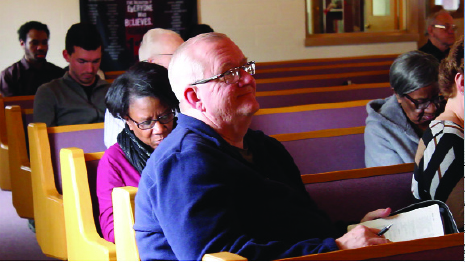
“From the very beginning, once we stacked hands and were ready to move forward with the merger, we very purposefully decided this was going to work,” Calvary Baptist elder Mike Blakemore (center) said of the union between his church and another in their town.

Answered prayer
It was that same Wednesday afternoon when Mike Young, unable to shake the tugging in his heart, decided to finally investigate the rundown church building on the edge of town. He pulled into the church’s parking lot, found a phone number on the door, and called. “I explained who I was and asked if there was anything I could do. I thought maybe they would need help with their building. I could help with that,” said Young, who has facilitated extensive renovations at the camp.

“Right then, they stopped that prayer meeting and they answered the phone,” Young said. “They didn’t have a pastor, they didn’t have a building, but they still had that core group of people.”

The group eventually called Young to serve as interim pastor, sparking a new beginning that would soon include First Baptist. That church was still without a pastor, and wondering what to do with their building. That’s when they heard about Calvary.

“When we heard that Calvary’s roof caved in and they were without a building,” Ken Abbott said, “we started praying for them. And while we didn’t know it at the time, they, in turn, started praying for us too because of our situation.”

“It was a challenging year for all of us,” said Tim Walter, an elder at First Baptist. He and Abbot extended an invitation to Calvary to worship with them.

“We were two churches in need of each other,” Walter said. “They needed a church home. And we had facilities, but we weren’t using them because our building was pretty much all closed up.”

Calvary accepted the invitation, and the two churches held a worship service in First Baptist’s fellowship hall in January 2017. “Over time as we met,” Young said, “worshipping together became so sweet, and the fellowship was just excellent.”

At first, each church collected their own offerings and maintained separate prayer lists and bulletins. Church meetings were held in separate rooms. After a couple months of worshipping together, each church wanted a more long-term plan, and eventually took separate votes on whether to merge. The votes were unanimous—both churches were fully in favor.
Reaching

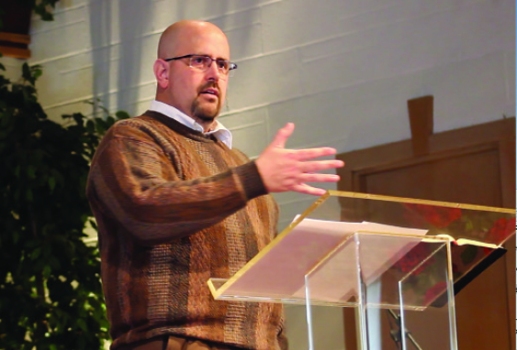
Pastor Aaron Jackson and his church are on a mission to proclaim Christ to their community.

Prayer, love, and willing hearts
Despite apprehension on each side that the other would want them to conform to their traditions, Blakemore said each church put aside their wants and traditions, focusing instead on God’s desire and Streator’s need for a thriving church.

Some described the experience as a marriage, with two parties making sacrifices toward a greater good. “When both churches came together, each naturally had their own tradition,” Young said. “But like any marriage, you have to give and take. And the two were willing to do that. They were willing to rely on God and trust him for the results. That is the most important part.”

“We had to come together as a new beginning,” Walter said. “The past is gone; First Baptist had to cease, and Calvary had to cease. As Dr. Dan Eddington told us, we had to have two funerals and a wedding for this to work.”

Both churches credit Young and Eddington, director of missions for Three Rivers Baptist Association, for guiding them through the merger. But overall, it was God, through prayer, that gave the churches their success.

“We had to bathe the entire process in prayer,” Blakemore said.

The Abbotts agreed. “From the beginning we were praying for Calvary and, without us even knowing, they were praying for us,” Linda said.

In September 2017, the two churches officially constituted as one, with a new name: New Beginnings Baptist Church. The church affiliated with IBSA last November.

“It’s new beginnings in a lot of different ways,” Martin said. “Not only is it a name for two churches coming together and a new start for a ministry, but it’s a new beginning for a work in Streator, as well as a new beginning to the lost who come here.”

Mike Young continued as interim pastor until the church was able to hire their first full-time pastor. Aaron Jackson has been serving as pastor almost a full year. “We’re already seeing what God is doing through ministries here at New Beginnings,” he said. “This is a very unchurched area and we’re doing as much as we can to get involved in the community.”

The church has moved back into the main building and has seen significant growth. They’re reaching out to Streator through multiple ministries. Walter describes the church as a family with a singular focus on Christ. “What is our mission? To preach the gospel and to proclaim Christ to a lost world. That is why we exist. And that’s our direction for the church: so that everything we do is to glorify him.”

Andrew Woodrow

Passing through Gethsemane

Lisa Misner —  April 18, 2019

By Eric Reed

Garden of Gethsemane.Jerusalem

Garden of Gethsemane.Thousand-year olive trees, JerusalemPassing through Gethsemane

A Baptist pastor said in an article I read recently that Maundy Thursday has become his favorite day of the Easter season. That was surprising, he admitted, since he didn’t grow up observing the day before Good Friday as anything special. Nor do many Baptist churches. But as he was called to pastor a church with a unique Thursday night Lord’s supper service prior to Resurrection Sunday, he took on the observance and came to appreciate it deeply.

I understood his experience. A couple of churches I served added Thursday services to their pre-Easter observance. At first, it was a matter of convenience for those who would travel on Good Friday to spend the weekend with grandma. But eventually we found we ourselves needed more time in the garden before we stood at the foot of the Cross, and ultimately at the vacated tomb.

“Maundy” Thursday may sound mournful, but the name itself comes from the Latin for “mandate.” A new commandment I give you, Jesus told his disciples in the upper room on that night, that you love one another. Maundy is a manmade term, as is the “Good” of Friday, but as for the events that happened that night, they are by God’s design.

After donning the servant’s towel and washing his followers’ feet, then giving them his body and blood in the first Lord’s Supper, Jesus led the crew, minus Judas, to the olive press on the other side of the temple grounds. Calling it Gethsemane, we forget that this was a working vineyard, where the crop was grown and at its maturity harvested, then crushed to release its treasure and fulfill its purpose. (Makes you have new respect for that bottle of oil in the cupboard, doesn’t it?) There, kneeling among the gnarled trees and the stone pressing floor, Jesus appears at his most human: suffering, knowing greater suffering was just ahead, wrestling, and yet willing.

And if we left the account there, we would miss several deep truths that make the events of Thursday night crucial to our understanding of Sunday’s victory. We might be tempted to think of Jesus as somehow less than fully human, that his deity abated his agony, if we did not see him wrestling in prayer while even his closest supporters a few yards away abandoned him in favor of sleep. We might miss a point of deep personal connection to Jesus that we need in our own times of crisis.

For Jesus Gethsemane was no rest. It is the place where one last time, his obedience and his surrender to the plans of his Father were tested. It is the place where God’s purpose and his own mission surpassed a momentary desire for relief from the pain of the night. And, blessedly, it is temporary.

In Gethsemane, the Father prepared the Son for the cross before him. Luke, who diagnosed Jesus’ suffering as bloody even in the garden, also tells us that God sent an angel to minister to Jesus.

The agony won’t last forever, but God knows we need help to get through it. And he sends it by his holy messengers. In our own seasons of crushing, we are lifted with the news that God has a purpose for the suffering he allows, and that it is temporary. God knows we hurt; God sends help; God sets a time limit.

In those times, it helps to know that Jesus suffered too. He cried over Lazarus. He cried out on the cross. And he endured in the garden where any remote possibility that he might put his relief ahead of our need was crushed: Not my will, but Yours be done, he said to the Father. We speak of “The Lord’s Prayer” as our model prayer. It, too, says, “Thy will be done.” But in Gethsemane, the prayer is tested and proven, and Jesus comes out the other side fully committed to finish his mission—at all personal cost to himself.

Finally, Gethsemane points to victory. To know the exhilaration of Jesus’ triumph over Satan and hell and sin and death, we must endure with him in his Gethsemane—and ours. In trial, we can be assured that Jesus has been here before. And though it hurts—a lot—we must not rush past Gethsemane, or we miss the magnitude of the victory, when the darkness of Thursday night surrenders to the brilliance of Sunday morning. And that light you see is the Son.

Eric Reed is editor of Illinois Baptist media.