Archives For November 30, 1999

Day 2 Grand Calling

More than 700 people were baptized in IBSA churches in the month of April. “One GRAND Month” focused on baptism, which increased 7% last year. But we have a long way to go.

Pray for new believers. And pray for IBSA churches to reach unbelieving people with the gospel throughout the year.

Learn more about the Mission Illinois Offering.

Day 1 EvangelismWith at least 8-million lost people among Illinois’ 13-million residents, IBSA encourages churches to focus on evangelism. Pat Pajak trains hundreds of churches each year. He teaches NAMB’s “Who’s your one?” prayer focus and “Three Circles” witnessing tool. Watch the video, “Sharing Christ.”

Pray for the IBSA evangelism team and for evangelistic zeal in all churches.

Learn more about the Mission Illinois Offering.

MIO Facebook Banner

With all of these Mission Illinois Offering resources and materials at your fingertips, you may be thinking, How do I get my church excited to give and contribute to kingdom work here in our own state? The first answer is to pray for state missions.

As a church leader, pray for your congregation’s hearts to be open to giving to the Mission Illinois Offering. Then, distribute the prayer guide and join as one body, committing to praying together for all the requests listed.

  • Ask your worship leadership team to allot time for prayer for Illinois during the month of September.
  • Consider holding a special prayer gathering at your church where you take turns individually lifting up each ministry and missionary.
  • Pray for the millions in our state who don’t know Christ, for church leaders and church planters in Illinois, and for local churches to have opportunities to share the love of God with their community.

Organize a state missions study. Each year the MIO kit includes missions-related studies geared specifically towards children, youth, and adults. Each age-appropriate lesson shows ways to get people involved with Illinois missions.

And rest assured, it is easy to do a missions study! The material is all ready. You simply need to pick a time for people to meet—it could even be during the Sunday school hour—and find someone to facilitate the study and discussion. We all could use a fresh understanding of the spiritual need in Illinois.

Look for the MIO kit in your church office, and explore resources on the MIO website.

Commit to give. And keep giving until your church’s goal is met! Lead by example and communicate to others the importance of this offering for furthering the kingdom in Illinois.

Provided in your church’s MIO kit are video reports showing the need for Christ across Illinois and some of the missions and ministries IBSA churches together support to meet those needs. During the Sundays leading up to MIO Week, please show them to your congregation.

Just as there are those who speak up for other annual offerings or ministry events, you can become a champion in your church for the cause of state missions. Whether you are a pastor, a deacon or elder, a missions leader, part of a committee, or a preschool teacher—you can be a voice for Mission Illinois. Our call to missions begins here where we live.

When you champion missions in Illinois, know that lives will be transformed because of your church’s commitment to prayer, generous giving, and missions involvement.

By Nate Adams

MIO Slider

I recently learned of the passing of Mary Lou Cameron at age 99. Mary Lou was the widow of Harold Cameron, who was state missions director and a church planting leader at IBSA for many years.

I didn’t know Mary Lou personally, but her passing reminded me of the only time I remember meeting her husband, Harold, probably in the late 1970’s. He came to speak in the St. Charles church where I was a youth minister, and shared passionately about the need for new churches in Illinois. In doing so, he told story after story of the challenges and opposition he and others faced in getting new Baptist churches established in northern Illinois, including ours.

At that time, our church had well over 200 weekly attenders, several vibrant ministries, and was baptizing new believers regularly. So it was hard for me as a 20-year-old youth minister to imagine a day just 25 years earlier, when our church didn’t exist.

During his one opportunity to do so, Harold convinced me that Illinois is a mission field, that church planting is the missionary task most needed here, that it is not easy, but that it is extremely worthwhile. His transparent heart cared not only for the lost, but for the lost of tomorrow. He knew that he couldn’t personally share Christ with all those lost people, but he could start churches that would. In that moment, I remember being personally grateful to him for starting our church.

Your giving supports vital church planting efforts across our state.

Now let me fast forward to today, when I am almost the age Harold was then, and when I ask you to join me in giving generously to the annual Mission Illinois Offering, preferably through your church, or at IBSA.org. Church planting is one of the primary ministries supported by that offering, and church planting is still desperately needed in Illinois. In fact, IBSA church planting staff have identified at least 200 places or people groups in Illinois where a new, Bible-believing church is needed, today.

With current leaders and resources, IBSA is seeing about 20 new churches started each year. But your generous offering can help accelerate the pace at which a New Testament church is established, in or near every community in Illinois.

Someone planted your church, and mine, whether it was 25 years ago or 200 years ago. The question for us today is how generously we will continue to pay our gratitude forward, and establish new churches for both new communities and new generations.

Reading Mary Lou’s obituary reminded me that Harold retired in 1981, just a couple of years after I met him as a young man. Men like my father and other church planting and associational leaders, and women like Mary Lou and my mom, then continued to champion that church planting legacy for their generation. In fact, they helped me plant a church in that same northern Illinois region in 1994, before I moved on to help church planting nationwide at the North American Mission Board. Now I stand on their shoulders, and without reservation ask us to continue planting new churches here in Illinois.

It probably won’t surprise you that Mary Lou Cameron designated any memorial contributions to either the scholarship fund of the Baptist Foundation, or to Illinois Baptist State Missions, or in other words, the Mission Illinois Offering. Mary Lou and Harold clearly had hearts for tomorrow, hearts for church planting, and hearts for tomorrow’s lost in Illinois. Our gifts through the Mission Illinois Offering this year can both honor their lives and echo their hearts.

Nate Adams is executive director of the Illinois Baptist State Association. Respond at IllinoisBaptist@IBSA.org.

Show and tell

Lisa Misner —  August 29, 2019

By Adron Robinson

Read: Galatians 5:22–23 (ESV)

“But the fruit of the Spirit is love, joy, peace, patience, kindness, goodness, faithfulness, gentleness, self-control; against such things there is no law.”

Tree made of citrus fruits, oranges, lemons, lime and green leavIn elementary school I always loved show-and-tell. It was exciting to see the hobbies, toys, pets, and even parents of my classmates. Well, for the child of God, every day is show and tell. We should show others the fruit of the Spirit and tell others about Jesus.

There is no such thing as hidden fruit. Fruit is always visible. The people around you will either see the fruit of the flesh or the fruit of the Spirit. We can talk about how much we love the Lord, but the proof is not in our talk, it’s in our walk. Fruit is always visible.

Not only is fruit visible, but fruit always reflects the character of its source. Apple trees always produce apples. Orange trees always produce oranges. And Christians produce love, joy, peace, patience, kindness, goodness, faithfulness, gentleness, and self-control. And notice the word fruit is singular, that means that the Holy Spirit produces all of these in every Christian. Some may not use patience much, for we still wrestle with sin, but it’s in you and the more you submit to Christ in every area of your life, the more the Spirit will produce his attributes in us.

Finally, fruit is for the benefit of others. I have never seen an apple tree eating an apple. Trees bear fruit for the benefit of others. Likewise, the Holy Spirit produces Christlike character in the Christian for our benefit, but also for the benefit of others around us. When they see us showing our fruit, they will want to know where this fruit came from. Then we can tell them about Jesus.

Prayer Prompt: Gracious Father, who gives every good and perfect gift, thank you for the fruit of the Spirit. Please help us to submit to your Spirit so that your attributes can be manifest in us, that you may be glorified in our daily walk. Amen.

Adron Robinson pastors Hillcrest Baptist Church in Country Club Hills and is president of IBSA.

By Eric Reed

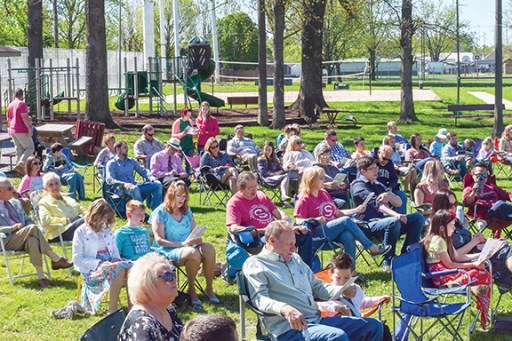
Wide Shot of CrowdShawn and Paige Ruffino live in Sesser, a small town of about 2,000 people in far south Franklin County. Sesser is Paige’s hometown, and Shawn says he has come to love it as his own. That’s why he’s concerned for the spiritual future of the people who live there.

Likewise, the leaders of the church where the Ruffinos are members, Immanuel Baptist Church in nearby Benton, are continually growing in their concern for lost people in Benton and Sesser, and throughout their county. “We’ve been praying at Immanuel for many years for the 26,000 who are lost in our county,” Pastor Sammy Simmons said. “I desperately want everyone the hear the gospel.”

Simmons has led Immanuel Church to join a new IBSA initiative called Everyone Hears. In our state of nearly 13-million people, at least 8-million don’t know Jesus as their personal savior. In many places lostness seems especially great. And there are pockets of hope, where churches are focused on sharing the gospel with everyone who will listen. Everyone Hears aims to organize those efforts, with an evangelism cycle that begins with prayer, and moves through specific activities to demonstrate caring, sharing the gospel, baptizing new believers, and where there is an emerging core group, starting new churches.

Day 3 Church Planting“The purpose of Everyone Hears is that every man, woman, boy, and girl in a certain region can hear the gospel multiple times in ways they can understand,” said Eddie Pullen, IBSA’s church planting strategist who is leading the initiative. So far, 25 IBSA churches across the state are participating in Everyone Hears, targeting their own communities, or areas nearby.

Immanuel Baptist is seeking to reach their county, and Benton and Sesser in particular. At Easter, the church cancelled events at their campus and took worship services outdoors in both communities. About 200 people attended in Sesser, and at least 60 of them had no church affiliation.

The church has engaged in other activities, including praying for lost individuals by name on many occasions, giving away groceries, working to improve the park, hosting opening ceremonies for local ball teams. Bible distribution and a social media campaign are next steps on their outreach list.

“The idea of gospel saturation really hit my heart,” Simmons said. “It’s not just the idea that we want somebody to hear the gospel once and think that’s good enough. Surveys say sometimes it takes seven times where somebody hears the gospel before they make a decision for Christ. And so we want to saturate our area with the gospel such that you can’t miss it.”

Immanuel Church is engaged in international missions, spreading the gospel in Uganda through 12 trips in eight years. But, the pastor said, “we can’t ignore the reality that there are people who have never heard in our own backyard.”

Shawn Rufina

Shawn Rufina

Shawn Ruffino agrees. “We believe it can happen right here; gospel saturation can start right here.” That’s why Ruffino is leading outreach in Sesser. He chokes up as he says, “Jesus changes us, and he can save us, and he can use us no matter what we’ve been through.”

Or where we live.

Learn more about the Mission Illinois Offering and Week of Prayer.

By Jack Lucas

Pupils and teacher smiling at camera in library at the elementary school

Back-to-school season is upon us, offering your church a great opportunity to serve families, teachers, and administrators in your community. Much of our back-to-school outreach often centers around meeting physical needs. School supplies, free haircuts, new tennis shoes—all of those giveaways and donations are wonderful ways to help families in this busy, often expensive season.

But churches can also look beyond August and September for effective ministry to families and education leaders in their communities. In addition to your back-to-school outreach this year, consider adding one or more of these longer-term strategies:

Try to meet unique needs. One school in our community required each student to stock the office by bringing a ream of copy paper at the beginning of the school year. We asked the school what they needed most. Paper, the staff said, so our church provided enough paper for the year, so that families didn’t have to. Throughout the year, check in periodically with schools in your area to ask what unique needs your church can help meet.

Share your space. Another of our local schools had space issues in their gym. We opened our church gym so their teams could practice there, and also hosted school sports banquets in our fellowship hall. Families visited our church who first heard about us after their child met us through school sports.

Work with administrators. You may be surprised at how willing your local principal is to partner with your church. Even with the caution required to keep church and state separate, school administrators often understand churches want to help, with no other agenda in mind. Our church was blessed to build relationships with principals who sent people our way when they had a specific need. Seek out these relationships with school administrators in your community, asking how your church can help.

Don’t forget older kids. Teens in our community responded well to a back-to-school bash at the church. They came to the high-energy outreach to reconnect with their friends, and left with a calendar of events we’d planned for the year ahead. Your church can also do this around holidays, or at the end of the school year as you look ahead to summer activities. Let them know they’re welcome at your church, and that there are specific opportunities for them.

Expect a cumulative effect. The best way to sum up back-to-school outreach is that it often moves the needle little by little as your church builds relationships with teachers, administrators, and families. The impact you make will likely share a close correlation with how consistent and sacrificial your ministry is, and how prepared you are to interact with the families that do show up at church.

As you brainstorm ministry opportunities this fall and beyond, ask your leaders and volunteers these questions:

  • What can we offer teachers and school administrators in the way of resources and encouragement?
  • How can we position our church as a go-to resource for families in need of support?

Our church had the opportunity to minister to couples and families that we never would have had if we hadn’t provided school supplies for their children, or hosted basketball practice for their student’s team. This year, gear up for long-term ministry that really helps families.

Jack Lucas is IBSA’s director of next generation ministries.

Rsource Fall 2019This article is adapted from the Fall issue of Resource magazine, which is available at Resource.IBSA.org.

By J.D. Greear

Editor’s note: Churches in Illinois baptized more than 700 people during One GRAND Month last April. September 8 is Baptism Sunday across the Southern Baptist Convention.

JD GreearFor several years now, I have been greatly burdened by the declining number of baptisms across the Southern Baptist Convention. I believe the baptism numbers serve as one of the best indicators of evangelism in our churches. Jesus came to seek and to save the lost, and that means that proclaiming the gospel is the core of who we are—not only as Southern Baptists, but most importantly, as disciples of Jesus Christ.

That’s why I’m challenging every Southern Baptist church to call for baptisms in services on Sept. 8, the date our SBC Executive Committee has designated as “Baptism Day” on the SBC Calendar.

Baptism Sunday will be an opportunity for thousands of people in our churches to take their step of obedience and faith. Many of them already know they should be baptized, and you can schedule baptism celebrations in advance. Other people in your churches may decide on Sept. 8 that God is calling them to those same baptismal waters.

I know conversations about immediate-response baptism services tend to draw some objections, many of which are grounded in healthy concern about encouraging insincere professions of faith. Trust me, I understand the concerns: I have seen dangerous and irresponsible calls for spontaneous baptisms. God forbid that we ever declare someone “saved” when they aren’t. Not only does this give them false assurance, but it also makes them that much more immune to future calls to repent and believe.

On Baptism Sunday, call people to respond to Jesus.

Our fear of extending these invitations wrongly, though, should never make us shy away from making the invitations at all. After all, every single baptism recorded in the New Testament, without exception, is spontaneous and immediate. For New Testament believers, the pattern was alarmingly simple: believe, confess, get baptized. There was never a gap between when a person trusted Christ and when that person was baptized. Not one.

This follows the example of Jesus’ Great Commission: “Make disciples of all the nations, baptizing them in the name of the Father, Son and Holy Spirit” (Matthew 28:19). Baptism is a believer’s first act of discipleship, a step of obedience that stands as a witness that we belong to Christ.

Baptism is like the wedding ring of salvation. I put on my wedding ring at the moment I decided to publicly declare my commitment to my wife. Putting on the ring did not make me married. But the demonstration of my commitment to my wife that the ring represents was a crucial first step in marriage. Had I refused to do it, my wife would have had reason to question my intentions.

In the same way, baptism is an outward symbol of an inward covenant we’ve made in response to Jesus’ offer of salvation.

Every one of our churches ought to do everything in its power to ensure that everyone who comes forward to be baptized understands the gospel and the significance of what they are doing. During baptism services at our church, for instance, we individually counsel every person who comes forward. Those conversations take time—often extending into the next service—and we always end up turning some people away. But that moment is important, because it starts a conversation about what it means to follow Jesus.

Baptism is of tremendous importance, but we need to keep the biblical order in mind: Baptism is the catalyst to spiritual maturity, not the sign of having attained it.

When we invite people to be baptized, we are calling them to make a decision. That’s exactly what so many of our people need. They come to our churches as consumers, going along with Jesus but never deciding for him.

Several years ago, our church chose to hold our first baptism service after we noticed the biblical pattern of spontaneous baptisms while preaching through a series in the book of Acts. Starting with that service, we saw three times more people choose to be baptized that year than we’d ever seen! I believe that’s because our church had been faithful in sharing the gospel, and we chose to be faithful in calling for a response to that good news.

I believe God is preparing a harvest of souls. Let’s faithfully call them to respond by publicly declaring faith through baptism!

J.D. Greear is president of the Southern Baptist Convention and pastor of The Summit Church in Raleigh-Durham, N.C. For Baptism Sunday resources, go to namb.net/baptism-sunday-resources.

Give them the gospel

Lisa Misner —  August 19, 2019

A new ministry reignited this church’s passion

By Meredith Flynn

MIO Next Gen

Outside the white wooden First Baptist Church building, Atwood is quiet on Wednesday evening. A few parents stroll babies on the sidewalks, and a group of teen boys walks toward the school gym, basketball in hand. This community of just over 1,000 people is minutes from Illinois’ Amish country.

From the church parking lot, though, the thump, thump, thump of a bass line played over stereo speakers gets louder at the door. Inside the darkened auditorium, children and teens swing their arms and stomp their feet—matching the motions of a worship leader onstage.

This is Ignite, FBC Atwood’s year-old ministry for kids and students. On this Wednesday night, Pastor Lanny Faulkner will baptize 17 young people who came to Christ through Ignite or another of the church’s ministries for kids and teens. (The church baptized 15 people total last year.)

His church understands the statistics, Faulkner said. Most people that come to faith in Christ do so at a young age.

“If we’re going to change the world, we have to change Atwood,” said Faulkner, who has led the church since 2006. “If we’re going to change Atwood, we have to reach children and young families.”

Braving a new world
The generation coming of age now has experienced the world in a completely different way than the adults leading them at church, said Jimmy Hammond, an IBSA associate who facilitates student ministry around the state.

“For us, the challenge is learning how to see things from their perspective, so we can find meaningful ways to connect to them,” Hammond said. Throughout the year, IBSA sponsors camps and conferences for kids of all ages, and training opportunities specifically tailored for children’s and youth leaders.

Those events are possible because of the Mission Illinois Offering & Week of Prayer. Collected in September in churches across Illinois, the Offering helps provide missions and ministry that address critical needs in the state. MIO also supports IBSA personnel like Director of Next Generation Ministries Jack Lucas.

As IBSA and church leaders partner together to reach the next generation, they recognize the window is narrow. A 2004 Barna study found that 43% of Americans who profess faith in Jesus do so before they turn 13, and 64% before their 18th birthday.

The next generation presents a unique set of challenges and opportunities for church leaders. They see the problems in the world around them, Hammond said, but they’re not content to sit idly. They want to be involved; they want to make a difference. “But they’re just not sure how to do that.

“We know the answer to that: the gospel’s the way to make the biggest, most meaningful change in the world.”

In the world, and in Atwood. Every Wednesday at the beginning of Ignite, attenders read or recite a 30-second gospel summary. Ignite leaders say they’ve heard kids sharing the gospel summary at school. And Faulkner recently baptized an entire family that came to Christ after the children heard the gospel every week. The parents, sitting at the back of the auditorium, heard it too, and responded in faith.

Finding what works
For 25 years, FBC Atwood church hosted a successful Wednesday night children’s ministry that depended on many teachers. When the number of available teachers dwindled, the church had to get a new vision for the ministry. They tweaked the structure so that fewer teachers are required. The church saw an average of 120 young people every Wednesday during Ignite’s first year.

Some things are the same, though. Faulkner still rides the church bus on Wednesday nights as it picks up a dozen or more children from neighboring communities. The pastor serves as bus captain (or monitor); the driver is a deputy sheriff who has been transporting kids to and from the church for 25 years. His wife, who recently passed away, started the original kids’ ministry in Atwood. Together, Faulkner said, the couple is responsible for hundreds of kids coming to know Christ.

On Wednesday nights in Atwood, the message is also the same as it always has been.

“The gospel is the power of God unto salvation,” Faulkner says. “It’s not preaching ability, teaching ability, how exciting the music is. The thing that brings people under conviction, the things that bring them to repentance and faith, is the gospel.”

Learn more about the Mission Illinois Offering.

Meredith Flynn

Parents weigh options ahead of 2020 school year

By Meredith Flynn, with additional reporting by Lisa Misner

School

Photo composite

Beginning next year, students at public schools in Illinois will study the role of LGBT people in U.S. and state history, after Gov. J.B. Pritzker signed a controversial measure into law Aug. 9. The new policy, which goes into effect July 1, 2020, affects students of all ages, although the state’s School Code stipulates that the curriculum be taught before the end of 8th grade.

House Bill 246 passed through the Illinois Senate last spring and was quietly approved May 23 by the House amid a flurry of other legislation, including legalization of recreational marijuana and the repeal of several restrictions on abortion. Pritzker’s signature on the curriculum bill dismayed many Christians and conservatives, with talk online quickly turning to education alternatives.

“Reason 157 to home or private school,” one poster wrote on IBSA’s Facebook page. Others expressed resolve to keep their kids in the public school system to shine the light of the gospel there.

“We are very aware that times are changing and more liberal views are entering the classroom,” said Caitlin Konieczka, a Springfield mother of three girls.

“We feel that the changes that are happening in the classroom and throughout the world right now are opportunities to share Christ and his message.”

Competing values
Illinois is one of a handful of states to consider curriculum legislation this year, but California lawmakers approved the FAIR Education Act in 2011. According to a Reuters article from May of this year, that state is still struggling to implement the law, and some parents are still protesting it. The article recounts recent fights over textbooks at school board meetings, where one mother expressed concern that her children would read books about transgender people before she’s ready to discuss gender and sexuality with them. “I should be the first one to educate about those things,” she said.

Candi Campbell and her husband, Charles, sent three daughters through the public school system in Illinois, recognizing their decision at the time as a natural way to be “a witness in the world.” The recent legislation would make the decision more difficult, Campbell said.

“As a parent, I believe it is my job to feed, lead, and protect my children. The law signed in Illinois represents a damaging social agenda to our little ones. And, until they can stand on a personal faith in Christ for truth, it is up to me to stand for them.”

A homeschooling mom in Springfield agreed, while acknowledging that homeschooling isn’t for every family. “No matter how we as Christians choose to educate our children, we must help them develop a biblical worldview,” she said. “Our children need our help in discerning truth and goodness through the lens of Scripture.”

Sen. Heather Steans (D-Chicago), one of the bill’s chief sponsors, has said the new curriculum will help LGBT students feel more accepted and supported in school. Her comments also may sound alarm bells for Christian parents who fear the normalization of sexual values they believe run counter to God’s Word.

“One of the best ways to overcome intolerance is through education and exposure to different people and viewpoints,” Steans said in a news release posted on her website. “An inclusive curriculum will not only teach an accurate version of history but also promote acceptance of the LGBTQ community.”

What now?
Laurie Higgins said the curriculum changes ought to spur Christians to action—and their churches with them. Churches should have been creating affordable Christian schools “yesterday,” said Higgins, a cultural affairs writer for the conservative Illinois Family Institute. While that will indeed take time, she acknowledged, “it doesn’t take time to make funds available.” Higgins urged churches to partner together to create scholarships to Christian schools.

“Parents need to understand if we lose our kids on this [issue], they will think the Bible is wrong on other things,” Higgins said. “We have to start creating affordable alternatives.”

She also encouraged parents to contact school administrators and teachers to ask that their children not be taught about homosexuality or cross-sex identification. Ask them to acknowledge receipt of the e-mail, Higgins added.

While the Konieczka family has made a different decision about school, they’re also planning for future action, Caitlin said. “We are working now to lay a solid foundation before the girls enter school on basic biblical principles and God’s design for creation and life.” Once school starts, she said, they’ll communicate and reinforce biblical truths and establish an environment that welcomes questions.

She acknowledged there could be topics they don’t want presented to their daughters. The couple, both educators, plans to preview textbooks and content and work with teachers and administrators to accommodate their preferences.

“We view this as an opportunity to be a light in the school, and an opening to conversations about our beliefs.”

– Meredith Flynn, with additional reporting by Lisa Misner