Archives For November 30, 1999

MIO Logo 500pxThe Mission Illinois Offering and Week of Prayer is September 9-16. For all the resources and materials available online and at your church, you may be thinking, Where do I begin? How do I get my church excited to give and contribute to kingdom work here in our own state? The first answer is to pray for state missions.

Pray for your congregation’s hearts to be open to giving to the Mission Illinois Offering. Then, distribute the prayer guide and join as one body, committing to praying together for all the requests listed.

  • Ask your worship leadership team to allot time for prayer for Illinois during the month of September.
  • Distribute the Mission Illinois Offering bulletin prayer guide in your Sunday morning worship service. The guide is in your MIO kit and at MissionIllinois.org under the tab “Downloadable Extras” and then scroll down the page to “Inserts and Other Helpful Documents.”
  • Consider holding a special prayer gathering at your church where you take turns individually lifting up each ministry and missionary.
  • Pray for the millions in our state who don’t know Christ, for church leaders and church planters in Illinois, and for local churches to have opportunities to share the love of God with their community.

Organize a state missions study. It is easy to do a mission study! Missions-related studies geared specifically towards students and adults are available at MissionIllinois.org. You simply need to pick a time for people to meet—it could even be during the Sunday school hour—and find someone to facilitate the study and discussion. We all could use a fresh understanding of the spiritual need in Illinois.

Look for the MIO kit in your church office. Download mission studies and videos at MissionIllinois.org. If your church has not received its kit, e-mail MissionIllinois@IBSA.org and request one.

Commit to give. And keep giving until your church’s goal is met! Lead by example and communicate to others the importance of this offering for furthering the kingdom in Illinois.

Provided in your church’s MIO kit are video reports showing the need for Christ across Illinois and some of the missions and ministries IBSA churches together support to meet those needs. During the Sundays leading up to MIO Week, please show them to your congregation. Make sure to include the video “Partners for Illinois” and at least one or two of the stories from the mission field.

Just as there are those who speak up for other annual offerings or ministry events, you can become a champion in your church for the cause of state missions. Whether you are a pastor, a deacon or elder, a missions leader, part of a committee, or a preschool teacher—you can be a voice for Mission Illinois. Our call to missions begins here where we live.

When you champion missions in Illinois, know that lives will be transformed because of your church’s commitment to prayer and to generous giving,

A blessing in the mirror

Lisa Misner —  August 16, 2018

By Adron Robinson

Mirror

Read: James 1:22-25

It’s not simply the hearing of the word that blesses us but the practicing of God’s word, James reminds us. Hearing the word is not enough. Warren Wiersbe once said, “Too many Christians mark their Bibles, but their Bibles never mark them.”

To prevent this, James gives us a mandate to observe the word: “Be ye doers of the word, and not hearers only, deceiving yourselves.” But many believe that hearing is enough, so they substitute reading the word and talking about the word for doing the word. But true disciples learn God’s word in order to do God’s word; we apply the word of God to the situations and circumstances of our lives and practice standing on the promises of God.
James also warns us that if we listen to the word and don’t obey the word, we deceive only ourselves. Others know, and most importantly God knows.

That’s why we need the mirror of God’s word. It reflects God’s glory and shows us our great need for God. And unlike those trick mirrors at the State Fair, the mirror of God’s word doesn’t lie. It always reflects the truth!

A quick glance at the Bible isn’t likely to reveal our deepest needs; we must examine our hearts in the ongoing light of God’s word. It’s like the difference between a photo and an MRI. They both involve exposure to light, but one is brief and reveals an external image, and the other is a prolonged exposure that reveals what’s inside of us. There is a blessing waiting for you in the mirror of God’s word.

PRAYER PROMPT: Father, thank you for your Word, for as we read your word, your word also reads us. Help us to look into the mirror daily and be doers of your word and not hearers only, so that you can shape and mold us to be more like you.

Adron Robinson is pastor of Hillcrest Baptist Church in Country Club Hills and president of the Illinois Baptist State Association.

‘To see the gospel carried through Baptist churches generation after generation’

Essentials MIO

MIO Logo 500pxSharing the gospel with at least 8 million people is a daunting calling, especially as the cultural opposition churches face continues to grow. But that is our calling here in Illinois. And each year in order to fulfill that calling, Illinois Baptists gather resources to fund ministries for evangelism, discipleship, and church planting.

How’s that working?

Gathered in the chapel of Broadview Missionary Baptist Church following a meeting of pastors, four IBSA leaders discussed the mission field and the future of ministry partnership through the Illinois Baptist State Association. In the discussion were:

• Nate Adams, IBSA Executive Director
• Mark Emerson, IBSA Associate Executive Director of the Church Resources Team
• Adron Robinson, pastor of Hillcrest Baptist Church in Country Club Hills, and serving his first term as IBSA President
• John Yi, IBSA Church Planting Catalyst focused on second-generation ministry in the Northeast region

How does our view of Illinois affect our churches’ commitment to partnership in state missions?

Nate Adams: I think a lot of people don’t think of Illinois as a mission field, because their community is reasonably churched and they’re reasonably happy in their church environment. But Illinois has 13 million people. At least 8 million of them don’t claim to have a personal relationship with Jesus Christ. And a lot of those who do say they are Christians have just nominal church relationships.

John Yi: And there are many people groups that don’t have a single church that serves them. In Chicago we see so much diversity—people from all over the world speaking all kinds of different languages. There are about two million immigrants in Illinois.
And there are at least a half-a-million young people who have come to Illinois to study, and a large portion of them have come from overseas. We really have a unique opportunity to reach people with the gospel—in our cities and all over the state.

Adams: Illinois is very much a mission field. In Acts 1:8 terms, where Jesus said, “You’ll be my witnesses in Jerusalem, Judea, Samaria, and the ends of the earth,” Illinois is the “Judea” part of that mission field. In this environment, Illinois Baptists are missionaries, going to places like college campuses and large cities and rural areas, bringing the gospel there as if it had not come there before. Because for a lot of people, they’ve never heard the gospel in a way that they can really understand, even here in Illinois.

Seeing the needs, some churches have noticeably raised their support for state missions. Yours is one of them, Pastor Robinson. Why?

Adron Robinson: My congregation recently increased its Mission Illinois Offering giving because we saw the work that was going forward because of last year’s offering. We were able to see the money that we invested going to reach lost people in Illinois—going to help us reach our Judea, you know. Hillcrest can’t reach the entire state, but by giving through the Mission Illinois Offering, we can help other Illinois Baptists reach other lost people in their areas. We can join in our part of fulfilling the Great Commission.

Adams: IBSA is helping churches think about the mission field that is most accessible to them. Even though it’s a wildly diverse mission field, it’s the one that’s near enough where they can go there themselves.

Illinois is a very diverse state, both ethnically and in spiritual need. And John, you serve among people who exemplify both needs.

Yi: Chicago is a landing spot for so many immigrants. And because that’s the case, we can’t stop planting churches for our first-generation folks. But as soon as they arrive, a cultural gap starts to form between the generations almost immediately. And so the challenge is two-fold—that we reach immigrants in their own language, but also reach their children with the gospel in English, which the parents are unfamiliar with, in a meaningful way that’s going to bring them to Christ.

What can our churches do together that they could never accomplish alone?

Robinson: I’m grateful for our partnership with IBSA, because it gives the local church the resources and the connections to do statewide ministry that we can never accomplish as one small local congregation. Through Disaster Relief, evangelism training, equipping of our local church body through IBSA staff, we are able to reach people all around the state.

Mark Emerson: As Pastor Robinson points out, missions is part of our work, along with evangelism and discipleship. And we help churches do this by equipping them for leadership: IBSA develops leaders.

I think back to several of the guys who were on the IBSA staff when I was a new pastor and church planter almost 30 years ago, how they took me under their wings and mentored me. Today, I’m thinking how great it would be if every Illinois Baptist pastor had that kind of connection.

Adams: I think the advantage that IBSA has, that allows us to create that kind of opportunity, is proximity to the churches. Southern Baptists have an International Mission Board helping churches go around the world, and a North American Mission Board focusing on some of the great cities in North America. But the Illinois Baptist State Association is the nearby partner. They’re the guy nearby to the church who equips the church to reach its own mission field right here in Illinois.

Emerson: As a pastor, I recall how I looked at a lot of different things in our organization and thought, “Well, our church is not growing because we have a community problem. Or an organizational problem. Or a financial problem.” What I learned is that our ministry really had a leadership problem. And if the church was going grow, I was going to have to grow.

So, we are developing leaders by providing the same kind of experience that I had through the state association—creating cohorts where leaders come together and learn to lead. We have about 40 of these groups all over the state now.

In addition to cohorts, the Church Resources Team equips 6,500 leaders from almost all of our 1,000 IBSA churches and church plants in all aspects of ministry in statewide and regional training events. And we train kids and students in missions and leadership with camps each summer and evangelism events in the fall.

Robinson: Our church has hosted youth events for the northern region. Without our IBSA connections, these things would never happen—praying together and serving faithfully, partnering together—

The key word is partnership.

Adams: I hope our young people won’t lose the vision of partnering with others who believe Baptist doctrine to send missionaries into places that no one church could send by themselves. But that working together as Baptist churches we can send reliable missionaries to places that will deliver the gospel and start New Testament churches that are relevant to that community. And I hope that’s something that will happen for generation after generation.

Emerson: That our work is handed from one generation to another.

So how do you see state missions in the future?

Adams: For me personally to see the gospel carried through Baptist churches generation after generation is a continuation of what my dad started when he was a pastor and a director of missions in Illinois. I want to see that happen in the generations of my kids and their kids—a stewardship of faithfulness, that we believe the Bible, that we believe the gospel, that we believe the mission of God is the most important thing in our lives.

By Joshua Steely

Open Bible

God the Father, Spirit, Son

Veiled in glory

Three-in-One

One true God in Persons three

Wondrous divine

Mystery

The last Sunday in May was Trinity Sunday, so I preached a sermon focused on the Trinity from the baptism of Jesus in Mark 1:9-11. It’s a powerful passage that displays God’s triune saving work.

A lot of Baptists, though, might think it a bit unusual to observe Trinity Sunday; we tend to leave this to our high-church brethren in other denominations. That’s a pity, because the doctrine of the Trinity is the vital heart of the Christian faith, and we should be regularly rejoicing in this great mystery. Here’s why:

First, God the Holy Trinity is the God we worship. Christianity is a relationship with God, and what is a relationship without knowing the other person (in this case, persons)? If the goal of our lives is to be near to God, to know him, then the Trinity is essential. Our prayer and worship, our personal relationship with God, is grounded in knowing him as God triune.

Second, God is our triune Savior. The doctrine of the Trinity is not only a biblical truth, it is a truth of Christian experience. God triune has saved us. When we were lost in sin and darkness, the Father sent the Son by the Spirit to rescue us. In the power of the Spirit, the Son lived a perfect human life in obedience to the Father. Having died for our sins, Jesus rose from the dead and sent the Spirit from the Father to indwell the hearts of believers. The Spirit living in us unites us with the Son by faith, for adoption as children of the Father. 

Salvation is a thoroughly triune work, and we cannot understand redemption rightly without some understanding of the doctrine of the Trinity.

Third, God triune is the God who loves us abundantly and graciously. The Trinity tells us that relationship has always existed in the one God—there has been love between the Father, Son, and Spirit for all eternity. That means that God has never been lonely, and he loves us not because he needs us, but simply because that’s who he is—the God who loves. The wonder of God’s love is magnified when we grasp the mystery of the Trinity.

All glory be to God our King,

Lord of love, One in Three;

Hearts rejoice and voices sing

Praise for all eternity.

The Trinity cannot be left to professional theologians and pastors who read big books. It must be a vital element in the life and worship of the church. How do we make that happen? 

1. Preach and teach on the Trinity.  Now, don’t get the wrong idea—I’m not saying you should turn your Sunday morning sermon into a systematic theology lecture.  Preach on the practical significance of the Trinity. Having a Sunday a year set apart for talking about it is a good habit. But more importantly, the Trinity should be explicitly present when we preach the gospel. Talk about the work of Christ as the saving work of the Father, Son, and Holy Spirit. Talk about salvation as being united with the Son by the Spirit for adoption as a child of the Father.

2. Shape the worship service to exalt the triune God. This doesn’t mean that every praise song has to be explicitly trinitarian. But if our worship service as a whole would be acceptable in a unitarian church, that’s a problem. We worship the one true God, the tri-personal God. Some of the old hymns are really good for this—“Holy, Holy, Holy!” is a standout example.

3. Encourage Trinitarian prayer and spirituality. The beginning of our spiritual life is marked by the Trinitarian baptismal formula—in the name of the Father, the Son, and the Holy Spirit. Carry that through into the everyday spiritual life of your church. In the public prayers of the worship service and in small groups and individual settings, model the practice of praying to the Father by the Spirit in the name of the Son. Talk (humbly) about the work of the Spirit in your life, about faith in the Son, and about the love of the Father. 

Help the people in your church find devotional materials and insightful books that bring out the practical significance of the Trinity for Christian spirituality, like “Delighting in the Trinity” by Michael Reeves (IVP, 2012).

The Trinity is the heart of the Christian faith, the fundamental mystery of our great God. May our churches reflect the centrality of this awesome truth.

Joshua Steely is pastor of Pontoon Baptist Church in Pontoon Beach.

MIO Logo 500px

6 weeks ahead
Open the kit. Visit MissionIllinois.org to see the additional pieces for promotion and  missions studies. Meet with the missions and stewardship leaders. Set a goal. Assign responsibilities for promotion for the campaign. Consider how MIO is a teaching opportunity. Plan a mission study.

5 weeks ahead
Meet with the worship planner. Consider how to incorporate MIO in worship services. Plan to use the videos in worship, online, or in mission studies. Ask platform leaders to include prayer for state missions in the prayer time. Schedule a special prayer meeting.

4 weeks ahead
Put up the posters in prominent places. Place the promo artwork in the church
bulletin and newsletter. Promote a special mission study and prayer meeting. Announce the goal.

3 weeks ahead
Show the short promotion video in worship. Post it on your website. Announce the goal. Start prayer for state missions.

2 weeks ahead
Show one mission video in worship. Ask someone to lead prayer for state missions. Encourage attenders to consider their offering.

1 week ahead
Show one mission video in worship. Ask someone to lead prayer for state missions. Make prayer guides and offering envelopes available.

The week of MIO
Show one mission video in worship. Stuff the prayer guide and offering envelopes in the bulletin. Pray for state missions, encourage daily devotions using the prayer
guide. Hold a mission study and special prayer meeting. Collect the offering.

Each week through September
Continue collecting the offering until the goal is met. Pray for state missions. Celebrate God’s work in Illinois.

The Week of Prayer for the Mission Illinois Offering for State Missions is September 9-16.

The Briefing

75 people shot, 12 fatally, in Chicago over the weekend
At least 75 people were shot in one of the most violent weekends of the year in Chicago, spurred by a 7-hour period early Sunday morning when 41 people were shot. Their ages spanned from 11 to 62 years old, and most were attacked on the South and West sides.

Bill Hybels faces new allegations of sex abuse; Steve Carter resigns
Another woman has come forward and accused Willow Creek Community Church founding pastor Bill Hybels of groping and performing unwanted sex acts in the 1980s. Following the new allegations, Lead Teaching Pastor Steve Carter announced his resignation over disagreement with how the church has handled sexual misconduct allegations against Hybels.

Support for Christians refusing to serve same-sex weddings goes … up
In the wake of Masterpiece Cakeshop’s victory at the US Supreme Court, a new survey finds that public support is increasing both for conservative wedding vendors like Colorado baker Jack Phillips and for same-sex weddings such as the one he refused to serve.

Christian ‘genocide’: naming Nigeria’s mass slaughter
The mass slaughter of Christians in Nigeria is calculated genocide abetted by the government in the nation that is Africa’s most Christian, cries a growing number of leaders calling on the United States to intervene.

Rauner signs bill to change state liquor control act, gives back local control
It will now be up to local officials as to whether they want a bar next to a church, school, military facility or hospital, with the signing of Senate Bill 2436, which passed with large bipartisan support.

Related:

Sources: Chicago Tribune, Christianity Today, Christianity Today, Baptist Press, Illinois News Now, World Magazine, Fox2Now

By Nate Adams

MIO Logo 500pxLast Saturday I received three voicemail messages from the same number. I suspected it was a mistake or a telemarketer, because the number wasn’t familiar, and I recognized the area code as being from out of state.

Indeed, the first message sounded like an elderly lady, who simply apologized for possibly dialing the wrong number. But in the second and third messages, the same lady said that she was sorry for bothering me again, but she was trying to reach the “Illinois Baptist Convention.” She asked if I could call her back and at least let her know if she had reached the right number.

Though it was a Saturday evening, and I couldn’t imagine what this lady might need, the frequency and urgency of her messages led me to call her back. It was then that I met Miss Myra, a 95-year-old grandmother from Kentucky.

After a few minutes of conversation, I learned several things about Miss Myra. She had just moved into a new assisted living facility a month earlier. She was nearly blind due to macular degeneration. And years ago, she had served for a while on the board of the Kentucky Baptist Convention. That’s how she knew to call me.

But I learned all those things after Miss Myra told me the primary reason for her call. Her grandson Ben had recently moved to Chicago, and she was concerned that he wasn’t attending church in that new, big city. His parents had raised him in a different denomination, she said, but he hadn’t seemed to stay connected with that church. And she didn’t know anyone to call there anyway. But she knew Southern Baptists, and she knew that if she called “the state convention office,” someone there would help her find a nearby church for her grandson. And she knew that church would be Bible-believing and gospel-centered.

I probably receive 3-4 calls a year like Miss Myra’s, often from someone in the South whose family member or friend has moved to Illinois, usually the Chicago area. They frequently are afraid that Southern Baptist churches “up there” are few or non-existent, and that the city is huge, and probably dangerous.

With Ben’s address, I was able to go to our online database and quickly find several churches within a few miles of where he lived. I did need to filter the options, because some of the IBSA churches nearest him were Spanish-speaking, or Russian, or Vietnamese. After all, Chicago is an international mission field. But a large-print letter went out to Miss Myra the following Monday, with contact information for six churches and pastors, and my offer to contact them personally if she or Ben would like me to do that.

The calls and e-mails and letters I receive like that one from Miss Myra remind me why IBSA continuously plants churches, especially in population centers like Chicago. I didn’t need to find a Chinese, or Romanian, or Korean church this time. But I could have.

Miss Myra’s call also reminds me why we ask churches to collect a Mission Illinois Offering each year, and why we ask Illinois Baptist church members to give generously. That annual offering helps us plant new churches in places like Chicago, or in one of the 22 Illinois counties that still have one, or zero, Baptist churches.

At one point in our conversation, Miss Myra said to me, “You know, I’m 95 and almost blind. I can’t do much. But I can do this.” I will remember her words when I give my Mission Illinois Offering through my church this year. I hope you will too.

Nate Adams is executive director of the Illinois Baptist State Association. Respond at IllinoisBaptist@IBSA.org.

Don’t quit!

Lisa Misner —  August 2, 2018

By Adron Robinson

Read: Hebrews 12:1-2

The other morning I decided to go for a run. I hadn’t run in a while and I knew starting back would be tough. But I underestimated just how tough it would be. I started slowly by walking the first lap. Then on the second lap I began to run. Things were going well for a while and then it happened: Just a few laps in, I began to feel winded and my chest started to burn. Soon, pain kicked in, and the first thought that came to my mind was to quit.

Have you ever been tempted to quit? Quit your marriage, quit your ministry, or even quit your church? I have. Ministry is hard work; it’s spiritual warfare. If you do what God called you to do, there will be serious opposition, but don’t quit. Pastor, ministry leader, spouse, hear me clearly: God did not call us to ministry because we are able. He called us to ministry because he is able! And by his grace, he has chosen to display his strength in the midst of our weaknesses (2 Cor. 12:9). So, don’t quit serving, just quit trying to serve by your own power.

Paul David Tripp tells the story about the day he attempted to resign from his church. He was sure this was the best decision for him and his family. He was weary.  On Sunday morning he made the announcement to the congregation. After the service, a member walked up to him and said, “We know you are immature, but where is the church going to find mature leaders if immature leaders run?”

Brothers and sisters, the church needs spiritually mature leaders, and God makes them by training us to endure trials and tribulations while trusting him. So don’t quit! Your family needs you, your church needs you, the Kingdom of God needs you. Don’t quit!

PRAYER PROMPT: Father, ministry is hard and at times we are tempted to quit. Teach us to trust your strength in the midst of our weakness and allow you to use every circumstance for your glory. Amen.

Adron Robinson is pastor of Hillcrest Baptist Church in Country Club Hills and president of the Illinois Baptist State Association.

By Andrew Woodrow

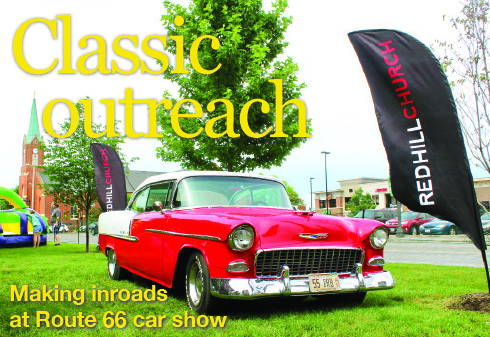
Classic Outreach

In a town proud of its Route 66 heritage, thousands gather every year to celebrate what John Steinbeck called “the Mother Road.” For more than 20 years, Edwardsville’s annual Route 66 festival at City Park has offered visitors fun, food, and classic cars. What was missing, realized church planter Rayden Hollis, was a gospel opportunity.

Hollis is the planter and lead pastor of Red Hill church in Edwardsville. The church isn’t quite three years old, and they don’t have their own building yet. But Hollis is passionate in leading his church by a missions strategy based on Jeremiah 29:7.

“Just as the Israelites, exiles in their community, were commanded to seek out the welfare of the city they were living in,” Hollis said, “it’s our philosophy that we too, as exiles, need to seek out the welfare of the city we live in and pray for it.”

That philosophy is at the core of Red Hill’s presence at their city’s summer festival—and it’s a noticeable presence. At this year’s event June 8-9, park visitors stirred the humid air with hand-held fans emblazoned with Red Hill Church. Diners at picnic tables ate under misting fans donated by the church. Dog walkers at the festival discussed their pets with dog walkers from Red Hill. Church members brought a bean bag set and played alongside park visitors.

Church Hits the ‘Mother Road’ from IL Baptist State Association on Vimeo.

And showcased just outside the church’s two tents at the festival: a 1955 Chevy Bel Air. The gleaming red and white car—made even more vibrant by the sun’s glare—attracted visitors to the Red Hill display.

To Hollis, Red Hill isn’t just about gathering for their Saturday evening worship, it’s about the church going out into the community and making the city better.

“I’ve been a part of churches where if the Lord removed that church from the community, the community wouldn’t even notice,” Hollis said. “We don’t want to be that church.

“We want to be so deeply integrated into the life of our community that if we were pulled out, it would have a devastating effect upon the regular rhythms that people engage in inside of our cities. So, we’re trying to find ways that we can step in and make an immediate impact and difference in the life of our city, just by observing what’s naturally happening in it.”

Nothing in return

Early on, Red Hill began to observe the rhythms and patterns of Edwardsville, seeking out ways to serve at city events with a focus to “breathe even more life into it,” Hollis said. “We want to be given an opportunity to show the city how much our church cares for it.”

Once Hollis learned of the success of Edwardsville’s Route 66 Festival, he knew he needed to get involved.

But at first, it wasn’t easy. Katie Grable, assistant director for the Edwardsville parks department, was uncertain about allowing a church to actively participate in the festival. “Initially I was a bit skeptical,” she told the Illinois Baptist. “Not because I was against a church partnership, but rather, I was nervous that their angle would be vocally evangelistic.”

Still, in 2015, Red Hill was granted permission to set up a photo booth tent in the far back corner of the festival. They provided props and space for festival-goers to pose for photos. “We wanted to do something that added to the festival’s success,” said Sarah Hollis, Rayden’s wife. “And through that, begin those gospel conversations with the park visitors.”

Realizing the potential to reach up to 10,000 people in one weekend, Rayden Hollis was eager to do more the next year. He asked Grable how Red Hill could best contribute to the festival, and the city’s success, from Red Hill’s own budget. His requests puzzled Grable, leading her to eventually ask Hollis what was in it for his church.

“Nobody just gives freely without wanting something in return,” Grable said. “And they were just willing to offer so much I eventually asked what Rayden wanted, and we would see what we could do to help.”

To Hollis, Grable’s question came as a surprise. “At first I didn’t know what she was talking about,” he said. “But then something really awesome happened.” Hollis was able to explain to Grable that what Red Hill was doing was meant to be a reflection of God’s love. Hollis further explained there wasn’t anything he needed but rather that the opposite was true. “I told her I had something that she desperately needed,” Hollis said. “And I got to share the gospel with her.

“Now the unfortunate news is that she didn’t receive Christ, but because of what we’re doing as a church, I got the opportunity to share with someone why we’re doing what we’re doing.”

Grable wasn’t yet ready to receive Christ, but she understood Red Hill’s genuine intent in giving. And a partnership blossomed between the Parks and Recreation department and Red Hill.

“It was through that experience that I finally realized this was just an honest willingness in wanting to help,” Grable said. “They’ve been our most frequent partner since then and are the only organization that is coming out to basically anything that we do in the city.”

Valued partners

Since their first involvement with the Route 66 Festival in 2015, Red Hill has come a long way at the event. Their photo booth tent is no longer in the far back corner of the park. It has instead been moved to the front.

“We even have a second tent where we pass out handheld fans,” said church member Casey Elmore. “And we do almost all the volunteering for the kids’ activities.”

Elmore emphasized Red Hill’s devotion to the city as a “heartbeat to serve and build relationships within our community. And through that, crack open those opportunities to share the gospel.”

The church is also fostering its relationship with the Parks and Recreation department, who has called on Red Hill to help open their newest park, and even made Hollis an administrator on their Facebook page.

The pastor thanks Illinois Baptists for giving through the Cooperative Program to help make his church’s outreach possible. 

“Events like this would never happen unless Southern Baptists of Illinois continued to give to the Cooperative Program, to the Mission Illinois Offering, and other Illinois Baptist offerings. So, to every pastor, thank you for inspiring and encouraging your church to give. And to every Illinoisan who’s given over the course of their lifetime, thank you.

“Your generous gift helps make this moment possible for us to be a gospel witness and to be the hands and feet of Jesus in this city.”

No girls allowed?

Lisa Misner —  July 26, 2018