Archives For November 30, 1999

The BriefingBans on travel to Miss., N.C., called ‘ridiculous’
At least nine U.S. cities and five states have banned non-essential travel by government employees to North Carolina, Mississippi or both, claiming religious liberty bills adopted there discriminate against homosexual and transgendered persons. Pastors and other Christian leaders call the bans “ridiculous.”

Women share abortion stories with the Supreme Court
Twenty-five years ago, two women found themselves in the same position: freshmen in college, pregnant and scared of derailing all they had worked toward. Both women walked into a Dallas abortion clinic. It’s what happened when they walked out, and in the weeks and decades that followed, that places them on opposite ends of the most significant abortion case to be heard by the Supreme Court in a quarter of a century. These and other women are sharing their abortion stories through friend-of-the-court briefs in the case of Whole Woman’s Health v. Hellerstedt.

Colleges welcome diversity, except evangelical Christians
San Diego State University recently withdrew official on-campus recognition from an evangelical sorority and an evangelical fraternity, stripping them of the privileges that all other on-campus student organizations possess. The problem according to the university was that these Christian student organizations were engaging in discrimination because they restricted their members to Christians in agreement with their statements of faith.

The footnote that could split the Catholic church
Some believe a footnote in Pope Francis’ new exhortation on marriage and the family, Amoris Laetitia could cause fractures in the Catholic church. There is an ongoing debate in the church about admitting remarried couples to the Eucharist. The footnote could further inflame that debate. Francis wrote, “In certain cases, this can include the help of the sacraments. Hence, ‘I want to remind priests that the confessional must not be a torture chamber, but rather an encounter with the Lord’s mercy’.”

Bible makes list of books most challenged
On the latest list of books most objected to at public schools and libraries, one title has been targeted nationwide, at times for the sex and violence it contains, but mostly for the legal issues it raises. The Bible.

Sources: Baptist Press, Washington Post, World Magazine, Gospel Coalition, Fox News

Stirring the Waters

After three years of declining baptisms, SBC leaders are calling it what it is—an evangelism crisis.

What happened to evangelism in the Southern Baptist Convention?”

The question, posed by SBC President Ronnie Floyd, came after the Annual Church Profile reports completed by Southern Baptist churches showed a third consecutive year of declining baptisms.

In fact, the total for 2014 (the most recent year for which national statistics are currently available) is the lowest number of baptisms since 1947. Southern Baptist churches baptized 305,301 people, a 1.63% decrease from the previous year. An in Illinois, the annual number of baptisms, which has hovered around 5,000, dropped to 4,400 in 2015.

“Deplorable” is how Floyd described the reality that even though there are more SBC churches than ever, and an ever larger population to reach with the gospel, it’s simply not happening—at least, not according to the baptism numbers.

Recently, Floyd and other SBC leaders have been increasingly vocal about how the numbers reflect an even bigger problem: an evangelism crisis.

“Lostness in North America is having a bigger impact on Southern Baptists than Southern Baptists are having on lostness,” New Orleans Theological Seminary President Chuck Kelley said at a recent chapel service.

The picture is bleak, but all is not lost, SBC leaders seem to agree. A turnaround is dependent on renewed appreciation for and dedication to evangelism in the Southern Baptist Convention and in individual churches. Church members need models, leaders who are soul winners themselves and can train people in the pews to share their faith.

“Let’s not be paralyzed,” Floyd wrote on his blog, urging Baptists to action. “Do something. Do more than you are doing now. Take a risk.

“Return to the importance of reaching and baptizing people.”

Mission drift

One reason some leaders cite for the SBC’s decline in baptisms, and overall in evangelism, is a culture that sidelines those things. In an address to the SBC Executive Committee in February, Floyd spoke about a critical shift that has brought the denomination to this point:

“Years ago, something happened where pastors and churches that reached and baptized people effectively came under the microscope of other Baptists who oftentimes did not have a heart for evangelism themselves. A culture of skepticism about evangelism began to creep into our convention. Evangelism began to die.”

Even the way we talk about evangelism is different, said IBSA’s Pat Pajak. The weekly opportunity to go out “soul winning” has been replaced with more politically correct titles such as outreach, or more often the practice has been lost altogether. “In the process, born-again believers have lost the passion and emphasis on reaching into the pagan pool and bringing the lost to Christ,” said Pajak, who leads the Church Consulting Team.

Recent research supports this: A 2012 study by LifeWay Research found that while 80% of Protestant church-goers believe they have a personal responsibility to share their faith, 61% hadn’t told anyone how to become a Christian in the previous six months. Nearly half (48%) hadn’t invited an unchurched person to attend a church event or service in six months.

LifeWay Research President Ed Stetzer broke down the research this way: “…The typical churchgoer tells less than one person how to become a Christian in a given year. The number for more than half of respondents was zero. The second most frequent answer was one.”
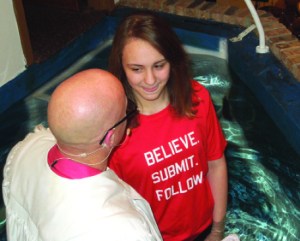
The shirt says it all -- Emily Zimmer is baptized by Pastor Tracy Smith at First Baptist Church in Mt. Zion.

The shirt says it all — Emily Zimmer is baptized by Pastor Tracy Smith at First Baptist Church in Mt. Zion, one of many congregations in Illinois that experienced large increases in baptisms in 2015.

To right the ship, SBC leaders have pointed first to the need for spiritual awakening—first in churches, then in the culture at large. But there are also solutions to be found at the denominational level and in local churches, starting with leaders.

Floyd recalled a time when only preachers who led strong evangelistic churches were invited to speak at the SBC Pastors’ Conference and annual meeting. Those leaders were also the ones nominated for denominational offices. In his November blog post about the state of evangelism in the SBC, Floyd seemed to call for a return to those principles.

“Quite honestly, I am not impressed by how many books a pastor sells, how many Twitter followers he may have, at how many conferences he speaks, how great of a preacher he is, or how much his church does around the world if he pastors or is associated with a church that has a lame commitment to evangelizing and baptizing lost people and reaching his own community with the gospel of Christ.”

At the local level, too, leaders can help reverse the decline by creating an environment that is conducive to evangelism, said IBSA’s Mark Emerson.

“The pastors who are effectively reaching people for Christ are creating an environment of evangelism in their churches,” said Emerson, whose Church Resources team equips churches in evangelism.

“They are making sure every ministry has an evangelistic purpose, they are designing their worship services to communicate the gospel and offer an opportunity for people to make a decision. These churches are training their members to effectively enter into gospel conversations.”

Modeling evangelism

Scott Foshie is one pastor currently training his congregation to have those gospel conversations. Steeleville Baptist Church will start evangelism training in April, based on the “Can We Talk?” program created by Texas pastor (and FBC Pastors’ Conference President) John Meador.

“When it’s time to bridge a conversation from small talk to gospel talk, that’s an awkward transition for people to make,” said Foshie, who has pastored the church since early 2015. The six-week curriculum combines training with practical experience; teams of three people go out into the community, visiting neighbors and practicing gospel conversations.

Foshie’s personal stake in the training goes beyond the fact that it’s happening at his church. As a student of the F.A.I.T.H. evangelism training tool, he led his future wife, Audra, to faith in Christ.

“Personal evangelism training is very important to me because it changed my life. So, I want people to experience that. Personal evangelism training unleashes the army of the Lord, (it’s) what God has called us to do.”

But first, people have to face down a common obstacle: fear. The pastor likened sharing the gospel to someone handing you the keys to their sports car and telling you to take it around town.

“What we need to teach them is, hey, you step out in faith, you begin to learn to share, you simply share, and the Holy Spirit’s going to help you,” Foshie said.

“Once people learn to share the gospel, it changes their life completely.”

Metro St. Louis leaders ready for Crossover partners

Crossover-Banner-smallSt. Louis | As Southern Baptists across the country turn their eyes to St. Louis, Ronny Carroll is more than ready to receive a few thousand extra laborers in order to achieve a great harvest.

“With the manpower coming, our churches can really pull off something God-sized,” said Carroll, executive director of missions for the Metro East Baptist Association, which serves the Illinois side of the St. Louis area. “The preparation alone has already given our churches a boost of energy and excitement in anticipation of what God’s going to do.”

Crossover St. Louis will take place on June 11, just before the 2016 Southern Baptist Convention (SBC) annual meeting, which will be held June 14-15 at the city’s America’s Center. Crossover will include more than 70 service and outreach projects throughout five counties in the St. Louis metropolitan area.

Prior to the 2015 SBC annual meeting in Columbus, Ohio, thousands of seeds were planted resulting in at least 345 people who made professions of faith. Carroll is hoping to double that this year.

“We are praying for 1,000 souls to come to Jesus and for 27 new churches to be established,” he said. “I believe God is going to do his job, we just need to be ready for his movement.”

Carroll said that during the last few months and even years, God has been paving the way for an epic revival of hope and healing to break out in St. Louis. And he said God has used Southern Baptists every step of the way.

“Look at all that has happened, in particular the flooding that occurred around Christmas, where Southern Baptists have been the hands and feet of Jesus,” Carroll said, referring to SBC Disaster Relief efforts in St. Louis just a few months ago. “At one level, Crossover will tie into the work that has already been done and add one more dimension to the truth that Southern Baptists, as individuals and as churches, really care about the people and the communities and quality of life they have. They are primed and ready to receive the eternal hope and salvation that Christ offers.”

And to do that, Carroll said the plan for Crossover St. Louis is to “keep it small, but make it huge.”

Crossover will impact churches in six different associations in both Missouri and Illinois. But, because of the unique needs within each association and community, the projects are indigenous to what will make the biggest impact in a given neighborhood.

“Each church has its own local vision and the 21 projects on our side of the river reflect the unique flavor of our communities,” Carroll said. “We are working with city officials and mayors for some of our cleanup projects and planning block parties, or fiestas, in some of our growing Hispanic neighborhoods.”

Tom Firasek, ministry and partnership coordinator for the St. Louis Metro Baptist Association, said organization-wise they are already miles ahead of where past Crossover events were at this stage of the preparation process.

“We met with Rich Halcombe (director of missions in Columbus) and other Columbus Southern Baptist leadership and spent the day learning what works, what doesn’t and what logistical needs might come up,” Firasek said.

“When you are about to support and rally behind 75 or so highly visible events at the same time, you want to be sure to orchestrate everything with excellence, while at the same time pointing to Jesus and proclaiming the gospel every step of the way.”

In addition, Firasek said between 100-150 seminary students will be joining the effort in St. Louis during the week leading up to Crossover.

“We would love to see God open up the needs and challenges of St. Louis so that some of these folks would consider planting their lives here or making ongoing partnerships here,” Firasek said. “In the metro area we have one church for every 7,500 people. We need more church starts.”

With Crossover St. Louis just a couple months away, Carroll said their biggest need is for more volunteers to commit to join them.

“If God’s leading you to be a part of Crossover, please commit to join us soon so we can get you partnered with a project,” he said. “Also, we would love for you to join us in prayer. We are praying God will flood us with his mercy and grace and that He will prepare the lost people to receive Jesus as their Lord and Savior.”

Carroll said they are also praying for churches to be ready to plug new Christians into their ministries and for church plants to grow quickly from the influx of new believers across St. Louis.

“God has already opened so many doors for the gospel to be presented in a mighty way here,” he said. “Pray that we will be faithful with the doors he’s opened.”

For more information on projects taking place during Crossover St. Louis visit the Metro East Baptist Association website at meba.org or visit namb.net/crossover.

Kayla Rinker is a freelance journalist in Missouri.

International Mission Board President David Platt says he wasn’t aware he would appear on a campaign video for Southern Baptist Convention President nominee J.D. Greear, according to a report by the Louisiana Baptist Message.

Platt_blog

International Mission Board President David Platt (BP photo)

The video, posted on YouTube shortly after Greear’s nomination was announced in March, was created by Ashley Unzicker, whose 2014 rap pardoy schooled Baptists on their own history (set to the theme song from “The Fresh Prince of Bel-Air.”) Unzicker’s new rap about Greear’s candidacy features cameos by SBC leaders, including Platt, Ethics and Religious Liberty Commission President Russell Moore, and Southeastern Seminary President Danny Akin, saying the line “It’s tricky.” (The rap is set to Run-D.M.C.’s 1986 song of the same name.)

In response to the video, some outlets (including this blog) have questioned whether SBC leaders should be seen as endorsing one candidate over another.

Baptist Message editor Will Hall informed fellow editors in an email April 4 that Platt “denies he knowingly endorsed J.D. Greear for president of the Southern Baptist Convention, stating he was not aware Greear’s request for a video clip was for the purpose of creating a campaign ad.”

In an email response to an IMB trustee March 23, Platt said he was overseas when Greear asked him to shoot the 2-second video clip, but he wasn’t aware how it would be used.

“Please be assured (and please assure anyone who asks you about it) that I am not personally (and we are certainly not organizationally) endorsing anyone for SBC president,” Platt wrote. He said he would “be thrilled” to serve alongside Greear or Steve Gaines, the pastor of Bellevue Baptist Church in Memphis, Tenn., who was announced as a candidate March 9, or “any other faithful Southern Baptist pastor who might be nominated to serve in this important role.”

Platt added that he had called Gaines “to assure him that I was not in any way ‘endorsing’ J.D., and I expressed my delight in the prospect of Steve potentially being in that role. We had a great conversation about his vision for the SBC, and I am completely confident in the Lord’s leadership in whoever serves in this role for the next couple of years.”

David Crosby, pastor of First Baptist Church, New Orleans, was announced on March 24 as a third nominee for the denomination’s top elected post. Messengers to the Southern Baptist Convention in St. Louis will vote for the office of president on Tuesday, June 14.


Lessons from Tom Adams

ib2newseditor —  March 31, 2016
Tom Adams

Tom Adams

It still surprises and moves me that so many people in Illinois Baptist churches fondly remember my father Tom Adams, or at least his writing. Dad entered his eternal life with the Lord ten years ago, just one month after I began my role here as IBSA’s executive director. Yet more often than not when I visit a church, one or more of its members will tell me how much my dad or his writing meant to them.

In fact, it’s not uncommon for one of those older church members to reach into their Bible and pull out a yellowed clipping of one of his columns because it met a particular, deep need in their lives. Dad wrote for the Illinois Baptist for 34 years, through columns such as “Problem Corner,” or “Ask Tom Adams.” So he became a sort of corresponding counselor to many.

Frankly, I thought I would have my dad’s counsel for a few more years here in Illinois.  Instead I have needed to rely on the years I had to observe him as father, pastor, and associational leader. With his memory in my heart, here are some of the lessons I learned from Tom Adams.

1. Writing broadens and lengthens influence.
Dad never pastored a large church, nor held a position of great stature. But because he wrote down carefully considered thoughts at least every couple of weeks for decades, he touched tens of thousands of people he wouldn’t have otherwise.

2. Few words can be more impactful than many words.
Dad was a man of few words interpersonally, and the format of his columns gave him only a little room to express an opinion or idea in writing. But he demonstrated both in speech and writing that a few, carefully considered words can have great impact. Apparently they also fit better in your Bible.

3. Readers are better leaders.
My dad would be the first to admit that his wisdom didn’t come from his own deep intellect or extensive formal education. But he was one of the more widely read men I have ever known. Just ask my mom, whose house is still filled with an incredible variety of books, even after giving many away. I’ve never been the avid reader my dad was. But I’ve rarely gone in to a serious meeting or problem without doing my homework.

4. Face your fears with faith.
I didn’t know it until years later, but my dad was scared to death to move our family from Southern Illinois to the Chicago area. My mom tells me he became physically ill over the decision to follow God’s call there. What was very hard for him became very good for me, and in their own ways for the rest of our family. For reasons I can’t go into here, I doubt very much if I would be at IBSA today if he hadn’t made that move when I was fourteen. But his example helps me face my fears with faith, even today.

5. Invest fully where you are.
Dad was never a self-promoter, or a ladder-climber. I know he dreamed of another position or two in his life, but he always chose to invest fully where he was called, until God through others beckoned him elsewhere. Me too.

I jotted down some other lessons I learned from Tom Adams: Do what you know is right, and trust God with the consequences. Marry well and let your spouse be herself.  How you say something can be just as important as what you say.  Some burdens are best borne privately.  Leaders come in all personality types.

A few years ago my mom and I helped my dad organize some of his Illinois Baptist columns into a book, titled after one of his columns, “Speaking Out.” If you don’t have a copy and will write me, I will be glad to send you one. He would be pleased for you to have it.  And I will be pleased for his influence to touch your life, as it deeply has mine.

Nate Adams is executive director of the Illinois Baptist State Association. Respond at IllinoisBaptist@IBSA.org.