Archives For November 30, 1999

DallasThe Briefing Chief Brown relies on his faith
In the wake of the July 7 ambush that killed five Dallas police officers and throughout his life, Police Chief David Brown believes in bedrock Christian doctrine — faithful submission to God’s plan followed by an eternal reward. He sees his job as a “divine assignment” and brings a Biblical perspective to all his decision-making, said his pastor, the Rev. Tony Evans of Oak Cliff Bible Fellowship.

Iowa claims it won’t muzzle pastors
The Iowa Civil Rights Commission, in a “clarification,” says it will not muzzle churches that teach on matters of biblical sexuality, nor force them to open single-sex restrooms to members of the opposite sex. The commission said it has revised its brochure on “Sexual Orientation & Gender Identity” to state that churches generally are exempt from certain provisions of the state’s civil rights law.

Is Trump the end of the Religious Right?
The evangelical divide over Trump has been widening for months, but it was only in recent weeks that the pro- and anti-Trump camps definitively split, with an increasing number of conservative evangelicals coming out forcefully against the candidate. The breaking point came on June 21, when Trump—ironically in an effort to appease the religious right—met with nearly a thousand evangelical leaders and announced a 25-person “evangelical advisory board” to help him reach conservative Christian voters.

Perry Noble fired
NewSpring Church, a multi-campus megachurch based in Anderson, S.C., announced Sunday that the church’s board of directors and pastor advisory team fired Senior Pastor Perry Noble for alcoholism, marital problems, and other “unfortunate” choices. Noble served as pastor of the Southern Baptist Convention–affiliated church since its founding in 2000.

Bill Nye tours Ark Encounter
When evolutionist Bill Nye “the science guy” visited a life-size replica of Noah’s Ark in northern Kentucky, he wanted to learn how children were reacting to what he has called a danger to science education. By the time he left the Ark Encounter theme park, he had also learned the story of Christ’s atoning death on the cross for humanity’s sins, Ark Encounter’s chief executive Ken Ham said, underscoring the park’s value as an evangelistic tool.

Sources: Dallas Morning News, Daily Signal, Politico, World Magazine, Baptist Press

Fractured alliances

ib2newseditor —  July 11, 2016

Fractured alliances

As the national political conventions approach, it’s time for evangelicals to decide. For some, it’s a choice they’d rather not make.

With the national conventions for both major American political parties just days away and the nominees all but a foregone conclusion, the only remaining question is how voters in November will react to this most unusual presidential election.

Christian voters in particular have yet to coalesce behind either candidate, although a June meeting between presumptive Republican nominee Donald Trump and nearly 1,000 evangelicals signaled things may be changing, at least for some conservative leaders.

And Trump’s announcement of an evangelical advisory committee, including several Southern Baptists, reverberated around the Twitter-sphere, shaking the unified front Baptists had shown just days before at the 2016 Southern Baptist Convention in St. Louis.

The divide is growing between conservatives who support Trump over Hillary Clinton’s liberal ideals, and those who say they won’t vote for the businessman-turned-reality TV star with a penchant for saying whatever is on his mind. Along with the differences among Christians, some pundits see a growing split between the traditional “religious right” and the Republican party.

“In the coming weeks, we are going to be learning a great deal more about the presidential candidates,” forecasted Southern Seminary President Albert Mohler in a recent edition of his Briefing podcast. “But it’s also increasingly true that we’re going to be learning a great deal about ourselves as evangelical Christians in America.

“Perhaps we’d better brace ourselves for what we’re going to learn.”

Meeting the Donald

On June 20, Donald Trump met in New York City with nearly 1,000 Christian leaders, including immediate past president of the Southern Baptist Convention Ronnie Floyd and newly elected president Steve Gaines, along with several other Southern Baptists.

The gathering, emceed by former Republican candidate Mike Huckabee, included a Q&A time with Trump, who has won over conservative voters in the primaries even as Christian leaders have decried his volatile speaking style and confession last year that he wasn’t sure he had ever asked God for forgiveness of his sins.

Following the meeting, Trump named a 25-member evangelical advisory board, which includes Floyd and at least seven fellow Southern Baptists. Floyd is among the members of the board who say their participation doesn’t constitute an endorsement of the candidate, rather “as an avenue to voice what matters to evangelicals,” he told The Christian Post.

Floyd also cited several key issues that compelled him to participate on Trump’s advisory board, including Supreme Court appointments, the sanctity of human life, religious liberty, Israel and the Middle East, and racial tension.

But many Christian and conservative leaders took issue with the meeting and the participation of those appointed to the advisory board. Russell Moore, president of the Ethics and Religious Liberty Commission and a recent Trump target on Twitter, took on the seeming divide between Trump’s public persona and his coziness with evangelicals:

“If you wondered why younger, theological, gospel-centered evangelicals reacted (negatively) to the old guard Religious Right, well, now you know,” Moore tweeted June 21, following up with, “If character matters then character matters.”

Moore wasn’t the only voice to question the authenticity of Trump’s relationship with Christians. Writing for The Federalist online, film critic Rebecca Cusey described reading through the meeting transcript, “thinking maybe Trump might exhibit some charm, some thoughtfulness in a smaller setting that is lost on the large stage, something that would explain why people who profess to believe in Jesus would be so taken in by Trump.

“Sadly, no. The transcript is shocking in its pandering: of Trump to evangelicals, yes—we expected that—but also in their pandering to Trump.”

Floyd acknowledged the widespread criticism, blogging a few days after the meeting that his short time out of the office of SBC president had been in some ways more difficult than leading the denomination for two years. He listed several Bible characters who had opportunity to speak into the lives of national leaders, including Old Testament prophet Daniel.

“What if Daniel had refused to acknowledge King Nebuchadnezzar and acted like he was too righteous to relate to him?” Floyd asked.

Similarly, Richard Land, who preceded Moore as president of the ERLC, asked critics of the Trump meeting what they would have the advisory team do instead of participate when asked.

“Would they really have us spurn the opportunity to give spiritual counsel and advice to Mr. Trump and his team?” Land wrote in a column for The Christian Post. “How would that be obedience to our Saviour’s command to be the salt of the earth and the light of the world?”
Fractured alliances 2

 Weighing other options

Some evangelicals are looking to Democratic candidate Hillary Clinton as an alternative to Trump, in spite of her policies on abortion and LGBT issues that run counter to traditionally-held conservative views.

Thabiti Anyabwile, in a column for The Gospel Coalition, said in May he planned, for the time being, to vote for Clinton. “…However we might evaluate her as a leader or her platform as a vision for America, we could say more or less the exact same things about Trump—with one glaring exception,” wrote Anyabwile, pastor of Anacostia River Church in Washington, D.C.

“We have no way of predicting Trump’s behavior from one hour to the next. None. Except to predict that the behavior will be vile and repulsive for any person who cares about civility, truth, and the dignity of the office.”

Deborah Fikes, executive advisor to the World Evangelical Alliance, gave Clinton her endorsement in June, saying of Trump, “…I worry that allowing religious and ethnic intolerance here in America will undermine our ability to have a prayer of fighting it around the world.”

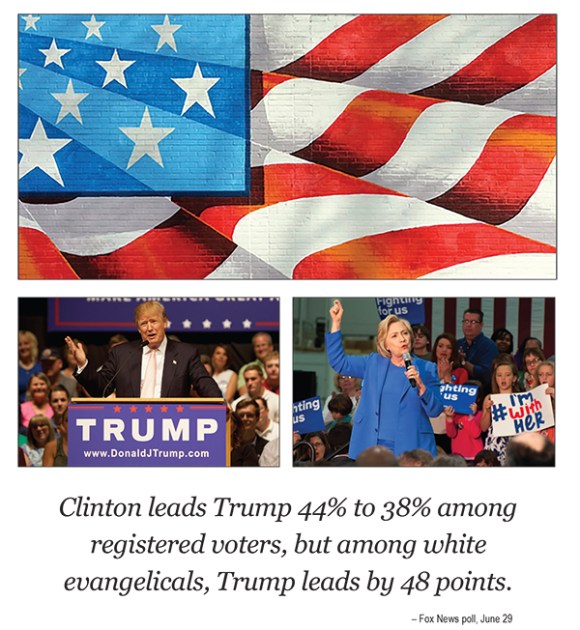
Still, Trump has branded himself as the candidate most invested in religious liberty and other Christian concerns. So far, a majority of voters agree: A June poll by CBS found Trump leads Clinton among evangelical voters by a margin of 62% to 17%.

However, as Religion News Service’s analysis of the poll pointed out, Trump’s 62% is lower than the percentage of white evangelical voters who favored George Bush (79%), John McCain (73%) and Mitt Romney (79%) in the last three elections.

Gallup polling from May found the two candidates neck and neck among those who identify as “Protestant” or “Other Christian”—36% had a favorable opinion of Clinton, and 38% had a favorable opinion of Trump. Both candidates’ numbers were slightly lower among the “Highly religious”—35% for Clinton and 37% for Trump.

For those voters who don’t foresee an appealing option for November, Christian and conservative leaders have floated other ideas, including third-party candidates, write-in voting, and abstention. Alan Noble, a professor at Oklahoma Baptist University, wrote for Vox that “unless a third-party candidate with broad appeal emerges, evangelical Christians would be better served by abstaining from that vote and shifting their energy toward electing people to Congress and local and state governments who have the opportunity to restrain whichever candidate is elected as needed.”

But many Christian leaders have been vocal about getting out the vote, even for candidates that are less than ideal. On his tour of state capitals, evangelist Franklin Graham has urged Christians to vote, but hasn’t endorsed specific candidates. Graham has instead warned against inactivity, citing a statistic that reports 20 million evangelicals did not vote in the 2012 presidential election.

In Springfield, Graham told several thousand gathered in front of the Capitol, “Our job as Christians is to make Christ felt in every [area] of life—religious, social, economic, political.”

Keep the lines open

No matter who believers support in the election, said Wheaton College’s Ed Stetzer, the rhetorical tone should be loving.

“In years past, I generally had to encourage evangelicals to avoid scorning fellow evangelicals who voted Democrat. Now, perhaps we need exhortation to avoid scorning those who vote for Donald Trump….Rather than looking down with scorn on evangelical Trump supporters, perhaps we should sit down with them, listen to them, and hear their concerns.”

Mohler prescribed similar action in his June 22 podcast, urging Christians to think through the issues at hand.

“In this difficult political season, evangelicals must not demonize one another as to how we’re thinking through these issues, but I must plead with all evangelicals that we must indeed think through these issues carefully and faithfully, and think very biblically and candidly.”

To fail to remember oneness in Christ and fall instead into factions and camps could result in a loss of the unity achieved during the recent Southern Baptist Convention, wrote Pastor Ted Traylor following the meeting with Trump, which he attended. At the June 14-15 convention in St. Louis, Baptists united around one presidential candidate, Steve Gaines, after another, J.D. Greear, bowed out prior to a second run-off election.

Now, as Baptists consider another election, Traylor, pastor of Olive Baptist Church in Pensacola, Fla., advised them to think carefully in a blog post titled, “What I learned from a conversation with Donald Trump.”

“There has been much vitriol on social media about the Trump meeting within the tribe of Southern Baptists. We left our convention last week in unity. Demonizing each other over secular politics will quickly destroy what we saw and hailed as God-given unity. We are in the Gospel business.

“However, as we render to Caesar what is his we must be wise, kind and discerning.”

I did not grow up a Southern Baptist. In fact, I only stumbled into the denomination 12 years ago. But every year I become happier and happier to be associated with this great tradition and organization. And this year’s Southern Baptist Convention in St. Louis made me more pleased than ever before to be a Baptist.

Maybe I am set up for future disappointment. I hear that these meetings are not always as eventful. This year, attendance was up. Emotions were high. We gathered in the immediate wake of the mass shooting in Orlando, the worst in our country’s history. We remembered the tragic shooting in Charleston one year earlier and acknowledged the racially charged atmosphere reflected in nearby Ferguson. “Election” also loomed large. The theological understanding of the term was a subtext for the hotly contested SBC presidential election. And the upcoming U.S. presidential election was in everyone’s mind.

One of the most memorable moments for me, though, came amid a flurry a motions presented to convention messengers. One brother from Arkansas had requested the removal of Southern Baptist officials or officers who support a right for Muslims in America to build mosques. The next day, after the Ethics & Religious Liberty Commission’s report, the same brother pressed ERLC President Russell Moore on the issue, likening the defense of the right to construct mosques to Jesus endorsing the erection of temples for Baal in ancient Israel.

As our culture unravels, we must remember our hope is in Christ, not country.

Dr. Moore’s response was sharp and received by the majority of messengers with applause. “The answer to Islam is not government power,” he said. “The answer is the gospel of Jesus Christ and the new birth that comes from that.”

In defending the idea of soul freedom for every individual, he illuminated a critical theological concept that lies at the heart of being Baptist. I am referring to religious liberty—the belief that no religion should be established by the state, but all faiths should be free to win adherents through the power of persuasion and not the sword.

In our history, Baptists have been persecuted by the government for non-conformity. We have seen the damage done by state churches to true religion. We do not baptize babies, in part, because we believe you cannot be born a Christian. Everyone must be genuinely converted without coercion. This should compel us to a radical witness to our Muslim neighbors and refugees, not to seek political action against them.

Recently there was a debate between a Christian and an atheist at the university near our church. It was sponsored by an evangelical campus ministry. To get there, you took the escalators to the third floor and turned left to find a small room with perhaps 100 mostly Anglo attenders. That same night, in the large room to the right of the escalators, there was a banquet for Islam Awareness Week with hundreds of Muslims from places like the Middle East and South Asia.

The lesson is this: We can wring our hands at the growing influence of Islam in the U.S., or we can get to work witnessing in new ways. Now is not the time for fear, but for bold faith.

In the New Testament era, the church is an altogether different institution than the state, with distinct ends and means. The two cannot be confused. So today, the proper analog to Baal altars in Israel is not Islamic Centers in Wheaton. It is idolatry in the corporate worship of the Church.

Patriotism definitely has its place, but perhaps one appropriate application would be to examine whether nationalism has crept into our Christianity. There are many forms of syncretism. As former SBC President James Merritt eloquently said in favor of a resolution to cease display of the Confederate battle flag, “Southern Baptists are not a people of any flag. We march under the banner of the cross of Jesus and the grace of God.”

As our culture continues to unravel and even the Bible Belt unbuckles, we must remember that our hope is in Christ, not country. His kingdom is unshakeable. And in many ways the dismantling of cultural Christianity that fused God and country is a good thing for the cause of the gospel. We Baptists want real believers that worship Christ alone, even if they are persecuted by a secular state or Islamic State.

– Nathan Carter is pastor of Immanuel Baptist Church in Chicago.

The BriefingTransgender troop ban repeal called ‘disastrous’
The Obama administration’s decision to allow openly transgender people to serve in the U.S. military has been classified by Southern Baptist leaders as “deluded,” “disastrous” and a step toward self-inflicted “national weakness.” Mark Coppenger, a former Illinois pastor and retired Army officer, said lifting the ban imperils “decency” and “military readiness.

Justice Alito’s warning about religious freedom
The Court’s decision not to hear a case challenging a Washington state law that forces a family-owned pharmacy to dispense emergency contraceptives is an “ominous sign” for those who value religious freedom, Justice Samuel A. Alito Jr. said. “If this is a sign of how religious liberty claims will be treated in the years ahead, those who value religious freedom have cause for great concern,” Alito said in a critical dissent.

SCOTUS marriage ruling sparked ministry
Numerous Baptist state conventions have helped equip churches for ministry in the new marriage culture. “Our energy is going into making sure churches understand their religious freedoms regarding same-sex marriage assertions, and helping them take steps to protect those liberties through their bylaws and written operating procedures,” said IBSA Executive Director Nate Adams. We have used conferences, articles and especially downloadable resources on our website to make these protections as accessible to churches as possible.”

We’re talking about religion
When it comes to who’s having those religious conversations with family and friends, it’s particularly evangelicals and black Protestants. The majority of evangelicals talked about religion in the last month with their immediate family (70%) and people outside their family (55%). Most black Protestants also had religious conversations with immediate family (61%) and extended family (51%). \

Russian law would prohibit evangelizing
The proposed Russian laws, considered the country’s most restrictive measures in post-Soviet history, place broad limitations on missionary work, including preaching, teaching, and engaging in any activity designed to recruit people into a religious group. To share their faith, citizens must secure a government permit through a registered religious organization, and they cannot evangelize anywhere besides churches and other religious sites. The restrictions even apply to activity in private residences and online.

Sources: Baptist Press, Daily Signal, Baptist Press, Facts and Trends, Christianity Today

Church in the United StatesThe election for President of the Southern Baptist Convention last month understandably attracted a lot of attention. But I was just as intrigued with the election for President of the annual SBC Pastors Conference that took place the day before.

Dave Miller, pastor of a medium-sized church in Sioux City, Iowa, somewhat surprisingly prevailed with 55% of the vote. The Pastors Conference President has traditionally been a megachurch pastor, often from a southern or larger state.

From my perspective, Pastor Miller ran not so much on his personal ministry resume as on a platform of ideas that proposed taking at least the 2017 Pastors Conference in a very new direction. Conference speakers would be only from SBC churches. No one who has spoken at the Pastors Conference in the past five years would speak at the 2017 meeting. Speakers would represent a diversity of geography, age, ethnicity, preaching style, and perspective. And there would be a focus on inviting pastors to speak who lead churches of 500 or fewer.

I’m glad we are reminded that these churches have a lot
to offer.

Not many of these parameters describe the Pastors Conferences of recent years, and the new ideas clearly resonated with a majority of those voting. Pastor Miller was elected, and his response the next day in his SBC Voices blog reminded me a little of the old adage, “Be careful what you wish for.” He wrote, “The budget of this two-day event is pretty much the annual budget of my church…But we are in this together and we are going to be looking to expand our circle.”

While I personally would have been glad for either candidate to lead next year’s Pastors Conference, I can’t help but feel a sense of satisfaction in the ideas that it appears will now influence next year’s program. I too have wondered why the same men sometimes speak in consecutive years of the Pastors Conference, or why speakers aren’t always from SBC churches.

Most of all, as a Midwestern Southern Baptist, I celebrate the idea that there are gifted preachers in small to medium-sized churches, and in churches outside the Deep South, and in churches of diverse cultural settings. The Pastors Conference will benefit from some of these voices, as it has from the gifted communicators who lead many of our megachurches.

After 10 years at IBSA, I still speak in or visit a church for the very first time at least once or twice a month. Many times someone in those churches will say something like, “We didn’t think you would come to a church our size,” or “We waited until our 100th anniversary to invite you because we know you’re so busy.”

I’m always humbled and a little embarrassed by those assumptions. So I want to say again that IBSA and I personally truly desire to serve and assist each and every local church we can, regardless of size, location, ethnicity, or age. Especially if I’ve never been there, I would love to come to your church, to get to know your church family, and to listen to your pastor or give him a week off, whatever serves the church best.

The average Southern Baptist church in Illinois had about 80 in worship last year. Across the SBC, the average was around 110. It may be that larger churches tend to have more full-time pastors and more practiced and polished preachers. But the ones I’ve been learning from all my life lead these wonderful, average churches. I’m glad a pastor from western Iowa reminded us that pastors from these churches have a lot to offer. And I’d love to come and worship in yours sometime soon.

Nate Adams is executive director of the Illinois Baptist State Association. Respond at IllinoisBaptist@IBSA.org.

Braveheart screengrab via YouTube

Braveheart screen grab via YouTube

The great experiment in democracy is in trouble.

We have only to look at the presidential election to see the truth in that statement. Apparently anyone can become president.

It is hardly believable that same-sex marriage was legalized in the U.S. only one year ago. In the brief time since, the moral ground beneath us has shifted with the force of tectonic plates in quake.

Not since William Wallace painted his face blue and led his native Scotland to a rousing victory over England has the world so needed someone to raise his fist and shout “freedom!”

On Broadway, the most popular show lauds our founding fathers (who, little did we know, were hip-hop artists!). But the freedom today’s culture celebrates is license, not liberty. In a few short decades the nation has abandoned the very principles on which it was founded.
Our founding fathers established this nation with a few basic understandings: individual rights are derived from a Creator and our civil laws are based on “the laws of nature and Nature’s God.” The great experiment in American democracy is also built on the presumption of an educated electorate, culture with a conscience, and society with a solid moral foundation. Tocqueville observed that in a democratic republic, education about the constitution and morality must remain inseparable.

Yes, our founders were sinners: ambitious, schemers, slaveholders, adulterers. But knowing the wickedness of the human heart, they crafted a system they hoped would hold those wills and ills in check. They held high the rights to “life, liberty, and the pursuit of happiness,” and more specifically, the basic freedoms of religion, the press, peaceable assembly, and the redress of grievances against the government.

Good luck with that. We can’t even get the Social Security Administration to answer the phone without a three-month appointment.

Congress is in gridlock, the Supreme Court issues endless rulings irrespective of morality, and the Administration makes edicts that endanger the psychosexual well-being of our children—all in the name of freedom. All in violation of basic common sense.

Not since William Wallace painted his face blue and led his native Scotland to a rousing victory over England has the world so needed someone to raise his fist and shout “freedom!” But it’s not freedom to have our own way that we need. What America needs is a fresh understanding that true freedom is liberty to be and do what God intends. Freedom that truly respects human dignity doesn’t allow people to destroy themselves and the nation by liberty gone wild.

Whom the Son sets free is free indeed.

The rest is just illusion.

– DER

The Briefing3 reasons evangelicals should care about Brexit
Although American evangelicals might think Brexit has little or no significance for them, the opposite is true. It shows we must find a way to mitigate the negative effects of globalization and trade on those who do not benefit. If we do not, we will be pouring gasoline on the fire of populist anger and passing up an evangelical opportunity to love our (populist) neighbor by helping find solutions to his very real problems.

Pew: Christians face more terrorism but less government hostility
From some angles, it looks like the beginning of a hopeful trend among the steady stream of persecution headlines. Both government and societal harassment of religion dropped worldwide in 2014, according to a recently released Pew Research Center study. This is the second year in a row that researchers found such a drop.

Court strikes down abortion provider regulations
In a 5-3 opinion, the Supreme Court ruled portions of a Texas law that regulate abortion doctors and clinics constitute an “undue burden” on a woman’s right to abort her child and are therefore unconstitutional. The high court’s reversal of the Fifth Circuit Court of Appeals in New Orleans invalidated a requirement an abortion clinic must meet the health and safety standards of other walk-in surgical centers.

Obama designates first national monument to gay rights
President Obama on Friday designated the first national monument to the gay rights movement, commemorating the Stonewall uprising in New York City. The site memorializes the six-day uprising that started after police raided the Stonewall Inn, a Mafia-owned bar frequented by gay men.

California’s religious liberty moment—coming to a state near you
Many faith-based universities hold to the traditional Christian view that sex and gender are distinct and united. If SB 1146 is passed without amendment, the state of California would drastically limit the religious freedom of such institutions to believe and live according to these traditional beliefs. In other words, the “free exercise of religion” becomes meaningless or restricted to only those schools that train pastors for ministry.

Sources: BruceAshford.net, Christianity Today, Baptist Press,  Washington Post, Christianity Today

Princesses and Hot Dogs

A lesson in leadership from a bold five-year-old.

A few days ago I saw a brief news story about a dance class for five- and six-year-olds, where the instructor had invited the little girls to wear costumes at their next rehearsal. She dubbed it “Princess Day,” knowing how many of her tiny dancers would enjoy dancing as princesses, and also how many of them already had princess costumes.

What helped the story go viral and hit the headlines, however, was the photo of seven little girls in princess costumes standing with one very unique little girl, dressed in a hot dog costume. Five-year-old Ainsley chose to come to Princess Day not with a tiara on her head, but with a stripe of mustard down her front. One of the many captions and tweets that circulated with the photo simply read, “In a world of princesses, dare to be a hot dog.”

“In a world of princesses, dare to be a hot dog.”

There are so many things that encourage me about this story. First, there is the individuality, confidence, and boldness of the little girl. Many times I have found myself wanting, even needing, to be the hot dog in a group of princesses. I had a minority opinion, or a different point of view, or simply knew that the direction of the group was not right. It’s just easier to conform than to stand alone.

Then there was the dad who encouraged little Ainsley. He later tweeted, “No parent is ready to learn that their daughter is trending…Best part is it was all her idea!” The courage and confidence to be different, and the empowerment to act on that difference, often comes from those closest to us.

But for me, the most encouraging character in this little real-life drama was dance teacher Sarah, who was suddenly placed in the position of leading a group with a non-conformist. Sarah could have taken offense at the little girl who didn’t follow instructions or apparently respect her position as teacher. She could have sent her home, or embarrassed her in front of the class, or not included her in the dance or the picture.

Instead, this good-natured teacher embraced the little hot dog’s uniqueness, accepted both her and her costume into the group, and proudly took the picture that ended up making her class famous.

In doing so, Sarah challenged me as a leader. And I think she should challenge all of us who lead as pastors, Sunday school teachers, and ministry leaders. As hard as it is to be the hot dog in a group of princesses, it may be even harder to effectively lead a group of presumed princesses when a hot dog shows up.

That hot dog may be the deacon with an outreach idea that would take a church outside its comfort zone. It may be the sincere new believer in a Sunday school class who asks questions that don’t have tidy or pat answers. It may be the church member who presses an uncomfortable budget issue in a business meeting, when it would be easier to just vote yes and go home.

A confident, secure leader embraces multiple points of view and even minority opinions as ways to potentially make the final decision or outcome even better. An insecure leader wants only quick, compliant agreement.

After the picture became famous, teacher Sarah revealed that Ainsley was actually wearing a princess costume underneath her hot dog costume. Ainsley explained that she was still a princess on the inside. I found that to be an extra encouragement. When we’re patient and accepting of hot dogs, even on Princess Days, we often find that deep down they want to dance too. And God may even use them, or you or me, to make the dance more famous.

Nate Adams is executive director of the Illinois Baptist State Association. Respond at IllinoisBaptist@IBSA.org.

Race panel

Resolution urges no more use of Confederate battle flag

The Southern Baptist Convention rejected use of an iconic Southern emblem, the Confederate battle flag still commonly seen in the South, because it is for many representative of slavery and ongoing racism against African Americans. The resolution states: “We call our brothers and sisters in Christ to discontinue the display of the Confederate battle flag as a sign of solidarity of the whole Body of Christ, including our African-American brothers and sisters.”

Its passage by a considerable majority was met with enthusiastic applause.

The vote came after an impassioned plea by Georgia pastor and former SBC President James Merritt, himself the descendant of two Confederate war veterans.

“Make no mistake, this is a seminal moment in our convention,” said Merritt. “I believe God has brought the SBC to both the kingdom and our culture for such a time as this. What we do today with this issue will reverberate in this nation, not just today, but I believe a hundred years from now. This is not a matter of political correctness, it is a matter of spiritual conviction and biblical compassion.”

Merritt proposed an amendment which strengthened the resolution, and removed a phrase some had used about “honor(ing) their loved one’s valor.” He substituted language to “discontinue the display of the Confederate battle flag as a sign of solidarity of the whole Body of Christ, including our African-American brothers and sisters.”

The amendment passed. While not all messengers who spoke supported the resolution, the will of the Convention was clear: Southern Baptists have broken with the racism of their past. After statements in 1995 and the election of an African American president in 2013, some expressed hope the sins of the past are repudiated as well as the flag.

SBC President Ronnie Floyd chose the St. Louis convention, just a few miles from Ferguson, Missouri, as the place to discuss racial reconciliation. Convention week began with outreach ministry in Ferguson, site of riots in 2014 following the police shooting of a black teenager.

Floyd told convention messengers, “America is…experiencing a racial crisis. Any form of racism defies the dignity of human life. Regardless of the color of human skin, God has put his imprint on each of us…Racism is a major sin and stronghold in America.”

Floyd staged a panel discussion, a rarity in SBC business sessions, called “A National Conversation on Racial Unity in America,” with 10 leaders.

“I am absolutely, totally convinced that the problem in America can be put totally at the doorsteps of our churches,” said Jerry Young, president of a mostly African American denomination, the National Baptist Convention.

Young noted Christ told his disciples to be the salt and light of the world, and he said Christians are failing in the task. “I challenge you to know that the problem in America is a problem with the church being what God called it to be….Here’s what needs to happen in America: Somebody needs to pass the salt and turn on the lights.”

The panel discussed the killing of nine people at Emanuel AME Church in Charleston, South Carolina last year. “That racially motivated murder hurt all of us,” said Marshall Blalock, pastor of the mostly white First Baptist Church in Charleston. “The white community for the first time began to understand.”

Blalock noted, “The killer was a terrorist, he wanted to create fear and cause hopelessness. But he went to church where there is no room for fear, or hate, or hopelessness…Only the gospel can eliminate racism.”

Kenny Petty, pastor of the Gate Church in St. Louis, said incidents such as the Charleston church shooting and police shooting of Michael Brown in Ferguson, Mo., exposed an infection. “That wound opened up and it reeked.” Since the shooting, “there has been some healing (in Ferguson), but we’ve got a long way to go. We found out that infection didn’t just stop with the culture, it went on to the doorstep of the church.”

“What we need is the mind of Christ,” Young said. “If we want to change racism in our churches and America we’re going to have to change our attitude through Christ.”

President of the SBC’s Ethics and Religious Liberty Commission Russell Moore called the convention’s action “an extraordinary moment.”

“We watched a denomination founded by slaveholders vote to repudiate the display of the Confederate battle flag in solidarity with our African American brothers and sisters in Christ,” Moore said.

– Lisa Sergent

Almost a thousand evangelical Christian leaders gathered in New York City Tuesday to meet with presumptive Republican presidential nominee Donald Trump. Among them were a number of prominent Southern Baptists. Eight were among the 25 leaders appointed to Trump’s evangelical advisory panel.

They are: Ronnie Floyd, immediate past president of the Southern Baptist Convention and pastor of Cross Church in northwestern Arkansas; Jerry Falwell Jr., president of Liberty University; Jack Graham, pastor of Prestonwood Baptist Church in Plano, Texas, and a former SBC president; Robert Jeffress, pastor of First Baptist Church in Dallas; David Jeremiah, pastor of Shadow Mountain Community Church; Richard Land, president of Southern Evangelical Seminary and former Ethics and Religious Liberty Commission president; James MacDonald, pastor of Harvest Bible Chapel in Chicago, which only recently joined the SBC; and Jay Strack, motivational speaker and founder and president of Student Leadership University.

Being on the advisory board does not amount to a full public endorsement (Falwell, Jr. is the only one who has publicly endorsed Trump) , however to many it does imply a tacit endorsement. Some have been critical of the leaders’ action, to which Land replied via an editorial in the Christian Post. “What would our critics have us do?,” he asked. “Would they really have us spurn the opportunity to give spiritual counsel and advice to Mr. Trump and his team? How would that be obedience to our Savior’s command to be the salt of the earth and the light of the world? (Matthew 5:13-16). After all, as Evangelicals we all believe that the heart of the king “is in the hand of the Lord . . . He turneth it whithersoever He will” (Proverbs 21:1).”

Current ERLC president, Russell Moore, has been a vocal opponent of Trump, tweeting Tuesday afternoon, “If you wondered why younger, theological, gospel-centered evangelicals reacted neg to the old guard Religious Right, well, now you know.”

And, a few minutes later, “Forget the politics. Forget the country. An unrepentant lost person pronounces himself to be a believer. And you stand there and applaud?”

At last week’s Southern Baptist Convention, in the President’s message, Floyd stated, “Our nation is divided. We are known more for being the divided states of America than the United States of America. The national political races we have observed over this past year personify the fractured, dysfunctional condition in America relationally.”

Floyd also led a panel on Pastor’s and Politics at the convention. He introduced the panel saying, “Disagreement doesn’t have to result in a strained relationship with brothers and sisters in Christ…This presidential panel is an attempt to address this conversation.”

Graham, who was one of the panelists urged Southern Baptists not to sit at home but to get involved in the process. “One concern we should all have 30-40 million stayed home and did not participate…This is a critical election for the future of America,” he said.

He pointed to three primary issues Christians should be looking at when voting for a presidential. They are choosing Supreme Court justices, belief in the sanctity of life, and maintaining religious liberty. Graham noted, “We must not abdicate our responsibility to pray and to vote.”

There words appeared to be at odds with other convention leaders. At the B21 Luncheon during the convention, Moore and Albert Mohler, president of the Southern Baptist Theological Seminary were among the panelists speaking. Replying to a question about the 2016 U.S. presidential elections, Mohler said, “I find myself in a situation I’ve never found myself in as a Christian. I’m going to find myself unable to vote for either candidate.”

Moore agreed and said he plans to write in a name on his ballot.

One thing is certain, there will be continued disagreement regarding the presidential election. Another thing is also certain, many in the U.S. appear to be having flashbacks to 1976 and having their own Howard Beale, “Network” moments in this election cycle.

– Lisa Misner Sergent