Archives For November 30, 1999

The BriefingAmericans most thankful for family & health
When Americans count their blessings at Thanksgiving, God will get most of the credit. And money might be the last thing on their minds. Most Americans are thankful for family (88%), health (77%), personal freedom (72%) and friends (71%). Fewer give thanks for wealth (32%) or achievements (51%), according to a new study from LifeWay.

Top Bible verse, topics of 2016 election
On Election Day, more people were searching the Bible for topics involving the end times than for praying for government. And the top Bible verse of the 2016 presidential election: 2 Chronicles 7:14.

Christian colleges grapple with election, views on women & minorities
Exit polls suggest 81% of white evangelicals voted for President-elect Donald Trump. But support for him may have been less decisive on Christian college campuses, where most students are also white evangelicals. Internal polls from some Christian colleges before the general election showed weaker Trump support than among the evangelical community at large. At Wheaton College in Illinois, 43% of respondents said they would vote for Clinton.

University: Religious volunteering doesn’t count
Two students are suing a Wisconsin university for denying them mandatory community service credits for work they did with a local church. The university claims their service projects violate a policy excluding hours that involve certain religious activities. The students, who filed a lawsuit in federal court, argue the policy is viewpoint discrimination and unconstitutional.

Protests at FBC Dallas draw spotlight
Protesters picketing First Baptist Church in Dallas will have no effect, pastor Robert Jeffress. “Look, these people, these protesters, aren’t opposing me or our church,” he said of the 50 or so protesters who picketed the church because of the pastor’s apparent public support of Trump during the contentious presidential campaign. “When I see these protesters, it kind of reminds me of a flea striking its hind leg against Mount Everest, saying I’m going to topple you over.

Sources: Facts & Trends, Christianity Today, Religion News, World Magazine, Baptist Press

Give thanks Autumn conceptual creative illustration

(Editor’s Note: Chicago Tribune columnist Joan Beck annually penned a list of things for which she was grateful, letting lines from a few famous hymns to guide her prayer. With appreciation, we borrow her literary form for our own version again this year.) 

As we gather together to count the Lord’s blessings, 396 years after the first Thanksgiving day, we are thankful once again that our forefathers brought forth on this continent a new nation… that survives even today, twelve score years later,

still committed as one nation, despite our divisions,
still committed to the proposition that all people are created equal,
still committed to pursuit of life, the cardinal freedoms, and happiness.

Our fathers’ God, to Thee, Author of Liberty, we are grateful—
For the rule of law and peaceful transfer of power,
for the right to vote, and whether we win or lose, we’re still one nation under God;
That truth, justice, and the American way, mystifying it at times may be
Is God’s gift, this noble attempt to govern well through liberty.

O Lord My God, when we in awesome wonder consider—
this year’s progress with cancer drugs, loyal dogs and healing hugs;
children raised with tender care, troops come home in answered prayer,
dear souls saved by God above…this is amazing grace, unfailing love.

O God, our help in ages past, our hope for years to come;
Wins we never dreamed came true, this was the year for champions:
Gymnasts, Phelps, and medals gold, victory laps and stories told
Of dedication’s sure reward, winners crowned and loss consoled;
Several million voices raised, the whole state rings with the praise;
Holy cow! a chant sublime, Go, Cubs, Go! It’s about time.

Count your blessings, name them one by one…
the bills were paid, the taxes too, the floors were sound, the roof was sure;
with many homeless, we were “homed,” many hungry, we were fed.

So thank you, Lord, for my three squares, Pease’s candy, deep-dish pizza,
Horseshoes, cornbread, and Cracker Barrel.
Forgive the irony, but thank you, too, for insulin and athletic shoes,
which we’ll use next year.

Surely, there are 10,000 reasons for my heart to say…Bless the Lord, O my soul, and forget not all his benefits.

In Christ alone my hope is found…and in a year of uncertainty, we have learned again the meaning of sovereignty, that God’s in charge whatever man plans, when the world’s unsafe we rest in Your hands. At day’s end with the lights turned out, we hold this blessed assurance close, that neither death, nor life, nor angels, nor principalities, nor powers, nor things present, nor things to come, nor height, nor depth, nor any other creature, shall be able to separate us from the love of God, which is in Christ Jesus our Lord.

Eric Reed is editor of the Illinois Baptist.

Taking the risk

ib2newseditor —  November 17, 2016

Serving Christ has always been dangerous. He said it would be. Now, even telling the stories of missionaries puts them in danger.

London | We can’t tell you their names. We can’t tell you where they live. We can’t really even tell you where they work. They are missionaries.

Times have changed. We all know social and cultural values have recently experienced massive upheavals in western nations. Religion has played a major role in these changes. Missions work is no longer tolerated in places it once was. Working to fulfill the Great Commission can no longer be done so openly.

We can’t tell you their names. We can’t tell you where they live. We can’t really even tell you where they work. They are missionaries.

Coinciding with these cultural shifts are changes within the Southern Baptist Convention’s largest missions sending agency. The International Mission Board (IMB) is adapting the way it does missions. When IMB President David Platt stepped into the role in 2014 he soon discovered the agency was facing a budget overspend of more than $200 million. Personnel costs would have to be greatly reduced with action being taken quickly. With a major and largely voluntary staff reduction in 2015, going from nearly 5,000 missionaries and staff to 3,800, IMB expects have a balanced budget in 2017.

The changes included cutting most of the communications team serving in Richmond, and replacing them with a small team of young communication specialists stationed at points all around the world. With them comes new strategies for engaging Southern Baptists with missionaries that take into account the risky business of gospel witness.

Not your mother’s mission magazine
You may have noticed the stories about IMB missionaries have changed. Remember Commission magazine, with its glossy photos and National Geographic style? Today’s mission stories are not written in a long, detailed format anymore. We don’t often see photographs of missionaries’ faces. The name of the countries where they serve may not be reported. There is a good reason for this. A very good reason.

horse-and-rider

SHADOW AND LIGHT – This photo from IMB’s
Instagram account shows their new communication strategy: show the missions concept, but protect the identity of the missionary. Posted with the photo is a brief message from the missionary: “Pray for God to provide me with a teammate willing to work in rough, remote places so we can reach the mountain shepherd people.”

Almost a dozen state Baptist convention newspaper editors met with members of the Board’s media network in London recently. The chief topic was security concerns.

“There’s spiritual warfare on the front lines,” a member of the media team shared. “A battle is going on against the spread of the gospel.”

For example, one missionary took all the necessary precautions. But when a photo that had been taken years earlier was found online it led to his undoing. Somehow a person in the country where the missionary was serving connected it with some other information online to learn the missionary’s true identity. It almost cost him his life.

He walked, unsuspecting, into a meeting and found the atmosphere was charged with anger. People once friendly were now menacing as they kept him there for hours shouting, “Is this you? Did you say this?” When he was finally allowed to leave, he gathered his family and they fled the country. His identity had been compromised and it was no longer safe for them to continue to spread the gospel message in that country.

The missionary life can require living in countries where it’s dangerous to be a Christian. But it can also be risky living in “safe” countries among those same people groups that are hostile to Christians. There are parts of Africa and Asia that have always been high risk and high security for missionaries. With the increased mobilization of people, now it’s not just there, it’s everywhere.

“There’s spiritual warfare on the front lines. A battle is going on against the spread of the gospel.”

In other cases, the country may feel it is already a Christian nation and therefore does not need to admit anyone into the country for the express purpose of doing mission work. In those places, missionaries enter as workers who are in the country to do charity work or other vocations.

Tell the old, old story—differently
If you visit the International Mission Board’s website, IMB.org, you can read its mission statement, “Our mission is evangelizing, discipling, and planting reproducing churches among all peoples in fulfillment of the Great Commission.”

In today’s world, technological advance has produced security issues, so can the missions stories be told to the people back home in the pews? It’s becoming more and more challenging. Things aren’t as simple as when Lottie Moon would write about her work in China and send the letter to Annie Armstrong to be copied (and recopied) by hand or typewriter, and distributed across the United States.

For years the National Woman’s Missionary Union’s prayer calendar in Missions Mosaic magazine has contained a birthday prayer calendar for missionaries. It listed their names and the countries where they served. In recent years, fewer real names or locations can be shared. Quite often a pseudonym will be used along with a region of the world, “South Asia,” for instance.

While the IMB remains committed to telling the story back home, they are having to become more and more creative in doing so. Lengthy articles are now less common and story vignettes are better vehicles not only due to safety concerns, but also for ever shrinking attention spans.

“The missionary life, missions sending, it’s always changing.”

This has caused the IMB to shift the way it creates the content of a story, looking more at the concept that describes the missions work. As a member of the media team said, “There are avenues of telling the story without focusing on people in specific locations. We’ve had to shift the way we’re doing content altogether.”

The use of social media including Instagram, Facebook, and Twitter is proving to be a good way for Southern Baptists to stay informed about missions. It connects with younger generations who need also to learn the importance of giving to missions through the Cooperative Program.

The IMB website has undergone a complete retooling and now sports a fresh look that supports this challenging new media world.

Another change is in the reporting on the safety of missionaries after breaking news events. Southern Baptists often express interest in how an event affects missions efforts in those areas. According to their website, “Due to security considerations for IMB personnel and the national believers with whom they work, we usually don’t discuss their locations. However, with any breaking news event, we are in contact with anyone who might be affected, due to travel or other reasons, to confirm their safety and security.”

A media team member summed it up: “The missionary life, missions sending, it’s always changing. There are always new security challenges necessitating a new way of telling their stories. Most of our missionaries, we can’t print their names.”

Lisa Misner Sergent will focus on London, a world city with many people groups, in her next report.

The BriefingNew outlook for high court cases under Trump?
Several Obama administration executive actions are currently in litigation and may disappear if Donald Trump’s administration undoes his predecessor’s policies. But many question marks remain about what executive actions Trump will take. One of the major cases at the Supreme Court this term, Gloucester County School Board v. G.G., addresses the matter of transgender restroom use in public schools.

Texas association may expel churches for LGBTQ views
Two Texas Baptist churches may be expelled from the Baptist General Convention of Texas for their welcoming open-door policies toward LGBTQ people, reports say. Wilshire Baptist in Dallas and First Baptist in Austin received letters from BGCT officials stating that because the churches had affirmed themselves with the LGBTQ people, they were “no longer being in harmonious cooperation with the BGCT.”

People donating to Planned Parenthood as Mike Pence
Some Americans unhappy with the election results have found a new way to protest. They’re sending donations to Planned Parenthood in the name of Vice President-elect Mike Pence, who has called for cutting off federal funds to the organization and — as governor of Indiana — imposed tougher restrictions on abortion for women in his state.

Muslim attacks on Egyptian Christians rising
The Christian and Muslim villagers grew up together, played on the same soccer fields as kids, and attended the same schools. But that didn’t matter on a recent day: An argument between boys sparked clashes between neighbors, with Muslims torching shops owned by Christians. A Christian farmer ran into the melee to protect his two sons. Someone in the crowd hit him with a stick. Others jumped in, striking him repeatedly until he fell to the ground with blood seeping from his head.

LifeWay won’t sell Amy Grant Christmas album
LifeWay Christian Resources will not be selling Amy Grant’s new Christmas album this year, and the manager for the Nashville-based singer says it’s because it’s not Christian enough for the Southern Baptist retailer.

Sources: World Magazine, Houston Chronicle, CNN, Washington Post, The Tennessean

Go Church Go!

ib2newseditor —  November 14, 2016

People in the form of  church.First let me say I how much I appreciate my many friends who are St. Louis Cardinals and Chicago White Sox fans, even those who seemed to suddenly become Cleveland Indians fans just prior to the 2016 World Series. I try not to be an annoying or gloating Cubs fan, though some might say that simply writing about the Cubs here makes me so.
But it’s not really the now-world-champion Cubs team or organization that I want to draw on for inspiration with these thoughts. Rather, it’s the persevering, always hopeful, and now victorious Cubs fans. Though I grew up a Cardinals fan like many in southern Illinois, five things have always drawn me to Cubs fans, and made me one of them.

Worldwide – The WGN cable network is probably most responsible for giving the Cubs a more than regional fan base. When wearing a Cubs logo, I have found other fans all around the country, and even around the world.

Wrigley – You just can’t deny the old world charm of the historic yet modernized stadium that the Cubs call their friendly confines. For true baseball fans, it’s one of the most inviting places in the world.

Waiters – As almost everyone now knows, Cubs fans had not seen a World Series championship since 1908. As the Series approached, numerous writers listed things that are more current than a Cubs championship, including the toaster and sliced bread itself. True, faithful Cubs fans are by definition those who patiently wait.

Winsome – While I’m sure we all know an abrasive Cubs fan or two, the overwhelming majority of Cubs fans I’ve known are friendly, hopeful, optimistic, and deeply loyal. Even though “lovable losers” is a label that’s practically become part of the official Cubs brand, you can’t get a rise out of a Cubs fan with that kind of insult. After all, until this year, what defense was there to that label? Cubs fans just smile, and winsomely recite their equally well-known mantra: “Wait ‘til next year.”

Winners – And finally, this year, we can add a new capital W that could only have been used in small case a few times over the past 108 years. This year, Cubs fans are winners. Their perseverance finally paid off. Next year has finally come. And in a demonstration of support and celebration that has now been labeled the largest gathering in American history, and seventh largest in world history, more than five million fans flooded the streets and parks of Chicago to relabel their lovable losers—beloved winners.

Now, how do I rationalize writing about baseball here? Well, almost any time I am moved or inspired by something in secular culture, I find it’s because I see in that event a reflection of something larger in God’s Kingdom, or God’s character, or God’s people. In this case, I think I find Cubs fans so inspiring (admittedly, some Cubs players are not) because I see in them a faint reflection of the same qualities I see in faithful Christians, and churches.

Throughout much of the world, including our own nation and state, faithful Christians are not seen as current winners. But, at least when we’re at our best, we are seen as winsome people who are patiently waiting for our victorious Lord Jesus to return. We are seeking to take our love and loyalty and gospel message worldwide. And yet we seek to make each local gathering place as inviting and friendly as the confines of Wrigley Field.

There will be a day when the five million that gathered to celebrate in Chicago will be a pale comparison to the tribes, tongues, and nations that will gather at the feet of Jesus, to worship him forever. But for now, a long-suffering group known as Cubs fans have reminded me of a more important group of people whose patient, faithful, hopeful perseverance will eventually be rewarded by victory. Go Church Go.

Nate Adams is executive director of the Illinois Baptist State Association. Respond at IllinoisBaptist@IBSA.org.

After a destructive election cycle, it’s time to ask some basic questions. 

Flag of USA painted on cracked wall. Political concept. Old text

Inwardly I chuckled when church historian Mark Noll said, “Evangelicalism is a fractious beast.” I was interviewing him for a documentary on the role Billy Graham played in the development of the evangelical movement when he founded Christianity Today magazine in 1956. As described by Noll, at the time a Wheaton College professor, evangelicals had no driving force other than their love for Jesus and desire to share him with the world.

In post-war mid-century America, the number of evangelicals, including Southern Baptists, was growing rapidly, but they were a people “about many things” as Jesus described Martha, with impact on society disproportionately weak compared to their numbers. They had no recognized think-tank to coalesce and articulate their conservative, biblical views and no central voice to bring those views to bear on culture, the courts, and behavior of the masses. No one was really paying attention to evangelicals as a political or cultural phenomenon.

We could use another Billy Graham today.

Graham remedied that by bringing top Christian thinkers together in his magazine, brought unity around a few ideals such that evangelicals over the next twenty years became a movement, and through a popular medium of the day he gave them a megaphone to broadcast their beliefs.

We could use another Billy Graham today.

Evangelicals today are fractured. The 2016 election cycle has divided us. While 4 out of 5 white evangelicals (the SBC’s predominant constituency) voted for Trump, that fact should not be read as evangelical unity. Believers who may have voted for Trump did so for a variety of reasons. Some were wholeheartedly behind the candidate; some were choosing “the lesser of two evils.” Some were motivated by religious liberty issues, or the future of the U.S. Supreme Court, or pro-life concerns.

No single issue or theology can be said to have brought together the 81% of self-identified white evangelicals who voted for Trump.

And there’s the other 19% who didn’t. And African Americans, Asians, and Hispanic believers who pollsters don’t measure as “evangelicals” and often lump in with other Protestants groups or even Catholics.

We are divided. The divides are between white and black, urban and rural, high levels of education and lesser. And in Southern Baptist life, we have seen some divide between older and younger Christians (especially Millennials), and notable differences among spokesmen for Baptist causes, and distance between leaders and pews.

What are the few things we will stand for—that will bring us together in the name of Jesus Christ?

For the first time in a generation, the Ethics and Religious Liberty Commission does not appear to have spoken for average Southern Baptists. Russell Moore and a few others were critical of Trump, especially on issues of character and behavior. On the other hand, a few leading megachurch pastors, including Robert Jeffress of First Baptist Church of Dallas, stood with Trump. Others kept mum. SBC president Steve Gaines advised not making politics a church issue, so as not to offend people who need to the hear the gospel.

In this election, there were many reasons for speaking up—or not. Thus, in their analysis of the Republican win, pundits may report evangelicals a “silent majority,” but if that is the case, this majority was bound by many motivations.

The need of the hour is for evangelicals, Southern Baptists in particular, to process this awkward election theologically—not practically, politically, or emotionally—and identify the kingdom-worthy reasons for future political involvement. What are the few things we will stand for—that will bring us together in the name of Jesus Christ?

Is it U.S. Supreme Court appointments that preserve religious liberty? Marriage, family, gender preservation?

Is it social justice and a biblical view of peace, poverty, and the sanctity of human life?

And what is the role of character and trustworthiness in supporting a candidate or, moving forward, working with a presidential administration? Which is mandatory for Christ-followers when choosing political allies: biblical political positions or biblical behavior? (It appears nearly impossible to find both in a single person these days.)

In the 1950s, Graham drew Christians together around conservative, biblical theology, and eventually brought that to bear on politics and politicians—not the other way around. At 98 (his birthday was the day before the election), does Graham even recognize the movement he codified?

Eric Reed is editor of the Illinois Baptist. 

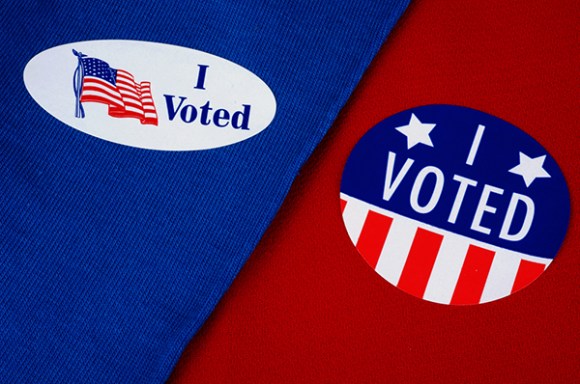
ivoted

A look at the electoral map says it all. A swath of blue on the West Coast and Northeast, and mostly red in the vast middle. Except for Illinois and Minnesota. We live in a divided nation.

For Christians, the issue today is how do we live Christ-like, now that the nation has chosen a president after a divisive and nasty two-year contest. Can we begin, as one observer put it, to love our neighbor who has “the wrong political sign” in his yard? Or to pray for political leaders of all parties to overcome division for the sake of the nation?

White evangelicals, white Catholics, and Mormons all supported Republican Donald Trump according to exit polls, while Black Protestants and Latino Catholics went for Democrat Hillary Clinton in the November 8 presidential election.

At 81%, the majority support for Trump by white evangelicals was a surprise to some, after leading evangelical leaders split on the candidate. His conservative stance on moral and political issues traditionally important to born-again believers was at odds with his irreligious lifestyle.

Russell Moore of the SBC’s Ethics and Religious Liberty Commission, is one of the few Southern Baptists who spoke against Trump, based on the candidate’s behaviors. Moore consistently urged Southern Baptists to keep conservative politics from swamping biblical beliefs. And his view the day after the election? He tweeted congratulations and called for prayer.

“The most important lesson we should learn is that the church must stand against the way politics has become a religion, and religion has become politics,” Moore wrote on his blog. “We can hear this idolatrous pull even in the apocalyptic language used by many in this election—as we have seen in every election in recent years—that this election is our ‘last chance.’”

But Robert P. Jones, CEO of the Public Religion Research Institute, counters, “Trump’s line—‘Let’s make America great again’—and his last-minute saying—‘look folks, I’m your last chance’—was really powerful for white evangelicals who see their numbers in the general population slipping.

“White Christians are declining every year by a percentage point or more as a proportion of the population,” Jones told Religion News Service. “So when Trump says, ‘I’m your last chance, folks,’ there’s a real truth to that.”

Some analysts attribute Trump’s victory to a middle-class, middle-of-the-country rebuke of the Obama legacy and the liberal cultural shift during his administration, as exemplified by the legalization of same-sex marriage and the recent actions on transgender issues. Others say Clinton lost, in part, because she ignored evangelicals.

“We asked for the votes of evangelicals and the Clinton campaign didn’t,” said Michael Wear, who served as faith outreach director for President Barack Obama’s 2012 re-election campaign. “It’s a campaign, you ask for people’s votes. And Hillary asked for just about every vote except this group of voters,” he told World magazine.

More prayer, more power

Arkansas pastor Ronnie Floyd didn’t endorse Trump while he served as SBC President. But the week after he was succeeded by Tennessee pastor Steve Gaines, Floyd was one of a handful of SBC leaders who attended Trump’s meeting with nearly 1,000 evangelicals. Now, Floyd advises prayer.

“Please prioritize praying for Trump….(and) for Vice President-Elect Mike Pence,” Floyd wrote on his blog. “Pray for wisdom, future, security, protection and leadership that will be extended to our nation. Pray for Trump as he selects members for his cabinet and begins the appointments of hundreds of people.”

The next move by evangelicals is to “stay in the game,” says Ed Stetzer of the Billy Graham Center at Wheaton College. Evangelicals who helped give Trump the office have a responsibility to help mold his presidency.

“There are many evangelicals who voted for Trump, and many Evangelicals who advised him,” Stetzer wrote for Christianity Today. “It’s time to advise him now that immigrants are made in the image of God, women are not tools and toys, racial and religious prejudice must be confronted, and so much more.”

Stetzer noted the decided shift on the importance of a candidate’s character to evangelical voters who supported Trump. “The answer is not for us to change our views on character, it’s to help a flawed candidate become a President of character.

“Evangelicals elected Trump,” Stetzer said. “Now they need to call him to a better way,” Stetzer said.

Eric Reed is editor of the Illinois Baptist.

Well, here we are

ib2newseditor —  November 9, 2016

Old Glory Flag

Though the majority of the nation is still surprised and in shock, half the nation is angry and hurting, and way more than half the nation is still overwhelmingly discontent with the outcome of last night’s election, here we are. The election process is over. Half of the country helped elect what they consider to be “the lesser of two evils” and the other half is stunned that the victorious candidate is considered by anyone to be “the lesser of two evils”.

As I have spent time reflecting on this election – this crazy, unbelievable, disappointing, and astonishing election – I have found myself ending up at the same place over and over again.

Though (I hope) few, if any, Christians would actually say this, most seem to view their political party of choice as the primary agent of cultural change and hope for our nation. Then again, I know many who would actually say that. But the idea that the Democratic Party is the party of God because it prioritizes things like diversity, equality, harmony, and caring for the poor, or, likewise, the idea that the Republican Party is the party of God because it prioritizes things like religious freedom, pro-life movements, and a conservative supreme court – needs to go.

Now, let me be clear – part of the beauty of our democracy is that we all have the freedom to care about certain issues and vote our conscience. That freedom is a gift from God for which every American should be grateful. But, Christians cannot continue to allow the church to become as polarized as our nation. Yes, our nation is more polarized than it has been in a long time because of this election and the events surrounding it. But in the face of such polarization, the church ought respond with unification, re-commitment to the Kingdom of God and the gospel message, and submission to the Lordship of Jesus Christ. Our identity as the Church defines us infinitely more deeply and profoundly than our identity as Republicans or Democrats. To see so much passion and so much anger surrounding this election only reminds us that so many have slipped into the idolatrous idea that our government is our savior and king.

Neither candidate was messiah and neither party is God’s chosen agent of change in this world – His Church is that agent of change. Neither party will deliver us from evil – only God will. Neither party can save us from a downward spiral, only God can. Neither party can offer true hope, only God can. There is no easier day and no easier year to see these truths than on this day of this year.

American is not God’s chosen nation. The Democratic Party is not God’s chosen party. The Republican Party is not God’s chosen party. And most importantly, neither party is His great love. The Church alone is God’s chosen people, whom he has drawn to himself and called to be the greatest agent of change the world has ever seen. The church alone is God’s embassy of hope, left here to represent his kingdom in this foreign land.

As we begin a new four year “reign” under a new political regime, may we constantly remind ourselves that Jesus alone is King and that his gospel message is the only message that matters.

Noah Adams is associate pastor at Calvary Baptist Church in Elgin, IL. He is also the son of IBSA Executive Director Nate Adams and wife Beth. This article was originally posted on Noah’s blog, Honest Thoughts About Church.

The BriefingExplaining the evangelical vote for Trump or Clinton
Last week, Donald Trump said that if evangelicals vote, he would win the 2016 presidential election. But while he commands a clear lead over Hillary Clinton for their support, surveys also show American evangelicals are much more divided this year compared to previous elections. Recent survey findings show how evangelicals are voting in 2016 and why.

High court accepts transgender case
The Supreme Court announced Oct. 28 it will review a lower court opinion regarding the right of a student to use the public school restroom that matches her gender identity rather than her biological sex. Oral arguments in the case likely will take place in early 2017, and an opinion is expected before the court adjourns next summer.

Danger follows Christian refugees to Germany
The situation of Christian refugees in German shelters is “unbearable” according to an updated report released this month and co-authored by Open Doors Germany. The report documents 743 cases of discrimination, death threats, and physical assaults against Christians by Muslim refugees between February and May of this year and claims the findings are only “the tip of the iceberg.”

Hatmaker books pulled over LGBT views
LifeWay Christian Resources has discontinued resources featuring bestselling Bible study author Jen Hatmaker just days after she voiced approval of gay marriage and the gay lifestyle. The Southern Baptist Convention entity has published several resources by the popular speaker and reality television star, including the bestselling B&H Publishing book, “7: An Experimental Mutiny Against Excess.”

The remarkable Billy Graham
Evangelist Billy Graham turned 98 November 7. Graham’s most obvious legacy is the three million men and women who registered commitments for Christ at his crusades. Graham’s legacy has also taken forms that are hard to measure but important to remember. We see them especially in the realms of evangelical beliefs, everyday life, American politics, and Christian hope.

Sources: Christianity Today, Baptist Press, World Magazine, Baptist Press, Christianity Today

Lost in London

ib2newseditor —  November 7, 2016

london-sceneWhen you travel you have to make allowances for some of the local customs. In New Orleans, prepare for Cajun cooking and in coastal southern California enjoy the more relaxed pace of life. In foreign countries the differences can be even more pronounced. But if you’re traveling to another English speaking country it can’t be that different, right? Wrong.

A week the southwest of England shined a spotlight on some of those differences.

A crosswalk isn’t a crosswalk. It’s a Zebra (pronounced with a short “e” sound) crossing. Other types of pedestrian crossings are Pelican, Puffin, Toucan, and Pegasus (for horses and their riders.) Google them for fun.

No washcloths for you. Not all hotels provide “flannels” the English word for washcloths. They are considered too intimate an item to be washed and reused by another person, so bring your own.

Can I get ice with that? It’s true, most beverages are served lukewarm in England, except tea, which is hot of course. I was told that if you ask for a glass of ice to go with your Coke, you would get four cubes and a slice of lemon. That’s exactly what happened. It became a game to me to count the ice cubes. One nice server in London went over the apparent allotment and gave me five cubes.

We don’t have restrooms here. Don’t ask to use the public restroom or bathroom, they don’t have one. They do have a public toilet, or loo. It may cost you 20 or 30 thirty pence (about 35-50 cents), and may or may not be clean.

One word – scones. My fellow Americans, we have been lied to by bakery cafés (you know who you are). Scones are not hard triangular-shaped baked goods. No, they are soft and biscuit-like and so delicious topped with clotted cream (bad name, great taste) and jam.

Empty churches. Sorry folks, this one isn’t funny. England is filled with lovely old churches, but sadly, most have become tourist attractions. People line up for tours of Westminster Abby and St. Paul’s Cathedral and for the services, however most of those attending the services are tourists too.

The church grounds are beautifully landscaped and immaculate, and popular with the locals. They are great spots for enjoying a picnic lunch in the middle of a hectic work day.

Of course there are flourishing churches in England, but they are few and far between. England and the rest of western Europe culturally trend 5-10 years ahead of the United States. This isn’t a trend Christians in the U.S. shouldn’t follow.

Lisa Misner Sergent recently spent time in England and will be writing a series of articles about the state of Christianity and missions in that country in upcoming issues the Illinois Baptist newspapers.