Archives For November 30, 1999

70116eldercare

Who will help the elderly live abundantly and finish faithfully?

Editor’s note: On January 22, many Southern Baptist churches will mark “Sanctity of Human Life Sunday,” a day for considering the sacred nature of God-given life.

Springfield | For Ruth McGlennon, one of the most challenging parts about her new life in a nursing home was getting used to the sound of her roommate crying. Although the woman wasn’t physically able to speak, McGlennon was able to guess right away the source of her sorrow.

“Her family never came to see her,” said McGlennon, a former kindergarten teacher and the eldest of 10 siblings. “She had sons, and I used to be very mad at them. She could have been the worst mother in the world, but she was still their mother, and they should have been there to see her.”

The story McGlennon shared is sadly common, said Joyce Mancke, leader of SonShine Ministries, which she and her husband started 12 years ago when they lived in Joliet. The ministry, which sends teams to visit local nursing homes, now has local expressions in communities across Illinois. The Manckes are members of Eastview Baptist Church in Springfield.

“Many times, we have the elderly who never get any attention at all, or family visits. Sometimes we are all they have,” said Mancke. “Too many times, they’re just put away. Viewed as a burden.”

In Illinois, 1.8 million people are over the age of 60, according to the U.S. Census Bureau projections for 2015. That means one in seven people in this state are seniors. And about 100,000 people live in nursing homes, according to the Department of Health. Mancke said the hardest thing for many of them is the loneliness, “feeling that nobody cares.”

But the church can help, said Andrew Walker, director of policy studies for the Ethics and Religious Liberty Commission. It’s vital for the church to be “at the vanguard of witnessing to the sacredness of life at all stages—from womb to tomb,” Walker said.

“The Scriptures speak clearly of the wisdom that comes with age, and younger generations should actively seek out wisdom.”

“We need to see seniors as important contributors within the life of the church. The Scriptures speak clearly of the wisdom that comes with age, and younger generations should actively seek out wisdom.”

Place of honor
Scott Foshie, pastor at Steeleville Baptist Church, said many seniors—whether they are in nursing homes, assisted living or homebound situations—feel as though “life’s passing them by.”

“It’s tragic, but sometimes people are so career-oriented—and people can be caught up in their own plans—that there’s that temptation to kind of neglect [seniors] and maybe kind of pretend that they’re not there,” he said.

Foshie said that kind of attitude undervalues the gift they bring to the body of believers. “None of us ever retire from ministry,” said Foshie, who mentioned many seniors in his church are phenomenal prayer warriors. “They should have a place of honor in our church. We should cherish their wisdom and honor their faithfulness. I think God blesses churches when we take the time to do that and give them that special place.”

One way Christians can honor older people actually hits very close to home, Walker said. “One of the most important things the church can do to witness to its pro-life convictions at all stages is to invite elderly parents, where it is medically possible, into the home to live with adult children.

“I am concerned that the default assumption in America and within the church is to offload care of parents to outside institutions.”

While Walker said nothing is inherently wrong with nursing homes or other similar institutions, he disagrees with the attitude society has about the elderly.

“They are not society’s burden,” said Walker, who plans to take in his parents someday. “They aren’t my burden. They are my parents and I owe them this honor.”

“They aren’t my burden. They are my parents and I owe them this honor.”

Joyce Mancke’s team of 8-10 people from Springfield churches, including Eastview Baptist, visits local nursing homes weekly. “I personally think you should have a [seniors’] ministry team for the church,” she said, adding that the size of the team isn’t important; it’s a person’s heart for the elderly that counts.

“If you’ve got two or three with the heart, God will multiply that,” she said. “It’s like the bread and the fishes. When you see the heartbeat and when you see the Lord directing their life, people want that. You’ve got to be willing to commit, and it’s a big commitment, but you’ve got to be willing to say, ‘Yes, Lord. I’ll go.’ And that’s contagious.”

Although it’s tempting to place all the responsibility of starting a seniors’ ministry onto the pastor, Foshie said the key is actually to mobilize members of the church.

“If I tried to do it all, it would actually limit what God wants to do,” the pastor said. “I think God is a God of relationships, and I think the relationships we enjoy between our generations in the church is a reflection of God’s unconditional love for us.

“If we do not do this, if we do not get involved in ministry on a cross-generational level, then we are really missing out on God’s plan for us.”

Elise Dismer is a freelance writer living in Springfield.

6 ideas for nursing home outreach

1. Sing hymns. Joyce Mancke of SonShine Ministries enlisted the aid of her husband’s quartet when she first started visiting nursing homes. She said that music, especially hymns, seemed to touch the seniors there in a powerful way.

Pastor Scott Foshie of Steeleville Baptist Church agrees that music is “absolutely effective” in seniors’ ministry and draws in a crowd at a nursing home quite quickly, even if it’s just two people singing.

2. Make phone calls and regular visits. Connecting and spending time with seniors is important, especially in cases where a senior can no longer drive. Foshie took his youth group to the nursing home every month or so to mingle and play games with seniors there. “They love it when teenagers come, and young people,” he said. “They love the energy and to interact with them, and I think the teenagers grew to love it. They would tell me if it had been a bit too long since we’d gone to see them.”

3. Study the Bible. Digging into the Word will not only encourage believers, it also acts as an outreach to those who may not know the Lord, Mancke said. She shared that while holding a Bible study with one man, his roommate, who overheard the studies, came to know the Lord.

4. Celebrate birthdays. Whether it’s with birthday cards, flowers, and balloons, Foshie said the gesture of celebrating a person’s life can go a long way in showing that you care.

Likewise, Mancke makes a point to ask if anyone has had a birthday on her visits to nursing homes so that the whole choir—and consequently the whole room—can sing “Happy Birthday” to him or her.

5. Give hugs. Mancke hugs everyone at the nursing homes she visits. She said it’s a good way to combat the feeling of loneliness that many people experience there. “The challenge is just knowing that people care about them,” she said. “You’ve got to make them feel like they’re part of the family.”

6. Make donations. Nursing homes often have a need for clothing like socks, underwear, T-shirts, and sweaters, Mancke said, as well as practical items like lotions, shampoos, combs, hair curlers, blankets, and stationery. Since each nursing home has its own policy on donations, it’s best to call the one near you to find out the most in-demand items or any restrictions that are in place.

In whatever way you reach out to seniors, Mancke said, the impact of the outreach is often surprising. “We go to be a blessing to these people,” she said, “but the funny thing is, we’re the ones who always come back on a mountaintop.”

61222word_cloud

We live by God’s surprises,” said Helmut Thielicke. The German pastor was speaking in times more trying than ours, but in the darkest days of WW2, he could see the hand of God at work—and was amazed by it.

Dare we say the same of the year just past?

We were surprised by events we witnessed. In their unfolding, we sought the reassurance of God’s sovereignty. Here are some noteworthy moments for Baptists in Illinois—some heavy, some light—and what they may say about the year before us.

– The Editors

SBC candidates: Unity matters

What the U.S. presidential election may have lacked in civility, the 2016 election for Southern Baptist Convention President more than made up for in grace. When a close vote forced a run-off between Steve Gaines and J.D. Greear, the election seemed poised to divide Baptists over matters of theology and generation.

Instead, the candidates talked the night before the third vote was to be taken, and one bowed out, urging his supporters to vote for his opponent.

“It’s time for us to step up and get involved, to keep pushing forward and engaging in the mission with those who have gone before us,” North Carolina pastor Greear posted in support of Tennessee pastor Gaines. “It’s time to look at what unites us.”

On paper, this decade’s SBC presidents are a diverse bunch, not united by much in terms of their backgrounds and interests:

  • Atlanta-area pastor Bryant Wright (2010-2012), who recently spoke out in favor of ministering to refugees
  • Dynamic New Orleans preacher Fred Luter (2012-2014), elected as the SBC’s first ever African American president
  • Ronnie Floyd (2014-2016), pastor of a multi-site church in Arkansas and a prolific blogger who led the denomination toward a laser-like focus on prayer
  • And Gaines, elected in 2016, who has espoused traditional Baptist theology and his own intense focus on evangelism.

What does unite them is a logical progression in the things they have called Baptists toward: For Wright, it was a return to Great Commission principles. Luter’s presidency was marked by impassioned pleas for spiritual awakening and revival. And Floyd called Southern Baptists to their knees—for themselves, their churches, the denomination, the nation, and the world.

Gaines announced he will continue the emphasis on prayer at the 2017 Southern Baptist Convention in Phoenix. It may be a sign that the desire for unity, despite differences in age, theological perspective, and communication style, is actually, in Greear’s words, “what unites us.”

A new missions paradigm

After a season in which budget shortfalls and personnel cuts seemed to limit the future potential for Baptist missions engagement around the world, International Mission Board President David Platt continued to preach a message to the contrary.

“Limitless” is the word Platt has used to describe the mission force needed to take the gospel to places without it. To achieve that goal, he has said, the SBC has to think differently about missions and missionaries than we have in the past.

“Let me be crystal clear: the IMB is still going to send full-time, fully-funded career missionaries just like we’ve always sent,” Platt said during his report at the 2016 Southern Baptist Convention in St. Louis. “They are the priceless, precious, critical core of our mission force.”

But the IMB’s emerging strategy is to put around those missionaries a “limitless” force of students, retirees, and professionals—people who, to borrow Platt’s words, are willing to leverage their jobs and lives so that more might hear and respond to the gospel.

The newly redesigned IMB website reflects the strategy, with buttons for people in a variety of categories to search for opportunities overseas. There are needs for business consultants, healthcare professionals, construction engineers, and more. The IMB also offers training resources for churches to equip and mobilize members for missions, both short-term and longer.

Global mission “is not just for a select few people in the church, but for multitudes of Spirit-filled men and women across the church,” Platt said in St. Louis.

A year ago, when hundreds of IMB missionaries moved back home, the chances of getting the gospel to some of the world’s darkest places seemed dimmer. Now, with a strategy focused on everyday people like the ones who sparked a gospel fire in the New Testament, the opportunities seem endless. Or, limitless.

If I had a hammer

We’ll hear it a lot in the new year. On Halloween night in 1517, disgruntled priest Martin Luther nailed his 95 complaints on the church door in Wittenberg and started an ecclesial revolution. We’re likely to hear about it from all corners, including events at our seminaries, panels at the Southern Baptist Convention in Phoenix, and bus tours of Germany. And we may have a few serious discussions about the theological direction of the SBC. Look for Reformation@500 in the pages of the Illinois Baptist throughout 2017.

Read Cloudy with a chance of surprises, pt. 1

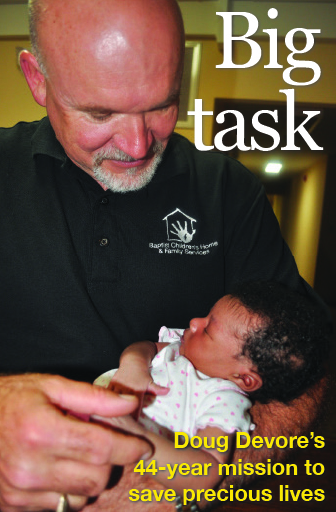
61226bigtaskDoug Devore didn’t grow up in a Christian home.

“I never knew my father, and I had three stepfathers,” Devore told the Illinois Baptist. Maybe that’s why family is so important to the long-time executive director of Illinois Baptist Children’s Home and Family Services. Devore will retire January 15 after nearly 44 years at the agency, including 21 years as executive director.

BCHFS has four residential cottages for children and teens in Carmi, and also operates Angels’ Cove Maternity Center in Mt. Vernon for expectant and new moms and their children. The agency has 11 counseling centers around central and southern Illinois, assists with adoptions, and partners with an orphanage in Uganda, among other initiatives.

The IB recently sat down with Devore to talk about his extensive ministry, the challenges of ministering to families in a shifting culture, and the success stories of children who have benefited from the care they received through BCHFS.

Illinois Baptist: Tell us how you got your start at BCHFS.

Doug Devore: I was working at Campbell Funeral Home here in Carmi. Gordon Lanthrup, who was the director of residential care at the Children’s Home, was there at the funeral home one day, and he just started to talk to me. He asked me if I would do some volunteer work at Baptist Children’s Home. I didn’t know it even existed.

I came out here and I met the kids and staff and I just fell in love with the place. God began to say, This is what I want for you. It makes me very emotional now to talk about something that happened 44 years ago, but it just began to click with me that there was a place for me to minister here and to be involved.

Illinois Baptist: When you retire January 15, your tenure at BCHFS will be just shy of 44 years. Wow.

Devore: I owe a lot to Gordon Lanthrup and (former BCHFS Executive Director) Leon Tally. To Gordon who saw something in me as a 21- or 22-year-old that I didn’t know was there. Why he ever asked me to do that is a mystery.

IB: It was a God thing.

Devore: I can’t explain it any other way. I always question, Why me?

IB: When you consider all that you have done and seen in your four decades at BCFHS, what touches your heart or brings a tear to your eye?

Devore: Well, you can see that I cry a lot, and the older I get, the more I cry.
(Devore shared an e-mail he received the day before from a young man who lived at the Children’s Home in 1982. He wrote, “I just wanted to say thank you again for being part of my life and helping me grow physically and mentally and emotionally and most of all SPIRITUALLY.” )

He now sings in a gospel quartet and travels the country; married and a faithful Christian, and sends me a little note like that. You can’t beat that.

IB: You can’t.

Devore: There was another man who is now 57 or maybe older. He has been in and out of prison all his life. But he calls me at least every six months to check in. Sometimes he is calling from prison or he’s out on parole. He calls me just to check in and let me know that he loves me and how he is doing. I try to give him my best advice while we are on the phone, but we are his connection, his touchstone. We are his family and I have been here long enough that I’m the only one around that was here when he was.

IB: Even with so many wonderful stories from your years at BCHFS, there have been challenges. What are some of the biggest?

Devore: The kids I saw in the 70s were coming out of situations when mom and dad couldn’t take care of them, so they ended up with us. They couldn’t take care of them because one parent died, or maybe they were orphans. Not so much behavior issues.

The kids today are coming to us because they are out of control and mom and dad can’t take care of them. Schools have thrown up their hands. We see kids today that have a lot more trauma in their lives.

IB: What about shifts in our culture? How have those affected BCHFS?

Devore: Most of the children we serve are growing up in single-parent families because the concept of marriage and staying together has changed over the years. Or, they’re growing up in blended families. With that comes lots of stress. There’s nothing wrong with a blended family, but it brings additional stress to kids than if mom and dad had stayed married and had a happy relationship.

A lot of our kids have been exposed to violence, abused and traumatized, and have post-traumatic stress disorder issues. We see kids coming out of inner cities that have gang involvement. They have seen people killed in front of them. They have had family members killed. It’s a bad situation for them. They are exposed to things that even I wasn’t exposed to in my wild upbringing.

IB: The concept of “residential care” has changed too.

Devore: Very few kids come here and grow up. Our average length of stay is eight months, something like that. When I came, there were kids who had been here for years. This was home for them. It happens a few times today, but generally, if that happens, we move those kids into foster care. If they don’t have a home to go back to, we are looking for them a more permanent situation.

IB: The need for residential facilities has changed in recent years because of expansion of the foster care system.

Devore: Residential care for kids is not a preferred placement today. There is federal legislation preferring foster care over residential care because some think being in residential care is a bad thing. I don’t think so. I think this is a great place for every kid that’s here. When it becomes not the most appropriate, then we will either move them back home or into foster care or some less restrictive care.

That’s always one of our issues: How do we stay relevant to the needs of society? How do we stay relevant now with the changing values? I guess on top of that, how do we stay relevant and still operate within our own values, without sacrificing what we believe in?

IB: What do you think about the movement urging Christians to
become foster parents through the state system?

Devore: I think that is excellent. If kids are going to live in foster care, my goodness, let them live in a Christian foster home. I think that is a tremendous idea and I would love to see more Christian families get involved in that.

IB: You became executive director at BCHFS in 1995. Did you set any goals for yourself?

Devore: The first thing I did when I became the executive director is that we did strategic planning for the agency. In that first strategic plan, one of the biggest things was to get our own board of trustees. The other big part was to hire a development person.

We worked through those goals and in 1999 we did another strategic plan. Every three years since that time, we have done another strategic plan. We have looked ahead to the future: Where do we want to be? How do we want to get there? How do we better minister to children and families? All that has happened—whether it be the international ministry or the Pathways Counseling ministry or the expansion of Angels’ Cove—has come out of those strategic plans.

IB: Are there things you planned to do that haven’t happened?

Devore: Yes. We didn’t become an international placing agency for adoption. It was very frustrating for me for quite a long time until it finally just sunk in that this just wasn’t what God wanted us to do. I think it was what Doug Devore wanted to do.

We talked about trying to have an on-ground school for some of our kids that have a difficult time making it in the public school, but there has always been something that prevented that from happening.

IB: As a leader, what has been your most difficult task?

Devore: How we find the resources to do what we need to do. I don’t want to say it’s about the money, but that’s been a challenge. When I became the director, our budget was $1 million and we were serving 160 children and adults. Today, our budget is approximately $2 million and we are serving over 1,300. The ministry has grown and developed, and the challenge has been how to find the resources to serve more people and how to develop programs to serve more people.

IB: You and your staff experience a lot of things most people don’t. What do you think to yourself when you see a young mom holding a baby she chose not to abort?

Devore: What a joy to see that baby born. To know that baby could have been aborted and not be here. To see that young mother hold that child and be happy they have made this decision to choose life. What a great thing that is, and now it is our responsibility to enable that mother to be the best mother that she can. Whether she is 12 or 40, she may not be prepared for that child. We have the responsibility to help get her prepared and to help her be the very best mother that she can be.

IB: What about those who choose adoption?

Devore: It’s hard to see any mother give up her child for adoption. Often it is the very best decision they can make and I admire their courage to make that decision. But it breaks your heart to see the pain they go through. Then you see the family who is taking that child, and you see the delight in their eyes that their dream has now come true. What a blessing.

IB: Does a specific story come to mind, something you’ve seen God do recently through BCHFS?

Devore: We had a 15-year-old girl come to our maternity center who had been adopted from Guatemala. She was pregnant and had decided to keep her baby. Her parents placed her at Angels’ Cove and said she and the baby couldn’t come back to live with them.

We just began to pray for her and Carla (Donoho, Angels’ Cove director) shared in a WMU meeting over at Woodlawn about this girl and that we were praying for a family for her. Carla finishes speaking, and a woman comes up and says, “I think my husband and I can take her.”

Really?! God does so many amazing things. The woman, who’s one of our board members, goes home and tells her husband. He says, “I don’t know why we couldn’t.” They had already adopted two kids. So they took the mother and her baby, and since then, they have officially adopted the mom.

IB: That’s an amazing story.

Devore: It was just miraculous. How does God find a family? It’s amazing. There have been hundreds and hundreds of those types of stories where God has worked in the lives of people, kids, and families, and made a difference. It has been very rewarding.

IB: What does the future of Baptist ministry to kids and their families look like, especially in Chicago where the need is so great but Southern Baptist presence is relatively small?

Devore: Baptist Children’s Home needs a presence in northern Illinois. We’ve just not had the resources to be able to do it and to make it work. We tried in 1999 when we opened a Pathways Counseling office but had to close it because it wasn’t financially feasible. I think the future for us would be that we would get a Pathways Counseling office open again in northern Illinois and to be able to provide Christian counseling.

We serve a lot of kids from that area and a lot of young mothers, but still we are out of sight, out of mind. We need a greater presence, a greater awareness of the ministry of the Children’s Home in northern Illinois.

IB: What advice would you give to Denny Hydrick as he takes over the executive director role at BCHFS?

Devore: The ministry faces many challenges in the coming years: competition for philanthropic dollars, managed care uncertainties, staff shortages, changing values regarding marriage, family and group care, and more complex behavior and mental health issues.

Denny Hydrick comes with great experience from working in child care agencies in both Mississippi and Florida. He understands the issues we are facing and I’m confident that he will provide the needed leadership for the days ahead. My advice to him is to trust God, who has maintained this ministry for 98 years, and to trust the people who work here. They have proven their faithfulness to children and families over and over.

61222word_cloud

We live by God’s surprises,” said Helmut Thielicke. The German pastor was speaking in times more trying than ours, but in the darkest days of WW2, he could see the hand of God at work—and was amazed by it.

Dare we say the same of the year just past?

We were surprised by events we witnessed. In their unfolding, we sought the reassurance of God’s sovereignty. Here are some noteworthy moments for Baptists in Illinois—some heavy, some light—and what they may say about the year before us.

– The Editors

Standing on the promises

61222trump_pence

Donald Trump (left), Mike Pence (right)

A third of Americans (34%) think Donald Trump will be a “good” or “very good” president, while 23% say “average” and 36% expect a “poor” performance. The survey by CBS News was conducted the second week of December, after Trump began announcing cabinet appointments.

The ratings fall along party lines: 70% of Republicans expect a good presidency, while 60% of Democrats predict poor results. That means evangelicals, who mostly supported Trump, have high expectations—but for what?

Religion reporter Sarah Pulliam Bailey, on her Washington Post blog, points to a half-dozen areas where Trump’s campaign promises intersect with evangelical interests. Some are the expected areas involving religious liberty. The nomination of Supreme Court justices who will uphold pro-life legislation topped the list. Trump also said he would defund Planned Parenthood, sign a bill that forbids abortions after 20 weeks, and make the Hyde Amendment permanent. It prohibits use of federal funds for most abortions. And Trump has expressed support for a group of nuns who have battled provisions in the Obama Affordable Care Act that mandate contraception as part of an organization’s health care plan. Southern Baptists have supported their lawsuit.

Trump promised to repeal the 1954 Johnson Amendment to the U.S. tax code, which prevents pastors from endorsing or opposing political candidates, or else lose their church’s tax exempt status. And he has taken a position on education funding that allows families to choose private, charter, or home schooling, with a promise to set aside $20 billion for vouchers in his first budget.

The U.S. will be a “true friend to Israel,” Trump said, a position common among evangelicals favoring Israeli interests over others in the Middle East and urging movement of the U.S. embassy to Jerusalem.

Many Southern Baptists would support these actions, if they came to pass. For SBC leaders who have been in contact with the future administration, the Trump presidency represents a new way of thinking about the White House. Since Ronald Reagan’s presidency, Southern Baptists in general have viewed Republican administrations as allies in the causes of pro-life, families and marriage, and religious liberty. They have, at the least, been sympathetic to evangelical causes, and even co-laborers in the faith. (Remember the stories of George and Laura Bush singing hymns at the White House piano with Attorney General John Ashcroft and Secretary of State Condoleezza Rice on the keyboard?) Democratic presidents, on the other hand, have often been at odds with evangelicals’ causes, even if they claimed to be Baptists, as in the case of Bill Clinton.

Donald Trump represents a third way of relating to the White House: a president who made promises to evangelicals and drew their support at the polls, but who shares no apparent faith commitment with the born-again community. (There are no stories of Trump walking on the beach with Billy Graham and committing his life to Christ. And the tycoon-turned-president has said he sees no need to ask for forgiveness for his sins.)

The evangelicals closest to Trump, including incoming vice president Mike Pence, take on the role of Joseph in Egypt—keeping the interests of God’s people before pharaoh, hoping to keep his ear and hold him to his promises.

High hopes for high court

Some voters who cast their ballots for Donald Trump said they did so because of concern for the U.S. Supreme Court. The February death of Justice Antonin Scalia left a vacancy, and three of the Justices—Ruth Bader Ginsburg, 83, Anthony M. Kennedy, 80, Stephen G. Breyer, 78—may be looking toward retirement in the next few years.

Focus on the Family founder Dr. James Dobson supported Trump. He told Christianity Today, “The next president will nominate perhaps three or more justices whose judicial philosophy will shape our country for generations to come.”

A LifeWay Research survey found 23% of evangelical pastors were most concerned about the candidates’ likely Supreme Court nominees. And 36% of Trump-supporting pastors cited the high court as a major factor in their choice.

Trump released a list of his potential Supreme Court nominees—20 judges and one senator, Mike Lee of Utah. Each met two criteria: they are pro-life and support the Second Amendment. The list was vetted and reviewed by the Federalist Society, which is comprised of conservative and libertarian lawyers, and the conservative Heritage Foundation.

Commentator Denny Burk told Baptist Press the list “does not alleviate the concerns that many of us have about his candidacy.” Because Trump didn’t promise to pick someone from the list, Burk said, “The list means nothing….And we are again being asked to trust the judgment of a man who changes his positions daily…” Burk is professor of biblical studies at Boyce College, the undergraduate school of Southern Seminary.

Reince Priebus, future White House Chief of Staff, told radio host Hugh Hewitt on December 14 that the President-Elect will likely name Scalia’s replacement near the January 20 inauguration.

Priebus said Trump may choose a younger nominee. “Well, I tend to believe younger is better, too, but I can tell you what the president (elect) believes is that the most qualified, best person to serve on the Supreme Court is what’s most important….Certainly longevity’s a factor, but it’s just a factor. Competence and having the best possible person nominated is what’s most important.”

Tension between leaders, pews

61222russell_moore

Russell Moore

The 2016 presidential campaign and election exposed deeper divides than many knew existed in the U.S.­­—and within evangelicalism. White evangelical voters overwhelmingly supported Trump, even while some of their leaders voiced their opposition.

As Wheaton College’s Ed Stetzer said after the election, “The evangelical leadership is out of touch with the evangelical rank-and-file,” during a Christianity Today podcast.
Tension over the election appears to be at least part of a rift between some Baptists and the SBC’s public policy entity, the Ethics and Religious Liberty Commission.

In November, Louisiana Baptists voted to ask their convention’s executive board to study recent actions of the ERLC.

Will Hall, editor of the state’s Baptist Message newspaper, noted that the motion did not elaborate on the issues of concern, “but ERLC President Russell Moore has come under fire nationally from Southern Baptist laymen and leaders for a number of controversial actions and statements, including…his aggressive attacks on Southern Baptists who supported Donald Trump.”

Moore, who has led the ERLC since 2013, wrote an opinion piece for The New York Times in May in which he said the election “has cast light on the darkness of pent-up nativism and bigotry all over the country.” His article caught the attention of Trump, who tweeted that Moore was a “truly a terrible representative of evangelicals.”

The op-ed also sparked a fervent debate on the SBC Voices blog, where Baptists posted a variety of opinions on Moore, from “he did what we pay him to do,” to “it is difficult for me to imagine Russell Moore functioning as ERLC President if Trump wins in November.”

The questions about Moore and the ERLC are just one example of the impact the 2016 election could have on religious organizations and denominations, and on the nature of Christian leadership. The tension leaders face, Ed Stetzer said, is between recognizing the responsibility to speak prophetically, and realizing they represent a constituency who largely feel very differently than they do.

For Christian leaders, their influence in the next four years may well depend on how well they strike the balance.

The BriefingStudy: Christians most persecuted
According to the Director of the Centre for Studies on New Religions (Cesnur), Massimo Introvigne, Christians are the most persecuted religious group in the world, with over 90,000 Christians killed in 2016 alone. Introvigne said there are nearly half a billion Christians who are unable to express or practice fully their Christian faith.

Chicago ends 2016 with 762 homicides
An argument between two men at an Uptown bar in the early hours of Jan. 1 ended with the two shooting at one another, leaving both dead. Their deaths ushered in the new year, marking the first and second homicides of 2017 and keeping up 2016’s soaring pace of violence.

Chicago priest puts a ‘bounty’ on killers
The violence on Chicago’s South Side is so pervasive that Father Michael Pfleger, a priest with the largest Catholic congregation in the area, isn’t waiting for a savior — he’s taking it upon himself to find murderers by offering rewards for information leading to an arrest. Pfleger says he’s given out 24 rewards over the last 10 years.

Judge rules against sex change coverage
Doctors and healthcare providers do not have to break with their consciences to perform sex change operations under a preliminary injunction against an Obama administration mandate. U.S. District Judge Reed O’Connor of Texas ruled in favor of eight states and three Christian healthcare groups by blocking a Department of Health and Human Services (HHS) rule set to go into effect Jan. 1.

Turkey denies appeal for U.S. pastor
A Turkish court has denied the appeal of a Christian pastor from North Carolina, who was imprisoned last month in Turkey on a false terrorism charge because of his Christian faith, according to the American Center for Law and Justice.  Andrew Brunson was imprisoned Dec. 9 after being charged with “membership in an armed terrorist organization.”

Sources: Fox News, Chicago Tribune, CBS News, World Magazine, Christian Post

watch pocketIn the church I grew up in, “missionary” was a sacred and scary title, bestowed only upon the spiritual elite, the Navy Seals of the Christian world. We considered them heroes, sat in awe through their slideshows, and gladly donated our money to their ministries.

It was years later that I first realized that every Christian was a missionary, that all Christians were called to leverage their lives and talents for the kingdom. God’s calling into mission is not a separate call we receive years after our salvation; it is inherent in the very call to salvation. Every believer is given a spiritual gift and a role to play in the spread of the Great Commission. “Follow me,” Jesus said, “And I will make you fishers of men.” That’s for everyone, not just those who feel a special tingly feeling they interpret as the call of God, or those who see some message from heaven spelled out in the clouds. Too many Christians sit around waiting on a “voice” to tell them what God has already spelled out in a verse.

Another way to put it: The question is no longer if we are called to leverage our lives for the Great Commission; it’s only where and how.

When “normal” Christians embrace this idea of calling, the gospel spreads like a prairie grassfire. Luke, the writer of Acts, goes out of his way to show us that the gospel travels faster around the world in the mouths of regular Christians than it does through full-time, vocational Christian workers. Luke notes, for example, that the first time the gospel left Jerusalem, it was not in the mouths of the apostles. Regular people “went everywhere preaching the word,” while the apostles stayed in Jerusalem (Acts 8:1–4). The first time the gospel actually went out into the world, not a single apostle was involved.

  • The first “international mission trip” was taken later in that same chapter by Philip, another layman. The Spirit carried him to a desert road where he met an Ethiopian government official, and Philip led him to Christ.
  • The church at Antioch, which served as the hub for missionary activity for the last half of the book of Acts, was not planted by an apostle, but simply “some brothers,” whose names Luke did not even bother to record—presumably because no one would have known whom he was talking about.
  • Apollos, a layman, first carried the gospel into Ephesus, and unnamed brothers first established the church at Rome. These Christians didn’t travel to Rome on a formal mission trip, but were carried there through the normal relocations that come with business and life. As they went, they made disciples in every place (Acts 8:5–8; 18:24–19:1; 28:15).
  • As the historian Steven Neill notes, “Nothing is more notable than the anonymity of these early missionaries.…Luke does not turn aside to mention the name of a single one of those pioneers who laid the foundation. Few, if any, of the great Churches were really founded by apostles. Peter and Paul may have organized the Church in Rome. They certainly did not found it.”

The next wave of missions will be carried forward, I believe, in much the same way—on the wings of business. Consider this: If you overlay a map of world poverty with a map of world evangelization, you will find that the areas most in need of business development are also the most unevangelized. Many of the most unreached places in the world, most closed to Christian missionaries, have arms wide open to any kind of businessmen.

Missiologists frequently refer to a “10/40 window” in which the most unreached peoples live (lying between the 10 and 40 degree latitude lines). For business leaders, the 10/40 window isn’t a window at all; it’s a wide open door.

God may not call you to leave the United States (though he might!). But if you’re a believer, he is calling you to follow him where he goes, as he seeks to make his name known. Whether you’re an investment banker or a full-time pastor, a stay-at-home mom or an overseas missionary, God has a mission for you. From Raleigh-Durham to Bahrain, the responsibility to think that way belongs to every believer. As we often say, “Whatever you are good at, do it well for the glory of God, and do it somewhere strategic for the mission of God.”

It’s time for the “ordinary believers” in our churches to recover the understanding that they are called to the mission and shaped by God for a specific role in that mission. The question is no longer if we are called to leverage our lives for the Great Commission; it’s only a matter of where and how.

J.D. Greear, Ph.D., is pastor of The Summit Church in Raleigh-Durham, N.C., and author of “Gaining by Losing: Why the Future Belongs to Churches that Send.”

Keep Christmas alive

ib2newseditor —  December 29, 2016

pouring-teaIt feels so wonderful! The spirit of Christmas adds oomph to life. We live in anticipation and we’re even nice to strangers. We become very intentional about giving to others.

But as we turned the calendar page to December 26, did that Christmas spirit fade? As you pack up those Christmas decorations, consider these five simple reminders to help keep that spirit of joy and generosity at the forefront all year.

1. Live expectantly. Anticipation is at a high during Christmas, but a sense of expectancy is a good thing all year long. It keeps us on our toes, helps us use time wisely, and reminds us to lean on God. So, live with enthusiasm every day of the year. “Don’t burn out; keep yourselves fueled and aflame. Be alert servants of the Master, cheerfully expectant” (Romans 12:11-12a MSG).

2. Be extra nice to strangers. Are you kinder to total strangers at Christmas? Your job as a Christian is to be God’s ambassador, representing him with your every word and deed. Take your ambassador job seriously all year long. Be nice to strangers.

3. Practice a “shoebox continuum.” Wasn’t it awesome to stuff gifts in shoeboxes for Operation Christmas Child or backpacks for Appalachian children? Don’t stop. Each month this year, gift a carefully prepared backpack or box to a local child in extraordinary need. Include a “God loves you” note.

4. Engage in better benevolence. Use Christmas ministry projects as a springboard to yearlong generosity. For example, instead of a give-and-run delivery of gifts or dinner for a local needy family, make a plan to show God’s love to them all year. Get to know them. Listen to their story. Invite them to church and welcome them. Pray with them. Introduce them to Jesus.

5. Smile freely. The Christmas season lends itself to joy. Joy isn’t seasonal for a Christian. It radiates from inside, and it’s there on happy days and desperate days, on New Year’s Day and Groundhog Day and every other day of the year. Radiate the joy of Jesus in non-December months.

The “spirit of Christmas” is not a December event. It’s a Christian’s lifestyle and mission. It’s our everyday marching orders from Christ. Exude the true Christmas spirit—God’s Spirit—as you live with joy, expectancy, love, and generosity.

© Diana Davis, dianadavis.org

Especially for leaders, new years require fresh vision. And for Christian leaders, fresh vision requires prayer. But quality prayer takes time and, for me at least, finding that time is one of the biggest challenges I face.

Time is so precious. I often feel I don’t have enough of it simply to do well with my family, my job, my church. So I end up giving almost all my time to those things, and telling myself that God will understand.

He understands, I’m sure. But he can’t be pleased.

shortage-of-prayerIt’s been well said that you spell love: T-I-M-E. And since prayer is an expression of my love for God, and I need quality time with God to gain fresh vision for the future and power for daily living, then I must spell prayer the same way. Prayer deserves my time.

I’m convinced I’m not alone in this struggle. Many of today’s well-intentioned pastors and Christian leaders are so pressed for time. And prayer can become one of the earliest casualties of a busy schedule. Yet the shortage of serious time for prayer becomes quickly evident in a leader’s life, and in the fruit of his or her ministry. I know they are in mine.

That’s why I struggled recently when I was asked to bring a devotional word to a national gathering of SBC prayer leaders in Chicago. With some difficulty, I decided to be vulnerable. I admitted to them that I am ashamed of how little I rely on prayer compared to my own efforts. I too rarely engage God in a way that invites him to override my desires or plans. Mostly, I quickly ask him to bless what I’m rushing off to do. I told them I see this happening with Christian leaders everywhere, and that we as leaders need their help reprioritizing prayer in our lives.

Then we looked at Gideon’s experience in Judges 6-7. Like this timid, reluctant, and frustrated leader, we often toil away in our own strength at things that don’t really help much, rather than inviting God into our challenges, and letting him empower our leadership.

But one life-changing day Gideon and God, as “the Angel of the Lord,” had a conversation that has deeply challenged me about my own prayer life. Here’s a summary of what I said about it in my devotion for those prayer leaders:

Gideon was weak when his extended conversation with God began, but God loves to use weak people. Though God initiated the conversation, Gideon did most of the talking, at first. Then, after questions and fleeces, there was a moment of surrender, when Gideon gave his fears, desires, and plans over to God. After that, God did most of the talking, and acting. Gideon never had to say, “God said obey me…” to the people he led. He simply acted with a new boldness that came out of his personal conversation with God. And the people gladly followed him in his obedience to God, with a powerful result that brought God glory and his people victory.

That’s the kind of prayer encounter I need. Gideon was a small man and a reluctant, fearful leader.But all that changed when he engaged God in extended, serious prayer.

In this coming new year, I have concluded that I must do whatever it takes to meet God like that. And I must encourage and facilitate that in the lives of those I lead and influence. I look around me, in Southern Baptist life and elsewhere, and I see that there are others sensing the same need. By God’s grace, a new year gives us more time. Let’s be leaders who give a great deal of that time to God in prayer.

Nate Adams is executive director of the Illinois Baptist State Association. Respond at IllinoisBaptist@IBSA.org.

The BriefingMoore clarifies comments on Trump supporters
Ethics & Religious Liberty Commission President Russell Moore has clarified that he never intended to criticize all evangelical supporters of President-elect Donald Trump, noting many were motivated by “biblical convictions” and “voted their conscience.”

National Geographic features trans girl, 9, on cover
Avery Jackson, a Kansas City fourth-grader, is the first transgender individual to grace the cover of the 128-year-old National Geographic magazine, which is rolling out to subscribers this week in a special edition devoted solely to gender issues around the globe. Growing up, “I really just wanted to be myself,” Avery told USA Today. “I’m just a girl.”

Movement for third gender option ‘exploding’
Since Jamie Shupe became the first legally non-binary U.S. citizen six months ago, the amount of people petitioning courts for third gender designations has increased exponentially. Some were born intersex (with female and male sex characteristics), while others identify on a spectrum of gender that doesn’t fit neatly into either of the categories currently available on identity documents.

U.S. citizen & pastor in Turkey jailed for faith
Andrew Brunson, formerly of Black Mountain, N.C., was reportedly detained 63 days without charges at the Harmandali Detention Center in Izmir, Turkey, before being imprisoned Dec. 9 at nearby Sakran Prison. He’s being held on false charges of being a member of an armed terrorist organization, World Watch Monitor reported.

Burmese Christians ministering in Mosul
As Iraqi coalition forces claw their way into Mosul, the retreating ISIS fighters have booby trapped streets, sent suicide bombers against the liberating army, and used civilians as human shields. The civilians left in their wake are hungry, thirsty, terrified, and exhausted. One of the first humanitarian groups to aid Iraq’s once second-largest city, moving in even as ISIS moves out, has been a group of persecuted Christians from Burma.

Sources: Baptist Press, USA Today, NBC News, Baptist Press, Christianity Today

Prince of Peace

ib2newseditor —  December 19, 2016
12-5-16-statehouse-nativity

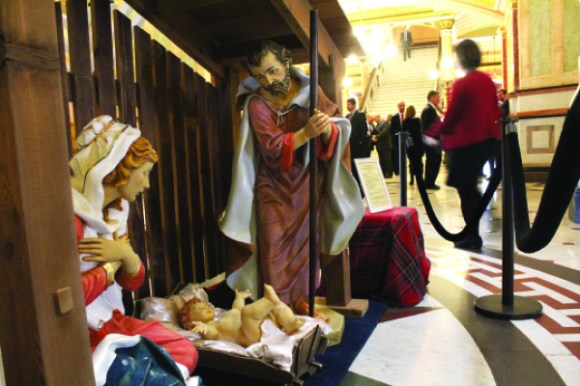
In the crèche at the Illinois Capitol building, a baby Jesus figurine reaches out with the promise of hope to passersby who mostly keep moving to get their business done.

In a world of chaos, we need peace to reign again. How is it possible?

Henry was despondent. His country was divided. His countrymen were at odds. Angry arguments had led to all-out war. And his son had joined the Army.

“In despair I bowed my head,” he wrote, describing the depth of his anguish. “There is no peace on earth,” he said, “For hate is strong, and mocks the song Of peace on earth, good will to men.”

Perhaps it wasn’t unusual at the time for a man to express himself in verse, but with a son in battle and his wife recently deceased, it seems an odd time to opine on peace. But that’s what Henry did.

“It was as if an earthquake rent The hearth-stones of a continent,” he wrote of the breadth of the national suffering. It wasn’t supposed to be this way, not in his America. This great angry gash “made forlorn the households born Of peace on earth, good will to men.”

So much for the forefathers’ intended peace.

Loyal to the Union, Henry Wadsworth Longfellow ascribed this national violation to Southern aggression in a verse not included in our hymnals today:

“Then from each black, accursed mouth

The cannon thundered in the South,

And with the sound The carols drowned

Of peace on earth, good will to men.”

Longfellow’s poem, written at Christmas in 1863, became an anthem for people who desperately needed an understanding of their wartime devastation. Was it to be to be attributed to human failure? Unbridged aggression? The natural consequence of sin? Or was it the judgment of God? The people took sides, brother against brother, and a nation at war with itself, in the middle of moral downfall, wondered, Where is this peace we were promised—our constitutional commitment and our biblical hope? Where is God in this unrestrained, unprecedented mess?

The poet drew images in sharp contrast: the ringing of cast-iron bells in church belfreys and the roaring of cast-iron cannons on farms-turned-battlefields. If the poem ended there, there would be no hope, for Longfellow or for us.

An uneasy peace
Thanksgiving 2016 may go down as the holiday that almost wasn’t (and similarly we fear for Christmas). Psychologists were advising families to avoid discussion of politics after the tumultuous and divisive election. The foment that was reported from workplaces and universities and city streets was likely to spill over into family gatherings as political debate became festering, destructive argument. Every family has at least one person who voted for the “wrong” candidate. Those who managed to keep their mouths shut at work would have little reason to hold back with their relatives. “Just don’t talk about it,” the Dr. Phil’s warned, for the sake of the peace.

But peace, by definition, demands reconciliation. A truce only promises a cessation of aggression, but that may not necessarily produce long-lasting, attitude-transforming, life-preserving peace.

Can there be peace after Clinton, peace past Trump? And beyond American politics, in this troubled year will there be peace in Latin America after Castro’s half-century grip on his nation (and ours)? For Aleppo divided down the middle by a narrow demilitarized zone that draws fire from both sides? For Syrian refugees still fleeing ISIS and Assad and for war zones in West Africa? And for persecuted believers in China, North Korea, Indonesia, and all corners of the world?

The fabled Christmas truce of 1914 seems so attractive right now.

Pope Benedict XV recommended in early December of that year that fighting be stopped to observe Christmas. Though the Great War was only five months old, French and German soldiers on both sides laid down their weapons and at many locations, it is told, entered the no-man’s land between their battle lines calling “Merry Christmas!”

“First the Germans would sing one of their carols and then we would sing one of ours,” British rifleman William Graham later wrote, “until when we started up ‘O Come, All Ye Faithful,’ the Germans immediately joined in singing the same hymn to the Latin words Adeste Fideles. And I thought, well, this is really a most extraordinary thing—two nations both singing the same carol in the middle of a war.”

Enemy soldiers swapped packets of cigarettes and plum puddings, played soccer together in at least one location, and generally enjoyed a day of peace. In all, up to 100,000 troops, about two-thirds of the battle forces, participated in this “short peace in a terrible war” as summarized in a Time magazine account. Some troops used the day to retrieve the bodies of their fallen comrades and give them a proper burial.

The next day, the shooting resumed.

If we may borrow Longfellow’s words, “The world revolved from night to day…” in the stanza that precedes the poet’s headlong plunge into desolation, but there was no voice, no chime, no chant sublime, only the tinny rat-a-tat of gunfire—in cities across France a century ago, as in Paris and elsewhere with recent terrorist attacks, as in Mosul, Chicago, Englewood, Urbana, and Springfield.

So much for a cease fire.

Come, Lord Jesus
The world Jesus entered as a baby experienced a false peace. It was enforced by dictatorship and military oppression. It was threatened by zealots, terror cells, and constant fear of revolt by the masses. And yet, the era was called Peace.

The Peace of Rome. The Pax Romana lasted for about 200 years, but it came at a high price. The Caesars were cruel and nervous men, as were their henchmen, the regional governors such as the paranoid Herods. Herod the Great would do anything to keep peace with Rome, and thereby keep his throne, even if it meant slaughtering a town’s entire population of boy babies.

The prophets predicted the coming of young king who would specialize in peace,

“…one who is to be ruler in Israel…..

And they shall dwell secure, for now he shall be great

to the ends of the earth.

And he shall be their peace” (Micah 5:2, 4-5a).

But the people who read the prophets understood how this peaceful monarchy would (of necessity) follow turmoil. Micah opened his sweet messianic prophecy with this arch salutation:

“Now, daughter who is under attack,

you slash yourself in grief;

a siege is set against us!” (Micah 5:1).

Even Isaiah, who gave the reassuring pronouncement that a Prince of Peace would be born, said honestly that saving the world is bloody business.

“For the yoke of his burden,

and the staff for his shoulder,

the rod of his oppressor,

you have broken as on the day of Midian.

For every boot of the tramping warrior in battle tumult

and every garment rolled in blood

will be burned as fuel for the fire” (Isaiah 9:4-5).

All this talk of peace comes with this honest admission: The Prince of Peace enters a world in chaos and bring his own chaos with him. The emergence of the Kingdom of God at the natal moment is not peaceful. Birth is not peaceful. It is bloody—and loud and painful. Birth brings its own chaos.

And the One born does not sleep in heavenly peace for long. “The cattle are lowing, the Baby awakes…” and the carol writer Anonymous assures us “no crying he makes.”

Dream on, Anonymous.

That Baby cried in his first minute of existence outside his mother’s womb. His birth announcement was a plaintive wail, and nothing has been the same since. Kingdom burst into existence and crashed into conflict with this sin-stained world. It should not surprise us that we still long for peace, we still wait for peace, even after the Prince of Peace has come. His transforming work is not done.

Our American culture in its religious naivety loves Jesus as a baby, treating him as an amulet against bad things—like Annelle, the misguided hair stylist in Steel Magnolias, who decorated her front door with a score of tiny mangers.

“I went to the fire sale at the Baptist Book Store in Shreveport last month,” she said in a drawl appropriate to her bayou setting. “They were selling mismatched manger scenes at incredibly low prices, and I cleaned them out of Baby Jesuses…”

If only a score of ‘Baby Jesuses’ could ward off our national ills and personal fears.

A meeting with Jesus this year comes with the realization that the supposedly tow-headed youngster in the cradle is but a hint at the reign of peace to come, and that the coming of the Prince of Peace into this world first creates crisis.

“Don’t assume that I came to bring peace on the earth,” Jesus warned his followers in Matthew 21:34. “I did not come to bring peace, but a sword.” And in John 14:27, his definition of peace apparently differs from our expectations: “Peace I leave with you. My peace I give to you. I do not give to you as the world gives. Your heart must not be troubled or fearful.”

His holiness collides with our sin—and by God’s grace overcomes it at Calvary. His peace confronts our warring—and the victory must first be won in our hearts.

The Prince of Peace himself is confirmation of God’s promise that peace will come to the earth. At his second coming, he will usher in peace forevermore. Until then, his peace will reign in believing hearts, even if peace seems remote in a decidedly unpeaceful world.

“Do not be afraid!” the angel told the shepherds on a green patch outside a farming village. One commentator pointed out recently that statement could rightly be translated, “There’s no reason for you to be afraid.” And the angel choir affirms this good news: “Glory to God in the highest heaven, Peace on earth to people he favors” (Luke 2:9, 14 HCSB).

The peace this year may not be political. It is certainly not pervasive. But it is providential. And it is deeply personal. In a world of chaos, the Prince of Peace reigns first and foremost in the heart.

In this time of uncertainty and unrest, we are reminded like Longfellow, who

“thought how, as the day had come,

The belfries of all Christendom

Had rolled along Th’ unbroken song

Of peace on earth, good will to men!”