Archives For September 30, 2017

Family blocks

The word “family” conjures up feelings of warmth, sentimentality, peace, and tranquility—the kinds of things we put on Christmas cards, said Russell Moore, president of the Ethics and Religious Liberty Commission.

Often, though, our families aren’t really like that. We’re not lying, Moore said, but there are so many things we leave unsaid. Those things—the challenges of parenting, the hard conversations, the fears that children won’t turn out like we want them to—were at the heart of the ERLC’s conference on “Christ-Centered Parenting in a Complex World.”

The podium at the Aug. 24-26 meeting was filled by family experts, church leaders, storytellers, and even a U.S. Senator (Ben Sasse of Nebraska). But the audience looked a lot like real parents. Strollers lined the walls of the auditorium as parents and children listened together. One speaker in a breakout for moms tweeted that it was highly appropriate to hear several crying babies in the session.

Over three days at Nashville’s Opryland Hotel, conference speakers drew on their experiences ministering and equipping families—and raising their own—to guide parents toward a gospel-centered view of the family. Along the way, they touched on some specific issues of our day—gender identity, racial division, sexuality, pornography, and the overwhelming influence of technology.

They also called Christian parents to an ideal that grows more and more radical as the culture around them changes. “Those who grow to know and serve God with everything they have do not blend in,” said author and speaker Jen Wilkin. “The goal of a Christian parent is to prepare their child to live in a world that is not their home.”

In his opening address, Moore said the unspoken challenges of parenting are part of the reason it can be so difficult. “…In our culture, parenting so often is about winning and displaying.” If something goes wrong in our family, he continued, we worry people are going to think something’s wrong with us. He quoted a friend who said he knew parenting would be humbling, but had no idea it would also be humiliating.

“Parenting matters. The stakes are high. That’s why it’s hard.”

– Russell Moore, president, Ethics and Religious Liberty Commission

The antidote to drowning in all the potential failures? A Christ-centered perspective, one that acknowledges parents are called to follow Christ’s example and take up a cross, Moore said.

“Parenting is a unique mixture of joy and terror, beauty and brokenness, happiness and disaster. Nothing is easier than loving your children, and nothing is harder than loving your children. We as Christians ought to be people who understand that dynamic.”

Alien children
It’s easy to blame kids for peer pressure—for exerting it on one another and for feeling it themselves. But it’s generally not children who fall victim to it, said Jen Wilkin. It’s parents who feel a strong pull to soothe their own memories of not fitting in by helping their kids fit in.

But Christian parents need to be looking instead for opportunities to help their children get comfortable with being different—even “alien” in our culture, Wilkin said. She gave five areas where Christian families and kids will look different, beginning with their activities.

“We have to be running these things through a different filter than other people,” she said. A filter that places a higher priority on the dynamic at home than allowing children to run themselves—and their parents—into the ground with an ever-increasing list of activities.

She read Deuteronomy 6:6-7: “And these words that I command you today shall be on your heart. You shall teach them diligently to your children, and shall talk of them when you sit in your house, and when you walk by the way, and when you lie down, and when you rise.”

“The author of Deuteronomy seems to think that there will actually be times when we sit in our house­—together,” Wilkin said. “Seems to think there will be times where we walk by the way­—together. When we lie down­—together, and when we rise up­—together.
“This passage assumes a natural rhythm of the home that is bringing the family together, versus spreading the family out.”

Jim Kerr is pastor of First Baptist Church in Fairview Heights. Wilkin’s talk on family activities resonated with him because he sees families in his church struggling to balance all the things they think they have to do. Churches can fall victim to the same kind of thinking, he said.

“The guilt of doing ministry sometimes overrides the benefit of the right amount of ministry and the right amount of time,” Kerr said. “Because we just wear ourselves out.” That’s why his church plans intentional seasons of break in certain activities and ministries, he said, “realizing that there’s so much going with our families and our children, we’re going to wear ourselves out from doing, while not really gaining the purposes we need.”

Wilkin talked about four other areas in which Christian families should be alien and strange: speech, possessions, entertainment, and friends. Look for more on counter-cultural families and how parents in Illinois are raising “alien” children in upcoming issues of the Illinois Baptist.

The role of the church
At least two speakers in Nashville quoted a study that found children are more likely to stick to their faith after high school if they’ve been invested in by adults other than their parents. Christ-centered parenting can’t be done in a vacuum. It calls parents to rely on others in their faith community, Russell Moore said. Christians are to bear one another’s burdens, including in parenting, he said.

“That is what is so dangerous about the church turning, in many cases, into silos filled with individual minivans full of families, coming to receive instruction and then to return home to their self-contained units.” Even more so in our rootless, hyper-mobile culture, Moore said, where children don’t see their extended families often and mothers and fathers fight feelings of isolation, parenting can be a lonely endeavor.

“We need each other, and we cannot be godly parents to our children if we are not brothers and sisters to each other.”

Moore recalled a woman who approached him after he preached at her church and leaned close to whisper a prayer request for her daughter, who was away at college and had decided she was an atheist. When Moore asked why she was whispering, she said, “I don’t want anybody to think, ‘There’s that lady with the atheist daughter.’”

Something’s terribly wrong with that picture, Moore said. “Here we are when every family in Scripture has prodigals, including God the Father. And we are scared to cry out to one another and say, ‘I feel like in my parenting I am drowning and I need help.’ That is what the church is for.”

If parenting in community means bearing one another’s burdens, it also involves having the courage to turn children loose to engage in God’s mission. In fact, that should be the goal of parenting, said North Carolina pastor J.D. Greear. Children are designed by God to be arrows, Greear said, referencing Psalm 127, not accessories.

Quoting family ministry expert Reggie Joiner, Greear said in our safety-obsessed culture, we forget the ultimate goal of parenting is to let go.

“The ultimate mission of the family is not to protect your children from all harm, but to mobilize them for the mission of God,” said Greear, pastor of The Summit Church in Raleigh-Durham.

And as they go, they’re sure to look different, having been shaped in a community in which the goal of the family is to glorify God and, through their example, to bring others to a saving knowledge of Christ.

“As Christian parents, the most hopeful thing we can do is lift up our own eyes and train the eyes of our children to behold our Savior, alien and strange,” Wilkin said. “He is coming on the clouds, and when he comes, may he find the family of God, and your family and my family, desperately hoping and yearning to look like him.”

For more from the ERLC’s National Conference on Christ-Centered Parenting in a Complex World, see upcoming issues of the Illinois Baptist, or go to ERLC.com to view conference sessions.

-Meredith Flynn, managing editor, Illinois Baptist


Our differences are theological and generational—and growing.

Wittenberg Doors

Nailing his 95 theses to it on October 31, 1517, disgruntled monk Martin Luther made the church door at Wittenberg a famous 16th-century landmark, and a modern-day tourist attraction.

Five hundred years after Martin Luther sparked the Protestant Reformation with his publicly posted list of grievances against Catholic church leaders and practices, to say the movement made a lasting impact on Christians of all stripes is a gross understatement.

Southern Baptists have certainly been shaped by the doctrines of the Reformation, but the question of just how Reformed we are has created a growing divide in the denomination. As Christians worldwide celebrate the anniversary of the Reformation on October 31, Southern Baptists continue to wrestle with how deeply we will be people of the Reformation in the next hundred years or two.

In his 2017 book on the Reformation, Alec Ryrie wrote that “like all great revolutions, it had created a new world.” And, like all revolutions, the Reformation has come with its own set of growing pains. Over 500 years, believers and non-believers have struggled with the tenets of the Reformers, leading to the formation of many Christian denominations, and differing strains even within those groups.

Baptists have roots in the Reformation, but often hold with varying degrees of conviction to the five points of doctrine most closely associated with Reformed theology, or Calvinism.

In the past decade, the debate over theology in the Southern Baptist Convention has found a new home: Blogs have given voice to proponents of Calvinism, and also to those who consider their soteriological views to be more traditionally Southern Baptist. The two streams hold separate meetings and conferences, but also gather annually at the Southern Baptist Convention, and have pledged to focus on the primary issues of evangelism and the Great Commission, rather than letting secondary issues divide them.

But exactly what that looks like is unclear, as is how the theological debate in the Convention will ultimately affect Southern Baptist churches. With baptisms trending downward, the questions of why and how and when we do evangelism, and what we say when we do it, have never felt more important.

As Alabama pastor Eric Hankins told the Illinois Baptist, “The controversy (over Reformed theology in the SBC) isn’t driven by pragmatic issues of working together. It’s driven by the growing realization that the two soteriological systems are incompatible.

“Should I want to share the gospel [along] with someone who thinks I have a deficient view of the nature of conversion? We’re going to have to articulate very specifically why we want to continue to work together when we believe very different things, or one side is going to have to make some adjustments in its doctrine.”

Judging from the proliferation of passionate theological arguments shared over the past decade, that’s unlikely.

Diagnosing the divides
“I am not a Calvinist,” Southern Baptist Convention President Steve Gaines wrote in an e-mail exchange earlier this year. Yet Gaines, pastor of a Tennessee megachurch, leads a denomination that most admit is increasingly Calvinistic in its leadership, if not in its pews.

“Without question, Calvinism is increasing in the SBC. How will that affect the SBC in the years to come? I don’t know,” Gaines said in the e-mail interview with Kyle Gulledge, editor of the blog SBC Today.

“I am not a Calvinist. I believe God loves everybody the same, Jesus died for everybody the same, and that anyone can be saved….If someone hears the gospel and is not saved, it is because they chose to reject Christ, not because God chose not elect them to salvation,” Gaines said.

“Many Calvinists would have a problem with what I just said. Yet, I am convinced that what I just said represents the prevailing theological beliefs of the majority of Southern Baptist laypeople.”

Gaines’ words are echoed in the principles that bond Connect316, a group of Southern Baptist pastors and leaders who organized in 2013 around what they called a “traditional” Southern Baptist understanding of salvation theology. At the recent Connect316 meeting in Phoenix, Hankins pointed to the influence of Calvinism in the SBC over the past 25 years, noting, “It’s clear that traditionalists, even though we are the theological majority in the SBC, are the minority in terms of leadership and influence in the convention.”

Much of that influence emanates from SBC seminaries, including arguably the most influential Southern Baptist Calvinist, R. Albert Mohler, Jr., president of Southern Seminary in Louisville, Ky. Many credit him with facilitating the rise of Calvinism in the denomination. And two of his former staff at Southern are now leading SBC seminaries as well, Danny Akin, president of Southeastern, and Midwestern President Jason Allen.

Together, three of the six SBC seminaries have schooled a generation of pastors in the Reformed perspective. The question is whether any of the remaining three will shift their theological slant when new leadership takes office.

In 2006, Mohler sat down with another seminary president to publicly discuss the growing theological divide in the SBC. Paige Patterson, 74, president of Southwestern Baptist Theological Seminary and a non-Calvinist, was Mohler’s foil in two standing-room only sessions during the Pastors’ Conference in Greensboro,

Baptist Press’ reporting on the conversation between Mohler and Patterson emphasizes both men’s congeniality toward one another, despite their clear theological differences. “This is a conversation among close friends,” Mohler said. Each warned those who would agree with them against vilifying the other side.

“I would caution my non-Calvinist brethren against the conclusion that the doctrine of Calvin automatically means that a person will not and cannot be evangelistic,” Patterson said. “…One of the commands that the Lord gives is to take the gospel to the ends of earth. No Calvinist worthy of his stripe would thereby disobey a command of God.”

Mohler urged Calvinists to remember their first priority. “It is not healthy to have a person who will drive across the state to debate Calvinism but won’t even drive across the street to share the gospel.”

The seminary presidents pointed in 2006 to the key area of impact for today’s theological debate: evangelism.

Multiple views

Southern Baptist Convention President Steve Gaines (left) and other SBC leaders addressed several denominational issues, including theological differences, during a panel discussion at June’s annual meeting in Phoenix. With Gaines, panelists are (left to right) Albert Mohler, Danny Akin, ERLC President Russell Moore, J.D. Greear, Texas pastor Matt Chandler, Baptist Convention of Maryland/Delaware Executive Director Kevin Smith, and moderator Jedediah Coppenger.

Competing views on salvation
The level of debate intensified in the years leading up to 2012. Just before the 2012 SBC annual meeting, a group of Southern Baptists released “A Statement of the Traditional Southern Baptist Understanding of God’s Plan of Salvation.” Primarily authored by Hankins, the document lays out “traditional” Southern Baptist understanding on salvation, and calls out some “New Calvinists” for trying to establish their position as “the central Southern Baptist position on God’s plan of salvation.”

In its 10 articles, the statement addresses points of doctrine affirmed by traditionalists, and others they reject. For instance, on the election to salvation, the traditionalist statement says, “We affirm that, in reference to salvation, election speaks of God’s eternal, gracious, and certain plan in Christ to have a people who are his by repentance and faith.

“We deny that election means that, from eternity, God predestined certain people for salvation and others for condemnation.”

Mohler, responding to the statement, said it was time for the two sides to come together and talk. “May God save us from dividing into tribes, even as we gladly and eagerly talk with one another about the doctrines we cherish, and especially when we discuss the doctrines on which we may disagree.”

The traditionalist statement set the stage for a potentially contentious annual meeting in New Orleans, the very year that the Convention was set to take an historic step.

Trying to find common ground
“Calvin’s been around 500 years, and we have to debate this now?” SBC President Fred Luter winningly joked about the SBC theological debate on a visit to Illinois in 2013, nearly a year after he was elected the denomination’s first African American president. “Why do you guys want to do this on my watch?”

Luter’s good-natured handling of the debate surrounding theology was mostly mirrored at the New Orleans convention, as speakers from the podium urged unity despite differences. Messengers approved a resolution on the “sinner’s prayer,” affirming it as a biblical expression of repentance and faith. And that fall, SBC Executive Committee

President Frank Page appointed a Calvinism study committee to come to a consensus—of sorts—as to how Baptists could work together despite theological differences.

Prior to the Southern Baptist Convention in Houston in 2013, the Calvinism study committee released its report. In it, the group, which included Calvinists and non-Calvinists, wrote about what principles ought to govern theological conversation within the SBC, and detailed specific points of doctrine.

The report also included specific suggestions for Baptists operating within the theological tension, like how candidates for ministry positions (and the search committees interviewing them) ought to be “fully candid and forthcoming about all matters of faith and doctrine.”

Mohler and Hankins had a public conversation about their experience on the study committee in the fall of 2013, modeling for seminarians at Mohler’s institution how to have a dialogue about areas of disagreement. When the conversation turned to evangelism, Mohler used the example of John Wesley and George Whitefield—leaders who had different soteriological views, but who shared the gospel the same way, he said.

“I think we can mislead not only others but ourselves in thinking that we have to have an absolutely common unified soteriology in order to tell people about Jesus because, if so, Southern Baptists would have had to stop doing common missions a very long time ago,” Mohler said.

Their conversation also touched on some of the more personal fallouts of the debate, with Hankins confessing that he as a traditionalist had been made to feel like his soteriology was deficient, or that he was dangerous.

Mohler countered that because they disagree, he does indeed find Hankins’ soteriological views deficient (to laughter from the audience), but not deficient enough to disallow missional cooperation.

“I would not want to be in cooperation with someone who’s soteriology I felt was deficient in a way that harmed the gospel and made common evangelism and missions impossible….If I felt that your soteriology was deficient in any way such as that, this isn’t the kind of conversation we’d be having.”

Castle at Wittenberg

Inside the castle at Wittenberg on a Reformation tour (right), Southern Seminary President Al Mohler preaches in the chapel where Luther regularly spoke.

Igniting evangelistic fire in both camps
The 2018 SBC annual meeting in Dallas could be the next time the theology debate is poised to make an impact on Southern Baptist life. Gaines will complete his second and final one-year term as president, and could nominate North Carolina pastor J.D. Greear for the office. Gaines mentioned that prospect in 2016, after Greear withdrew his candidacy to prevent a second run-off election between the two.

At the 2017 annual meeting in Phoenix, Gaines confirmed the account, but declined to speak further because he and Greear haven’t discussed it since, according to the North Carolina Biblical Recorder.

Prior to the 2016 convention, Gaines and Greear were viewed as representative of different parts of the SBC: Gaines, then 58, is by his own admission “not a Calvinist.” Greear, then 43, represents a generation that has increasingly embraced Reformed theology. Before Gaines’ election in St. Louis, The Christian Post online newspaper said in a headline, “SBC votes today on whether Millennial Reformed theology represents the future.”

In the end, unity and a cooperative spirit won out. The candidates met, each seeking a way to avoid division, and both volunteered to step aside before Greear ultimately convinced Gaines to accept his concession.

In 2018, should Greear be nominated and elected, he would be the first of his generation of Reformed thinkers to hold the office of SBC president. He also would have the responsibility that all SBC presidents hold to name the Committee on Committees, which names the Committee on Nominations, which nominates trustees for SBC boards. Gaines recently outlined that process, in answer to a question by SBC Today about how everyday Southern Baptists can have a voice in SBC life.

“If ‘the grass-roots, mom-and-pop Southern Baptist members’ want their voice to be heard, they need to elect SBC presidents that will appoint SBC Committee on Committee members who will appoint people who share their convictions,” Gaines said. “They should attend every SBC annual meeting and vote for the SBC president who will best represent their views.”

Gaines has made prayer and evangelism the markers of his presidency. At the June annual meeting in Phoenix, he encouraged all Southern Baptists to focus on evangelism, “regardless of their doctrinal convictions on the matter,” Baptist Press reported.

“Our world is going straight to hell and we need to be one in telling people about Jesus and not letting these secondary things divide us,” Gaines said during a panel discussion hosted by Baptist21, a network of younger Baptist leaders.

He has appointed a soul-winning task force to reverse the trend of declining baptisms and to renew evangelism in the denomination. Greear is part of the team.

“The main thing we can do to go forward is to focus on winning people to Jesus Christ,” Gaines said in Phoenix.

“If you’re a Calvinist or a non-Calvinist, you don’t know who’s lost and who’s saved. I would just say if you’re going to be a Calvinist be a Spurgeon Calvinist, and let’s go out and tell people about Jesus Christ. The bottom line is this: we’re supposed to ask people to repent and believe in the gospel.”

– By Meredith Flynn with reporting by Baptist Press

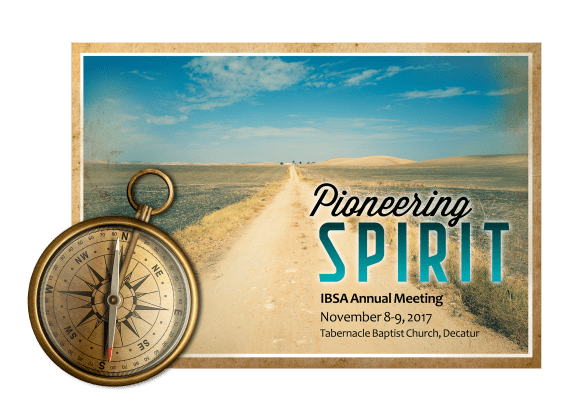
Postcard art.pngThe 2017 Annual Meeting of the Illinois Baptist State Association is Nov. 8-9 at Tabernacle Baptist Church in Decatur. The online pre-registration process, detailed in a letter sent to IBSA churches, is now open for those who will serve as messengers, or voters, at the meeting.

Pre-registered messengers should bring their paperwork to the meeting in Decatur, where they will be fast-tracked through the rest of the registration process.

The Decatur gathering will focus on the “pioneering spirit” required of those who settled Illinois nearly 200 years ago, and of Christians today who are seeking to push back spiritual lostness in the state.

“When pioneers were settling Illinois in 1818, only about 35,000 residents lived in the entire state, alongside the Native American population,” said IBSA Executive Director Nate Adams. “It was extremely challenging just to survive and to eke out a living. But some of those early pioneers were also pioneers of Baptist faith. During difficult and dangerous times, they considered it a priority to share the gospel and to start new Baptist churches.

“Today Illinois has over 13 million residents, and only about 80,000 Illinois Baptists in church on a given Sunday. In many ways our Great Commission challenge is greater in 2018 than in 1818. We need a fresh wind of pioneering spirit today.”

Southern Baptist Convention President Steve Gaines will speak during the Annual Meeting, and also will be on hand for the IBSA Pastors’ Conference Nov. 7-8 at Tabernacle in Decatur. (For more on the Pastors’ Conference, see the ad on page 6.) The Pastors’ Conference and the Annual Meeting will each offer dinner prior to the Tuesday and Wednesday evening sessions; for more information and to purchase dinner tickets, go to IBSAannualmeeting.org.

The Briefing

How do we find meaning in yet another mass shooting?
Al Mohler asks that question following the tragedy in Las Vegas.
In the face of such overwhelming news, we naturally seek after facts. But the facts of who and what and where and how, still unfolding, point to the even more difficult question — why? We cannot help but ask why because, made in God’s image, we are moral creatures who cannot grasp or understand the world around us without moral categories.

Gov. signs HB40 into law; Baptists deeply disappointed
Gov. Bruce Rauner ended months of speculation last week when he signed legislation allowing state health insurance and Medicaid coverage for abortions. Reaction has been swift and strong.


So. Baptists, others release letter on ‘alt-right’ to Trump
A letter drafted by a group of Southern Baptists and others has called on President Trump to denounce clearly the racism of the “alt-right.” The letter commends the president for signing a joint congressional resolution rejecting white nationalism and supremacy, but it tells him the country “needs your voice and your convictions to defeat racist ideologies and movements in every form that they present themselves.”

Pew surveys governments on religion
More than 40% of the world’s countries have an official or preferred state religion, according to a study released by the Pew Research Center. The most common official state religion is Islam, which is named in the constitutions or basic laws of 27 countries. That’s 63% of the 43 countries that officially designate a religion. Thirteen countries list Christianity as their state religion—nine in Europe, two in the Caribbean, one in Africa, and one Pacific island nation.

Sources: AlbertMohler.com, Springfield State Journal-Register, Baptist Press (2), Christianity Today

Somebody’s prayin’

ib2newseditor —  October 2, 2017

Pray button

After my dad’s mother died, I remember him saying that he physically felt the absence of her prayers. Dad had, in some ways, a challenging personality for pastoring. He was introverted, in many ways non-assertive, a quiet thinker and reader who scripted his sermons by hand so that he could deliver them effectively.

So, if you only knew my dad personally, you may have been surprised when you first saw him step into the pulpit, or witnessed him in some other pastoral role. He was wise, articulate, bold, insightful, truly helpful. As a pastor, he was supernaturally equipped for the role to which God had called him, in a way that eclipsed his natural limitations. And I believe this was supernaturally sustained by the devoted prayers of people who supported him over the years, his mother and my mother chief among them.

Our pastors need our sincere and earnest prayer. They need us to intercede spiritually for them, every bit as much as they need us to support them in leading the ministries of our church. Not all pastors face the same challenges that my dad did, but all of them face their own unique struggles and obstacles. If it is primarily those closest to them that sustain them in prayer, just think what could happen with an entire church earnestly praying.

Pastors need our sincere and earnest intercession.

October is Pastor Appreciation Month. If this is not already your practice, let me encourage you to take the month of October to pray for your pastor, and perhaps other pastors you know, daily. At the IBSA.org website, there will be a daily prayer guide to assist you in that discipline.

You will not be alone. Throughout October, our IBSA staff will be praying for every IBSA church pastor, by name. We are also asking for specific prayer requests by e-mail, and personally calling more than 300 pastors for whom we don’t have a current e-mail address, to ask them how we can pray.

I hope many pastors will share specific prayer needs, perhaps some that are difficult to share with church members, and will allow us to pray for them personally in this way. For those from whom we don’t receive specific requests, we will simply use the prayer guide to pray for each pastor.

Many churches give gifts and other expressions of love to their pastors during October. Prayer, especially consistent, daily prayer, is one of the greatest appreciation gifts you can give. When something “appreciates,” it increases in value. And I believe that the sincere, consistent prayers of a congregation will “increase the value” of a pastor more than anything else. And by the way, that’s true even when you may personally struggle with your pastor!

In a recent IBSA chapel, we were talking about praying for pastors. Our state worship director, Steve Hamrick, shared about his dad, also a pastor, who prayed for him daily throughout his ministry. When his dad passed away a few years ago, his father-in-law noted at the funeral how special that prayer relationship was, and committed to him to take up the privilege of praying for Steve from that day forward.

During that same chapel, Steve led us in singing the old Ricky Skaggs song, “Somebody’s Prayin’.” The first two lines of that song are simply, “Somebody’s prayin’, I can feel it. Somebody’s prayin’ for me.”

IBSA pastors, I will be one of those somebodies praying for you throughout the month of October, along with every member of our staff. I hope you “feel” it in the same way that my dad did from his mom. And I hope you will feel it from many faithful church members as well.

Nate Adams is executive director of the Illinois Baptist State Association. Respond at IllinoisBaptist@IBSA.org.