Archives For April 30, 2016

The BriefingTrump: ‘Moore Is Truly a Terrible Representative of Evangelicals’
Presumptive Republican presidential nominee Donald Trump lashed out at ERLC President Russell Moore with a tweet May 9. The tweet comes after Moore told “Face the Nation”that “the Donald Trump phenomenon” is an “embrace of the very kind of moral and cultural decadence that conservatives have been saying for a long time is the problem.” He also noted some conservatives “now are not willing to say anything when we have this sort of reality television moral sewage coming through all over our culture.”

Evangelicals feel abandoned by GOP
Some conservatives whose voting decisions are guided by their Christian faith find themselves dismayed and adrift now that Trump has wrested control of the Republican Party. Even progressive Christians — evangelicals and Catholics, among others — who don’t necessarily vote Republican are alarmed that Trump is attracting many voters who call themselves religious.

Justice Dept., NC sue over bathroom law
The Justice Department and North Carolina filed dueling lawsuits May 9 over the state’s controversial “bathroom” law, with the Obama administration answering an early-morning lawsuit filed by Republican Gov. Pat McCrory with legal action of its own.

51 Illinois families sue over transgender bathroom policy
A group of 51 families whose children attend a Palatine, IL high school filed a federal lawsuit attempting to reverse a policy that allows a transgender student to use girls’ bathrooms, locker rooms, and other sex-specific facilities. They are challenging a policy at District 211 that was mandated by the U.S. Department of Education to accommodate the transgender student, who was born male but identifies as a female.

111 Methodist clergy come out as LGBT
Dozens of United Methodist clergy members came out as lesbian, gay or bisexual on May 9, defying their church’s ban on “self-avowed practicing homosexuals” serving in ministry and essentially daring their supervisors to discipline them.

Bono wants Christian music to get honest
When U2 musician Bono reads Psalms he sees the full range of human emotions: anger, irritation, sadness, bliss. Bono, who has become more outspoken about his Christian faith in recent years, is advocating Christian music return to the raw and honest emotion of the Psalms.

Sources: Christian Post, Baptist Press, Washington Post, Fox News, Daily Signal, CNN, Huffington Post

The Illinois Baptist editors asked the SBC Presidential candidates this question: What are the three greatest challenges facing the SBC? Here are their replies:

David CrosbyDavid Crosby
First Baptist Church, New Orleans

1. We must get out of our buildings and into our communities. We are plagued with the mentality that people “go to church.” This says that “church” is a location somewhere. We need the reverse: “Churches go to people.”

I want us to expand the presence of our churches in their communities. I will seek to foster strategies of compassion ministries that keep us in touch with neighbors in need and open wide the doors of loving witness. These ministries break down racial and class barriers and help our churches look more like our communities and more like heaven. This is our future.

2. We must bring a message of hope to our churches and our culture. The primary metaphor for being in the world as believers is not warfare. It is light. Anyone in darkness is thrilled to see a glimmer of light. Our warfare mentality has had the unintended effect of stealing hope from our hearts and our message. An angry and fearful posture in the world is unwise, unfounded, and unchristian. Losing the culture wars is no loss at all compared to losing the message of a living hope.

My daily reality is the hardscrabble world of urban New Orleans. I will lead the SBC from the perspective of this highly diverse and difficult mission field where God’s people shine like stars and loving engagement brings true hope.

3. We must be cooperative. Southern Baptists are distinguished from other groups in that they actually do mission together, not just independently. Cooperation, we believe, is biblical and is a superior strategy for accomplishing the world mission of the church.

The spirit of cooperation has waned, but the need for it has not.

As SBC President, I will not talk or act as if a return to the society method of supporting our cooperative work is progress. I will cultivate and promote a cooperative spirit. I will demonstrate cooperation by continuing to give a substantial percentage of the undesignated receipts of my church to our unified giving plan.


Steve GainesSteve Gaines
Bellevue Baptist Church, Memphis

Three of our greatest challenges in the SBC are: spiritual awakening, soul winning, and stewardship.

Regarding the second challenge, the SBC is in a 15-year downward trajectory in baptisms, the longest in SBC history. In 2014 we baptized 100,000 fewer people than in 1999. Regarding the third challenge, we recently called 1,000+ IMB missionaries home due to financial deficits.

In my opinion, the first challenge, our need for spiritual awakening, is the most important. If prioritized, it can solve the other two.

The SBC needs fresh wind and fire from heaven. That will only come when a spirit of prayer and repentance captivates our pastors, lay leaders, church members, associations, state conventions, and SBC entities.

I will seek to lead our SBC to prioritize passionate prayer in each person’s personal life, and encourage the development of specific prayer strategies for pastors, church members and all who serve in our SBC agencies. Without spiritual awakening, the SBC will continue to decline. God can do more in revival in one hour than we can do in years without it.

Both the early church (cf. Acts 2:1f) and missions (cf. Acts 13:1f) were birthed in prayer meetings. Prayer and revival caused the early church to win multitudes to faith in Jesus. Prayer and revival also made the early believers strong financial stewards who gave generously. When we pray, we will evangelize and make disciples. God will also activate his angelic army to defeat our enemy, the devil, and thus advance his kingdom in our churches, Convention and culture.

If chosen to lead the SBC, I will give myself wholeheartedly to help the SBC experience spiritual awakening to bring glory to God through souls being saved, people being discipled, financial resources being made available, and more missionaries being sent out to the ends of the earth.


JD GreearJ.D. Greear
The Summit Church, Raleigh-Durham

First and foremost, we need a continued re-awakening to the gospel. Historically, revival has begun not with lost people getting saved, but with the church getting “re-converted” to the gospel, which then leads to massive evangelism. I know we feel like we live in a dark age, but if we look at the last four awakenings in the Western world, we see that the conditions in our country are riper for revival now than at any other point since the Great Awakening.

The time is right. The harvest is ready. So we need to boldly ask God for what we know he wants to give us. And our entities need to respond accordingly. The Convention doesn’t exist for sake of the entities or the state conventions. It exists for the Great Commission. We must constantly re-evaluate everything we do in light of that.

Second, we need to bring a new generation of Southern Baptists to the table to partner with older generations in the cooperative missions of the SBC. There is a new wave of excitement about the SBC, but many newer generations of churches are still sitting on the sidelines. We need to take personal responsibility for the entities of the SBC and step up to own the mission. We must join with a faithful older generation to sacrificially give, support, and serve in these entities, boards, and institutions.

Third, we need to see diversification in the leadership of the SBC. About one in five churches in the SBC now is predominantly non-Anglo (praise God!), and we want to see our brothers and sisters from these non-Anglo backgrounds join us in leadership. I believe we are at a kairos moment in this. We should strive to see SBC leadership reflect the diversity of the SBC—culturally and racially, including younger and older, more traditional and more modern. We are united by The Baptist Faith and Message (2000) and our passion for the Great Commission. I believe that our greatest days are yet ahead!

Signs of Hope

ib2newseditor —  May 5, 2016

Illinois women on a mission in South Asia see lives changed by the story many there had never heard.

Editor’s note: In April, a team of women from Illinois traveled to South Asia to share gospel stories and witness how believers there are working to push back spiritual darkness. Lindsay McDonald, a pastor’s wife from First Baptist Church in Casey, captured the trip in words and pictures.

Okay, you can start,” Mim* says, leaning towards Gail Faulkner, who sits on the chair beside her. Having practiced the “Creation to Christ” story for months now, today is Gail’s opportunity to tell the gospel story that her team traveled nearly 8,000 miles to share.

“So, I should go ahead and start the story?” Gail confirms with Mim, a believer working to reach others in her country. About 20 women are gathered, clustered together on handcrafted floor mats.

A Hindu woman offered her simple, empty home for today’s story. The room is dark and still.

The women look expectantly at the visiting Americans and their translators and ministry partners—women from this country who have converted to Christianity.

“Yes, tell them. They are thirsty,” Mim responds with urgency.

S_Asia_women_no_text

Women here talk to each other while they prepare meals, wash clothes in the village pond, and care for their children. When the women in the last village on the last day were asked about how to apply the story to their lives, they said, “If we spend less time gossiping, we will have more time to share the gospel.”

Gail, a pastor’s wife from Bethalto, Ill., joined this mission team even when this part of the world wasn’t on her radar. She says God made it clear to her that it was her time to be on the team, and cleared her path of any financial obstacles to traveling thousands of miles from home.

Joining her on the team were six other women from Illinois and three from the Carolinas. They came from a variety of life stages: young mothers, grandmothers, retirees, professionals. All prepared and trained for months to bring the message of hope Isaiah prophesied to the Israelites thousands of years earlier: a perfect sacrifice, Jesus.

The Illinois volunteers came to partner with two missionaries serving in this densely populated country, and three national believers who served as their guides and interpreters. These Christians focus primarily on evangelism to Muslim women, who they can encounter more freely because of the culture here. The nation’s oral tradition is built on conversations and storytelling. Much like the story about to begin in this dark house.

Out of darkness

Life in South Asia is hard.

“Oppression is real and hope seems distant,” says Amy Neibel, a mission team member from First Baptist Church in Carmi. In this country in South Asia, 80% of the people live on less than $2 a day, and 40% live on less than $1.

Poverty is real.

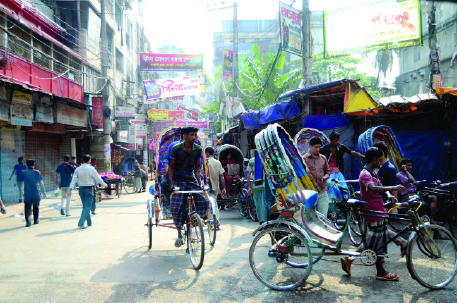
It bombards all of your senses—the smell of waste in the street, as adults and children sift through it, looking for items to recycle and sell. Cars honk in the dense traffic, and rickshaw drivers pedal passengers to and fro for a minimal wage.

Darkness is prevalent.
S_Asia_street_no_text.jpg

Sights of daily life whizzed past our van as we traveled the dusty, dirty, bumpy roads that are congested with chaos. Traffic, animals, people. Vendor after vendor sells fruit, meat and South Asian cuisine. Physically and mentally disabled adults lay on the side of the road, and beggars tap on the vehicle window looking for money.

“It is a place where you not only sense it, but also see the spiritual darkness on the faces of the people,” Amy says. The country is 98% Muslim and many haven’t heard about salvation through Jesus.Almost 16 million people hear the Muslim call to prayer fives times a day; some stop and pray and others proceed with their day.“Though you can sense the darkness, they are just like us—they are hurting,” team leader Kimberly Sowell says during a morning devotional. Sowell’s ministry, Bangladesh: For Faith and Freedom, supports job training for women and girls, offering them a way out of the hopelessness that is so prevalent.

“All of God’s people are called to be used of him but why do some not go?” Kimberly asks the team. They answer, We’re comfortable where we are. The missions call is for “other people.” There’s plenty of spiritual need at home.

Most of all, this place is hard.

“God is working here. That’s why there is persecution, if God wasn’t moving there would be no persecution,” says Mim.

Into the light

Walking is a part of the daily routine here. While out one day in the capital city and a nearby port city, Gail says, “I noticed there was no life. The faces of the women passing me were stoic. No expression. The lack of hearing the voices of children crushed my grandma’s heart. I’ve never been to an area where the noise of children playing, yelling, running and crying could not be heard.”

Stepping into the Light of Life and Light of Hope Learning Centers is a different story. Within these walls, there is life! Young smiles greet the team as they enter. They play Twister, Phase Ten, and Old Maid with the girls to teach them colors, animals, numbers, and occupations.

The ministry Sowell began in 2013 supports efforts to provide nutrition, hygiene, education and vocational training to young women. Here, they also hear the gospel, so they can find faith and freedom in Jesus Christ.

“The Light of Hope Learning Center is an amazing place full of laughter and love,” says Connie Lang, a volunteer from First Baptist of Casey, on her first international mission trip. “It is run by an amazing missionary, Susan Kirker,* who loves the girls and their mothers.

“As we built relationships with the girls, I loved hearing them recite the Bible story that was being taught to them,” Connie says. “This trip has been life-changing. I have grown closer to the Lord and have seen the power of prayer at work.

“I would love to go back again.”

While leaving the capital city headed to our next area of work on Friday, we had just started to pray for the city when we drove by a mosque. Hundreds of men were lying facedown praying to Allah. Our hearts were sick to see the lostness right before our eyes. It’s everywhere—less than 1% are believers. You can feel the spiritual darkness.

Both centers are funded by the International Mission Board, but they are run independently from one another, with different directors and school formats. Light of Life, located in the capital, has a school for at-risk girls during the day and brings in Muslim women in the afternoons for sewing lessons.

Light of Hope offers similar activities. Girls have the opportunity to sew in the mornings while earning a daily wage, and then attend school in the afternoon.

Both centers give hope to hopeless lives of the girls living in the city slums. “Yet it is even more than that,” Gail says. “The girls are offered a daily clean shower, two meals for the day, an education, sewing skills, Bible teaching and love.”

 Walking in new life

Back in the dark village house, the Hindu and Muslim women listen to the “Creation to Christ” story and then take turns repeating it, trying to commit it to memory. Since they live in an oral culture, many do not know how to read or write. Messages must be verbally transmitted in speech or song among friends and family, and then passed down through generations.

More than 30 women accepted Christ after hearing the stories the team shared. Several who believed have already set up a time to be baptized—a big step of obedience in a place where the decision to follow Christ could bring persecution.

“God showed himself mightily to the South Asians and our team,” said Niece Edwards from First Baptist, Carmi. “I was stretched as never before and learned more about God’s sustaining power.”

“Walking through this South Asian country during this season of my life, really displayed how I need to walk beside my husband with the purpose of harvest,” said team member Kathy Fullerton. “We need to be intentional with neighbors, strangers, friends, and family because the gospel can permeate cultural bounds. Jesus died for those in burkas and overalls alike.”

*Names changed.

The BriefingESPN edits Schilling out of sports history
ESPN edited out footage from Curt Schilling’s legendary “bloody sock” game when replaying a 2010 documentary about the Boston Red Sox’s 2004 World Series comeback win. The move to cut him out of the documentary happened less than two weeks after the network fired him for objecting to laws allowing men who identify as transgender to use a women’s restroom.

Companies oppose religious freedom bills
Almost 200 bills have been proposed this year in more than 30 states that would limit or prohibit protection against discrimination for LGBT individuals, according to the advocacy group Human Rights Campaign (HRC). In response, large companies that have already contributed millions of dollars to HRC and other advocacy groups have been taking steps to coordinate their lobbying activities.

1 million Americans boycott Target
More than one million people have decided they will no longer buy their Nutter Butters or Wet Wipes at Target. The American Family Association launched a boycott of the nation’s second largest retailer over a week ago – over Target’s corporate policy allowing men who identify as women to use the bathrooms and fitting rooms of their choosing.

Student expelled for views on homosexuality
Former Missouri State University student Andrew Cash is suing the college for expelling him from the school’s counseling program based on his opposition to same-sex relationships. Cash, who began his master’s in counseling in 2007, was expelled from the program in 2014 for expressing his views on counseling homosexual couples on relationship issues.

Religious freedom deteriorating around the world
Religious freedom remains under “serious and sustained assault” around the globe, according to a new annual report from the U.S. Commission on International Religious Freedom. “At best, in most of the countries we cover, religious freedom has not gotten better,” commission chairman Robert P. George said May 2. “In the worst cases, it has spiraled further downwards.”

Sources: The Federalist, Bloomberg, Fox News, Baptist Press, Religion News

Worth the risk

ib2newseditor —  May 2, 2016
A whirl of color – The Illinois mission team tries on pieces of the sari indigenous to the culture.

A whirl of color – The Illinois mission team tries on pieces of the sari indigenous to the culture.

As Carmen Halsey walked the roads of this South Asian country, she challenged herself to a game of sorts. “I’m a make eye contact, smile kind of person,” said IBSA’s director of women’s ministry and missions. Halsey tried to lock eyes with women she passed and see if she could get them to smile. But it never happened.

“I’ve never seen the face of oppression like what I saw there,” Halsey said, remembering how she tired of the multiple calls to prayer at the mosque, ringing out daily and reminding her mission team of how many people are walking in spiritual darkness.

Halsey’s trip to South Asia was actually years in the making. When she joined the IBSA staff in 2013, she mobilized women in the state around awareness and prevention of human trafficking—a focus started by National Woman’s Missionary Union.

In Illinois, Halsey has continued that emphasis, putting in place a task force to study the issue, create resources for churches, and facilitate mission trips in North America and internationally to be involved in rescuing victims of trafficking. The trafficking focus is how Halsey met Kimberly Sowell and Bangladesh: For Faith and Freedom.

The April trip, led by Sowell, gave Halsey and Illinois women an opportunity to see up-close trafficking prevention and rescue at the Light of Hope Center. But they also saw the importance of encouraging national Christians—South Asian women who have come to Christ and are now risking persecution to reach others with the gospel.

During their trip, the Illinois women saw in a new, real way the threats Christians face in other parts of the world. The awareness that believers in South Asia could lose their lives for their faith spurred the team on, Halsey said, and inspired “intense, beautiful” prayer. It also left Halsey wrestling with a bigger question: As Christians in the U.S., most of us don’t have a target on our backs. Why then are we not sharing here?

As the team ministered in a village one day, they were asked to pray for people who were sick. One woman went to get her son, a Muslim, so Halsey could pray for him. Halsey describes what happened next as her boldest moment. “I looked at him and said, ‘I will pray for you. But I have got to be clear: There is only one name I’ll pray to.”

In this place, where people are in desperate need of hope, only one Name can deliver it: Jesus.

For more information about IBSA mission opportunities, contact Carmen Halsey at (217) 391-3138 or CarmenHalsey@IBSA.org.

– Meredith Flynn