Archives For January 31, 2015

THE BRIEFING | Meredith Flynn

Three-dimensional map of Illinois. USA.It’s “State of the States” time at Gallup, and the researcher is releasing new findings every other day. Last week’s data covered President Obama’s job approval rating, political party identification, and ideology–each measured by state. To see how Illinois ranked (a quick preview: The state had the 10th highest approval rating for the President), go to Gallup.com.


Phillip Bethancourt examines “Johnny Manziel, Rehab and the Gospel” on FaithStreet.com, in light of the Cleveland quarterback’s entry into a treatment center earlier this month. “As Christians, our response to the collapse of Johnny Manziel should not be an ‘I told you so’ triumphalism or an ‘anyone could see that coming’ dismissiveness,” wrote Bethancourt, executive vice president for the Ethics and Religious Liberty Commission. “Instead it should be a ‘such were some of you’ recognition that, apart from Christ, we might also be there.”


Pew Reseach reports the U.S. Supreme Court could face some religion-themed decisions this year, including two very different cases related to employment. In one, a would-be employee at Abercrombie & Fitch is arguing for her right to wear a head covering. In the other, religiously affiliated non-profits say they shouldn’t have to comply with the Affordable Care Act’s contraceptive mandate.


At the Feb. 5 National Prayer Breakfast, President Barack Obama compared current acts of terrorism committed by ISIS and other groups to past movements–including the Crusades–he said were often committed or justified in the name of Christ.

“His flawed comparison to atrocities that happened hundreds of years ago minimizes the severity of ISIS and other groups that are brutalizing and killing innocent people,” Southern Baptist Convention President Ronnie Floyd told Baptist Press. “Instead of focusing on the past, America needs heroic leadership in the present–leadership that champions religious liberty for all people.”


Christian rapper Lecrae Moore gave credit where credit is due during his Grammy acceptance speech Sunday night.  “…You can’t celebrate gifts without celebrating the giver of all gifts. So I want to celebrate Jesus for gifting us all with the gift of love and sacrifice.” Lecrae’s song “Messengers” (featuring for KING AND COUNTRY) won the Grammy for Best Contemporary Christian Song/Performance. Read more at ChristianPost.com.


HEARTLAND | Eric Reed

When I said to my co-workers, “Well, let’s go meet a thousand of our closest friends,” I didn’t know how true that statement would be. We left our offices and drove the four blocks to Springfield’s Crowne Plaza Hotel, site of the 2015 Midwest Leadership Summit. And like so many of our Baptist gatherings, this one felt like Homecoming Week at Sandy Creek Church. We saw dear friends from across Illinois, and some we knew from the other dozen states in attendance.

Eric_Reed_Feb9But I never expected to see Woodie.

After all, it’s been 35 years. And the last time I saw Woodie, he was a Mormon. In Alabama. Go figure. Woodie and his siblings were fourth-generation Reformed Latter Day Saints (RLDS) living in a fishing town on the Gulf Coast. We all went to high school together. Although our school was a ministry of a conservative fundamentalist church, no one made an issue of Woodie’s religion. All his family
were clean-cut, well-mannered, and better behaved than many in our class who claimed to be Christians. I remember Woodie as a great guy, a good football player, and very well liked. But lost.

Woodie came to that truth while in college. Through a campus ministry he came to a life-saving faith in Jesus Christ and left his family’s religion. Later, he attended Mid-America Seminary and was called to ministry. Eventually Woodie moved to Lamoni, Iowa, the place where Latter Day Saints founder Joseph Smith once lived and present-day home to the RLDS college. Woodie had attended that college for a couple of years until he began question the RLDS religion.

Returning in 1991, Woodie started a Baptist student ministry, reaching out to RLDS students and others.

Eventually he pastored First Baptist Church of Lamoni, the sponsor of his college ministry, for nine years, and just recently was called to lead Calvary Baptist Church in Clinton, Iowa. Woodie said God is opening doors to Brazilian soccer players (in Iowa!) because his son plays soccer and his wife is originally from Brazil. Go figure.

That’s why he was at the Midwest Leadership Summit and standing in the hallway outside the ballroom at the Springfield Crowne Plaza. Woodie is a Southern Baptist pastor in the Midwest, looking for fresh ideas, inspiration, and encouragement.

I stand amazed by all God has done in Woodie’s Christian life and Baptist ministry. And I’m so glad God brought our paths to cross again.

I should be more amazed that 35 years after high school—even though Woodie hasn’t changed much—I recognized him standing there. But that’s the Lord’s doing too.

Go figure.

Eric Reed is IBSA’s associate executive director for the Church Communications team, and editor of the Illinois Baptist newspaper.

How a biblical proverb can help us manage modern money

COMMENTARY | Doug Morrow

Doug_Morrow_blog_calloutI’ve been working on a project since mid-November. Once a week (okay, once every two weeks), I write an extended devotional or comment based on a chapter of Proverbs and have been addressing it to my children. Proverbs represents some of the most amazing “counsel” ever written, and much is written as from a parent to a child. I’ve been trying to amplify the Proverbs into my own paternal voice for the benefit of Reed, Lauren and Claire.

It was in this process that I discovered a nugget that describes what I believe in so passionately, and the mission of the Baptist Foundation of Illinois:

“Honor the Lord with your wealth and with the first fruits of all your produce,” reads Proverbs 3:9, “then your barns will be filled with plenty, and your vats will be bursting with wine.”

King Solomon’s words can be difficult to translate to our time and culture. “First fruits” has a different meaning in an America so replete with cheap food that we’re far more likely to queue up at the McDonald’s drive-thru than pray for rain for the wheat crop. Few of us have barns, and ever since municipal water projects, there are even fewer with “vats bursting with wine.” So, what could the Spirit say to us through these words to those living in the wealthiest nation in our planet’s history? “Honor the Lord with our wealth?”

In truth, most of the assets we steward for the Lord aren’t in our income (technically our “first fruits”), or emergency cash. Over time, most people collect “wealth” in things like real estate (67% of Illinoisans own their home), IRA or other retirement assets (often acquired ‘pre-tax’), life insurance, or other “stuff” we collect over our lifetimes.

I think the way we honor the Lord with this wealth, along with our first fruits, is amazingly simple and can be found in the text itself. The pattern we apply to our wealth should be consistent with the pattern we establish with our “first fruits!”

Do we take care of our needs such as food, shelter and clothing with our first fruits?

Do we use those fruits to care for our children and dependents?

What about supporting the work of God’s church?

Absolutely, on all three counts. And because we do those things with our first fruits, we should do so with our wealth.

How does all of this come together in a way that accomplishes this God-honoring stewardship plan? Well, since most of our “wealth” is not accessed until our death, it’s important to put together a Christian Estate Plan now. Such a plan accomplishes the “pattern” that God has called us to live out in our lives—taking care of our own needs, caring for children and dependents, and investing in the work of God’s church.

These are the elements I commonly refer to as the “big four” parts of a Christian Estate Plan:

• A will and possibly a living trust
• A financial (durable) power of attorney (when not using a living trust)
• A health care power of attorney
• Careful attention to titling, beneficiary designations, or transfer on death devices on retirement assets, life insurance, financial accounts or other assets, since any asset designated in this way bypasses the will and the probate process

The Baptist Foundation has actually made the process simpler than you might imagine—and much less expensive than you might fear. A great place to start is with the Life Stewardship Navigator, a free download from http://www.BaptistFoundationIL.org. BFI provides complimentary and confidential help in putting together a plan that enables you to provide for your family and support Christian causes in exactly the manner you wish to support.

Over the next few months, I’ll keep working on the Proverbs chapters (my wife wants me to arrive at chapter 31 in time for Mother’s Day). In the meantime, it’s important that we begin this year with the counsel that all we are, hope to be, or ever will steward belongs to our God. May we carefully honor Him in everything.

Doug Morrow is executive director of the Baptist Foundation of Illinois.

One Baptist leader says Scripture’s case for cooperation is the most compelling reason to work together.

Micah_Fries_blog“My entire life growing up, what I heard about the Cooperative Program was, ‘give to it because it works,’” said Micah Fries (left), vice president of LifeWay Research.

Indeed, historical evidence supports it—CP does work. Southern Baptists’ main method of supporting missions and ministry here and around the world, will turn 100 in 10 years, and has helped mobilize one of the largest missionary forces in the world.

Last year, Baptists gave more than $186 million through the CP Allocation Budget to send and support church planters in rural America and the country’s largest cities, and to get the gospel to places and people around the world that have never heard it. At a meeting of the SBC Executive Committee last year, CEO Frank Page called CP the best way to “concurrently, consistently and, yes, completely fulfill Acts 1:8 as a church body. Through that, you’re involved in missions and ministries all over the world, all the time.”

But the average percentage churches give through CP has fallen over the years, from 10.7% in 1982, to less than 5.5% the last few years.

In this climate of decline when it comes to cooperative engagement, there is a better, more compelling reason to work together than to do so “because it works,” Fries said during a breakout session at the recent Midwest Leadership Summit in Springfield, Ill. He argued for a theological foundation, rather than pragmatic justification.

“…I want to plead with you to go back to your churches and plead with your churches, go back to your associations and your state conventions and plead with them to be faithful at partnership mission, but not because it works. But because the Bible tells me so.”

A better rationale
Our need for a biblical foundation for cooperation, Fries said, starts with characteristics we have that are specifically human, and specifically American. In our consumer-driven culture, most people shop for churches like they shop for blue jeans. Where can I get the best product for the lowest cost? If the personal price is too high, they’ll look elsewhere.

That consumerism, along with pride, independence, and the valuing of perception over reality, runs counter to the ideas of community and cooperative engagement.

“…When you and I call for community in the context of the local church, and cooperation or collaboration between local churches, we need to understand that what we’re calling for is a radically counter-cultural identity,” Fries said. “It strips away the core of who we are, and calls us to be like Jesus.
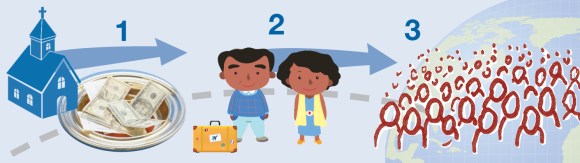
CP charts are complicated, Fries said, even for those who have long understood the system. “Stop making it so confusing for people.” “That’s what the Cooperative Program does," Fries said.

CP charts are complicated, Fries said, even for those who have long understood the system. “Stop making it so confusing for people. You put money in the plate, money goes to a missionary, missionary tells people about Jesus. That’s what the Cooperative Program does.”


“This is challenging. This is why it’s not enough to say, ‘We need to give to the Cooperative Program because it works.’ Because ‘it works’ is not a compelling enough reason to deny the core of who we are.

“Because it makes us to be like Jesus, because it helps to advance the gospel, because it helps to glorify God; those are compelling reasons to engage in counter-cultural activity.”

Younger Baptists are looking for more than pragmatic justification too, Fries said. The generation raised after the Conservative Resurgence spends more time thinking about what the Bible actually says, than arguing its truth. “So, you’re not going to compel them with pragmatic arguments, it’s going to have to a biblical rich, theologically rooted argument.”

Toward gospel advance
“Without a doubt, the high calling and common cause that unites diverse Baptist churches in cooperation is the Great Commission of Jesus to make disciples of all the world’s peoples,” IBSA Executive Director Nate Adams wrote for Resource magazine last year. “Wherever else Baptists may disagree, we are agreed on the priority of advancing the gospel, both across the street and around the world.”

CP also helps involve different kinds of churches in that mission, Page noted during the Midwest Leadership Summit. The SBC is a convention of small churches, including many ethnic congregations. “The Cooperative Program levels the playing field so everyone has opportunity to bring worshipers to God.”

Ultimately, biblical cooperation leads to an advanced gospel, which is “the compelling apologetic for collaborative mission,” Fries said. Choosing for the gospel to go forward through believers wasn’t the most pragmatic choice for God to make, he said; rather, he designed it that way because it brings him glory and brings us joy.

Read more from the Feb. 2 issue of the Illinois Baptist, online at http://ibonline.IBSA.org.

Rob (left) and Mona Payne (center) lead worship during "Pop Up Church" for Downtown Phoenix Church, also known as DTPHX Church. Photo by Shawn Hendricks/BP

Rob (left) and Mona Payne (center) lead worship during “Pop Up Church” in Phoenix. Photo by Shawn Hendricks/BP

THE BRIEFING | Meredith Flynn

Young adults in downtown Phoenix “don’t think about going to church on Sunday morning any more than you and I think about going to bingo on Friday nights,” says Pastor Jim Helman. To reach Millennials, his Downtown Phoenix Church “pops up” every other week at a coffee shop or in a park, and uses the other weeks to serve the community. Read more at BPNews.net.


His Seattle Seahawks may have lost the Super Bowl in stunning fashion (that second down call!), but quarterback Russell Wilson seems to already be bouncing back via Twitter. After the game, the outspoken Christian posted motivational messages and Psalm 18:1–“I will love You, O LORD, my strength.”


Imprisoned pastor Saeed Abedini thanked President Obama for meeting with his wife and children last week, and for assuring the couple’s young son that he will try to secure his father’s release by March (when Jacob Abedini will celebrate his 7th birthday). “I know that as a father you can truly understand the pain and anguish of my children living without their father and the burden that is on my wife as a single mother,” Abedini wrote to Obama from Rajaee Shahr prison in Iran.

In the letter, provided online by the American Center for Law and Justice, Abedini also thanked Obama “for standing up for my family and I and for thousands of Christians across the world who are persecuted for their faith in Jesus Christ.”


The American Bible Society will relocate to Philadelphia after selling its Manhattan building for $300 million, reports The Christian Post. The 12-story facility on Broadway, which has housed ABS since 1966, is about 10 blocks from another ministry: the offices of the Metro New York Baptist Association.


Religion writer Cathy Lyn Grossman reports on the “post-seculars,” a group defined in a new study as falling between “traditional” and “modern” views of science and religion. Said study co-author Timothy O’Brien, “We were surprised to find this pretty big group (21 percent) who are pretty knowledgeable and appreciative about science and technology but who are also very religious and who reject certain scientific theories.”


Democrats feel more warmly toward Muslims than do Republicans, Pew reports in a study on how ideology and age affect American “temperatures” about Muslims and Islam.


As Boko Haram continues to wage a war of terror in Nigeria, “…God has raised up believers who have remained steadfast and bold in the midst of applied pressures to silence them,” said one Christian worker, according to this Baptist Press story.


When leaders gather

nateadamsibsa —  February 2, 2015

Nate_Adams_February2HEARTLAND | Nate Adams

More than 50 years ago, a small group of leaders from six Baptist state conventions here in the Upper Midwest gathered to discuss how they could help churches reach people with the gospel more effectively. They recognized that, even in that day, our Baptist faith and message were counter-cultural, not only to the spiritually lost, but also to those who had been exposed to the religious traditions that dominated the region. Being Southern Baptist in the north was and is not easy. The Midwest is a challenging mission field.

Those leaders returned home, determined to work with local associations to invite 10 leaders per association to the first North Central States Rally. The objective was to encourage stronger evangelism and church planting, and to deliver highly relevant training along with the clear message that Midwest pastors and church leaders were not alone.

I remember the first of these that I attended, back in January 2006. I was serving with the North American Mission Board, and was asked to come and lead a couple of conferences on the Acts 1:8 paradigm for missions strategy in the local church.

Though I had been assured that it happened every three years, I have to admit that I did not expect to find many leaders gathered in snowy Indianapolis in late January. But I was wrong. Almost 900 pastors, church planters, associational leaders, and lay leaders from all over the Midwest came, and eagerly soaked in the training and inspiration provided by Midwest practitioners and state and national SBC leaders.

In the hallways, in small group gatherings, and around the lunch and dinner tables, two central messages were clear. We are all here to advance the gospel in this region, and we are not alone.

That 2006 Rally, and the 2009 and 2012 Rallies that followed it, were all hosted in Indianapolis, which is fairly central to the six state conventions whose leaders gather. But in January 2015, the gathering expanded to include 10 state conventions. It took on a new name, The Midwest Leadership Summit. It attracted more than 1,000 leaders, the largest ever. And we were blessed to host it right here in Springfield, Illinois.

An all too common mindset these days seems to be that it’s too difficult to attract people to meetings. It’s not just that people are busy and travel is expensive. There seems to be a spirit of independence, sometimes even isolationism that can easily creep in to churches and their leaders. It’s easy to convince ourselves that things will be easier, simpler, cheaper, if we just stay home and focus on our own church.

But it is autonomy pulled together into cooperation, not independence pulled apart into isolation, that has produced missions advance by churches over the years. Sure it’s challenging and costly to get together, especially for busy leaders. But when committed, missions-minded leaders gather and ask how they can work together to more effectively advance the gospel, good things are bound to happen.

In the days ahead, we at IBSA will be working more intentionally with associational and church leaders to facilitate key leadership gatherings that are focused on evangelistic, gospel advance. You will see some of those plans elsewhere in this issue.

Some will be fairly local, in the form of leadership cohorts. Some will be “virtual,” facilitated by webinars or other online tools. And yes, some will continue to be statewide, even though that can involve costly time and travel.

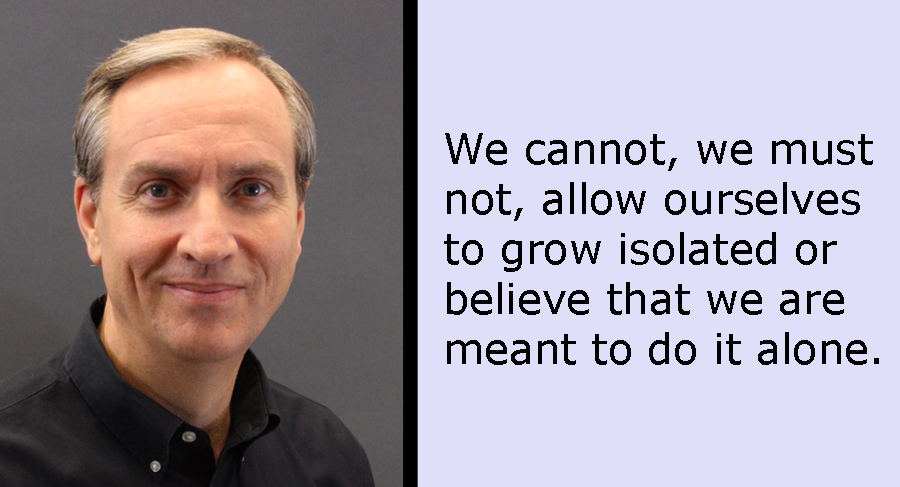
We believe the gathering of leaders is worth it. It’s when leaders gather that we can remind one another that the mission of reaching people with the gospel is urgently important, and bigger than any of our individual lives, or churches. We cannot, we must not, allow ourselves to grow isolated or believe that we are meant to do it alone.

Nate Adams is executive director of the Illinois Baptist State Association.