Archives For December 31, 2014

Newsweek_0112COMMENTARY | Meredith Flynn

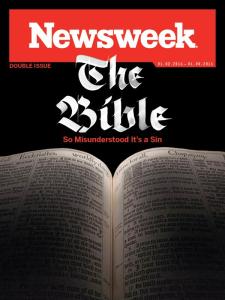
Christians who read Kurt Eichenwald’s Dec. 23 cover story might have been reminded of a well-known line from a comic strip:

“We have met the enemy, and he is us.”

The words, written by Pogo cartoonist Walt Kelly, weren’t about Bible-believers coming face to face with an article claiming to debunk some really famous stories. But read through the Newsweek article, paying particularly close to the pictures, and it might be difficult not to squirm in your seat or look over your shoulder.

We have met the enemy—or, at least, we know who Newsweek thinks it is. It’s us.

As Southern Seminary President Al Mohler and others have pointed out, the first two paragraphs of Eichenwald’s article read like an attack: “They wave their Bibles at passersby, screaming their condemnations of homosexuals. They fall on their knees, worshipping at the base of granite monuments to the Ten Commandments while demanding prayer in school.”

And those are just the first two sentences. What follows is mostly about the Bible, but tinged with the same hostility toward Christians, which also has been noted by numerous leaders and scholars. Mohler called it “one of the most irresponsible articles ever to appear in a journalistic guise.” Michael Kruger, president of Reformed Theological Seminary in Charlotte, said Eichenwald deserved a “slap on the journalistic wrist.”

But even for those who can’t counter every one of the anti-Bible arguments in the article or don’t care to debate its journalistic merits, if you can get past Eichenwald’s angry words, his piece can bring some valuable introspection. Because as soon as you realize you’re his enemy, you scroll past a photo of a protest by members of the infamous Westboro Baptist Church. Or controversial TV preacher Pat Robertson. Eichenwald lumps all Christians together, like it or not.

What else would you expect from a non-Christian, one might ask? It’s a good question, but the better question is, What is this non-Christian asking of us? Near the end of the article, Eichenwald puts forth two pleas:

Christians, know the Bible, he writes. (His stinging criticism suggests many of us “seem to read John Grisham novels with greater care” than God’s Word.) That’s good advice, even from a source that proved less than empathetic in his previous 8,500 words.

“And embrace what modern Bible experts know to be the true sections of the New Testament,” Eichenwald writes. “Jesus said, Don’t judge. He condemned those who pointed out the faults of others while ignoring their own. And he proclaimed, ‘Thou shalt love thy neighbor as thyself. There is none other commandment greater than these.’”

To that we would say Amen, and we’re glad Eichenwald acknowledges some biblical teaching is worthy of embrace. But there are plenty of modern scholars who believe the whole Bible is true. He should talk to some of them next time.

My best prayerwalking technique came from second graders.

PRAYER | Cheryl Dorsey

Editor’s note: This is the fourth and final post in a series on prayer and spiritual awakening. Read the previous posts: 2015: The Year of Prayer, Revise us, O Lord, and 15 prayer requests for your city.

One of my most profound prayerwalks took place with a pair of 7-year-olds. On that particular Saturday at our church, everyone had already paired up for the half-hour walk through our community of 500 homes. Leaving me with my son, Joseph, and a friend’s grandson, Antoine.

On school days, waking Joseph up was an ordeal. But on prayerwalking Saturdays, he beat me at getting up and ready to head to church. Amazing! We use the simple strategy – walking the neighborhoods around our church in two’s and three’s – to identify needs in our community and pray on the spot for people we encounter, that they might come to know Christ.

Joseph, Antoine and I began to walk three blocks around the church. I launched into a powerful prayer: “Lord, let your salvation come to this house! Send your power, Father. Change hearts, O God!” When I paused to allow the babies to get a word in edgewise, I heard this:

“Lord, help this little boy to help his mommy clean the front yard.”

And another saying, “Jesus, please give the little boy in this house a new Big Wheel because his is broken.”

And then, “Jesus, help them get these beer bottles out of the yard. They shouldn’t be drinking, Lord! Help them to stop.”

Even though I was towering over my prayerwalking partners, I felt seven inches tall.

That morning, the Holy Spirit taught me what prayerwalking is all about. He used Joseph and Antoine to teach me again what it means to pray “on site with insight,” which is how we encourage all our prayerwalking teams. Here’s what it looks like for us:

Each session starts with a 15-minute meeting at the church. This is when we distribute prayer guides, go over prayerwalking basics, and point everyone to a focal Scripture that will set the stage for the next hour.

We send pray-ers out from the church in two’s and three’s, instructing them to go as far as they can and be back in half an hour. As they go, we urge them to pray “on site with insight.” That’s God’s insight and not their own.

Prayerwalkers pray as they’re prompted by the things they encounter. Every street is different. Our prayers should feel conversational, low-key, but powered from on high. If folks across or down the street can hear us, we’re doing it wrong.

Each person in the groups takes a turn praying in short paragraphs, not soliloquies. I like it to making a prayer quilt – everyone brings a piece. If we encounter people along the way, we introduce ourselves and ask if they have any prayer needs. If they say yes, we ask permission to pray for them right there. Or, we take the names and requests back to the church to add to our prayer list for the week.

During our walk, we may pray, quote Scripture, or sing, all as the Spirit prompts the pray-ers. Once everyone is back at the church, we take 15-20 minutes to recap the experience. This is very powerful! Prayerwalking teams share what they encountered and how the Lord had them praying, as well as names they’re adding to the prayer list. As the teams report, a scribe records the headlines on a flip chart, chalkboard, or poster.

The Lord reveals his awesomeness as our teams often see a theme emerge. Even though they prayed on different streets, they see how God loves the community, and works in us through the Holy Spirit to “pray things out” over our neighbors. The prayerwalkers recognize that God has a plan, that they can hear his voice, and that he can use them to bless his people.

That first day I prayerwalked with Joseph and Antoine, I witnessed our youngest pray-ers interceding from their perspective. They prayed for the practical and immediate needs of the house we were passing by, and they hit some spiritual pay dirt. From that point on, they were my favorite prayerwalking partners that summer. I mention them often when I teach, saying kids pray differently because they see things from a different level.

They blessed me, and showed me that children have a place in our prayerwalking ministry. You don’t need to pontificate, just walk, see and pray.

Cheryl Dorsey is a prayer coordinator and pastor’s wife at Beacon Hill Missionary Baptist Church in Chicago Heights. She also serves as prayer leader for Chicago Metro Baptist Association. This column first appeared in the Spring 2015 issue of Resource magazine, online at http://resource.IBSA.org.

In a border town of Turkey, a Syrian family who fled from the civil war struggles to find food and shelter. IMB photo by Jedediah Smith

In a border town of Turkey, a Syrian family who fled from the civil war struggles to find food and shelter. IMB photo by Jedediah Smith

THE BRIEFING | Meredith Flynn

The International Mission Board’s pictures of the year show “light in the darkness” around the world. In the Philippines, hard hit by a typhoon just over a year ago; in Turkey, where a Syrian family tries to escape civil war (right); and in the Dominican Republic, where church planting efforts reach across geographical and cultural divides. See them all and more at IMB.org.


Almost 9.5 million people heard the gospel through the Billy Graham Evangelistic Association in 2014, and more than 1.6 million of those trusted Christ. “Our hearts overflow with gratitude to God for all He has done and is doing, and we are eager to keep pressing forward as He continues to open doors,” BGEA’s chief executive officer Franklin Graham wrote recently, The Christian Post reported.


Also from The Christian Post: Houston Baptist University will create a Center for American Evangelism, spearheaded in part by apologist Lee Strobel and directed by author Mark Mittelberg.


“I’ve been there, done that and I’d love to share with you a few reasons why, even though I’ve failed, I’m doing it again,” Trillia Newbill writes about her resolve to read the Bible in 2015. Read about the four step plan she chose at ERLC.com.


Most of us make and break them every year, but can New Year’s Resolutions actually be harmful? Author (and Billy Graham’s grandson) Tullian Tchividjian says yes, in this interview with Religion News Service. “When it’s up to you to go out and get the love you crave, create your own worth, or work at becoming acceptable to those you want to impress, life gets heavy,” Tchividjian told writer Jonathan Merritt. “New Year’s Resolutions are a burdening attempt to fix ourselves and make ourselves more lovable.”


The current basketball season has gone “in the opposite direction” L.A. Laker Jeremy Lin anticipated, he posted on his blog at the beginning of this year. But despite his slump, Lin—a known Christian—said he wants to live with more joy in the coming year. “…[T]hrough it all, I’ve been learning how to surrender the results to God, how to walk by faith and not by sight, how to be renewed through times of prayer/Scripture and how to fight for a life of joy in the midst of trials.”


HEARTLAND | Charles Lyons

Editor’s note: This is the third post in a series on prayer and spiritual awakening. Read “2015: The Year of Prayer,” and “Revise us, O Lord,” at ib2news.org.

A mid-1800’s revival that started with a small prayer meeting in New York City resulted in thousands upon thousands of people trusting in Christ. We need such a movement today, perhaps using several ideas from this list. Use personally, or with family devotions. Share it with your church prayer group of Bible study group. Share on Facebook.

City HallLead your church to pray for one item each Sunday for 15 Sundays. Use each one for a church prayer focus for a week each.

“Seek the welfare of the city where I have sent you into exile and beseech the Lord on its behalf. For in its welfare you will also have welfare.” (Jeremiah 29:7)

1. Invite the Holy Spirit to teach you to pray as He helps you to pray.

2. Pray for your pastor – his spiritual health, his marriage, his family, his vision, wisdom, and spiritual power. Ask God to enhance his ability to lead your church to reach your city or town.

3. Pray for your church family to enthusiastically engage in serving your community.

4. Pray the same for the pastors in your city.

5. Pray for the newest church you know and the oldest church.

6. Pray that your church family will impact your city or town in 2015 as never before.

7. Pray for your mayor – a sense of accountability to God, humble acknowledgement of need for wisdom, relationship to God, and desire for righteousness and integrity.

8. Pray the same for your police chief.

9. Pray the same for your fire chief.

10. Pray the same for your city council or your local elected official.

11. Pray the same for your superintendent of schools.

12. Pray for the schools closest to you, the high school and its principal, the grade school and its principal.

13. Pray for those who work in the healthcare system in your community – administrators, doctors, nurses, technicians.

14. Pray for your closest neighbors or friends to be saved and be fully devoted disciples of Jesus Christ.

15. Pray for a merchant or clerk you interact with on a regular basis.

Part 1

Part 2

Charles Lyons pastors Armitage Baptist Church in Chicago.

PRAYER | Phil Miglioratti

Editor’s note: This is the second in a series of posts on prayer and spiritual awakening. Read the first, “2015: The Year of Prayer,” here.

Read the headlines in Christianity Today and you’ll being praying for a revival. Read Time magazine and you’ll plead with heaven for a spiritual awakening.

From the church, we have reports of plummeting Sunday attendance: Polls once claiming 40% or more are now reporting a more accurate 17%. And the statistics about disappearing youth are even more appalling.

Plant in dried cracked mudAnd in the culture: States are redefining marriage. Economic collapse is rooted in a corrupt banking system. And for more examples of why we are desperate for a spiritual awakening, we need only to watch the evening news.

The Church needs to be revived. Not merely your congregation, but the Church across North America. A revival that spills out of our sanctuaries and brings spiritual awakening to the tributaries that feed and fuel our culture. Education. Business. Media. Family. Health Care. Entertainment.

But have we considered this: What if God is responding to our prayers for a revival and our pleas for an awakening, but we are failing to notice?

What if God is answering our calls for reviving the Church by His work of revising the Church? Could the revising work of the Holy Spirit be a preparing of the Church for some kind of non-traditional impact on our culture? Should we be looking for new ways the Church is influencing communities with God’s good news?

Since the 1980’s leaders have commented on how several trends have brought correction and health to the Church.

  • Worship has become, well, worship. We are learning to sing songs as an expression of praise and petition rather than as performance or for our entertainment.
  • In many congregations, prayer has matured from reciting lists of sick members to listening to the Spirit; from me, myself, and I, to the least, the lonely, and the lost.
  • Church planting has become a top priority in a growing number of evangelical denominations. The churches my daughters take my grandkids to are new and vibrant, unhindered by traditions and systems designed for 19th century cultures.
  • Cities are no longer merely zip codes. God has raised up “city reachers,” leaders with a citywide vision who call the Body of Christ in a community or city to serve better together in collaborative evangelism. The “100 Cities Invitation” hopes to catalyze acts of kindness and justice to demonstrate the Good News in 100 cities in 2016.
  • That same year, RESET, a new initiative led by under-35 leaders, will call young people to the National Mall in Washington, D.C. for repentance and revival. Could spiritual awakening of their generation be far behind?

In all this, I see God answering our pleas for revival by revising the Church in a Romans 12:2 way. Our methodologies are being transformed by the Holy Spirit’s renewing of our minds. We are rethinking the need to reconnect evangelism and discipleship. Even very small congregations realize they need to get our of their seats and into the streets with the prayer-care-share lifestyle of Christ-followers. We read more and more of a new generation of leaders who bring good news in very different ways that relate to our radically changed culture.

I see signs that God is responding to our “revive us again” supplication and the seeds He is planting for spiritual awakening. What signs do you see?

Part 1

Part 3

Phil Miglioratti heads the National Pastors’ Prayer Network and serves as IBSA’s prayer ministries consultant. This column first appeared in the Spring 2015 issue of Resource magazine, online at http://resource.IBSA.org.

2015: The year of prayer

Meredith Flynn —  January 1, 2015

Editor’s note: This is the first in a series of posts on prayer. In 2014, Illinois Baptists focused on prayer and spiritual awakening at their November Annual Meeting. The national Southern Baptist Convention also will mark a Call to Prayer this year, detailed by Ronnie Floyd during his few few months as SBC President.)

Eric Reed | Our IBSA Annual Meeting focused on prayer, as part of a statewide call to revival and spiritual awakening. Using Isaiah 6:1-8 as our inspiration, moving through this cycle of prayer:

Layout 1


1. We lament the sins of our state. As Isaiah said, after witnessing the holiness of the Lord in the temple, “Woe is me…I am undone.”

2. We repent of apathy among believers and ask God to send revival to our churches. The angel affirmed to Isaiah, “Your sins are forgiven.”

3. We intercede for the needs of the 13 million people of Illinois and especially the 8 million or more who are lost, asking God for spiritual awakening in our state and across the United States. The Lord asked Isaiah, “Who will go?”

4. We commit to pray for their salvation and to minister in the name of Jesus. And He waits to hear, “Here I am. Send me.”

The four video collages from the IBSA Concert of Prayer (held during November’s Annual Meeting) are available for use in your church. Download them here.

Part 2

Part 3

Eric Reed is IBSA’s associate executive director for the Church Communications team, and editor of the Illinois Baptist newspaper.