Archives For November 30, 2013

NEWS | The U.S. Supreme Court has issued additional protection to Wheaton College as it fights a mandate in the Affordable Care Act that requires employers to cover drugs like the morning-after pill in their employee health plans.

Wheaton, a Christian college in a western Chicago suburb, already qualified for an exemption from the Affordable Care Act offered to faith-based non-profit organizations. But many have said the government’s plan – to let non-profits sign a form allowing insurers to pay for the drugs, rather than the organization itself – isn’t enough. As the Associated Press reported July 3, “Wheaton and dozens of other non-profits have sued over the form, which they say violates their religious beliefs because it forces them to participate in a system to subsidize and distribute the contraception.”
The Supreme Court’s unsigned opinion July 3 says that during its court case, Wheaton doesn’t have to sign the form but can write a letter to the U.S. Department of Health and Human Services explaining its objection to the requirements.

The Court’s three female justices – Ruth Bader Ginsburg, Elena Kagan and Sonia Sotomayor – disagreed with the temporary injunction. Sotomayor wrote that the Court’s action “undermines confidence in this institution.”

On June 30, the justices ruled 5-4 that “closely held,” for-profit businesses Hobby Lobby and Conestoga Wood Specialties don’t have to cover abortion-inducing drugs in their employee plans. ChristianityToday.com has a helpful infographic from The Becket Fund forecasting next steps in court cases against the mandate.

Lisa Sergent holds a musket used by a private who served under General George Washington. It is owned by history buff and pastor Dan Fisher (left).

Lisa Sergent holds a musket used by a private who served under General George Washington. It is owned by history buff and pastor Dan Fisher (left).

COMMENTARY | Lisa Sergent

There’s an old song that says, “Don’t know much about history.” What Dan Fisher knows has been largely ignored – or forgotten – in our time. Clergymen were heroes in the American Revolution, said Fisher, himself a Southern Baptist pastor and Oklahoma state representative.

Fisher, the pastor of Trinity Baptist Church in Yukon, Okla., travels the country presenting “Bringing Back the Black Robed Regiment.” A term coined by British sympathizers, the “regiment” were the pastors – Presbyterian, Methodist, Lutheran, Baptist and Episcopalian – who helped lead the fight for liberty from the British. He shared his message to a gathering hosted by the Illinois Family Institute this spring.

Portraying Lutheran pastor Peter Muhlenberg, later a general in the Continental Army who rallied his congregation to fight, Fisher said, “If the church doesn’t speak out, then who will? We were the men of the book, we were the men of truth, we were the men of true liberty because we knew that ultimately true liberty can only come though an internal relationship with Christ. When you have true liberty, then you can defend external liberty.”

Fisher shared how many of these 18th century pastors gave their lives and livelihoods in the fight to defend liberty. He encouraged today’s pastors to stand boldly for religious liberty. “What price are you willing to pay?” he asked.

He applies this aspect of United States history, forgotten by many, to today’s cultural issues. “There comes a time when our liberty must be protected,” said Fisher. “Friends, if we lose our external liberty we lose our internal liberty to believe and preach.”

Urging Christians to take a stand, Fisher stated, “Some 50% of today’s evangelicals don’t even bother to vote. And out of those who do vote, 25% vote the opposite of what Christians believe. Not on political issues, but on moral issues…How do we justify that?”

Fisher repeated second U.S. President John Adams’ warning to America in 1798: “We have no government armed with power capable of contending with human passions unbridled by morality and religion…Our constitution was made only for a moral and religious people. It is wholly inadequate to the government of any other.”

Lisa Sergent is director of communications for the Illinois Baptist State Association and contributing editor of the Illinois Baptist.

Pre-ruling panel discussion explores impact of Hobby Lobby case and threats to religious freedom

NEWS | Meredith Flynn

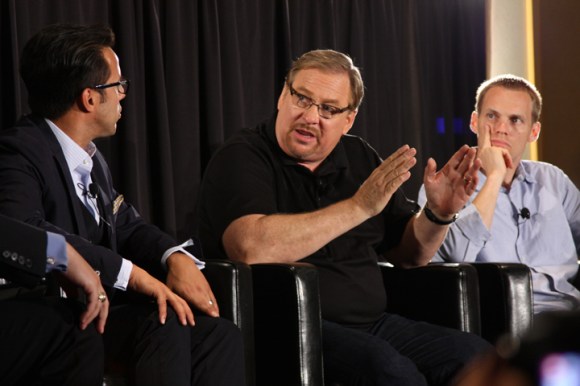
Pastors Rick Warren and David Platt (center and right) joined a panel discussion in June on Hobby Lobby and religious liberty. The panel was sponsored by the Ethics and Religious Liberty Commission during the Southern Baptist Convention in Baltimore.

Pastors Rick Warren and David Platt (center and right) joined a panel discussion in June on Hobby Lobby and religious liberty. The panel was sponsored by the Ethics and Religious Liberty Commission during the Southern Baptist Convention in Baltimore.

After the Supreme Court’s June 30 ruling in favor of Hobby Lobby, many Christians celebrated the decision that opens the door for “closely held” companies to refuse to cover abortion-inducing drugs in their employee health care plans.

“A great day for Religious Liberty!” tweeted Southern Baptist Convention President Ronnie Floyd, with the hashtag #hobbylobby.

“This is as close as a Southern Baptist gets to dancing in the streets with joy,” wrote Russell Moore, president of the SBC’s Ethics and Religious Liberty Commission. Moore presented an award to the Green family, who owns Hobby Lobby stores, during the SBC Annual Meeting in June. The Greens filed suit against the Department of Health and Human Services two years ago over what has become known as the abortion-contraceptive mandate in the Affordable Care Act.

“… We simply cannot abandon our religious beliefs to comply with this mandate,” CEO David Green said then.

The Hobby Lobby case has brought new visibility to religious liberty issues. But Texas pastor Robert Jeffress told Fox News “the victory will be short lived.”

“…People of faith are going to increasingly come into conflict with governmental mandates that violate their personal faith,” said Jeffress, the pastor of First Baptist Church, Dallas, according to a report by The Christian Post.

Imperiled religious liberty was the focus of a panel discussion in Baltimore during the Southern Baptist Convention last month. Religious freedom is a critical issue for churches, panelists said, but it’s still flying under the radar for most of them.

Moore and the ERLC hosted the conversation that include pastors Rick Warren and David Platt, and Samuel Rodriguez, president of the National Hispanic Christian Leaders Conference. The panel focused on the Hobby Lobby Supreme Court case but also veered into other questions concerning religious freedom.

The panelists’ main point was clear: All church members must be aware of issues that threaten religious liberty, standing firmly in a Gospel that compels Christians to stand up for their religious freedoms, and for that of others.

Before the Court ruled in favor of Hobby Lobby, Moore said the verdict would be one of the most significant decisions affecting religious liberty in years. The case and several others, like the Washington florist who was sued when she declined to provide flowers for a same-sex wedding, have raised awareness about religious freedom and threats to it.

But religious liberty isn’t just tied to current events or cases. It has ancient roots.

“Before religious liberty is a political issue or a social issue, religious liberty is a Gospel issue,” Moore said during the panel discussion. People come to Christ when the Word of God addresses their conscience, he explained. An uncoerced conscience.

“We don’t believe that the Gospel goes forward by majority vote,” he said. “We believe that the Gospel goes forward by the new birth, and so we need freedom in order to do that.”

Refusing to fight for religious liberty now, Moore added, will be highly detrimental to future generations. “If we shrug this off, what we’re doing is consigning future generations, and we’re consigning people’s consciences, to a tyranny that we are going to be held accountable for.”

There are also ramifications for Christians living and working in contemporary society. Platt, pastor of The Church at Brook Hills in Birmingham, Ala., said during the panel discussion he felt convicted about how many of his church members are aware of how their freedoms could be threatened.

People in churches “need to know it’s coming,” Platt said. “It’s going to affect every person in every profession in the church. This is not just for certain groups.”

Costly faith

One lesson from the Hobby Lobby case, Moore said, is that threats can simmer under the surface for a long time before they bubble up. “Many people assume that religious liberty violations come with shock and awe, with tanks coming in. And religious liberty violations typically happen this way, with a bureaucrat’s pen…By the time the issue gets to you, you have not even seen how it has already advanced.”

Perhaps because so many flagrant violations of religious liberty happen in other countries, the issue can seem like what Moore termed “other people’s problems.” That’s why it’s key to champion freedom not just for Americans, or Christians, the panelists said. “If it’s them today, it’s us tomorrow,” Warren said of other religious groups facing threats to their freedom.

Concerning religious liberty in America, the panelists talked about voting as one area that can breed complacency. If you preach sanctity of life and biblical marriage and religious liberty on Sunday, Rodriguez said, but then vote in a way that runs counter to those things on Tuesday, isn’t that hypocrisy? “Our vote must be a reflection of my Christian worldview belief.”

One other cause for a lack of concern, Platt said, is a lack of urgency. Many church members aren’t taking risks for the Gospel, he said. Faith doesn’t cost anything for many of us. But, he said, “When you believe in a resurrected king, you speak about him all the time, and whatever he says you do, no matter what it costs you in the culture.”

Baptists almost ‘dance for joy’ over religious freedom ruling

THE BRIEFING | Meredith Flynn

The U.S. Supreme Court ruled June 30 in favor of Hobby Lobby and Conestoga Wood Specialties, deciding that the companies do not have to cover abortion-inducing drugs in their employee health plans.

The 5-4 decision sets an important precedent for “closely held” companies (those owned by individuals or families) that object to what has become known as the abortion-contraceptive mandate in the Affordable Care Act.

In the opinion, Justice Samuel Alito wrote that under the standard set by Religious Freedom Restoration Act of 1993, “the HHS contraceptive mandate is unlawful.”

The_BriefingSouthern Baptist leaders responded quickly to the ruling. “It is an absolute victory for the proponents of religious liberty,” said SBC Executive Committee President Frank Page. “I am thankful that both common sense and conscience have seen a victory in a day where such victories are rare.”

Russell Moore, president of the SBC’s Ethics and Religious Liberty Commission, called the ruling an “exhilarating victory for religious freedom.” During the SBC Annual Meeting in Baltimore earlier this month, Moore presented an award to the Green family, who owns Hobby Lobby.

“As a Baptist, I am encouraged that our ancestors’ struggle for the First Amendment has been vindicated,” Moore said after the Court’s decision.

“This is as close as a Southern Baptist gets to dancing in the streets with joy.”

Read more at BPNews.net.

Court also rules on abortion clinic buffer zones
The Supreme Court struck down a 2007 Massachusetts law restricting pro-life advocates from congregating within 35-foot zones around abortion center entrances and driveways, Tom Strode of Baptist Press reports. Justices issued a 9-0 opinion on the matter, and Chief Justice John Roberts wrote that the law “imposed serious burdens” on free speech.

Marriage in limbo in several Upper Midwest states
Indiana has joined a list of states in which the definition of marriage is pending an appeal of a federal judge’s ruling. After Judge Richard Young struck down the state’s same-sex marriage ban June 25, a federal appeals court issued a stay two days later. Michigan and Wisconsin are in a similar situation, as seen in this map from USA Today (which doesn’t reflect the Indiana appeal). Same-sex marriage officially became legal in Illinois June 1, although some counties began issuing marriage licenses in the spring.

LifeWay survey: Domestic violence rarely preached about in church
Nearly three-fourths of Protestant pastors say domestic or sexual violence is a problem in their community, but 42% rarely or never preach on the topic. The survey, conducted by LifeWay Research and sponsored by Sojourners and IMA World Health, also found 74% of pastors know someone who has experienced domestic violence. Read more at LifeWayResearch.com.

Thief-turned-pastor shares testimony
George Aguilar, once an enemy of churches in Oklahoma, is now a pastor in his home country of El Salvador. After robbing from and vandalizing 11 churches in the Tulsa area, Aguilar came to Christ after one of the churches he stole from took him in. Read his story from The Baptist Messenger.


Hannah_Batista

Hannah Batista shares her testimony in a video produced by FBC Bethalto.

HEARTLAND | The last year of Hannah Batista’s life has been different from the first 16. Last summer, she accepted Christ during Super Summer, a week that’s less about camp activities and more about discipling students.

Through a series of tough circumstances, Hannah had ended up living in the home of a member of First Baptist Church in Bethalto. She was an unwilling church attender, and an unwilling Super Summer participant when she wound up at Greenville College last June. “I was guilted into going, honestly,” she says now.

But during the week, something changed. Lots of things, actually. In the quiet of her dorm room on the last night of the week, Hannah accepted Christ.

“Everything I thought I knew was being torn down, and in its place, something new was being built up,” she said from her seat in the dining hall at this year’s Super Summer. Hannah is now a leader in her youth group, and was baptized this year by her youth pastor, Tim Drury.

Watch a video of Hannah’s testimony and baptism at FBC Bethalto (courtesy of the church’s Facebook page).

Fred_Luter_revivalCOMMENTARY | Eric Reed

I’ve never been prouder – of Fred Luter or of the Southern Baptist Convention – than when, on the second day of the annual meeting in Baltimore, they suspended the agenda and spent most of an hour in prayer.

Will this be Bro. Fred’s lasting contribution to the SBC, I thought to myself, that he was willing to lay aside the fixed orders of business, to call us all to our knees, and to take our deep needs to the Lord?

Two years earlier, I sat on a bench in the cavernous lobby of the New Orleans Convention Center talking with a pastor-friend of mine. He’s African American. I seemed more excited by Luter’s election that day than he did. I posed a question about the new president’s lasting impact.

“We’ll have to wait and see,” was his response. “Will this be a one-time thing, or has the Convention really changed? Is there room for me in leadership?”

That has been the response of several people I’ve asked since then, even Luter himself. Many people, especially African American pastors, said they wanted to see what happened after Luter’s term. Would he really be able to increase the ethnic diversity on SBC boards and in leadership? Would there be a lasting place at the table for black, Hispanic, and Asian leaders?

Under Luter’s direction, the committees responsible for manning those boards have attempted to broaden representation. In fact, messengers at the Phoenix convention in 2011 had ordered the start of such a concentrated effort even before Luter’s election as the SBC’s first African American president.

It was good to see several African American pastors on the platform in 2014: Southern Seminary Professor Kevin Smith spoke for the Resolutions Committee. Chicago’s very own Marvin Parker of Broadview Missionary Baptist Church served with the Committee on Order of Business and Michael Allen of Uptown Baptist Church was elected “back-up preacher” for the 2015 annual meeting.

But it took a messenger from the floor to confirm what those watching the live video stream had noticed. There was not a lot cultural diversity on the worship platform. The messenger moved that the music teams next year be more diverse, because, he noted, while the choirs and bands were almost all white, the Convention isn’t anymore – and heaven won’t be either.

I saw a similar message in the official photograph of the incoming SBC officers: five middle-aged white guys in dark suits. Except for one goatee, that photograph could have been snapped in 1974.

Or 1954.

We missed an opportunity to extend Bro. Fred’s impact. Korean-American pastor Daniel Kim ran for president, and his showing as a late-entry against winner Ronnie Floyd was respectable. But both first and second vice-presidents ran unopposed. Why? Because no one else stepped up.

Fred Luter’s lasting impact may not be that he radically altered the composition of committees or platform personnel. Instead, he demonstrated the door is open and there’s room at the table. And he was willing to take the risk.

As a pastor in New Orleans, Luter suffered jeers for his embrace of the historically white denomination. And before he agreed to run for SBC president in 2012, one advisor warned, “Look at the racial make-up of the Convention, Fred. You might lose.”

But he won. In a big way. Unopposed. Twice. To cheers and tears and shouts of joy from a whole lot of people glad that a new day had arrived for Southern Baptists.

Successor Floyd called him “the most beloved president” in recent SBC history. Luter traveled widely and preached in churches of all sizes and ethnicities. He embodied the new spirit of the SBC, and he did it with characteristic joy and grace. For all that, he is deservedly and deeply appreciated.

But, for me, Fred Luter’s lasting impact is that he was willing to step up.

Eric Reed is editor of the Illinois Baptist.

Hobby_LobbyNEWS | The U.S. Supreme Court is expected to hand down its decision in Sebelius v. Hobby Lobby and Conestoga Wood Specialties sometime this week. The case has been closely watched by religious liberty advocates who believe the Court’s ruling will have significant impact on the freedom Americans have to practice their religious convictions.

At issue is the businesses’ refusal to cover abortion-inducing drugs for its employees, a measure required of for-profit companies by the Obama administration’s healthcare plan.

“The United States Supreme Court is deciding whether or not in this country there is the freedom to dissent, and the freedom to accommodate these conscientious objections in the governing of people’s lives and in the running of their businesses,” Russell Moore told Southern Baptist pastors and leaders meeting in Baltimore. The president of the Ethics and Religious Liberty Commission took part in a panel discussion about the case during the SBC’s annual meeting in June.

“It’s going to be a tremendously significant and important case for every single one of your churches and your ministries,” Moore said. “This will have everything to do with everything that your church does for the next 100 years.” In March, the ERLC issued a call to prayer for Hobby Lobby and the Supreme Court’s ruling.

Several institutions have won their fight against the health care mandate, including Colorado Christian University just this week. But Hobby Lobby and Conestoga Wood Specialties’ status as Christian-owned, for-profit businesses is what makes their case different.

The Hobby Lobby case sparked an online discussion about what makes a business “Christian.” See today’s Briefing for more.

The_BriefingTHE BRIEFING | Meredith Flynn

Leading up to the Supreme Court’s expected ruling on a case involving Hobby Lobby, culture writer Jonathan Merritt took issue with calling the craft retailer a “Christian business” because of its dealings with China, one of the world’s worst offenders of human rights.

Hobby Lobby currently is fighting for an exemption to the government’s requirement that for-profit companies cover some abortion-inducing drugs in their employee health care plans. The Supreme Court’s ruling is expected this week.

The things Hobby Lobby claims to stand for, Merritt wrote for The Week magazine, including sanctity of life and religious liberty, are grossly undervalued in China.

“Hobby Lobby reminds us why for-profit businesses should resist calling themselves ‘Christian,’” he wrote. “The free market is messy and complicated and riddled with hypocrisy. Conducting business in today’s complex global economy almost ensures one will engage in behavior that is at least morally suspect from a Biblical standpoint.”

Merritt invited Russell Moore, president of the Ethics and Religious Liberty Commission, to respond to his article. Moore recently presented the Green family with the John Leland Award for Religious Liberty.

Forsaking business in China, Moore wrote, likely won’t help improve human rights there. Historically, he said, “open trade, in most cases, tends to help the development of political rights rather than hinder them.” If the Greens believed boycotting Chinese business would turn the nation’s government toward improved human rights, Moore said, they would.

But, “The Greens cannot control the decisions made by the Chinese government. They can, however, direct their own actions. And, as Americans, they can participate in a democratic republic in which the people are ultimately accountable for the decisions of their government.

“Buying products from companies that operate in a country that aborts children is not the same as being forced by the United States government to purchase directly insurance that does the same.”

Meriam Ibrahim released from prison, then rearrested
A 27-year-old mother of two imprisoned for her Christian faith was released June 23, but rearrested just hours later, The Christian Post reported this morning. Meriam Yahia Ibrahim, a Sudanese doctor, had been imprisoned with her young son and newborn daughter after she was found guilty of apostasy and adultery. (Because Ibrahim’s husband, Daniel Wani, is a Christian, their government does not recognize their marriage.) Her death sentence was to be carried out in two years. After Ibrahim was freed and her sentence commuted Monday, she was rearrested with her husband and children as they prepared to leave Sudan. Ibrahim’s case has drawn attention internationally and in the U.S., 38 members of Congress signed a letter asking the government to intervene on her behalf. Read more at ChristianPost.com.

Benched basketball star says ‘I know God has a plan!’
Isaiah Austin, a center for the Baylor University basketball team, was expected to be a first-round pick in the June 26 NBA draft. Instead, a diagnosis of Marfan syndrome will end his career, reported The Christian Post. He sat down for an emotional interview with ESPN, but was hopeful on Twitter and Instagram, using social media to talk about his faith in God.

“I know God has a plan!” Austin posted as part of a message on Instagram, with the hashtag #NewBeginnings. “I would love to thank EVERYONE who has reached out to me,” he tweeted under the handle God’s Child. “Toughest days of my life. But not the last! Life goes on. GOD IS STILL GREAT!”

Mohler: PCUSA marriage vote helps establish ‘clear divide’
When the General Assembly of The Presbyterian Church (U.S.A.) voted to allow pastors to conduct same-sex marriages, their decision set a dividing line in culture and in Christianity, said Southern Seminary President Albert Mohler.

“That very clear divide puts on one side those who stand with 2,000 years of Christian witness and on the very clear statements of Scripture, and, on the other side, those who stand with the moral revolution of the era…,” Mohler said on his daily podcast.

The Presbyterian denomination not only voted on the policy change for pastors, but also to amend their constitution to define marriage as between “two people” instead of “a man and a woman.” A majority of the PCUSA’s presbyteries must approve the amendment for it take effect, Baptist Press reported, but the departure of many conservative congregations makes the change a likely prospect.

NEWS | Meredith Flynn

Ask church leaders what is the single biggest threat to marriage right now, and most would probably give the same answer: the stunning wave of approval for same-sex marriage.

But a changing definition of marriage isn’t the only thing endangering the institution, said Baptist leaders at an April summit on sexuality and the Gospel. In fact, it may not even be at the top of the list.

Pornography has dulled the consciences of many Christians. Cultural trends have tended to devalue marriage at the expense of other arguably good things, like education, career and financial stability. And pastors may not feel the freedom or confidence to speak plainly about the issues affecting their congregations: sexual purity, marital fidelity, and what the Bible really says about all of it.

Faced with these threats to marriage, Andrew Walker of the Southern Baptist Ethics and Religious Liberty Commission said the church has a choice: “We can confront these changes, we can acknowledge them, we can work to combat them, or, sadly, we can conform to them.”

One thing the church can’t afford to do: nothing.

For today’s 20-somethings, marriage and family look very different than when their parents were making decisions about who to wed and how many kids to have. In 1960, 72% of American adults were married. In 1980, it was 62%. In 2012, it was just over 50%.

According to a 2013 study by the University of Virginia, the average age of first marriage now is historically
high – 27 for women and 29 for men. Waiting to marry has resulted in a lower divorce rate and better economic prospects for women; however, researchers also point to higher birth rates among unmarried women.

Almost half (48%) of first births are to unmarried women.

“What exists outside the church usually makes its way inside the church,” said Walker, the ERLC’s director of policy studies. In a breakout session at the Nashville summit hosted by the ERLC, he explored 11 threats to contemporary marriage, including:

The “soul mate” concept of marriage that emphasizes emotional and sexual fulfillment and partnership over biblical covenant and commitment.

Marriage as an aspiration. People marry later when they wait until they’re financially established, Walker said. “We need to mitigate against the [idea] that someone needs a Master’s degree and $75,000 in the bank” before they get married, he added.

– The rise of “professional marriages” where spouses have individual bank accounts and separate social lives.

Also on Walker’s list of external threats to marriage: divorce. Many would say it’s a threat inside the church too, although the statistics that place divorce rates the same or higher among Christians have been misreported, some researchers say. The more subtle danger may be Christians’ acceptance of the divorce culture.

In an interview last year with Christianity Today, ERLC President Russell Moore said divorce is one way Christians have surrendered to “the patterns of this age.”

“Evangelical Christians are as counter-cultural as we want to be, and it is clear that we are slow-train sexual revolutionaries, embracing the assumptions of the outside culture a few years behind everybody else,” Moore said. “This has had disastrous consequences.”

How these factors have marginalized marriage inside the church is supported largely by anecdotal evidence. The single adults in your congregation likely weren’t raised to focus on whom they would eventually marry. Marriage has been confined to “meeting the right person” for an entire generation (maybe more); it’s not something they can control. So young Christians focus instead on friendships, education and career. On top of all that, they’re haunted by the specter of divorce. Looking toward marriage seems strange to most of them, even limiting – and potentially disappointing.

David Prince is a Kentucky pastor who also spoke at the ERLC summit. He said that when he visits new parents in the hospital, he prays over their babies, and specifically for their future spouses. One grandfather in a hospital room expressed his disbelief that Prince was praying that way already, the pastor said.

The majority of Americans, and even more religious Americans, still have faith in the institution of marriage, according to research presented at the summit by sociologist Mark Regnerus. The question is whether they have enough faith to pursue it for themselves. In the absence of a “marriage culture,” wrote blogger Trevin Wax last year, Christians who marry early and stay married 40, 50 or 60 years will stand out. Which is good news for the church. “We’ll be ordinary oddballs,” Wax said. “So let’s not waste the opportunity.”

A healthier view
If negative influences on marriage and sexuality that exist outside the church have made their way inside, Scripture offers a better way forward. And it speaks to modern-day problems like pornography, said Southern Seminary professor Heath Lambert.

Likening porn to the “forbidden woman” in Proverbs 7, he told summit attenders there is a silent killer running rampant in churches. And it’s not growing acceptance of same-sex marriage.

“A greater threat to the church today is the Christian pastor, the Christian schoolteacher, the Christian Bible college and seminary student, who exalts sound theology, points to the Bible, and then retreats to the basement computer to indulge in an hour or three of internet pornography.”

Regnerus shared daunting numbers: When asked whether they had looked at porn on a given day, 11% of men said yes. Between 35 and 40% said they had within the last week, including 20-25% of Christian men between the ages of 18 and 39. And it’s not just men. In a reflection on biblical womanhood during the summit, Trillia Newbill said research from 2007 showed 13 million women clicked on pornographic web sites every month. Women represent one in three visitors to adult entertainment sites, she said.

“There is a stereotype and a really, really, really bad rumor that women don’t struggle with sexual sin,” said the ERLC’s consultant for women’s initiatives. “The sin that came into the world and corrupted all that was beautiful in the world, also corrupted us women.”

How can churches offer hope and the truth of the Gospel? By presenting marriage and sexuality in the same tone as Scripture, said Kevin Smith, who closed the conference with a message on biblical sexuality within marriage.

“…Certainly, let us avoid vulgarity and certainly let us avoid [language] that will remove the mystery of sexual intimacy between a husband and a wife,” the pastor and professor from Louisville, Ky., said.

“I’m kinda tired of preachers bragging about their hot wife.”

But Smith also warned church leaders not to let a sex-saturated society muzzle proclamations of biblical marriage and sexuality. Avoid the “flattening out” of sex that happens in our culture, which removes emotional, commitment and intellectual aspects of the one-flesh union of the Bible, Smith said.

“The one who is proclaiming the Word of God and speaking of sexuality in a biblical context, we’re trying to heighten the conversation. We’re not trying to make sex less dramatic, we’re trying to make sex more dramatic.”

And more biblical.

Meredith Flynn is managing editor of the Illinois Baptist newspaper. Read the IB online at http://ibonline.IBSA.org.

Nate_Adams_blog_callout_JuneHEARTLAND | Nate Adams

One big event that pulls many of us together each June is the annual Southern Baptist Convention. This year’s gathering in Baltimore was filled with inspirational music, messages and reports. But at its core, the annual SBC is a business meeting where messengers from autonomous churches gather to affirm or determine how they will cooperate.

Those messengers elect board and committee members. They agree on how to invest shared resources in missions and ministry. And they declare to one another and to many onlookers the biblical truths on which they will continue to stand.

It’s a big event with big consequences. But the reality is that there are relatively few messengers at the annual meeting compared to the number of churches and church members that cooperate as the Southern Baptist Convention. Most of us trust a few of us to determine which leaders, strategies, and priorities should direct the resources that we all have shared.

That’s why I would argue that the real big event for Southern Baptists does not take place in a convention center, or in a single city, or even on the same day. The real big event that determines at least the financial strength of our Great Commission cooperation happens in multiple locations at multiple times. It’s called the local church business meeting. That is where each church determines the percentage of its budget that will go through the Cooperative Program to support Southern Baptist missions and ministries. And that is the “big event” that really determines the degree to which we will cooperate in fulfilling our shared, Great Commission purpose.

For more than 20 years now, the percentage given by all SBC churches through the Cooperative Program as a percentage of undesignated giving has ever so slowly declined. It’s only been a fraction of a percent each year. But over time, national CP giving as a percentage of churches’ undesignated giving has declined to 5.4%, when it used to be almost 11%.

Here in Illinois, our churches are doing a little better than the national average. IBSA churches’ CP giving is about 7% of their undesignated gifts. But that is still well below the level being given 20 years ago.

There are some indications, however, that the trend in CP giving may be on the verge of a reversal. Annual Church Profile data for 2013 was recently released, revealing a second consecutive year of uptick rather than decline in national CP giving. The “One Percent Challenge” that Dr. Frank Page has been championing for 2-3 years now appears to be gaining traction, and numerous churches are accepting that challenge to intentionally increase the percentage of their CP giving.

Other churches are starting to give a percentage of their offerings, rather than a flat amount. It’s only two years, but it’s enough to encourage optimism that churches may be recapturing their vision for the power and effectiveness of cooperative missions giving.

So whether you were able to attend the big event of the Southern Baptist Convention this year or not, I hope you will consider attending the big event of your church’s business meetings, especially the one where the annual budget is discussed. Challenge your church to be one that’s helping reverse the trend by increasing your commitment to SBC missions and ministries through the Cooperative Program.

The Big Event of all history, of course, will be that day when Jesus returns and our Great Commission task as His church draws to a close. All our churches’ big events should anticipate and point to that one. And our churches’ business meetings are a good place to start, because that’s where we can choose priorities that demonstrate we believe He’s coming back soon.

Nate Adams is executive director of the Illinois Baptist State Association.