Archives For August 31, 2013

MIO_blogDAY 2: Watch “Share Christ”

Gosen Church in Port-au-Prince, Haiti, is a large building with silk flowers hanging from the ceiling. Illinois volunteers helped build this church over three weeks last November. Cinderblocks with artful designs cut out of them make up the windows, and the doors are always open.

When Meredith and her team went there to work in July, they met at the church building to sing and pray together. Then they went to work building houses in a community hard-hit by Haiti’s earthquake in 2010.

This team was one of many from Illinois serving on international mission trips, creating long-term relationships and sharing Christ with people around the world. In fact, more than 25,000 Baptists from Illinois are engaged in missions and mission trips each year.

Read: Jonah 1:10-16; Habakkuk 2:14

Think: How does God use catastrophic events, such as storms and earthquakes, to reveal Himself and His plans?

Pray for IBSA’s Bob Elmore, who helps arrange mission trips, including several each year to Haiti. Pray for your church’s next mission trip.

MIO_blogHEARTLAND | More and more, churches in Illinois are responsible for missions in Illinois. This is where we live, work, shop, and go to school. This is where our families, friends, and neighbors live – 13 million of them. And at least 8 million don’t yet know Jesus Christ as Savior and Lord.

In the face of such great spiritual need, some of our denominational partners are focusing on church planting as their main method of evangelism. That is a worthy tactic. But it means that Illinois Baptists must make up the difference in other areas that are still fertile for advancing the Gospel. We must focus on missions that remain vital to us here in Illinois, including compassion and crisis ministries, outreach on college campuses and in inner cities, and the education and mobilization of church members for missions. Children, students, and families in Illinois need the life-saving Gospel of Jesus Christ. And Illinois churches need help in dozens of ways that are funded only by Illinois Baptists.

Many of these ministries and missions efforts would not be possible if not for the Week of Prayer and Offering for state missions each September.

DAY 1: Watch “Partner to Plant”

Pastor Peters is passionate about winning lost people. Perhaps it’s because as a kid growing up in Chicago, he never heard the Gospel. Or because so many family and friends still living there do not have a relationship with Jesus Christ. “We have to win the cities, because that’s where the people are,” Peters says of the teeming metro areas. Pastoring a church near St. Louis, Peters has led his congregation to engage in ministries nearby. And he has led them to partner with several churches in metro Chicago.

Read: Jonah 1:1-9; Isaiah 62:6-7

Think: Is our reaction to big cities and people we don’t know more like Jonah’s opinion of Nineveh, or Pastor Peters’ feelings about Chicago?

Pray for the 200 places in Illinois already identified as needing an evangelical church. Pray for IBSA churches to pray, partner with existing churches, and plant new churches.

The Bible, a book with edge

Meredith Flynn —  September 12, 2013

swordCOMMENTARY | Mark Coppenger

Back in the 1990s, I was involved in the launch of a new publication, and I attended a workshop in New York to be sure we were crossing our t’s and dotting our i’s. One of our teachers explained that we would need to decide first off if we were going to publish a magazine with “edge” (such as The Nation or National Review), or one that avoided provocative opinions on hot issues (such as Saturday Evening Post or Martha Stewart Living).

Of course, most publications offer mixed fare, but it’s useful to distinguish those which strive always to be amiable to the exclusion of conscious affronts to the general reader’s sensitivities, and those quite willing to sacrifice gentility (though not civility, one hopes) in the cause of truth.

We decided we would not shrink from applying edge to our pages, and it occurred to us that our reference point, the Bible was a book with considerable edge. While Scripture is full of comforting and gracious passages—regarding the Lord’s shepherding in Psalm 23; regarding the rest promised for those who labor and are “heavy laden” (Matthew 11:28); regarding “living water” in John 4; regarding the glories of heaven in Revelation 22—it also has great cutting power.

Indeed, the Bible speaks of itself in these terms. Hebrews 4:12 says that “the word of God is living and active, sharper than any two-edged sword, piercing to the division of soul and of spirit, of joints and of marrow, and discerning the thoughts and intentions of the heart.” And, as Jesus said in Matthew 10:34, “Do not think that I have come to bring peace to the earth. I have not come to bring peace, but a sword.”

In his memoir, “Thirty-Nine Years of Short-Term Memory Loss”, former “Saturday Night Live” regular, Tom Davis of Franken and Davis, chronicled a life of prodigious drug consumption. Not surprisingly, he befriended drug guru Timothy Leary. He recounted their times together, including a phone conversation where Leary asked him what books he was reading. When Davis said he was trying to read the Bible from cover to cover, Leary exclaimed, “Oh no—there goes another one.”

Davis urged him to relax: “You don’t have to worry about me. Maybe you’ll feel better if I read you something really good that I just found in it.” With Leary’s okay, he pressed on, reading 1 Timothy 1:9-11 in the old King James. It declared that the law was “not made for the righteous man.” Rather, it was made for “the ungodly and for the sinners, for the unholy and profane, for murderers of fathers and murderers of mothers, for manslayers. For whoremongers, for them that defile themselves with mankind, for menstealers, for liars, for perjured persons . . .”

Laughing, Leary exclaimed, “Whoa! That was wonderful! Thank you for that.”[1] Being two very laid-back fellows, they rolled their eyes at the “over the top” language, but they had to recognize that this was a book that didn’t fool around. It had edge. (And one suspects there was a touch of nervousness in their laughter.)

Though modern translations speak of the “sexually immoral” rather than the “whoremongers,” and the expression “slave traders” is less weird to the modern ear than “menstealers,” there’s no diluting the force of those verses. In fact, the newer versions can be more provocative, as when “them that defile themselves with mankind” are shown to be “men who practice homosexuality.”

The message to the church should be plain. While the Bible is a boundless source of blessing and encouragement, it is also a book whose words can sting and divide, and efforts to disguise this truth should embarrass those who presume to be ministers of the Word.

Mark Coppenger is professor of Christian apologetics at The Southern Baptist Theological Seminary and director of the Seminary’s Nashville extension. This column first appeared on the blog of BibleMesh, online at http://www.biblemesh.com/blog.

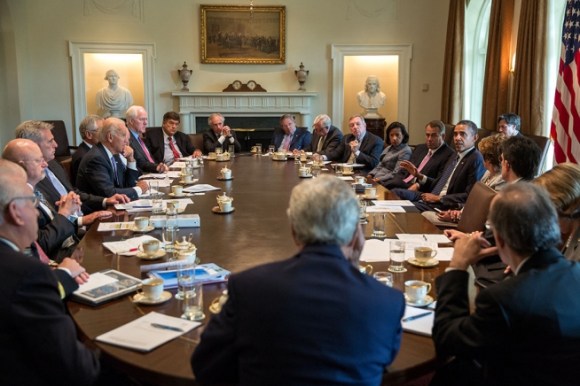
President Barack Obama meets with members of Congress to discuss Syria in the Cabinet Room of the White House on Sept. 3. White House photo by Pete Souza.

President Barack Obama meets with members of Congress to discuss Syria in the Cabinet Room of the White House on Sept. 3. White House photo by Pete Souza

THE BRIEFING | Meredith Flynn

(From Baptist Press) President Barack Obama is poised to address the nation tonight about why he believes U.S. forces should intervene in Syria, currently entrenched in a civil war that has reportedly killed more than 100,000 people since 2011. The President’s appeal to the public and to U.S. lawmakers (expected to vote on military action as early as Wednesday) is primarily the result of a chemical assault on civilians that U.S. intelligence has linked to the regime of Syrian President Bashar al Assad. The gas attack August 21 killed more than 1,400 people.

“This attack is an assault on human dignity. It also presents a serious danger to our national security,” Obama said late last month.

Russell Moore, president of the Southern Baptist Ethics & Religious Liberty Commission, agreed in a recent Religion News Service article that Assad’s regime is “lawless and tyrranical” and that there is just cause for war.

“That said, there are other principles missing here, both to justify action morally and to justify it prudentially,” Moore added. He used points from just war theory, which dates back to the fourth century, to support his position against U.S. intervention in Syria.

Read more about the just war ethic at BPNews.net.

“I do not see, from President Obama, a reasonable opportunity to prevail, or even a definition of what prevailaing would mean.

“Regime change is not the point of this action, and even if it were, we don’t yet know who the good guys are. Replacing one set of terrorists with another does not bring about justice or peace.”

Daniel Heimbach, a professor at Southeastern Baptist Theological Seminary, also disagrees with the President’s plan, but said the U.S. lacks a basis for intervening “in the internal affairs of a distinctly sovereign and separate state.”

He also noted, “The meaning and interpretation of a just cause for war (in a just war ethic) requires the nation being attacked (Syria) to have done, or to be doing, or to be moving toward doing some terrible wrong toward the attacking nation (United States) – not merely doing something bad within their own borders against their own people.”

The U.S. Senate may vote on Obama’s proposal for action against Syria as early as Wednesday of this week, and the House could consider it next week, according to Fox News.

Baptist aid organization helps Syrian refugees

Southern Baptist relief efforts are touching lives in significant ways as an estimated 2 million refugees have fled Syria for neighboring countries. BGR photo

Southern Baptist relief efforts are touching lives in significant ways as an estimated 2 million refugees have fled Syria for neighboring countries. BGR photo

(From Baptist Global Response) The civil war in Syria has displaced more than 5 million people either outside or inside the country, said Jeff Palmer, executive director of Baptist Global Response (BGR).

“The majority of Syrian refugees are women and children and a few older men,” Palmer said. “Husbands, fathers, brothers and uncles stayed behind to protect their precious resources – unfortunately, many times in vain. They were so thankful for the small amount of help we gave them. We promised we would be back the following week with more.”

For more than a year, BGR has assisted the refugees through emergency food packets, hygiene kits, basic shelter materials and some medicines.

While an estimated 2 million refugees have fled Syria for neighboring countries, the prospect of Western powers entering the conflict has dramatically increased the outflow in recent days, Palmer noted.

Americans place terrorism prevention high on list of national priorities
A new survey by Barna released just before the 12th anniversary of the September 11 attacks found a high majority of Americans believe preventing terrorism is as important or more important than healthcare, the break-up of the family, education, unemployment, and immigration.

The survey also found members of the millennial generation, who were children and teens on 9/11, “are among the most likely to prioritize preventing terrorism above other social concerns.”

For more Barna findings, including a comparison of the emotions people associate with 9/11 and the recent Boston Marathon bombings, go to Barna.org.


It could have been me

Meredith Flynn —  September 9, 2013

Jonathan_HayashiHEARTLAND | Jonathan Hayashi

Editor’s note: The following column is adapted from a response Jonathan Hayashi wrote after a gang-related shooting outside Uptown Baptist Church in Chicago August 19.

August 19 was a normal Monday here at Uptown Baptist Church.

We started our second service that evening with “Amazing Grace,” while around 100 people in the pews waiting to hear the sermon. Then, “Bang, bang, bang!” About 20 loud noises that sounded like fireworks. In fact, that’s what our speaker said from the podium. But it was too loud to be fireworks.

Pastor Michael Allen rushed to the east side door that opens onto Sheridan Avenue. We opened the doors to chaos. It looked like a war had taken place. People running in every direction, hundreds of people on the streets, people screaming and crying. Shattered glass, bullet shells on the ground; two men I remember coming through the building, one was shot in his thighs and another in his wrist.

I knew I could have been one of them.

If I had stayed in the gang, it could have easily been me. I still remember like it was yesterday, when I found out a friend had died at age 18 because of gang activity. I knew God loved me and had a plan for my life. But what about them?

God is not willing that any should perish. The problem is us.

We would rather stay safe, while neglecting our call to evangelism and discipleship. We are called to be the hands and feet of Jesus. The Great Commission itself is about people being with the people and living there with the people!

Evangelist Dwight L. Moody recognized this important principle. “Moody was one of the few who had the audacity and courage to go into the worst district of Chicago, the Sands,” writes Lyle Dorsett in his biography of the missionary. “Sometimes called ‘Little Hell,’ this is where Moody went to rescue souls.”

Church, we are to rise up! Let’s get out of our seats and go into the streets. We wonder why revival doesn’t break forth in our community. But where are all the Christians? We are to be salt and light, seasoned by God’s grace and holding to the teaching of Scripture. Surely, then, there will be change in our communities.

We must learn how to view both the city and the Gospel with new eyes. We must see every person as more than a number, each made in the image of God. Every number has a name, and every name has a story. We must recognize the Gospel more like an every day process than a one-time event.

Moody himself said, “Water runs down hill, and the highest hills are the great cities. If we can stir them, we shall stir the whole country.” It’s time for a fresh wind in the Windy City. We must win souls for Christ and have victory for Jesus, but there will be no victory without a battle.

Jonathan Hayashi is minister of music at Uptown Baptist Church in Chicago and a student at Moody Theological Seminary.

What churches do together

Meredith Flynn —  September 5, 2013

MIO_blogCOMMENTARY | Nate Adams

Editor’s note: This column is the third in a three-part series, interpreting IBSA’s 2013 state mission offering theme statement: Mission Illinois – Churches Together, Advancing the Gospel. Read Part 1 and Part 2 here.

When Beth and I were first married, she was a third grade teacher and I was director of marketing at a Christian magazine publisher. It was always easy for me to explain to others what my wife did for a living; everyone knows what a teacher does. But when people asked Beth what I did, exactly, at Christianity Today, she usually simplified my role quite a bit by saying “You know those annoying little cards that fall out of magazines when you open them? He makes those.”

Now to me, what I did for a living seemed much more important and complicated than that. But I had to admit that, in 20 words or less, Beth gave the average person a pretty clear picture of my job. It was to get subscribers to our magazines.

In fact, my task of creating those “blow-in cards” was very similar to the challenge Beth faced in quickly telling people what I did. In just a couple of square inches, we had to tell prospective subscribers why they should spend $20 or more on a magazine subscription. By the time you printed a picture of the magazine and gave the subscriber space to write their name and address, you only had a sentence or two to describe what the magazine could do for them. It’s not always easy to deliver an important or powerful message in just a few words.

As we looked for just a few words to describe what “Mission Illinois” is and why we should all support the Mission Illinois Offering, we chose the words “Churches Together, Advancing the Gospel.” In two previous columns I wrote about the significance of the words “churches” and “together.” Some churches tend to mind their own business and do their own thing. But Mission Illinois describes churches that believe the same core, biblical doctrines, and that choose to work together for both the fellowship and the effectiveness that cooperation brings. And the noble cause that our cooperation serves is the advancement of the Gospel, both here in Illinois and around the world.

There are lots of good phrases that could follow “Churches Together…” and that would be true heart cries of Illinois Baptists. With equal enthusiasm we could say, “Believing the Bible” or “Seeking the Kingdom” or “Making Disciples of Jesus” or “Growing Stronger and Multiplying.”

But in the phrase “Advancing the Gospel” we have identified, at least for now, the few words that best summarize why we as churches choose, even in our autonomy, to sacrificially work together. We want to see the good news of the Gospel delivered lovingly and effectively to every person in our home mission field of Illinois. We want to see Bible-believing, disciple-making congregations established in every community of our state. And we want devoted Christians from those churches to go boldly into all their Acts 1:8 mission fields. The “ripple effect” image of our third Mission Illinois icon symbolizes the advance of the Gospel from local churches, throughout Illinois, to the ends of the earth.

When we place “Mission Illinois” in front of that phrase, we declare who we are as an association of churches, and what we intend to do together. It is our five-word “blow-in card” to one another, and to the world. We are not independent churches; we are interdependent churches. We are not doing the Great Commission alone; we are doing it together. And even if we do a lot more than can be quickly communicated in a few words, we will seek to do these few words above all others.

We will advance the Gospel.

Nate Adams is executive director of the Illinois Baptist State Association.

pull quote_flynnIn the struggle to keep young people in church – or bring them back – are we simply choosing one trend over another?

COMMENTARY | Meredith Flynn

Blogger Rachel Held Evans sparked numerous online conversations this summer with her posts about young people and church. Evans, 32, is a lightning rod in the evangelical community, having already tackled evolution and gender roles in her books. Her columns this summer on CNN’s Belief blog about why millenials are leaving the church are probably less polarizing, but likely more important too.

The disconnect between young people and the church is a real, documented problem. And the news is bleak: Barna found 59% of young Christians will leave the church permanently or for an extended period of time at some point after they turn 15.

Evans posits that young Christians can see straight through the church’s attempts to keep them. She writes, “Many of us, myself included, are finding ourselves increasingly drawn to high church traditions – Catholicism, Eastern Orthodoxy, the Episcopal Church, etc. – precisely because the ancient forms of liturgy seem so unpretentious, so unconcerned with being ‘cool,’ and we find that refreshingly authentic.”

Young Christians, Evans says, don’t want a change in style; they want a change in substance.

Indeed, candles are cool again. And robes and vespers services and responsive readings. In fact, some churches have gotten so cool that those of us millenials who have grown accustomed to stopping by the coffee station before heading into the service are no longer cool enough. We’ve aged out of our own demographic.

That’s what happens when you emphasize style over substance. Style is divisive. So is substance, but we’re promised it will be if the church is focused on the Gospel.

Evans claims substance trumps style, but she’s still advocating for a change in the latter. The instruments of the ancient church have much deeper roots in church history than online giving and electric guitars, but they’re still accessories we use to “decorate” the corporate worship experience and draw people to participate.

None of those things are inherently right or wrong. But they are part of the overall style of a church, and hopefully not its substance.

I know the authentic, unpretentious church Evans writes about in her blog post. I grew up there, except mine was a Southern Baptist church that didn’t follow the contemporary wave of the early 1980s and 90s, but instead waved real palm branches on Palm Sunday. We dressed to the nines, sang along with a pipe organ, and recited the same prayer of contemplation every week. And in my small youth group, kids still struggled with their faith. Some even left the church.

Style may attract people to a church, but it won’t keep them in. No matter how old the style, or how young the people. The church needs something substantial, and fortunately, we have it.

Blogger and LifeWay editor Trevin Wax wrote that he mostly agrees with Evans’ style vs. substance thesis, but would tweak it this way: “What millennials really want from the church is substance. Not a change in substance, necessarily, just substance will do.”

And that never goes out of style.

Tuesday_BriefingLeaders debate disconnect between millenials and the church

THE BRIEFING | Meredith Flynn

“Some millenials, like many from generations before us, want the church to become a mirror – a reflection of our particular preferences, desires, and dreams,” Trevin Wax blogged earlier this summer.

“But other millenials want a Christianity that shapes and changes our preferences, desires, and dreams.”

Those words from Wax, managing editor of LifeWay’s “The Gospel Project,” succinctly explain the debate sparked in July by a blog post by Rachel Held Evans. At issue: the millennial generation (generally defined as those born around and after 1980), the church, and the perceived distance between the two.

Evans, a 32-year-old author right on the edge of the millenial divide, shared on CNN’s “Belief” blog that too often, church leaders think they can bridge the gap with better, cooler style choices in music, technology, and the entire worship experience. But, “we’re not leaving the church because we don’t find the cool factor there; we’re leaving the church because we don’t find Jesus there,” Evans wrote.

She gives to church leaders who want to appeal to young Christians: “…I explain how young adults perceive evangelical Christianity to be too political, too exclusive, old-fashioned, unconcerned with social justice and hostile to lesbian, gay, bisexual and transgender people.

“I point to research that shows young evangelicals often feel they have to choose between their intellectual integrity and their faith, between science and Christianity, between compassion and holiness.”

Evans’ column lit up social media and garnered thousands of comments on CNN’s site, where it’s still getting feedback more than a month after it posted. Other Christian leaders responded too, agreeing with some of Evans’ points but also offering their own take on the problem: 59% of young people disengage from the church for an extended period of time or for good, according to Barna.

It’s an important conversation to have, said Chase Abner, IBSA’s collegiate evangelism strategist. “Like it or not, Millenials will soon be at the helm of our churches, schools and governments. Let us labor that they might hear and respond in faith to Christ.”

It’s the in’s and out’s and how to’s of that labor that had leaders talking about Evans’ blog post. Trevin Wax noted that although Evans says Millenials long for Jesus in the church, the ideal church she describes may not look like Him.

“When I read the Gospels, I’m confronted by a Jesus who explodes our categories of righteousness and sin, repentance and forgiveness, and power and purity,” he blogged. “I see a King who makes utterly exclusive claims, and doesn’t seem to care who is offended.”

Wax writes later, “Rachel says Millenials want to be ‘challenged to holiness,’ but the challenge she appears to be advocating is one on our own terms and according to our own preferences.”

Several leaders who commented on Evans’ post turned the focus away from the church and took a harder look at Millenials themselves. Are today’s young Christians giving the “me generation” a run for their money when it comes to self-centeredness?

“I’m sorry Millenials, but I’m going to have to throw us under the bus here: we do not have everything figured out,” wrote author Brett McCracken on The Washington Post’s On Faith” blog. “And if we expect older generations and well-established institutions to morph to fit our every fickle desire, we do so at our peril.”

In response to Evans’ suggestion that church leaders sit down with young Christians and talk about what they’re looking for in a church, McCracken proposed the opposite. “Millenials, why don’t we take our pastors, parents and older Christian brothers and sisters out to coffee and listen to them?”

Jason Allen, president of Midwestern Baptist Theological Seminary, echoed that idea in a column on Baptist Press, but took it a step further by calling on church leaders and parents to help young people experience the church as a member of the body, rather than just part of various age-graded programs.

“When they are disconnected from the congregation, it should not surprise us that young adults, who have never known the church as a whole, are disinclined to embrace it when their age-graded group has run its course.”

Allen wrote he wants his children to get to know people at all stages of life in the church – from young couples to senior citizens. That focus on relationships is increasingly important to young Christians, Abner said. In a day when technology can make anyone an expert on anything – even Christianity – young people want to know whether the information we have is making a difference in the world.

“They can’t see that just from shaking your hand before or after a service. They can’t see that just because you teach the Bible well,” Abner said. “But they can see it in the way you love your spouse and children. They can see it in the way you follow Jesus at work. They can see it in the way you refuse to compartmentalize your devotion to the Gospel.”

Read more about young people and the church in the next issue of the Illinois Baptist, online this Friday at http://ibonline.IBSA.org.

Kazakh Baptists fined for meeting
Authorities in Kazakhstan fined 18 Baptists this summer for participating in religious activity not authorized by the state, Baptist Press reports. The country’s Administration Code bans participation, leadership or financing of any unregistered religious community. Forum 18, a religious freedom organization based in Norway, reported three Baptists fined an two months’ average salary for leading the meetings, and 15 others were fine one month’s average salary for attending worship.

Kazakhstan’s Council of Baptists don’t seek state registration, maintaining that the country’s constitution and international human rights commitments forbid requiring government approval for worship. Read more at BPNews.net.

Doves offer something for everyone
The nominees for the 44th annual Dove Awards showcase Christian music’s diversity, from rock to hip-hop, Southern Gospel to praise & worship. “The Doves represent the best of the best – in all genres of Gospel music, celebrating talent, ministry and outstanding performances,” said Jackie Patillo, executive director of the Gospel Music Association. The Dove Awards will be presented Oct. 15 and broadcast Oct. 21 on the UP network. Worship leaders Matt Redman and Chris Tomlin each received nine nominations, and will vie for song of the year with “10,000 Reasons” and “Whom Shall I Fear,” respectively. Read the full list of nominees at DoveAwards.com.

NAMB offers online resources to encourage church leaders
With Pastor Appreciation Month coming in October, the North American Mission Board is providing churches with resources to encourage and support their leaders. NAMB is encouraging churches to pick one Sunday to lift up their pastors during a worship service. The web page NAMB.net/honoring_pastors offers posters and bulletin inserts with 50 practical, specific ways lay leaders can encourage their pastors and their families year-round. Read the full story at BPNews.net.