Archives For July 31, 2012

Pioneer Territory

Lisa Misner —  August 10, 2012
IBSA Executive Director Nate Adams and his son, Ethan, at Yellowstone National Park.

IBSA Executive Director Nate Adams and his son, Ethan, at Yellowstone National Park.

ILLINOIS MISSION OFFERING | Nate Adams

Since reading Robert Lewis’s book “Raising Modern Day Knights” several years ago, I’ve been taking special father-son trips with each of our three sons – before high school, after high school, and after college.  Our youngest son Ethan graduated from high school in June, and so last month he and I set out for Yellowstone National Park in northwest Wyoming – the first trip there for either of us. 

Yellowstone was Ethan’s choice.  He said he wanted to go somewhere none of our family had been before, and to see and do some things I hadn’t already experienced with one of his older brothers.  He was looking for pioneer territory. 

And we found it.  Because Yellowstone is the nation’s oldest national park, it has for generations been protected from development, and preserved in its natural state.  Yes, there are roads, and along them a few lodges and campgrounds where carefully restrained visitors can stay and experience the park.  But Yellowstone is still far more wilderness than civilization.

Spiritually speaking, our Illinois mission field is, like Yellowstone, more wilderness than civilization.  And our churches are outposts in what is still very much a pioneer territory, especially for Southern Baptists, but really for all of evangelical Christianity.  The gospel simply has not advanced or spread as far here as it has in other parts of the nation. 

Though Illinois has been a state for almost 200 years and Baptists have been here even longer, the vast and growing population, especially of Northern Illinois, continues to dwarf the number of churches and believers.  Today the ratio of Southern Baptist churches to population in Mississippi and Alabama is 1:1400, and 1:1700 as far north as Kentucky.  Yet here in Illinois the ratio is 1 church for every 12,700 in population.  And of course on average our churches here are much smaller.

That’s why I invite your church to enthusiastically promote the Illinois Mission Offering this fall, and to ask every devoted church member to give generously through it.  Right now Illinois Baptists have 80 new churches in some stage of development or launch, and dozens of additional sites identified where churches are needed.  Your state staff is traveling tirelessly among hundreds of existing churches, equipping them in evangelism, education, leadership, discipleship, worship, student ministry, missions, and more.  And due to lower Cooperative Program receipts and reduced funding from the North American Mission Board, the Illinois Mission Offering is more important than ever. 

Last year the IBSA family of churches stepped up and gave a record Illinois Mission Offering that was almost 17% higher than the previous year.  That $65,000 increase has helped soften the blow of a $265,000 annual funding reduction from the North American Mission Board that began in 2012.  Still it was necessary to trim back staff and ministries that serve churches here in Illinois.  A strong 2012 Illinois Mission Offering will be our primary resource for continuing and strengthening ministries that no longer receive funding from the North American Mission Board.  Your gifts will help us know how much you value those ministries. 

We live in a pioneer territory.  We have chosen to be Biblical, evangelical Christians, to be Illinois Baptists, where there is more spiritual wilderness than civilization.  Unlike Yellowstone, where the natural state is one of beauty and grandeur, the natural state of our mission field is one of spiritual darkness.  Most of the people who live here with us are lost.  They don’t know Jesus yet. 

We’re not tourists here.  We’re more like park rangers who live on site, year round, for the sake of the park’s natural inhabitants.  When the park closes for the winter and most others go home, we bundle up and press on.  We stick together, we cooperate, and we share and sacrifice.  We’re not preserving the natural state of our mission field.  We’re heaven bent on transforming it.

Nate Adams is executive director of the Illinois Baptist State Association.

Two Americans in Paris

Meredith Flynn —  August 9, 2012

COMMENTARY | Serena Butler

There are certain things in life that bring comfort to us during times of trouble. Hugs, a cup of hot chocolate, a smile from a friend, knowing someone is praying for you – those are just a few of the things that come to mind. Recently I found comfort from something I never expected.

I was finishing up a mission trip to the Olympics in London when something went wrong. Our team had decided to end our trip with a day in Paris. We boarded the train and headed into Paris to see whatever time would allow. Crowded subways to us to Notre Dame, the Eiffel Tower, and a boat ride on the Seine. Then we headed back to the subway that would take us back to the train back to London. When we got off the subway, one of our team members discovered that her wallet, which contained her passport, credit cards, and money, was missing. (We assume she was the victim of a pick pocket.)

Without a passport, you can’t leave France. So, the rest of the team boarded the train to London, leaving two of us behind. We made phone calls to the States, filed a police report, and found a hotel. This all happened on Friday evening, and the US Embassy wouldn’t open until Monday morning at 8:30 am. So we found ourselves in Paris, with a lot of time to get all our papers in order for our visit to the Embassy.

We arrived at the gate at 7:20 am Monday morning to find 13 people ahead of us in line. We later learned that they were most likely French citizens applying for Visas to the US. At about 7:30 they opened the gate and we stood in line to go through security. As soon as I showed my US Passport we were put into a different line that put us ahead of everyone else. We were the first admitted to the Embassy and were sitting inside by 7:35, being smiled at by portraits of President Obama and Secretary of State Hilary Clinton.

Now comes the surprisingly comforting moment: I’ve heard others say this, but this morning I experienced for myself the peace and comfort that comes from knowing you are on American soil in a foreign country. I don’t think you fully understand it until you have experienced it. I felt a little bit of home and, most importantly, I felt safe. There were at least 13 other Americans there who had lost passports over the weekend and we spoke to them, joined together by the same circumstances.

As I sat waiting, I thought this might be something like the feeling we will have when we found ourselves ushered into heaven. Instead of the President, Jesus will be smiling at us. Instead of a portrait, He will be standing right in front of us. Instead of showing a passport, they will see our names in the Lamb’s Book of Life and they will point us to the open door. We will not have metal detectors or scanners to walk through, but will be greeted with open arms.

After a lifetime on earth, a place that is not our eternal home, we will finally feel at rest and at home, safely in the land of our heavenly citizenship.

Serena Butler blogged here about her adventures in London, and also will be featured in the August 13 issue of the Illinois Baptist. Sign up for your free subscription at IBSA.org/IllinoisBaptist.

COMMENTARY | Daniel Waters

Editor’s note: Just two weeks after a mass shooting at a Colorado movie theater, the country was rocked by a similar crime when a gunman opened fire in a Sikh temple in Wisconsin Sunday, killing six people and wounding four others. In this column, Daniel Waters shares his experience in another place of worship – a Baptist church in Texas – that was devastated by violence, and how God has answered a really big question in his life: How could a good God let this happen?

The recent, terrible shootings have left many asking, “Where was God?” and “How can a good God allow such a terrible thing to happen?” I know that, regardless of the correct theological answer, for people who go through an ordeal like that, the pain will not soon dissipate.

I asked the same questions when as a young man I went through a similar tragedy. At the beginning of my senior year of high school, I attended a city-wide worship service at Wedgewood Baptist Church in Fort Worth, Texas, to celebrate See You At The Pole. This was September 15, 1999. That evening, while we worshiping and reflecting on that morning’s success, a gunman entered the sanctuary and started firing. Seven people were killed and more were injured. I was devastated.

When I returned home that night I asked God those questions, and He led me to open my Bible to Psalm 27. “The Lord is my light and my salvation, whom shall I fear? The Lord is the stronghold of my life of whom shall I be afraid?” God was telling me that He holds my life and the only safe place is in His hands. If I had given the lordship of my life to God, I had to trust Him even when everything around me was failing.

This word from God comforted me. But the question, “Why would a good God allow this terrible thing to happen to me?” still had to be answered, and I had to grapple with His sovereignty in order to ever move on from that night. My journey to answer that question showed me a lot about God’s character, my relationship with Him, and the state of our fallen world.

Here’s what I determined: When I asked God, “How could You, a loving God, allow this to happen?” He showed me the problem has to do with the nature of love. If love can’t be chosen, it doesn’t exist. Under the umbrella of His sovereignty, God has allowed men relative freedom to be stewards of his creation and to choose to follow Him.

But if you can choose love, you can also chose hate, which is really only love of the wrong object – usually one’s self and one’s desires.

God showed me we suffer because we all choose to love things other than God. Because God loves the world, this suffering is only temporary; His sovereignty is displayed in his authority to judge everyone by His standard, to punish the wicked and make all things right. In Revelations 21:4, God tells us that, “He will wipe every tear from their eyes, and there will be no more death or sorrow or crying or pain. All these things are gone forever.”

When we face such heartache, it seems impossible to move forward. But thank God there is hope and healing when you place your faith in a God who makes the impossible, possible, and can answer even the hardest questions in our darkest hours.

Daniel Waters is associate pastor of Living Faith Baptist Church in Sherman.

THE BRIEFING | Meredith Flynn

The country’s major political parties will gather for their national conventions in the next two weeks. Republicans, meeting in Tampa Aug. 27-30, take with them into their convention a major unanswered question – who will be Mitt Romney’s running mate? And Democrats, scheduled for Charlotte Sept. 3-6, are poised to make a historic shift on same-sex marriage.

The Democratic Party followed President Barack Obama’s example on same-sex marriage late last month, announcing they’ll add language to their official platform endorsing the legalization of gay marriage.

The announcement, the first of its kind by either major party, came nearly three months after Obama expressed his personal support for same-sex marriage. A recent Pew Research survey found 65 percent of Democrats support same-sex marriage, marking an increase of 15 percent since 2008.

On the other side of the political aisle, Republicans await the announcement of presumptive nominee Mitt Romney’s running mate. Voters – evangelicals in particular – are waiting to see whether public perception of his Mormon faith will affect his choice.

Will Romney choose a vice presidential candidate with stronger evangelical Christian ties than his own? A Barna survey found it may not matter: Of likely voters, only 14 percent said a candidate’s religious faith is one of the most important factors in deciding to vote for him or her. Faith was fifth on the list after position on issues, personal character, the candidate’s political party, and political experience.

To read more about Barna’s findings, including how 12 key issues rank in importance amongst voters, go to barna.org.

Other news:

Platt, Stetzer, Giglio, others on platform at NAMB’s SEND conference
More than 2,000 people attended the North American Mission Board’s SEND North America conference, designed to galvanize leaders toward church planting in urban areas. Speakers including David Platt, J.D. Greear, Ed Stetzer, Johnny Hunt and Louie Gilglio were all on hand to encourage pastors and leaders toward investment in church planting and church revitalization. Chicago and St. Louis are two of the focus cities that will benefit from added ministry partnerships over the next several years. Read more about the conference at namb.net.

(Still) appreciating Chick-Fil-A
Although Chick-Fil-A declined to release exact sales numbers, Wednesday, August 1, was a “record-setting day” for the restaurant chain, according to a news release from the company. More than 600,000 signed up on Facebook for National Support Chick-Fil-A Day. Counter protests from proponents of same-sex marriage – the issue that precipitated Chick-Fil-A Day – are underway, but haven’t yet gathered as much steam, at least on Facebook, as the original event. Read one seminary professor’s defense of why he chose to “eat more chicken” August 1.

Kentucky conference explores Calvinism debate
There is a deep division in the Southern Baptist Convention over Calvinism, said SBC Executive Committee President Frank Page, during a conference hosted by the Kentucky Baptist Convention. “Calvinism: Concerned, Confused, or Curious,” brought together four SBC leaders of varying theology perspectives to discuss what many think is the most important – and potentially divisive – debate in the convention. Read more at bpnews.net.

Olympics: U.S. volleyball captain relies on personal faith
The U.S. men’s volleyball team experienced tragedy four years ago in Beijing, when Coach High McCutcheon’s father-in-law was killed while in China to cheer on the team. Reid Priddy was a member of that squad, who rallied to an emotional gold medal. Now, as team captain, he’s hoping to lead his team back to the top of the podium. Priddy spoke to Baptist Press about his personal faith and how God has used volleyball to mold his character. Read the profile here.

When God says no

Meredith Flynn —  August 6, 2012

HEARTLAND | Meredith Flynn

Have you ever run across something in Scripture that you’re pretty sure wasn’t in there before? Like maybe it’s new since the last time you read that particular book? I know the Word of God is a two-edged sword, and dynamic in the ways it applies to our lives depending on the season, but I recently ran across a story that was completely new to me.

It’s in Deuteronomy, when Moses is reviewing with the Israelites all that God has done for them. He takes them through their history, pausing for this one moment of personal reflection:

“And I pleaded with the Lord at that time, saying, ‘O Lord God, you have only begun to show your servant your greatness and your mighty hand. For what god is there in heaven or on earth who can do such works and mighty acts as yours? Please let me go over and see the good land beyond the Jordan, that good hill country and Lebanon.’

But the Lord was angry with me because of your and would not listen to me. And the Lord said to me, ‘Enough from you; do not speak to me of this matter again. Go up to the top of Pisgah and life up your eyes westward and northward and southward and eastward, and look at it with your eyes, for you shall not go over this Jordan.'” (Deuteronomy 26: 23-27, ESV)

How disappointed Moses must have been. Not only does God say no, He closes the subject – forever. This is Moses’ last request, after a lifetime of service to God’s people, and the answer is still no. I can think of three possible (and probable) responses:

1. What he could have done: Go and die, probably in bitterness. I imagine the disappointment was heartbreaking, and Moses was at the end of his life anyway. He could have let it end with God’s no.

2. What I probably would have done: Kept on going, but without the energy and purpose I had before. How easy is it to do just that? To meet disappointment, be disappointed by it, and then call yourself moving on, but all the while you’re still wallowing in it.

3. What Moses did do: In the very next breath (well, the beginning of the next chapter), Moses completely changes his posture. After this very personal confession about his conversation with God, he’s back as the authoritative, instructive leader of the people:

“And now, O Israel, listen to the statutes and the rulesthat I am teaching you, and do them, that you may live, and go in and take possession of the land that the Lord, the God of your fathers, is giving you.” (Deuteronomy 4:1, ESV)

How incredible is it that Moses is able to muster that reaction? Granted, we can’t quite tell from the text when all of these small events and conversations happened in relation to one another, so it could have been a while since the initial disappointment of God saying no. But still, he has just described a wrenching moment, when he asked God for the thing he wanted most and was denied it. And still, God is good, and Moses knows the people’s best course of action is to follow the plan He’s laid out for them.

When I run into disappointment, I want that reaction. And I think it starts with a knowledge and a remembering of how God has forgiven and redeemed before. Moses had seen God love and renew and forgive His people (and then do all of those things over and over again), and he also understood how God had forgiven him personally. So that even when God said no, Moses trusted Him enough to move forward. With Him.

Farewell London

Meredith Flynn —  August 3, 2012

OLYMPICS | Serena Butler

We’ve wrapped up our week of ministry at these Olympics, and will head to Paris on Friday for some sightseeing. (We’re also taking Olympic pins and some More Than Gold booklets that explain the Gospel, because you never know who we’ll run into).

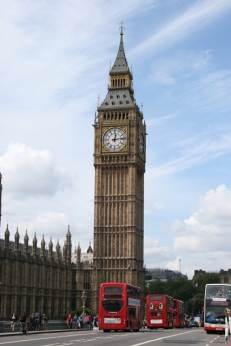
Our last few days in London have been really full. We continued to work in the Kings Cross coffee house and Southfields TV Lounge, and we also saw a little of the city (Picadilly Circus, Trafalgar Square, St. Paul’s Cathedral, the Tower of London, and Big Ben). We even caught some Olympic action – half our group watched the U.S. women’s volleyball team (indoor) beat China in straight sets. The rest of us cheered on the U.S. women’s basketball team as they took on Turkey, and won 89-58.

We looked across the court and could see the men’s team there to support the women. So, yes, I was in the same building as Lebron James.  On our way out of the Olympic Park we saw a retired NBA player, and Ian and Mari-Sue had their picture taken with him. (But you’ll have to ask them who it was – I’m not as up on that as I should be).

On Thursday, our last ministry day, I saw something really interesting at the Southfields TV Lounge: One of the gamemakers (people who are working at the Olympic venues) had picked up an Evangicube (a witnessing resource) and was showing it to a young boy who was there with his mother. He went through the Gospel with the little guy. One of our team members had brought the Evangicube from home and now the story was being passed on through the locals who are working the Games.

There are many more stories to tell about our time here. We have made new friends and also now have a home church in London. If I am ever back, I know where to worship. Thanks to you all for praying for us – we’ll see you soon!

OLYMPICS | Serena Butler

Our long train commute has been a blessing; we’ve had so many opportunities to meet Olympics volunteers and visitors, and people who actually live in London.

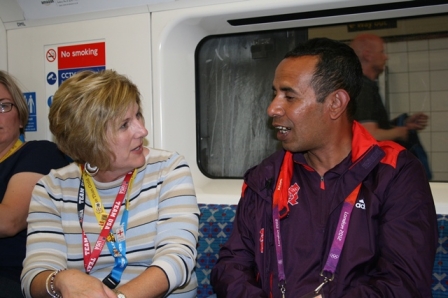
On the Tube ride home after a long day Tuesday, I sat down in my seat as the train started to move. When I looked up, three of our team members were already talking to the people sitting next to them. All of them had the opportunity to share the Gospel. Mari-Sue spoke with a lady who missed her stop because they were deep in conversation. Here are a few of the new friends we’ve met during our commutes and days at the ministry centers:

  • Geraldine, a Londoner I talked to on the Tube. We talked about the Olympics and she asked who we were working with. I was able to give her one of our pins and explain the colors and go through the Gospel with her. She was very receptive to hearing about it and loved the pin. She told me that she was raised Catholic but is not in church anymore; then, she changed the subject. She got even quieter and we rode a few stops in silence. As she was getting off at her stop, she leaned over and grabbed my arm and said, “Will you please pray for me?” Then she stepped off the train. I wanted to get off with her, but had no way to communicate with my team what I was doing, so I stayed on, but told Geraldine I would pray for her. She smiled and waved to me as the doors closed. We prayed for her later during our prayer time.
  • Igor graciously took a group photo of us at the airport in Chicago. He’s from Russia but has lived in the U.S. for a long time. He asked if we were some sort of sports team. I told him that we were a mission team going to work at the Olympics. I also told him that I had been to Russia in May. When I told him we had worked with Baptist churches there, he was surprised to learn that there were Baptist churches in Russia. He grew up in a village in the north where there was no church at all. I was able to share a little bit with him about God and the hope He offers. I hope that brief conversation will plant a seed so that he wants to learn more about the Gospel.
  • Anya is working at the Sand Volleyball venue and her boyfriend was one of the drummers in the Opening Ceremonies. She was baptized as a baby, but isn’t in church at all now. We gave her a pin and a booklet, which she quickly started asking questions about. As the conversation got deeper, she wanted to change the subject, so we talked about her schooling at the university and what she wants to do with her life. I pray that she will read the booklet and that the Spirit will work on her heart.

Please pray with us for these and others we’ll meet during our time in London, that God will give us boldness to start conversations about Him.

Posted by Meredith Flynn

Waiting customers spilled out into the parking lot at the Chick-Fil-A in Wheaton, Ill., on Wednesday, designated as National Support Chick-Fil-A Day.

If you’re headed to your local Chick-Fil-A, give yourself a few extra minutes. Or maybe half an hour. Or longer.

Americans are flooding into the restaurant chain’s 1,600 locations as part of National Support Chick-Fil-A Day, created by former Arkansas Governor Mike Huckabee to counteract negative response the chain has received for its support of traditional marriage and family values.

More than 600,000 people pledged their support for Chick-Fil-A on Facebook through the campaign, which started less than two weeks ago.

Cars were lined up for at least half a mile to wait in the Chick-Fil-A drive-through line in Wheaton, Ill., reported local pastor Jim Rahtjen. He stopped by during the lunch rush and said the line of customers waiting to get inside the restaurant was wrapped around the building, too.

One drive-through customer told Rahtjen she would wait however long it took to order her lunch, because she supports freedom of speech. “Even if I don’t fully support what people are saying, that’s what we’re founded on,” she said.

So, what do you think? If there’s a Chick-Fil-A nearby, are you planning a trip? Do you think financial support (like buying a chicken sandwich) is a beneficial way to support traditional family values? Or do you think the whole thing has caused too much divisive debate? Leave a comment here, or head over to Facebook to vote in our poll.

What day is it?

Meredith Flynn —  August 1, 2012

OLYMPICS | Serena Butler

Have you ever felt like you’ve been somewhere forever, but it’s only been a week? That’s how I would describe our first week in London. In just eight days, we traveled here, trained for our Olympic assignments, worshiped in local churches, set up two coffee houses, and met more people from more countries than I can begin to count. Our two-hour ride into town each morning is starting to feel like second nature, and we’re still getting lots of opportunities to talk to people about why we’re here.

Meeting a new friend on the Tube, who was excited to show off his USA shirt.

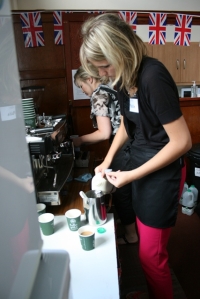
The crowd at the Kings Cross coffee house is growing. The church decided to pull a ping pong table out onto the Square in front of the church to see if it would draw a crowd…and did it ever. Local shop owners came over on their breaks to play a game. Kids came in from around the neighborhood, and some Olympic tourists stopped by, too.

Over at Southfields Church, we’re seeing more visitors in the TV Lounge. One older gentleman comes every day. He doesn’t really care about spiritual things, but something keeps bringing him back every day. It might be the pull of being with others. He has talked to several of us on the team about his loneliness. We are glad that he feels comfortable coming and hope the TV Lounge is helping to break through some of the ice.

Just like Starbucks.

The weather is helping us out, too. One day, it rained off and on all day, and people came in to warm up with a coffee or tea. Several of the workers from the tennis venue are coming in, and we learned that man in charge of crowd control is telling his volunteer staff to come to the Lounge during their break time. He said that he “wasn’t much of a religious person, but this is a great place for them to come.” Word is also spreading among the Tube workers and they’re beginning to stop in. It is our prayer that Southfields Church will continue to build relationships with those who live and work in their area.

God is working in the city. Pray for the team as the long days are beginning to wear on us. Our host churches have been so gracious, and there is still so much work to be done.