


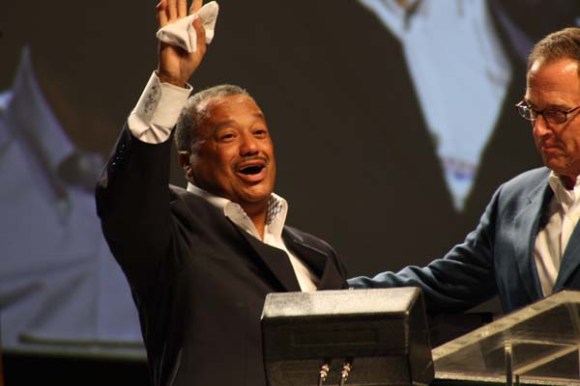
“To God be the Glory! Great things He has done! Thank you, I love you.” – SBC President Fred Luter on his election.
The face of the Southern Baptist Convention has changed. He’s African American, the first minority president in the denomination’s 167-year history. More important, given the challenges before him, he’s smiling.
Fred Luter was elected by acclamation at the annual meeting in New Orleans on June 19. He ran for the presidency of the 16-million member convention unopposed.
The denomination that was born out of a break between slave-owning Baptists in the South and northern abolitionists finished the repudiation of racism begun 16 years earlier by naming the New Orleans native, a pastor known for fiery preaching, effective leadership, and a winsome ability to work across cultural lines, as its first black president.
“God has given me a gift in building bridges through the years, and my prayer is that, someway, somehow, I can get groups on this end [and] groups on this end…and meet together,” Luter said after his election. His diplomatic strategy, joy.
“I love to laugh,” he told a reporter. “I love to have a good time.”
This joy in the face of adversity has seen Luter through difficult tasks before, including rebuilding Franklin Avenue Baptist Church, a large congregation decimated by Hurricane Katrina in 2005. “If anybody has joy, if anybody has peace and happiness, it should be us,” he said, referring to Christians.
Because no other candidate ran against Luter, the convention recording secretary came to the microphone to cast the official ballot of the entire convention for Luter, but outgoing president Bryant Wright welcomed messengers to participate in the historic moment by raising their own ballots.
They did.
And approximately 8,000 people stood to their feet for several minutes of clapping and cheering and, for many, weeping “That was such a wonderful and historic moment …. I was moved to tears of joy as were the African-American pastors I was sitting with,” said Michael Allen, pastor of Uptown Baptist Church in Chicago.
As Bryant brought Luter to the platform on a wave of adulation, it was evident this was everyone’s decision. Now the question looms, can Luter ride this wave to bring lasting change in the denomination that faces declining membership and offerings, and the need for broader appeal in an increasingly diverse American culture.
“I think he’ll do a great job, and I think he’ll work at trying to build up the Kingdom of God through the Southern Baptist Convention,” said Marvin Parker, pastor of Broadview Missionary Baptist Church, a large mostly African-American congregation in metro Chicago. “I expect there to be a greater outreach winning souls for Christ, I really expect a great increase because I think he’ll attract more folks with his style of preaching and all.”
Other actions
The 2012 convention was historic for reasons other than the barrier-breaking election. One issue that threatened to divide the convention in recent months was the prospect of a name change.
Messengers approved “Great Commission Baptists” as a descriptor name that can be used in place of “Southern Baptists,” an adjustment many in the north and west see as necessary for effective ministry. The issue was debated on the convention floor until it passed by a narrow majority, 52.78 percent.
Chairman of the name change task force Jimmy Draper presented the recommendation to the convention. Draper told the Illinois Baptist the motivation for the informal change is “missional.”
“We’re not going to be more evangelistic just because we have a new descriptor. But who among us could be against focusing on the Great Commission?” Draper said. “It’s something that would point us in the right direction, and would always be descriptive of who we are as Southern Baptists. We are, without apology, a Great Commission people.”
The annual meeting wasn’t the forum for debate on Reformed theology that some thought it might be, but messengers did engage in deep discussions about how people come to a saving relationship with Jesus. Alabama pastor David Platt told the stories of two active members of his church who realized they had never come to true faith in Christ. He pleaded with Southern Baptists to reexamine their understanding of repentance and belief.
“They represent a pandemic problem across contemporary Christianity, and some of you have the same story. You made a decision, prayed a prayer, signed a card, got baptized, you thought you were a Christian, you were told you were a Christian, and now you know that you were not. You were deceived.”
Platt sparked conversation about the “sinner’s prayer” months before the convention, in a YouTube video that resulted in a resolution establishing the sinner’s prayer as a biblical expression of repentance and faith. That resolution, along with another that addressed pre-convention debate between Calvinists and non-Calvinists, was recommended by the SBC Resolutions Committee to emphasize cooperation said Chairman Jimmy Scroggins.
“Southern Baptists are going to have to agree on the essentials. We’re going to have to disagree on certain things, but what we really want to do is lock arms and fight the darkness.”
Other resolutions included statements on same-sex marriage (affirming traditional marriage while discouraging hurtful language in dealing with homosexual issues) and religious freedom (including repudiation of requirements by the Obama health care act requiring religious institutions to provide contraception and other services contrary to their beliefs as part of their employees’ insurance benefits).
Reports by the SBC’s six seminary presidents, the heads of the International Mission Board, North American Mission Board, LifeWay, GuideStone, and the Executive Committee of the SBC were received without objection and with few questions from the messengers.


 iB2 News