Archives For November 30, 1999

THE BRIEFING | Meredith Flynn

While 30% of the Millennial generation say going to church isn’t important at all, 30% also say church attendance is very important. And 40% are in the middle. The reasons why vary, as detailed in research by Barna Group. Among all Millennials, the researchers found, 66% say American churchgoers are judgmental, and 44% believe it seems like an exclusive club.

Better news: 65% say church is a place to find answers to live a meaningful life.


A Peoria, Ill., woman committed to wear a traditional Muslim head covering during Lent in order to “remember what it feels like to be an outsider.” “People end up grouping all Muslims with extremists. I want to remember that people are individuals, and so by doing this I’m remembering to welcome and include people no matter what they look like,” Jessey Eagen told The Christian Post.


Phyllis Sortor, a missionary with the American Free Methodist Church who was kidnapped in Nigeria in February, has been released, The Christian Post reports. “It appears she was kidnapped by a criminal gang, and there is no evidence this event is associated with terrorism or religion,” said David W. Kendall in a news release from the denomination’s Board of Bishops.

Sortor’s kidnappers originally demanded $300,000 for her release, the details of which will not be discussed publicly, Kendall said.


Franklin Graham, son of famed evangelist Billy Graham and president and CEO of the Billy Graham Evangelistic Association, told Fox News on Sunday, “I believe we’re going to see persecution in this country. We’ve already seen many laws that have been passed that restrict our freedom as Christians.”


The Washington florist who came under fire for refusing to provide services for a same-sex wedding said she would hug her accuser if he walked into her shop. “The same faith that tells me that I can’t be a part of Rob’s wedding is the same faith that tells me to love him as Christ does,”

Barronelle Stutzman told Baptist Press. The 70-year-old Southern Baptist church member was found guilty last month of violating her state’s non-discrimination law. She is appealing the verdict.


Fanny_CrosbyHEARTLAND | Steve Hamrick

February marked the 100th anniversary of the death of one of America’s greatest hymn writers and poets, Fanny J. Crosby. Frances Jane van Alstyne (née Crosby), lived nearly 95 years, from March 24, 1820, to February 12, 1915.

At six weeks old, young Francis developed an inflammation in her eyes that was treated with a mustard poultice, a common treatment of the 19th century. Whether because of the mustard or a congenital condition, blindness resulted. But it rarely affected her attitude. She was known in early years as the “happy little blind girl.”

Her first attempt at verse at age eight shows her outlook.

Oh, what a happy child I am,
Although I cannot see
I am resolved that in this world
Contented I will be

The attitude of God’s gratefulness continued as a theme throughout her life. “When I get to heaven,” she once said, “the first face that shall ever gladden my sight will be that of my Savior.”

It is estimated that Crosby wrote more than 8,000 hymns, with over 100,000,000 (that’s one hundred million) copies in print. Many of her hymns include references to sight and light. Notice the insight of one of her most well known songs, “Blessed Assurance”:

Perfect submission, perfect delight,
Visions of rapture now burst on my sight;
Angels descending bring from above
Echoes of mercy, whispers of love.

In addition to her hymns, Crosby published more than 1,000 secular poems, four books of poetry and two best-selling autobiographies. Most don’t know that she also wrote a number of popular and patriotic songs of her day.

During her long life she had the honor of reading her works in front of the U.S. Senate, Congress, and before many U.S. presidents, including John Q. Adams and James Polk; she also was dear friends with Grover Cleveland.

Despite being one of the most popular personalities of the 19th century, Crosby’s most rewarding work during her lifetime was her service to rescue missions. She dedicated her life in serving the poor, immigrants and less fortunate. During her years as a mission worker she wrote, “Pass Me not O Gentle Savior,” “More Like Jesus,” and “Rescue the Perishing.”

Her songs are still sung by churches around the world. Thousands of arrangements have been set for choirs, orchestras and praise teams. The band Caedmon’s Call recently recorded “Draw Me Nearer” (I am Thine O Lord) using one of Mrs. Crosby’s best texts. The words tell her story well:

I am thine, O Lord, I have heard thy voice,
And it told thy love to me;
But I long to rise in the arms of faith
And be closer drawn to thee.

Steve Hamrick is IBSA’s director of worship and technology.

COMMENTARY | Heath Tibbetts

“So what do you think about demons?” This was the random text message my 21-year-old brother sent me a few months back. I replied, “They sound scary, and they’re totally real.”

He called and told me of his friend, John, who believed he was being harassed by a demon. John doesn’t go to church, but he decided to call a few of the local pastors in his town, asking them what he should do. In each instance, the pastor didn’t believe his story, and offered nothing further.

Heath_Tibbetts_Feb26John lives out of state from my brother and me, so I offered to call. Soon, he was explaining his story to me. Let’s put it this way…YIKES! The hairs on my neck stood at attention as John explained this entity’s ability to take a visible shape while bringing him feelings of dread and even depression. He was now worried that this “entity” (I told him demon was the correct term) would attempt to possess him, and he was highly fearful.

I’ve heard of pastors who have blown off these types of stories. A previous pastor I served with said he had received a call from someone who thought they had a demon in their house. When I asked him what he was going to do, he replied, “Not go over there!” This didn’t sit well with me. Jesus spent many days defeating demons who were bringing hopelessness and harm to people all over Israel (Matthew 8:16, Luke 11:20, bunches of others). The Bible spoke of demons as a real threat, and I was shocked that our church didn’t act accordingly.

After telling John I believed him, I asked about his relationship to God. He admitted to having none, though he had been growing more curious about spiritual things. And as John continued to talk, I realized these attacks had intensified during this newfound curiosity. Long story short, I shared with John the Good News of Jesus and he willingly repented of his sins over the phone and placed his trust in Jesus. Then, we had a crash course in Holy Spirit theology. I told him that according to 1 Corinthians 6:19, no one can ever possess him now that he has become a temple of the Holy Spirit. John hung up the phone sounding much more confident about the future.

In fact, in the three months since John accepted Christ, he’s experienced a great change. Because the local pastors didn’t offer hope, he was unwilling to attend their churches. I’ve been discipling him by phone, texts, and e-mails. He reports no visits from this demon since his salvation, and he is reading his Bible and spending time in prayer. John is also finding new plans opening up for his life. He is moving to a new city in February to continue his education, and the first question he asked me was, “How do I find a good church when I get there?”

What is the takeaway for us? First of all, there were pastors who had an unbeliever call them for hope and they offered NONE. We have the hope of salvation and purpose in Jesus. When an unbeliever approaches us, no matter their dilemma, we must be prepared to help them see that Jesus is calling them in the midst of their crisis.

Secondly, if the Bible warns us of something, we had better take it seriously! Satan and his demons are real and they are working tirelessly to deceive, depress, and destroy souls. We must remain aware that spiritual warfare is going on all around us. Sometimes we can see it more clearly than others, but we are not fighting against people, but against “the spiritual forces of evil,” according to Ephesians 6:12. God has called us to be
warriors for the gospel who will help the hurting and broken find hope in Jesus Christ. As Peter said, let us always be prepared to share the hope that lies within us.

Heath Tibbetts pastors First Baptist Church in Machesney Park.

THE BRIEFING | Meredith Flynn

As Egypt responded to the apparent beheadings of Egyptian Christians with airstrikes on ISIS in Lybia, believers in the west used social media to grieve for the 21 Coptic Christians believed to have been killed.

The_Briefing“These are my brothers, faithful unto Christ even unto death, Russell Moore posted on Instagram with an image from ISIS’ video of hostages and their captors. “King Jesus puts heads back on, and puts worlds back together. Maranatha,” wrote the president of the Ethics and Religious Liberty Commission.

In a guest post on thegospelcoalition.org, Southern Seminary professor Tom Schreiner offered a biblical meditation on the executions of the Christians.

“Paul says that ‘to live is Christ, and to die is gain’ (Phil. 1:21). Still, the matter is not simplistic, and life is not easy,” Schreiner wrote. “We ‘weep with those who weep’ (Rom. 12:15). Paul said that if Epaphroditus had died he would experience ‘sorrow upon sorrow’ (Phil. 2:27). Grief floods the hearts of those left behind.”


Only 22% of people agree with President Barack Obama’s 2014 statement that terror group ISIL (or ISIS) “is not Islamic,” LifeWay Research reported in a series of surveys conducted last fall. But almost half of Americans also say the group is not a true reflection of the nature of Islam.


CNN will start a six-part series March 1 that the news channel says “discovers fascinating new insights into the historical Jesus, utilizing the latest scientific techniques and archaeological research.” The Christian Post reports the series, titled “Finding Jesus: Faith, Fact, Forgery,” will feature commentary from Ivy League theologians and Los Angeles pastor Erwin McManus, among others.


Illinois’ Baptist Children’s Home and Family Services recently achieved Hague accreditation for its adoption program, meaning BCHFS can continue to do home studies for adoptions in countries that require it. The accreditation is also a first step toward being able to complete adoption placements internationally, but adoption specialist Regina Thompson stressed the agency isn’t equipped to do so now.

“Our main reason for getting Hague accredited,” Thompson said, “was so that we could continue to do international home studies.”


Christianity Today reports Family Christian Stores – the largest chain of Christian bookstores in the U.S. by number of stores – has filed for bankruptcy, but “does not expect to close any stores or lay off any employees.”

“We have carefully and prayerfully considered every option,” President and CEO Chuck Bengochea said in a Feb.11 statement. “This action allows us to stay in business and continue to serve our customers, our associates, our vendors and charities around the world.”

Rob (left) and Mona Payne (center) lead worship during "Pop Up Church" for Downtown Phoenix Church, also known as DTPHX Church. Photo by Shawn Hendricks/BP

Rob (left) and Mona Payne (center) lead worship during “Pop Up Church” in Phoenix. Photo by Shawn Hendricks/BP

THE BRIEFING | Meredith Flynn

Young adults in downtown Phoenix “don’t think about going to church on Sunday morning any more than you and I think about going to bingo on Friday nights,” says Pastor Jim Helman. To reach Millennials, his Downtown Phoenix Church “pops up” every other week at a coffee shop or in a park, and uses the other weeks to serve the community. Read more at BPNews.net.


His Seattle Seahawks may have lost the Super Bowl in stunning fashion (that second down call!), but quarterback Russell Wilson seems to already be bouncing back via Twitter. After the game, the outspoken Christian posted motivational messages and Psalm 18:1–“I will love You, O LORD, my strength.”


Imprisoned pastor Saeed Abedini thanked President Obama for meeting with his wife and children last week, and for assuring the couple’s young son that he will try to secure his father’s release by March (when Jacob Abedini will celebrate his 7th birthday). “I know that as a father you can truly understand the pain and anguish of my children living without their father and the burden that is on my wife as a single mother,” Abedini wrote to Obama from Rajaee Shahr prison in Iran.

In the letter, provided online by the American Center for Law and Justice, Abedini also thanked Obama “for standing up for my family and I and for thousands of Christians across the world who are persecuted for their faith in Jesus Christ.”


The American Bible Society will relocate to Philadelphia after selling its Manhattan building for $300 million, reports The Christian Post. The 12-story facility on Broadway, which has housed ABS since 1966, is about 10 blocks from another ministry: the offices of the Metro New York Baptist Association.


Religion writer Cathy Lyn Grossman reports on the “post-seculars,” a group defined in a new study as falling between “traditional” and “modern” views of science and religion. Said study co-author Timothy O’Brien, “We were surprised to find this pretty big group (21 percent) who are pretty knowledgeable and appreciative about science and technology but who are also very religious and who reject certain scientific theories.”


Democrats feel more warmly toward Muslims than do Republicans, Pew reports in a study on how ideology and age affect American “temperatures” about Muslims and Islam.


As Boko Haram continues to wage a war of terror in Nigeria, “…God has raised up believers who have remained steadfast and bold in the midst of applied pressures to silence them,” said one Christian worker, according to this Baptist Press story.


COMMENTARY | Bob Elmore

Bob_Elmore_blog_calloutWaking up to the sound of a high-pitched alarm is never a good start to a day. But this morning in April 2012 started just that way. It had been a stormy night, so I initially thought it was the weather alert radio and I mentally prepared to get my family down to the basement—not an easy task, since we have two sons with profound autism who strongly resist any changes to their routines.

I groggily opened my eyes and remembered I had been sleeping on the couch in the living room with my wife and son, Mark, who has epilepsy in addition to autism. He had a seizure that night, so we had been keeping watch over him as he slept on the floor. I looked around at our dark house and saw an odd orange glow coming from Mark’s room. The shrill alarm I heard was our smoke alarm. Mark’s room was on fire!

I woke up my wife and we got our protesting sons out of the house and into the car, which we moved away from the house. We were in pajamas and bare feet while we waited for the heater in the car to warm up. We watched dark smoke billow out of our windows as our small local fire department arrived.

Somehow, my wife and I were filled with a peace that belied our circumstances. We gripped hands and prayed, thanking God for our family’s safety and especially that our son had not been in his room when the fire began—the first time we were ever grateful for a seizure.

We opened our eyes after the “Amen.” All we had in the world was given to us by God, like Psalm 24 tells us. “The earth is the Lord’s, and everything in it, the world, and all who live in it.” We instinctively knew that He would give us what we needed, just like He always had before…and He did.

Our dear neighbors and loving church family in Winchester, Ill.—about an hour west of Springfield—brought us blankets, clothes, coffee and emotional support. Over the next days, weeks and months, we would watch God fold His arms around us by bringing people to us. We had spent years together trusting God to take care of our atypical family each day, and He had always proved Himself faithful and now continued to do so.

Within three months, we had relocated to Springfield, where I now serve as IBSA’s short-term missions coordinator. We have a new house and new furnishings. Most importantly, we have another reason to entrust all that we have to God. Matthew 6:21 reminds us that “where your treasure is, there your heart will be also.”

Our treasure always lies with our God. That way, our hearts will forever be in a safe and peaceful place.

Bob Elmore is IBSA’s short-term missions coordinator. He and his family are members of Western Oaks Baptist Church.

THE BRIEFING | Meredith Flynn

International Mission Board workers called for prayer in the wake of devastating terrorist attacks in France, Baptist Press reports. “There exists today a delicate tension in France that teeters toward breaking, and [Wednesday’s] tragic events will likely serve to further stir up the tension,” said Mark Stone, a church planter in southern France. The outbreak of violence started Jan. 7 with a shooting that left 12 people dead at the headquarters of satirical newspaper Charlie Hebdo.

“We are praying that the outcry against these heinous acts committed by religious extremists will not become outcries against anyone who claims to have any sort of religious belief,” IMB worker Tara Chaney told Baptist Press.

“Right now, we are praying that the people of France will turn toward God and not away from Him.”


The_BriefingThe Muslim actor who will play Jesus in an upcoming National Geographic Channel said he didn’t believe Jesus would judge him for playing the part. “I cannot speak for Jesus, but I can quote his teachings and He said, ‘Love your neighbor as yourself,'” Haaz Sleiman told Entertainment Weekly. “…How would He react to me playing Jesus? He wouldn’t judge it. He wouldn’t judge His own enemy…playing this part highlights His teaching in a very nice way.”

Sleiman will portray Christ in “Killing Jesus,” a miniseries based on a book by Bill O’Reilly and Martin Dugard. Read the full story at ChristianPost.com.


North Korea is atop Open Doors’ annual World Watch List for the 13th consecutive year, followed by Somalia, Iraq, Syria and Afghanistan. The list tracks the countries “where it is most dangerous and difficult to be a Christian.”


“Under no circumstances have I been discriminatory or hateful towards any member of the department in the LGBT community or a member of the LGBT community at large,” former Atlanta Fire Chief Kelvin Cochran told Baptist Press Jan. 6. Cochran was fired after an investigation into his self-published book which briefly mentions homosexuality as an immoral behavior, BP reports. Cochran teaches Sunday school and serves as a deacon at Elizabeth Baptist Church, which is affiliated with the Georgia Baptist Convention.


Where do the majority of Congressional representatives fall, faith-wise? Pew Research breaks down the religious makeup of the current U.S. Congress in this full report.


Wondering what else happened in Louis Zamperini’s life that didn’t make it into the recently released feature film Unbroken? Check out this half-hour documentary from the Bill Graham Evangelistic Association about the war hero’s conversion to Christianity.


We’ll give this a few weeks to see how it checks out: LifeWay Research recently found only 15% of churchgoers said they would skip worship to watch their favorite football team.


And what the trends mean for your church

An Illinois Baptist team report

"Imagine if you could spend 10 focused minutes each Sunday morning in extraordinary prayer on two major needs locally, in your church, in America, or across the world.” SBC President Ronnie Floyd’s “Call to Prayer” that began at the Annual Meeting in Baltimore now turns to Sunday mornings, starting with one worship service in January.

SBC President Ronnie Floyd’s “Call to Prayer” that began at the Annual Meeting in Baltimore now turns to Sunday mornings, starting with one worship service in January.

1. Churches respond to “Call to Prayer”
“It is past time for us to prioritize prayer personally and in the church,” SBC President Ronnie Floyd wrote on his blog in early December. “For far too long, we have seen what we can do; it is time for us to see what God can do. This can only happen when we pray.”

Floyd’s continued call to prayer—leading to the June 2015 SBC Annual Meeting in Columbus, Ohio—began about two years ago with a series of meetings for pastors and church leaders. Floyd began quoting famed Puritan preacher Jonathan Edwards who called believers to “extraordinary prayer” for revival in America.

“God’s people will be given a spirit of prayer,” Edwards wrote in 1746, “inspiring them to come together and pray in an extraordinary manner, that He would help his Church, show mercy to mankind in general, pour out his Spirit, revive His work, and advance His kingdom in the world as He promised.”

Today’s growing urgency in prayer coincided with planning for the 2014 IBSA Annual Meeting in November. “We will either hunger for God’s righteousness out of desperation or…out of devastation,” IBSA President Odis Weaver told messengers. The November meeting peaked in a Concert of Prayer for Spiritual Awakening in Illinois and across the U.S.

“I believe we need to cry out to God for spiritual awakening, and for revival in our churches,” said IBSA Executive Director Nate Adams. He led more than 400 pastors and church leaders through a prayer cycle lamenting the lost condition of people in Illinois, repenting of apathy and ineffectiveness, interceding for spiritual awakening, and commiting to pursuit of revival in our churches.

Afterward, many pastors said they would lead similar prayer events when they returned home.

Now Floyd is asking churches to dedicate an entire Sunday morning service to prayer in January: “Just imagine if 100 churches, 500 churches, or several thousand Southern Baptist churches would turn a Sunday morning into insuring that Jesus’ House would be a genuine house of prayer for all the nations.
Just imagine what could happen if, from this point forward, you could spend 10 focused minutes each Sunday morning in extraordinary prayer on two major needs locally, in your church, in America, or across the world.”

Jonathan Edwards imagined the outcome. He called it the “revival of religion.” We would call it “advancement of the Gospel”—the salvation of lost souls, renewal of our churches, and restoration of moral sensibility to the nation.

In your church: SBC churches will likely give prayer a higher profile in 2015, but what are we praying for? How will we sustain prayer in our congregations as more than a once-in-a-while emphasis? Consider a Concert of Prayer in January. As Floyd wrote, “If we do not plan to pray, we will not pray!

2. Evangelicals cope with minority status
Say goodbye to Mayberry. The culture is shifting. What was once called good is now called evil, and vice versa, just as Isaiah said of his own times. The majority opinion in the U.S. approves of same-sex marriage, and many other sexual matters—once outside the norm—are being accepted by society at large. But, while the morals and mores are changing, Southern Baptists are not.

We still stand on the Word.

“One of the biggest challenges for conservative Christians is moving beyond a Bible Belt mentality, or a moral majority mentality,” said Russell Moore, president of the SBC’s Ethics and Religious Liberty Commission, “and seeing ourselves instead as in many cases a prophetic minority speaking to a larger culture about things that matter.”

Moore called on pastors and church leaders to “prepare people for what the future holds, when Christian beliefs about marriage and sexuality aren’t part of the cultural consensus but are seen to be strange and freakish and even subversive.”

“The Bible Belt is collapsing,” Moore has concluded.

The main evidence of that in Illinois is same-sex marriage which became legal June 1. Churches, at one point concerned they would be forced to perform
gay weddings, instead began addressing their bylaws as means of protection.

Another response by evangelicals is to make the church a place of refuge, said John Stonestreet, commentator for Breakpoint Ministries. “People who are enslaved to porn and suffer different forms of brokenness need to be able to come to the church and find answers. The church needs to offer hope and solutions. We need to say, ‘Here’s an option. Here’s the hope; here’s the gospel; here’s the truth; here’s Jesus; and here’s the cross.’”

Moore concurs. “We must have a voice that speaks to the conscience, a voice that is splattered with blood. We are ministers…not of condemnation, the devil can do that, we are ministers of reconciliation, which means that we will speak hard words…truthful words to address the conscience, even when that costs us everything.”

In your church: Church leaders are ministering from a new vantage point, but with the same apologetic. The challenge will be to confront cultural ills in a way that is biblically faithful and yet winsome. The message hasn’t changed, but some in our society today need to hear the truth truly spoken in love.

At a meeting in Asia, young missionaries surround new IMB President David Platt to pray for him as he seeks to mobilize churches. Photo by Hugh Johnson/IMB

At a meeting in Asia, young missionaries surround new IMB President David Platt to pray for him as he seeks to mobilize churches. Photo by Hugh Johnson/IMB

3. Young leaders urge peers to “re-engage”
The evidence has been building for a few years now: young Baptists are back. Or on their way back, at least.

They’re more visible at the Southern Baptist Convention’s annual meetings, and, in 2014, at two meetings on the gospel and marriage hosted by the Ethics and Religious Liberty Commission. They’re also beginning to look remarkably similar in age to the leaders of several of the denomination’s entities. At the ERLC’s October national conference, 125 young leaders had dinner with President Russell Moore and the heads of the SBC’s two missions agencies, Kevin Ezell and David Platt. At four years, Ezell is the longest-tenured at his post; Moore took the ERLC reins in 2013, and Platt was elected in August.

“There’s never been a better time in my lifetime to re-engage as a Southern Baptist than right now,” Ezell, president of the North American Mission Board, said at the meeting. “I really believe that God is up to something very special in the Southern Baptist Convention.”

Many young Baptists likely would cite the election of Platt, 36, as one of the highlights of 2014. Midwestern Seminary President Jason Allen, himself 38, blogged that when he announced Platt’s election during a September chapel service, students (and faculty and staff) broke into applause for the missiologist and author of bestseller “Radical.”

More than 1,000 miles away in Richmond, Va., young missionary appointees gathered around Platt shortly after his election to congratulate him and tell him how “Radical” and his messages on reaching the nations had helped lead them to the international mission field.

After Platt’s election, some Baptist leaders expressed concern that his Birmingham congregation, The Church at Brook Hills, gave a lower amount through traditional Cooperative Program channels, instead sending a large portion of their gifts directly to the SBC Executive Committee and International Mission Board.

But even with those concerns, established leaders affirmed Platt’s ability to mobilize young people to share the gospel to the ends of the earth. Southwestern Seminary President Paige Patterson noted it in a blog post published shortly after Platt’s election, calling for “thanksgiving to God for the presence of a young leader who has obviously garnered the hearts of the younger generation and who will have the opportunity to lead them to a commitment to the world mission enterprise.”

One blogger put it a little more plainly, noting Platt may be just the right voice to deliver tough love to would-be male missionaries outnumbered by female “Journeymen” appointed through the IMB.

“Lend your voice to addressing the issue of young males wimping out of Journeyman service,” William Thornton wrote at SBC Voices. “These guys think you walk on water, Mr. Radical. Give ‘em both barrels on this and see what happens.”

In your church: Look for increased excitement from your own young leaders now that the authors and speakers they’ve followed for several years are in prominent positions. Be prepared for them to want to go to the hard places for ministry and missions. “That’s where we hear young couples saying they want to go, that they want to be radically obedient to what God has called us to do for the nations,” said IMB trustee chairman David Uth. “The passion is there.”

4. Growing persecution: From “the Nun” to “resurrection people”
Before Ebola dominated headlines, another one-word threat struck fear in the hearts of many around the world—and even here. The war of terror and persecution waged by ISIS, or the Islamic State of Iraq and Syria, was the story of the year earlier in 2014.

ISIS chased religious minorities high into the mountains of Iraq. They filmed beheadings and broadcast them as warnings to the rest of the world. And they stirred many in the Western world to stand with the persecuted church. The Arabic letter “Nun” was used on social media pages to symbolize solidarity with those persecuted for their faith in “the Nazarene,” or Jesus.

It’s not just a problem in the Middle East. In Nigeria, 1,505 Christians were killed for their faith in the first seven months of 2014, according to non-profit Jubilee Campaign. North Korea again topped Open Doors’ list of most persecuted countries, highlighted by the imprisonment of American Kenneth Bae, who was finally released in November. Others, including Pastor Saeed Abedini in Iran, remain in prison.

Closer to home, Christians felt a different kind of persecution. Businesses and non-profits faced government fines for not providing abortion-causing contraceptives. The mayor of Houston, Texas, subpoenaed the sermons of pastors who were against the city’s pro-LGBT ordinance.

Christian leaders here urged believers to remember who they belong to. “The answer to the decline of religious freedom and the change in the moral climate is not found in waging incessant cultural wars, filled with rage at our changing culture,” said LifeWay Research President Ed Stetzer. “Simply put, you can’t hate a people and reach a people at the same time.”

Instead, he urged Christians, “Let’s live like the resurrection people, adorning the gospel with lives of grace. Even in our passion to defend freedoms increasingly at risk, let’s remind ourselves this generation is desperately in need of the love of Christ, lived and shared.”

In your church: Be prepared to think globally about persecution. How can your church go beyond your normal prayer times to intercede for those under threat for their faith?

Be alert to what government bodies are doing. Speak out when religious liberties are threatened. The IRS prohibits churches from supporting candidates, but not from speaking on issues related to faith.

SBC’s Frank Page speaks frequently about the future of the Cooperative Program, painting a hopeful picture despite years of declining offerings. Photo by Morris Abernathy

SBC’s Frank Page speaks frequently about the future of the Cooperative Program, painting a hopeful picture despite years of declining offerings. Photo by Morris Abernathy

5. Cooperative missions for a new generation

Most Baptists agreed the Cooperative Program, the denomination’s chief method of funding missions and ministry, is the best way for churches together to pursue the Great Commission. But how to fix the CP, plateaued and trending slightly downward for years, is up for debate. The election of David Platt as IMB president revealed how his church and other large churches have bypassed their state conventions, even though CP gifts for national and international missions are supposed to be routed first through the state level.

“I have heard some people say, ‘The big problem is that the younger generation simply isn’t educated about CP,’” blogged pastor J.D. Greear after Platt’s election. “That may be true for a small percentage of people, but the bigger problem is probably that they are educated about it. The more they find out about CP giving, the less they are motivated to give.”

Meanwhile, blogger Bart Barber spoke up for the reliability of the system itself, calling those who disagree with the way CP funds are allocated to greater involvement in SBC life. “…Within the Cooperative Program approach you can pursue any ministry, reallocate any budget, or adopt any methodology that you can convince enough of your fellow churches and fellow pastors to adopt,” Barber posted at SBC Voices.

“Bring on the changes! Make your proposals! Go to the floor of the SBC Annual Meeting! Attend your state convention meeting! Advocate tirelessly and fearlessly for the improvements you’d like to see. Whatever they are and however much adaptation they would require, I’m betting that almost none of it would actually require any changes at all in the Cooperative Program.”

SBC Executive Committee CEO Frank Page continued his campaign for increased giving through the Cooperative Program, touring the nation (including Chicago) to talk with younger pastors and leaders. “I’ll drop the Cooperative Program if you can show me something else that long-term is effective and engages every church concurrently and consistently in an Acts 1:8 strategy,” Page has said on several occasions. “Show it to me, and I’ll support it….But I
haven’t found it yet.”

In your church: More conversation about CP in the national SBC could mean it’s time for a refresher course in your local church. A class for young or new Baptists is an opportunity to teach about why Baptists give cooperatively. One big reason: CP helps missionaries focus on their mission field, instead of fundraising. Another reason: CP helps the local church have a balanced missions strategy, supporting work on all their Acts 1:8 mission fields.

-With reporting from Baptist Press

Read all of the December 22 Illinois Baptist at http://ibonline.IBSA.org.

NEWS | Meredith Flynn

“Our town is starting to come back,” said Pastor David Siere. For a year, he has watched Brookport, Ill., recover from a tornado that destroyed several homes and killed three people in Massac County, located at the southern tip of the state.

The storm hit on a Sunday afternoon, part of a tornado outbreak that wreaked havoc all over the state. Siere’s church, First Baptist in Brookport, sits next to a mobile home park that was almost completely destroyed, he said.

But Brookport is rebuilding, and Siere and his church are playing an integral role in the process. The town is starting to look a lot better, he said, and “we’re praising God for what He’s done so far.”

Brookport_1_1222

The Massac Pope County Recovery Committee has helped rebuild five homes since a tornado tore through the region last November. Nine more new houses are under construction. Photo from MPCRC Facebook page

Immediately after the tornado, FBC became Brookport’s ground zero for storm recovery. A ministry facility they had built in 2011 across the parking lot from the main building housed donated food, water and clothing. The pastor sees God’s provision in that building—“I don’t know what we would have done if we hadn’t had it.”

Illinois Disaster Relief teams moved quickly into the area to cut down damaged trees and visit with shaken residents. About a week after the tornado, Siere was approached by a city leader about being part of a long-term recovery team. Two of his church members, Bob Craig and Jerry Muniz, also joined the Massac & Pope County Recovery Committee.

So far, volunteer groups working through MPCRC have built five houses in Brookport, and nine more are in process. In August, the first homeowners moved in, including Clark Blasdel, who said he had never been through anything as bad as the tornado, and had never had anything as good happen to him as his new home.

“It’s unbelievable. I’m happy,” Blasdel told WPSD in Paducah, Ky.

The work of the committee is funded through grants and donations, combined with money provided to residents by the Federal Emergency Management Agency (FEMA). Their goal is two-fold: To provide housing for people who were displaced after the tornado, and to make Brookport a better place to live. In doing so, the team, which includes members of local churches, is also looking out for the spiritual well-being of their town.

“We keep God at the center of it, and I think that’s what makes a difference,” said Craig, noting that without God, it would be difficult to keep a sweet, loving attitude. The committee’s meetings start with prayer and Scripture reading, and they recently sponsored a “gospel sing” on the one-year anniversary of the
storm.

Craig, who pastored FBC Brookport before Siere, told around 200 attenders that with all the safety precautions people take—like storm shelters and weather radios—there’s a greater safety to be found in Christ. “You might not make it through another circumstance like this, and you need to have that provision taken care of,” he said.

When asked if there are stories from the past year that stand out, Craig recalls one young man whose mobile home rolled over several times during the storm, even as his wife and child were inside. They were bruised and banged up, Craig said, but survived. And the young man gave his heart to Christ.

“It was such a thrill, because it was a son-in-law of a long-time brother in Christ that I’ve known many years.”

To God be the glory
After the tornado, Siere was unsure what to put on the church sign, in light of everyone who had done so much to help Brookport. He settled on a simple message: “Thank you, everybody.”

Certainly, many are thanking the church in return. All of the houses built through the recovery committee have been constructed by volunteer workers, and those workers are fed at the church through the efforts of a woman from Metropolis who coordinates the meals. She was looking for a way to help and, Siere
said, “God led her here.”

The volunteer teams have slowed down for the winter; one group is scheduled for late December and one in January. But as the weather warms up, the committee expects more people will come to help.

When they started a year ago, eight houses was set as a goal, Siere said, and “God has seen fit for us to do a lot more than that.” The number 23 has come up, but whether or not the committee is able to see that many projects through, they want to help as many people as possible get a place to live.

Ultimately, he said, they want God to get the glory.

“We meet once a week still, here at the church, and as we’re seeing things happen, we just thank God because it has to be a God thing.”

JesusTHE BRIEFING | Meredith Flynn

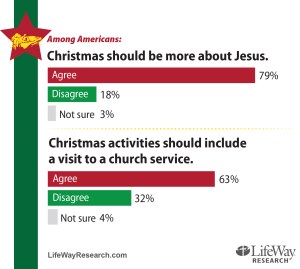
How well do Americans fare at keeping Christ the center of Christmas? Pretty well, according to a new survey from LifeWay Research. 79% agreed that “Christmas should be more about Jesus,” and 70% said “Christmas would be a better experience if it had a more Christian focus.” 63% of people said the holiday should include a visit to church.

Even so, LifeWay reported, people are less sure about the season’s theological details: Only 56% agreed that Christ existed before Jesus’ birth.


As you send your Christmas cards this year, remember who’s on the receiving end, Kay Warren said in a Dec. 4 Facebook post and a later article for ChristianityToday.com. Warren, whose son, Matthew, committed suicide in 2013, said receiving cards with happy family photos served as sharp reminders of their own family’s grief.


As protestors rallied to speak out against grand jury decisions in Ferguson, Mo., and Staten Island, N.Y., the Ethics and Religious Liberty Commission changed the theme of its second annual leadership summit to racial reconciliation. The March 26-27 meeting was set to focus on pro-life issues, but ERLC leaders announced the new emphasis in light of national response to current events, Baptist Press reported.


Christian leaders will gather today in Memphis, Tenn., to discuss the church and race relations. “It’s Time to Speak” will be streamed live from the Lorraine Motel and National Civil Rights Museum. The event, organized by Memphis pastor Bryan Loritts, also includes John Piper, Derwin Gray, Matt Chandler and Darrin Patrick. Gray told The Christian Post, “This event will be a call for the local church to be what she was meant to be – a multi-ethnic and multi-class of communities of reconciliation, love, and unity.


The plywood nailed to the windows of homes and businesses reminded Stoney Shaw of living near the threat of hurricanes when he was younger.

“People would brace themselves for the storm that was coming,” said Shaw, senior pastor at First Baptist Church of Ferguson, Missouri. “That’s exactly what is happening here; a devastating storm. But praise God things seem to be winding down and there is a lot of rebuilding going on, which is what we’ve been praying for.” Read the full story from the Illinois Baptist.


More than $30,000 has been donated online to help three families in the wake of a triple murder in Florida. Southern Baptist pastor Tripp Battle was one of the victims in the Dec. 4 shootings, which also took the lives of Denise Potter and Amber Avalos. Avalos’ husband, Andres, was arrested Dec. 6 in connection with the deaths, Baptist Press reported.


The upcoming movie version of Louis Zamperini’s life may not fully explore his faith, but the WW2 survivor’s conversion was in the spotlight leading up to the Dec. 25 release of “Unbroken.” The 1949 Los Angeles revival where Zamperini was saved not only changed him, wrote Religion News Service’s Cathy Lynn Grossman, but also transformed the ministry of the young evangelist preaching those nights.