Archives For November 30, 1999

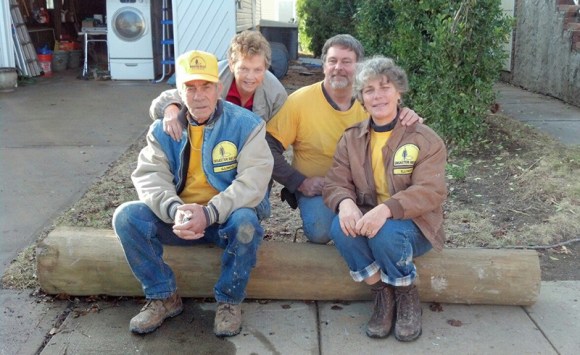
Fulkerson and Porter group photo web

Disaster Relief volunteers Bob Fulkerson and his wife Margie (left) and Butch and Debbie Porter (right) rest for a moment during a call out a few years ago in New York. Fulkerson passed away Tuesday, March 29 while serving on a call out in Leesville, La. Both couples are members of First Baptist Church of Galatia, Ill. Photo courtesy Butch and Debbie Porter.

Funeral arrangements have been made for Southern Baptist Disaster Relief (DR) volunteer Don Fulkerson, who died of a heart attack Tuesday, March 29, while serving flood victims in Leesville, Louisiana. Fulkerson, 77, was with a group of trained DR workers from First Baptist Church of Galatia, IL, and volunteers from other Illinois Baptist churches.

Visitation will take place Friday, April 1 from 6-9 p.m.  and Saturday, April 2 from 9-11 a.m. at First Baptist Church of Galatia, 108 E. Church St., Galatia, IL 62935. His funeral will be Saturday, April 2 at 11 a.m. also at First Baptist Church of Galatia. Fulkerson was a member of the church.

Rex Alexander, Disaster Relief coordinator for the Illinois Baptist State Association (IBSA), suggested DR volunteers attending the funeral, “wear your yellow shirts in honor of Don’s faithful service to the Lord through Disaster Relief Ministry.” Southern Baptist DR volunteers are easily identified at disaster recovery scenes by the bright yellow shirts they wear.

“The callout to Louisiana was Don’s 15th response over a period of only four years and his wife, Margie, was almost always by his side serving whenever the opportunity arose,” shared Alexander. “Their faithful service to Christ brought great joy to both of them as they served side by side in the ministry of Disaster Relief.”

Cards of condolence may be mailed to his widow Margie Fulkerson, P.O. Box 5, Galatia, IL 62935.

The DR team from First Baptist Church of Galatia were first responders in what is expected to be a series of callouts to aid victims of spring floods in Louisiana. IIBSA teams will serve alongside teams from around the country.

IBSA has 1,600 trained volunteers who serve as part of the Southern Baptist Convention’s Disaster Relief ministry (SBDR), the third largest relief agency in the United States. Disaster Relief often responds to natural disasters by providing feeding stations, mobile kitchens, child care, and chaplains. In the case of flooding, volunteers in their signature yellow shirts help homeowners with “mudout,” clearing flooded properties of debris and contaminated building materials, so they can begin rebuilding and recovery.

On its surface, the contest for Southern Baptist Convention president appears to be about passing the baton. Steve Gaines is 58. He is the pastor of Bellevue Baptist Church in metro Memphis, an old-school megachurch whose pulpit Adrian Rogers commanded for more than three decades. From that post, Rogers helped engineer the conservative resurgence in the SBC. Gaines, likewise, is committed to conservative theology in the Rogers mould, a traditionalist on evangelism, the need for personal commitment to Christ in salvation, and the commonly held Baptist soteriology of the past century. Gaines is a product of Southwestern Seminary whose president, Paige Patterson, was a chief engineer in the conservative resurgence, and who at 73 is a leading example of altar-call style, personal commitment evangelism.

J. D. Greear, at 42, represents the new wave. His, too, is a megachurch, built in his 14 years as pastor. The Summit Church is contemporary. Its attenders are younger than the average Southern Baptist congregation, and their theology learned from Greear is more reformed. Greear speaks to the crowd identified in Collin Hansen’s book of the same title as “young, restless, and reformed.” He is often a headliner at events for younger Southern Baptists. Greear holds two degrees, both from Southeastern Seminary.

Yes, this election may appear to be about the passing of boomers and the ascendance of Gen-X and Millennials to top leadership in the convention. But more important, it’s about theology and the breadth of the SBC tent. The denomination took a decided step to the right when Patterson, Rogers, and the leaders of the 1970’s and 80’s planted a firm stake for biblical inerrancy and social conservatism. But the convention has continued inching right as a generation of pastors inspired by Southern Seminary president Al Mohler and other reform theologians assumes leadership. The outcome of this election will say whether people in the pews are moving with them.

Messengers will elect a new Southern Baptist Convention president at the SBC Annual Meeting June14-15 in St. Louis, MO.

Eric Reed is editor of the Illinois Baptist.

Crossover makes a difference in host city and back at home

Uptown_Crossover

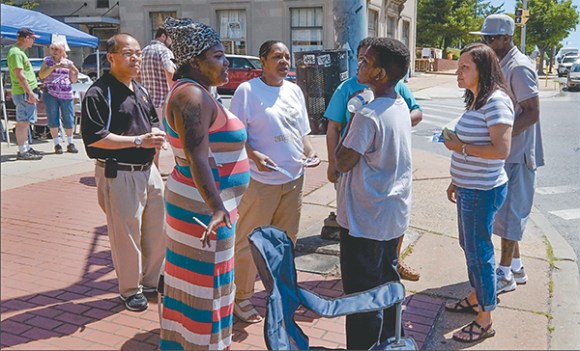
COLUMBUS – Mission volunteers from Uptown traveled to Columbus, Ohio in 2015, where they worked for two days training and encouraging local believers in prayer walking and evangelism.

The words of an old praise chorus aptly describe the effect missions can have in a local church:

“It only takes a spark to get a fire going…”

Once church members who have engaged in missions start “passing on” their experiences to their friends, it can ignite a missions fire of sorts, causing a church to look in their own neighborhood and beyond for ways they can reach more people with the gospel.

That’s how IBSA zone consultant Steven Glover describes the impact of Crossover, an annual outreach event held prior to the Southern Baptist Convention. This year’s Crossover initiative in St. Louis is planned largely for Saturday, June 11, although some projects start earlier (see planning checklist below).

Last year, Glover and his family participated in Crossover with a team from Uptown Baptist Church in Chicago. The volunteers worked with a church in urban Columbus, Ohio, to prayer walk their community and share the gospel with people they met. Glover and the team also helped train the Ohioans in prayer walking and evangelism, equipping them for the ministry they did together.

Once they got back to Chicago, they shared with the rest of the congregation what had happened in Columbus. As with any mission trip, the resulting benefits could have stopped there, Glover said.

“But if you have people who have participated in and are excited about it, they’ll continue to talk about it,” he said. That’s why the key is getting as many people involved as possible.

This year, Uptown will take a team to St. Louis to work with a church in a similar ministry setting as their own inner-city church. In Columbus, said Uptown’s missions coordinator Doug Nguyen, the church worked with “an urban congregation that ministered to Muslims and immigrants, as well as families around the neighborhood in downtown Columbus.
“And we’re looking to do the same in St. Louis.”

Uptown_Crossover_2014

BALTIMORE – Members of Uptown Baptist’s Crossover team share the gospel prior to the 2014 Southern Baptist Convention.

 
After Uptown partnered with a Baltimore church for Crossover in 2014, they were able to pray for the congregation specifically when rioting broke out in the city the next spring. “We’re all praying for them right now, for churches to really step up and be the salt and light in that community,” Nguyen told the Illinois Baptist at the time.

When mission volunteers help other Christians reach their community, they’re bearing each other’s burdens, Glover said. They’re energized by helping fulfill the Great Commission, by doing what God has called his people to do.

They’re also more likely to come back home and find ways to do the same in their own city.

“It’s a good investment,” Glover said, “because it’s an ongoing thing.” Iron sharpens iron, he said, referencing Proverbs 27:17. “Getting next to someone who has gone out and done that has such an impact.”

Crossover checklist

Making plans to join Uptown and hundreds of other churches at Crossover prior to this year’s Southern Baptist Convention? Start now by working through this checklist of questions:

Who’s going?
As you recruit volunteers for your Crossover team, think about who they are. What are their ages, ministry skills, and spiritual gifts?

View the list of Illinois Crossover projects at meba.org/crossover-st-louis- 2016, and look for those that fit your team. For example, if you have Spanish speakers in your group, consider joining Iglesia Bautista Maranatha in Granite City for prayer walking and door-to-door evangelism in their community.

Interested in sports outreach? Help Sterling Baptist Church host a 3-on-3 basketball tournament.

What time can they give?
Most Crossover projects happen the Saturday before the Convention begins—this year, that’s June 11. But some initiatives cover a longer span of time:

  • A church plant in Fairmont City needs help with a home makeover
    project June 6-11.
  • Two congregations in Hartford and East Alton are working together on a week-long canvassing project, capped off with a community block party.
  • A new church in Collinsville will utilize volunteers for community surveying and sharing the gospel on  Saturday, and then will host a preview worship service Sunday.
  • Check the full project list at meba.org for more multi-day opportunities.

What’s next?
Start thinking now about how to share your ministry experiences with the congregation back at home.

Which stories best illustrate how God worked through your team to increase your partner church’s influence and favor in their community? Did anyone accept Christ? What spiritual needs can your church pray for over the next year?

Also, how might you extend the relationship with your Crossover partner church? Uptown kept in touch with Baltimore pastor Ryan Palmer, who they worked with in 2014. He visited Uptown when he was in Chicago the next year. As you plan your Crossover project, consider how it might spark a ministry partnership that goes beyond one day.

The Forgotten Side

Lisa Misner —  February 1, 2016

Metro East prepares for the Southern Baptist Convention | June 14-15, 2016

Brook's Catsup

The World’s Largest Catsup Bottle may not be as tall as the Gateway Arch (it’s only 170 feet tall from base to cap), but the big monument in Collinsville, Illinois, is older, by 16 years. It was erected over the Brooks plant in 1949. The Brooks bottle has its own website and fan club. Catsupbottle.com

People from elsewhere are confused when I say I am from Illinois, near St. Louis. For many, Illinois means Chicago. But our state is much bigger than that.

When James Eads built the first bridge across the Mississippi in 1874, downtown St. Louis was connected to Illinois as never before. We love our giant city to the north, but much of our state is closer to St. Louis.

If you live near enough to the S-T-L, you know that our region is called Metro East. Let me tell you some of the Metro East story.

The Metro East is five counties on the Illinois side of the river. With 700,000 residents, it’s about one-fourth of the population of metropolitan St. Louis, which comes in at 2.8 million. It includes places like East St. Louis, Alton, Belleville, Edwardsville, Columbia, Collinsville, Fairview Heights and, yes, my town of O’Fallon.

We are diverse, but sometimes segregated. For example, East St. Louis is 98% African American, while O’Fallon is 82% white.

We are old towns, but there is a lot of new growth. Many of us work downtown, but new jobs are being created on our side of the river as well. And Scott Air Force Base has a large influence here. We have poverty and wealth. We have struggling churches and churches that are growing rapidly. We have challenges and opportunities.

Our relationship with St. Louis is complex. We love the city, the sports teams (at least those who don’t move away!) and the many things to see and do there. But we feel forgotten by the Missouri side. We go to the west side of the river often. They rarely come to the east side. We love and need St. Louis, but we identify closely with our own towns and schools.

Our area has many Catholics, but Baptists have a strong influence as well. St. Louis was founded by French explorers and Catholic missionaries. About half of the people in St. Louis consider themselves religious because they have a Catholic background, but the other half don’t claim to be anything.

New Design Baptist Church

The first Baptist church in Illinois was founded at New Design near present day Waterloo in 1796. This log meeting house dates back to 1832.

The first Baptist church in the state of Illinois was in a community called New Design. It was formed in 1786 near the Metro East city of Waterloo. Colonists traveled from Virginia and Kentucky to that spot near the Mississippi River. Among their number were two preachers, James Smith and David Badgley, who preached at New Design. The colony had more than 200 residents by 1800 and was the largest settlement in Illinois at the time.

Since that day, Baptists have impacted the region with the message of the gospel. Many of the strongest churches in IBSA are in Metro East and there are numerous new church plants here.

When the Southern Baptist Convention comes to St. Louis this summer there will be many Metro East Baptists in attendance. We will work and host many of the events that precede the convention. Our churches are planning to host and participate in Crossover events during the weekend before the convention. And my wife is president of the Ministers’ Wives luncheon that will be held on Tuesday of the convention week. She will be very busy!

Okay, we get it. Metro East isn’t Chicago. It isn’t even St. Louis, exactly. But it is a great place to live and we have a great view of the Arch. And God is at work here. And that makes it pretty great!

Doug Munton is pastor of First Baptist Church of O’Fallon. (Illinois, that is, not the one on the Missouri side of the river.) This is part of a series of articles on the Illinois side of the 2016 Southern Baptist Convention meeting in St. Louis.


Come to Metro East for Crossover

What do you get when 5,000 or more Southern Baptists descend on your town for a week? Outreach partners!

Crossover is the SBC’s concentrated evangelistic effort in the days just before each Southern Baptist Convention. Often, it’s a focused outreach day on the preceding Saturday. Churches from all across America bring workers and witnesses to meet needs and share Christ.

And local churches and new church plants find a ready supply of helpers, if they will simply put them to work.

Matt Burton, associate pastor of First Baptist Church of Mascoutah says they have a “two-fold Crossover plan.”

  • Tuesday through Friday of that week we will be doing a “Mascoutah Changers” where our students will use the skills they’ve learned in four years of World Changers to make an impact on the community. Included in our light construction or clean-up projects will be evangelism training and prayer walking.
  • Then on Saturday, the actual Crossover day, the church is planning a block party. We will host a health fair offering such things as school health exams, pregnancy screenings, blood pressure checks, eye exams, etc. And during the day, we will separate out adults from children and give each a clear gospel presentation with an intentional follow-up plan, Burton said.

What to do now:

For Metro East churches, start planning your strategy. Either host a Crossover event or make plans to support another church with theirs. Partnerships formed now can last for years, and advance the gospel in many communities.

For churches outside Metro East, now is the time to make contact with a church in the St. Louis region and form a partnership. Churches will offer different types of ministry events, depending on the demographics and needs of their communities.

Illinois Crossover projects are listed on the Metro East Baptist Association website—meba.org/crossover-st-louis-2016. Most of the projects are scheduled for Saturday, June 11, but some, like the week-long construction initiative in Mascoutah, start earlier.

Go to meba.org and click on “Crossover St. Louis 2016” in the right column for more information, or contact the association at (618) 624-4444.


The Briefing‘Saeed Is Free:’ wife offers thanks
Naghmeh Abedini, the wife of released Pastor Saeed Abedini, has thanked President Barack Obama, the Rev. Franklin Graham, the various groups that campaigned for her husband’s release, and the millions of people around the world who signed petitions for the cause. “I wanted to say thank you to all of you for having prayed and have wept with us, have signed petitions and have called your government officials. Thank you for having stood with our family during this difficult journey,” Abedini wrote on Facebook.


LGBT activist group targets Baptist schools
The homosexual activist group Human Rights Campaign has targeted 23 institutions of higher learning with Southern Baptist ties in a report that also names 35 other colleges and universities with distinct Christian identities. The report, “Hidden Discrimination: Title IX Religious Exemptions Putting LGBT Students at Risk,” asks education officials to increase reporting requirements for these 58 schools because each was granted “exemptions of interest” relating to either “gender identity” or “sexual orientation” or both.


SBC entities: Mandate violates religious liberty
The Obama administration’s abortion/contraception mandate forces Christians to violate either their religious beliefs or the government’s rules, Southern Baptist entities have told the U.S. Supreme Court. In a friend-of-the-court brief filed Jan. 11, the Ethics & Religious Liberty Commission (ERLC), the International Mission Board (IMB) and Southern Baptist Theological Seminary — as well as Southern’s president, R. Albert Mohler Jr. — urged the high court to rule the controversial, federal regulation infringes religious freedom.


Boy and girl locker rooms going extinct on U.S. coasts
At the end of 2015, two human rights commissions over 2,800 miles apart enacted new rules that could be precedent-setting for the gender battle across the nation, including giving people the right to use whichever locker rooms and bathrooms they choose. Now, concerns abound in Washington State and New York City over bathroom safety and privacy in wake of the transgender policies enacted last month by unelected officials.


Catholic hospital can’t be forced to do sterilizations
A California judge declined Thursday to force a Catholic hospital to facilitate a sterilization procedure for a woman who’s having a scheduled C-section at the facility later this month. “Religious-based hospitals have an enshrined place in American history and its communities, and the religious beliefs reflected in their operation are not to be interfered with by courts at this moment in history,” Superior Court Judge Ernest Goldsmith said.

Sources: Baptist Press, Christian Post, World Magazine

The BriefingWho’s next for National WMU?
Wanda Lee, National WMU Executive Director, announced her retirement Monday (Jan. 11) at the annual January Board Meeting of the Woman’s Missionary Union. Lee has been at the helm of the National WMU since 2000 when she replaced Dellana O’Brien. Among those speculated on as her possible replacement is Sandy Wisdom-Martin, former Illinois WMU Executive Director and current Executive Director of Texas WMU. http://www.sbcthisweek.com/national-wmu-facing-pivotal-moment-with-lees-retirement/


SBC President on the ‘spiritual’ state of the union
As President Obama prepares to give his final State of the Union address tonight (Jan. 12), the President of the Southern Baptist Convention issued his own spiritual state of our union. Floyd shared on his blog, “What’s especially alarming to me, serving as the President of the Southern Baptist Convention, is that we fail to realize how the spiritual health of our nation affects the state of our union. As our spiritual lives go, so goes the nation.” http://www.ronniefloyd.com/blog/10027/


Over 5,000 to join Chicago’s March for Life
Pro-lifers in Illinois are expecting over 5,000 people to join the annual Chicago March for Life event ahead of the national march in Washington D.C. A local version of the march held every year in the nation’s capital on the anniversary of the U.S. Supreme Court decision Roe v. Wade, the Chicago march on Jan. 17 is expected to be the largest held in the entire Midwest. http://www.christianpost.com/news/chicago-march-for-life-5000-pro-lifers-attend-illinois-abortion-declining-parental-notification-154282/#CSgVFLGvvAWl5t93.99


Process begins to remove prof over ‘same God’ comments
A panel of Wheaton College faculty will meet within the next 30 days to consider whether to recommend termination for political science professor Larycia Hawkins. Administrators placed Hawkins on paid leave in December after she made comments on social media about Muslims and Christians worshipping the same God. http://bpnews.net/46121/first-steps-taken-to-fire-prof-over-muslim-comments


Churches see need to screen volunteers
Almost half of the background checks requested by churches through LifeWay’s program with backgroundchecks.com reveal some type of criminal offense. Most of those are minor incidents such as speeding tickets, but 21 percent of inquiries discovered misdemeanors or more serious crimes. http://factsandtrends.net/2016/01/07/more-churches-recognizing-need-for-volunteer-screening/#.VpQoi3mhqUn

Sources: Baptist Press, Christian Post, Facts and Trends, RonnieFloyd.com, SBC this Week

Editor’s note: After an often tearful year, the Christian’s counterattack is hope.  The enemy may use the events of last year to strike chords of fear, but in reporting them, we offer notes of hope for 2016. God is in control of this world, and whatever happens, this history being made before our eyes will turn people toward him. He is our hope.
This is our certainty as we anticipate the new year, our hope.

Steeples-squareBy Meredith Flynn| In late 2015, Southern Baptist Convention President Ronnie Floyd wrote a blog post titled “Why we are where we are.”

It could well have been the slogan so far for Floyd’s year-and-a-half as SBC president. The Arkansas pastor has used his platform and his online presence to paint a picture for Southern Baptists of the state of things, and how to move forward together.

Throughout his presidency, Floyd has identified pressing issues for Baptists. He has written about how to think and pray on global issues like immigration and terrorism. Within the Convention, he has highlighted the need to pray for spiritual awakening, culminating in a corporate prayer meeting last summer in Columbus, facilitated by Floyd.

He also has championed the Cooperative Program, calling for it to be “the financial priority of each of our churches” after the International Mission Board announced a plan to cut personnel in light of budgetary shortfalls.

“If you are concerned about some of our missionaries having to come home and the decrease of our missionary forces,” Floyd wrote, “the greatest thing your church can do to help turn it around is increase your giving through the Cooperative Program. It helps build our base of support financially, which in turn will increase our ability to reach the world.”

Looking ahead: Giving through the Cooperative Program was up 1.39% for the 2014-15 fiscal year, an encouraging increase following several years of calls from SBC leaders for churches to increase their giving. In 2016, look for more information about “Great Commission Advance,” an initiative introduced at the Convention in Columbus. It’s set to run through 2025, the 100th anniversary of the Cooperative Program.

When Southern Baptists elect a new president in St. Louis this summer, the “Floyd factor” likely will be in play, as the denomination looks for another leader able to bring Baptists together around key issues inside and outside the Convention.

Lifeway: SBC becoming more urban
LifeWay’s new list of the top 500 Southern Baptist churches shows the denomination is becoming more urban because the American population is becoming more urban. Among other findings the South—and particularly Texas—is the epicenter of SBC megachurches; and of the 20 largest SBC churches, 20% are predominantly non-anglo. Learn more findings.


Feds give Chicago school 30 days to let boy use girls’ locker room
A transgender female student has complained District 211 high school in Palatine has “set her apart from her female classmates and teammates.” The district however has “noted two concerns it had in giving full locker room access to the student: First, a biological male would have opportunity to see girls changing clothes, and second, girls might see the student’s ‘biologically male body.’ OCR said those concerns were ‘unavailing in this case,’ and called them a pretext.”


German Protestant church rejects the Great Commission
The Evangelical Church in the Rhineland says the passage in the Gospel of Matthew known as the Great Commission does not mean Christians must try to convert others to their faith. Their position paper states, “A strategic mission to Islam or meeting Muslims to convert them threatens social peace and contradicts the spirit and mandate of Jesus Christ and is therefore to be firmly rejected.”


Religious liberty key to refugee crisis, leaders say
Religious freedom and the protection of religious minorities are essential to resolving the escalating refugee crisis in Syria and other countries, human rights advocates say. The repressive role of a religious group against other religious adherents can be seen not only in Syria but in Burma, the Central African Republic, Eritrea, Nigeria and Pakistan.


High court to hear GuideStone abortion mandate appeal
The U.S. Supreme Court (Nov. 6) agreed to hear appeals by several ministries, including GuideStone Financial Resources, to a U.S. Department of Health and Human Services mandate that would require certain ministries served by GuideStone to provide potentially abortion-causing drugs and devices or face crippling penalties.

Sources: Baptist Press, Religion News Services, ThomRainer.com

Martin Luther monument on Neumarkt in front of Frauenkirche, DresdenCOMMENTARY | “Do Southern Baptists consider themselves Protestants?” I was asked recently. The question seemed innocuous.

“Why do you ask?” I said.

“Well, in my former church, we were taught that Baptists aren’t Protestants. That we weren’t part of the groups that withdrew from the Catholic Church. You can’t really protest what you weren’t part of to begin with.”

Interesting point.

Normally I wouldn’t spend much time pondering how Baptists emerged on the scene, because I would find it outweighed by the question: How does that matter now? But here on the 498th anniversary of the Reformation, and peering over the cultural and moral precipice of the 21st century, I find the question is deep—and important.

In my friend’s church background, the teaching is that there always existed on a sort of parallel track to the Catholic Church a string of truly New Testament churches that were faithful to the biblical doctrines of salvation, believer’s baptism, and local church autonomy. They don’t identify themselves with Martin Luther, the agitated priest who on All Hallows Eve in 1517 started a movement—and a schism—with a hammer and nail as he posted his complaints on the door of his church building. Nor do they fully identify with Calvin, Knox, and Zwingli, Luther’s contemporaries. These Reformers nailed down faith by grace alone, but ultimately they kept the practice of infant baptism and a hierarchical church polity.

Methodists technically didn’t “protest” the Catholic Church. They withdrew from the Anglican Church, which was formed by Henry VIII because the Pope refused him permission to divorce and remarry—and remarry—and remarry. About 200 years later, Anglican priest John Wesley got saved and unintentionally started another movement. Not really a protest.

But in our day, the denominations that cite these Reformers as their antecedents are called Protestants. Mainline Protestants in America are Lutheran (of various types), Presbyterian (mostly PCUSA), United Church of Christ, Episcopalian (ECUS), United Methodist, American Baptist, and a couple of others.

We Southern Baptists never considered ourselves Mainline. But are we Protestants?

The reason this is important today was underscored at the symposium on “SBC in the 21st Century” hosted by Midwestern Baptist Theological Seminary in September. All the presenters—mostly seminary presidents and leading SBC thinkers and pastors—referenced the current cultural decline and the need for Southern Baptists to take biblical stands against it.

David Dockery, former president of Union University and now head of Trinity Evangelical Divinity School in metro Chicago, masterfully explained the shifts in Southern Baptists’ relationship to the prevailing culture.

He recited the SBC’s history as a series of six generations starting with its founding in 1845, each delineated by the death of some significant SBC figure. The period from 1950 to 1980 was one of expansion and accommodation, as the SBC grew dramatically and surpassed the Methodists to become the largest “Protestant” denomination in the U.S. The period was marked by movement toward the mainline, as downhome Southern Baptists moved up in the world. For a while, it was cool to be Baptist.

Dockery described how our cultural accommodation resulted in theological drift, identity crisis, and the Conservative Resurgence, intended to stop liberalization of the denomination. From that time, the SBC and society-at-large began moving in opposite directions. Here, 35 years later, we find ourselves on the fringe again, decrying moral decay and building battlements to preserve what remains of our religious liberty.

Perhaps my friend is right. Out here on the edge, we are not served well by the label “Protestant.” As applied to people and churches today, Protestant has lost its theological meaning. By it we are lumped in with those who have surrendered their doctrinal standards for the sake of cultural acceptance.

Perhaps we should consider ourselves simply “Baptist.”

Eric Reed is editor of the Illinois Baptist. Read the most recent issue of the Illinois Baptist online.

Forward thinkingNEWS | Jason Allen is the youngest by far of the group he has called together. And in this gathering of seminary presidents and convention leaders, there is a sense that a passing of the baton is happening before our eyes. In fact, that is one topic Allen has asked his illustrious guests to address in this symposium on “The SBC in the 21st Century.”

Their reports will be gathered and published in a book for wider distribution, but for now—at this late September gathering on the campus of Midwestern Baptist Theological Seminary—the task is to listen and learn what their listy observations hold in common.

Midwestern Seminary’s “miraculous transformation” is not the subject of this meeting, although most every speaker references it in his opening remarks. They speak of Allen’s impact, engendering confidence in a once-struggling institution. They take note of the new chapel that rises above a green slope at the entrance to the Kansas City campus. The building in a clean prairie style was completed just as Allen assumed the presidency of the school two years ago. A couple of speakers reference the rise in enrollment. And there’s some discussion of the just-announced $7-million gift to build a much-needed student center and dining complex.

Among the notables here is an unnamed presence, Charles Spurgeon, the famous 19th century British preacher and evangelist. Midwestern recently acquired much of Spurgeon’s personal library collection and has converted the former chapel space to house it. There’s a lot of informal conversation about Spurgeon. Most attenders take the tour.

But amid obvious historical footings and with the insight of SBC heads, the subject is the future. At 38, fresh in his seminary presidency, Allen draws experienced leaders and thinkers to look forward—and tell us what they see.

Who are we now?

Many questions about Baptist identity seem to have been answered in the past 30 years. Starting with the Conservative Resurgence in 1979, Southern Baptists have affirmed biblical inerrancy and ended a lean toward mainline Protestant liberalism. That shift also ended whatever tendency Southern Baptists would have had toward cultural accommodation. We aren’t mainline or mainstream, and as the culture moves farther left, we don’t want to be.

We know who we aren’t, but who are we?

The more recent issue for Southern Baptists is that of Reformed theology: Just how Calvinistic are we. Trinity University President David Dockery calls Southern Baptists “modified Calvinists” because we are not consistent in all five points.

Three of our seminaries are more strongly Reformed, products and by-products of Al Mohler’s 22-year presidency at The Southern Baptist Theological Seminary. At this conference, only Paige Patterson, President of Southwestern Baptist Theological Seminary, was clearly not Calvinist. He raised the issue of evangelistic zeal, and questioned whether the growth of Calvinist adherents will cool the baptismal waters further.

“Evangelism will have to be reestablished as the majority of the Great Commission,” Patterson said. He criticized church planting that does not produce new believers. Talking about the gospel is as far removed from effective witnessing as talking about race cars is from driving in NASCAR, Patterson said in a pithy list of analogies.

The more current “ecclesial crisis” is that of regenerate church membership. In the quest to reach seekers and postmoderns and millennials, church membership has been devalued, and more specifically, the certainty that people who join our churches are in fact believers in Christ as evidenced by baptism.

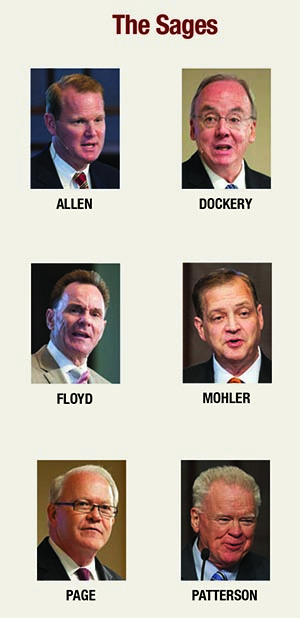
The SagesConfessional conviction

Will Southern Baptists embrace an identity that is more theological than tribal?” Mohler asked in his list of “10 unavoidable questions.”

The sages are almost uniform in their desire for Southern Baptists to have stronger theology and firmer confessional expressions of those beliefs. Too many people are members of SBC churches because it’s the family church, their friends go there, or they like the music—not because they hold strongly to the church’s theology.

Not to devalue our “tribal identity,” Mohler said, but “the tribe is not enough.” Tribalism—this informal gathering based on traditions and relationships—will give way to cultural accommodation, he warned, whereas confessional conviction will give believers (and thereby the denomination) theological moorings to withstand societal pressures to surrender to sexual redefinitions and moral decline.

Mohler asked whether today’s generation will “summon the courage” to face these issues which will require of them vigilance.

The current era is one of warm evangelicalism whose backbone is softening, to summarize several speakers. That makes this “the Baptist moment” according to Mohler. Among evangelicals, Baptists are best positioned to give the issues of “late modernity” a solid biblical, theological response.

Generational handoff

The discussion among panelists on “passing the baton” was playful at points with elder Patterson describing youthful Allen as “a man not yet dry behind the ears.” At another time Patterson, turning, 73 this month, commented, “I came on the scene right after Polycarp was martyred.” (That’s 155 A.D.) In these moments, it’s clear the baton is passing.

Mohler framed the handoff this way: “We have to ensure that there is healthy, courageous generational transition” in such a way that there is a Southern Baptist Convention in the future.

For Dockery, the handoff is more than from one generation to the next. It must be intergenerational. “Most Southern Baptists (and most Americans) do not find our identity in generations; our identity is in Christ.” Dockery says the handoff is also international and global, given the growth of evangelicalism in Africa and Asia.

Collaborative ministry

In a time when there is much discussion about “cooperation” as a denominational distinctive, SBC Executive Committee CEO Frank Page injected a new term, one that may have more weight with Millennials. “Collaborative ministry is biblical,” Page said. And for a generation accustomed to frequent electronic communication on every aspect of daily life, “collaborative” may be an easier sell than “cooperative.”

Cooperation indicates compliance with a mindset and participation in a program, whereas collaboration implies partnership and full participation by all parties involved.

As a denomination comprised mostly of smaller congregations, collaborative ministry “gives everyone a seat at the table,” Page said, including the SBC’s over 10,000 ethnic churches. But there’s education to be done. And it’s not only younger leaders who need the crash course. “We find there is a lack of understanding among ethnic churches of collaborative missions,” Page said.

But it was Dockery who pointed out that while the SBC has made strides in righting the sin of prejudice (the “one stain” on our record, he said), greater effort is required to bring minorities into leadership.

What about associations?

“This is no time to fly solo in the culture,” SBC President Ronnie Floyd said, “and no time for a church to fly alone.” Floyd’s presentation had the same listy character of the other speeches, but as a pastor, his list was most practical.

Floyd in particular called for a reduction in duplication (“and triplication”) of ministries and services by local, state, and national entities.

Larger state conventions, especially in the South, often offer their own versions of education, missions, and church planting; but since the implementation of the Great Commission Resurgence five years ago, those conventions have shifted funds to the national SBC in an effort to more effectively share the gospel in “new work” or frontier areas. And state convention staffs have been reduced by one-third, from 1,750 nationally to 1,350.

Making the denomination leaner is part of the thrust toward more effective collaboration. Floyd raised the issue of mergers, naming the International Mission Board and North American Mission Board as one possibility.

Local associations are another example where “regionalization” may make the SBC more effective. It’s a question that should be answered “honestly and boldly,” Floyd said, rather than trying to “preserve our old wineskins.”

“How can we leverage where we are and what we have and who we are to reach forward in a unprecedented manner” to advance the gospel?

Eric Reed is editor of the Illinois Baptist. Read the latest issue online.