Archives For November 30, 1999

By Nate Adams, IBSA Executive Director

I can usually measure the value of a meeting by the follow-up actions I note for myself as a result of it. If I don’t write anything down, the meeting was probably pretty pointless. If the meeting moves me to action or change, it may have been worthwhile.

So let me share with you a few of my follow-up notes from the recent Southern Baptist Convention in New Orleans, at least as they relate to the major issues discussed at this year’s annual meeting. You can read about these issues in the July 2 of the Illinois Baptist or at IBSA.org.

My notes about the informal name “Great Commission Baptists” as an alternative to “Southern Baptists” could be summarized simply by the phrase “wait and see.” Clearly a large number of churches feel that having an alternate name, even an optional one, is not a positive thing. But the majority that voted to endorse the alternate name gave those who wish to try it out a new tool to potentially reach people for whom the term “Southern” may be a barrier.

For now, I plan to “wait and see” how many churches embrace the new name, especially here in the Midwest. I suspect we will continue using the “Illinois Baptist” identity in our communications more than either of the others.

My notes about the various issues that have the Calvinist vs. Arminian theology debate at their root simply say, “stay above the fray.” Both outgoing President Bryant Wright and SBC Executive Committee President Frank Page served us well, I thought, when they essentially stated that the Baptist Faith and Message is big enough for both strains of theological thought, and that there is more danger in our heart attitudes about either position than in the doctrinal differences themselves.

Some time ago I came to the personal conclusion that Calvinist theology describes salvation more from God’s perspective outside time, and that Arminian theology describes salvation more from man’s perspective within time. I’m sure that those for whom that explanation is not sufficient will continue this centuries-old debate. I plan to try and stay above the fray of that argument, and pray it does not distract us from our far more important Great Commission task.

Finally, you may not think I need follow-up notes from the election of Fred Luter as the SBC’s first African American president. But I found I did. Tuesday night, just after Pastor Luter’s election, I attended a dinner with the African American Fellowship of Southern Baptists that included SBC entity executives and state executive directors like myself from all over the country.

Even during that dinner, I formed several follow up notes for myself: Don’t just sit with people you know – get to know some new African American brothers and sisters. Learn to understand and appreciate the history and the pain, the culture and the passions of African American churches and their leaders, especially those that have chosen to be part of the Southern Baptist family. Relax and enjoy different worship and preaching styles – God wants to speak to you through those too! Recognize how important it is to make sure African American leaders are participating in Southern Baptist life, both in key discussions and in key leadership positions. Develop more personal, not just professional, relationships with African American pastors and leaders.

As I said, I can measure the value of a meeting by the follow-up actions I note for myself. If the meeting truly moves me to action or change, it may have been worthwhile. My follow through on these notes has the potential to make this year’s SBC meeting truly worthwhile. I hope these notes for needed future action help you too.

(Editor’s note: New Orleans in Rear View. Now that we’re back home, our Illinois Baptist news team reflects on the question: What is the lasting value of the 2012 SBC?)

Posted by Eric Reed

Parents watch the convention proceedings from the "stroller section," a cordoned-off area for families with young children.

Parents watch the convention proceedings from the “stroller section,” a cordoned-off area for families with young children.

Descending the escalator on the final day of the convention, I watched on the floor below me as a four-year-old had a meltdown. He wasn’t alone. His sister, a couple of years younger, perched in a carrier seat atop a stroller, teared up, and eventually wailed.

I felt the same way. We were all tired. The only difference between us was, I couldn’t get away with a meltdown.

Landing at the foot of the two-story escalator, I was suddenly in a sea of small children. “Don’t run!” the father of one said futilely. “There are grown-ups here.”

Really?

Not as many grown-ups as children, it seemed at times. This was a convention of young people. Once the domain of people with hair in various shades of gray and blue, this gathering was marked by a large percentage of young adults, many of whom bought their families. (There were strollers everywhere, even a “stroller section” roped off near the platform.) And their presence was felt in all the proceedings of the convention.

Perhaps the Pastors Conference foreshadowed a shift we should notice. Opening on Fathers Day, the line-up included sons introducing their better-known fathers as conference speakers. “Dad’s gonna bring the heat!” one son said before his father preached. But in one notable reversal, it was the father, a former convention president, who introduced his up-and-coming son. There was a changing of the guard, it seemed.

The most challenging and emotionally gripping moments among the pre-meeting sermons came from the youngest preacher, in his early 30s.

The debate over use of “the sinner’s prayer” started with young people, as an older generation’s tried and accepted method is challenged. 

And it is young people who raised debate over Reformed theology and Calvinism. A young pastor (age 40, son of a past SBC president) drafted a response and coined the phrase “Traditionalists” to describe his (and many elders’) Southern Baptist theology.

Many messengers speaking from the floor mics during the business sessions were younger pastors. 

This emergence of young people in SBC life was clearest at the Baptist 21 panel discussion (and turkey po-boy lunch). “21” in the name refers to 21st century, but it might have characterized their age. Fully half the people in the SRO crowd of nearly 1,000 were in their 20s and 30s.

For watching the panel discussion, the Conservative Resurgence of the 1980s was ancient history. Like WW2. Many of them were not born at the time today’s senior convention leaders stopped what they described as a left-leaning drift and returned the denomination to biblical inerrancy. For these young people, Judge Paul Pressler and Dr. Paige Patterson are historical figures to be honored (which they were at the luncheon).

For a few minutes in New Orleans, the convention’s past met its future. And it was clear in that moment that this is not your grandfather’s SBC.

Or even your father’s.

It belongs to the kids.

Posted by Eric Reed

(New Orleans) — As we come down to the wire on this annual meeting of the Southern Baptist Convention, I am reminded of my friend Martha who told her husband every year as he left to attend the convention, “Bring home a copy of the resolutions!” For her, the essence of Southern Baptist life is not so much in the election of officers or agency reports; it’s in the annual statements messengers make on the clarification of our beliefs, and the intersection of our faith with contemporary culture.

Sometimes it’s from the resolutions that mainstream media find statements that are perceived as critical of the culture, politics, and secular leadership. But it is also in these resolutions what we affirm our faith and the value of biblical principles and lifestyles in transforming our culture by godly standards.

This year, in the waning moments of the 2012 convention, we are affirming the doctrine of salvation, the doctrine of inerrancy, religious liberty—with attention to issues involving mandated health care and same-sex marriage, the value of human needs ministry, and the contributions of African Americans to Baptist history.

A lot of people went home early.

The hall was not full when these resolutions were debated and adopted. But they are worth our time and attention—because it’s often in these areas that our faith is lived out.

When Baptist Press publishes the resolutions, take time to read them.

And “bring them home.” 

The name “Southern Baptist Convention” tells who we are, but it doesn’t tell what we do. The descriptor “Great Commission Baptists” tells what we should be doing.

Messenger on the floor of the convention speaking for adoption of informal “descriptor” name for optional use by churches. Name was adopted by 52% vote.

From the floor: Name Change

Posted by Eric Reed

(New Orleans) — The outcome of Tuesday’s ballot on adopting the optional use of ‘Great Commission Baptists’ in addition to the official name Southern Baptist Convention was announced this morning– it was approved by a 52.48% vote.

The announcement of the tally was delayed yesterday, after a hand vote was too close to call and a ballot vote was required. Messengers debated the “name change” which would allow churches and SBC entities to use the descriptor, without changing the official name of the SBC.

The narrow margin of the vote reflects both strong opinions and ambivalence over the change, which would lessen the regional nature of the convention’a name. Floor debate included memorable comments from advocates. One church planter who was on the committee that recommended the name change said, “This motion helps church planters outside the south build a bridge to share Jesus.”

Another advocate, Micah Freeze of St. Joseph, MIssouri, said, “We are an incredibility diverse people. As we polled those Southern Baptists who live in the frontier areas, they said to us with strong voice that this would help them advance the gospel. For those who live in the hard areas, to push back the darkness, I don’t see how we can say no to them.”

But Gary Honeycutt of Arkansas countered, “I don’t care what you call your church, I care what you call the convention.”

Ted Traylor, pastor of Olive Baptist Church in Pensacola, Florida, observed this morning, “I’m note sure we’re going to help ourselves by having a name and a half. We may just cause confusion….If Gateway Seminary wants to use the name, and it will help them, that’s good. But in New Orleans, being Southern Baptist is a good thing—especially after Hurricane Katrina. And in New York, after 9/11.”

The use of the description “Great Commission Baptists” will be a the discretion of local churches.


Posted by the IB Team

(New Orleans) — After messengers at the Southern Baptist Convention engaged in heated debate about the convention’s possible adoption of a new nickname for churches that choose to use it, a vote by raised ballots failed to produce a clear outcome. Later, messengers cast ballots, but the tally was not announced by the end of the first day’s sessions. Great Commission Baptists is the new descriptor name under consideration at this year’s annual meeting.

Jimmy Draper, who chaired a task force assigned to explore the name change, spoke first, explaining that his committee’s recommendation wouldn’t require action on the part of any church or entity. Approval of the recommendation would only make the descriptor name available for use for those who choose to use it.

Messengers still voiced strong opinions on both side of the issue.

“I don’t care what you call your church; I care what you call the convention,” said one messenger from Ft. Smith, Ark.

The debate continued, and it was clear the real issues were tradition and legacy versus the ability to effectively minister in non-Southern (and non-U.S.) areas. Finally, a motion from the floor was made to vote on the recommendation, but it was too close to call, requiring messengers to take to their ballots.

At his first press conference following his historic election as the convention’s first African American president, Fred Luter said he was surprised by the debate over the name change:

“Honestly, I did not think it was going to be such a big deal.  I really did not. I was there in Nashville when it was presented and discussed by the Executive Committee.  As Dr. Draper said, I thought it was going to be a win, win situation….

“One of the guys at the microphone said it best, particularly a lot of the younger guys—they are not planting churches in the South. They’re in California, they’re in other places. And they just feel that another name would help them. 

“I thought the name Great Commission Baptist was really, really good.”

It is expected that the outcome of the vote will be announced at the first session Wednesday morning.

Let us understand that these two views on election and salvation can coexist as long as we stay Christ centered and biblically based in our theology. So a word to these two groups. To our Calvinist friends, a bit of humility would be most welcome….
To those who call themselves traditional Southern Baptists, the time for judgmentalism is over, because judgmentalism quickly moves into slander….It is time to show some respect to those of differing views when it comes to election…and salvation.

Bryant Wright, outgoing SBC President, in his final convention sermon

On the Platform: Reformed Theology debate

Posted by Lisa Sergent

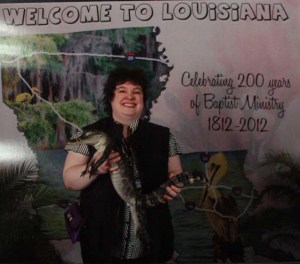
Holding a baby alligator at the Louisiana Baptist Convention's exhibit

You never know what you will find in the SBC Exhibit Hall. This year it was an alligator at the Louisiana Baptist Convention’s exhibit.

One of the best things about the SBC Annual Meeting is the Exhibit Hall. You never know what you will see. One year, a seminary graduate who had become an animal trainer was there with a lemur and a vulture.  Another year, messengers got to take turns riding a Segway around the North American Mission Board’s exhibit.

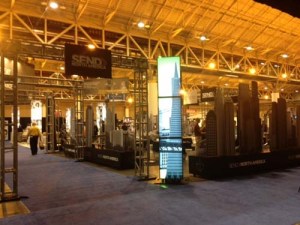
NAMB exhibit

The 2012 NAMB exhibit features Send North America.

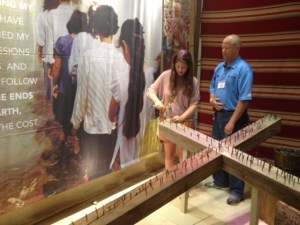
This year has not disappointed. From the Ethics and Religious Liberty Commission’s exhibit where children can make balloon animals and have their caricatures drawn, to LifeWay’s test of strength challenge, to the International Mission Board’s interactive exhibit that gives messengers the opportunity to hammer a nail into a large, wooden cross as an expression of their commitment to the Great Commission.

Cross at the IMB's interactive exhibit

A young woman hammers a nail into a cross at the International Mission Board’s interactive tent inside the SBC Exhibit Hall. The exhibit prompt reads, “I place this nail in the cross as a commitment to take the Gospel to the ends of the earth.”

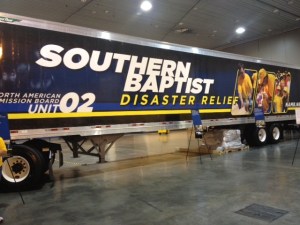
Disaster Relief has large tractor-trailers, a Ford F550 Western Hauler truck, sample mud-out and other equipment, a shower/laundry unit and more. WMU is there with World Crafts on display and for sale. FAITH Riders have a Harley on display and Mid-Continent College as a great classic car.

Disaster Relief Tractor-Trailer

One of the North American Mission Board’s Disaster Relief Tractor-Trailers on display in the SBC Exhibit Hall in New Orleans. Southern Baptists have the nation’s third largest disaster relief response organization behind only the American Red Cross and Salvation Army.

Mid-Continent College's classic car

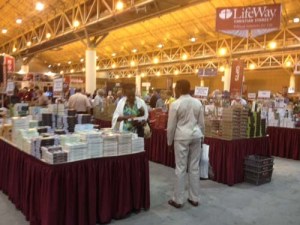
The exhibit hall also houses an entire LifeWay Christian Bookstore. You can find anything they sell in their regular book store and probably more. With a quick glance around the convention center’s corridors, it is easy to see messengers carry LifeWay bags full of their newly found treasures.

LifeWay Christian Bookstore

Messengers shop at the LifeWay Christian Bookstore in the SBC Exhibit Hall.

But the most unusual display this year was hosted by the Louisiana Baptist Convention.  Convention-goers had the opportunity to hold a live, baby alligator and have their picture taken with it.  Never one to shy away from a challenge, I stepped up, held the alligator and smiled at the camera.  His mouth was bound shut, so there was no worry of being bitten. I also noted the alligator’s skin was surprisingly soft.

I texted the photo to my husband and parents who couldn’t believe I held and petted a “gator.” My mother immediately started calling me “Gator Girl.” Thanks mom.

So now I’m thinking, what could we do at the IBSA Annual Meeting in November? The Illinois state bird is a red Cardinal (what do Cubs fan think of that?), the state animal is white-tailed deer (I’m sure hunters could help us with that), our state amphibian is the Eastern Tiger Salamander (I don’t want to hold a salamander), and, finally the state fish, a blue gill (do we want to pose with a dead fish?).

And don’t forget, our state reptile is the painted turtle and our state insect is the monarch butterfly.

Being the Land of Lincoln, maybe we should have a large cut out of President Lincoln. Do you think the Presidential Museum would lend us his wax figure? If they agree, maybe they could include Mrs. Lincoln and the children, too.

Think about it. What should we have in the IBSA Annual Meeting Exhibit Hall this year? Just don’t call me Gator Girl.

You can go home again

eric4ibsa —  June 17, 2012

Posted by Eric Reed

(New Orleans) — When I visited New Orleans in 2005, a few months after Hurricane Katrina, I stopped at the church where I had served for almost ten years. The doors were off their hinges, a few windows hung open, and the playground was overgrown. The whole neighborhood was a ghost town, with house after house marked with the dates they were searched by recovery crews and the number of bodies found inside.

I slipped into the familiar sanctuary and up the stairs to the balcony. The pews and choir loft were destroyed, the walls lined by water seven feet deep for three weeks.

All I found of the years I had served was one red Bible from the set we had purchased for the pews. From my home in Chicagoland, I had tried to contact the friends and church members we had known and loved in the previous decade, but had located few of those who had fled the city as the waters rose. Looking down on the place where we had worked and worshiped, I wept. Not much was left of our work, it seemed.

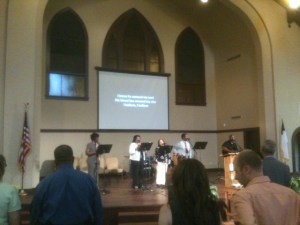
Today, I was back in that sanctuary, worshiping with the people who have returned.

Seven years after the flood, there is a church worshiping in that place again. And more important, there is a church reaching the people who have returned to our former community.

Our former congregation was virtually decimated in 2005. Only a couple of families remained after Katrina, wondering how to restore their homes and their church. A neighboring SBC church had a few families, but their facility was completely wiped out. God brought all these things together, with wave upon wave of hearty Southern Baptist construction teams, and over several years a new ministry has been born.

It did my heart good to see people from the neighborhood worshiping there. Present with them this morning were IMB missionaries, former church members in town for the convention, and yet more construction teams from Arkansas.

God bless Arkansas Baptists, and Illinois Baptists, and campus ministries such as the team at SIU Carbondale, who continue to make New Orleans their ministry construction project. As I toured the classrooms filled with bunk beds used by the visiting work teams, I understood what one member told me: “It’s good to be a Southern Baptist in New Orleans now.”

It wasn’t always so. In my experience, our New Orleans neighbors were more interested in Mardi Gras than in the gospel.

“People are grateful for what Southern Baptists have done to restore New Orleans,” she continued. “Today, they will listen when we share the gospel.”

In the aftermath of Katrina, city planners estimated it would take 30 years for the population—and the neighborhoods—to return to their pre-flood numbers. A driving tour confirms that.

But my old neighborhood is looks better than a ghost town today. And to hear the brothers and sisters who continue Christ’s work there as they tell stories of hope and restoration, we see they are well on their way.

An old building is restored and a church is reborn seven years after Hurricane Katrina sent most of the congregation fleeing from New Orleans. Much of the work is thanks to work crews and mission teams from Southern Baptist churches across the nation.