Archives For November 30, 1999

And what the trends mean for your church

An Illinois Baptist team report

"Imagine if you could spend 10 focused minutes each Sunday morning in extraordinary prayer on two major needs locally, in your church, in America, or across the world.” SBC President Ronnie Floyd’s “Call to Prayer” that began at the Annual Meeting in Baltimore now turns to Sunday mornings, starting with one worship service in January.

SBC President Ronnie Floyd’s “Call to Prayer” that began at the Annual Meeting in Baltimore now turns to Sunday mornings, starting with one worship service in January.

1. Churches respond to “Call to Prayer”
“It is past time for us to prioritize prayer personally and in the church,” SBC President Ronnie Floyd wrote on his blog in early December. “For far too long, we have seen what we can do; it is time for us to see what God can do. This can only happen when we pray.”

Floyd’s continued call to prayer—leading to the June 2015 SBC Annual Meeting in Columbus, Ohio—began about two years ago with a series of meetings for pastors and church leaders. Floyd began quoting famed Puritan preacher Jonathan Edwards who called believers to “extraordinary prayer” for revival in America.

“God’s people will be given a spirit of prayer,” Edwards wrote in 1746, “inspiring them to come together and pray in an extraordinary manner, that He would help his Church, show mercy to mankind in general, pour out his Spirit, revive His work, and advance His kingdom in the world as He promised.”

Today’s growing urgency in prayer coincided with planning for the 2014 IBSA Annual Meeting in November. “We will either hunger for God’s righteousness out of desperation or…out of devastation,” IBSA President Odis Weaver told messengers. The November meeting peaked in a Concert of Prayer for Spiritual Awakening in Illinois and across the U.S.

“I believe we need to cry out to God for spiritual awakening, and for revival in our churches,” said IBSA Executive Director Nate Adams. He led more than 400 pastors and church leaders through a prayer cycle lamenting the lost condition of people in Illinois, repenting of apathy and ineffectiveness, interceding for spiritual awakening, and commiting to pursuit of revival in our churches.

Afterward, many pastors said they would lead similar prayer events when they returned home.

Now Floyd is asking churches to dedicate an entire Sunday morning service to prayer in January: “Just imagine if 100 churches, 500 churches, or several thousand Southern Baptist churches would turn a Sunday morning into insuring that Jesus’ House would be a genuine house of prayer for all the nations.
Just imagine what could happen if, from this point forward, you could spend 10 focused minutes each Sunday morning in extraordinary prayer on two major needs locally, in your church, in America, or across the world.”

Jonathan Edwards imagined the outcome. He called it the “revival of religion.” We would call it “advancement of the Gospel”—the salvation of lost souls, renewal of our churches, and restoration of moral sensibility to the nation.

In your church: SBC churches will likely give prayer a higher profile in 2015, but what are we praying for? How will we sustain prayer in our congregations as more than a once-in-a-while emphasis? Consider a Concert of Prayer in January. As Floyd wrote, “If we do not plan to pray, we will not pray!

2. Evangelicals cope with minority status
Say goodbye to Mayberry. The culture is shifting. What was once called good is now called evil, and vice versa, just as Isaiah said of his own times. The majority opinion in the U.S. approves of same-sex marriage, and many other sexual matters—once outside the norm—are being accepted by society at large. But, while the morals and mores are changing, Southern Baptists are not.

We still stand on the Word.

“One of the biggest challenges for conservative Christians is moving beyond a Bible Belt mentality, or a moral majority mentality,” said Russell Moore, president of the SBC’s Ethics and Religious Liberty Commission, “and seeing ourselves instead as in many cases a prophetic minority speaking to a larger culture about things that matter.”

Moore called on pastors and church leaders to “prepare people for what the future holds, when Christian beliefs about marriage and sexuality aren’t part of the cultural consensus but are seen to be strange and freakish and even subversive.”

“The Bible Belt is collapsing,” Moore has concluded.

The main evidence of that in Illinois is same-sex marriage which became legal June 1. Churches, at one point concerned they would be forced to perform
gay weddings, instead began addressing their bylaws as means of protection.

Another response by evangelicals is to make the church a place of refuge, said John Stonestreet, commentator for Breakpoint Ministries. “People who are enslaved to porn and suffer different forms of brokenness need to be able to come to the church and find answers. The church needs to offer hope and solutions. We need to say, ‘Here’s an option. Here’s the hope; here’s the gospel; here’s the truth; here’s Jesus; and here’s the cross.’”

Moore concurs. “We must have a voice that speaks to the conscience, a voice that is splattered with blood. We are ministers…not of condemnation, the devil can do that, we are ministers of reconciliation, which means that we will speak hard words…truthful words to address the conscience, even when that costs us everything.”

In your church: Church leaders are ministering from a new vantage point, but with the same apologetic. The challenge will be to confront cultural ills in a way that is biblically faithful and yet winsome. The message hasn’t changed, but some in our society today need to hear the truth truly spoken in love.

At a meeting in Asia, young missionaries surround new IMB President David Platt to pray for him as he seeks to mobilize churches. Photo by Hugh Johnson/IMB

At a meeting in Asia, young missionaries surround new IMB President David Platt to pray for him as he seeks to mobilize churches. Photo by Hugh Johnson/IMB

3. Young leaders urge peers to “re-engage”
The evidence has been building for a few years now: young Baptists are back. Or on their way back, at least.

They’re more visible at the Southern Baptist Convention’s annual meetings, and, in 2014, at two meetings on the gospel and marriage hosted by the Ethics and Religious Liberty Commission. They’re also beginning to look remarkably similar in age to the leaders of several of the denomination’s entities. At the ERLC’s October national conference, 125 young leaders had dinner with President Russell Moore and the heads of the SBC’s two missions agencies, Kevin Ezell and David Platt. At four years, Ezell is the longest-tenured at his post; Moore took the ERLC reins in 2013, and Platt was elected in August.

“There’s never been a better time in my lifetime to re-engage as a Southern Baptist than right now,” Ezell, president of the North American Mission Board, said at the meeting. “I really believe that God is up to something very special in the Southern Baptist Convention.”

Many young Baptists likely would cite the election of Platt, 36, as one of the highlights of 2014. Midwestern Seminary President Jason Allen, himself 38, blogged that when he announced Platt’s election during a September chapel service, students (and faculty and staff) broke into applause for the missiologist and author of bestseller “Radical.”

More than 1,000 miles away in Richmond, Va., young missionary appointees gathered around Platt shortly after his election to congratulate him and tell him how “Radical” and his messages on reaching the nations had helped lead them to the international mission field.

After Platt’s election, some Baptist leaders expressed concern that his Birmingham congregation, The Church at Brook Hills, gave a lower amount through traditional Cooperative Program channels, instead sending a large portion of their gifts directly to the SBC Executive Committee and International Mission Board.

But even with those concerns, established leaders affirmed Platt’s ability to mobilize young people to share the gospel to the ends of the earth. Southwestern Seminary President Paige Patterson noted it in a blog post published shortly after Platt’s election, calling for “thanksgiving to God for the presence of a young leader who has obviously garnered the hearts of the younger generation and who will have the opportunity to lead them to a commitment to the world mission enterprise.”

One blogger put it a little more plainly, noting Platt may be just the right voice to deliver tough love to would-be male missionaries outnumbered by female “Journeymen” appointed through the IMB.

“Lend your voice to addressing the issue of young males wimping out of Journeyman service,” William Thornton wrote at SBC Voices. “These guys think you walk on water, Mr. Radical. Give ‘em both barrels on this and see what happens.”

In your church: Look for increased excitement from your own young leaders now that the authors and speakers they’ve followed for several years are in prominent positions. Be prepared for them to want to go to the hard places for ministry and missions. “That’s where we hear young couples saying they want to go, that they want to be radically obedient to what God has called us to do for the nations,” said IMB trustee chairman David Uth. “The passion is there.”

4. Growing persecution: From “the Nun” to “resurrection people”
Before Ebola dominated headlines, another one-word threat struck fear in the hearts of many around the world—and even here. The war of terror and persecution waged by ISIS, or the Islamic State of Iraq and Syria, was the story of the year earlier in 2014.

ISIS chased religious minorities high into the mountains of Iraq. They filmed beheadings and broadcast them as warnings to the rest of the world. And they stirred many in the Western world to stand with the persecuted church. The Arabic letter “Nun” was used on social media pages to symbolize solidarity with those persecuted for their faith in “the Nazarene,” or Jesus.

It’s not just a problem in the Middle East. In Nigeria, 1,505 Christians were killed for their faith in the first seven months of 2014, according to non-profit Jubilee Campaign. North Korea again topped Open Doors’ list of most persecuted countries, highlighted by the imprisonment of American Kenneth Bae, who was finally released in November. Others, including Pastor Saeed Abedini in Iran, remain in prison.

Closer to home, Christians felt a different kind of persecution. Businesses and non-profits faced government fines for not providing abortion-causing contraceptives. The mayor of Houston, Texas, subpoenaed the sermons of pastors who were against the city’s pro-LGBT ordinance.

Christian leaders here urged believers to remember who they belong to. “The answer to the decline of religious freedom and the change in the moral climate is not found in waging incessant cultural wars, filled with rage at our changing culture,” said LifeWay Research President Ed Stetzer. “Simply put, you can’t hate a people and reach a people at the same time.”

Instead, he urged Christians, “Let’s live like the resurrection people, adorning the gospel with lives of grace. Even in our passion to defend freedoms increasingly at risk, let’s remind ourselves this generation is desperately in need of the love of Christ, lived and shared.”

In your church: Be prepared to think globally about persecution. How can your church go beyond your normal prayer times to intercede for those under threat for their faith?

Be alert to what government bodies are doing. Speak out when religious liberties are threatened. The IRS prohibits churches from supporting candidates, but not from speaking on issues related to faith.

SBC’s Frank Page speaks frequently about the future of the Cooperative Program, painting a hopeful picture despite years of declining offerings. Photo by Morris Abernathy

SBC’s Frank Page speaks frequently about the future of the Cooperative Program, painting a hopeful picture despite years of declining offerings. Photo by Morris Abernathy

5. Cooperative missions for a new generation

Most Baptists agreed the Cooperative Program, the denomination’s chief method of funding missions and ministry, is the best way for churches together to pursue the Great Commission. But how to fix the CP, plateaued and trending slightly downward for years, is up for debate. The election of David Platt as IMB president revealed how his church and other large churches have bypassed their state conventions, even though CP gifts for national and international missions are supposed to be routed first through the state level.

“I have heard some people say, ‘The big problem is that the younger generation simply isn’t educated about CP,’” blogged pastor J.D. Greear after Platt’s election. “That may be true for a small percentage of people, but the bigger problem is probably that they are educated about it. The more they find out about CP giving, the less they are motivated to give.”

Meanwhile, blogger Bart Barber spoke up for the reliability of the system itself, calling those who disagree with the way CP funds are allocated to greater involvement in SBC life. “…Within the Cooperative Program approach you can pursue any ministry, reallocate any budget, or adopt any methodology that you can convince enough of your fellow churches and fellow pastors to adopt,” Barber posted at SBC Voices.

“Bring on the changes! Make your proposals! Go to the floor of the SBC Annual Meeting! Attend your state convention meeting! Advocate tirelessly and fearlessly for the improvements you’d like to see. Whatever they are and however much adaptation they would require, I’m betting that almost none of it would actually require any changes at all in the Cooperative Program.”

SBC Executive Committee CEO Frank Page continued his campaign for increased giving through the Cooperative Program, touring the nation (including Chicago) to talk with younger pastors and leaders. “I’ll drop the Cooperative Program if you can show me something else that long-term is effective and engages every church concurrently and consistently in an Acts 1:8 strategy,” Page has said on several occasions. “Show it to me, and I’ll support it….But I
haven’t found it yet.”

In your church: More conversation about CP in the national SBC could mean it’s time for a refresher course in your local church. A class for young or new Baptists is an opportunity to teach about why Baptists give cooperatively. One big reason: CP helps missionaries focus on their mission field, instead of fundraising. Another reason: CP helps the local church have a balanced missions strategy, supporting work on all their Acts 1:8 mission fields.

-With reporting from Baptist Press

Read all of the December 22 Illinois Baptist at http://ibonline.IBSA.org.

COMMENTARY | Meredith Flynn

“Great Awakening: Clear Agreement, Visible Union, Extraordinary Prayer.” The theme for the 2015 Southern Baptist Convention won’t fit easily on a T-shirt. But it’s a clear prescription for the kind of spiritual awakening Ronnie Floyd has been talking about since his election as SBC President.

SBC Annual Mtg logo

Theme art for the 2015 Southern Baptist Convention

The complex rallying cry also is a departure from the themes chosen over the past several years. While past presidents have certainly called Baptists to greater engagement in evangelism and missions, this is the first year in recent memory that a leader has set so direct a path to a common goal.

Floyd, pastor of Cross Church in northwest Arkansas, is uniquely situated to call Baptists to prayer. He’s written books on prayer, fasting and revival. He gathered leaders for regional and national meetings devoted to praying together. He is also leading the SBC at a time when churches are baptizing fewer people and facing more pushback from the culture.

When asked in a recent media conference call what he’s learned in his first few months as president, Floyd said he has found that Southern Baptists are optimistic about the future of the denomination.

“I have also found that while we have our challenges, people are very hopeful that we’re gonna find a way to make things happen together.”

Perhaps that’s why “clear agreement” and “visible union” are two prongs in Floyd’s theme: He’s hearing that Southern Baptists want to move forward as a denomination, despite decline or differing theology. “Southern Baptists need to be together,” he told media, referencing why he wants as many people as possible to be at the SBC Annual Meeting next June.

The Call to Columbus might be a difficult sell—it’s an out-of-the-way convention city for many Baptists, it’s an election “off-year,” and there’s no Disney World or White House anywhere nearby.

But Floyd’s call to “extraordinary prayer”—something he has trumpeted since his election—is intriguing. He drew the phrase from a Jonathan Edwards sermon whose title rivals that of Floyd’s new e-book in length. In “Pleading with Southern Baptists…,” the SBC President lays out the need for a great awakening in our culture and our churches (see sidebar at right), and suggests five action items.

His plan is reminiscent of the Isaiah 6 cycle people prayed through at the IBSA Annual Meeting in November, not because of its content, but because Floyd’s list puts the priority on prayer as the jumping-off point for any great move of God.

“It’s time to pray,” he said shortly after he was elected in Baltimore. “Quite honestly, it’s past time to pray.”

Baptists have heard the call, clearly outlined. Now, the question is whether they’ll heed it.

Meredith Flynn is managing editor of the Illinois Baptist newspaper.

The_BriefingTHE BRIEFING | A new survey shows 21% of same-sex couples in Illinois have opted to wed since it became legal in the state June 1, but a second survey asks how long those marriages will last. And two more new polls cast doubt on the percentage of homosexuals in the U.S.

Equality Illinois, a group that advocates for lesbian, gay, bisexual and transgender issues in Illinois, surveyed the state’s 102 counties and found at least 3,274 marriage licenses have been issued to same-sex couples and 1,694 civil unions have been converted to marriages. According to the most recent U.S. Census, 23,409 same-sex couples reside in Illinois. Using this data, 21.2% of same-sex couples in the state have married or plan to marry.

The group stated the exact number of licenses issued or civil union conversions is difficult to determine because not all of the state’s county clerks recorded whether licenses were issued to same-sex couples, while others recorded conversions together with licenses, not separately.

Nine counties reported no licenses issued to same-sex couples or civil union conversions and five counties did not respond to the survey.

What might the future hold for these couples? The National Review’s online blog, The Corner, reported this month in a new Scandinavian study of civil unions (more heavily equated to marriage than in the U.S.) over the nearly two decades that they have been legal in that region of the world. The study reported male couples were 35% more likely to divorce than heterosexual couples, and female couples were over 200% more likely to divorce. It also found, whether or not the couples had children made little difference in the divorce rate.

Gay, more or less

In related news, the Centers for Disease Control and Prevention reported July 15 that less than 3% of the U.S. population identify themselves as gay, lesbian or bisexual. It’s the first time the government has measured American’s sexual orientation through the National Health Interview Survey.

According to the 2013 survey just out, 1.6% of adults self-identify as gay or lesbian, and 0.7% consider themselves bisexual.

And these findings conflict with a new Pew Research Center survey that says there are more homosexuals in the United States than previously reported. The figure cited for years was 10%, based mostly on the Kinsey Report of 1948. Critics called Kinsey’s methods flawed, and said the number was more like 4% to 8%.

Pew used two survey methods, allowing for indirect responses. While the “direct report” method shows 11% of U.S. adults “do not consider themselves heterosexual,” the “veiled report” showed considerably higher numbers: 19% of U.S. adults said they “do not consider themselves heterosexual.” That’s 15% of men and 22% of women.

Using the “veiled method,” Pew also found that 27% of U.S. adults admitted having a sexual experience with someone of the same sex.

Overall, the public perception of the number of homosexuals in the U.S. has grown as same-sex marriage has dominated the news. A 2013 Gallup poll that found Americans believe 25% of the population is gay, lesbian or transgendered.

-Reported by Lisa Sergent for the Illinois Baptist

Other stories:

SBC leaders tour Texas border shelters
Southern Baptist Convention President Ronnie Floyd and ethicist Russell Moore will today visit two border facilities tending to the needs of children detained after attempting to cross into the U.S. The Department of Homeland Security reports 57,000 such kids have been detained in the last nine months. The children “need immediate attention that elevates their health and safety above all,” Floyd wrote for Baptist Press last week. “From my point of view, the children must become our number one priority.” Read more at BPNews.net

Research guages ‘religious temperatures’
Americans view Jews, Catholics and evangelical Christians warmly, according to a new study from Pew Research that measures perceptions about different religious groups. Respondents ranked groups on a “feeling thermometer” of 0 to 100. The “warm” groups all received average rankings in the low 60s, while atheists (41) and Muslims (40) received the lowest numbers. Read more at PewForum.org.

Baptist school gets partial win in court
A California Superior Court ruled in July that a Southern Baptist university had the right to expel a transgender student for violating its code of conduct. Domaine Javier, a former California Baptist University nursing student who identifies as a female, sued the school for gender discrimination after being expelled for claiming to be female on his application.

Judge Gloria Connor Trask ruled the school didn’t violate the state’s Unruh Civil Rights Act because its on-campus activities do not constitute a “business enterprise.” But Trask did award attorney’s fees and $4,000 in damages to Javier because he was excluded from off-campus enterprises open to the public. Read more at BPNews.net.

Movies to explore Tolkien/Lewis friendship
Christianity Today reports on two upcoming movies that will look at the relationship between beloved Christian authors C.S. Lewis and J.R.R. Tolkien. The films “Tolkien and Lewis” and “Jack and Tollers” are expected in 2015, and another movie about Tolkien’s life also is in the works.


Baltimore | The Southern Baptist Convention’s 2014 annual meeting ended this afternoon as Fred Luter handed off the gavel to new President Ronnie Floyd. The pastor of Cross Church in northwest Arkansas, said, “Boom!” as the gavel met the podium to officially close the meeting. And Luter threw his arms in the air with a big grin.

Check back later for more images from the Convention and Pastors’ Conference, and our list of takeaways from this week in Baltimore. Thank you always for following the news with us!

Gavel_1Gavel_2Gavel_3

Candidates lead in varied contexts: Small church, city church, megachurch

Baltimore | With the Southern Baptist Convention’s annual meeting one week away, the election to succeed current President Fred Luter appears to be a three-candidate race:

Ronnie_FloydRonnie Floyd
Church:
Cross Church has four campuses in northwest Arkansas, and launched a site in Neosho, Mo. this Easter. According to the church’s website, more than 17,000 people have been baptized during Floyd’s 27-year tenure.

SBC service: He has chaired the SBC Executive Committee and led the Great Commission Resurgence Task Force. Most recently, Floyd organized national prayer meetings for Southern Baptist ministers.

Quotable: “It is obvious to me that we need a mighty, fresh manifestation of God’s presence in our lives personally, which I would call personal spiritual revival,” Floyd said in an interview with Midwestern Seminary President Jason Allen about the SBC presidency. “Our churches need that mighty manifestation of God’s presence through the life of the church – revival, revitalization, whatever you want to call it, refreshing winds of the Spirit. There is no question that the greatest need in American life is a spiritual awakening.”

Read the Baptist Press Q&A with Floyd here.

Dennis_KimDennis Manpoong Kim
Church: 
Global Mission Church of Greater Washington, a predominantly Korean congregation, is the largest church in the Baptist Convention of Maryland/Delaware.

SBC service: Kim is a past president of the Council of Korean Southern Baptist Churches in America, and recently served on a task force appointed by the North American Mission Board to
study the SBC’s declining baptisms.

Quotable: In his interview with Baptist Press, Moon outlined how he would call the SBC forward in fulfilling the Great Commission if he is elected president: “In a time when about 1,000 churches close their doors every year, I believe that the need of the hour is an evangelistic tool that is simple enough to train all church members, effective enough to ignite believers’ passion for evangelism and engaging enough to captivate the hearts of the present generation.”

Read the entire Baptist Press Q&A with Kim here.

Jared_MooreJared Moore
Church:
New Salem Baptist in Hustonville, Ky., is a church of about 60 members that Moore describes as a “loving, caring, godly group of people.” He served as a youth minister and pastor in Tennessee before moving to Kentucky.

SBC service: Moore currently is second vice president of the Southern Baptist Convention.

Quotable: “I want to represent Southern Baptists like the ones I serve on a daily basis who may not have the opportunity to attend the convention or serve at the convention level,” Moore wrote on his blog. Among his other reasons for running: promoting unity and the Cooperative Program.

“Apart from cooperating with other SBC churches through the Cooperative Program, our small church could not support as many ministries on our own,” Moore wrote. “I hope to encourage churches to begin, continue, or increase their support of the Cooperative Program.”

Read Moore’s Baptist Press Q&A here.

Ronnie_Floyd_blogCOMMENTARY | Meredith Flynn

Ronnie Floyd is the first candidate to toss his hat in the ring for the next Southern Baptist Convention president. Although, in keeping with tradition, Floyd’s nominator actually did
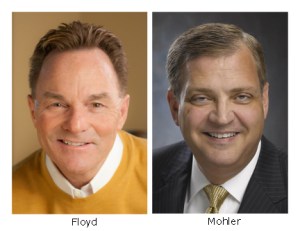
the tossing: Southern Seminary President Al Mohler announced last month he will nominate Floyd for the convention’s top elected post at the annual meeting in Baltimore.

No one else has allowed his name to be brought forth so far. This unusual across-the-aisle nomination, and a potential single-candidate race, has several implications for Southern
Baptists:

1. The Calvinism debate doesn’t have to result in a hostile takeover for either camp. Mohler’s well-known and well-documented theological perspective is different from what is known of Floyd’s. In an open letter announcing the nomination, the seminary president and leading Reformed thinker lauded Floyd as a unifier. He specifically mentioned the theology talk that has dominated conversation over the past several years, pointing to Floyd as a leader who can move the SBC toward a common goal of reaching the world for Christ.

Mohler’s nomination of Floyd is likely the kind of unifying event SBC Executive Committee President Frank Page had in mind when he appointed an advisory committee to study how the two “sides” can work together.

2. The generation gap may be narrowing. Mohler has the ear of many young Baptists, as a seminary president and proponent of Reformed theology, whose adherents tend to skew younger. He is in the unique position of being able to steer 30-somethings toward active participation in Southern Baptist life, without being a 30-something himself. His nomination
of Floyd indicates he’s willing to guide young leaders away from a concentration on divisive issues and toward goals we can work on together.

3. With revival as the goal, Baptists are ready to rally around the Great Commission. Current SBC President Fred Luter made revival and spiritual awakening his platform during his two years of leadership, aiming to stem the decline in baptisms. “Fred Luter has led us so well as he has unified and inspired us,” Mohler wrote in his nomination letter. “Our next president needs to unify and inspire us for our next steps together.”

Floyd chaired the Great Commission Resurgence Task Force, which presented a comprehensive strategy in 2010 to push funding to areas of the country (and world) that are less churched and often more urban. More recently, he organized two prayer gatherings to guide pastors and leaders toward personal and corporate revival.

“Pastors believe the Great Commission can be fulfilled in their generation,” Floyd blogged after the prayer meeting in Atlanta. If he’s elected in June, he’ll be charged with communicating that vision to a multigenerational, theologically diverse denomination.

Meredith Flynn is managing editor of the Illinois Baptist.

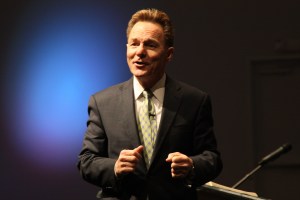
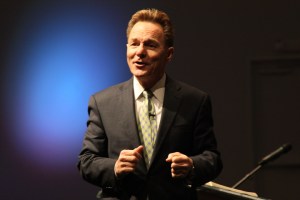
FRIENDLY INVASION – “Invade your city strategically,” advises Ronnie Floyd. The Arkansas pastor and SBC leader urged Illinois pastors to identify local people groups and customize ministry to share the Gospel with them.

“Invade your city strategically,” advises Ronnie Floyd. He urged Illinois pastors to identify local people groups and customize ministry to share the Gospel with them.

COMMENTARY | Eric Reed

Many pastors and church leaders may wonder if they could be more effective in a different community or congregation. But Ronnie Floyd, who has served his Arkansas church for more than 25 years, warned against longing for a better location.

“Some of you wonder if He forgot your e-mail address and your cell number, but He’s got you fixed where you are,” said Floyd, who spoke to Illinois leaders during the IBSA Pastors’ Conference November 13.

He told a story about his community of Springdale, Arkansas, which is home to up to 8,000 people from the Marshall Islands. It’s a long way from Arkansas to the tiny collection of atolls in the North Pacific Ocean. In fact, fly out of Little Rock to Honolulu, and you’re still only about halfway there.

These thousands of Marshallese have journeyed to the middle of America in search of jobs, mostly in the poultry industry. They found jobs. But more important, they found the Gospel.

“They thought they were coming for chicken,” Floyd said of the Marshallese immigrants, “but they were groping for Jesus.” Today, Floyd’s congregation hosts the first Southern Baptist congregation for Marshallese in North America.

God’s placement of people – whether it’s a pastor or someone who needs to hear the Gospel – is providential and purposeful.

“God had brought everyone of those people to town for a purpose, that they might seek and go after God,” Floyd said. “His sovereign plan has brought lost people to your town, too, so you can see them as he sees them and can strategize and reach them.”

DECATUR, Ill. | When we get offended and stay offended, we’re dangerously close to allowing unforgiveness to take root, said Ronnie Floyd during the IBSA Pastors’ Conference at Tabernacle Baptist Church.

We have high expectations of people, Floyd said. “When our expectations are not met, we take offense and we stumble, and [it] becomes the foundation for unforgiveness in your life.”

Floyd, pastor of Cross Church in Arkansas, encouraged pastors to let go of the things that offend them now and have offended them in the past, whether it was other people, life’s circumstances, or God’s activity. He spoke from Luke 7, where Jesus said, “And anyone who is not offended because of Me is blessed.”

“Ministry can be mean, ministry can be tough…When we are in even the best of conditions, offense occurs. We stumble. At times, you have to deal with stuff relating to unforgiveness. And just like a bad tooth, you’ve got to get it out of your mouth.”

But there’s good news, too, Floyd said. “God wants to use everything in your life for good. Everything in your ministry for your good.

“Some of your stories today are messy and curvy. I’ve got good news. God wants to use you.”