Archives For November 30, 1999

Editor’s note: This is part 2 of the Illinois Baptist’s coverage of a recent summit hosted by the Ethics and Religious Liberty Commission on racial reconciliation and the gospel. Read part 1 here.

Layout 1

Read the April 6 edition of the Illinois Baptist at http://ibonline.IBSA.org.

NEWS | If Southern Baptists are to be serious about Jesus’ Great Commission to make disciples of all peoples, said historian Matt Hall, they need to honestly think through where they’ve come from. Hall, Southern Seminary’s vice president for academic services, spoke in a video message about the SBC’s history with slavery, racism, and segregation during a March summit hosted by the Ethics and Religious Liberty Commission on racial reconciliation and the gospel. (The Convention was formed over a divide between Baptists in the North and those in the South who wanted to continue owning slaves.)

Hall also led one of the summit’s panel discussions, joined onstage by Moore, Philadelphia pastor K. Marshall Williams, SBC Executive Committee President Frank Page, and past SBC President Fred Luter.

Understanding the SBC’s past ought to inform how we address racial issues now, Moore said. The divide over slavery “really was a justification for evil and for wickedness,” he said.

“Which, to me, ought to cause us not so much to look back and say, ‘Weren’t they evil and weren’t they wrong?’ as much as it ought to cause us to look back and to say, ‘Look at these people who knew their Bibles, and who were preaching their Bibles, and who were trying to gather up money for world missions, and yet were not able to see this glaring and wicked sin and unrighteousness and injustice that they were part of.’

“That ought to not give us a sense of our superiority to them; it ought to give us a sense of humility to say, ‘If these people who knew their Bibles like this, could get this that wrong on an issue that is so basic to what Scripture is teaching, then we need the mercy and the power of God.’”

IBSA African American Church Planting Strategist Ed Jones has faced the obstacle of the SBC’s history, he said. Some African Americans have told him, “I don’t necessarily want to be part of the Southern Baptist Convention because of its past,” he told the Illinois Baptist during the summit. The Nashville meeting was an opportunity to tackle those issues head-on and bring things into the open.

Luter said the Convention’s history resulted in one question asked by every person who interviewed him in the months before his election: Why would a black man want to be president of the SBC? Frankly, he didn’t know much about the Convention’s history when he went from street preacher to pastoring New Orleans’ Franklin Avenue Baptist Church almost 30 years ago. A couple of years into his pastorate, several of his older church members suggested Franklin Avenue leave the SBC.

“…There’s nothing we can do about our past,” was Luter’s response. “But there’s a whole lot we can do about our future.”

Luter was on the SBC Resolutions Committee that in 1995 proposed a resolution adopted by Convention messengers apologizing “to all African-Americans for condoning and/or perpetuating individual and systemic racism in our lifetime,” and repenting “of racism of which we have been guilty, whether consciously or unconsciously.”

The applause and tears that accompanied his election as SBC president made June 19, 2012, “one of the greatest hours in the life of the Southern Baptist Convention,” Luter said as people in the Nashville auditorium clapped too. “My only concern is that hopefully it’s not the last time.”

“That’s where the real test is,” said Moore. “We’ve got the pictures of the presidents of the Southern Baptist Convention over there. Let’s come back in 20 years and if Fred Luter is an island in a sea of middle-aged white guys, that’s means that we have not been where we need to be.”

Can we keep the ‘beast feast’?
H.B. Charles was in the middle of a potential church merger when he was asked that question about a long-held tradition. Charles’ largely African-American church, Shiloh Metropolitan Baptist in Jacksonville, Fla., was considering combining with largely Anglo church across town. One member of that congregation was most concerned with whether Charles as pastor would let them keep their annual wild game dinner and evangelistic outreach, known as the “beast feast.”

“He looked at me and said, ‘Pastor, I know you’ll agree with me, that if one redneck comes to Jesus, it’s worth it all.’ And in that moment,” Charles said, “I just had a feeling everything was going to be all right.”

The summit’s lightest and most practical moments came when practitioners like Charles explained what racial reconciliation looks like in a church setting. Josh Smith, pastor of MacArthur Boulevard Baptist Church in Irving, Tex., experienced a similar would-be culture clash when a woman at his increasingly diverse church brought a tambourine to play during worship, and during his sermon.

Smith and his team decided the next day they would allow the tambourine playing during the worship, but not during the message. He explained their thoughts to the woman, who’s still at the church six years later. “It was a lot of those hard conversations,” Smith said of the church’s transition to be more diverse, “and I just felt like it was not as much from the pulpit as interpersonal conversations.”

Sometimes, unity is a matter to preach about, as Adron Robinson found when he became pastor of Hillcrest Baptist Church in Country Club Hills. Robinson, who attended the ERLC summit, said his first sermon series was on forgiveness, because the church had recently experienced a difficult time in its history when he arrived almost six years ago.

Hillcrest’s community is largely African American, Robinson said, and his church currently reflects their neighborhood. But during the summit, he said he was wrestling with one of the conversations happening onstage: Is it best for churches to reflect their communities, even if those communities are predominantly one ethnicity?

“I’m good with the fact that our church reflects our community, but I’m also wondering, Is that enough? Does a church need to look more like heaven?

“There’s some ease…some accomplishment in the fact that we look like our community, but I also think that there’s more for us to do, that the church needs to be more multi-cultural, more multi-ethnic,” Robinson said. He also sees a need for more unity between churches.

“We’re cordial and we speak, but there’s not really true fellowship,” Robinson said of some African-American and Anglo Southern Baptist congregations. “So, that’s been an issue, and I think it’s an issue on both sides. [I don’t think] that I’ve done everything that I can do to encourage that either.

“This conference has helped me see the need for communication, for us to sit down, share a meal, and actually build a better relationship, so that we can be the family that God has called us to be.”


COMMENTARY | Meredith Flynn

PrintOne of the major stories out of last year’s Leadership Summit hosted by the Ethics and Religious Liberty Commission was the negative reaction on social media. In fact, the “Reporter’s Notebook” column space in the following issues of the Illinois Baptist was devoted to “angry birds” who spoke out on Twitter about the speaker line-up, the subject matter, and the opinions expressed.
It seemed like almost everything that was said (or tweeted or blogged) at last year’s meeting made somebody mad.

This year, not so much. Yes, there was some chatter, according to tweets after the event, about Baptists having an agenda for tackling this year’s topic, racial reconciliation. At least one poster noted the Southern Baptist Convention should be honest about its past in regards to slavery and racial division. (One whole panel discussion and pieces of other messages were devoted to the topic.)

But most of the Twitter feedback was positive. Maybe it was because much of it came from inside the summit. Racial reconciliation may not have drawn the same large online audience as last year’s topic: sexuality. Or, there’s this possibility: At its core, the summit was a meeting about a problem that every Christian can identify with, and one for which even those outside the church see the need for a solution.

Divisions exist around racial identity, and in recent days, they have been especially ugly, violent, frightening and real.

Leaders at the summit seemed to view racism as a common enemy. And, for Christians, as sin. There are some things you don’t do anymore once you have a relationship with Christ, said recent Southern Baptist Convention President Fred Luter.

“Don’t tell me you’re saved and still lying like a rug. Don’t tell me you’re saved and still cussing like a sailor. Don’t tell me you’re saved and still mean as a pit bull. Don’t tell me you’re saved and still don’t like someone because of the color of their skin.”

From the podium in Nashville, summit speakers talked about racial division as a universal problem, and a universal responsibility. Thabiti Anyabwile compared having skewed ideas about racial identity to walking into a cafeteria and seeing one table of diners that look like you, and one that doesn’t. You immediately think the table that looks like you has something in common with you, and is therefore safe for you.

“The mind is a relentless stereotyper,” Anyabwile said. No matter who you are. At the ERLC Summit, speakers and attenders were unified by that knowledge, and in the belief that the gospel is the only thing that has the power to reconcile people to God and to one another.

And the angry birds, for the most part, stayed away.

Meredith Flynn is managing editor for the Illinois Baptist newspaper.

Editor’s note: This is part 1 of the Illinois Baptist’s coverage of a recent summit hosted by the Ethics and Religious Liberty Commission on racial reconciliation and the gospel. Read part 2 next week here at ib2news.org.

NEWS | Meredith Flynn

Weeks of riots in Ferguson, Missouri, following the police shooting of a young black man, Michael Brown. More protests in major cities after the death of another African American, Eric Garner, during an arrest. And with the shooting death of 12-year-old Tamir Rice in Cleveland, the culmination of a summer of racial unrest in America. And it was only the beginning.

Chants of “Hands up, don’t shoot” in the streets gave way to “Black lives matter,” and in personal conversations, the question has become “Why now?” and “I thought we had made so much progress on race relations in the U.S.”

A sad and challenging summer, followed by a new round of unrest in Ferguson after a condemning report from the U.S. Department of Justice, leaves many thinking, “Apparently not.”

And the church wonders, What can we do? And in some corners Christians have asked, What does the gospel require us to do?

“How do we as people formed by Christ start to have those conversations out in the world?” said Ethics and Religious Liberty Commission President Russell Moore at a March summit in Nashville. “It starts if we’re in the same body, gathered around the same table, praying with one another, praying for another, serving one another, being led by one another, and then we will stand up for and speak up for one another.”

The state of race relations in America, from Ferguson to New York, and coast to coast, is demanding fresh thinking and producing new preaching on race in all kinds of churches—including here in Illinois.

More than 500 current and future church leaders gathered at LifeWay Christian Resources last month to address racial reconciliation and the gospel. The second-annual Leadership Summit hosted by the Ethics and Religious Liberty Commission brought together nearly 40 speakers who presented on a wide range of topics: multi-ethnic ministry, Islam, the SBC’s history on racial issues, pop culture, and more.

In each message and panel, the summit’s key theme was clear: Racial reconciliation is a gospel issue. The gospel reconciles people to God and to one another, but sin is still at work in the world, causing tension, division, strife and violence.

The solution, leaders said at the summit, is for the church to preach and live out the gospel on matters of race. To examine itself for any lingering race-related sin of pride, and to work together to fight the common enemy of racism.

“We’ve got a long way to go,” Moore said in his opening address. “Our sin keeps wanting us to divide up. But to the faithful, Jesus promises, ‘You will be called overcomers.’ And we shall overcome.”

Summit attenders gathered in the aisles and at the altar to pray together at the start of a March meeting on racial reconciliation and the gospel.

Summit attenders gathered in the aisles and at the altar to pray
together at the start of a March meeting on racial reconciliation and the gospel.


Learning how to see each other
“All creatures of our God and King; lift up your voice and with us sing…”

The first hymn led by band Norton Hall and worship leader Jimmy McNeal took on extra significance as the words reverberated around the auditorium. All creatures, lifting up their voices, together. African American, Anglo, Hispanic; male and female; young and old. At the summit, mostly young.

The picture painted in “All Creatures of Our God and King” isn’t possible when people are left to their own devices, summit speakers said. The gospel is central to racial reconciliation. In perhaps one of the few times the Good News has been compared to mayonnaise, Dallas pastor Tony Evans said it acts as an “emulsifier,” like the eggs that helps combine the ingredients in his favorite sandwich condiment.

“Grabbing a black Christian and a white Christian, a red Christian and a yellow Christian, a Baptist and a Methodist, Pentecostal,” Evans preached as the crowd clapped and agreed with Amen’s. “He’s able to pull them together when you understand that the gospel can change an environment, and can do anything.”

Thabiti_Anyabwile_blogThe mission of reconciliation can be seen in the Bible from the very beginning, said Washington, D.C., pastor Thabiti Anyabwile (right). Preaching from the book of Genesis, he urged his listeners to consider how they look at people different from themselves, in light of the fact that everyone is made in the image of God.

“Every person we have ever looked at, smiled at, greeted, encouraged, insulted, slandered, touched, is a person bearing the marks of divine likeness, the ‘imago dei.’ So, racial reconciliation must begin with our learning the habit of seeing each other as together made in the image of God, and therefore possessing inestimable, unfathomable dignity and worth and preciousness.”

But seeing other people is such a commonplace occurrence, Anyabwile continued, and then there’s the problem of sin. That’s why true reconciliation requires a constant renewing of the mind. How a Christian treats people of different ethnicities is such a key part of living out one’s faith that it ought to be a category of discipleship, the pastor said.

“That [racism has] moved so rapidly to be a despised thing is wonderful,” he said. “But along the way, I think many Christians have been so afraid of the label, so afraid of the discussion, and so afraid of the implications, that they don’t even want to have the conversation.”

Working out the reconciliation that Christ has achieved for us is one of the most underdeveloped areas in Christian discipleship in the U.S., he said. A believer can live his whole life without someone sitting down with them to explore their identity in Christ.

And so, Anyabwile said, “We’re weak when the Fergusons erupt around us, we’re weak when we watch Eric Garner choke to death on a city sidewalk. We feel incompetent when we see a Tamir Rice shot in Cleveland.

“We don’t know quite what to say or what to do, when the (Department of Justice) reports come out, whether it’s telling us that ‘hands up don’t shoot’ isn’t true, or whether it’s telling us that, man, this police department is shot through with racist practice….It immobilizes us, because we’re not discipled, because we don’t have this as a category in what it means to mature as a Christian, as a follower of Christ.”

Afshin_Ziafat_2NEWS | It was an English tutor who first showed the gospel to Afshin Ziafat.

As a first grader, Ziafat, who now pastors Providence Church in Frisco, Texas, moved to the United States with his family from Iran. It was 1979, a bad year to be Iranian in America, Ziafat told his listeners at the Ethics and Religious Liberty Commission’s summit on racial reconciliation and the gospel.

Ziafat’s family left Iran during the Islamic Revolution. “We had no idea what kind of unrest we were about to walk into,” he said.

The ongoing hostage crisis involving American victims meant Ziafat’s new home—Houston, Texas—was a hostile place. Radio stations played a new version of the Beach Boys’ song about Barbara Ann: “Bomb, bomb, bomb…bomb, bomb Iran…”

Rocks were thrown at his family’s home, and his parents’ tires were slashed. Ziafat and his brother were threatened at school.

And when he was in second grade, his tutor—who had taught him English by reading him books—gave him a small New Testament.

“You’re not going to understand this today, Afshin, but promise me you’ll hold on to it and read it when you’re older,” she told him.

Ten years later, Ziafat accepted Christ.

“Had any other American given me that New Testament, I would have thrown it away,” Ziafat said in Nashville today. “Because I didn’t trust them.

“You want to win a Muslim for Christ, I believe you have to earn the right to be heard. And she did it by the way she was loving me.”

“There are many more Afshin Ziafat’s today than there were back then, in your neighborhoods,” he said, “and God is calling us to step out. Listen to me folks— especially at a time when it is expected for us to distrust and maybe even hate Muslims.”

Ziafat ended his testimony with the story of the prophet Jonah, who knew that God was calling him to go preach to Assyrians who were not only his enemies, but also would conquer his people. Jonah’s book ends with a question from God about the people the prophet was called to go to, Ziafat noted:

“Should I not pity them?”

“You never get the answer from Jonah,” Ziafat said. “You know why? Because I think that questions goes out for us today….And I’m telling you, friends, we answer that question with the way we live our lives.

“The gospel calls me to step out of my comfort zone and go out to people who don’t look like me, who don’t dress like me, who are not of my skin color, but on top of that, especially those who are my enemies. Who I am expected to hate? When I show them love, the gospel is revealed.”

Tony_EvansNashville, Tenn. | “Jesus reversed over 800 years of racial discord in 24 hours,” Tony Evans preached this afternoon at the ERLC’s Summit on the gospel and racial reconciliation.

Walking his listeners through John’s account of Jesus’ encounter with the Samaritan woman at the well, Evans, pastor of Oak Cliff Bible Fellowship in Dallas, made application to modern times:

Jesus met the woman on common ground, at Jacob’s well (John 4:6). “Jews didn’t like Samaritans, Samaritans didn’t like Jews, but since they both loved Jacob, that’s where he stopped,” Evans said. The Old Testament patriarch was viewed as the father of both Orthodox Jews, and the pariah Samaritans.

He didn’t hide who He was. The woman at the well knew Jesus was Jewish (John 4:9), even though he didn’t say it. But though he looked and talked like a Jewish man, Evans noted, he didn’t act like one to the woman, who other Jews would have viewed as an outcast. Nor did he try to be something he wasn’t.

God is not asking you to stop being different than you are to reach somebody different than you are, Evans said. He doesn’t want white people to be black or vice versa. “He’s asking both to be biblical.”

Jesus earned the right to deepen the conversation. “Because he was willing to drink out of her cup” at the well, Evans said, “he has now earned the right to take a normal discussion about water and turn it into a discussion about eternal life” (John 4:13-14).

Jesus was about his father’s business. Father God plays an integral role in the story of the woman at the well. The conversation changed when the Samaritan woman brought Him up, trying to change the subject when Jesus reveals he knows her current situation (John 4:19-20).

Jesus uses the opportunity to show her what she’s always known to be true about her history, her background, and her identity isn’t, in fact, true. Jesus’ words apply to the racial absolutes we live by too, Evans inferred.

“Black is only beautiful when it’s biblical, and white is only right when it conforms with holy writ,” he said.

Many more Samaritans believed in Jesus because of the woman’s testimony, John writes. How can the reversal detailed in the story happen in just 24 hours, Evans asked. Because Jesus was about his father’s business.

Watch the Summit online at live.erlc.com.

Nashville, Tenn. | Racial reconciliation is the main topic of the Ethics and Religious Liberty Commission’s 2015 Leadership Summit, which starts today at 1 p.m. The Illinois Baptist is in Nashville covering the event, which today includes plenary sessions on:

  • Why racial reconciliation is a gospel issue
  • Ferguson, Eric Garner, and your community
  • Key issues in racial reconciliation: Poverty, fatherlessness, criminal justice and urban ministry

Tonight, ERLC President Russell Moore will interview civil rights leader John Perkins, and speakers Danny Akin and H.B. Charles will explore how racial reconciliation is shaped by the gospel and the Great Commission. The evening session will conclude with a panel discussion on the church and multi-ethnic ministry.

The Summit was originally scheduled to focus on pro-life issues, but unrest in Ferguson, Mo., and other U.S. cities caused ERLC leaders to change the topic. “Racism and injustice are not just social ills; they are sins against God,” Moore said last year.

“This summit will help equip us to tear down carnal divisions, to bring about peace, so that churches reflect the kingdom of God.”

LifeWay Research has found that while 86% of Protestant senior pastors have congregations with one predominant racial group, only 40% of American churchgoers believe their church needs to become more ethnically diverse.

Check back here for news from the Summit, and in the next issue of the Illinois Baptist.

THE BRIEFING | Meredith Flynn

Amid continuing tension in Ferguson, Mo., church members will engage in a block-by-block outreach initiative to promote relationships–and healing–in the St. Louis suburb rocked by violence and protests since the shooting of teenager Michael Brown last August.

The_BriefingJose Aguayo, a Ferguson pastor and chaplain with the Billy Graham Evangelistic Association, will lead the effort to send out teams of church members tasked with getting to know residents on their assigned block. Eventually, Aguayo told Baptist Press, ministries resulting from the outreach could include “sports teams, community outings and study assistance for children and adults.”

First Baptist Church in Ferguson, led by Pastor Stoney Shaw, is one of the churches participating. He told The Pathway newspaper in Missouri, “We want to join with other churches and minister. Walking the streets and praying is a simple yet powerful plan.” Read more at BPNews.net.


In other news from Ferguson, Christianity Today reports on a dialogue between Franklin Graham and other Christian leaders. Graham, CEO of Samaritan’s Purse and the Billy Graham Evangelistic Association, posted March 12 on his Facebook page, “Most police shootings can be avoided. It comes down to respect for authority and obedience.” (Read the entire post here.) But according to a group of 31 Christian leaders who wrote an open letter to Graham, the issue is often more complicated.


Family is the most central factor in how Americans identify themselves, Barna found in a new study, followed by being an American at #2, and their religious faith at #3. But the answers change, depending on how old you are.


On the day marking the Iranian New Year, President Obama issued a statement calling for the release of Pastor Saeed Abedini, who has arrested in the country in 2012. “Saeed Abedini of Boise, Idaho has spent two and a half years detained in Iran on charges related to his religious beliefs,” Obama said. “He must be returned to his wife and two young children, who needlessly continue to grow up without their father.” Read more at ChristianityToday.com.


Texas Senator Ted Cruz spoke about Christianity and liberty at Liberty University in Lynchburg, Va., where he also announced he will run for President in 2016. Jerry Falwell, Jr., president of the Christian university, introduced Cruz but was careful to note Liberty was giving the candidate a platform rather than endorsing him, The Christian Post reported.


More than $2.5 billion is wagered on the annual March Madness basketball tournament, according to the FBI. But Christians would be wise not to throw any money in the pot, says Barrett Duke, a vice president for the Ethics and Religious Liberty Commission. Read the full story at BPNews.net.

THE BRIEFING | Meredith Flynn

doneenoughA report on a new LifeWay Research survey says what Martin Luther King, Jr., once said about Sunday morning in America is still true: “At 11:00 on Sunday morning when we stand and sing and Christ has no east or west, we stand at the most segregated hour in this nation.”

Released just before the national holiday in honor of King, the survey found more than 80% of churches are made up of one predominant racial group, but 67% of churchgoers say their church is doing enough to become ethnically diverse. And 53% disagree that their congregation needs to become more diverse.

“Surprisingly, most churchgoers are content with the ethnic status quo in their churches,” said Ed Stetzer, executive director of LifeWay Research, in the research report by Bob Smietana. “In a world where our culture is increasingly diverse, and many pastors are talking about diversity, it appears most people are happy where they are—and with whom they are.

“Yet, it’s hard for Christians to say they are united in Christ when they are congregating separately.”


In honor of MLK Day, ChurchLeaders.com gathered 25 of his “retweetable” quotes, starting with this one: “Every man must decide whether he will walk in the light of creative altruism or darkness of destructive selfishness.”


In the newest “Question and Ethics” podcast, Ethics and Religious Liberty President Russell Moore interviews actor David Oyelowo, who portrays Martin Luther King in a recently released movie. “…I think what you see in ‘Selma’ the film is not only was Dr. King a speaker of the word–we celebrate him as an orator–but he was a doer of it, and that’s the attribute I most admire in any Christian,” the actor says.


The U.S. Supreme Court said Jan. 16 it will soon hear arguments in an appeals court case concerning same-sex marriage. “Depending on the justices’ decision,” Baptist Press reports, “gay marriage could be legal throughout the country by the end of June or states could maintain their authority to define marriage as only between a man and a woman.”

Oral arguments about the appeals court decision, which concerns Kentucky, Michigan, Ohio and Tennessee, are expected in March or April, BP reports, with a decision before the Court’s summer adjournment.


“I did not die. I did not go to heaven.” Christianity Today reports on that retraction by 16-year-old Alex Malarkey concerning his book “The Boy Who Came Back from Heaven.”

Malarkey made his admission in a statement titled “An Open Letter to LifeWay and Other Sellers, Buyers, and Marketers of Heaven Tourism, by the Boy Who Did Not Come Back From Heaven.” LifeWay Christian Resources–an entity of the Southern Baptist Convention–told The Christian Post they “are returning to the publisher the few copies we have in our stores.”

The Post also notes that during their annual meeting last June, Southern Baptists adopted a resolution reaffirming “the sufficiency of biblical revelation over subjective experiential explanations to guide one’s understanding of the truth about heaven and hell.”


Colton Burpo, whose account of heaven also became a bestselling book and later a feature film, said he stands by his story. The Christian Post reports Burpo took to his website to say, “”I know there has been a lot of talk about the truth of other Heaven stories in the past few days.

“I just wanted to take a second and let everyone know that I stand by my story found in my book Heaven is for Real.”


The Seattle Seahawks’ unbelievable comeback in the NFC championship game Jan. 18 brought quarterback Russell Wilson to tears in his post-game interview. Before and after the victory, Russell, who is vocal about his Christian faith, tweeted his thankfulness and praise to God. “My pursuit of exellence is to honor Jesus!” Wilson tweeted Saturday, with the hashtag #ItsAllAboutHim.

After the game, he posted a praise chorus by Lenny LeBlanc: “There is none like You! No one else can touch my heart like You do! I can search for all of eternity, but there is none like You!”

THE BRIEFING | Meredith Flynn

Tis the season for best-of lists, and several interesting are already floating around the internet:

Other news:

“I’m proud of you,” Rick Warren told Mars Hill Church Dec. 28. Via video, Warren, pastor of Saddleback Church in Lake Forest, Ca., preached the final message members of the multi-site church will hear before Mars Hill disbands and several of the locations become independent congregations. “You know, anybody can follow Jesus when it’s a party,” Warren said. “The real test of spiritual maturity is how you handle the storms of life, the difficulties, and even the changes that you didn’t ask for.” Mars Hill Pastor Marc Driscoll resigned in October amid charges of unbiblical leadership.

“We can support the police and talk about how to make policing better at the same time,” writes Ed Stetzer. “We can seek to insert grace into these difficult moments.” The missiologist and president of LifeWay Research (and native New Yorker) reflected on his blog in the wake of the murders of two New York City police officers.

If the United States’ unchurched population was its own country, it would be the eighth most populous nation in the world, Barna reports in these “10 Facts About America’s Churchless.”

A positive note to end on: Seven NFL players participated in a holiday Bible giveaway, reports The Christian Post. “God placed us here for a reason. Use the time you have on this platform to spread His Word,” Tampa Bay Buccaneer Alterraun Verner told CP.

JesusTHE BRIEFING | Meredith Flynn

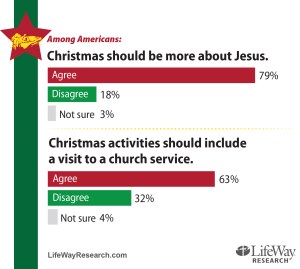
How well do Americans fare at keeping Christ the center of Christmas? Pretty well, according to a new survey from LifeWay Research. 79% agreed that “Christmas should be more about Jesus,” and 70% said “Christmas would be a better experience if it had a more Christian focus.” 63% of people said the holiday should include a visit to church.

Even so, LifeWay reported, people are less sure about the season’s theological details: Only 56% agreed that Christ existed before Jesus’ birth.


As you send your Christmas cards this year, remember who’s on the receiving end, Kay Warren said in a Dec. 4 Facebook post and a later article for ChristianityToday.com. Warren, whose son, Matthew, committed suicide in 2013, said receiving cards with happy family photos served as sharp reminders of their own family’s grief.


As protestors rallied to speak out against grand jury decisions in Ferguson, Mo., and Staten Island, N.Y., the Ethics and Religious Liberty Commission changed the theme of its second annual leadership summit to racial reconciliation. The March 26-27 meeting was set to focus on pro-life issues, but ERLC leaders announced the new emphasis in light of national response to current events, Baptist Press reported.


Christian leaders will gather today in Memphis, Tenn., to discuss the church and race relations. “It’s Time to Speak” will be streamed live from the Lorraine Motel and National Civil Rights Museum. The event, organized by Memphis pastor Bryan Loritts, also includes John Piper, Derwin Gray, Matt Chandler and Darrin Patrick. Gray told The Christian Post, “This event will be a call for the local church to be what she was meant to be – a multi-ethnic and multi-class of communities of reconciliation, love, and unity.


The plywood nailed to the windows of homes and businesses reminded Stoney Shaw of living near the threat of hurricanes when he was younger.

“People would brace themselves for the storm that was coming,” said Shaw, senior pastor at First Baptist Church of Ferguson, Missouri. “That’s exactly what is happening here; a devastating storm. But praise God things seem to be winding down and there is a lot of rebuilding going on, which is what we’ve been praying for.” Read the full story from the Illinois Baptist.


More than $30,000 has been donated online to help three families in the wake of a triple murder in Florida. Southern Baptist pastor Tripp Battle was one of the victims in the Dec. 4 shootings, which also took the lives of Denise Potter and Amber Avalos. Avalos’ husband, Andres, was arrested Dec. 6 in connection with the deaths, Baptist Press reported.


The upcoming movie version of Louis Zamperini’s life may not fully explore his faith, but the WW2 survivor’s conversion was in the spotlight leading up to the Dec. 25 release of “Unbroken.” The 1949 Los Angeles revival where Zamperini was saved not only changed him, wrote Religion News Service’s Cathy Lynn Grossman, but also transformed the ministry of the young evangelist preaching those nights.