Archives For November 30, 1999

THE BRIEFING | Meredith Flynn

International Mission Board workers called for prayer in the wake of devastating terrorist attacks in France, Baptist Press reports. “There exists today a delicate tension in France that teeters toward breaking, and [Wednesday’s] tragic events will likely serve to further stir up the tension,” said Mark Stone, a church planter in southern France. The outbreak of violence started Jan. 7 with a shooting that left 12 people dead at the headquarters of satirical newspaper Charlie Hebdo.

“We are praying that the outcry against these heinous acts committed by religious extremists will not become outcries against anyone who claims to have any sort of religious belief,” IMB worker Tara Chaney told Baptist Press.

“Right now, we are praying that the people of France will turn toward God and not away from Him.”


The_BriefingThe Muslim actor who will play Jesus in an upcoming National Geographic Channel said he didn’t believe Jesus would judge him for playing the part. “I cannot speak for Jesus, but I can quote his teachings and He said, ‘Love your neighbor as yourself,'” Haaz Sleiman told Entertainment Weekly. “…How would He react to me playing Jesus? He wouldn’t judge it. He wouldn’t judge His own enemy…playing this part highlights His teaching in a very nice way.”

Sleiman will portray Christ in “Killing Jesus,” a miniseries based on a book by Bill O’Reilly and Martin Dugard. Read the full story at ChristianPost.com.


North Korea is atop Open Doors’ annual World Watch List for the 13th consecutive year, followed by Somalia, Iraq, Syria and Afghanistan. The list tracks the countries “where it is most dangerous and difficult to be a Christian.”


“Under no circumstances have I been discriminatory or hateful towards any member of the department in the LGBT community or a member of the LGBT community at large,” former Atlanta Fire Chief Kelvin Cochran told Baptist Press Jan. 6. Cochran was fired after an investigation into his self-published book which briefly mentions homosexuality as an immoral behavior, BP reports. Cochran teaches Sunday school and serves as a deacon at Elizabeth Baptist Church, which is affiliated with the Georgia Baptist Convention.


Where do the majority of Congressional representatives fall, faith-wise? Pew Research breaks down the religious makeup of the current U.S. Congress in this full report.


Wondering what else happened in Louis Zamperini’s life that didn’t make it into the recently released feature film Unbroken? Check out this half-hour documentary from the Bill Graham Evangelistic Association about the war hero’s conversion to Christianity.


We’ll give this a few weeks to see how it checks out: LifeWay Research recently found only 15% of churchgoers said they would skip worship to watch their favorite football team.


And what the trends mean for your church

An Illinois Baptist team report

"Imagine if you could spend 10 focused minutes each Sunday morning in extraordinary prayer on two major needs locally, in your church, in America, or across the world.” SBC President Ronnie Floyd’s “Call to Prayer” that began at the Annual Meeting in Baltimore now turns to Sunday mornings, starting with one worship service in January.

SBC President Ronnie Floyd’s “Call to Prayer” that began at the Annual Meeting in Baltimore now turns to Sunday mornings, starting with one worship service in January.

1. Churches respond to “Call to Prayer”
“It is past time for us to prioritize prayer personally and in the church,” SBC President Ronnie Floyd wrote on his blog in early December. “For far too long, we have seen what we can do; it is time for us to see what God can do. This can only happen when we pray.”

Floyd’s continued call to prayer—leading to the June 2015 SBC Annual Meeting in Columbus, Ohio—began about two years ago with a series of meetings for pastors and church leaders. Floyd began quoting famed Puritan preacher Jonathan Edwards who called believers to “extraordinary prayer” for revival in America.

“God’s people will be given a spirit of prayer,” Edwards wrote in 1746, “inspiring them to come together and pray in an extraordinary manner, that He would help his Church, show mercy to mankind in general, pour out his Spirit, revive His work, and advance His kingdom in the world as He promised.”

Today’s growing urgency in prayer coincided with planning for the 2014 IBSA Annual Meeting in November. “We will either hunger for God’s righteousness out of desperation or…out of devastation,” IBSA President Odis Weaver told messengers. The November meeting peaked in a Concert of Prayer for Spiritual Awakening in Illinois and across the U.S.

“I believe we need to cry out to God for spiritual awakening, and for revival in our churches,” said IBSA Executive Director Nate Adams. He led more than 400 pastors and church leaders through a prayer cycle lamenting the lost condition of people in Illinois, repenting of apathy and ineffectiveness, interceding for spiritual awakening, and commiting to pursuit of revival in our churches.

Afterward, many pastors said they would lead similar prayer events when they returned home.

Now Floyd is asking churches to dedicate an entire Sunday morning service to prayer in January: “Just imagine if 100 churches, 500 churches, or several thousand Southern Baptist churches would turn a Sunday morning into insuring that Jesus’ House would be a genuine house of prayer for all the nations.
Just imagine what could happen if, from this point forward, you could spend 10 focused minutes each Sunday morning in extraordinary prayer on two major needs locally, in your church, in America, or across the world.”

Jonathan Edwards imagined the outcome. He called it the “revival of religion.” We would call it “advancement of the Gospel”—the salvation of lost souls, renewal of our churches, and restoration of moral sensibility to the nation.

In your church: SBC churches will likely give prayer a higher profile in 2015, but what are we praying for? How will we sustain prayer in our congregations as more than a once-in-a-while emphasis? Consider a Concert of Prayer in January. As Floyd wrote, “If we do not plan to pray, we will not pray!

2. Evangelicals cope with minority status
Say goodbye to Mayberry. The culture is shifting. What was once called good is now called evil, and vice versa, just as Isaiah said of his own times. The majority opinion in the U.S. approves of same-sex marriage, and many other sexual matters—once outside the norm—are being accepted by society at large. But, while the morals and mores are changing, Southern Baptists are not.

We still stand on the Word.

“One of the biggest challenges for conservative Christians is moving beyond a Bible Belt mentality, or a moral majority mentality,” said Russell Moore, president of the SBC’s Ethics and Religious Liberty Commission, “and seeing ourselves instead as in many cases a prophetic minority speaking to a larger culture about things that matter.”

Moore called on pastors and church leaders to “prepare people for what the future holds, when Christian beliefs about marriage and sexuality aren’t part of the cultural consensus but are seen to be strange and freakish and even subversive.”

“The Bible Belt is collapsing,” Moore has concluded.

The main evidence of that in Illinois is same-sex marriage which became legal June 1. Churches, at one point concerned they would be forced to perform
gay weddings, instead began addressing their bylaws as means of protection.

Another response by evangelicals is to make the church a place of refuge, said John Stonestreet, commentator for Breakpoint Ministries. “People who are enslaved to porn and suffer different forms of brokenness need to be able to come to the church and find answers. The church needs to offer hope and solutions. We need to say, ‘Here’s an option. Here’s the hope; here’s the gospel; here’s the truth; here’s Jesus; and here’s the cross.’”

Moore concurs. “We must have a voice that speaks to the conscience, a voice that is splattered with blood. We are ministers…not of condemnation, the devil can do that, we are ministers of reconciliation, which means that we will speak hard words…truthful words to address the conscience, even when that costs us everything.”

In your church: Church leaders are ministering from a new vantage point, but with the same apologetic. The challenge will be to confront cultural ills in a way that is biblically faithful and yet winsome. The message hasn’t changed, but some in our society today need to hear the truth truly spoken in love.

At a meeting in Asia, young missionaries surround new IMB President David Platt to pray for him as he seeks to mobilize churches. Photo by Hugh Johnson/IMB

At a meeting in Asia, young missionaries surround new IMB President David Platt to pray for him as he seeks to mobilize churches. Photo by Hugh Johnson/IMB

3. Young leaders urge peers to “re-engage”
The evidence has been building for a few years now: young Baptists are back. Or on their way back, at least.

They’re more visible at the Southern Baptist Convention’s annual meetings, and, in 2014, at two meetings on the gospel and marriage hosted by the Ethics and Religious Liberty Commission. They’re also beginning to look remarkably similar in age to the leaders of several of the denomination’s entities. At the ERLC’s October national conference, 125 young leaders had dinner with President Russell Moore and the heads of the SBC’s two missions agencies, Kevin Ezell and David Platt. At four years, Ezell is the longest-tenured at his post; Moore took the ERLC reins in 2013, and Platt was elected in August.

“There’s never been a better time in my lifetime to re-engage as a Southern Baptist than right now,” Ezell, president of the North American Mission Board, said at the meeting. “I really believe that God is up to something very special in the Southern Baptist Convention.”

Many young Baptists likely would cite the election of Platt, 36, as one of the highlights of 2014. Midwestern Seminary President Jason Allen, himself 38, blogged that when he announced Platt’s election during a September chapel service, students (and faculty and staff) broke into applause for the missiologist and author of bestseller “Radical.”

More than 1,000 miles away in Richmond, Va., young missionary appointees gathered around Platt shortly after his election to congratulate him and tell him how “Radical” and his messages on reaching the nations had helped lead them to the international mission field.

After Platt’s election, some Baptist leaders expressed concern that his Birmingham congregation, The Church at Brook Hills, gave a lower amount through traditional Cooperative Program channels, instead sending a large portion of their gifts directly to the SBC Executive Committee and International Mission Board.

But even with those concerns, established leaders affirmed Platt’s ability to mobilize young people to share the gospel to the ends of the earth. Southwestern Seminary President Paige Patterson noted it in a blog post published shortly after Platt’s election, calling for “thanksgiving to God for the presence of a young leader who has obviously garnered the hearts of the younger generation and who will have the opportunity to lead them to a commitment to the world mission enterprise.”

One blogger put it a little more plainly, noting Platt may be just the right voice to deliver tough love to would-be male missionaries outnumbered by female “Journeymen” appointed through the IMB.

“Lend your voice to addressing the issue of young males wimping out of Journeyman service,” William Thornton wrote at SBC Voices. “These guys think you walk on water, Mr. Radical. Give ‘em both barrels on this and see what happens.”

In your church: Look for increased excitement from your own young leaders now that the authors and speakers they’ve followed for several years are in prominent positions. Be prepared for them to want to go to the hard places for ministry and missions. “That’s where we hear young couples saying they want to go, that they want to be radically obedient to what God has called us to do for the nations,” said IMB trustee chairman David Uth. “The passion is there.”

4. Growing persecution: From “the Nun” to “resurrection people”
Before Ebola dominated headlines, another one-word threat struck fear in the hearts of many around the world—and even here. The war of terror and persecution waged by ISIS, or the Islamic State of Iraq and Syria, was the story of the year earlier in 2014.

ISIS chased religious minorities high into the mountains of Iraq. They filmed beheadings and broadcast them as warnings to the rest of the world. And they stirred many in the Western world to stand with the persecuted church. The Arabic letter “Nun” was used on social media pages to symbolize solidarity with those persecuted for their faith in “the Nazarene,” or Jesus.

It’s not just a problem in the Middle East. In Nigeria, 1,505 Christians were killed for their faith in the first seven months of 2014, according to non-profit Jubilee Campaign. North Korea again topped Open Doors’ list of most persecuted countries, highlighted by the imprisonment of American Kenneth Bae, who was finally released in November. Others, including Pastor Saeed Abedini in Iran, remain in prison.

Closer to home, Christians felt a different kind of persecution. Businesses and non-profits faced government fines for not providing abortion-causing contraceptives. The mayor of Houston, Texas, subpoenaed the sermons of pastors who were against the city’s pro-LGBT ordinance.

Christian leaders here urged believers to remember who they belong to. “The answer to the decline of religious freedom and the change in the moral climate is not found in waging incessant cultural wars, filled with rage at our changing culture,” said LifeWay Research President Ed Stetzer. “Simply put, you can’t hate a people and reach a people at the same time.”

Instead, he urged Christians, “Let’s live like the resurrection people, adorning the gospel with lives of grace. Even in our passion to defend freedoms increasingly at risk, let’s remind ourselves this generation is desperately in need of the love of Christ, lived and shared.”

In your church: Be prepared to think globally about persecution. How can your church go beyond your normal prayer times to intercede for those under threat for their faith?

Be alert to what government bodies are doing. Speak out when religious liberties are threatened. The IRS prohibits churches from supporting candidates, but not from speaking on issues related to faith.

SBC’s Frank Page speaks frequently about the future of the Cooperative Program, painting a hopeful picture despite years of declining offerings. Photo by Morris Abernathy

SBC’s Frank Page speaks frequently about the future of the Cooperative Program, painting a hopeful picture despite years of declining offerings. Photo by Morris Abernathy

5. Cooperative missions for a new generation

Most Baptists agreed the Cooperative Program, the denomination’s chief method of funding missions and ministry, is the best way for churches together to pursue the Great Commission. But how to fix the CP, plateaued and trending slightly downward for years, is up for debate. The election of David Platt as IMB president revealed how his church and other large churches have bypassed their state conventions, even though CP gifts for national and international missions are supposed to be routed first through the state level.

“I have heard some people say, ‘The big problem is that the younger generation simply isn’t educated about CP,’” blogged pastor J.D. Greear after Platt’s election. “That may be true for a small percentage of people, but the bigger problem is probably that they are educated about it. The more they find out about CP giving, the less they are motivated to give.”

Meanwhile, blogger Bart Barber spoke up for the reliability of the system itself, calling those who disagree with the way CP funds are allocated to greater involvement in SBC life. “…Within the Cooperative Program approach you can pursue any ministry, reallocate any budget, or adopt any methodology that you can convince enough of your fellow churches and fellow pastors to adopt,” Barber posted at SBC Voices.

“Bring on the changes! Make your proposals! Go to the floor of the SBC Annual Meeting! Attend your state convention meeting! Advocate tirelessly and fearlessly for the improvements you’d like to see. Whatever they are and however much adaptation they would require, I’m betting that almost none of it would actually require any changes at all in the Cooperative Program.”

SBC Executive Committee CEO Frank Page continued his campaign for increased giving through the Cooperative Program, touring the nation (including Chicago) to talk with younger pastors and leaders. “I’ll drop the Cooperative Program if you can show me something else that long-term is effective and engages every church concurrently and consistently in an Acts 1:8 strategy,” Page has said on several occasions. “Show it to me, and I’ll support it….But I
haven’t found it yet.”

In your church: More conversation about CP in the national SBC could mean it’s time for a refresher course in your local church. A class for young or new Baptists is an opportunity to teach about why Baptists give cooperatively. One big reason: CP helps missionaries focus on their mission field, instead of fundraising. Another reason: CP helps the local church have a balanced missions strategy, supporting work on all their Acts 1:8 mission fields.

-With reporting from Baptist Press

Read all of the December 22 Illinois Baptist at http://ibonline.IBSA.org.

The_BriefingTHE BRIEFING | Meredith Flynn

A new Barna study explores what kinds of worship spaces are most attractive to Millennials, and what words describe their ideal church. Not surprisingly, not every answer matches up: 77% chose “sanctuary” compared to 23% who answered “auditorium.” And 67% of Millennials chose “classic” over “trendy” to describe their idea church. But modern and casual also won out over traditional and dignified.

Barna points out this “cognitive dissonance” evident in the survey: “Many of them aspire to a more traditional church experience, in a beautiful building steeped in history and religious symbolism, but they are more at ease in a modern space that feels more familiar than mysterious.”


After the Sixth Circuit Court of Appeals became the first such court to uphold states’ rights to ban same-sex marriage, Southern Baptist ethicist Russell Moore said it’s now up to the Supreme Court to take up the issue, The Christian Post reported.


From ChristianityToday.com: “The Pakistani state has to act proactively to protect its minorities from violence and injustice,” Prime Minister Nawaz Sharif said after a Christian couple was beaten and burned to death one week ago. A mob attacked Shahzad Masih and Shama Bibi, who was five months pregnant, over accusations that Bibi had burned the Qur’an.


Christian Kenneth Bae returned to the U.S. over the weekend after two years of imprisonment in North Korea, CNN reported. “Kenneth has been in God’s care all this time, and we are thankful that he brought him home,” Bae’s sister, Terri Chung, told reporters. “He only has the best wishes and intentions for that country, still.”


The organizers of International Day of the Bible are calling for people around the world to read Scripture out loud at noon on November 24.


Baptist Press reports Golden Gate Baptist Theological Seminary has finalized the purchase of its new, larger campus in Southern California and is on schedule to relocate its main campus from the Bay Area by June of 2016. The seminary will request a name change—to Gateway Seminary of the Southern Baptist Convention—during the 2015 SBC Annual Meeting in Columbus, Ohio.


International Mission Board President David Platt launched his new podcast series, Radical Together, on Nov. 3. “Every 2 weeks, 30 minutes of Word to exhort you to pray, give, & go however God leads in the world,” he tweeted.


Things are looking up for church giving, according to survey by LifeWay Research. More than half of the Protestant churches surveyed reported still feeling the negative impact of the economy, but two-thirds are meeting or exceeding their budgets for 2014. And 74% report offerings at or above 2013 levels.

THE BRIEFING | Meredith Flynn

Nearly two-thirds of Protestant senior pastors rarely or never speak to their congregations about mental illness, according to an extensive new study by LifeWay Research. But the majority of people who have a family member suffering from mental illness, or who are suffering themselves, want their church to talk openly about the topic so it won’t be so taboo.

“Our research found people who suffer from mental illness often turn to pastors for help,” said Ed Stetzer, executive director of LifeWay Research. “But pastors need more guidance and preparation for dealing with mental health crises. They often don’t have a plan to help individuals or families affected by mental illness, and miss opportunities to be the church.”

According to the study, 68% of pastors said the church maintains a list of mental health resources for members, but only 28% of families said they were aware of those resources in the church.

The “Study of Acute Mental Illness and Christian Faith” also surveyed pastors about their own struggles with mental illness. Of those surveyed, 23% said they had experienced some kind of mental illness themselves, and 12% have received a diagnosis for a mental health condition, according to a report by LifeWay’s Bob Smietana.

Religious groups ask SCOTUS to settle marriage issue
The Southern Baptist Ethics and Religious Liberty Commission joined several other religious groups earlier this month in asking the Supreme Court to settle the same-sex marriage issue. “Legal uncertainty is especially burdensome for religious organizations and religious believers increasingly confronted with thorny questions,” the friend-of-the-court brief stated in part.

To help answer some of those questions for Illinois pastors and church leaders, the Illinois Baptist State Association will host the “Elevate Marriage” conference October 16 from 10 a.m. to 2 p.m. at the IBSA Building in Springfield. Featured speakers include Kevin Smith, The Southern Baptist Theological Seminary; Andrew Walker, Ethics and Religious Liberty Commission; and Jill Finley, Bethel Baptist Church, Troy, Ill. Lunch is included, and registration is required; go to http://www.IBSA.org/Marriage.

Winter coming soon for religious minorities in Iraq
As cold weather draws nearer in northern Iraq, the situation for refugees fleeing ISIS grows more desperate, reports Baptist Global Response. “Shelter is lacking or inadequate,” said Abraham Shepherd, who directs work in the Middle East for BGR. “People are living in their cars, under doorsteps, in the open fields—with mainly tarps covering them. People know winter will come quickly on them, and they need to be ready—if ever you can be ready in those conditions.” Click here for more on how BGR is assisting refugees in the Middle East.

Abedini to pray for husband outside White House
Naghmeh Abedini, the wife of a pastor imprisoned in Iran, will pray outside the White House this week as part of a multi-site prayer vigil for her husband and other persecuted Christians. Saeed Abedini, an American citizen, was arrested in Iran in 2012. This week marks the second anniversary of his imprisonment.

Rapper Lecrae thankful for ‘voice into culture’
Christian rapper Lecrae appeared on “The Tonight Show” Sept. 18, sitting in with house band The Roots and rapping bits from his new (and Billboard #1) album between segments. “It’s a lot to take in,” he posted on his social media pages after the show. “I am so grateful for the support. I know I represent something much bigger than me. Thank you! I thank God for a voice into culture. I pray I use it wisely.” Read more at ChristianityToday.com.

This image was captured from a 2012 YouTube video Saeed Abedini made before his 2013 imprisonment for his faith.

This image was captured from a 2012 YouTube video Saeed Abedini made before his 2013 imprisonment for his faith. Photo from BP

Note: This article was compiled by Baptist Press, with reporting by Morning Star News (www.MorningStarNews.org).

HEARTLAND | As pastor Saeed Abedini nears the second anniversary of imprisonment in Iran, his wife Naghmeh is organizing a Sept. 26 worldwide prayer vigil for Abedini and other Christians persecuted for their faith.

“I’m doing a prayer vigil on this day to remember Pastor Saeed and others who are imprisoned for Christ, but also as a chance to come together as the Body of Christ and see the move of God as we pray together,” she said in a video posted on the Be Heard Project’s website, an initiative of the American Center for Law and Justice. “Please join me on this special day as we come together and pray.”

As of Sept. 18, groups had signed up to host individual prayer meetings at more than 418 locations in the United States, including Southern Baptist churches, the White House, the steps of state capitols, and Christian churches of various denominations.

Abedini is serving an eight-year sentence imposed Jan. 27, 2013, on charges he threatened national security by planting house churches in Iran years earlier. Iran refuses to recognize the U.S. citizenship Abedini gained in 2010.

Abedini faces death threats in prison, avoiding exercise sessions when radical Islamists would most likely try to kill him, the U.S. Center for Law and Justice reported in August. His wife and their two children remain in Idaho.

The prayer vigil comes as at least three other Christian pastors in Iran are facing charges deemed punishable by death, Morning Star News reported. Read more at BPNews.net.

Registration information for the prayer vigil is available at http://beheardproject.com/prayer-vigil/saeed.

THE BRIEFING | A group of church planters worked together Aug. 13 to help clean up Ferguson, Mo., a St. Louis suburb rocked by rioting and protests since 18-year-old Michael Brown was killed by Police Officer Darren Wilson on Aug. 9.

The_BriefingJoe Costephens pastors The Passage Church on the border of Ferguson and Florissant. “We bring in anywhere between 8 to 15 mission teams every summer to serve the cities of Florissant and Ferguson—putting on block parties and reaching out to the community,” he said. “So when this came up, I called some church planting buddies, and said, ‘Hey we want to bless our city, let’s do a cleanup day.’”

Costephens and other church planters mobilized between 100 and 200 people to pick up trash and clean up looted storefronts. The group also attended a citywide prayer service at First Baptist Church in Ferguson. According to a Baptist Press report, Pastor Stoney Shaw said the interracial prayer service exuded a spirit of reconciliation, with participants recognizing the need to love and understand one another. Read more at BPNews.net.


Nigerian cities threatened by terrorist group
A Nigerian relations expert said the crisis precipitated by the Boko Haram terrorist group has reached a “new dimension.” Adeniyi Ojutiku told Baptist Press the group has started using tactics associated with ISIS (Islamic State in Iraq and Syria), the militant group responsible for recent persecution of Christians and other religious minorities in Iraq. Boko Haram’s takeover of the town of Gwoza has resulted in nearly 1,000 deaths, rather than the 100 reported by some sources, Ojutiku said.


“They attack, they occupy, they hold the town,” he said. “Now that they have started adopting ISIS methodology, they should be receiving the type of treatment that ISIS is receiving.”


Read more about the persecuted church in the August 18 issue of the Illinois Baptist, online now.

Pew: In 30 nations, specific religious affiliation is requirement for head of state
Analysis by Pew Research found that 15% of the world’s countries require their head of state to be affiliated with a certain religion. In 17 of those nations, the head of state must be a Muslim, while two countries (Lebanon and Andorra) require the person who holds the post to have a Christian affiliation. Interestingly, Lebanon also requires its prime minister to be a Sunni Muslim.


Gay songwriter urges church to rethink views on sexuality
Vicky Beeching, author of popular worship songs like “Glory to God Forever,” told culture writer Jonathan Merritt that “the church needs to become more comfortable with people not being on the same page about everything.” Beeching, who came out as gay in an interview with The Independent Aug. 13, told Merritt, “God loves us unconditionally, so we should aim to model that to those who see things from a different angle, even if that’s really hard to do. I’m trying my best to keep extending that love today to all the conservative Christians who are telling me I am ‘siding with the devil’ because they are still my brothers and sisters in Christ.”


Blogger and professor Denny Burk responded to Beeching’s comments, referencing Matthew 12:46-50. “Jesus draws a line between those who are his brothers and sisters and those who are not. The line runs between those who are allied to God’s will and those who are in open defiance against it.”

LifeWay exploring sale of corporate offices
LifeWay Christian Resources is studying the advantages and disadvantages of selling part or all of its property in downtown Nashville, President Thom Rainer told staff in an Aug. 1 letter. Citing demand for property in the area and fewer employees working at the downtown location, Rainer said, “…It would be poor stewardship for the organization not to explore the possibilities this situation could present for our ministry.” About 1,100 employees currently work at LifeWay’s corporate offices, Baptist Press reported. LifeWay spokesman Marty King estimated nearly one-third of the building is vacant or leased.

COMMENTARY | Chip Faulkner

As a missionary with the Southern Baptist International Mission Board, I served among people groups in which genuine Christ-followers made up a very low percentage of the population, and where governments were not supportive of evangelical churches or the public proclamation of the gospel. The level of persecution, while not extremely severe, was certainly more intense than what the majority of evangelical churches in America are facing.

Still, it doesn’t take much of a spiritual barometer to sense the cultural storm building here towards those who preach and apply Scriptural standards.

Callout_Aug14_edited-1At a recent meeting of pastors and Christian leaders in our area, we discussed how many politicians and governing bodies in our nation and state are taking a strong stance against Christian values—such as biblical marriage. The pastors and ministry leaders did not express fear or panic at the awareness of growing persecution, but there was concern that we must be better prepared to respond correctly to mounting attack.  

After that meeting, I came back to the office and began making notes that turned into a Bible study on persecution. Authentic followers of Christ Jesus that “desire to live a godly life” will be persecuted for their faith (2 Tim. 3:12). Since the New Testament was written to believers and local churches in a sensual society similar to that of modern America, we can appreciate the relevance of the Word in an era of mounting persecution.

First, we should be prepared. Jesus forewarned of persecution by saying that his disciples would be “delivered up” by their relatives and close friends (Luke 21:12-16). So, let us “not be surprised” at the fiery trials that come our way, and we should “rejoice and be glad” to suffer for the name of Christ (1 Peter 4:12-16).  

As Christian facing inevitable persecution, we also should be prayerful. Our human nature is to desire revenge and retaliation, but Jesus commands that we “pray for those who persecute you” (Matt. 5:44-45). Remember that the weapons at our disposal are “not of the world” (2 Cor. 10:4). Trials develop spiritual maturity in intercession. Suffering for the faith increases our empathy and specifies our prayer.

It is important that we be proactive. Since persecution is new to most American believers, we need to sharpen our skills in strategically and fearlessly going on the offense with the gospel. Churches are feeling threatened by the rapidly changing culture. There will be a temptation for churches to react with a “fort” mentality and seek safety behind closed doors.

However, similar to the Christians in pagan Rome, we must take the initiative in “blessing those who persecute you” (Rom. 12:14). Just like the Father sent the Son into the world, we are sent into the world as salt and light (John 17:18; Matt. 5:13-16).

As children of God, we are to be pure. Granted, wickedness is getting darker in our society, but if we are “blameless and innocent” we have the opportunity to “shine as lights” (Phil. 2:14-15). The distinctions of our Christian worldview, values and morals certainly draw attack, yet this persecution will result in a purer church. God does his best work through clean vessels.

In seasons of persecution, it is vital that genuine believers and true churches draw closer together and be in partnership (Phil 1:6). Persecution will sadly reveal that the majority of members on church rolls are phony professors. Likewise, persecution will expose the startling number of false prophets currently serving as church leaders. When it costs everything to follow Christ, many will deny the gospel and join the ranks in assailing the saints. As church attendance wanes and income falls, it will be imperative to pool our resources and draw encouragement from one another (Phil. 1:3-6).

May we Christians also be positive. The apocalyptic literature in the Bible is there to encourage us. Read it and rejoice because God wins in the end! Jesus actually said we are considered “blessed” to be persecuted and that you will receive the “kingdom of heaven” (Matt. 5:10-11). Even if we “suffer for righteousness’ sake” we should not be fearful or troubled as we positively defend our hope with “gentleness and respect” (1 Peter 3:14-15).

Finally, we should persevere in the surpassing power of our Savior. If we remain “steadfast under trial” and “faithful unto death” we will receive the “crown of life” (James 1:12; Rev. 2:10). Echoing the testimony of Paul: “When persecuted, we endure; when slandered, we entreat” (1 Cor. 4:11-13).

The first waves of persecution are only beginning to wash across our country. Even though the price of proclaiming truth will prove enormous, may we go with our Savior “outside the camp and bear the reproach he endured” (Heb. 13:12-15).

Chip Faulkner pastors First Baptist Church, Bethalto.

The_BriefingTHE BRIEFING | Russell Moore, president of the Southern Baptist Ethics and Religious Commission, urged Christians to “pray fervently” for believers facing persecution for their faith.

“As Christians, we should pray for the president and our military leaders to wisely administer the sword of justice (Romans 13:1-3),” Moore said in a written statement. “As part of the global body of Christ, we must also pray fervently for our persecuted brothers and sisters in Iraq and across the Middle East (Hebrews 13:3).”

His comments came after President Barack Obama authorized U.S. airstrikes and humanitarian aid to help Iraqi religious minorities under attack from militant groups in the country.

Obama “is right to take action to protect religious minorities, including Christians, in Iraq from ISIS,” Moore said. “He has my prayers.”

Read the full story at BPNews.net, or click here for an overview of the recent onslaught of persecution around the world.

Other news:

Amid controversy surrounding Driscoll, LifeWay stops selling Seattle pastor’s books
A day after the Acts 29 church planting network removed Pastor Mark Driscoll and his churches from their membership, LifeWay Christian Resources stopped selling Driscoll’s books online and in stores. “LifeWay Stores and Lifeway.com are not selling Mark Driscoll’s books while we assess the situation regarding his ministry,” communications director Marty King told Christianity Today.

The Acts 29 and LifeWay decisions came after a string of controversies and charges surrounding Driscoll, founding pastor of Mars Hill Church in Seattle.

Gungor stands by beliefs about Adam & Eve, biblical flood
Christian musician Michael Gungor’s admission that he no longer believes in a literal Adam and Eve or flood sparked controversy when the comments were published in a WORLD magazine online report this month. Ken Ham, founder of Answers in Genesis and the Creation Museum, called for Gungor to apologize for the statements, while the musician responded to the controversy on his blog.

Marriage rates in decline among Millennials
Millennials are less likely to marry by 40 than any other previous generation, according to data from the American Community Survey analyzed by the Urban Institute. For example, in 1990, 91% of women age 40 had married; currently, only 69.3% of women age 40 have married. The rate for men is approximately 4% lower, Baptist Press reported.

Coming to a theater near you: “Christian Mingle The Movie”
Girl creates fake faith profile on Christian dating site, meets potential Mr. Right. Girl admits phony faith and loses Mr. Right, but gains a relationship with God. “Christian Mingle The Movie” is due in theaters in October. Read more at ChristianPost.com.

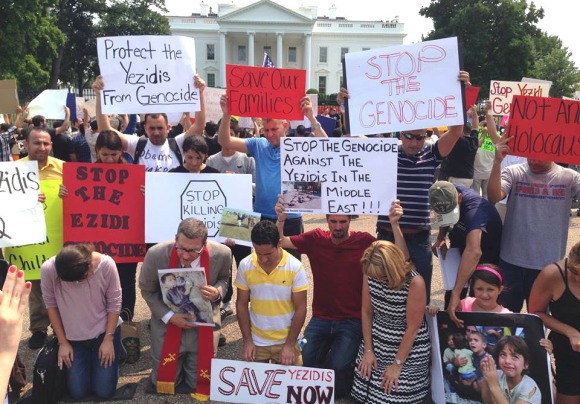
Rob Schenck (front, red scarf), president of Faith in Action and the National Clergy Council, prays Aug. 7 for the Yazidis and Christians suffering in Iraq. IMB photo

Rob Schenck (front, red scarf), president of Faith in Action and the National Clergy Council, prays Aug. 7 for the Yazidis and Christians suffering in Iraq. IMB photo

Christians around the world face heightened persecution

NEWS | From Baptist Press and IMB reports

An unfamiliar symbol began showing up on social media pages late last month. The curved line under a single dot is the Arabic letter “Nun,” reportedly used by militants in Iraq to mark the homes of Christians in the country.

“Nun” stands for Nazarene, or Jesus.

Extremists with the Islamic State of Iraq and Syria (ISIS) have forced Christians from their homes under threat of death. The Iraqi believers and other religious minorities joined millions of Syrian refugees already displaced by civil war. In a region rich with Christian history, many have noted, very little evidence of Christianity is left.

The onslaught of persecution this summer has awakened many in the Western church to the needs of Christians around the world. Many pastors and Christian organizations in July changed their Twitter avatars and Facebook profile photos to include the letter “Nun.” They also used the hashtag #WeAreN as a show of solidarity with the persecuted believers.

“The Islamic militants mean it for evil when they mark homes with ‘N’ for ‘Nazarene,’” wrote Russell Moore, president of the Ethics and Religious Liberty Commission. “They assume it’s an insult, an emblem of shame. Others once thought that of the cross.

“But in that intended slight, we are reminded of who we are, and why we belong to one another, across the barriers of space and time and language and nationality. We are Christians. We are citizens of the New Jerusalem. We are Nazarenes all.”

Iraqi refugee crisis

“There are no Christians left in Mosul.”

That’s how religious freedom advocate Nina Shea described conditions in Iraq’s second largest city in July.

Shea, director of the Hudson Institute’s Center for Religious Freedom, told CBN News that Islamic militants have eradicated virtually every trace of Christianity from Mosul, the center of Iraq’s Christian community for 2,000 years. Mosul is located on the site of the ancient city of Nineveh.

In June, militants with the Islamic State in Iraq and Syria (ISIS) extended an offer to let Christians in Mosul practice their Christian faith behind closed doors, after they paid a hefty tax and agreed not to proselytize. However, multiple sources in the region said that offer was later withdrawn and all Christians were told to leave or face execution.

Members of Assyrian Christian and Chaldean Catholic groups left empty handed, Shea said. Militants confiscated all of their possessions, including homes, cars, clothes “and even their wedding rings, sometimes with the finger attached if it would not come off.”

Christians aren’t the only religious minority targeted by ISIS. On August 3, militants seized the city of Sinjar, forcing the Yazidi Kurdish population to flee. Many escaped to the nearby Sinjar Mountains, a barren heap of rock where daytime temperatures can top 120 degrees.

More than 150 Yazidi immigrants rallied in front of the north lawn of the White House August 7 to plead for American involvement in the growing crisis. (President Obama announced that evening he had authorized military airstrikes on Iraq.) The protestors came from across the U.S. to rally on behalf of the Yazidis, who do not practice Islam but instead follow an ancient religion ISIS equates to “devil worship.”

Christians and religious minorities in other nations also have faced recent persecution due to war and religious hostilities:

Syria | The recently released International Religious Freedom Report included a daunting sentence about the country that shares Iraq’s northwestern border: “In Syria, as in much of the Middle East, the Christian presence is becoming a shadow of its former self.”

A three-year-old civil war has resulted in millions of refugees and increasingly persecuted religious minorities, including Christians caught between the regime currently in power and militants fighting against it. The report, released annually by the U.S. State Department as a picture of the state of international religious freedom the previous year, found that in the city of Homs, only 1,000 Christians remain. There were approximately 160,000 Christians there before the war.

Nigeria | Approximately 1,505 Nigerian Christians have been killed for their faith this year, as the Boko Haram terrorist group and other extremists continue their campaign of religion-based violence in the West African nation. Boko Haram and other groups have killed nearly as many Nigerian Christians in the first seven months of this year as were killed in all of 2013, the advocacy group Jubilee Campaign reported July 29.

Christians killed to date include seven fathers of the 223 Chibok school girls still missing after Boko Haram kidnapped more than 300 students in mid-April. (The group is dedicated to fighting the influence of Western education.) The fathers were killed July 20 when Boko Haram attacked the city of Damboa and hoisted a Boko Haram flag there, the Associated Press reported.

Response from the West

David Curry is president and CEO of Open Doors USA, which offers assistance to persecuted Christians around the world and lobbies repressive governments to cease religious persecution. In July, he called the plight of Christians in Mosul and the remainder of northern Iraq “unprecedented in modern times.”

“This latest forced exodus of Christians further shows why Western governments and the people in the West need to cry out in support for religious freedom in the Middle East and elsewhere,” Curry said in a statement. “If this does not move us concerning the near extinction of Christianity in the Middle East, it’s likely nothing else can.”

Since the United States invaded Iraq in 2003 to overthrow Saddam Hussein, nearly one million Christians have fled the country for safer surroundings.

In an editorial this month for The Christian Post, Curry expressed doubt that the persecution of Christians would ever be treated as “a major humanitarian crisis” by governments and secular media. “However, we should be able to count on our own family,” he wrote.

“The persecution of Jesus followers should be preached from every pulpit and prayed for at every kitchen table. One day soon it may be your faith that is under attack and you will be hoping that others will be praying for you…or even notice that it is happening.”

The International Mission Board and its ministry partner Baptist Global Response are coordinating relief efforts among Iraqi refugees. For more information about how to help, go to www.IMB.org.

The_BriefingTHE BRIEFING | Meredith Flynn

Leading up to the Supreme Court’s expected ruling on a case involving Hobby Lobby, culture writer Jonathan Merritt took issue with calling the craft retailer a “Christian business” because of its dealings with China, one of the world’s worst offenders of human rights.

Hobby Lobby currently is fighting for an exemption to the government’s requirement that for-profit companies cover some abortion-inducing drugs in their employee health care plans. The Supreme Court’s ruling is expected this week.

The things Hobby Lobby claims to stand for, Merritt wrote for The Week magazine, including sanctity of life and religious liberty, are grossly undervalued in China.

“Hobby Lobby reminds us why for-profit businesses should resist calling themselves ‘Christian,’” he wrote. “The free market is messy and complicated and riddled with hypocrisy. Conducting business in today’s complex global economy almost ensures one will engage in behavior that is at least morally suspect from a Biblical standpoint.”

Merritt invited Russell Moore, president of the Ethics and Religious Liberty Commission, to respond to his article. Moore recently presented the Green family with the John Leland Award for Religious Liberty.

Forsaking business in China, Moore wrote, likely won’t help improve human rights there. Historically, he said, “open trade, in most cases, tends to help the development of political rights rather than hinder them.” If the Greens believed boycotting Chinese business would turn the nation’s government toward improved human rights, Moore said, they would.

But, “The Greens cannot control the decisions made by the Chinese government. They can, however, direct their own actions. And, as Americans, they can participate in a democratic republic in which the people are ultimately accountable for the decisions of their government.

“Buying products from companies that operate in a country that aborts children is not the same as being forced by the United States government to purchase directly insurance that does the same.”

Meriam Ibrahim released from prison, then rearrested
A 27-year-old mother of two imprisoned for her Christian faith was released June 23, but rearrested just hours later, The Christian Post reported this morning. Meriam Yahia Ibrahim, a Sudanese doctor, had been imprisoned with her young son and newborn daughter after she was found guilty of apostasy and adultery. (Because Ibrahim’s husband, Daniel Wani, is a Christian, their government does not recognize their marriage.) Her death sentence was to be carried out in two years. After Ibrahim was freed and her sentence commuted Monday, she was rearrested with her husband and children as they prepared to leave Sudan. Ibrahim’s case has drawn attention internationally and in the U.S., 38 members of Congress signed a letter asking the government to intervene on her behalf. Read more at ChristianPost.com.

Benched basketball star says ‘I know God has a plan!’
Isaiah Austin, a center for the Baylor University basketball team, was expected to be a first-round pick in the June 26 NBA draft. Instead, a diagnosis of Marfan syndrome will end his career, reported The Christian Post. He sat down for an emotional interview with ESPN, but was hopeful on Twitter and Instagram, using social media to talk about his faith in God.

“I know God has a plan!” Austin posted as part of a message on Instagram, with the hashtag #NewBeginnings. “I would love to thank EVERYONE who has reached out to me,” he tweeted under the handle God’s Child. “Toughest days of my life. But not the last! Life goes on. GOD IS STILL GREAT!”

Mohler: PCUSA marriage vote helps establish ‘clear divide’
When the General Assembly of The Presbyterian Church (U.S.A.) voted to allow pastors to conduct same-sex marriages, their decision set a dividing line in culture and in Christianity, said Southern Seminary President Albert Mohler.

“That very clear divide puts on one side those who stand with 2,000 years of Christian witness and on the very clear statements of Scripture, and, on the other side, those who stand with the moral revolution of the era…,” Mohler said on his daily podcast.

The Presbyterian denomination not only voted on the policy change for pastors, but also to amend their constitution to define marriage as between “two people” instead of “a man and a woman.” A majority of the PCUSA’s presbyteries must approve the amendment for it take effect, Baptist Press reported, but the departure of many conservative congregations makes the change a likely prospect.