Archives For November 30, 1999

News of interest to Illinois Baptists

Posted by Meredith Flynn

Southern Baptist Convention President Fred Luter was in Springfield, Ill., earlier this week to meet with pastors and leaders, and to preach a three-day festival of hope at Union Baptist Church, a congregation affiliated with National Baptists. The May 6 issue of the Illinois Baptist will feature full coverage of his visit; the photos below show a few of the highlights:

FredLuter_IBSA

Near the end of his first term as president of the Southern Baptist Convention, New Orleans pastor Fred Luter visited Springfield, Ill., and met with pastors and leaders from around the state. Luter is up for re-election at this year’s SBC Annual Meeting in Houston, Texas, June 11-12.

Choir_Union

A community choir sings during the Festival of Hope, a three-day event at Union Baptist Church in Springfield. Luter preached all three evenings, and the choir, composed of singers from several churches, led in worship.
Luter_preaching

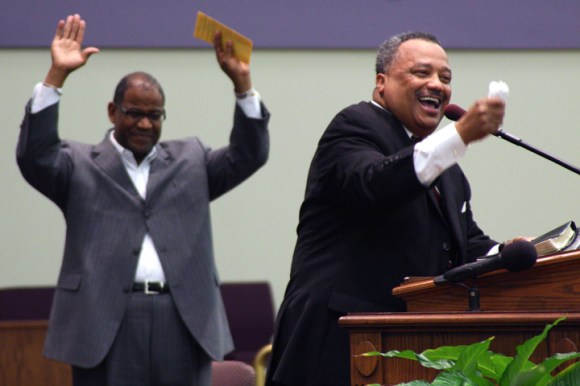
The Festival of Hope and Fred Luter’s visit was designed to help churches in the Capital City Baptist Association connect with African American churches in the city, said David Howard, the association’s director of missions. Howard, who once pastored in the New Orleans area, envisioned Luter’s visit more than a year ago. “…Fred is just a unique guy – if you can’t like Fred, you’re not going to like anybody. So I wanted him to come and help us build bridges.” Here, Luter preaches at Union Baptist while T. Ray McJunkins, the church’s pastor, worships along with him.

Worship

Elizabeth and Fred Luter (center) participate in a worship service at the Illinois Baptist State Association Building alongside IBSA Executive Director Nate Adams (far right) and his wife Beth (far left).

Q&A

During an hour-long Q&A session, Luter answered questions from Illinois Baptist pastors and leaders, like “What has surprised you most as SBC President?” and “How would you encourage pastors of small churches?”

Baseball

Adams presented Luter with Chicago Cubs and St. Louis Cardinals camps, telling him, “You brother are a unifier, and a bringer-together, not only for baseball fans, but for believers in our state.”
Pictures

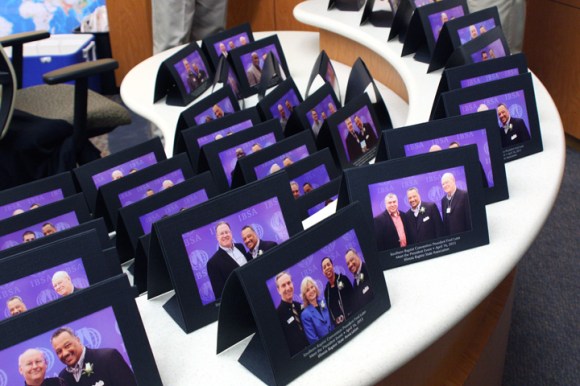
Guests at the “Meet the President” event received a souvenir photo with President Luter to commemorate the occasion.
Chicago_pastors

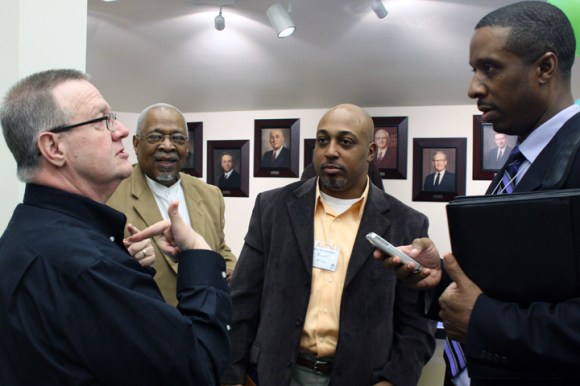
Dale Davenport (left) helped gather a large group of Chicagoland pastors at the event in Springfield, including (from left) Don Sharp, Bryan Price, and David Sutton.

Prayer

“If you’re doing anything for me, I need you to pray for me,” Luter said. “I don’t want to mess this thing up. I really want to honor this position, to honor my family, my church, my state convention, the Southern Baptist Convention, and I want to honor God in all I do.”

Diner

The Luters and David Howard (far right) met with reporters from the Illinois Baptist newspaper for breakfast at Charlie Parker’s diner in Springfield. Look for our Q&A with them in the next issue of the IB, due May 6.

 

THE BRIEFING | Meredith Flynn

When Rick Warren, pastor of Saddleback Church in Lake Forest, Ca., announced his church will not host a forum featuring presidential candidates Barack Obama and Mitt Romney, he cited uncivil political discourse as a main reason why.

“The forums are meant to be a place where people of goodwill can seriously disagree on significant issues without being disagreeable or resorting to personal attack and name-calling. But that is not the climate of today’s campaign,” Warren told The Orange County Register.

Saddleback Church hosted a 2008 Civil Forum with then-candidate Obama and Sen. John McCain, and Warren had announced his hopes to have a similar meeting this year, although no officials plans had been made. In a Q&A posted on the church’s website, Warren called the current campaign climate “the exact opposite” of the purpose of the church’s Civil Forums.

Much of the negative talk is in the political advertising that will inundate American households – those with a TV, at least – from now until the November 6 election.

“I haven’t watched any of the debates, but I’m struck by the negative, accusatory campaign commercials that I’m hearing about,” said Curt Starner, pastor of Erven Avenue Baptist Church in Streator, Ill. “They say to me that the attitude of the writers is, ‘He can’t win on his record, so let’s destroy his opponent’s reputation and character. Maybe he can win that way.’”

While it’s clear the country is in for its share of negative campaigning in the months to come, Warren and Saddleback Church are shifting their focus to religious freedom, an issue he said is “more significant and has far greater implications for America’s future.” The church will host a Civil Forum on the topic in September. Read more about the event, and Warren’s response to the political climate at saddleback.com/blogs/newsandviews.

Other news:

Huckabee joins Missouri Baptists in support of embattled Akin
The Christian Post reports former Arkansas Governor and prominent conservative pundit Mike Huckabee participated in a conference call with hundreds of Baptist pastors August 24 in support of Todd Akin, the U.S. Senate candidate currently under fire for his controversial remarks about rape. (Speaking against abortion in cases of rape, Akin said medical science supports that contraception is rare in that context because women’s bodies can prevent such pregnancies. He has since backed away from that claim). The conference call was convened by Don Hinkle, who edits the Missouri Baptist Convention’s newspaper The Pathway.

John Yeats, executive director of the Missouri Baptist Convention, was also on the call. Politico.com quoted him as saying, “One of the things we have to remind ourselves of and remind our people of is that Congressman Akin represents the mainstream of our values. He is the mainstream of our values.” Read more at politico.com.

Slow economy continues to weigh on pastors
Giving in their churches may have stabilized, but nearly two-thirds of pastors say the economy is still negatively impacting their churches, according to a new survey by LifeWay Research. That’s the bad news, but the good news includes fewer churches with declines in giving, and fewer falling below budget. Get the full survey results at LifeWay.com.

‘American Bible Challenge’ a success for Game Show Network
Nearly two million viewers tuned in for the debut of “The American Bible Challenge” on the Game Show Network on August 23, according to the marketing website broadcastingcable.com. The game show, which asks Bible trivia questions of three teams playing for charity, drew 1.7 million viewers, the network’s largest ratings to date. For more on the show, go to ChristianPost.com, or tune in Thursdays at 7 p.m. (CT).

Women report more ‘modern’ struggles than ‘traditional’ sins
An extensive study by Barna Research on the state of the Christian woman found more women report to struggling with flaws like disorganization and inefficiency than more “traditional” sins like envy and lust. Half of the women surveyed admitted disorganization is a struggle, making it the most frequently reported problem, followed by inefficiency (42%), anger (36%), selfishness (25%), excessive arguing (19%), arrogance (16%), envy (13%) and lust (8%). Read more findings at barna.org.

COMMENTARY | Posted by Meredith Flynn

LifeWay Christian Resources recently released the Annual Church Profile, a statistical picture of the health of Southern Baptist churches and denomination as a whole. There was some good news: slight increases in baptisms, total number of churches, and giving. But also some bad news: a nearly 1% decline in total membership (from 16,136,044 million last year to 15,978,112 this year). It’s the fifth straight year total membership of SBC churches has dropped.

More concerning, said LifeWay Vice President Ed Stetzer, is the rate of decline. In a Baptist Press column June 13, Stetzer wrote total membership has declined 2% since 2007, including nearly one whole percentage point this year. “This trend points to a future of more and faster decline — and it is a 60-year trend.”

Rather than manage the decline like other denominations, Stetzer said, there are some steps Southern Baptist pastors and leaders can take to “fight for our future.” Four steps he suggests:

1. Rally around the things we agree on under the Baptist Faith & Message, and refuse to engage in battles over secondary issues that will only end in further division.

2. Raise up new leaders who represent a variety of ethnicities and generations.

3. Reach more people. “Southern Baptists love evangelism, as long as someone else is doing it,” Stetzer wrote. “But ‘someone else’ is not doing it either. Every year, it takes more Southern Baptists to reach one lost person, as the member to baptism ratio shows.”

4. Plant more churches by equipping and then supporting church planters.

Now it’s your turn: How can leaders, pastors and members of Southern Baptist churches help reverse the denomination’s trend of decline?

THE BRIEFING | Meredith Flynn

Illinois marriage law gets court defender
A Chicago-based legal organization will work to uphold Illinois’ definition of marriage as being between a man and a woman.

The Thomas More Society was granted intervenor status by a state judge last week, meaning they will oppose the lawsuits brought by the American Civil Liberties Union and Lambda Legal on behalf of 25 gay and lesbian couples who were not allowed to marry in Cook County.

The couples say Illinois’ 1996 Marriage and Dissolution of Marriage Act (which defines marriage as being between a man and a woman) is unconstitutional, based on the state’s equal protection clause.

Soon after the lawsuits were filed, Peter Breen, executive director of the Thomas More Society, told World News Service the suits would not hold up in court under the constitutional arguments.

“Going around the will of the people is not the right way to change an institution that has thousands of years of history and is sound in its reasons for existing,” Breen said.

The society has filed a motion to dismiss the case, and oral arguments will be heard Sept. 27. Read the full story at BPnews.net.

Other news:

Presbyterian Church USA divided over same-sex marriage
By a very narrow margin, the Presbyterian Church USA (PCUSA) voted to maintain its definition of marriage as “between a woman and a man,” rather than change it to “between two people.” Delegates to the denomination’s General Assembly voted 338-308 against the recommendation to change the definition. The PCUSA last year lifted its ban on partnered gay clergy. Read more at christianpost.com.

New books focus on Christianity and politics
As campaigns heat up in advance of the upcoming party conventions, at least two authors are addressing how Christians interact with the political scene. Wheaton College professor Amy Black just released “Honoring God in Red or Blue: Approaching Politics with Humility, Grace and Reason.” And pastor and culture writer Jonathan Merritt’s “A Faith of Our Own” focuses on a younger generation’s attempts to reconcile social justice with conservative views. Read an interview with Merritt about the book on pastorsedge.com.

Economy still affecting giving to churches
A recent Barna Group study found 41% of adults surveyed have reduced their giving to non-profit organizations in the last three months, and 11% have stopped giving altogether. That’s an increase from 4% of Americans who said they had stopped giving in 2008. Go to barna.org for the full story.

Purdue QB promotes ‘Choose2’
Caleb TerBush, a senior quarterback at Purdue University, is wearing a blue Choose2 wristband in advertisements for the team’s upcoming season. TerBush’s father Ken is the pastor of Elm Ridge Missionary Baptist Church in East Peoria, Ill. Choose2, a ministry of the Illinois Baptist State Association, asks participants to pick two family members or friends who don’t know Christ and pray for them twice a day. Read more about the initiative at IBSA.org.

THE BRIEFING | Meredith Flynn

In his own words: David Platt on the ‘sinner’s prayer’
David Platt has released two blog posts to explain his views on recent debate surrounding the “sinner’s prayer.”

Platt, pastor of The Church at Brook Hills in Birmingham, Ala., sparked controversy in a YouTube video earlier this year in which he called the prayer “superstitious,” and also delivered an intense message on the topic at the Southern Baptist Pastors’ Conference.

In the posts, Platt combats media accounts that he is “against” the sinner’s prayer, or that the issue stems from Reformed theological views that some people don’t have a chance for redemption in Christ.

“…Words really can’t describe how much a comment like this pierces my heart, for nothing (I hope and pray) could be further from the truth,” Platt wrote in the first post. “Any cautions I have expressed with a ‘sinner’s prayer’ have absolutely nothing directly to do with the doctrine of election, and I definitively don’t believe that certain people ‘actually have no chance for life in Christ.’”

So, does the sinner’s prayer ever fit into an evangelism strategy? Platt’s second blog post outlines the plan he teaches in his church’s evangelism and missions class, including how to lead someone to call out to God in repentance and belief. Read both posts at radical.net/blog.

Religious groups pledge to stand firm despite healthcare decision
After last week’s healthcare ruling, opponents responded to the Supreme Court’s decision to uphold the 2010 law, which requires insurance plans to cover contraceptives and sterilizations without cost to employees. O.S. Hawkins, president of GuideStone Financial Resources, said GuideStone “will never allow this Administration, or any other, to tell us that we have to provide abortive drugs like morning-after pills. … We will maintain our advocacy on behalf of ministers we are privileged to serve.” To read more about the Supreme Court’s decision and the fallout, go to bpnews.net.

What does the average American think about the Bible?
A new Barna study says younger adults are less likely to perceive the Bible as relevant and useful when compared with older adults. The 2012 State of the Bible survey, conducted by Barna for the American Bible Society, also found nearly half of Americans believe the Bible contains the same truths as the Koran and the Book of Mormon. Read more findings here.

Disaster Relief volunteers mobilize for action in Colorado, Florida
As monster wildfires rage in Colorado and other Western states while Hurricane Debby leaves massive flooding behind in north Florida, Southern Baptist Disaster Relief leaders are busy mapping responses in both parts of the country. Read more at bpnews.net.

Teen carries carries cross from Texas to Washington – on foot
Junior Garcia, a 19-year-old from Saginaw, Texas, has received permission to set up a 12-foot cross in Lafayette Park, across the street from the White House. And’s he’s taking it there by foot. Garcia and a team from Oasis International Church set out on “The Journey” June 7, and will hold a prayer service in the park to celebrate the end of their trip. Read the full story at christianpost.com.

By Nate Adams, IBSA Executive Director

I can usually measure the value of a meeting by the follow-up actions I note for myself as a result of it. If I don’t write anything down, the meeting was probably pretty pointless. If the meeting moves me to action or change, it may have been worthwhile.

So let me share with you a few of my follow-up notes from the recent Southern Baptist Convention in New Orleans, at least as they relate to the major issues discussed at this year’s annual meeting. You can read about these issues in the July 2 of the Illinois Baptist or at IBSA.org.

My notes about the informal name “Great Commission Baptists” as an alternative to “Southern Baptists” could be summarized simply by the phrase “wait and see.” Clearly a large number of churches feel that having an alternate name, even an optional one, is not a positive thing. But the majority that voted to endorse the alternate name gave those who wish to try it out a new tool to potentially reach people for whom the term “Southern” may be a barrier.

For now, I plan to “wait and see” how many churches embrace the new name, especially here in the Midwest. I suspect we will continue using the “Illinois Baptist” identity in our communications more than either of the others.

My notes about the various issues that have the Calvinist vs. Arminian theology debate at their root simply say, “stay above the fray.” Both outgoing President Bryant Wright and SBC Executive Committee President Frank Page served us well, I thought, when they essentially stated that the Baptist Faith and Message is big enough for both strains of theological thought, and that there is more danger in our heart attitudes about either position than in the doctrinal differences themselves.

Some time ago I came to the personal conclusion that Calvinist theology describes salvation more from God’s perspective outside time, and that Arminian theology describes salvation more from man’s perspective within time. I’m sure that those for whom that explanation is not sufficient will continue this centuries-old debate. I plan to try and stay above the fray of that argument, and pray it does not distract us from our far more important Great Commission task.

Finally, you may not think I need follow-up notes from the election of Fred Luter as the SBC’s first African American president. But I found I did. Tuesday night, just after Pastor Luter’s election, I attended a dinner with the African American Fellowship of Southern Baptists that included SBC entity executives and state executive directors like myself from all over the country.

Even during that dinner, I formed several follow up notes for myself: Don’t just sit with people you know – get to know some new African American brothers and sisters. Learn to understand and appreciate the history and the pain, the culture and the passions of African American churches and their leaders, especially those that have chosen to be part of the Southern Baptist family. Relax and enjoy different worship and preaching styles – God wants to speak to you through those too! Recognize how important it is to make sure African American leaders are participating in Southern Baptist life, both in key discussions and in key leadership positions. Develop more personal, not just professional, relationships with African American pastors and leaders.

As I said, I can measure the value of a meeting by the follow-up actions I note for myself. If the meeting truly moves me to action or change, it may have been worthwhile. My follow through on these notes has the potential to make this year’s SBC meeting truly worthwhile. I hope these notes for needed future action help you too.

(Editor’s note: New Orleans in Rear View. Now that we’re back home, our Illinois Baptist news team reflects on the question: What is the lasting value of the 2012 SBC?)

Posted by Eric Reed

Parents watch the convention proceedings from the "stroller section," a cordoned-off area for families with young children.

Parents watch the convention proceedings from the “stroller section,” a cordoned-off area for families with young children.

Descending the escalator on the final day of the convention, I watched on the floor below me as a four-year-old had a meltdown. He wasn’t alone. His sister, a couple of years younger, perched in a carrier seat atop a stroller, teared up, and eventually wailed.

I felt the same way. We were all tired. The only difference between us was, I couldn’t get away with a meltdown.

Landing at the foot of the two-story escalator, I was suddenly in a sea of small children. “Don’t run!” the father of one said futilely. “There are grown-ups here.”

Really?

Not as many grown-ups as children, it seemed at times. This was a convention of young people. Once the domain of people with hair in various shades of gray and blue, this gathering was marked by a large percentage of young adults, many of whom bought their families. (There were strollers everywhere, even a “stroller section” roped off near the platform.) And their presence was felt in all the proceedings of the convention.

Perhaps the Pastors Conference foreshadowed a shift we should notice. Opening on Fathers Day, the line-up included sons introducing their better-known fathers as conference speakers. “Dad’s gonna bring the heat!” one son said before his father preached. But in one notable reversal, it was the father, a former convention president, who introduced his up-and-coming son. There was a changing of the guard, it seemed.

The most challenging and emotionally gripping moments among the pre-meeting sermons came from the youngest preacher, in his early 30s.

The debate over use of “the sinner’s prayer” started with young people, as an older generation’s tried and accepted method is challenged. 

And it is young people who raised debate over Reformed theology and Calvinism. A young pastor (age 40, son of a past SBC president) drafted a response and coined the phrase “Traditionalists” to describe his (and many elders’) Southern Baptist theology.

Many messengers speaking from the floor mics during the business sessions were younger pastors. 

This emergence of young people in SBC life was clearest at the Baptist 21 panel discussion (and turkey po-boy lunch). “21” in the name refers to 21st century, but it might have characterized their age. Fully half the people in the SRO crowd of nearly 1,000 were in their 20s and 30s.

For watching the panel discussion, the Conservative Resurgence of the 1980s was ancient history. Like WW2. Many of them were not born at the time today’s senior convention leaders stopped what they described as a left-leaning drift and returned the denomination to biblical inerrancy. For these young people, Judge Paul Pressler and Dr. Paige Patterson are historical figures to be honored (which they were at the luncheon).

For a few minutes in New Orleans, the convention’s past met its future. And it was clear in that moment that this is not your grandfather’s SBC.

Or even your father’s.

It belongs to the kids.

Posted by Eric Reed

(New Orleans) — As we come down to the wire on this annual meeting of the Southern Baptist Convention, I am reminded of my friend Martha who told her husband every year as he left to attend the convention, “Bring home a copy of the resolutions!” For her, the essence of Southern Baptist life is not so much in the election of officers or agency reports; it’s in the annual statements messengers make on the clarification of our beliefs, and the intersection of our faith with contemporary culture.

Sometimes it’s from the resolutions that mainstream media find statements that are perceived as critical of the culture, politics, and secular leadership. But it is also in these resolutions what we affirm our faith and the value of biblical principles and lifestyles in transforming our culture by godly standards.

This year, in the waning moments of the 2012 convention, we are affirming the doctrine of salvation, the doctrine of inerrancy, religious liberty—with attention to issues involving mandated health care and same-sex marriage, the value of human needs ministry, and the contributions of African Americans to Baptist history.

A lot of people went home early.

The hall was not full when these resolutions were debated and adopted. But they are worth our time and attention—because it’s often in these areas that our faith is lived out.

When Baptist Press publishes the resolutions, take time to read them.

And “bring them home.” 

The name “Southern Baptist Convention” tells who we are, but it doesn’t tell what we do. The descriptor “Great Commission Baptists” tells what we should be doing.

Messenger on the floor of the convention speaking for adoption of informal “descriptor” name for optional use by churches. Name was adopted by 52% vote.

From the floor: Name Change

Posted by Eric Reed

(New Orleans) — The outcome of Tuesday’s ballot on adopting the optional use of ‘Great Commission Baptists’ in addition to the official name Southern Baptist Convention was announced this morning– it was approved by a 52.48% vote.

The announcement of the tally was delayed yesterday, after a hand vote was too close to call and a ballot vote was required. Messengers debated the “name change” which would allow churches and SBC entities to use the descriptor, without changing the official name of the SBC.

The narrow margin of the vote reflects both strong opinions and ambivalence over the change, which would lessen the regional nature of the convention’a name. Floor debate included memorable comments from advocates. One church planter who was on the committee that recommended the name change said, “This motion helps church planters outside the south build a bridge to share Jesus.”

Another advocate, Micah Freeze of St. Joseph, MIssouri, said, “We are an incredibility diverse people. As we polled those Southern Baptists who live in the frontier areas, they said to us with strong voice that this would help them advance the gospel. For those who live in the hard areas, to push back the darkness, I don’t see how we can say no to them.”

But Gary Honeycutt of Arkansas countered, “I don’t care what you call your church, I care what you call the convention.”

Ted Traylor, pastor of Olive Baptist Church in Pensacola, Florida, observed this morning, “I’m note sure we’re going to help ourselves by having a name and a half. We may just cause confusion….If Gateway Seminary wants to use the name, and it will help them, that’s good. But in New Orleans, being Southern Baptist is a good thing—especially after Hurricane Katrina. And in New York, after 9/11.”

The use of the description “Great Commission Baptists” will be a the discretion of local churches.