Archives For November 30, 1999

The Reformation at 500

ib2newseditor —  January 30, 2017
70116rose-parade-jan-2

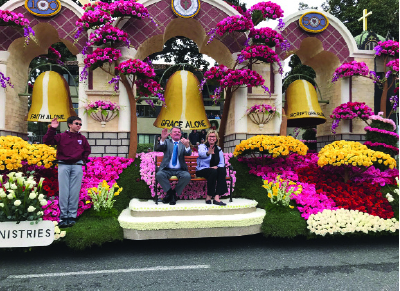
Rose Parade Jan. 2, 2017

When the Protestant Reformation gets its own float in the Tournament of Roses Parade, something big must be happening. Not that we needed the Pasadena tableau to underscore the upcoming event, but we must admit it was surprising to hear NBC’s Al Roker announce the 500th anniversary of the Reformation as three flower-covered church bells tolling “A Mighty Fortress Is Our God” cruised by at 10 mph.

Would Martin Luther—ex-communicated, jailed, and persecuted for his pursuit of biblical faith—have been shocked to see his life’s work trussed in rose petals and paraded before cheering crowds?

I was.

There, following the surfing dogs, the Rose Queen, and the Salvation Army Band, was the Wittenberg Door, covered in black beans and poppy seeds, commemorating that All Hallow’s Eve in 1517 when the angry priest Luther nailed his complaints against the Catholic Church on the front door. Inscribed on the giant bells was “Faith Alone,” “Grace Alone,” and “Scripture Alone,” the three-sola distillation of Reformation theology.

Also at the front of the float was a man dressed as Jesus, waving to the crowd on one side of Colorado Boulevard and then the other. We can’t fault the sponsors, Lutheran Layman’s League, for their exuberance, for Luther himself redirected the attention of the faithful worldwide to the finished work of Christ as the only means of salvation. Not obeisance to saints or Mary, time served in purgatory, the purchase of “indulgences” for others or ourselves—only God’s grace through faith in Jesus Christ can save us. So commonplace today, this must have sounded radical to Luther’s first audiences. Yet, here we stand, benefactors of his brave actions, celebrating his Halloween escapade and all that resulted from it.

70116luther
But five centuries after the fact, this anniversary is an opportune time for Southern Baptists to ask a few serious questions:

How Reformed are we? What was started by Luther was picked up, refined, and defined by John Calvin and others. The line from Calvin (and other Reformers) to Southern Baptists isn’t as obvious as is the line from John Knox to the Presbyterians or Luther to the Lutherans, but the Reformers have certainly informed our Baptist theology.

Some Southern Baptists fully embrace Calvin’s doctrines of grace, the sovereignty of God, and election, considering themselves “five-point Calvinists.” Others, who defined their position as “traditional” Southern Baptist in the 2012 debate at the New Orleans convention, accept some of Calvin’s points, but rely more on the verses about God’s desire that all would be saved. Some would say they live in the tension between Calvinism and Arminianism, between the sovereignty of God in bringing people to salvation and the free will of man to accept or reject God’s offer.

This anniversary is a good opportunity for churches to study the principles of Reformed theology and ask, How Reformed are we?

What is the appeal of Reformed theology? For people who have grown up in an era of slushy theology and postmodern uncertainty, Reformed theology offers clear, clean delineation of belief. It’s faith with handles on it. That might explain the appeal to Christians who were described as “young, restless, and reformed” in Collin Hansen’s seminal work by that name in 2008. Hansen capsulized a phenomenon that had been in development for two decades by the time he wrote the book, and must be credited in large part, in SBC life, to Albert Mohler. From his position as president of Southern Seminary starting in 1993, Mohler has schooled a generation of young pastors, theologians, and now seminary presidents.

What is the long-term impact of rising Reformed theology on the SBC? Not everyone is enamored by the growth of Calvinism in Southern Baptist ranks. Some leaders have expressed concern about the possible impact on missions and evangelism.

Certainly our theological debate has been invigorated in recent decades. A denomination given to pragmatic, applicable theology through the Baby Boom years has more recently turned to serious consideration of the nature of the gospel. Can committed Calvinists, “traditional” Southern Baptists focused on evangelism, and the “somewhat Reformed” all coexist in the SBC tent, with a shared purpose that unites us, despite differences over finer points of theology? Or is another schism coming?

What will happen to evangelism? Our denomination’s baptism numbers continue to decline. Southwestern Seminary President Paige Patterson, a “traditionalist,” continues to express concern that rising Calvinism will naturally cool the fires of evangelism.

International Mission Board President David Platt might demonstrate a new kind of Reformed pastor, for whom evangelistic work by God’s people has high priority in God’s sovereignty. Will Platt’s zeal prove characteristic of the younger generation who are following his charge: “For the nations!” Or will the soul-winning Calvinist prove to be an anomaly?

Now, 500 years after Luther struck the first blows for Reformation, these are a few of the issues Southern Baptists must address—before the parade passes by.

– Eric Reed is editor of the Illinois Baptist.

New IMB strategy targets cities and self-funded volunteers

london-table

This model of London fills a room at the New London Architecture Museum. The areas marked by white circles are near Underground (subway) stations. They are the focal points of church planting, making participation in worship and Bible study groups easily accessible to the city’s highly mobile population.

(Editor’s Note: The Week of Prayer for the Lottie Moon Christmas Offering and International Missions is Dec. 4-11.) Tourists from around the world flock to Buckingham Palace, Westminster Abbey, The Tower Bridge, and other iconic English landmarks. Getting around via the Tube, red doubledecker buses, or those famous London black cabs is simple, and very British. It’s very easy to lose oneself in the surroundings. But the world is moving to London, and sharing its culture with it.

Across the street from the Royal London Hospital are rows of shops featuring Middle Eastern goods including halal meats, and just a few blocks away is the largest mosque in London. Other parts of the city are home to large Indian populations and curry has become a staple of the British diet.

Some 300 languages are spoken by its 8.3 million people within its 607 square miles. According to the International Mission Board, 37% of its residents come from outside the United Kingdom and one-quarter of its population arrived within the last five years. Forbes magazine named it “#1 City of Influence.”

London by the numbers

300 languages spoken

37% of population from outside the UK

¼ population arrived within the last 5 years

50 non-indigenous communities with populations of 10,000+

34 average age in London

44.7% profess no religion, “nones”

20 average church attendance

This diversity is why London was chosen as one of five cities the International Mission Board (IMB) has selected to be part of its Global Cities Initiative (GCI). In previous centuries most of the world’s population lived in rural areas. In this century, 54% of world’s population lives in urban areas and the Southern Baptist Convention’s missions sending agency has taken notice. The cities represent life-altering, world-changing, gospel-planting opportunities that can’t be missed.

The four other GCI cities are Dubai, where 80% of the population is foreign-born with more than 2 million residents from more than 200 nationalities; Kuala Lumpur, the capital of Malaysia, home to 8 million people with 62% following Islam and 20% Buddhism; Shanghai, the largest city in China with a population of more than 24 million people, most of whom claim to be nonreligious or atheist; and an unnamed Southeast Asian city that’s home to nearly 17 million people with large populations of Hindus and Muslims and very few Christians.

“Every people group is represented in London. This is what heaven will look like,” said James Roberts, the IMB London city manager.

He described the economic conditions of the people living in the city, “There’s a wide gap financially, the poorest of the poor and the super wealthy, very little middle class. We’re trying to work together more across affinity groups.”

london-bridge-station

Exit signs in the London subway system read “Way Out.” For Southern Baptists sharing Christ in this bustling multi-cultural melting pot, the phrase speaks of opportunity the gospel offers for more than half of Londoners who claim a non-Christian religion or no religion at all.

Where do you even begin to start in such a large city?

Victoria. Paddington. White Chapel. They’re all stations in the London Underground subway system where up to 4.8 million passenger journeys take place each day, according to Transport for London. There are 280 stations along the 11 lines of the Tube, as it’s commonly called. The stations are the key to IMB’s outreach here.

“The goal is to have a missional community in each area,” Roberts said, describing a map-driven analysis of the entire city. “A missional community is a group that discerns how God is moving and tries to gather to share community—mom’s groups, small groups, men’s groups.”

The team in London knows it won’t be easy. “It’s a lot of networking, coffee, work, limitless streams of people coming in,” Roberts said. “We try to connect, catch people as they come with the goal of starting new groups and church work. It takes a village to pull this thing off and courage to pull this together.”

Shane Mikeska is a student mobilizer on the London team. Before coming to England, he and his family lived in Asia, but illness forced a move from the tropics. “Western Europe is the hardest place to engage the population. In Asia it’s easier to have a spirited conversation. Here in this context most (people) are apathetic.”

On campuses, he said, “the students most open to new things are internationals. There are opportunities to connect to hold worship and Bible study.” Reaching them is a focal point in the cities initiative. “They can go home and go into their culture and share boldly.”

About 50,000 Americans study abroad each year and many are Christians. “We want them to come and plug into the local church and ministry, not just travel and experience things.”

You are here
The Global Cities Initiative allows people who feel called to go—but not in the traditional career-missionary way.

D. Ray Davis is part of the IMB mobilization team. “We used to say God is calling and people aren’t listening. Now we’re saying God is calling and more people are listening than we can send.”

IMB President David Platt uses the word “limitless” to describe his vision for reaching the world: limitless numbers of missionaries utilizing “multiple pathways” to the mission field. GCI is one of those pathways to “send limitless missionaries to engage lostness all over the world,” Roberts said. “Business professionals, students, retirees—a GCI person raises their own support.” Groups and individuals are also invited to come serve on short-term projects. “There’s no language barrier to overcome,” Roberts said of his London mission field.

After getting to know the city, Mikeska has grown to love London and thinks others will too. “Now, I look at this vast city and wail over it and cry over it, like in the Bible. God’s done a transformational work in my heart,” the young missionary said. Even as he weeps for the lost, Mikeska concludes, “We’re excited about the future, being part of this team.”

To learn more, visit IMB.org. All statistics, unless otherwise noted, are from the International Mission Board.

– Lisa Sergent recently traveled to London to meet with members of the International Mission Board’s communications team. With staffing changes abroad and at the Richmond, Virginia headquarters, IMB is implementing new mission strategies. The goal is to multiply the number of missionaries on the field, especially short-term and volunteer workers who will practice their professions and their faith among the world’s lost people. Targeting huge cities in five regions of the world is one of those strategies.

Taking the risk

ib2newseditor —  November 17, 2016

Serving Christ has always been dangerous. He said it would be. Now, even telling the stories of missionaries puts them in danger.

London | We can’t tell you their names. We can’t tell you where they live. We can’t really even tell you where they work. They are missionaries.

Times have changed. We all know social and cultural values have recently experienced massive upheavals in western nations. Religion has played a major role in these changes. Missions work is no longer tolerated in places it once was. Working to fulfill the Great Commission can no longer be done so openly.

We can’t tell you their names. We can’t tell you where they live. We can’t really even tell you where they work. They are missionaries.

Coinciding with these cultural shifts are changes within the Southern Baptist Convention’s largest missions sending agency. The International Mission Board (IMB) is adapting the way it does missions. When IMB President David Platt stepped into the role in 2014 he soon discovered the agency was facing a budget overspend of more than $200 million. Personnel costs would have to be greatly reduced with action being taken quickly. With a major and largely voluntary staff reduction in 2015, going from nearly 5,000 missionaries and staff to 3,800, IMB expects have a balanced budget in 2017.

The changes included cutting most of the communications team serving in Richmond, and replacing them with a small team of young communication specialists stationed at points all around the world. With them comes new strategies for engaging Southern Baptists with missionaries that take into account the risky business of gospel witness.

Not your mother’s mission magazine
You may have noticed the stories about IMB missionaries have changed. Remember Commission magazine, with its glossy photos and National Geographic style? Today’s mission stories are not written in a long, detailed format anymore. We don’t often see photographs of missionaries’ faces. The name of the countries where they serve may not be reported. There is a good reason for this. A very good reason.

horse-and-rider

SHADOW AND LIGHT – This photo from IMB’s
Instagram account shows their new communication strategy: show the missions concept, but protect the identity of the missionary. Posted with the photo is a brief message from the missionary: “Pray for God to provide me with a teammate willing to work in rough, remote places so we can reach the mountain shepherd people.”

Almost a dozen state Baptist convention newspaper editors met with members of the Board’s media network in London recently. The chief topic was security concerns.

“There’s spiritual warfare on the front lines,” a member of the media team shared. “A battle is going on against the spread of the gospel.”

For example, one missionary took all the necessary precautions. But when a photo that had been taken years earlier was found online it led to his undoing. Somehow a person in the country where the missionary was serving connected it with some other information online to learn the missionary’s true identity. It almost cost him his life.

He walked, unsuspecting, into a meeting and found the atmosphere was charged with anger. People once friendly were now menacing as they kept him there for hours shouting, “Is this you? Did you say this?” When he was finally allowed to leave, he gathered his family and they fled the country. His identity had been compromised and it was no longer safe for them to continue to spread the gospel message in that country.

The missionary life can require living in countries where it’s dangerous to be a Christian. But it can also be risky living in “safe” countries among those same people groups that are hostile to Christians. There are parts of Africa and Asia that have always been high risk and high security for missionaries. With the increased mobilization of people, now it’s not just there, it’s everywhere.

“There’s spiritual warfare on the front lines. A battle is going on against the spread of the gospel.”

In other cases, the country may feel it is already a Christian nation and therefore does not need to admit anyone into the country for the express purpose of doing mission work. In those places, missionaries enter as workers who are in the country to do charity work or other vocations.

Tell the old, old story—differently
If you visit the International Mission Board’s website, IMB.org, you can read its mission statement, “Our mission is evangelizing, discipling, and planting reproducing churches among all peoples in fulfillment of the Great Commission.”

In today’s world, technological advance has produced security issues, so can the missions stories be told to the people back home in the pews? It’s becoming more and more challenging. Things aren’t as simple as when Lottie Moon would write about her work in China and send the letter to Annie Armstrong to be copied (and recopied) by hand or typewriter, and distributed across the United States.

For years the National Woman’s Missionary Union’s prayer calendar in Missions Mosaic magazine has contained a birthday prayer calendar for missionaries. It listed their names and the countries where they served. In recent years, fewer real names or locations can be shared. Quite often a pseudonym will be used along with a region of the world, “South Asia,” for instance.

While the IMB remains committed to telling the story back home, they are having to become more and more creative in doing so. Lengthy articles are now less common and story vignettes are better vehicles not only due to safety concerns, but also for ever shrinking attention spans.

“The missionary life, missions sending, it’s always changing.”

This has caused the IMB to shift the way it creates the content of a story, looking more at the concept that describes the missions work. As a member of the media team said, “There are avenues of telling the story without focusing on people in specific locations. We’ve had to shift the way we’re doing content altogether.”

The use of social media including Instagram, Facebook, and Twitter is proving to be a good way for Southern Baptists to stay informed about missions. It connects with younger generations who need also to learn the importance of giving to missions through the Cooperative Program.

The IMB website has undergone a complete retooling and now sports a fresh look that supports this challenging new media world.

Another change is in the reporting on the safety of missionaries after breaking news events. Southern Baptists often express interest in how an event affects missions efforts in those areas. According to their website, “Due to security considerations for IMB personnel and the national believers with whom they work, we usually don’t discuss their locations. However, with any breaking news event, we are in contact with anyone who might be affected, due to travel or other reasons, to confirm their safety and security.”

A media team member summed it up: “The missionary life, missions sending, it’s always changing. There are always new security challenges necessitating a new way of telling their stories. Most of our missionaries, we can’t print their names.”

Lisa Misner Sergent will focus on London, a world city with many people groups, in her next report.

Proud moment

ib2newseditor —  September 1, 2016

Sandy Wisdom-Martin elected to lead National WMU

Sandy_Wisdom-MartinThe news spread quickly among Illinois Southern Baptists that one of their own was named to serve as executive director/treasurer of Woman’s Missionary Union.

Sandy Wisdom-Martin, an Illinois native who grew up near the small town of Marissa, was unanimously elected by the WMU executive board at a special-called meeting July 29-30 in Birmingham, Ala. She directed women’s missions and ministries for IBSA from 2001 until 2010, when she moved south to serve as executive director of WMU of Texas.

“Many of us here in Illinois are ‘busting our buttons’ with pride and gratitude for Sandy’s selection, because we consider her one of our own,” said IBSA Executive Director Nate Adams.

The Illinois Baptist paper is not large enough for me to list the ways or the people who have impacted my life. I take with me to Birmingham a priceless heritage passed down to me by faithful Christ-followers.

“People eagerly hear her, respond to her, and follow her because of her personal integrity and character, and because she clearly follows the Lord’s leadership in her own life.”

Wisdom-Martin was highly involved in Illinois WMU as a student, serving on the state Acteens panel and several Acteens Activator mission teams. She also was the first recipient of the Darla Lovell Scholarship from Illinois WMU while studying at The Southern Baptist Theological Seminary in Louisville, Ky.

While at IBSA, she served as president of Mississippi River Ministries and led the first international WMU Habitat for Humanity team, which traveled to Ghana to build houses.

“I am thrilled beyond words in Sandy’s selection as Executive Director of WMU,” said Evelyn Tully, who directed Illinois WMU prior to Wisdom-Martin. “Her missions commitment, her ministry lifestyle, and her exemplary relationships have uniquely prepared her for this tremendous responsibility.

“I know Illinois missions-minded women will be her strong prayer supporters.”

The Illinois Baptist interviewed Wisdom-Martin via e-mail shortly after her election:

Illinois Baptist: Congratulations! We’re so excited one of our own is on her way to Birmingham!

Sandy Wisdom-Martin: Thank you. That means a great deal to me.

IB: Let’s start with the name and role of your organization. What does “woman’s” and “auxiliary” mean in the 21st century?

SWM: Our leaders have all said in different ways, “We are not a women’s organization, we are a missions organization.” My first full-time ministry supervisor, Julia Ketner at the Arkansas Baptist State Convention, said, “We shout missions and whisper WMU.”

We are not about perpetuating an organization. We are about making Christ known in the world. If we focus on who we are, we will fail. If we focus on Christ and the mission he has given us, we cannot fail.

IB: What will you take from your Illinois/IBSA experience to Birmingham?

SWM: I am a product of Illinois Southern Baptists. The daughter of a coal miner and foundry worker. The first Illinois Southern Baptists I knew were my Christian parents who worked hard and served well. I learned lessons too numerous to mention. The members of Clarmin Baptist Church poured their lives into mine giving me every advantage possible as a young Christ-follower.

A new pastor’s wife introduced our church to Acteens and I discovered what God was doing in the world. State missions camps and events, as well as Acteens Activator teams, sealed my heart for missions. Then came the opportunity to rub shoulders with heroes of the faith who served with the Illinois Baptist State Association. In college, the Nine Mile Baptist Associational WMU council invited me to join their team. They let me teach conferences. I was awful. They loved me anyway. Baptist Student Union at SIU-Carbondale became one of the most important discipling influences of my life.

And that’s only the beginning. The Illinois Baptist paper is not large enough for me to list the ways or the people who have impacted my life. I take with me to Birmingham a priceless heritage passed down to me by faithful Christ-followers.

IB: How will you make WMU relevant for a new generation of women?

SWM: We have challenges to be sure. The future will demand higher visibility and more options. I find that when people understand what we really do, they value us.

As WMU, we have these six objectives: pray for missions, engage in mission action and personal witnessing, learn about missions, support missions, develop spiritually toward a missions lifestyle, and participate in the work of the church and denomination. While we want people engaged in all six objectives, ministries seem to be the way to capture people’s heart for missions initially.

So, in Texas, we began doing things like building houses in partnership with local associations. We converted an old bus to a rolling WorldCrafts store and have sold more than $100,000 in WorldCrafts products while teaching shoppers about fair trade and missionaries who work with artisans. We have a truck and generator being converted into a “Suds of Love” laundry unit.

Once we get people involved initially, we invite them to go deeper in missional living. We strive to engage missional disciples for life.

IB: It seems like a lot of churches have moved away from missions education programs like Girls in Action and Royal Ambassadors. Do you think people need to be reminded (or taught for the first time) why missions education is important?

SWM: I think the experience of 2015 should be enough to remind people of the importance of missions education. Between 600-800 international missionaries were brought home (because of budgetary shortfalls at the International Mission Board). When people know about the needs of the field, they respond by praying and by giving. When they don’t know, the reverse happens.

I think we have moved away from missions education because we have moved away from the Great Commission. We are failing at the one thing Jesus told us to do which is “make disciples.” Making disciples is a lifelong process.

I am who at I am today because Illinois Southern Baptists began pouring their lives into mine and discipling me through local church missions education, missions education camps, associational missions, campus ministry and statewide missions activities. I grew up passionate about the Cooperative Program because that was what I was taught. We lived and breathed missions in my small country church. It was not an option. It was part of the DNA of our congregation.

IB: People today are awfully busy. How can WMU leaders find time on the church schedule for missions education?

SWM: We live in a wonderful age where resources are readily available and creativity abounds. There are countless ways to engage in missions education and involvement.

WMU provides premier missions resources. I think the problem is not with church schedules or other issues. I think the primary problem is that we have forgotten our “why.”

Our identity is with Christ. We believe Christ gave his all for us. We follow his teachings and his example. We do it all for the sake of Christ. We believe we are people made in the image of God with infinite worth because we are his creation. We know we are broken people in need of restoration and healing. Through Christ’s forgiveness, mercy, and grace, our lives are being made new. We are passionate about telling his story and how it has changed us. We want every culture to know his story and be changed by it as well. We give our lives to that pursuit. That is why we do what we do.

IB: What does partnering with the International Mission Board look like now, with a new leadership team and reduced missionary force from funding challenges?

SWM: I’m looking forward to discussions with both IMB and NAMB (North American Mission Board) when I get settled, but believe our partnership will focus on reaching the nations for Christ as it always has. WMU actively promotes the Lottie Moon Christmas Offering and Week of Prayer for International Missions, encourages members to pray for missionaries daily through the missionary prayer calendar, coordinates stateside housing, provides water filters through Pure Water, Pure Love, and so much more.

IB: What is WMU’s main point of connection with NAMB, given its church planting focus?

SWM: Through our partnership with NAMB, we help participants live out the six objectives we discussed earlier. We count it a joy to be able to tell the stories of all our missionaries, as well as support their work through extensive promotion of the Annie Armstrong Easter Offering and Week of Prayer. We also support NAMB missionaries through Christmas in August, scholarships for MKs (missionary kids), and more. When it is possible, we continue to invest our lives in their ministries through hands-on involvement.

IB: How do you make missions cool in a world without borders? What is the compulsion to “Go…” when “all the world” seems so close these days?

SWM: For more than 125 years, the name of our organization has been said incorrectly in many venues. We are named Woman’s Missionary Union because it is the individual woman who understands and responds to God’s call on her life.

That is how we make missions cool. We help each individual understand their own giftedness and God’s call on their life to make disciples. It’s not about what you do. It’s about who you are in Christ. You were created in the image of God for His purpose and glory. We are here to help nurture that call.

TentI often find myself at denominational functions looking around the room and wondering, “What is it that really brings us together here?” Is our unity based simply on an expressed common desire to reach the lost? Or do we gladly join together in mission because we have deeply shared doctrinal convictions?

I’ve found some guidelines in a couple of the smallest books in the Bible, 2 and 3 John. One way to read these short letters (which combine for a total of just 28 verses) is to put them side-by-side as two crucial lessons in cooperation.

First, here is some background to both books: a church planting movement is taking root in the Roman world furthered by traveling missionaries who depend upon support from other Christians, primarily in the form of food and lodging.

In 2 John the tone and feel is one of caution: “Many deceivers have gone out into the world.” “Watch yourselves.” The emphasis is on getting the gospel right. Specifically, some of these traveling missionaries “do not confess the coming of Jesus Christ in the flesh,” what has been referred to as the “Gnostic heresy.” John speaks soberly of remaining in Christ’s teaching and not going beyond it. He then directs genuine believers: “If anyone comes to you and does not bring this teaching, do not receive him into your home… for the one who says, ‘Welcome’ to him shares in his evil works.” In other words, don’t cooperate with everyone!

The tenor is different in 3 John. Here John is commending a “dear friend” for his generosity to certain missionaries. The emphasis in this mini-epistle is on getting the gospel out. “You will do well to send them on their journey in a manner worthy of God.” These missionaries “set out for the sake of the Name” and trusted God to provide through his people. “Therefore, we ought to support such men,” says John. He even calls out a guy named Diotrephes for his independent spirit. “He not only refuses to welcome the brothers himself, but he even stops those who want to do so.” Don’t be like Diotrephes. Don’t cooperate with no one!

2 John teaches us not to make our tent too big. 3 John encourages us not to draw our circle too small. We need both messages.

Notice the disproportionate amount of times the words truth and love occur in these two short letters. We absolutely cannot disconnect them. There are people who have great drive, but do not have good doctrine. We have to be discerning about who we partner with. On the other hand, there are Christians who are cranky and overly separatist. We must be large-hearted and kingdom-minded.

Because of 2 John I know that the Apostle John would applaud the “Conservative Resurgence” in the SBC. Is it not amazing that we have six top-notch seminaries that are committed to robust and orthodox theological training?

At the same time, based on 3 John, I am pretty certain that the Apostle would thoroughly endorse the concept of the Cooperative Program and be thrilled with our North American and International Mission Boards. It is wonderful that we have state and local associations. And is it not telling that we have Directors of Mission and not District Superintendents? We are the people who come up with campaigns like “Million More in ’54.” And I love that I live in what was once a Strategic Focus City, now a SEND City.

However, we have not always gotten this balance right. At times I have seen people approved for work in the SBC based on their passion without an examination of their doctrine. And at other times I have seen people who were well qualified turned away because of a technicality.

In all of our missional zeal, may we never fudge on doctrinal clarity. And in making sure we are all on the same page about what the gospel is, may we make sure we are doing whatever it takes to get the gospel out. If we are truly faithful to Scripture, we will heed the lessons of both 2 and 3 John. But there just might be something to the fact that 2 John comes before 3 John.

Nathan Carter is pastor of Immanuel Baptist in the University District of Chicago.

Reported IMB baptisms drop sharply; lowest since 1969
The Louisiana Baptist Message reports overseas baptisms by the International Mission Board 2015 dropped to 54,762 from the 190,957 reported for 2014, according to information submitted by the International Mission Board in response to a request by the Southern Baptist Convention Executive Committee. Likewise, the number of new churches fell from 13,824 to 3,842 over the same one-year period.

Groups urge NCAA to end ties to Title IX waiver colleges
As March Madness started, a homosexual advocacy group began pressuring the NCAA to exclude from its membership all schools with federal government approval to “discriminate” against transgender individuals on religious grounds. Southern Seminary President R. Albert Mohler Jr. predicted the NCAA eventually will succumb to pressure from activists and grant the request to ban schools with a biblically orthodox view of human sexuality from America’s most prominent college athletics association.

Wheaton names first female provost
For the first time in Wheaton College’s over 150-year history, the Illinois evangelical higher education institution has named a woman to be the school’s provost. Wheaton College President Philip Ryken announced Seattle Pacific University assistant provost and Wheaton alumna Margaret Diddams will take over as provost after current provost Stanton Jones steps down later this year.

Tchividjian fired over prior affair
The grandson of evangelist Billy Graham, Tullian Tchividjian, has been fired by another church after confessing to another affair that he previously had. The news broke when Willow Creek Church in Winter Springs, FL, explained that the 43-year-old pastor admitted he had an affair with another woman, which he had not previously mentioned.

Billboard: Nuns are sticking with St. Louis
Racial tensions and severe floods have rocked St. Louis in recent months. Then, the city’s NFL team announced it’s move to Los Angeles. But the Catholic nuns of the metropolitan area want the city to know that they are sticking around and they have launched a billboard campaign to show their commitment, featuring the message “We have faith in you, St. Louis.”

Sources: Louisiana Baptist Message, Baptist Press, Christian Post, One News Now, Religion News Service

Platt surprised by number, but financial position called ‘much healthier’

Richmond, Va. | David Platt’s report to the International Mission Board’s Board (IMB) of Trustees was the culmination of six month’s worth of efforts to undo the six year’s worth of overspending.

The IMB president, told trustees 1,132 total IMB personnel had accepted the Voluntary Retirement Incentive (VRI) or Hand Raising Opportunity (HRO).  The numbers broke down to 702 missionaries and 109 staff personnel accepting the VRI, and 281 missionaries and 40 staff accepting the HRO. The positions of 30 personnel in IMB’s Richmond communications office were eliminated in its mobilization restructure.

The total was nearly twice the minimum number the mission board needed to depart to balance its budget. As a result, the number of missionaries on the field are down to around 3,800, a number not seen 1992 when, according to Southern Baptist Convention (SBC) annual reports, the year ended with 3,893 international missionaries were serving.

Platt told reporters participating in a press conference via telephone February 24, “The numbers surprised me, for which I don’t have an explanation. We’ve put it in the hands of missionaries as much as possible… This a larger number than I or anyone else was anticipating. We called on people to pray so we’re going to trust in the Lord and his decision.”

While the press conference was taking place, Platt told reporters a severe storm was passing through and noted the lights were flickering on and off. A few minutes later the lights went out and a Tornado Warning Alert could be heard. The press conference was stopped for a half hour until the storm passed.

After discussing the numbers, Platt told the gathered media, “I want to talk about the number of missionaries who are left. Thousands of missionaries remain on the field, with thousands of years of collective experience. Everyone of them on the field has been placed there by God.”

IMB reported it had “consistently spent more money than it has received — a combined $210 million more since 2010…Because 80 percent of IMB’s budget is devoted to personnel salary, benefits and support expenses, leaders determined a need to reduce the total number of personnel by approximately 600-800 people to get to a healthy financial place in the present for sustained growth and engagement in the future.”

The Illinois Baptist asked what his reaction was to receiving almost double the number of resignations needed? “My heart is heavy but hopeful,” he answered. “Heavy in a sense that my heart is not to see less people on the field. My heart is heavy seeing the effects…It’s a hopeful confidence mingled with that heaviness.”

“What does this say about the confidence the missions force has in the new leadership?” the Illinois Baptist asked in a follow-up. Platt replied, “I’m very encouraged to see God working in the middle of all this. I have a hopeful confidence in what the IMB will be able to do in the future.

“I hope Southern Baptists see a serious desire to love and lead the IMB well…This is in no way a commentary on past leadership. Past leadership made a bold decision to put people on the field.”

Platt also addressed a question he said people have been asking, “How can you send thousands more when you just sent a thousand off the field?” His answer focused on what some would describe as marketplace missions, “limitless opportunities for people to work overseas and retire overseas.” In turn they would be funded by their paychecks and pensions. He also noted mission opportunities for students studying abroad.

One reporter expressed concerns from churches about the departure of so many missionaries leaving a “brain drain” on the field. Platt responded, “We encouraged missionaries returning to take their last days on the field to pour into our national partners and other IMB missionaries that were still there.”

Another reporter asked Platt if he saw this proposed use of self-funded missionaries as the IMB taking a societal approach to missions.

In his answer Platt noted, people who get jobs overseas and are paid by their businesses, universities provide scholarships to students, and countries in southeast Asia are seeking Westerners to retire there “rolling out the red carpet.” With these opportunities, he asked, “How can we not support the core paid missionaries with those around them that can help?”

He continued, “I can’t pray Matthew 7:9 and then tell people who want to serve with the IMB, ‘no.’ God’s created these other avenues…”

Platt also responded to a question regarding what kind of response he has heard from Southern Baptists. “I’ve not been surprised by the feedback from Southern Baptist pastors and church leaders,” he shared. “They’re thankful we’ve chosen to stewardship resources in the way we have…They’ve been very encouraging. Once they hear the big picture they say that makes sense, thank you for making that decision.”

He went on to say, “People aren’t happy about it. I’m not happy about it. It’s a hard reality for Southern Baptists to face that we don’t have the resources to keep more people on the field….I expect people to be upset that people are leaving the field but God’s leading us to greater financial stewardship.”

SBC President Ronnie Floyd told Baptist Press, “This reset is not regress or retreat. Southern Baptist churches must see this as a fresh calling to reaching the world for Christ. Now is the time to go forward with a clear vision and an aggressive strategy to make disciples of all the nations for Christ.”

Twenty-six new missionaries were appointed to the International Mission Board Feb. 23, in a service that was the first to be live-streamed.

The IMB Board of Trustees met February 22-24 in Richmond, Virginia.

IMB will host a livestream focused on “The Future of the IMB” Thursday, March 3, at 11 a.m. EST. For more information, visit IMB.org/live.

Editor’s note: After an often tearful year, the Christian’s counterattack is hope.  The enemy may use the events of last year to strike chords of fear, but in reporting them, we offer notes of hope for 2016. God is in control of this world, and whatever happens, this history being made before our eyes will turn people toward him. He is our hope.
This is our certainty as we anticipate the new year, our hope.

Steeples-squareBy Meredith Flynn| In late 2015, Southern Baptist Convention President Ronnie Floyd wrote a blog post titled “Why we are where we are.”

It could well have been the slogan so far for Floyd’s year-and-a-half as SBC president. The Arkansas pastor has used his platform and his online presence to paint a picture for Southern Baptists of the state of things, and how to move forward together.

Throughout his presidency, Floyd has identified pressing issues for Baptists. He has written about how to think and pray on global issues like immigration and terrorism. Within the Convention, he has highlighted the need to pray for spiritual awakening, culminating in a corporate prayer meeting last summer in Columbus, facilitated by Floyd.

He also has championed the Cooperative Program, calling for it to be “the financial priority of each of our churches” after the International Mission Board announced a plan to cut personnel in light of budgetary shortfalls.

“If you are concerned about some of our missionaries having to come home and the decrease of our missionary forces,” Floyd wrote, “the greatest thing your church can do to help turn it around is increase your giving through the Cooperative Program. It helps build our base of support financially, which in turn will increase our ability to reach the world.”

Looking ahead: Giving through the Cooperative Program was up 1.39% for the 2014-15 fiscal year, an encouraging increase following several years of calls from SBC leaders for churches to increase their giving. In 2016, look for more information about “Great Commission Advance,” an initiative introduced at the Convention in Columbus. It’s set to run through 2025, the 100th anniversary of the Cooperative Program.

When Southern Baptists elect a new president in St. Louis this summer, the “Floyd factor” likely will be in play, as the denomination looks for another leader able to bring Baptists together around key issues inside and outside the Convention.

From there to here

Lisa Misner —  December 14, 2015
IBSA_Building_March21_13

The IBSA Building in Springfield, IL.

Over the past few weeks, I have spoken personally to more international missionaries than at any other time in my life. The International Mission Board has offered hundreds of personnel over age 50 a “voluntary retirement incentive,” and I have been working through IMB’s transition team to try and match at least two or three of those missionaries with IBSA’s current vacancies. The process has left me with three lasting impressions.


First, I’ve been reminded that international missionaries are regular people, just like you and me. In my various interviews and reference checks, I have met people from places like Kentucky, Indiana, and yes, Illinois. We’ve talked about the churches that sent them overseas, and the families they hope to see more frequently once they’re back in the states. We’ve talked about the schools, the jobs, and the Sunday school classes that prepared them for their service. Though some have been missionaries for decades and in one or more foreign lands, I could easily see them feeling at home in our IBSA churches.

Second, I’ve been pleasantly surprised to learn how many of these missionaries are doing jobs that prepare them well for service at IBSA. They are able to see their possible move from the international field to the state mission field as a change in venue and not a change in calling.

Three of our current openings at IBSA are in areas such as business, accounting, and communication technology. I often picture international missionaries as field evangelists or church planters, and, of course, many of them are. But supporting their work are also missionaries in roles such as “finance team leader” and “logistics coordinator.” Without those roles, evangelism and church planting would be difficult, if not impossible.

I’m very pleased that one of those logistics coordinators, Jeff Deasy, will join the IBSA staff in January as our newest Associate Executive Director, succeeding Melissa Phillips in leadership of IBSA’s Church Cooperation Team. Jeff and his wife, Kathy, have served for the past 20 years in Brazil, Tanzania, and, most recently, Kenya. Though he has taught music, learned Portuguese and Swahili, and done church planting fieldwork, it is Jeff’s years of administrative experience that have prepared him most specifically for his new role.

Jeff and his office staff in Nairobi have helped make it possible for up to 30 missionary families to serve the people and churches of Kenya. Now he will lead our office staff in serving the people and churches of Illinois.

The third lasting impression that I have from talking with multiple international missionaries actually came most poignantly from the Deasys themselves. As we got to know each other, we talked about what it would be like to leave their friends and home in Kenya after so many years, and make a new home in Illinois.

“We’re missionaries,” they both said. “We will be missionaries wherever we are. Here in Kenya, we talk openly about our faith. And in Tanzania, every Friday is designated by the government as a ‘religion day,’ where we can talk openly in schools and other public places about our faith. Even predominantly Muslim communities recognize this right, and many hear the gospel as a result.”

I was encouraged to see their eyes sparkle with optimism and newfound purpose as they continued. “We haven’t been in America often the past 20 years. But from what we understand, there seems to be more religious freedom in Kenya and Tanzania than in much of America today. We will be just as happy to be missionaries in Illinois.”

Nate Adams is executive director of the Illinois Baptist State Association. Respond to his column at IllinoisBaptist@IBSA.org.


The BriefingIllinois to stop accepting Syrian refugees

Illinois Gov. Bruce Rauner has temporarily suspended programs to resettle Syrian refugees in the state. Rauner cited the recent terror attacks in Paris as the reason for his action. In a statement he said,” We must find a way to balance our tradition as a state welcoming of refugees while ensuring the safety and security of our citizens.”


Pastor Saeed’s wife halts public advocacy, cites marital woes and abuse

Naghmeh Abedini appeared at the 2015 Southern Baptist Convention Pastors’ Conference where she urged prayer for the release of her husband Saeed, an Iranian-American imprisoned in Iran for his Christian beliefs. Abedini recently shocked supporters announcing she was stepping back from her public advocacy due to “physical, emotional, psychological, and sexual abuse (through Saeed’s addiction to pornography).” Abedini said she will withdraw from public life for a time of prayer and rest.


‘Death, pain & terror’ in Paris met by prayer, hope

“Are the French people hurting? Without a doubt,” Michael Harrington, a Baptist worker in France, said after the Nov. 13 terror attacks in Paris. “Many will find their loved ones home and safe, but there are over 300 people that are not home, nor safe. Our hearts hurt. Our colleagues in the French Baptist Federation expressed solidarity in the face of hurt, pleading adherence to 1 Timothy 2:1-8, which calls for petitions, prayers and intercession.”


Mattel features boy in Barbie ad

In a new Mattel commercial, a mohawk wearing boy places a purse on the arm of a Barbie doll while sounding like a fashionista saying, “Moschino Barbie is so fierce!” Progressives are hailing the commercial for the designer doll as a step forward, while others are saying the commercial is over the top and wondering if it is real.


LifeWay reopens search for new headquarters

LifeWay Christian Resources is stepping away from the purchase of a 1.5-acre site in downtown Nashville, President Thom Rainer said Nov. 16. Rainer stated the entity has come to the conclusion there are “other potential downtown properties that are a better fit for LifeWay’s future.” LifeWay does intend to complete the sale of its 14.5-acre campus, also located in downtown Nashville.

Sources: Baptist Press. CBS Chicago, Christianity Today, New York Post