Archives For November 30, 1999

Nate_Adams_blog_callout_2HEARTLAND | Nate Adams

Last month Directors of Missions and other associational leaders from around the state gathered at the IBSA Building for a time of leadership development, fellowship, and strategic thinking about how best to assist churches. Dr. Chuck Kelley, president of New Orleans Baptist Theological Seminary, was invited to speak to us on “Fostering a Positive Baptism Trend in an Association.”

To set the stage, Dr. Kelley reminded us that the number of baptisms in SBC churches overall has been on a 50-year plateau, and has now actually declined six of the past eight years. Nationwide data for 2013 is not yet available, but in 2012 baptisms declined 5.5% from 2011, to only 314,956. That’s the lowest level since 1948, when SBC churches reported only 6 million members rather than the current 16 million. In fact, to give those numbers some further context, baptisms totaled 445,725 in 1972, and 429,063 in 1959.

Here among IBSA churches, baptisms were actually up 3.1% in 2013 to 5,063, building on the previous year’s 2.6% increase. Still, 2013 is our churches’ first year above 5,000 baptisms since 2009. And in 2005, IBSA churches reported 6,499 baptisms.

While all of us were eager to hear what Dr. Kelley would suggest, none of us were really surprised when he said there are no easy answers to reversing the current baptism trend. I was personally grateful to hear him underscore that we shouldn’t seek to affix blame or pass the buck. Instead, we all need to focus passionately and sacrificially on the urgent need to reach people with the Gospel in an increasingly challenging environment.

While I don’t have space here to recap everything Dr. Kelley shared with us, I can share his alliterated outline. He said we need to Focus on Filling (of the Spirit, or revival), on Fruitfulness (intentional evangelism), on Faithfulness (a return to true discipleship), and even on Fighting (embracing the inevitable conflict that comes when change is needed, yet with Christ-like attitudes and righteousness).

All of these points hit home deeply with me, and couldn’t have come at a better time. Not only are we beginning a new year of ministry here at IBSA, and in all our churches, but we are also beginning our planning and budgeting for 2015. We can’t keep doing ministry as usual and expect a much different result.

As Dr. Kelley urged, we must persistently ask God to fill us afresh with His Spirit, and bring revival to our churches and spiritual awakening to our land. We must focus much more intentionally on fruitfulness, starting new Bible studies and Sunday School classes and evangelistic ministries, and equipping believers to courageously share the Gospel. We must more carefully embrace true discipleship, investing God’s Word deeply in those who will be faithful to live the Gospel and pay it forward into the lives of others. And yes, we must be so committed to a different level of fruitfulness that we are
even willing to engage the conflict that often seems to come with change, even in churches.

Those of us leading and serving churches today have lived most of our adult lives on the downwardly sloping plateau of this baptism trend. In many ways we have been maintaining our processes and doing church in comfortable ways, and if we simply continue our current patterns in the face of a changing culture, we will soon see the downward slope of the current trend steepen dramatically.

So as we prepare to plot one more year of baptisms on the chart of history, it is this urgency of reaching spiritually lost people with the Gospel that must compel us, and our churches. Baptisms may not be the only measure of fruitfulness, but they are a measure that we cannot be content to see in even gradual decline.

Nate Adams is executive director of the Illinois Baptist State Association.

Mark Emerson, pictured here, and a team of four volunteers from Illinois spent a week in Guinea engaging people there with stories from the Bible.

Mark Emerson, pictured here, and a team of four volunteers from Illinois spent a week in Guinea engaging people there with stories from the Bible.

HEARTLAND | In Guinea on a short-term mission trip, Mark Emerson met his own version of the man from Macedonia (see Acts 16:9).

Emerson and fellow Illinois volunteer Harold Booze were waiting for a boat to take them and their missionary guide to share Bible stories with an unreached, unengaged people group. As they endured the six-hour wait, they met John, a soldier from a nearby village. When they told him where they were going and why, John asked, “Why are you passing by me?”

“So, on our return, we came back a day early to tell stories to him and his family,” Emerson said.

John was one of many Guineans who heard true stories from the Bible that week. Five volunteers from Illinois partnered with International Mission Board missionaries to locate and share with unreached people groups in the country. The mostly Muslim nation is largely non-literate; the people rely on stories to pass down their traditions and culture. In one historic village, the Americans listened first to the story of how the people had come to settle there. After detailing hundreds of years of their people group’s history – including specific names – the Guineans turned to the Americans and said, “You tell us a story.”

“I’ve got a great one,” Emerson said before launching into the account of the Good Samaritan.

The Bible stories were the group’s inroads into the villages, a way to begin building relationships so that missionaries and future teams can go back and keep sharing about Jesus. In a village where they stayed several days, the chief brought a sick child to them. After they prayed for him, the Muslim chief was so moved by the passion of their prayers that he took the group from place to place so they could pray for more people.

They met a man near death and prayed for him, that he would choose Jesus. Their missionary guide felt like they shouldn’t leave the room until they had given the man the Gospel, so, “I gave him the whole thing, the full-barrel Gospel,” Emerson said. The man didn’t turn to Christ, but the missionary encouraged Emerson and the other volunteers. “At least he had a choice.”

“My responsibility is to help people have a choice,” Emerson said once back in the U.S. “I didn’t win anybody to Jesus, but I got a whole lot of people closer.” Like the chief who told him, with his hand on his own chest, “God has designed us to know Him in our hearts.”

200255412-001HEARTLAND | Meredith Flynn

I got stuck in a shopping center right before Christmas. My ride wasn’t coming for another hour, and I had already been in every store. I pulled out my phone, hit the round button and…nothing. Dead battery.

Without anything else to do, and almost an hour of free time stretching out in front of me, I decided to think.

For 45 whole minutes. (It took me 15 minutes to decide to think in the first place.)

It was an idea that had been percolating for a few weeks. In my work, and probably every other job, good ideas are essential. Creativity is key. And I had been out of both for a while. Maybe if I think – just think – for a few minutes, I’ll have some good ideas, I thought.

So I did. And as I thought – in my case, going through the next issue of our newspaper page by page – thinking quickly turned into praying:

What feature story should go on page 11?

Which columnists should we use on page 5?

What headline will catch people’s attention on page 1?

When my husband pulled into the parking lot, I didn’t have any big answers. But I did have some ideas. And I felt calmer after having turned over some of my concerns to God, who understands the value of creativity.

That’s why one of my New Year’s resolutions is to think. For at least half an hour every day. I admit, I’ve already failed; it will be a difficult discipline for me. But its value extends to areas outside of work too. If I thought a little more – about how I could give more generously, speak more lovingly, or live more joyously – I’m sure God will be faithful to show me how.

I know what you’re thinking – this is less about thinking than it is about praying. It’s basically a resolution to pray more, which lots of Christians probably make every year. All true. But I find that resolving to pray more often ends up in me staring at the ceiling, thinking about all I need to do.

I’m a list maker. Maybe you are too. As the lists get longer of everything I need to do, I can get too busy to think or pray about what I’m doing. But what if I resolved to take seriously the charge in Philippians 4:6? “…Through prayer and petition with thanksgiving, let your requests be made known to God.”

So, I’ll think in 2014. My prayer life depends on it.

HEARTLAND | Eric Reed

Yellow_shirts_blog

Disaster Relief volunteers got to work in southern Illinois just two days after a tornado hit the area Nov. 17.

It’s a clear day in Springfield. The storms have passed. But in the third floor conference room of the IBSA Building, the effects of the tornado-band that killed six people in Illinois are real and present in the minds of those at the table. By this time on Monday morning, IBSA’s Rex Alexander has been working since just after the first storms touched down on Sunday, gathering reports from the Illinois Disaster Relief field teams on the scene, taking calls from across the nation with offers of help, and readying the response of Southern Baptists in Illinois.

In the “situation room,” the leadership team shares news of churches and members affected by the tornadoes, discusses their emergency needs, and our actions. Illinois Baptists are already headed to hard-hit communities. In at least two churches, DR workers prepare meals – more than 2,000 a day. And chainsaw teams from 13 associations are on standby for their assignments.

The yellow shirts are on the move.

What many people don’t know is that Southern Baptists nationwide have 82,000 trained volunteers. Our state conventions and associations have 1,550 mobile units for every need that arises after disaster, from childcare to showers to mobile kitchens, and more. Southern Baptist Disaster Relief is the third largest relief agency, after the American Red Cross and The Salvation Army. And a lot of people don’t know that.
But they do know in the northeast U.S., where our teams are present still in the wake of Hurricane Sandy and mission teams are planning return visits this summer.

And they know in New Orleans, where mission teams from churches and colleges and Campers on Mission are still helping devastated residents muck out, tear down, and rebuild eight years after Hurricane Katrina. A recent letter to the editor decried the fact that certain Catholic churches are still not repaired. The Catholics should ask the Baptists to help, the writer said, because Baptists could get the job done.

“You have changed the image of Southern Baptists in New Orleans,” SBC President and New Orleans pastor Fred Luter told Illinois Baptists during a visit here in April.

And they know in South Dakota and Colorado, where Illinois teams served last month. And they know in Moore, Oklahoma. National news anchor (and Methodist) Harry Smith said at the time of the tornado there, “…if you’re waiting for the government, you’re going to be in for an awful long wait. The Baptist men, they’re going to get it done tomorrow.”

And they know in Peoria, where spring floods drove hundreds from their homes, and Illinois Baptists were there mudding out, feeding hungry people, and sharing Christ.

And now they know in Washington and Brookport, and wherever help is needed.

The yellow shirts are on the move.

I want you to know

Meredith Flynn —  November 4, 2013
MI_logo

The IBSA Annual Meeting Nov. 13-14 will explore the theme “Mission Illinois: Churches Together Advancing the Gospel.”

HEARTLAND | Nate Adams

Opportunities for our entire Illinois Baptist family of churches to be together at once are all too rare.  But the IBSA Annual Meeting each November is one of those precious opportunities.  This year the meeting returns to the downtown Springfield Hilton for the first time since our 100th anniversary meeting in 2007. I hope to see you there November 13-14, or perhaps earlier at the Pastors Conference or one of the other related gatherings.

Click here for more on the IBSA Annual Meeting.

But in case you can’t come, let me preview some highlights of the information that I plan to share during that meeting.

I want you to know that Illinois Baptists are going into their Acts 1:8 mission fields in dramatically increased numbers. After several years of our churches reporting around 20,000 missions volunteers, last year churches reported more than 27,000 volunteers, a 34% increase! And there is no indication of that rate slowing down this year.

I want you to know that 28 new churches were planted across our state last year, and through August of this year at least 19 more have been planted. During our Wednesday night worship session at the Annual Meeting we will be hearing from seven of those creative and hard-working planters, and you will be able to meet them and others in person during a dessert reception following the session.

Dr. Gary Frost of the North American Mission Board will bring a challenging message that evening, and you will also meet Dr. Gene Crume, Judson University’s new president, and hear about an exciting new church planting partnership we are working on together in Chicagoland.

I want you to know that our dedicated staff continues to crisscross the state helping churches, and that through September they have already delivered 17,000 trainings in strategic ministry and mission skills to IBSA church leaders and workers.  Baptisms in IBSA churches were up over 2% last year, and the continued momentum of evangelism strategies like “Choose 2” give us hope of another increase when all the 2013 Annual Church Profiles are tabulated.

Finally, in case you can’t come to the annual meeting, I want you to know that the IBSA Board is exploring the option of acquiring a new property in Springfield, a retreat-like facility devoted to leadership development and pastoral renewal. You can read more about that possibility in this issue of the Illinois Baptist, and there will be additional information on http://www.IBSA.org.

Last year when the IBSA Board was exploring this possibility, I invited feedback, both positive and cautionary, from IBSA churches.  The responses were relatively few, but were favorable toward the idea by about a two-to-one margin.

The cautionary and even negative responses were just as helpful as the supportive and enthusiastic ones, however. They helped lead me to recommend to the IBSA Board that we not make an offer on the property unless or until we had the cash in hand to acquire it, even though that probably meant missing the opportunity. And they helped me discover some concerns about developing our camp properties that I felt could be addressed in time.

To my surprise, the potential leadership center property we looked at last year is still available, now at a further reduced price. That doesn’t necessarily mean we should acquire it. In fact, I’ve been praying that someone else would, if it’s not God’s best for IBSA churches. But the IBSA Board and I believe it’s in our best interest to at least explore the option again, because leadership development and renewal among pastors and church leaders is such a strategic need, and we think this property might play a role in meeting that need.

So please let me hear from you again, certainly if you support the idea, because often we leave positive feedback unexpressed. But if you have cautions about the idea, please patiently express them as well. Either way, I want you to know I’m listening.  And I hope to see you soon.

Nate Adams is executive director of the Illinois Baptist State Association.

HEARTLAND | What an amazing promise God makes to His people who are in exile! In Jeremiah 29, He lays out a plan to rescue them, even though they’ve turned away from Him again and again. His instructions and comfort to them are so specific – look at Jeremiah 29:10-14:

For this is what the Lord says: “When 70 years for Babylon are complete, I will attend to you and will confirm My promise concerning you to restore you to this place. For I know the plans I have for you” – this is the Lord’s declaration – “plans for your welfare, not for disaster, to give you a future and a hope. You will call to Me and come and pray to Me, and I will listen to you.You will seek Me and find Me when you search for Me with all your heart. I will be found by you” – this is the Lord’s declaration – “and I will restore your fortunesand gather you from all the nations and places where I banished you” – this is the Lord’s declaration. “I will restore you to the place I deported you from.”

“Oh How I Need You” by All Sons & Daughters says, “Lord, I find You in the seeking. Lord, I find You in the doubt.” God’s people in exile must have experienced intense doubt. But they found Him in the seeking, and even better, He sought them out for the express purpose of comforting them in exile.

Check out All Sons & Daughters “Oh How I Need You.”

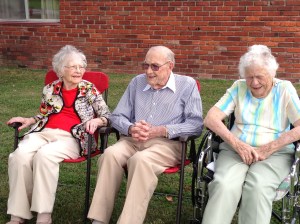
CELEBRATION YEAR – (From left) Georgia Griffin, Goebel Patton, and Maxine Ferrari, all members of Second Baptist in West Frankfort, turned 100 in 2013.

CELEBRATION YEAR – (From left) Georgia Griffin, Goebel Patton, and Maxine Ferrari, all members of Second Baptist in West Frankfort, turned 100 in 2013.

HEARTLAND | Meredith Flynn

Goebel Patton will turn 100 years old this week. But he’s not the only one in his community, or even his church, to celebrate that milestone this year. Maxine Ferrari and Georgia Griffin, fellow members of Second Baptist in West Frankfort, already celebrated their 100th birthdays in 2013.

The unique situation – three centenarians in one church – attracted the attention of a local newspaper and has given their church cause to celebrate. Together, they represent 238 years of church membership at Second Baptist.

Patton joined the church in 1926 as a 13-year-old. “Back in that day, the only social activities were at church,” he says. Drawn to Second Baptist for the fellowship with other young people his age, he has stayed for 87 years, and still serves as chairman of the finance and properties committees. He also started a men’s prayer group in 1991, and reports they’ve met every single Tuesday morning since then.

Having Patton, Ferrari and Griffin as part of the church “ties us to our history,” says Pastor Brett Beasley. The 100-year-olds help younger people understand the church’s history, and give a perspective of what church life was like and how it’s changed.

Their faithfulness is also a source of encouragement, Beasley says. Two years ago, Ferrari arrived at church on a messy wintry morning when only about half of the church’s regular attenders were there. Beasley remembers good-naturedly teasing his congregation: “Maxine made it today, so really nobody’s got an excuse.”

Each of the centenarians has already received a birthday party this year, but Second Baptist is hoping to celebrate the three of them together some time in the future.

Happy Birthday indeed.

Happy, Happy, Happy

Meredith Flynn —  October 14, 2013

dv0301212HEARTLAND | Justin Kinder

I recently started a sermon series at my church in the Beatitudes. I first asked my congregation this question: “How many of you want to be happy?” Most of them raised their hands but a few did not. I repeated the question again, just to make sure everyone had heard me. Again, there were still some who did not raise their hands. I was flabbergasted by their response. Doesn’t every person want to have joy and happiness in their life?

Maybe some of them didn’t raise their hands because they were afraid to do so. Others might have been embarrassed by my question. Or maybe there were some who didn’t want others to see that they weren’t truly happy Christians at this point in their lives.

I can understand how they feel.

Believe it or not, there was a time in my life when I was not a very happy or joyful Christian.  When I was in college, I was a grump.  I knew I was born again by the Spirit of God but I didn’t have the happiness I saw in other Christians’ lives. My roommate Luke, for example, was a very happy-go-lucky person. He would often “torture” me by asking me over and over again, “Are you a happy person?” What was his secret to happiness?

I sought the answer in God’s Word, through prayer, and through a book titled, “Happiness is a Choice.” What I discovered was that my happiness was actually quite shallow. My happiness was based on obtaining material possessions, achieving academic status, relationships with people, and the circumstances of life. But those things were constantly changing!  I needed something that could give me happiness consistently. I discovered the joy of the Lord could help me to be happy even in life’s ever changing circumstances.

You see, Jesus preached a happy, happy, happy, message in the Beatitudes. Over and over again Jesus used the word “blessed,” which has as one definition, “happy.” Happy are the poor in spirit. Happy are they that mourn. What a great message to the world and to Christians who are very unhappy!

But the happiness and blessedness Jesus talks about in the Beatitudes isn’t shallow. It has a deeper mean than we usually give the word, according the Reformation Study Bible. “It includes spiritual well-being, having the approval of God, and thus a happier destiny.”

We will never get anywhere in our search for happiness until we give up trying to find it by our own efforts.  The secret to true happiness is found in loving Jesus and following Him all the days of your life. We will not find true joy and happiness until we find it in Him.

Justin Kinder is pastor of Main Street Baptist Church in Braidwood, Ill.

PRAYER | Frank Page

Editor’s note: This column is part of a Baptist Press series designed to follow the SBC Call to Prayer issued by Frank S. Page (photo below), president of the SBC Executive Committee, to pray for revival and spiritual awakening for our churches, our nation and our world during 2013.

Frank_PageState convention season is here!

I spoke at the Baptist Convention of New York’s annual meeting earlier this week to kick off a full season of state convention travel. My goal is to represent the Southern Baptist Convention to as many states as possible. The reason for this is simple: It is a time when I can touch the lives of a large number of pastors and church leaders.

Our cooperative ministries will only thrive when trust is strong among the churches, associations, state conventions and the SBC. I strive to encourage our state convention leaders in the common work for Christ in which we’re engaged. Trust is built when these relationships are strengthened.

Our state conventions serve as partners in many ways. First and foremost, they are involved in reaching people in their respective states with the Gospel. They also provide specialized ministries to a large number of our churches.

With more than two thirds of our churches facing slow-growth or no-growth challenges, many of our churches are hurting. In most instances, when a church needs help, it is the state convention to which it goes for training, encouragement and assistance across a wide range of needs.

State conventions also serve as partners as the conduits through which our Southern Baptist missions and ministries receive Cooperative Program funds to do the work God has entrusted to them. They have taken significant steps in forwarding a larger percentage of CP funds to these SBC ministries, for which we are grateful. Partnerships developed over the decades remain strong as we join together to do the work of God at every level.

It took me a little over a year in my current role to get to every state convention and visit with the executive directors of those conventions. I have found these men to be deeply called and passionate about winning people to Christ. Interestingly enough, most come from the states they serve and have a deep passion for their home base. They also have a clear vision for reaching the nations with the message of salvation through Jesus Christ, both here and abroad.

I have often said that if we lose the base, we have lost the battle. We need to work as partners in encouraging one another. While we have many, many churches in our state conventions, particularly in the South, we desperately need to understand the lostness that surrounds even those churches.

If there was ever a time when we need to be strengthening churches to reach the lost, it is now. Our state partners are true helpers in that needed ministry.

Join me in praying for the work of our state convention ministry partners.

— Pray for your state convention executive director.

— Pray for the church planting and other ministry specialists employed by your state convention.

— Pray for the ministry entities of your state convention.

— Pray for and participate in the missions initiatives of your state convention.

— Pray for the collegiate ministries in your state.

— Pray for me as I continue my assignment of building relationships and hopefully deepening trust as we encourage one another in the good work of our Lord.

I am thankful for our state convention partners and pray this fall will be a time of deepening resolve and commitment to the work of our Lord.

This column first appeared on BPNews.net.

Music for your Monday

Meredith Flynn —  October 7, 2013

HEARTLAND | If you’re thinking, “I need a pick-me-up this morning,” you’re in luck! Check out this video from Rend Collective Experiment.