
Archives For November 30, 1999

ERLC_Summit_logoNEWS | Meredith Flynn

Nashville, Tenn. | The Ethics and Religious Liberty Commission’s summit on the Gospel and sexuality drew to a close this morning. Much was said on a variety of topics related to sexual ethics, and we’ll cover the conference extensively in the May 5 and May 26 issues of the Illinois Baptist. For now, here are three threads that ran through the conversation in Nashville this week.

Same-sex marriage isn’t the only threat to biblical marriage, and may not be the biggest. In a breakout session this week, Andrew Walker of the ERLC outlined 11 contemporary threats. Same-sex marriage was #6 on his list that also includes economic pressures, divorce, singles aspiring to find their soul mates, and the rise of “professional marriages,” in which spouses have individual bank accounts and separate social lives.

Closing speaker Kevin Smith summarized it this way: “I don’t know what homosexuals shall do or can do to the institution of marriage in the future, but I know marriage is jacked up right now in America in the popular culture and among believers because of heterosexuals.”

The call to reclaim biblical marriage is more urgent. Summit speaker David Prince probably raised some eyebrows when he said that as a pastor visiting new parents, he prays over their babies, and specifically for their future spouses. One grandfather in a hospital room expressed his disbelief that Prince was praying that way already, the Kentucky pastor said. But several leaders this week echoed the principle: At a time when marriage is being redefined, and fewer people are getting married in the first place, it’s up to evangelicals to reclaim and profess the biblical meaning of marriage.

Embrace the strangeness. One of Moore’s main messages during his first year as ERLC president has been that Christians will be increasingly strange – he has even used the word “freakish” – as nominal Christianity falls away and culture continues to move away from previously held values. Twitter proved that point this week, as posts with the hashtag #erlcsummit poured in during nearly every session. The majority of the feedback was negative from those watching online or following along on Twitter, but that’s not surprising, Andrew Walker said.

“We are talking about the Christian sexual ethic being more unique and distinguishable in society, and we’re trying to warn Christians, ‘Hey, the ground has kind of fallen out from beneath you. The culture has changed on this issue. And one way to really gage that is to see what social media is saying.'”

The correct response to our increasing strangeness, Moore said, is an awareness of what’s happening in the world and a commitment to speak lovingly into the culture. “We have to understand that as we speak prophetically within the church and outside of the church when it relates to issues of sexuality or any other issue, we have to do that in a way that opposes the devil, without acting like the devil.”

 

An almost-Gospel is no match for the sexual revolution.”

Russell Moore, president of the Ethics and Religious Liberty Commission

NEWS | Meredith Flynn

Nashville, Tenn. | There are few things that make the Gospel more offensive and more out of sync with culture than what the Bible teaches about sex. But the church has to keep talking about it.

J.D. Greear, pastor of The Summit Church in Raleigh-Durham, N.C., told leaders gathered for the Ethics and Religious Liberty Commission’s summit on the Gospel and sexuality that the church can’t surrender the “high ground” in talking about sex, and also shouldn’t avoid hard topics like homosexuality. Greear also stressed that the root of sexual sin is idolatry, and the Gospel is powerful to deal with it.

“Our message cannot simply be, ‘Stop having sex.’ Our message has to be, ‘Behold, your God.'”

Encouraging leaders not to avoid hard topics, Greear said he had struggled two years ago with whether to speak publicly in favor of his state’s attempt to define marriage as between a man and a woman. He did and was met with harsh criticism, including one blogger who published the Greears’ home address.

For three weeks, Greear thought he and his leadership team might have made the wrong decision, he said. But now he has little doubt it was the right thing to do. Teaching his church to think “Christian-ly” about the issue was the goal; also, his church has seen several people come out of a homosexual lifestyle, accept Christ, and be baptized.

Greear’s message and the first day of the ERLC summit got a lot of attention on Twitter; by Monday evening, #erlcsummit was one of the social media site’s top trends. Posts from conference attendees were positive, but others watching from home or following the tweets expressed different views. The Twitter traffic seemed to increase when several leaders joined Greear on stage for a panel discussion on the Gospel and homosexuality.

There were light moments, like when Florida pastor Jimmy Scroggins told pastors to reject “redneck theology” when talking about homosexuality. No more “Adam and Steve” jokes, he said. But the conversation was serious when the panel talked about what pastors should do when gay people or couples want to join their church, or how to counsel a Christian who still feels attracted to members of his or her same sex.

“There are things that are broken because of the curse of sin that you becoming a believer doesn’t automatically fix,” Scroggins said. That’s why pastors have to preach the second coming of Christ, he said, and the transformation of all believers who are in Christ. “In some mysterious way that I can’t comprehend, He is going to put Humpty Dumpty back together again,” Scroggins said. Breaking into a grin, he added, “Can’t wait to see these tweets.”

Watch the ERLC Summit online at live.erlc.com.


My job and the Gospel

Meredith Flynn —  April 7, 2014

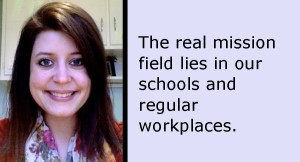
Carrie_Campbell_blog_calloutHEARTLAND | Carrie Campbell

Looking around my middle school classroom in Springfield, I’m struck by how different it is than where I was eight months ago, surrounded by the beautiful mountains of eastern Kentucky.

Or five months ago, when I was immersed in the bright and flashing lights of New York City.

After college, I decided to take a season of my life and do full-time ministry. I spent two years in Kentucky working with at-risk kids. I followed that up with a
few months in Brooklyn, learning about ministry in an urban context. I came back home to Illinois in November and felt called to live out a personal dream: becoming a teacher. I received an exciting job offer to teach current events to sixth, seventh and eighth graders.

My classroom isn’t as scenic as the mountains or the city, but it’s certainly a mission field.

Going from a mission-minded environment to a secular workplace was a big jump for me. In many ways it was one of my biggest life challenges. I went from being surrounded by those who have the same eternal goal in mind, to working with people who have lots of different goals. I quickly learned that the “harvest is plentiful but the workers are few.” But God has given me opportunities to share the Gospel.

One of the first things I noticed among my co-workers was that the environment in my school was very negative. I started writing encouraging notes to the teachers on my team as well as the administrative staff. My coworkers quickly took notice of that and sought me out to talk about their struggles. A before-school prayer meeting started up again. People are more positive now. I realized that sharing the Gospel starts with the small things, and God can take those small things and transform a school.

The most valuable part of my job is getting to know my students and letting them know I care about their needs. Even though I’m not allowed to say, “Christ has a future for you,” I can give positive feedback and point them toward their strengths.

One student recently was placed in my room for a behavior problem. He quickly got bored, so I gave him the simple task of fixing my three-hole punch. He liked that I gave him some attention and that he was able to accomplish this task for me. We’ve had a positive relationship since then, and he knows that I care about him and want him to do better in school.

Even with the challenges this new workplace brings, I have been constantly reminded that Christ is in control, and that the real mission field lies in our schools and regular workplaces. People with needs are crying out and, for us who are Christians, being able to step into those places and bring the Gospel is an honor.

Carrie Campbell is a member of Delta Church in Springfield.

Do you know Carol?

Meredith Flynn —  March 10, 2014

Guinea_boats_blogHEARTLAND | Meredith Flynn

Mark Emerson had spent several hours on a boat off the coast of Guinea, looking for the Mbotini people group. It was getting late, and the group would eventually have to turn around. But Emerson had a good reason to find the Mbotini.

They were Carol Stewart’s people.

Before his trip in January, Emerson talked to Stewart about the people group she and her church adopted several years ago. Stewart, a member of Lincoln Avenue Baptist in Jacksonville, Ill., had visited Africa’s west coast. But still, it was surprising how many times
Emerson heard the question:

“Do you know Carol?”

From two missionaries and a local pastor, on the other side of the world. “This Illinois Baptist is known in Guinea because she went there in representation of her church,” Emerson said.

He’s hoping others will follow her example. The International Mission Board is calling congregations to be “engaging churches” who will adopt an unreached, unengaged people
group (UUPG) and send small teams several times a year.

Reaching unreached people groups will require a long-term investment. “This was my first mission trip I’d ever participated in that we didn’t win anyone to the Lord,” Emerson said of
his time in Guinea. Referencing William Carey, he said, “We forget that these hall of fame missionaries of the past spent years before they saw anyone come to the Lord.”

When he joined IBSA’s missions team, Emerson said he had a goal to get as many Illinois Baptists to the mission field as possible. Now, “I’m thinking we need to get the Gospel
where it’s not.”

Read more Africa stories in the newest issue of the Illinois Baptist newspaper, online here.

BIG_pic_0210HEARTLAND | It had been a long, frustrating boat ride.

Mark Emerson and Harold Booze were just off Africa’s west coast, trying to locate a people group everyone seemed familiar with, but no one could find. With evening approaching and no place to stay for the night, Emerson knew they needed to go back to Kamsar, the city they had left a few hours before.

Go to IBSA’s Facebook page for a slideshow from the trip.

“The crushing blow is, I’ve had to turn this boat around, and I haven’t gotten to give the Gospel to anyone,” he said.

Emerson and Booze had come to Guinea with three other Illinois Baptist pastors to share Bible stories with people in the mostly Muslim, largely illiterate country. The group had split up, each with a missionary guide and an interpreter, and each in search of people groups who haven’t yet been engaged with the Gospel.

On the boat, “I’m going to give the Gospel to somebody,” Emerson decided. Along with the boat captain, two other Guineans were also on board. Emerson started telling “every ship story of Jesus, one right after the other,” he said, laughing at the memory.

On a later visit to an historic village, the Americans took a turn as listeners, hearing the story of how the people had come to settle there. When they finished the detailed account, the villagers said, “You tell us a story.”

Emerson replied, “I’ve got a great one.”

The International Mission Board will host a Base Camp training conference March 28-29 at FBC, Woodlawn, Ill., for churches interested in engaging unreached people groups of Sub-Saharan Africa. E-mail MarkEmerson@IBSA.org for more information.

Justin_KinderCOMMENTARY | Justin Kinder

A recent article in the Illinois Baptist newspaper caught my attention:

“The Presbyterian Church USA chose not to include the song, ’In Christ Alone,’ in their new hymnal all because the song mentions the ‘wrath of God.’ On Christiancentury.org, Mary Louis Bringle, chair of the committee who made the decision, wrote that the song propagates ‘the view that the cross is mainly about God’s need to assuage God’s anger and that view could be harmful to future generations of worshippers.’”

I guess I shouldn’t be surprised by such an article in today’s day and age. However, I did almost spit out the Cheerios I was having for breakfast as I read it.

We must understand what the Bible says about sin and about God and His wrath. When our first parents Adam and Eve fell in the Garden of Eden, they let sin enter into our world. We are all sons and daughters of Adam. In other words, we are all born into this world as sinners. Adam and Eve did not escape punishment for their sin either. They were going to die a physical death and they also died a spiritual death. The same holds true for us: we are all going to die someday and before we ever come to know Jesus Christ as Lord and Savior, we are spiritually dead in our trespasses and sins.

We must also understand that God, the God of the Bible, is a holy God. He cannot tolerate sin. In fact, He hates sin and He must judge sin. We deserve God’s wrath for sin but God in His mercy and grace sent Jesus Christ to be the perfect sacrifice to take away the punishment and penalty for our sin. When Jesus was on the cross, He endured God the Father’s wrath for sin for us. I believe that shows amazing love and grace by God!

There is also further proof from the Bible that Jesus Christ endured God’s wrath for sin while He was on the cross. When Jesus was in the Garden of Gethsemane remember that He prayed, “My Father, if it is possible, let this cup pass from Me; yet not as I will, but as You will.” The cup that Jesus was talking about is referring to the wrath of God. Remember that Jesus also said while He was on the cross, “My God, My God, why have you forsaken Me?” He was quoting a psalm of David but in reality what was happening is that Jesus Christ was experiencing the wrath of God the Father at that very moment.

In John 3:36 it says, “Whoever believes in the Son has eternal life, but whoever rejects the Son will not see life, for God’s wrath remains on them.” In that passage, there is good news and bad news all at the same time. The bad news is this:  if you reject the cross of Jesus Christ, then the wrath of God still abides on you, but you don’t have to remain in that condition.  You can be saved.  Saved from what specifically? The wrath of God. Here is the good news then: when you believe on Jesus Christ as Lord and Savior the wrath of God is taken away from you and you are given eternal life. You are no longer under condemnation but under God’s grace. My friends, we must not sugarcoat the Gospel. We must speak the truth in love and not be afraid to offend people with the truth of God’s Word.

Justin Kinder is pastor of Main Street Baptist Church in Braidwood, Ill.

Jonas, Charlotte and Simon Abner

Jonas, Charlotte and Simon Abner Photo by Alisha Abner

HEARTLAND | Chase Abner

Just over five years ago, my firstborn came into the world. My wife, Alisha, and I thought we were doing something noble by naming him Simon, hoping that would set a Godward course for his life since it originates from a Hebrew phrase for “he has heard.” Ironically, Simon strives to understand every conversation going on around him and asks me, “What’d you say?” about a hundred times each day.

Just 15 months later, our second came along. “Name him Jonas,” we said. “It’s from the Hebrew for dove. He’ll be a peaceful child.” Little did we know that in some contexts Jonas also means “destroyer,” making it more appropriate than ever. The same child who can give the sweetest, voluntary snuggles, is also the most prone to fits of anger that leave broken toys and scarred furniture in his wake.

Finally, there is 2-year-old Charlotte whose name we chose simply because we thought it was extremely cute. So far, she’s lived up to that expectation. The only problem is she has already learned to use it to her advantage.

I share all this to demonstrate that I’m a father to real, live kids. And though I’m enamored with them, they still suffer from the effects of the fall and, like me, are in need of the grace of God. As a matter of fact, that is my charge as their dad – to teach them how we are all utterly dependent upon the grace of God.

I wish there was a Bible verse that told me exactly how to respond when Simon asks me the same question 20 times in a row. I wish Jesus had preached a sermon on how to discipline Jonas when he throws toys. I wish God gave us step-by-step instructions on how to teach Charlotte not to be manipulative. But He didn’t.

He gave us something better…the Gospel.

Fatherhood is teaching me just how much better the Gospel is than the law, especially a parenting law. Rather than loving us based on how well we love our children, God loves us exactly as He loves Jesus. Rather than condemning us for the promises we break to our children, God keeps His promise to make us new. Rather than judging us by how healthy we keep our children, God gave His only son on our behalf.

I’m really glad that no one but God could see what was in my heart during the sleepless nights while Simon was an infant. We had prayed for this gift from God and welcomed him with tears in our hospital room. Yet in my sinful, selfish moments, I viewed Simon like a curse just because he was on a different sleep schedule than me. I found that the best way to soothe him was to pace through our Carbondale apartment singing hymns as lullabies. That was God’s design. He knew I’d need reminders in those moments of how He has loved me through the cross, so that the Gospel would again equip me to love my children at cost to myself.

One of the most comforting implications of God’s sovereignty is that all circumstances in the lives of His children, even the bad ones, are means of grace by which He is revealing His goodness to us. After all, as Romans 8:1 tells us, “There is therefore now no condemnation for those who are in Christ Jesus,” (ESV). So then, whatever God gives or withholds in our lives is meant to draw us closer to Him.

One of those gifts in my life is fatherhood. No experience has taught me more about my sinfulness and God’s goodness. I have seen how prone I am to selfish pride when I get something right. I have seen how judgmental I am when I see another parent’s failures. And yet, I’m secretly insecure because I often just don’t know if I’m getting one bit of fatherhood right.

In those wee hours of the night in my early fatherhood, Simon’s favorite hymn seemed to be “Down at the Cross.” It’s fitting because few things drive me to Jesus like my failures as a father. Because of His perfection, my Father accepts me as though I had never once been selfish or lost my temper. So to those who are right there with me, the hymn has this to say: “Come to the fountain so rich and sweet, Cast thy poor soul at the Savior’s feet; Plunge in today and be made complete.”

Chase Abner is IBSA’s collegiate evangelism strategist.

pull quote_ADAMS_jan24COMMENTARY | Nate Adams

A few days ago I had the privilege of performing the wedding ceremony for our son Caleb and his now wife Laura. As is true for most young couples, it was arguably the biggest moment of their lives. So I was very pleased when, together, they told me their desire was for the ceremony to honor God. But I was especially moved when they went a step further, and asked me to make sure the Gospel was clearly presented.

You pastors that are reading this know what a welcome and freeing experience that is. We long, most of us, for opportunities to share Christ openly. But we also need to be sensitive to the couple’s or family’s wishes at times like weddings, anniversaries, or funerals.

And not everyone wants to give the big moments of their lives to the Lord. Even devoted Christians often expect the bride to be the primary focus of a wedding day, and that’s understandable. But I think you can focus on the bride, honor the Lord, and share the Gospel without diminishing any of the three. Let me share briefly here the few words I included in Caleb’s and Laura’s ceremony:

“Now let me pause here and say something to the rest of the congregation. When Caleb and Laura and I were planning this ceremony, I asked them, what would you like the central message of your wedding ceremony to be? What would you like the people gathered there on that special day to know above all else?

“Here’s what they said. ‘The most important thing about us and our story is that we would not be together except for the way God has worked in our lives. We want others to see His story in our story. We didn’t really know how to love each other until Christ became the center of our relationship. We would love everyone there to know what it means to have God at the center of their lives and their relationships.’

“You see, the way this young couple came to know and love each other is the way many people come to know and love God. It may begin with just a casual acquaintance, an occasional prayer, maybe even periods of disinterest and distance. And then one day, your realization that God loves you unconditionally comes alive, perhaps through the joyful expression and heartfelt testimony of someone who really knows Him. You realize the void in your life, and that God has been there all along, loving you and reaching out to you. Nothing would please Caleb and Laura more, and nothing would honor their wedding day more, than for you to turn to God as they have, and to surrender your life to Him.  Caleb and Laura want you to know that, with the certainty they do.”

Words along those lines can give wedding guests something to talk about at the reception. More importantly, they can give lost friends and family something to talk about on the drive home, or with the couple after they return from the honeymoon.

The biggest wedding day of all will be when the risen and victorious Lord Jesus returns to earth as a Groom coming for his bride, the Church. That day will certainly focus on the Bride, but it will also glorify God and lead every knee to bow at the truth of the Gospel. It will be a day when we will all be glad for the big moments of our lives that we gave to the Lord, especially if He uses them as opportunities to draw our loved ones to Himself for eternity.

Nate Adams is executive director of the Illinois Baptist State Association.