Archives For November 30, 1999

Columbus, Ohio | Meredith Flynn

The most personal testimony shared publicly during the 2015 Southern Baptist Convention in Columbus, Ohio, came from a source most Baptists probably had never heard of prior to the meeting.

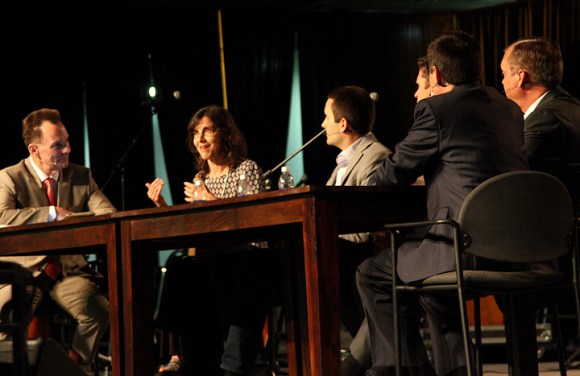
Rosaria Butterfield (second from left) was part of a panel discussion on same-sex marriage at the 2015 Southern Baptist Convention.

Rosaria Butterfield participated in a panel discussion Wednesday afternoon with some very familiar faces—men that have been instrumental in calling Baptists to a deeper reliance on the gospel when it comes to understanding how it intersects with cultural issues.

When it was her turn to speak, she delivered the truth, plain and simple:

“I often tell people I was not converted out of homosexuality,” said Butterfield, a former lesbian. “I was converted out of unbelief. And then the Lord started working on some other stuff.”

One reporter in the press room later commented they were glad Butterfield had been in Columbus, so that more people could hear her story. Her past and, in a different way, her present—her husband pastors a Reformed Presbyterian Church—set her apart from her audience in Columbus. But as she nodded encouragingly as the other panelists talked, and when she delivered the short version of her testimony with an almost-constant smile, the value of hearing from a new voice at the Southern Baptist Convention was clear.

As a professor at Syracuse University, Butterfield said she had finished the book she needed to write to achieve tenure and turned her attention to what she really wanted to write: “a critique of the religious right from a lesbian feminist point of view.”

In the process, she met a Christian pastor and his wife who invited her into their home (and visited hers) and truly befriended her. At first, “I thought I simply got free research assistants,” Butterfield told the audience in Columbus.

But after two years and reading through the Bible seven times, she said, “The Bible simply got to be bigger inside me than I. And one of the things that I realized was that I wanted Jesus.”

Butterfield’s fascinating testimony, detailed in her book “The Secret Thoughts of an Unlikely Convert: An English Professor’s Journey Into Christian Faith,” stands alone as encouragement to churches trying to reach out to their neighbors with genuine love and the truth of the gospel.

But it was what she said later in the discussion that could prove to be most helpful. In just a few minutes, Butterfield laid out a prescription for how the church can minister compassionately to the LGBT community:

Make your Christian community an accessible community. That means giving up ownership of our time, Butterfield said, and also gaining a more “collective” understanding of sin.

She quoted 1 Corinthians 10:13, about God providing a way of escape from temptation. “What if your home is the way of escape?” she asked.

Share “the means of grace” in a public way. How can Christians make repentance more known (and understood) among their neighbors?

Get to know the Bible—better than we do now. Time with the Lord is “a public community service,” Butterfield said. It’s how Christians get ready to speak a word of truth.

“Don’t deny the power of the gospel to change lives and to travel at the grassroots level,” Butterfield said near the end of the conversation. “Your friendships matter.”

For those listening to her story in Columbus, the power of the gospel was undeniable.

Watch the panel discussion, held during the Wednesday afternoon session of the Southern Baptist Convention, at http://live.sbc.net.s3-website-us-east-1.amazonaws.com/ondemand.html.

Afshin_Ziafat_2NEWS | It was an English tutor who first showed the gospel to Afshin Ziafat.

As a first grader, Ziafat, who now pastors Providence Church in Frisco, Texas, moved to the United States with his family from Iran. It was 1979, a bad year to be Iranian in America, Ziafat told his listeners at the Ethics and Religious Liberty Commission’s summit on racial reconciliation and the gospel.

Ziafat’s family left Iran during the Islamic Revolution. “We had no idea what kind of unrest we were about to walk into,” he said.

The ongoing hostage crisis involving American victims meant Ziafat’s new home—Houston, Texas—was a hostile place. Radio stations played a new version of the Beach Boys’ song about Barbara Ann: “Bomb, bomb, bomb…bomb, bomb Iran…”

Rocks were thrown at his family’s home, and his parents’ tires were slashed. Ziafat and his brother were threatened at school.

And when he was in second grade, his tutor—who had taught him English by reading him books—gave him a small New Testament.

“You’re not going to understand this today, Afshin, but promise me you’ll hold on to it and read it when you’re older,” she told him.

Ten years later, Ziafat accepted Christ.

“Had any other American given me that New Testament, I would have thrown it away,” Ziafat said in Nashville today. “Because I didn’t trust them.

“You want to win a Muslim for Christ, I believe you have to earn the right to be heard. And she did it by the way she was loving me.”

“There are many more Afshin Ziafat’s today than there were back then, in your neighborhoods,” he said, “and God is calling us to step out. Listen to me folks— especially at a time when it is expected for us to distrust and maybe even hate Muslims.”

Ziafat ended his testimony with the story of the prophet Jonah, who knew that God was calling him to go preach to Assyrians who were not only his enemies, but also would conquer his people. Jonah’s book ends with a question from God about the people the prophet was called to go to, Ziafat noted:

“Should I not pity them?”

“You never get the answer from Jonah,” Ziafat said. “You know why? Because I think that questions goes out for us today….And I’m telling you, friends, we answer that question with the way we live our lives.

“The gospel calls me to step out of my comfort zone and go out to people who don’t look like me, who don’t dress like me, who are not of my skin color, but on top of that, especially those who are my enemies. Who I am expected to hate? When I show them love, the gospel is revealed.”

Tony_EvansNashville, Tenn. | “Jesus reversed over 800 years of racial discord in 24 hours,” Tony Evans preached this afternoon at the ERLC’s Summit on the gospel and racial reconciliation.

Walking his listeners through John’s account of Jesus’ encounter with the Samaritan woman at the well, Evans, pastor of Oak Cliff Bible Fellowship in Dallas, made application to modern times:

Jesus met the woman on common ground, at Jacob’s well (John 4:6). “Jews didn’t like Samaritans, Samaritans didn’t like Jews, but since they both loved Jacob, that’s where he stopped,” Evans said. The Old Testament patriarch was viewed as the father of both Orthodox Jews, and the pariah Samaritans.

He didn’t hide who He was. The woman at the well knew Jesus was Jewish (John 4:9), even though he didn’t say it. But though he looked and talked like a Jewish man, Evans noted, he didn’t act like one to the woman, who other Jews would have viewed as an outcast. Nor did he try to be something he wasn’t.

God is not asking you to stop being different than you are to reach somebody different than you are, Evans said. He doesn’t want white people to be black or vice versa. “He’s asking both to be biblical.”

Jesus earned the right to deepen the conversation. “Because he was willing to drink out of her cup” at the well, Evans said, “he has now earned the right to take a normal discussion about water and turn it into a discussion about eternal life” (John 4:13-14).

Jesus was about his father’s business. Father God plays an integral role in the story of the woman at the well. The conversation changed when the Samaritan woman brought Him up, trying to change the subject when Jesus reveals he knows her current situation (John 4:19-20).

Jesus uses the opportunity to show her what she’s always known to be true about her history, her background, and her identity isn’t, in fact, true. Jesus’ words apply to the racial absolutes we live by too, Evans inferred.

“Black is only beautiful when it’s biblical, and white is only right when it conforms with holy writ,” he said.

Many more Samaritans believed in Jesus because of the woman’s testimony, John writes. How can the reversal detailed in the story happen in just 24 hours, Evans asked. Because Jesus was about his father’s business.

Watch the Summit online at live.erlc.com.

Government leaders need support, encouragement, advice and gospel centered truth, says Carrie Campbell (second from right).

Government leaders need support, encouragement,
advice and gospel centered truth,
says Carrie Campbell (second from right).

COMMENTARY | Carrie Campbell

Every year, my family goes to the Springfield City Basketball Tournament to watch our four city high schools duke it out for the top spot. A few weeks ago, we were sitting at the tournament on a Saturday night when I got a text message from my roommate: Bruce Rauner, Illinois’ newly elected governor, was there.

I quickly scanned the crowd looking for men in suits and a cluster of people. After searching for about 10 minutes, my mom spotted him among the crowd looking just like the rest of us, wearing blue jeans. I immediately decided I wanted to meet him. My sisters and a friend of ours from church headed down to where he was sitting near the court. Gov. Rauner was taking photos with a few other people, and when it was our turn, he smiled at us brightly and told us to come in close and put our heads together.

I introduced myself and told him that I was a middle school teacher. He laughed and said, “God bless you.” We went back to our seats, but later that evening, I went back to talk to him and his team a bit more. I told them that I teach at a diverse school, with students from more than 10 countries. I invited him to meet our students, most of whom have probably never met anyone that influential, especially a government official.

As Christians, I think it’s easy to get intimidated or star-struck by people that lead lives that seem more important than ours. Yes, the governor of Illinois does make many important decisions for our state. But he’s also like the rest of us, a human being put on this earth to glorify God. My introduction to Gov. Rauner reminded me that not only is it extremely important that we lift up our government officials in prayer, but also that we build relationships with them when we have the opportunity. They need our support, encouragement, advice, and gospel centered truth just as much as the next person does.

Romans 13:1 calls Christians to action in just this way: “Let every person be subject to the governing authorities. For there is no authority except from God, and those that exist have been instituted by God.” So I put forth a challenge to you: The next time you come in contact with a government leader, encourage that person with a friendly introduction, handshake, and—as God gives opportunities—with gospel centered truth.

Carrie Campbell is a middle school teacher in Beardstown and a member of Delta Church in Springfield.

Nick_RynersonCOMMENTARY | Nick Rynerson

It’s that time of year again. Christmas pageants, Advent sermons, beautifully lit homes, crowded malls, and—of course—television commercials showing you “the perfect gift for this holiday season.” Consumeristic binge-shopping and “once a year sales” have become as much a part of American Christmastime as trees, stockings, and the Nativity scene.

Modern Christians are quick to point out the gross consumerism that surrounds the celebration of Christ’s birth and we often viciously fight to curb and challenge Consumeristic Christmas™.

Perhaps rightfully so. As we all know, Christmas is more than just an excuse to spend money in excess, get together with family, and watch “It’s a Wonderful Life.” Christmas is a time to celebrate that God loved humanity enough to send His Son to free us from the unsolvable mess of sin we’d gotten into. Christmas marks the beginning of the end for humanity’s sin problem.

And, amazingly, we live in a culture that recognizes that.

Our culture may not recognize that they recognize it, but think about it for a second: probably almost everyone you know (if you live in the United States) changes up their life rhythms to spend prodigious amounts of money on other people, make an effort to get together with estranged relatives, and even go to church (sometimes)!

Christmas shoppingWhenever I think of how most non- Christian Americans celebrate the Christmas season, I’m deeply moved. The secular “holiday spirit” reminds me of Paul’s words to the Greek pagans in Acts 17:

“And he made from one man every nation of mankind to live on all the face of the earth, having determined allotted periods and the boundaries of their dwelling place, that they should seek God, and perhaps feel their way toward him and find him. Yet he is actually not far from each one of us, for, ‘In him we live and move and have our being’; as even some of your own poets have said, ‘For we are indeed his offspring’” (Acts 17:26-28 ESV).

If we set aside our criticisms to consider the Christmastime shopping habits of most people, we will glimpse something that echoes the woman in Mark 14:3-8 who anointed Jesus’ feet with expensive oil—people spending reckless amounts of money on gifts for their children, parents, friends, and relatives. At the mall, masses of people seek to communicate the deep and Christ-reflecting love they have for their families and neighbors in the best way they know how: through gift-giving.

While there are clearly sin issues at play in American consumerism, let’s be encouraged that—at least at Christmas—the generosity of Jesus flows through our malls and checkbooks. And when we talk with our non-Christian neighbors about Jesus this Christmas season, we, like Paul, can affirm God’s image, God’s love, and God’s common grace in them.

Nick Rynerson is a staff writer for Christ and Pop Culture and works for Crossway Publishing in Wheaton.

COMMENTARY | Josh Monda

This week marks the one-year anniversary of the EF-4 tornado that devastated parts of Washington, Ill. Brookport, New Minden, Diamond, Coal City and Pekin were among the other Illinois communities affected by powerful storms on Nov. 17, 2013.

This week marks the one-year anniversary of the EF-4 tornado that devastated parts of Washington, Ill. Brookport, New Minden, Diamond, Coal City and Pekin were among the other Illinois communities affected by powerful storms on Nov. 17, 2013.

Humanitarian effort void of the gospel of Jesus Christ does nothing to change one’s eternal destiny. Moments after making this statement during a sermon, a tornado would rip through our town, passing a quarter mile from our church.

The day of the tornado was not without trouble, even before the storm came through Washington. A month before, my father-in-law had been diagnosed with esophageal cancer. The day before the tornado, my 14-year-old daughter laid on my living room floor near death, and that evening was in the hospital.

Taking a full load in seminary, and trying to balance all that was going on in my life, I gathered our two young sons that Sunday morning and got them ready for church. The rest, as they say, is history. An EF-4 tornado hit our town as my congregation took shelter in the church basement.

It would have been easy then (and now) to focus on all that changed that day, or how everything after November 17 would be different than before. Indeed, a lot is different, even a year after the storm. Members of my church, deacons in my church, lost their homes. One of our deacons moved away, and for a small church, this is difficult.

Change has touched my family too. My daughter eventually recovered from the infection that put her in the hospital, but my father-in-law passed away before the tornado.

Not every change has been negative: After the storm, people seem more in tune to the needs of others, and thoughts about possessions have changed.

But my focus, and our church’s focus, is on something that will never change: the gospel of Jesus Christ. It was not by mistake that I would make the statement about humanitarian effort and the gospel moments before the tornado hit. Our focus has to be on the gospel.

When people are hurting, our focus must be the gospel.

When people are suffering, our focus must be the gospel.

When people know not where to turn, our focus is the gospel.

A tornado can change our circumstances, it can even change where we live. But a tornado will not transfer someone from the Kingdom of Darkness into the Kingdom of Light; only the gospel does this.

As a people, as a church, we can allow a tornado to either drive us to what truly makes a difference, or distract us from it. May our focus be on what makes a difference; may our focus be on the gospel of Jesus Christ.

Josh Monda is pastor of First Baptist Church in Washington.

THE BRIEFING | InterVarsity Christian Fellowship will lose its current access to all 23 schools in the California State University system because the ministry requires their leaders to affirm Christian doctrines, reports Christianity Today. IVCF’s policy is in violation of a university rule, adopted in 2012, that requires recognized groups to accept all students as potential leaders.

The_Briefing“While we applaud inclusivity, we believe that faith-based communities like ours can only be led by people who clearly affirm historic Christian doctrine,” reads a statement on IVCF’s website.

The ministry received a one-year exemption from the policy for the 2013-14 school year, but will now lose privileges including free meeting space and access to campus activity fairs.

On his blog, LifeWay’s Ed Stetzer examines the ramifications: “The bigger, and ongoing, issue is the continual sanitization of unacceptable religious voices from universities.”

State marriage cases likely to land in high court
Recent rulings on marriage by federal judges and circuit courts have advocates on both sides of the debate looking toward the U.S. Supreme Court to decide the issue. On Sept. 4, 32 states—15 that allow same-sex marriage and 17 that don’t—asked the high court to settle it once and for all, reported the Associated Press.

Same-sex marriages in Illinois officially began June 1, although some counties issued licenses earlier. The state’s General Assembly approved “The Religious Freedom and Marriage Fairness Act” last fall.

‘Elevate Marriage’ scheduled for Oct. 16
The Illinois Baptist State Association will host an “Issues & Answers” event in Springfield, Ill., to help churches address cultural shifts on marriage. The Oct. 16 conference for pastors and church leaders will feature Kevin Smith, The Southern Baptist Theological Seminary; Andrew Walker, Ethics and Religious Liberty Commission; and Jill Finley, Bethel Baptist Church, Troy, Ill. Lunch is included, and registration is required; go to www.IBSA.org/Marriage.

Chick-Fil-A founder Truett Cathy dies at age 93
Christian leaders and fans of Chick-Fil-A mourned the loss of S. Truett Cathy, who died early Monday morning. Cathy built the chain—known for its chicken sandwiches—from one store in 1946 to more than 1,800 restaurants currently operating in 40 states and Washington, D.C. He was known for his Christian faith and Chick-Fil-A’s “closed on Sundays” policy. Read more at BPNews.net.

Osteen answers criticism
Megachurch co-pastor Victoria Osteen said that church-goers at Lakewood Church in Houston, Texas, understood her recent controversial comments about why people ought to obey God. “When you come to church, when you worship Him, you’re not doing it for God really,” Osteen said during a Lakewood service Aug. 31. “You’re doing it for yourself, because that’s what makes God happy.” The video went viral, garnering much criticism on social media. Osteen told The Blaze she could have been more articulate, but she stands by her point. “I did not mean to imply that we don’t worship God; that’s ridiculous, and only the critics and cynics are interpreting my remarks that way.”

Al Mohler, president of The Southern Baptist Theological Seminary, blogged that the message preached by Osteen and her husband, Joel, “is the latest and slickest version of Prosperity Theology.” Read Mohler’s commentary here.

THE BRIEFING | Dozens of people came to faith in Christ at the August 2 funeral for 15-year-old Braxton Caner, according to reports on social media.

“Dozens saved today @ Brax’s funeral. We wanted the Gospel given,” tweeted Braxton’s father, Ergun Caner, president of Brewton-Parker College in Georgia. Caner also re-tweeted a photo of his son’s football teammates kneeling and praying after the service for Braxton, whose death was reported July 29 as a suicide.

On July 30, Ergun Caner wrote, “No words. No sermon. No funny quotes. No answers. No note. Nothing but excruciating pain & the assurance that I’ll see him in Glory.” The next day, he posted a photo of himself baptizing then-6-year-old Braxton.

Pastor Rick Warren, who lost his 27-year-old son to suicide last year, was one of many Christian leaders who reached out to Caner and his wife over Twitter. “I am weeping with you @erguncaner and Jill.”

Read The Christian Post’s report here.

Other news:

The_Briefing‘Third way’ church could be removed from fellowship with Baptist association
The executive board of the Los Angeles Southern Baptist Association has recommended that messengers from New Heart Community Church not be seated at the association’s annual meeting in October. Danny Cortez, pastor of the La Mirada congregation, announced earlier this year that he no longer believes same-sex relationships are sinful. The church voted to become a “third way” church that neither condemns nor affirms homosexuality. Read more at BPNews.net.

Missionary doctor recovering from Ebola virus in U.S.
The director of the Centers for Disease Control and Prevention said Aug. 3 that Dr. Kent Brantley is “improving” after contracting the Ebola virus. Brantley, an aid worker in Liberia with Samaritan’s Purse, was flown to Atlanta for treatment Aug. 2. Fellow American Nancy Writebol is expected to join him today. Both doctors contracted the Ebola virus while treating patients in a region where hundreds have died from a recent outbreak. Read more at SamaritansPurse.org.

IMB worker reports on ‘invisible war’ with Ebola
The Southern Baptist International Mission Board says it is monitoring the Ebola epidemic in West Africa, and medical coordinators “have been in touch with Southern Baptist missionaries in the region to keep them informed of the changing situation,” Baptist Press reports. The IMB has personnel in Guinea and Liberia, two of the countries affected by the outbreak.

A Christian worker in Liberia shared her account of what it’s like to live in a country where people are fighting an “invisible” enemy like the virus. Read it at BPNews.net.

Praying for peace in Jerusalem
Southern Baptist Convention leader Roger S. Oldham gives several specific ways to pray for the conflict between Israel and Hamas. “On the political front, the ‘peace of Jerusalem’ seems to be an elusive dream,” Oldham wrote. “But on the spiritual front, those who know the Prince of Peace have learned that peace is a gift the Lord gives (John 14:27).”

Editor’s note: This is the final story in a series of three testimonies about Super Summer, an annual discipleship week for students sponsored by the Illinois Baptist State Association. Click here to read how Hannah Batista met Christ at Super Summer, and here for why youth minister Tim Drury takes his students to Greenville for the week every year.

Zaxxson_NationHEARTLAND | Zaxxson Nation spent Super Summer 2014 teaching high school seniors the most practical parts of discipleship— finding a mentor, building intentional friendships, and investing in a local church. As assistant dean for the green school, which is focused on discipleship, Nation helped transfer to his students some of the same principles he learned as a Super Summer student.

Assistant dean is just one hat Nation has worn since his first week in Greenville 12 years ago. As a 16-year-old student leader from Rochester First Baptist, he realized at Super Summer that his Christianity was based more on head knowledge than faith that had taken root in his heart.

“God really changed everything in my life” that week, Nation said. “And at that point I was ready to serve, to do whatever it took to just serve Him.”

Part of what makes Super Summer different from some other camps is the laser-like focus on knowing Jesus more, Nation said. At his first Super Summer, “When we had free time, we were talking about Jesus. And when we went to bed at night, we were joking around, but we were also sharing our testimonies.”

Years later, he said, “I think it’s the same now as it was 12 years ago when I was a student. It’s still people coming together for the same reason; it’s still students that are serious about their faith.”

Nation acknowledged that Super Summer creates an environment that’s impossible to recreate once students get home and the distractions of life flood back in. Being cut off from regular life for a week is both a blessing and a curse, he said. “God uses it, though; He used it for my life,” he said.

“The other big thing about Super Summer is it’s pretty much where I got my standard for being a godly man,” Nation remembered. He met pastors and leaders who had memorized large chunks of the Bible and shared their faith regularly.

“Super Summer puts you under those guys’ teaching for an entire week, and you leave inspired. And I left personally saying, ‘Wow, I want to be like that.’

“Because as a student I saw that and was challenged by those high standards, I want to go back and work under those guys, and be peers to those guys and continue to learn from them. That’s a huge motivator for me, to think that one day a student could look at me and my life and say that I’m inspiring them in the same way that those guys inspired me.”

Growing trends among second-generation and multi-site congregations

By Eric Reed
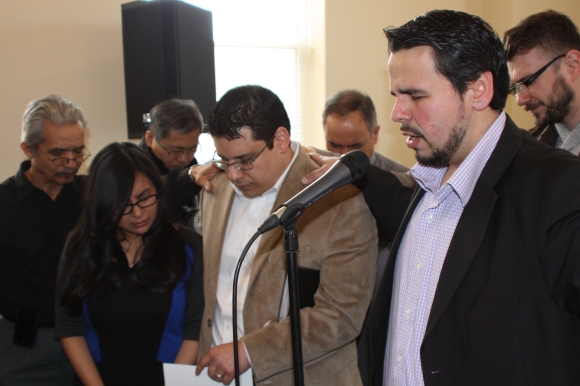
Starting Point in Chicago: Pastor Marvin del Rios of Iglesia Bautista Erie (right) prays for the new congregation his church is sponsoring, led by Pastor Jonathan de la O and his wife, Emely, surrounded by leaders from Chinese, Korean, and Romanian church plants who attended the April 6 launch service.

Starting Point in Chicago: Pastor Marvin del Rios of Iglesia Bautista Erie (right) prays for the new congregation his church is sponsoring, led by Pastor Jonathan de la O and his wife, Emely, surrounded by leaders from Chinese, Korean, and Romanian church plants who attended the April 6 launch service.


Across Illinois |
Five new churches held their “grand opening” events during the two weekends before Easter.

The congregations couldn’t be any more different: They are Hispanic, Korean, Anglo, and multicultural. They meet in the inner city, in new suburbs and older neighborhoods, and way out in the countryside.

Yet their worship services are remarkably alike: all in English, all contemporary, all enthusiastic, and mostly loud.

Collectively they show how some important ministry trends are reaching both main roads and back roads in Illinois:

➢ After decades of planting ethnic language churches, English-language ministries may be the next wave as the grown children of immigrants aren’t feeling comfortable in their parents’ churches.

➢ Starting new churches is getting more complicated and expensive and harder for planters to do solo. That is resulting in more multi-site churches and in new networks among church leaders.

➢ And in some situations, starting from scratch may prove a better strategy than re-engineering a faltering ministry.

Jonathan de la O was born in the United States, but his parents are from El Salvador. He is the product of two countries. “I wasn’t 100% Latino or 100% American, at least in the eyes of those around me,” he said. “It made it difficult to identify with a people group.”

When called to pastor a church, he asked what kind? “I didn’t know where I fit in,” he said in a video.

That tension produced a new kind of church in the Humboldt Park neighborhood: Hispanic worship in English. It’s designed to reach people like him, second-generation young adults, the children of immigrants who are often more like the kids they went to school with than their own parents.

De la O cites a statistic showing 60% of second-gen adults have markedly different culture, language, education, and income than first-gen immigrants. If they don’t find a different kind of church than mom and dad’s, he said, they are likely to drop out.

At home, and not at home

If the very different needs of younger people sound familiar, there’s good reason, said IBSA’s multicultural church planting specialist, Jay Noh. “The gap between first-gen immigrants and their U.S.-born second-gen children includes every challenge that the mainstream U.S. churches have faced, compounded by differences in languages and culture.” In his words, “The paternalistic assumptions of the first-gen won’t be accepted” by their children.

“As soon as they are able to escape the world of their parents and other people of authority, they find a place that is somewhere between their ethnic heritage and the dominant American culture,” said Van Kicklighter, who heads church planting for IBSA.

De la O hopes that place will be his new church. Starting Point Church is meeting in the newly refurbished building owned by Chicago Metro Baptist Association. Noh is assisting another second-gen church start that also shares the space, The Way Bible Church, reaching young Romanians. The Romanian congregation, and second-gen Koreans, Chinese, and international students from Moody Bible Institute, packed out the launch service to show support for De la O and the new church.
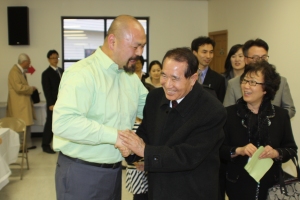
Bethel Church in Mt. Prospect: A multi-ethnic crowd feasted on an international menu following the church's first public service. Pastor John Yi (in the green shirt) shakes hands and bows to almost every guest. Yi has led a ministry to poor families in another Chicago suburb since 2008.

Bethel Church in Mt. Prospect: A multi-ethnic crowd feasted on an international menu following the church’s first public service. Pastor John Yi (in the green shirt) shakes hands
and bows to almost every guest.

Later that same day, northwest of Chicago in Mt. Prospect, a worship band rehearsed prior to the first public service of Bethel Church. On the platform was the expected array of guitar players and drummers, plus one violinist. Mostly Korean, they sang in English and the music was loud.

“Is this typical of Korean worship services?” a guest asked two teenage girls who were thumbing their phones while sitting on the back row of the borrowed sanctuary.

“No,” one girl said. “Not the Korean-language services. They are very traditional.”

“Very,” the other added, “but EM – that’s English Ministry – those services are contemporary. Not as, um, Korean,” she said, smiling.

“Not as, um, Korean” might be a good slogan for Bethel Church. Pastor John Yi has led a multicultural community ministry to poor families in Maywood, about 15 miles away. Now he is starting a new church, also multicultural, which is expected to draw several ethnic groups, but especially second-generation Asians. Like the young women on the back row.

“Our principal attention has been on unchurched English-speaking people in our surrounding neighborhoods in Mt. Prospect even though Bethel Church is made up of a largely Asian-American base,” Yi said. “Interestingly, our ethnic affinity is difficult to dismiss and thus, we have attracted a lot more Korean-speaking people than we had planned.”

The disconnect between generations becomes evident as older people filled the pews, then attempted to sing English worship songs. It’s not only the linguistic gap, there’s a musical gap that many churches have had to bridge.
Their discomfort is evident, but clearly the older people support Yi and his effort to reach their children’s generation. It’s all smiles and bows as about 300 people filled the fellowship hall after the service and shared an inaugural meal of stir-fried rice, Buffalo wings, and Italian spaghetti.

“The first generation has a growing understanding of the necessity of having a gospel ministry that’s culturally indigenous for their U.S.-born second gen,” Noh said. “This may have come about belated as a result of a decade or more of the young generation’s silent exodus from their ethnic churches.”

New networks, new sites

Grace Point in Frankfort: Pastor Emanuel Istrate greets worship attenders at his church's first service. Grace Point is a church plant of Crossroads Community Church in Carol Stream.

Grace Point in Frankfort: Pastor Emanuel Istrate (right) greets worship attenders at his church’s first service. Grace Point is a church plant of Crossroads Community Church in Carol Stream.

In the far south Chicago suburbs, another church launched this day. Meeting in a middle school amid large new houses, this church plant is a restart. “First Baptist Church of New Lennox approached us asking for help,” said Scott Nichols, pastor of Crossroads Community Church in Carol Stream, another suburb 40 miles away. “They sold their building and had been meeting in a school….Unfortunately, they were…near to closing the doors.”

Nichols and his team did what they have done twice before: they brought in leaders and vision. First they offered Saturday night services utilizing the Carol Stream staff. Then, after calling a campus pastor to lead the new work, they restarted Sunday morning worship.

On opening day, Grace Point Community Church in Frankfort welcomed about 60 people from the area. Their target is not based on ethnicity but proximity. “Our target is anyone who will hear us,” Nichols said. “We have gone door to door and mailed about 20,000 postcards to the area.”

Nichols recounts how he’s often said, “You could blindfold an ape and give him a dart. Any place on the Chicagoland map he hits is a good place to plant a church!”

The Crossroads/Grace Point plant demonstrates two trends: the trend toward shutting down a foundering church, then allowing a stronger church to restart a ministry with new vision and new DNA; and the emergence of networks among churches that produce multi-site ministries.

“I believe this is happening both out of necessity and a new valuing of multiplication and reproduction,” Kicklighter said. “Necessity, because churches and pastors are hungry for connection with others,” but also from “a passionate commitment to impact lostness and to do whatever it takes to reach people and give them a local church in which to grow as disciples.”

North by northwest

Grace Fellowship in Davis Junction: Pastor Brad Pittman's church meets in a renovated electrician’s shop at an Ogle County crossroad. Pittman (left) is leading Grace Fellowship's third campus.

Grace Fellowship in Davis Junction: Pastor Brad Pittman’s church meets in a renovated electrician’s shop at an Ogle County crossroad. Pittman (left) is leading Grace Fellowship’s third campus; the other sites are in Ashton and Amboy.

As at Crossroads, the leaders of Grace Fellowship have a broad vision. On Palm Sunday weekend, in a small metal building in north central Illinois south of Rockford, that vision is becoming reality – for the third time.

“I got my first job when I was 13,” Brad Pittman said, “tasseling corn. Anybody know what tasseling corn is?” Hands shot up across the room, along with a few chuckles. “Best job in the world,” he said, before describing his journey from corn tasseler to full-time church planter. A member at Grace Fellowship for 13 years, Pittman eventually joined the staff with pastors Jeremy Horton and Brian McWethy. From the main campus in Ashton, the trio launched Grace Fellowship in Amboy in 2012, and next in rural Davis Junction.

“This is a part of the state where Southern Baptists have had little presence,” said Kicklighter. “When Baptists moved from the south, they settled primarily in the metropolitan areas of the north to work in industry. They did not come to Illinois to buy farms…so we have few churches in these kinds of settings.”

The mainline denominations were better established here, but their churches are in steep decline. So, there is potential here.

“There are over 4 million people living in the non-urban context in Illinois,” said IBSA’s John Mattingly, who leads church planting in the northwest quadrant. “I believe God has prepared many more churches like Grace Fellowship to step out in faith and do something remarkable.”

The three pastors targeted Davis Junction (called “DJ” by the locals) because there was only one faltering mainline church there to serve more than 4,000 people. “We hung over 800 door hangers” in the week before the launch, Pittman said. “We don’t know what the Lord is going to do; we’ll have to wait and see,” he said, before describing how deeply he feels the spiritual need in the area.

“This is not the typical multi-site church plant,” Kicklighter said, “but a commitment to reproduction and, even more importantly, sending people who will impact another place with the Gospel. This is a value system commitment that says extending the reach of the Gospel and the church is at least as important as how many we gather in our own building on Sunday morning.”

More than 60 turned out for the first Saturday evening service, some from the church’s other locations, but many new visitors from DJ. After the service in the brightly rehabbed building, there are lots of hugs, as at each of the launches, and cake.

It is a birthday, after all.

After closure, new hope
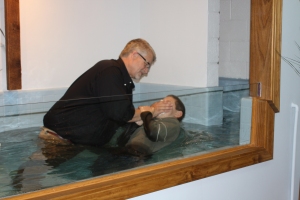
New Hope in Rock Falls: Pastor Jon Sedgwick prays with IBSA church planting leaders Van Kicklighter (left), John Mattingly (right) and Jordan Van Dyke, a future church planter in Galesburg, prior to the launch service. Later Sedgwick baptized a brother and sister.

New Hope in Rock Falls: Pastor Jon Sedgwick baptized a brother and sister at his church’s launch service.

The next morning Jon Sedgwick is all smiles as he baptizes two new believers. Sedgwick didn’t intend to plant a church in northern Illinois. “I didn’t like Illinois,” the former Missouri pastor said emphatically. Illinois was just a place to get through when traveling home to Indiana for visits with family. “But God gave us a love for Illinois!”

“We love Rock Falls!” his wife, Rhadonda, added, equally enthusiastically.

Mattingly had visited the Sedgwicks’ Missouri church describing the need for planters in the Northwest quadrant of Illinois. After Mattingly’s second appeal – “Is God calling someone here to come and help?” – the couple realized, “It was us. God was calling us. God said, ‘Why not you?’”

In 2012, they arrived and began building a new ministry at the building that once housed First Southern Baptist Church of Rock Falls. To the usual round of Bible studies and home meetings, Sedgwick added “Celebrate Recovery,” a faith-based twelve-step program originated by Rick Warren and Saddleback Community Church in California. Reaching out to people with addictions, Sedgwick found doors opening that once were closed to Baptist ministry.

At the worship service, greeters David and John freely told guests how they came to be part of New Hope Church through the recovery ministry.

Also in attendance was Jordan Van Dyke, a planter who is gathering a core group for a new church in Galesburg.
It is commonly observed that ministry in northwest Illinois is especially challenging. “It’s because of the soil,” Van Dyke said. “It’s hard. Sometimes I wish I’d been sent to southern Illinois where, when it’s Sunday, people go to church. In the northwest, it’s Sunday and church is an option. ‘Will I go to church?’ Maybe. Maybe not.”

On this day they do, because there’s new hope in Rock Falls.

Eric Reed is editor of the Illinois Baptist newspaper. In the May 26 issue of IB, we’ll continue our series on The Midwest Challenge with a focus on church revitalization. Go to http://ibonline.IBSA.org to read past issues.