Archives For November 30, 1999

Personal belief, salvation, spiritual disciplines, formation

The_BriefingTHE BRIEFING | Meredith Flynn

Ronnie Floyd, elected president of the Southern Baptist Convention last week in Baltimore, is calling on Baptists to rally in Columbus, Ohio, next summer to pray together for spiritual awakening.

“As I work with our Order of Business Committee as well as other leaders, I will respectfully request that we dedicate as much time as possible in next year’s convention to pray extraordinarily for the next Great Awakening,” Floyd wrote in a June 16 column for Baptist Press. “I want to call you to Columbus to what could be one of the most significant prayer gatherings in our history.

Floyd, pastor of Cross Church in northwest Arkansas, said in Baltimore that America’s greatest need is a great awakening. Prior to the convention, he organized two national gatherings for Baptist pastors to pray together.

“Our convention has bemoaned our decline in baptisms, membership, attendance and giving far too long,” Floyd wrote. “Now is the time for us to take aggressive action by calling out to God together in prayer.

“At the same time, we must take the needed strategic actions to change our trajectory as a convention of churches. While we face these critical times, we know God is doing some amazing things right now through Southern Baptists. As we celebrate those to the glory of God in Columbus, we will also call out to God in urgent desperation.”

Read Floyd’s column at BPNews.net, and click here to read more of the Illinois Baptist’s coverage from Baltimore.

Stanley explains tweets during SBC meeting
Georgia pastor Andy Stanley sparked a long online conversation when he tweeted during the Southern Baptist Convention’s annual meeting, according to a Christian Post report. The Baltimore meeting focused heavily on revival and spiritual awakening. Stanley, pastor of North Point Community Church in Alpharetta, was not at the meeting but tweeted on the topic several times, including, “Instead of praying for revival leaders of the SBC should go spend three weeks with @perrynoble Why pray for one when you can go watch one.”

Stanley was referring to Pastor Perry Noble of New Spring Church in South Carolina. He told The Christian Post that in the tweet and others during the meeting, he was referring to revival in the local church, rather than in a great awakening sense. “I can understand the confusion and I definitely contributed to it,” said Stanley, who still exhorted the local church to take actions that can lead to spiritual awakening.

“I love the local church. And I’ll admit I get a bit stirred up when I hear church leaders talk about the need to reach more people while refusing to make the changes necessary to actually get the job done.” Read more at ChristianPost.com.

Millenials tell Barna: Top 5 things to do before 30
Barna’s recent study of Millenials – “20 and Something” – delves into what the generation believes about life and work. Including the five things they most want to accomplish before they turn 30: gain financial independence (59%), finish their education (52%), start a career (51%), find out who they really are (40%), and follow their dreams (31%). Read more at Barna.org.

Be fruitful, says Pope
After celebrating Mass with 15 married couples at the Vatican, Pope Francis warned against childlessness. “It might be better – more comfortable – to have a dog, two cats, and the love goes to the two cats and the dog,” he said, according to a report by Religion News Service. “Then, in the end this marriage comes to old age in solitude, with the bitterness of loneliness.”

The pope’s remarks came on the heels of a report that Italy’s birth rate fell to a record low in 2013. The U.S. birth rate hit a record low in 2012, but about 4,700 more babies were born in 2013, according to the Centers for Disease Control and Prevention.

List locates world’s most persecuted countries
Christians face the worst persecution in North Korea and Somalia, according to the 2014 World Watch List. For 12 years, North Korea has topped the list released by non-profit organization Open Doors. Syria, Iraq, Afghanistan, Saudi Arabia, Pakistan, Iran and Yemen also are in this year’s top 10, along with the Maldives, a chain of islands off the coast of India.

HEARTLAND | This morning, read Psalm 68. Then think on these 25 attributes of God seen in the psalm, outlined by David Platt in a sermon at the Southern Baptist Pastors’ Conference in Baltimore.

God is awesome.
God is active.

He subdues all who rebel against Him.
He satisfies all who trust in Him.

He is the One True God.
He is the covenant-keeping Lord.

God is father of the fatherless.
He is protector of the widow.
God loves the lonely.
He rescues the captive.
He provides for the needy.

God is sovereign over all nature.
He is sovereign over nations.

God is powerful above us.
God is present with us.

He commands a heavenly army.
He conquers an earthly victory.

God daily bears our burdens.
He ultimately saves our souls.
He is my God and King.
He is our God and King.

He draws peoples to Himself.
He deserves praise throughout the earth.
He is the divine warrior.

God speaks a dependable word.

For us, there are two implications, Platt said. Give glory to this God. And give your life to His mission.

SBC_annual_meeting_logoBaltimore | The Southern Baptist Convention’s annual meeting officially starts here June 10, but Baptists are already on their way to Charm City for pre-Convention festivities. Here’s our list of what to watch for over the next few days:

1. Southern Baptists will elect a new president, and their choice could point to the lasting legacy of Fred Luter, elected two years ago as the SBC’s first African American president. A victory for Maryland pastor Dennis Kim could mean Baptists have embraced Luter’s charge to bring more diverse voices to the leadership table. Electing Ronnie Floyd might mean they’ve taken to heart Luter’s pleas for revival, and believe that Floyd, who organized recent prayer gatherings for church leaders, is a president who can lead Baptists toward the repentance required for spiritual awakening. And a vote for Kentucky pastor Jared Moore, the youngest candidate at 33, could signify older Baptists recognize the importance of engaging the next generation of leaders.

All three have expressed their desire to help Baptists unify around the Great Commission and cooperative missions. Click here to read short profiles of each candidate, and link to their Baptist Press Q&A’s.

2. How much will numbers matter? Attendance at the Convention will likely be a hot topic before and after the final tallies come in – last year’s registration in Houston was uncharacteristically low for a southern city, and some think Baltimore’s messenger total could rival the decades-low point set in Phoenix in 2011. Low attendance might reignite conversation about an online meeting/voting process, which some bloggers have advocated for in recent years.

In another mathematical matter, the SBC Executive Committee will discuss whether to bring a recommendation to the floor to amend Article III of the Constitution, which governs how many messengers individual churches may send to the annual meeting. Some have questioned whether the amendment would inhibit participation from smaller churches, since it would increase the financial contribution required to send additional messengers (more than two). But Executive Committee President Frank Page has vowed not to do anything that will hurt small churches.

3. Same old culture war? The issues might be similar to those in recent years – marriage chief among them – but Southern Baptists tactics in the culture war seem to be shifting. Ethics & Religious Liberty Commission President Russell Moore has encouraged Christians to embrace the strangeness of their beliefs and to avoid “more culture war posturing” for the sake of a “Christ-shaped counter-revolution.” At least two issues could put his encouragements to the test: A California congregation that recently split over whether to affirm same-sex lifestyles, and a proposed resolution on gender identity issues.

All that plus crab cakes, regular cake (courtesy of famed Baltimore baker Duff Goldman), and a special tour of the city highlighting favorite daughter Annie Armstrong. Check back here for frequent updates, or go to Facebook.com/IllinoisBaptist and Twitter.com/IllinoisBaptist. Thanks for traveling with us!

THE BRIEFING | Meredith Flynn

A California congregation voted May 18 to retain their pastor, Danny Cortez, who had announced three months earlier that he affirms same-sex lifestyles. The decision by New Heart Community Church in La Mirada, Ca., brings the Southern Baptist Convention to “a moment of unavoidable decision” just before its annual meeting in Baltimore, said Southern Seminary President Albert Mohler.

Cortez blogged May 29 on Patheos.com that New Heart will “formally peacefully separate” June 8, when a group affirming traditional church teachings about homosexuality leaves the congregation. The church took three months to study and pray over the issue after Cortez told them about his beliefs in February. Prior to Cortez’ confession to his church, his teenage son told him he was gay and posted a “coming out” video on social media sites.

The_BriefingIn May, the church voted to keep Cortez as pastor and become a “third way” church that stands in the middle ground between condoning and condemning same-sex relationships.

“So now, we will accept the LGBT community even though they may be in a relationship,” Cortez wrote on Patheos.com. “We will choose to remain the body of Christ and not cast judgment. We will work towards graceful dialogue in the midst of theological differences.”

Despite the church’s decision, “there is no third way,” Mohler said on his blog.

“A church will either believe and teach that same-sex behaviors and relationships on sinful, or it will affirm them. Eventually every congregation in America will make a public declaration of its position on this issue. It is just a matter of time (and for most churches, not much time) before every congregation in the nation faces this test.”

That New Heart’s decision is in conflict with The Baptist Faith & Message, the SBC’s statement of faith, could result in discussion and/or action when messengers gather in Baltimore.

“I am confident that the Southern Baptist Convention will act in accordance with its own convictions, confession of faith, and constitution when messengers to the Convention gather next week in Baltimore,” Mohler said.

“But every single evangelical congregation, denomination, mission agency, school, and institution had better be ready to face the same challenge, for it will come quickly, and often from an unexpected source. Once it comes, there is no middle ground, and no ‘third way.’”

Other news:

Poll: Most believe same-sex couples should be able to adopt
A new Gallup poll shows 63% of Americans believe same-sex couples should be allowed to adopt a child. The percentage of approval is higher than approval for same-sex marriage, which, according to another recent Gallup poll, is at 55%. Read more at Gallup.com.

Imprisoned pastor still sharing the Gospel
The wife of a U.S. pastor imprisoned in Iran says his sentence may be extended because he’s leading people to Christ. “I don’t see him [witnessing] as an act of defiance,” Naghmeh Abedini told Baptist Press about her husband, Saeed. “Knowing Saeed’s heart as a pastor, he’s seeing people in such a dark place…on death row for murders and rapes, and just seeing people who are in prison whose future is so dark. Knowing Saeed’s heart, I know that his heart was to give them the hope that he’s found in Christ that no one can take away, even in prison.”

Abedini, a U.S. citizen, was sentenced last year to eight years in prison for his involvement in the Iranian house church movement. He moved to the U.S. in 2005 and was arrested two years ago during a trip to build an orphanage in Iran. Read more at BPNews.net.

SBC leaders call for ‘renewed passion’ amid declining numbers
Southern Baptist churches reported more than 310,000 baptisms in 2013, but the total was 1.46% less than the previous year. The Annual Church Profile report, compiled by LifeWay Christian Resources in cooperation with Baptist state conventions, also showed declines in church membership (down 0.9%) and primary worship attendance (down 2.2% to 5.8 million worshipers).

“I am grieved we are clearly losing our evangelistic effectiveness,” said Thom S. Rainer, president of LifeWay Christian Resources. “I continue to pray for revival and a renewed passion for the Great Commission in our churches. May God renew all of us, including me, with a greater heart for the lost.” Read more at BPNews.net.

A Southern Baptist task force addressed declining baptisms in a report released in May, ahead of the denomination’s June meeting in Baltimore. Read their report here.

Viewing habits: What do we all have in common?
Sheldon Cooper, at least according to research by the Barna Group. Their survey found “The Big Bang Theory” is the most commonly watched show among American adults (30%) and the Millenial generation (31%). And with 23% it was #2 on the list for practicing Christians. Among that group, Sheldon, Penny and the gang lost out by two percentage points to “NCIS.” Read more at Barna.org.

HEARTLAND | Eric Reed

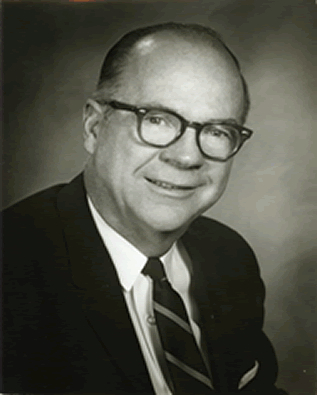
Owen Cooper was a prophet. “We live in an age when it is popular to be tolerant and it is a stigma to be called intolerant,” the chemical engineer from Mississippi preached to messengers at the Southern Baptist Convention. “Tolerance of a half truth soon leads to tolerance of an untruth and then to tolerance of an error,” he warned. “Social and political pressures in the name of tolerance are quenching the flame of missionary zeal.”

Owen_Cooper_0616

Photo from Mississippi Historical Society website

Cooper was describing his own time, but his convention sermon delivered in Atlantic City in 1964 has proven an apt description of our time.

Among Cooper’s insights: Christianity is losing ground in the U.S., world population is growing faster than the Christian faith, and Islam is on the rise; baptisms in SBC churches are declining, more ministry is focused on places where Southern Baptists are strong than to regions and nations where evangelical witness is weak, and the word “witness” itself is almost lost from our vocabulary – and our activity.

“Southern Baptists are losing their mission zeal because of a growing feeling among many theologians and the laity that, after all, man is not lost.” He cited contemporary articles declaring the beginning of “the post-Christian era.”

In 1964? Really?

“Perhaps it is well to ask ourselves the question, ‘What is wrong?’” Cooper said. “‘What is the trouble? Why the diminution of spiritual momentum in the world, and in our country, and in our denomination?’”

In the two decades after World War 2, the Southern Baptist Convention grew rapidly. An emphasis on Sunday school and evangelism that reached the burgeoning families of returning GIs swelled the ranks. The SBC eclipsed the mainline denominations that peaked in 1964 and started their downward spiral. Even as the SBC rallied for growth in membership, Cooper sounded an alarm. Ten million Southern Baptists were on the church rolls, but three million of them couldn’t be accounted for. Baptisms flatlined.

The numbers are no better today. With 15.7 million members officially, our churches report only 5.8 million in worship on any given Sunday. And baptisms are down for seven out of the last nine years, after 40-plus years mostly plateaued. We peaked in 1972.

“We may find ourselves somewhat in the position occupied by Gideon when his followers included…those who follow the crowd as well as the earnest and dedicated,” Cooper said. Apparently some thinning of the herd at the watering hole wouldn’t hurt. “It’s too easy to join a Baptist church,” he stated.

But more than the incipient decline, Cooper decried the loss of commitment to evangelism. “The Southern Baptist Convention was organized for the purpose of ‘directing the energies of the whole denomination for the propagation of the Gospel.’ Witnessing was acknowledged as our principle objective; it must continue to be such.”

Cooper, a layman, was very public about his faith. (Even in 1964, he said personal witnessing would be considered “intolerant, bigoted, and improper” in many circles.) One of only two laymen elected president of the SBC, he served two terms starting in 1973.

In the 1964 sermon, Cooper called on messengers to increase Cooperative Program giving. In 1962, he said, citing the most recent statistics available, 10% of receipts by Southern Baptist churches went to the CP missions and 8% to state missions; today CP giving is down to 5.4% per church, on average. And he called for more money, missionaries, and church planters in distant and unreached parts of the U.S.

But mostly Cooper called for a return to witnessing: “The challenges and problems faced by Southern Baptists, yea even in Christianity for that matter, seem overwhelming when viewed in their totality. Yet broken into their component parts, it becomes much simpler. As Southern Baptists, as Christians, our task is to ‘win them one by one.’

“Ask men to witness,” he urged. “At the time a person joins the church, he should understand that part of his responsibility is to witness, and opportunities should be provided for Christian witness…Without the primacy of missions and witnessing, the church is without true purpose,” Cooper said, “the pulpit is without power and the pew is without potency.”

Eric Reed found Owen Cooper’s 1964 convention sermon while researching the SBC for the Illinois Baptist series B-101. Cooper, from Yazoo City, Mississippi, was a member of the SBC Executive Committee at the time he delivered it.

THE BRIEFING | Meredith Flynn

Oregon and Pennsylvania became the 18th and 19th states to approve same-sex marriage after judges struck down their states’ same-sex marriage bans May 19 and 20.

An Oregon appeals court denied a request to stay the ruling, and no appeal has been filed in Pennsylvania. In both states, the attorney general has said she would not defend the ban.

Layout 1Earlier in May, Arkansas became the first southern state to issue marriage licenses to gay couples. Arkansas joined the list of states in limbo between a judge’s decision and current law. In Kentucky, Ohio and Tennessee, the debate is over whether to recognize same-sex marriages performed in other states.

Only one same-sex marriage bans remain unchallenged – North Dakota – after lawsuits were filed late last week in Montana and South Dakota. The Minneapolis attorney who filed suit in South Dakota told the Post he will do the same in North Dakota within six to eight weeks.

Same-sex marriages were scheduled to begin June 1 in Illinois after the passage of SB10, the “Religious Freedom and Marriage Fairness Act.” But many counties began issuing licenses after Attorney General Lisa Madigan gave clerks the go-ahead in March.

According to a Gallup poll released May 21, 55% of Americans approve making same-sex marriage legal, including 78% of those in the 18-29 age bracket.

More news:

Baptist seminary criticized over admission of Muslim student
Southwestern Baptist Theological Seminary President Paige Patterson faced criticism this month when a blogger reported the school had admitted a Muslim student to its Ph.D in archaeology program. Patterson told the Southern Baptist Texan that the student “had had no other options for Ph.D. work in his field,” and that he hoped to win him to faith in Christ. Patterson also said, “We required that the student would agree with our moral standards while a student at Southwestern. It was no problem for him.”

The decision, which Patterson said he is responsible for, was debated online after Oklahoma pastor Wade Burleson published the report on his blog. Trustee chairman Steven James said the board will discuss the issue at its scheduled meeting in September. According to the Texan, Southwestern’s website includes requirements for graduate-level courses including “a mature Christian character” and “desire for Christian ministry.”

Boy Scouts president stands by decisions made last year
Robert Gates, president of the Boy Scouts of America, said he supports the organization’s decision last summer to include openly gay participants, and would have extended the policy change to include adults too. But Gates, a former U.S. Defense Secretary, also said it’s time to let the issue rest, according to a report on ChristianPost.com.

“Given the strong feelings – the passion – involved among our volunteers on both sides of this matter,” Gates said at the organization’s annual meeting May 23, “I believe strongly that to reopen the membership issue or try to take last year’s decision to the next step would irreparably fracture and perhaps even provoke a formal, permanent split in this movement with the high likelihood that neither side would survive on its own.”

Southern Baptist Convention Annual Meeting to focus on prayer, revival
Restoration, revival and prayer are the themes of this year’s Southern Baptist Convention annual meeting, scheduled for June 10-11 in a city known for its place in American and Baptist history. And baseball and crab cakes.

SBC President Fred Luter will preside over his final annual meeting as his second one-year term draws to a close. He told Baptist Press this year’s meeting theme is similar to last year’s – revival – with added importance given to prayer. The meeting also will include a Tuesday night revival service. “…We just come for worship and the word,” Luter said. “That’s it. No business will be conducted.”

Three candidates will reportedly be nominated to succeed Luter: Ronnie Floyd, pastor of Cross Church in northwest Arkansas; Dennis Manpoong Kim, pastor of Global Mission Church of Greater Washington, and Jared Moore, pastor of New Salem Baptist Church in Hustonville, Ky. Read more about the SBC Annual Meeting at BPNews.net.


Nate_AdamsCOMMENTARY | Nate Adams

Just a few days ago, my wife, Beth, and I finally got around to doing something we had promised ourselves we would do for years. We updated our wills.

It’s only the second time in our married life that we have drawn up wills, and this time around it was quite different. For one thing, our young adult sons are now old enough to play significant, legal roles in matters such as our future healthcare decisions and finances. Frankly, it felt a little sobering this time around to assign those responsibilities to our children rather than our parents.

We also discovered that the people and causes to which we wish to entrust our earthly possessions at life’s end have, at least in some cases, evolved. Our confidence in the effectiveness of some ministries has increased, while in others it has decreased. Even within the ministries we have always planned to support with our estate, we now have more specific causes we want to empower.

But by far the biggest difference in updating our estate plan this time around was in the help we had doing it. This time we had a wonderful tool from the Baptist Foundation of Illinois called the “Life Stewardship Navigator.” And we had the expert help of our friend and BFI Executive Director Doug Morrow.

The Life Stewardship Navigator is simply a do-ityourself document that walks you through the different types of assets and decisions you need to consider as you form your estate plan. It helped us pull together our records and documents, and talk through key decisions we needed to make as a couple.

With that information in hand, we were ready to sit down with Doug and discuss the best ways to both
take care of our family and invest in Christian causes well beyond our lifetimes. Doug called it “taking
care of both the kids and the Kingdom.”

With Doug’s office here in Springfield where we live, having that conversation with him personally was easiest for us. But the Foundation also has qualified attorneys all over the state who make it relatively
easy for any Illinois Baptist to have that same helpful conversation.

Frankly, the hardest part of the entire process was not filling out the Life Stewardship Navigator, or
walking through the paperwork with Doug. The hardest part was simply sitting down as a couple and
making some of the biggest decisions of our lives about our life stewardship as disciples of Jesus
Christ.

Though we are lifelong tithers and seek to be generous with Kingdom causes beyond our tithe, we realized during this process that our estate plan would far exceed even our lifetimes of weekly giving
through our church. What we chose to do with the accumulated wealth of our lives, however large or
small that might be, would be our largest single opportunity ever to contribute financially to God’s
Kingdom on earth. So prayerfully, thoughtfully, we wrote out a plan that will care for our family, and that will support ministries that advance the Gospel and support Baptist churches and ministries, especially here in our Illinois mission field.

I realize now that the day I sat down with my spouse to outline our estate plan was, in effect, my own personal Memorial Day. It was the day I was able to intentionally choose the values that I want to
memorialize my life, and to stand the tests of time and eternity.

I know that my life is about far more than my material possessions. But I also know that where my
treasure is, there my heart is also. So I chose to communicate to God that the biggest giving opportunity of my life places His Kingdom as the top priority. We can all do that. After all, where there’s a will, there’s a way.

Nate Adams is executive director of the Illinois Baptist State Association.

Where_Was_God_posterTHE BRIEFING | Meredith Flynn

Film documents storm recovery
One year after a tornado killed 24 people in Moore, Oklahoma, survivors are sharing their stories in a new documentary film. “Where was God? Stories of Hope After the Storm” was produced and promoted in partnership with several churches and faith-based groups, including the Baptist General Convention of Oklahoma.

“We want to remind people that God is always near, no matter what,” said pastor and executive producer Steven Earp. “There is not a single thing that we could ever go through that our heavenly Father does not understand, and there is not a single dark place that He has not already walked.” Read more at BPNews.net.

Sudanese woman won’t recant, faces death sentence
A Sudanese doctor was sentenced to death after she refused to reject her Christian faith. Meriam Yahia Ibrahim, 27, was convicted of apostasy April 30 and given 15 days to recant. “I am a Christian, and I have never been a Muslim,” she told the judge, according to Morning Star News. Ibrahim, who is due to give birth soon, is married to Daniel Wani, a South Sudanese Christian who also is a U.S. citizen.

Her sentence, set to be carried out two year’s after her child’s birth, is representative of “increasing Islamization” of Sudan sparked by the secession of South Sudan in 2011, Christianity Today reported. Read more at ChristianityToday.com.

Americans inflate church attendance
It’s easier to be honest online, at least about church attendance. A new study by the Public Religion Research Institute found Americans inflate their levels of religious participation, especially when answering questions about it over the phone. For example, 36% of Americans who took PRRI’s telephone survey said they attend services weekly or more, compared to 31% who answered an identical question on a self-administered online survey.

Among white evangelical Protestants, 9% answering over the phone said they seldom or never attend services, while 17% reported the same on the online survey. PRRI reports young adults, Catholics and white mainline Protestants are most likely to over-report their church attendance. Read more at publicreligion.org.

‘Gay Christian’ publisher out of National Religious Broadcasters
WaterBrook Multnomah resigned this month from the National Religious Broadcasters (NRB) network over a controversial book published by an affiliated imprint, Convergent Books. “God and the Gay Christian: The Biblical Case in Support of Same-Sex Relationships” by Matthew Vines theorizes that Scripture doesn’t condemn monogamous same-sex relationships.

Though WaterBrook Multnomah and Convergent are separate entities with the same leader, employees of both companies are reported to have worked on the book. According to a Christianity Today report, NRB President Jerry Johnson wrote in a letter to his board, “This issue comes down to NRB members producing unbiblical material, regardless of the label under which they do it.”

Baptist history gets hip-hop treatment
“Now this is a story all about how the Baptists became what they are now…” Rapping seminary study Ashley Unzicker took the outline from one of her classes and set it to the “Fresh Prince of Bel-Air” theme song, creating a 5-minute ode to Baptist history that starts with religious persecution in England, and concludes with the election of Fred Luter as the SBC’s first African American president. Now, that’s fresh. Watch the video on YouTube.

Blessed bikers

Meredith Flynn —  May 19, 2014
Rainy weather

The annual Blessing of the Bikes April 27 in Decatur went on despite stormy weather.

HEARTLAND | Meredith Flynn

It wasn’t a great weather day for the annual Blessing of the Bikes in Decatur, Ill. Gray clouds piled up in the sky on Sunday afternoon, April 27, and then came a downpour, just as hundreds of motorcyclists made their way to and from the Harley-Davidson store to be prayed over by volunteers in orange vests.

Every spring, riders gather in Decatur and at the Bald Knob Cross in southern Illinois to be blessed. Over the sounds of revving engines, pray-ers put their hands on the shoulders of each rider and ask God for a safe motorcycle season.

It’s a tradition IBSA’s Pat Pajak has kept for several years, including the most recent blessing. He hustled home from a preaching engagement that Sunday afternoon to change into his Harley shirt, blue jeans and leather vest. On the way to the blessing, he stopped to help a couple whose bike had hit a pothole and slid down an embankment.

“After patching up a cut on the wife’s chin and helping her husband wrestle the bike out of the mud and wet grass, I shared how the Lord had watched over them,” Pajak said. “Our discussion led to the Blessing of the Bikes, which they were headed to, and ultimately the Gospel.

“Standing on the side of Highway 51 in the rain, I had the privilege of leading both of them to Jesus Christ.”

Pajak was 30 minutes late by the time he got to the Harley-Davidson parking lot, but he – and his new brother and sister in Christ – had already been extraordinarily blessed.

F.A.I.T.H Riders is a ministry for motorcyclists who want to use their passion for biking to share the Gospel. For information about how to start a chapter in your church, contact Pajak at (217) 391-3129.

Growing trends among second-generation and multi-site congregations

By Eric Reed
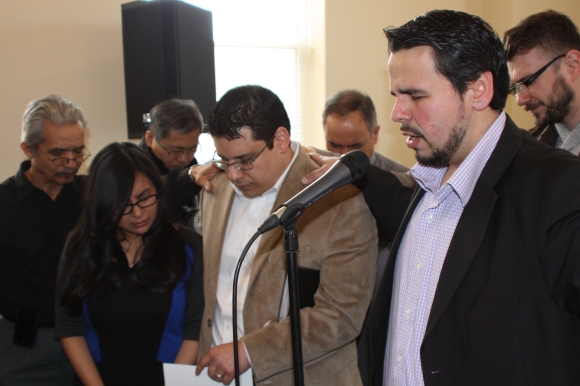
Starting Point in Chicago: Pastor Marvin del Rios of Iglesia Bautista Erie (right) prays for the new congregation his church is sponsoring, led by Pastor Jonathan de la O and his wife, Emely, surrounded by leaders from Chinese, Korean, and Romanian church plants who attended the April 6 launch service.

Starting Point in Chicago: Pastor Marvin del Rios of Iglesia Bautista Erie (right) prays for the new congregation his church is sponsoring, led by Pastor Jonathan de la O and his wife, Emely, surrounded by leaders from Chinese, Korean, and Romanian church plants who attended the April 6 launch service.


Across Illinois |
Five new churches held their “grand opening” events during the two weekends before Easter.

The congregations couldn’t be any more different: They are Hispanic, Korean, Anglo, and multicultural. They meet in the inner city, in new suburbs and older neighborhoods, and way out in the countryside.

Yet their worship services are remarkably alike: all in English, all contemporary, all enthusiastic, and mostly loud.

Collectively they show how some important ministry trends are reaching both main roads and back roads in Illinois:

➢ After decades of planting ethnic language churches, English-language ministries may be the next wave as the grown children of immigrants aren’t feeling comfortable in their parents’ churches.

➢ Starting new churches is getting more complicated and expensive and harder for planters to do solo. That is resulting in more multi-site churches and in new networks among church leaders.

➢ And in some situations, starting from scratch may prove a better strategy than re-engineering a faltering ministry.

Jonathan de la O was born in the United States, but his parents are from El Salvador. He is the product of two countries. “I wasn’t 100% Latino or 100% American, at least in the eyes of those around me,” he said. “It made it difficult to identify with a people group.”

When called to pastor a church, he asked what kind? “I didn’t know where I fit in,” he said in a video.

That tension produced a new kind of church in the Humboldt Park neighborhood: Hispanic worship in English. It’s designed to reach people like him, second-generation young adults, the children of immigrants who are often more like the kids they went to school with than their own parents.

De la O cites a statistic showing 60% of second-gen adults have markedly different culture, language, education, and income than first-gen immigrants. If they don’t find a different kind of church than mom and dad’s, he said, they are likely to drop out.

At home, and not at home

If the very different needs of younger people sound familiar, there’s good reason, said IBSA’s multicultural church planting specialist, Jay Noh. “The gap between first-gen immigrants and their U.S.-born second-gen children includes every challenge that the mainstream U.S. churches have faced, compounded by differences in languages and culture.” In his words, “The paternalistic assumptions of the first-gen won’t be accepted” by their children.

“As soon as they are able to escape the world of their parents and other people of authority, they find a place that is somewhere between their ethnic heritage and the dominant American culture,” said Van Kicklighter, who heads church planting for IBSA.

De la O hopes that place will be his new church. Starting Point Church is meeting in the newly refurbished building owned by Chicago Metro Baptist Association. Noh is assisting another second-gen church start that also shares the space, The Way Bible Church, reaching young Romanians. The Romanian congregation, and second-gen Koreans, Chinese, and international students from Moody Bible Institute, packed out the launch service to show support for De la O and the new church.
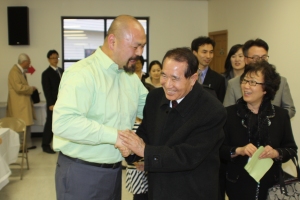
Bethel Church in Mt. Prospect: A multi-ethnic crowd feasted on an international menu following the church's first public service. Pastor John Yi (in the green shirt) shakes hands and bows to almost every guest. Yi has led a ministry to poor families in another Chicago suburb since 2008.

Bethel Church in Mt. Prospect: A multi-ethnic crowd feasted on an international menu following the church’s first public service. Pastor John Yi (in the green shirt) shakes hands
and bows to almost every guest.

Later that same day, northwest of Chicago in Mt. Prospect, a worship band rehearsed prior to the first public service of Bethel Church. On the platform was the expected array of guitar players and drummers, plus one violinist. Mostly Korean, they sang in English and the music was loud.

“Is this typical of Korean worship services?” a guest asked two teenage girls who were thumbing their phones while sitting on the back row of the borrowed sanctuary.

“No,” one girl said. “Not the Korean-language services. They are very traditional.”

“Very,” the other added, “but EM – that’s English Ministry – those services are contemporary. Not as, um, Korean,” she said, smiling.

“Not as, um, Korean” might be a good slogan for Bethel Church. Pastor John Yi has led a multicultural community ministry to poor families in Maywood, about 15 miles away. Now he is starting a new church, also multicultural, which is expected to draw several ethnic groups, but especially second-generation Asians. Like the young women on the back row.

“Our principal attention has been on unchurched English-speaking people in our surrounding neighborhoods in Mt. Prospect even though Bethel Church is made up of a largely Asian-American base,” Yi said. “Interestingly, our ethnic affinity is difficult to dismiss and thus, we have attracted a lot more Korean-speaking people than we had planned.”

The disconnect between generations becomes evident as older people filled the pews, then attempted to sing English worship songs. It’s not only the linguistic gap, there’s a musical gap that many churches have had to bridge.
Their discomfort is evident, but clearly the older people support Yi and his effort to reach their children’s generation. It’s all smiles and bows as about 300 people filled the fellowship hall after the service and shared an inaugural meal of stir-fried rice, Buffalo wings, and Italian spaghetti.

“The first generation has a growing understanding of the necessity of having a gospel ministry that’s culturally indigenous for their U.S.-born second gen,” Noh said. “This may have come about belated as a result of a decade or more of the young generation’s silent exodus from their ethnic churches.”

New networks, new sites

Grace Point in Frankfort: Pastor Emanuel Istrate greets worship attenders at his church's first service. Grace Point is a church plant of Crossroads Community Church in Carol Stream.

Grace Point in Frankfort: Pastor Emanuel Istrate (right) greets worship attenders at his church’s first service. Grace Point is a church plant of Crossroads Community Church in Carol Stream.

In the far south Chicago suburbs, another church launched this day. Meeting in a middle school amid large new houses, this church plant is a restart. “First Baptist Church of New Lennox approached us asking for help,” said Scott Nichols, pastor of Crossroads Community Church in Carol Stream, another suburb 40 miles away. “They sold their building and had been meeting in a school….Unfortunately, they were…near to closing the doors.”

Nichols and his team did what they have done twice before: they brought in leaders and vision. First they offered Saturday night services utilizing the Carol Stream staff. Then, after calling a campus pastor to lead the new work, they restarted Sunday morning worship.

On opening day, Grace Point Community Church in Frankfort welcomed about 60 people from the area. Their target is not based on ethnicity but proximity. “Our target is anyone who will hear us,” Nichols said. “We have gone door to door and mailed about 20,000 postcards to the area.”

Nichols recounts how he’s often said, “You could blindfold an ape and give him a dart. Any place on the Chicagoland map he hits is a good place to plant a church!”

The Crossroads/Grace Point plant demonstrates two trends: the trend toward shutting down a foundering church, then allowing a stronger church to restart a ministry with new vision and new DNA; and the emergence of networks among churches that produce multi-site ministries.

“I believe this is happening both out of necessity and a new valuing of multiplication and reproduction,” Kicklighter said. “Necessity, because churches and pastors are hungry for connection with others,” but also from “a passionate commitment to impact lostness and to do whatever it takes to reach people and give them a local church in which to grow as disciples.”

North by northwest

Grace Fellowship in Davis Junction: Pastor Brad Pittman's church meets in a renovated electrician’s shop at an Ogle County crossroad. Pittman (left) is leading Grace Fellowship's third campus.

Grace Fellowship in Davis Junction: Pastor Brad Pittman’s church meets in a renovated electrician’s shop at an Ogle County crossroad. Pittman (left) is leading Grace Fellowship’s third campus; the other sites are in Ashton and Amboy.

As at Crossroads, the leaders of Grace Fellowship have a broad vision. On Palm Sunday weekend, in a small metal building in north central Illinois south of Rockford, that vision is becoming reality – for the third time.

“I got my first job when I was 13,” Brad Pittman said, “tasseling corn. Anybody know what tasseling corn is?” Hands shot up across the room, along with a few chuckles. “Best job in the world,” he said, before describing his journey from corn tasseler to full-time church planter. A member at Grace Fellowship for 13 years, Pittman eventually joined the staff with pastors Jeremy Horton and Brian McWethy. From the main campus in Ashton, the trio launched Grace Fellowship in Amboy in 2012, and next in rural Davis Junction.

“This is a part of the state where Southern Baptists have had little presence,” said Kicklighter. “When Baptists moved from the south, they settled primarily in the metropolitan areas of the north to work in industry. They did not come to Illinois to buy farms…so we have few churches in these kinds of settings.”

The mainline denominations were better established here, but their churches are in steep decline. So, there is potential here.

“There are over 4 million people living in the non-urban context in Illinois,” said IBSA’s John Mattingly, who leads church planting in the northwest quadrant. “I believe God has prepared many more churches like Grace Fellowship to step out in faith and do something remarkable.”

The three pastors targeted Davis Junction (called “DJ” by the locals) because there was only one faltering mainline church there to serve more than 4,000 people. “We hung over 800 door hangers” in the week before the launch, Pittman said. “We don’t know what the Lord is going to do; we’ll have to wait and see,” he said, before describing how deeply he feels the spiritual need in the area.

“This is not the typical multi-site church plant,” Kicklighter said, “but a commitment to reproduction and, even more importantly, sending people who will impact another place with the Gospel. This is a value system commitment that says extending the reach of the Gospel and the church is at least as important as how many we gather in our own building on Sunday morning.”

More than 60 turned out for the first Saturday evening service, some from the church’s other locations, but many new visitors from DJ. After the service in the brightly rehabbed building, there are lots of hugs, as at each of the launches, and cake.

It is a birthday, after all.

After closure, new hope
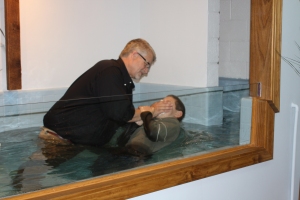
New Hope in Rock Falls: Pastor Jon Sedgwick prays with IBSA church planting leaders Van Kicklighter (left), John Mattingly (right) and Jordan Van Dyke, a future church planter in Galesburg, prior to the launch service. Later Sedgwick baptized a brother and sister.

New Hope in Rock Falls: Pastor Jon Sedgwick baptized a brother and sister at his church’s launch service.

The next morning Jon Sedgwick is all smiles as he baptizes two new believers. Sedgwick didn’t intend to plant a church in northern Illinois. “I didn’t like Illinois,” the former Missouri pastor said emphatically. Illinois was just a place to get through when traveling home to Indiana for visits with family. “But God gave us a love for Illinois!”

“We love Rock Falls!” his wife, Rhadonda, added, equally enthusiastically.

Mattingly had visited the Sedgwicks’ Missouri church describing the need for planters in the Northwest quadrant of Illinois. After Mattingly’s second appeal – “Is God calling someone here to come and help?” – the couple realized, “It was us. God was calling us. God said, ‘Why not you?’”

In 2012, they arrived and began building a new ministry at the building that once housed First Southern Baptist Church of Rock Falls. To the usual round of Bible studies and home meetings, Sedgwick added “Celebrate Recovery,” a faith-based twelve-step program originated by Rick Warren and Saddleback Community Church in California. Reaching out to people with addictions, Sedgwick found doors opening that once were closed to Baptist ministry.

At the worship service, greeters David and John freely told guests how they came to be part of New Hope Church through the recovery ministry.

Also in attendance was Jordan Van Dyke, a planter who is gathering a core group for a new church in Galesburg.
It is commonly observed that ministry in northwest Illinois is especially challenging. “It’s because of the soil,” Van Dyke said. “It’s hard. Sometimes I wish I’d been sent to southern Illinois where, when it’s Sunday, people go to church. In the northwest, it’s Sunday and church is an option. ‘Will I go to church?’ Maybe. Maybe not.”

On this day they do, because there’s new hope in Rock Falls.

Eric Reed is editor of the Illinois Baptist newspaper. In the May 26 issue of IB, we’ll continue our series on The Midwest Challenge with a focus on church revitalization. Go to http://ibonline.IBSA.org to read past issues.