Archives For November 30, 1999

Personal belief, salvation, spiritual disciplines, formation

HEARTLAND | Eric Reed

The world has gotten scarier in recent months. If the ongoing threat from Al Qaida, government-sponsored terror in Syria, escalating conflict in Israel, and the persecution of Christians across the Middle East were not enough, now there’s the march of ISIS, a vast, mobile, and unpredictable kind of terror that produces beheadings on our TV screens and a surge in troop deployment.

We might soothe ourselves by saying, “That’s far away—over there,” if not for Ferguson, Missouri. The scenes of protests following the shooting death of a teenager by a city policeman are still fresh, and the threat of deadly riots pending the outcome of a grand jury investigation of the policeman’s actions is even scarier. Our Illinois friends who live in metro St. Louis television market have been subjected to four months of daily news coverage predicting trouble. Teachers, pastors, and church leaders have all been advised what to do if protests again turn violent.

Eric_Reed_Nov24And don’t forget Ebola. For people all over the world, these are scary days. But into such frightening times, God often sends a message: fear not.

The Lord assures Joshua as he assumes command after Moses, “Haven’t I commanded you: be strong and courageous? Do not be afraid or discouraged, for the Lord your God is with you wherever you go” (Joshua 1:9).

Gideon, ordered to save Israel from the Midianites, is fearful until he hears from God himself: “But the Lord said to him, ‘Peace to you. Don’t be afraid, for you will not die’ (Judges 6:23).

From Lamentations, the prayer of all Israel: “You come near when I call on You;
You say: ‘Do not be afraid.’” (Lam. 3:57).

And most famously, the head of a night-sky army tells a little band of shepherds outside Bethlehem, “Fear not, for behold…” In their declaration there’s a reason for steely nerve: A savior, a rescuer has been born.

When God sends the message to be brave and courageous, he often couples it with an assurance of his own presence. “Do not fear, for I am with you; do not be afraid, for I am your God. I will strengthen you; I will help you; I will hold on to you with My righteous right hand” (Isaiah 41:10).

In Isaiah’s question, “Who has believed what we have heard?
And who has the arm of the Lord been revealed to?” (53:1), the prophet is referring to the coming Messiah. God’s strong right arm is Jesus himself. That’s who will defend us. That’s who will protect us.

“Fear not” is not an idle command; God backs up what he says. “For behold” is an invitation to look and see that His promise is ready to be tested and fully verified.

Jesus, walking on water, tells the disciples: “‘Have courage! It is I. Don’t be afraid.’

‘Lord, if it’s You,’ Peter answered Him, ‘command me to come to You on the water.’

‘Come!’ He said” (Matt 14:27-29).

Fear not, Peter, the Lord’s strong arm will hold you up, even on the roiling sea. With such an all-powerful guard alongside, there is no reason to be afraid.

Kizzie Davis, owner of the Ferguson Burger Bar, told KMOX radio last week she refused to board up her new business, as other owners were doing ahead of the grand jury’s report. The mom-and-pop hamburger shop opened one day before the death of Michael Brown and survived the first protests. “We had no issues at that time,” Davis told the reporter. “Prayerfully, we won’t have any issues if unrest occurs this time.”

Customers commended her brave stance. “Cool management. They fear no one, but God,” one posted at the restaurant’s website. (And the turkey burger topped with a fried egg got five stars.)

Davis reminds us all that we can’t live in fear, even in fearful times. And if we follow her example, we too will stay open, keep cooking, and pray.

Eric Reed is editor of the Illinois Baptist and associate executive director for IBSA’s Church Communications Team.

COMMENTARY | Josh Monda

This week marks the one-year anniversary of the EF-4 tornado that devastated parts of Washington, Ill. Brookport, New Minden, Diamond, Coal City and Pekin were among the other Illinois communities affected by powerful storms on Nov. 17, 2013.

This week marks the one-year anniversary of the EF-4 tornado that devastated parts of Washington, Ill. Brookport, New Minden, Diamond, Coal City and Pekin were among the other Illinois communities affected by powerful storms on Nov. 17, 2013.

Humanitarian effort void of the gospel of Jesus Christ does nothing to change one’s eternal destiny. Moments after making this statement during a sermon, a tornado would rip through our town, passing a quarter mile from our church.

The day of the tornado was not without trouble, even before the storm came through Washington. A month before, my father-in-law had been diagnosed with esophageal cancer. The day before the tornado, my 14-year-old daughter laid on my living room floor near death, and that evening was in the hospital.

Taking a full load in seminary, and trying to balance all that was going on in my life, I gathered our two young sons that Sunday morning and got them ready for church. The rest, as they say, is history. An EF-4 tornado hit our town as my congregation took shelter in the church basement.

It would have been easy then (and now) to focus on all that changed that day, or how everything after November 17 would be different than before. Indeed, a lot is different, even a year after the storm. Members of my church, deacons in my church, lost their homes. One of our deacons moved away, and for a small church, this is difficult.

Change has touched my family too. My daughter eventually recovered from the infection that put her in the hospital, but my father-in-law passed away before the tornado.

Not every change has been negative: After the storm, people seem more in tune to the needs of others, and thoughts about possessions have changed.

But my focus, and our church’s focus, is on something that will never change: the gospel of Jesus Christ. It was not by mistake that I would make the statement about humanitarian effort and the gospel moments before the tornado hit. Our focus has to be on the gospel.

When people are hurting, our focus must be the gospel.

When people are suffering, our focus must be the gospel.

When people know not where to turn, our focus is the gospel.

A tornado can change our circumstances, it can even change where we live. But a tornado will not transfer someone from the Kingdom of Darkness into the Kingdom of Light; only the gospel does this.

As a people, as a church, we can allow a tornado to either drive us to what truly makes a difference, or distract us from it. May our focus be on what makes a difference; may our focus be on the gospel of Jesus Christ.

Josh Monda is pastor of First Baptist Church in Washington.

COMMENTARY | Jill Waggoner

I never gave hunger much thought until I became a mother.

Motherhood begins with conversations about “the schedule” and bottles and quickly turns to the veggie/fruit count, snack monitoring, and introduction of potential allergens. The advice you receive about what your child needs and when he needs it can be overwhelming. Yet, my troubles only amounted to worrying about how I would get my one-year-old to drink the non-sweetened, organic, vanilla almond milk, not how we would pay for it.

For many, including mothers, the question of where their next meal will come from is a daily, if not hourly, worry. In the United States alone, 89% of households with children are considered “food insecure,” meaning they do not know how they will provide their next meal, according to the 2014 “Hunger in America” study by Feeding America. Today, one in seven Americans receives support through a feeding program, including 12 million children. This is a reality I have not known and, I
confess, have taken for granted.

Jill_Waggoner_calloutNumbers like these are an important reminder that hunger happens everywhere—not just in the slum of a foreign country or the housing developments of urban cities. Hunger is a part of my life and part of yours, by proximity, whether we realize it or not.

My church uses the phrase “as you go” when talking about sharing the Gospel. We share Christ with others as we live our lives in our communities, in our families and in our jobs. It’s incorporated into everything we do—that as we walk with Christ, knowing and serving Him, we would make disciples by encouraging others to join us.

On a personal level, “as we go,” means we must have our eyes opened to the hunger needs in our communities and neighborhoods. I believe you will find many ministries and governmental organizations meeting the critical needs where you live. I challenge you to join forces with those who do effective, Christ-centered ministry and seek out those who still might be overlooked.

On an international level, Global Hunger Relief operates from a similar mindset. The work of Southern Baptists around the world is vast, varied and Gospel-focused. Yet, “as we go” we encounter physical needs that must be met in order to effectively minister. GHR, formerly known as World Hunger Fund, is a cooperative initiative that comes alongside existing Southern Baptist partners and provides the funding to meet those needs. And while most humanitarian organizations keep 30-70% for administrative overhead, GHR is able to devote 100% of resources given to this life-saving work.

Southern Baptists around the globe will be drawing attention to both this critical need and the important work of Global Hunger Relief Oct. 12 with World Hunger Sunday. I encourage you to visit globalhungerrelief.com to learn how you and your church can participate and help us to change forever lives and communities in the name of Christ.

Jill Waggoner is deputy press secretary for the Ethics and Religious Liberty Commission and lead brand strategist for Global Hunger Relief.

THE BRIEFING | Meredith Flynn

49% of Americans say same-sex couples should be allowed to marry, Pew found in research released last week. The percentage is down five points since the researcher last asked the question in February.

According to the report on Pew’s website, “It is too early to know if this modest decline is an anomaly or the beginning of a reversal or leveling off in attitudes toward gay marriage after years of steadily increasing public acceptance.

“Moreover, when the February poll and the current survey are combined, the 2014 yearly average level of support for same-sex marriage stands at 52%, roughly the same as the 2013 yearly average (50%).”

The_BriefingWe could know as early as this week whether the U.S. Supreme Court will hear any of the pending same-sex marriage cases, Reuters reports. The justices met yesterday for a private conference prior to the new term that begins Oct. 6. In September, 32 states asked the Court to decide the marriage issue once and for all, as did a coalition of religious groups including the Southern Baptist Ethics and Religious Liberty Commission.

SBC disfellowships ‘third way’ church
The Southern Baptist Convention’s Executive Committee voted last week to withdraw fellowship from New Heart Community Church, the California congregation whose pastor announced in February he no longer believes same-sex lifestyles are sinful. The committee’s action followed a similar decision by the California Southern Baptist Convention in September.

More from Pew: Public split on business rights and same-sex marriage
Pew’s recently released data also shows 47% of people think wedding-related businesses should be allowed to refuse services to same-sex couples, while 49% say they should be required to provide services. Half of those surveyed believe homosexuality is a sin, up from 45% a year ago, Pew reported.

Court to hear Arizona church sign case
One case already on the Supreme Court’s schedule is Reed vs. Town of Gilbert, in which a Presbyterian congregation is fighting its town’s signage code. Gilbert, Arizona, requires that signs like those posted by Good News Presbyterian Church cannot go up more than 12 hours before the event advertised—Sunday worship, in this case.

‘Kimye’ pastor will star in reality show
The Oxygen network has announced Miami pastor Rich Wilkerson, Jr., who performed the Kim Kardashian/Kanye West wedding earlier this year, will get his own show. “The Wilkersons” will focus on the pastor of Trinity Church and his wife, DawnChere. The show will join other Oxygen faith-centric shows including “Preachers of L.A.” and the upcoming spin-off “Preachers of Detroit.” Read more at ChristianPost.com.

COMMENTARY | Eric Reed

In the past couple of weeks, I found myself reaching for the remote every time the news showed that video of NFL football player Ray Rice coldcocking his future wife in a hotel elevator. Seeing him drag her, unconscious, into the hallway and dumping her body on the floor is too much to take. For some of us, domestic violence hits too close to home.

A 2010 survey by the Centers for Disease Control showed 24% of women and 14% of men have been “hit with a fist or something hard, beaten, slammed against something at some point in their lifetime” by a partner. And yet, new LifeWay Research shows 4 out of 10 pastors never preach or teach about it, and only 2 in 10 raise the topic annually.

Country Church InteriorThat means in two-thirds of our churches, attenders might hear domestic violence, which affects one-fourth of households, referenced in a sermon or large group meeting once a year, if at all.

Spousal abuse still isn’t a subject for public conversation—even from the pulpit.

In my years of hearing and reading sermons, I’ve encountered only one on domestic violence. The preacher was a quiet man, unmarried, and he gave no indication what prompted him to tackle the subject. He chose as his text the account of Jephthah’s daughter in Judges 11.

So many more familiar verses would have supported his argument and from a more positive angle: Man, God made womankind to be your perfect complement (Genesis 2:18). Love your wife as Christ loves the Church; love her as you love your own body (Ephesians 5:25, 28). And as simply as this: love your neighbor as yourself (Matthew 22:39, Mark 12:31).

But instead the preacher trudged faithfully through the gruesome report of a rash vow that ended, by most interpretations, in the slaughter of an innocent woman. This wasn’t violence of a husband against wife, but the horrific act of father against daughter was just as unthinkable. And the preacher’s willingness to tell the bloody story made domestic violence very real, even within the sanctuary.

The preacher applied Jephthah’s brutality to parents who abuse their children and husbands who beat their wives. He even spoke of domestic partners and live-in relationships where it appeared degradation perversely motivated staying together, even when no law required it and no church encouraged it.

Knowing his congregation, that was a brave move. In his neighborhood there along the streetcar line, brutish Stanley Kowalski was still a common character. TMZ attests he still is.

Not many pastors tackle the subject as bravely. Even pastors who preach on domestic violence once in a while are more likely to think violence in the home troubles their community (72% said it did) more than their church (only 25% said so). Lifeway Research says half of senior pastors (52%) say they don’t have enough training to deal with the issue. Many say nothing.

I remember my mother wearing sunglasses in church of necessity, and rehearsing an excuse that she ran into a door should anyone question her. No one did. Even as she directed the choir and led the singing behind shades, the cause of her bruises was never raised.

But what the church historically hasn’t done, perhaps TMZ and the NFL will force us preachers to do: bring what happens in angry, broken households into the light and hold it up against the Word of God.

Because for too many of us, domestic violence hits close to home.

Eric Reed is editor of the Illinois Baptist.

–Statistics from BP.net and LifeWay Research

COMMENTARY | Chase Abner

Note: This article originally appeared on Collegiate Collective, a new resource that features articles, podcasts, and videos designed to equip leaders to advance the gospel on college campuses.

Chase_Abner_calloutI’ve been around collegiate ministry for about eleven years. In those years, I’ve been witness to all sorts of public hubbub on the world stage of evangelicalism. At first, there was the challenge posed by Dan Brown’s “The Da Vinci Code.” Then there was a lot of back-and-forth about the Emergent Church and how post-modernism was going to erode all of Christendom. And that was just a precursor to Rob Bell’s “Love Wins” and the battle for the doctrine of hell. And Mark Driscoll has been the subject of his fair share of controversies. Throw “The Shack” and Calvinism into the mix and you’ve got yourself enough blog fodder to last you until the other side of eternity.

Early on, I somehow got the impression that a big part of my job as a campus minister was to help students be on the “right side” of all these public controversies. I read a lot of blogs and way too many blog comments. I sought out what side my heroes were on. I studied the Bible hard and I tried to provide my students with all the right answers.

However, there was one big problem.

They weren’t even asking the questions. Most of them didn’t even know who Brown or Driscoll or Bell or Calvin was. They were more concerned about passing their biology test or paying tuition in the spring or what they were going to say to their roommate struggling with depression.

So I gave up. I stopped trying to be up-to-date on the controversy of the day. I decided that if it wasn’t something that was directly impacting my students, then I wouldn’t bother with it.

And guess what? I found that I had a lot more time to hear from God, rather than about Him from someone on a podcast. I found that I was freer to hear the questions the students actually had, rather than the ones I forced on them. And I found that it’s a lot easier to follow Jesus when you’re not fighting over Jesus.

So last week, a video of Victoria Osteen made the rounds. If you didn’t know, she is the wife of America’s most famous mega-pastor Joel Osteen. The clip is from a sermon in August wherein Victoria makes some…how do you say…provocative claims about proper motivation for obeying God. (If you haven’t seen it yet, then count yourself blessed and forget I mentioned it.)

Here’s what naïve Chase would’ve probably done in response to this clip if it had come along in my early days of ministry: I would’ve torn the thing to bits, shared all the parody videos, and read every blog that critiques the Osteens’ errant theology. I might’ve even used one of the parody videos in our weekly gathering or taught an entire lesson in response. In other words, I would’ve wasted a lot of time doing battle against something that had virtually zero influence on the people in my care.

Let me suggest this template for responding to public Christian controversies in your collegiate ministry context.

  1. Pray for the individuals caught in sin or espousing false teaching.
    • Example: Pray for the Osteens and those influenced by their teaching ministry.
  2. Examine yourself in light of Scripture.
    • Example: Ask God to show you where you have selfish motives in your obedience to him. Repent as necessary.
  3. Listen to your students. Respond when necessary.
    • Example: If your students aren’t being influenced by the controversy, then press on in your disciple-making as if nothing has happened. If they have questions about it, then address the controversy.

You see, as you focus your energy on developing mature Christians who believe and apply the gospel to all of life, they will be equipped to address the counterfeits on their own. If at times, the controversies catch their attention and your students have questions, then embrace those as teachable moments. But remember, they are just that—moments—and not the normal pattern for your ministry.

Most of all, avoid the temptation to define yourself and your ministry by what you’re against. Is the gospel exclusive? Yes. Does God draw some hard lines in Scripture? Yes. But most clearly, he reveals himself in the person and work of Jesus Christ who gave most of his energy on earth to proclaiming the good news of the Kingdom.

Chase Abner is Collegiate Evangelism Strategist for the Illinois Baptist State Association.

THE BRIEFING | InterVarsity Christian Fellowship will lose its current access to all 23 schools in the California State University system because the ministry requires their leaders to affirm Christian doctrines, reports Christianity Today. IVCF’s policy is in violation of a university rule, adopted in 2012, that requires recognized groups to accept all students as potential leaders.

The_Briefing“While we applaud inclusivity, we believe that faith-based communities like ours can only be led by people who clearly affirm historic Christian doctrine,” reads a statement on IVCF’s website.

The ministry received a one-year exemption from the policy for the 2013-14 school year, but will now lose privileges including free meeting space and access to campus activity fairs.

On his blog, LifeWay’s Ed Stetzer examines the ramifications: “The bigger, and ongoing, issue is the continual sanitization of unacceptable religious voices from universities.”

State marriage cases likely to land in high court
Recent rulings on marriage by federal judges and circuit courts have advocates on both sides of the debate looking toward the U.S. Supreme Court to decide the issue. On Sept. 4, 32 states—15 that allow same-sex marriage and 17 that don’t—asked the high court to settle it once and for all, reported the Associated Press.

Same-sex marriages in Illinois officially began June 1, although some counties issued licenses earlier. The state’s General Assembly approved “The Religious Freedom and Marriage Fairness Act” last fall.

‘Elevate Marriage’ scheduled for Oct. 16
The Illinois Baptist State Association will host an “Issues & Answers” event in Springfield, Ill., to help churches address cultural shifts on marriage. The Oct. 16 conference for pastors and church leaders will feature Kevin Smith, The Southern Baptist Theological Seminary; Andrew Walker, Ethics and Religious Liberty Commission; and Jill Finley, Bethel Baptist Church, Troy, Ill. Lunch is included, and registration is required; go to www.IBSA.org/Marriage.

Chick-Fil-A founder Truett Cathy dies at age 93
Christian leaders and fans of Chick-Fil-A mourned the loss of S. Truett Cathy, who died early Monday morning. Cathy built the chain—known for its chicken sandwiches—from one store in 1946 to more than 1,800 restaurants currently operating in 40 states and Washington, D.C. He was known for his Christian faith and Chick-Fil-A’s “closed on Sundays” policy. Read more at BPNews.net.

Osteen answers criticism
Megachurch co-pastor Victoria Osteen said that church-goers at Lakewood Church in Houston, Texas, understood her recent controversial comments about why people ought to obey God. “When you come to church, when you worship Him, you’re not doing it for God really,” Osteen said during a Lakewood service Aug. 31. “You’re doing it for yourself, because that’s what makes God happy.” The video went viral, garnering much criticism on social media. Osteen told The Blaze she could have been more articulate, but she stands by her point. “I did not mean to imply that we don’t worship God; that’s ridiculous, and only the critics and cynics are interpreting my remarks that way.”

Al Mohler, president of The Southern Baptist Theological Seminary, blogged that the message preached by Osteen and her husband, Joel, “is the latest and slickest version of Prosperity Theology.” Read Mohler’s commentary here.

Josh_Laxton_Aug21COMMENTARY | Josh Laxton

For the last eight years, I have been working in churches that were in need of revitalization, or breakout. I know this doesn’t make me an expert, but it has given me field experience. In addition, for the last three years I have been intensely studying the condition of the American church and her impact in contemporary culture.

I have come across many success stories of pastors who led their church to positive breakout. But it seems that for every story of success, there are nine stories of struggle and heartache. In all honesty, leading a church to breakout is like trying to climb Mount Everest. It’s daunting and extremely difficult.
In my last column on Nehemiah, I explained how his breakdown laid the foundation for the breakout of his people. But that’s not the end of the story.

Nehemiah also faced many obstacles in leading the breakout. The king (his boss) had already stopped the rebuilding of the wall years earlier. Nehemiah hadn’t led this kind of work before. He faced a long, dangerous journey to get to the people, and once he arrived, he met a discouraged people in need of motivation and organization.

Just like Nehemiah, those who want to lead a church to breakout will face a variety of obstacles. As leaders, we face obstacles of perceptions, practices, poor theology, and people’s resistance to change. For many, the perception is that the church is fine—we’re paying the bills and ministries are still running. When it comes to practices, over time churches tend to focus on insiders, not outsiders, which can lead to neglecting the building, failing to create hospitable environments, and lacking a defined process for connecting new people.

Poor theology also can be an obstacle. Without being aware, a congregation can lose their passion for the centrality of Jesus and his gospel, their urgency to call people to repentance and salvation, and their missional posture towards the community and the nations.

One of the toughest obstacles is leading people to embrace change. I have found many church members want growth (or, at the very least, they don’t mind it), but don’t want things to change. In short, leading breakout isn’t easy, especially in light of the various obstacles. Nehemiah knew this as well. He navigated through the obstacles by way of breakthrough—an “aha moment.”

His prayer, starting in Neh. 1:4, gives us at least three principles of breakthrough that have implications for our ministry today:

God is the breakthrough power. Immediately after hearing the condition of the people, Nehemiah went to the Lord. “Let Your eyes be open and Your ears be attentive to hear Your servant’s prayer,” he says in verse 6. “…I confess the sins we have committed against You.”

This is paramount for church and denominational leaders to understand, especially given the fact that we live in a self-help culture where there is no shortage of books, conferences, leadership podcasts, and workshops about how churches can breakout from their unhealthy condition. While there’s nothing wrong with many of these resources, I have to constantly remind myself that these are supplements to breakout, not the source.

Humility is the breakthrough position. Nehemiah’s prayer reflects his understanding of God’s position and power, and that he and Israel are His servants (Neh 1:5, 6,10). Our prayers should reflect God’s transcendent position in relations to us—how great, gracious, awesome, faithful, and powerful he is. In addition, our prayers should reflect our humble position to God—a position that’s here to serve him and be used by him to do what he has put in our hearts.
When it comes to leading our churches to breakout may we never confuse our role with God’s—we are simply conduits by which He works to bring his people where He wants them to be.

Faithfulness is the breakthrough pattern. In Nehemiah’s prayer, we see that his going to the Father wasn’t a one-time deal; he did this “for days.” Scholars note that four months passed between chapter one and two. Thus, for over four months, Nehemiah faithfully goes to the Lord, humbling and submitting himself to God’s will and leading. His continued faithfulness reflects both the seriousness of leading a breakout and his belief that only God could do it.

If we desire to lead our churches to breakout, not only must we have a breakdown, but we must have a breakthrough—an “aha moment” were we realize God is the only one who can breakthrough the obstacles we face.

Josh Laxton is lead pastor of Western Oaks Baptist Church in Springfield. His first column on Nehemiah appeared in the July 28 issue of the Illinois Baptist.

The_BriefingTHE BRIEFING | Russell Moore, president of the Southern Baptist Ethics and Religious Commission, urged Christians to “pray fervently” for believers facing persecution for their faith.

“As Christians, we should pray for the president and our military leaders to wisely administer the sword of justice (Romans 13:1-3),” Moore said in a written statement. “As part of the global body of Christ, we must also pray fervently for our persecuted brothers and sisters in Iraq and across the Middle East (Hebrews 13:3).”

His comments came after President Barack Obama authorized U.S. airstrikes and humanitarian aid to help Iraqi religious minorities under attack from militant groups in the country.

Obama “is right to take action to protect religious minorities, including Christians, in Iraq from ISIS,” Moore said. “He has my prayers.”

Read the full story at BPNews.net, or click here for an overview of the recent onslaught of persecution around the world.

Other news:

Amid controversy surrounding Driscoll, LifeWay stops selling Seattle pastor’s books
A day after the Acts 29 church planting network removed Pastor Mark Driscoll and his churches from their membership, LifeWay Christian Resources stopped selling Driscoll’s books online and in stores. “LifeWay Stores and Lifeway.com are not selling Mark Driscoll’s books while we assess the situation regarding his ministry,” communications director Marty King told Christianity Today.

The Acts 29 and LifeWay decisions came after a string of controversies and charges surrounding Driscoll, founding pastor of Mars Hill Church in Seattle.

Gungor stands by beliefs about Adam & Eve, biblical flood
Christian musician Michael Gungor’s admission that he no longer believes in a literal Adam and Eve or flood sparked controversy when the comments were published in a WORLD magazine online report this month. Ken Ham, founder of Answers in Genesis and the Creation Museum, called for Gungor to apologize for the statements, while the musician responded to the controversy on his blog.

Marriage rates in decline among Millennials
Millennials are less likely to marry by 40 than any other previous generation, according to data from the American Community Survey analyzed by the Urban Institute. For example, in 1990, 91% of women age 40 had married; currently, only 69.3% of women age 40 have married. The rate for men is approximately 4% lower, Baptist Press reported.

Coming to a theater near you: “Christian Mingle The Movie”
Girl creates fake faith profile on Christian dating site, meets potential Mr. Right. Girl admits phony faith and loses Mr. Right, but gains a relationship with God. “Christian Mingle The Movie” is due in theaters in October. Read more at ChristianPost.com.

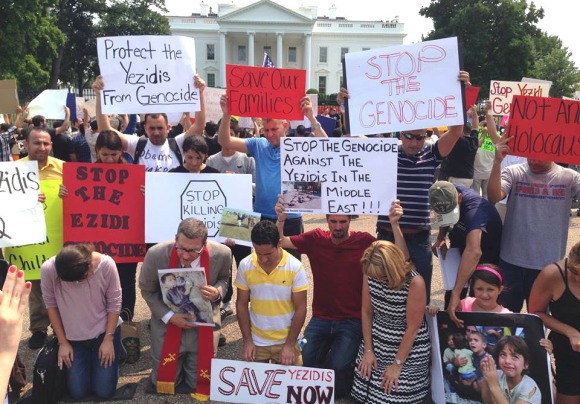
Rob Schenck (front, red scarf), president of Faith in Action and the National Clergy Council, prays Aug. 7 for the Yazidis and Christians suffering in Iraq. IMB photo

Rob Schenck (front, red scarf), president of Faith in Action and the National Clergy Council, prays Aug. 7 for the Yazidis and Christians suffering in Iraq. IMB photo

Christians around the world face heightened persecution

NEWS | From Baptist Press and IMB reports

An unfamiliar symbol began showing up on social media pages late last month. The curved line under a single dot is the Arabic letter “Nun,” reportedly used by militants in Iraq to mark the homes of Christians in the country.

“Nun” stands for Nazarene, or Jesus.

Extremists with the Islamic State of Iraq and Syria (ISIS) have forced Christians from their homes under threat of death. The Iraqi believers and other religious minorities joined millions of Syrian refugees already displaced by civil war. In a region rich with Christian history, many have noted, very little evidence of Christianity is left.

The onslaught of persecution this summer has awakened many in the Western church to the needs of Christians around the world. Many pastors and Christian organizations in July changed their Twitter avatars and Facebook profile photos to include the letter “Nun.” They also used the hashtag #WeAreN as a show of solidarity with the persecuted believers.

“The Islamic militants mean it for evil when they mark homes with ‘N’ for ‘Nazarene,’” wrote Russell Moore, president of the Ethics and Religious Liberty Commission. “They assume it’s an insult, an emblem of shame. Others once thought that of the cross.

“But in that intended slight, we are reminded of who we are, and why we belong to one another, across the barriers of space and time and language and nationality. We are Christians. We are citizens of the New Jerusalem. We are Nazarenes all.”

Iraqi refugee crisis

“There are no Christians left in Mosul.”

That’s how religious freedom advocate Nina Shea described conditions in Iraq’s second largest city in July.

Shea, director of the Hudson Institute’s Center for Religious Freedom, told CBN News that Islamic militants have eradicated virtually every trace of Christianity from Mosul, the center of Iraq’s Christian community for 2,000 years. Mosul is located on the site of the ancient city of Nineveh.

In June, militants with the Islamic State in Iraq and Syria (ISIS) extended an offer to let Christians in Mosul practice their Christian faith behind closed doors, after they paid a hefty tax and agreed not to proselytize. However, multiple sources in the region said that offer was later withdrawn and all Christians were told to leave or face execution.

Members of Assyrian Christian and Chaldean Catholic groups left empty handed, Shea said. Militants confiscated all of their possessions, including homes, cars, clothes “and even their wedding rings, sometimes with the finger attached if it would not come off.”

Christians aren’t the only religious minority targeted by ISIS. On August 3, militants seized the city of Sinjar, forcing the Yazidi Kurdish population to flee. Many escaped to the nearby Sinjar Mountains, a barren heap of rock where daytime temperatures can top 120 degrees.

More than 150 Yazidi immigrants rallied in front of the north lawn of the White House August 7 to plead for American involvement in the growing crisis. (President Obama announced that evening he had authorized military airstrikes on Iraq.) The protestors came from across the U.S. to rally on behalf of the Yazidis, who do not practice Islam but instead follow an ancient religion ISIS equates to “devil worship.”

Christians and religious minorities in other nations also have faced recent persecution due to war and religious hostilities:

Syria | The recently released International Religious Freedom Report included a daunting sentence about the country that shares Iraq’s northwestern border: “In Syria, as in much of the Middle East, the Christian presence is becoming a shadow of its former self.”

A three-year-old civil war has resulted in millions of refugees and increasingly persecuted religious minorities, including Christians caught between the regime currently in power and militants fighting against it. The report, released annually by the U.S. State Department as a picture of the state of international religious freedom the previous year, found that in the city of Homs, only 1,000 Christians remain. There were approximately 160,000 Christians there before the war.

Nigeria | Approximately 1,505 Nigerian Christians have been killed for their faith this year, as the Boko Haram terrorist group and other extremists continue their campaign of religion-based violence in the West African nation. Boko Haram and other groups have killed nearly as many Nigerian Christians in the first seven months of this year as were killed in all of 2013, the advocacy group Jubilee Campaign reported July 29.

Christians killed to date include seven fathers of the 223 Chibok school girls still missing after Boko Haram kidnapped more than 300 students in mid-April. (The group is dedicated to fighting the influence of Western education.) The fathers were killed July 20 when Boko Haram attacked the city of Damboa and hoisted a Boko Haram flag there, the Associated Press reported.

Response from the West

David Curry is president and CEO of Open Doors USA, which offers assistance to persecuted Christians around the world and lobbies repressive governments to cease religious persecution. In July, he called the plight of Christians in Mosul and the remainder of northern Iraq “unprecedented in modern times.”

“This latest forced exodus of Christians further shows why Western governments and the people in the West need to cry out in support for religious freedom in the Middle East and elsewhere,” Curry said in a statement. “If this does not move us concerning the near extinction of Christianity in the Middle East, it’s likely nothing else can.”

Since the United States invaded Iraq in 2003 to overthrow Saddam Hussein, nearly one million Christians have fled the country for safer surroundings.

In an editorial this month for The Christian Post, Curry expressed doubt that the persecution of Christians would ever be treated as “a major humanitarian crisis” by governments and secular media. “However, we should be able to count on our own family,” he wrote.

“The persecution of Jesus followers should be preached from every pulpit and prayed for at every kitchen table. One day soon it may be your faith that is under attack and you will be hoping that others will be praying for you…or even notice that it is happening.”

The International Mission Board and its ministry partner Baptist Global Response are coordinating relief efforts among Iraqi refugees. For more information about how to help, go to www.IMB.org.