Archives For November 30, 1999

Personal belief, salvation, spiritual disciplines, formation

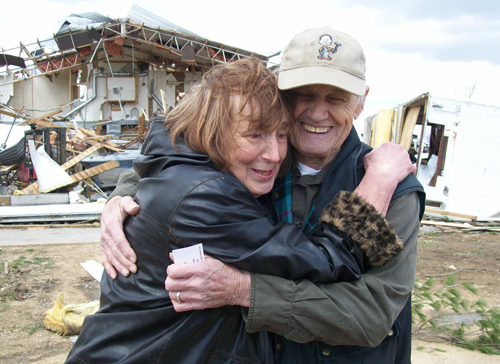
Raymond and Betty Kramer hug each other after being interviewed by the media about their experience in a Rochelle, IL restaurant's storm cellar while a tornado was on the ground above them. This photo was taken during and interview  in the town of Fairdale, IL, which was completely destroyed by tornado April 9.

Raymond and Betty Kramer hug each other after being interviewed by the media about their experience in a Rochelle, IL restaurant’s storm cellar while a tornado was on the ground above them. This photo was taken n the town of Fairdale, IL, which was completely destroyed by tornado April 9.

HEARTLAND | Lisa Sergent

Raymond Kramer and his wife, Betty, were driving home from Rockford, Ill.,

when it started to hail. As the icy stones got larger and came down harder, they started to look for shelter. Then, to his west, Kramer saw a funnel cloud on the ground.

The funnel cloud was part of a tornado outbreak that hit northern Illinois April 9. It caused destruction in town of Rochelle and completely destroyed the small community of Fairdale, where two people died.

The Kramers, members of Grace Fellowship in Ashton, took shelter in Grubsteakers Restaurant, where “the owner herded us through the kitchen, out the door, and we made a u-turn down into a good old-fashioned storm cellar,” Kramer told the Illinois Baptist.

When the tornado had passed, they tried to open the cellar doors, but found them blocked by debris. The back dining room and pantry walls had fallen on top of the doors. And the restaurant owner’s SUV had been lifted up by the tornado and was sitting on top of the walls.

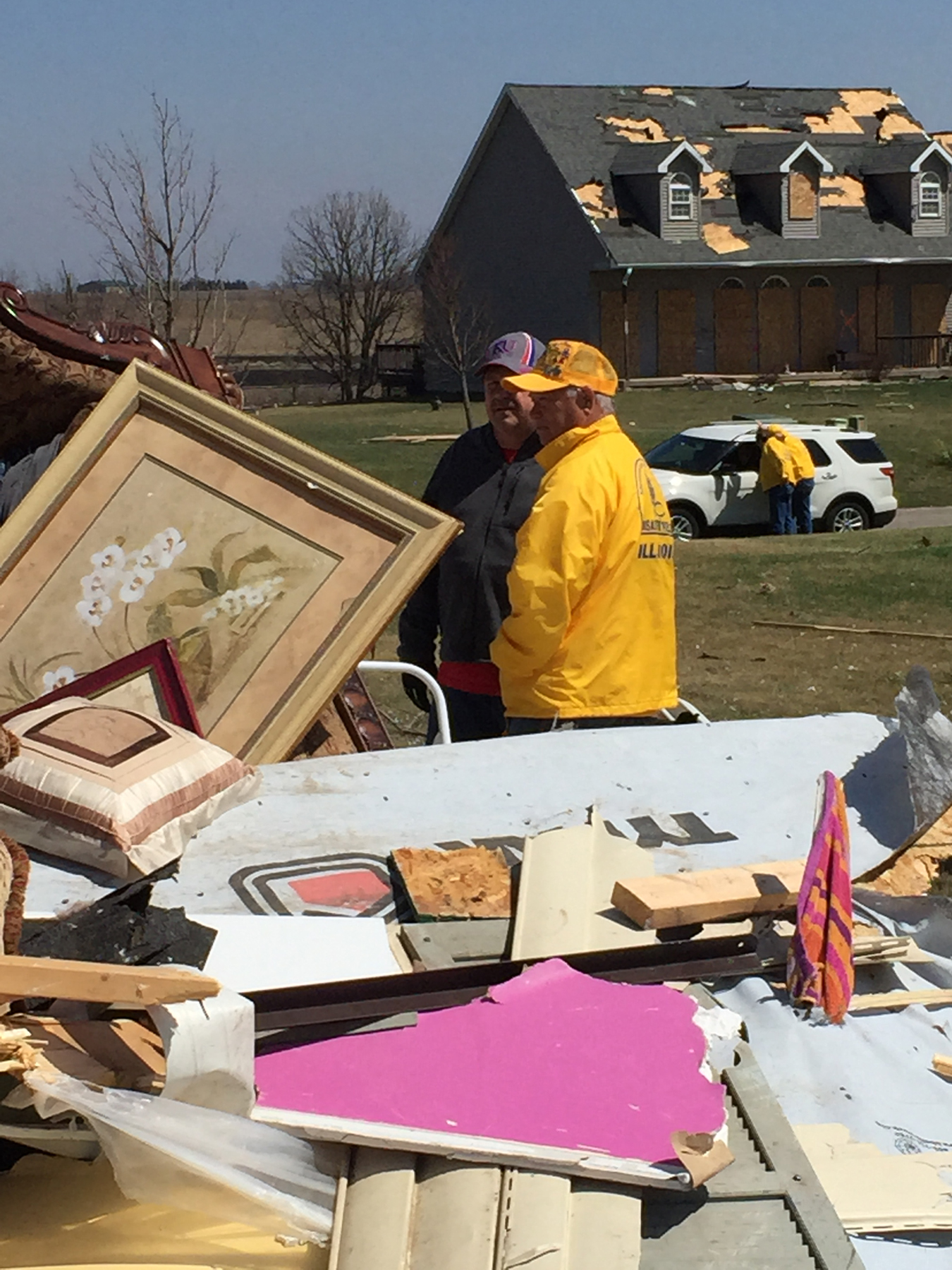
Illinois Baptist Disaster Relief workers survey damage after a tornado outbreak in northern Illinois April 9.

Illinois Baptist Disaster Relief chainsaw teams were on the scene two days after a tornado outbreak in northern Illinois April 9.

The Kramers prayed with 10 fellow survivors as they waited for first responders to arrive, which they did in 30 minutes. However, it took two hours for responders to free them. Sitting in the dark with only cellphone flash lights and, later, a light passed down by the responders, the Kramers prayed with the group.

One woman was crying, and as his wife comforted her, Kramer prayed. “I pray aloud in situations like this,” he said.

To help everyone relax, Kramer said he started singing, “’I’ll be there to pick you up in the wheel barrow honey, after about a quarter past eight….’ Then, I sang, ‘Que Sera, Sera, whatever will be will be…’”

Since the tornado, Kramer has been interviewed by local and national media who have called the 81-year-old and his wife heroes. “We’re not heroes,” he said. “We’re just servants of the Lord Jesus Christ…I had the joy of the Lord down there. I prayed to my God and I knew He would protect us.”

IBSA Disaster Relief participated in clean-up efforts after the tornado outbreak. Chainsaw teams from four associations of churches—Fox Valley, Quad Cities, Sinnissippi, and Three Rivers—worked at three homes in Rochelle.

Rex Alexander, Disaster Relief Coordinator said the callout “was a good opportunity for northern teams to work in their own backyard.”

To learn more about Disaster Relief ministry, go to www.IBSA.org/dr or call (217) 391-3142.

THE BRIEFING | Meredith Flynn

After an unarmed man was shot and killed by a South Carolina police officer, urban ministry strategist D.A. Horton advocated “radical righteousness” instead of retaliation.

The_Briefing“Radical righteousness is lived out when we work to see a criminal receive proper punishment, instead of private revenge; public order instead of personal retaliation; and respond with practical righteousness in place of our personal rights,” said Horton during a chapel service at Charleston Southern University April 8. The North American Mission Board’s national coordinator for urban student missions said the church must pursue the “radical righteousness” Jesus prescribed in Matthew 5:38-42, according to Diana Chandler’s report for Baptist Press.

“I was not present for Mike Brown [in Ferguson, Mo.], for Tamir Rice [in Cleveland, Ohio], for Eric Garner [in New York City], for Ezell Ford [in Los Angeles] and for the multitude of names that have been going down. I wasn’t there when the officers got gunned down in Brooklyn,” Horton said.

“… But what I do know as a believer, there was a real world with real hurt. There [are] real issues going on out there. And if believers cannot look to the words of Christ, and be words of comfort and clarity to our culture, then we don’t need to be claiming to be the church.”


The American Humanist Association has dropped its lawsuit against a New Jersey school district, allowing students to continue saying “under God” during the Pledge of Allegiance. Read the full story at ChristianPost.com.


A prayer written by Southern Baptist pastor Jack Graham will be read around the country on May 7, the National Day of Prayer. Graham is a former president of the Southern Baptist Convention and current pastor of Prestonwood Baptist Church in the Dallas metro area.

“We repent of our sins and ask for Your grace and power to save us,” says Graham’s prayer, which will be read at Day of Prayer celebrations. “Hear our cry, oh God, and pour out Your Spirit upon us that we may walk in obedience to Your Word. We are desperate for Your tender mercies. We are broken and humbled before You.”


The Ethics and Religious Liberty Commission is urging Christians to promote an April prayer emphasis with the hashtag #PrayforMarriage. Last week, the Southern Baptist ethics entity issued a challenge to pray at 10 a.m. (Eastern time) on April 28, the morning the Supreme Court is scheduled to hear oral arguments in several same-sex marriage cases. The web page ERLC.com/article/prayformarriage includes a sample prayer guide.


A majority of Americans believe politics would be more civil and effective if politicians read the Bible more. Read more in Christianity Today’s report on the 2015 State of the Bible study from the American BIble Society.


More news from the State of Bible report: Of the nearly 7,000 languages used as first languages, more than half lack a completed Bible translation. At the same time, 72% of Americans believe the Bible is available in all the world’s languages. Read more at Barna.com.


By the year 2050, Pew Research has forecasted, 38% of the world’s Christians will live in Sub-Saharan Africa. Meanwhile, Europe’s share of the global Christian population will continue to decline, from 66% in 1910, to 26% in 2010, to 16% projected for 2050.

COMMENTARY | Meredith Flynn

PrintOne of the major stories out of last year’s Leadership Summit hosted by the Ethics and Religious Liberty Commission was the negative reaction on social media. In fact, the “Reporter’s Notebook” column space in the following issues of the Illinois Baptist was devoted to “angry birds” who spoke out on Twitter about the speaker line-up, the subject matter, and the opinions expressed.

It seemed like almost everything that was said (or tweeted or blogged) at last year’s meeting made somebody mad.

This year, not so much. Yes, there was some chatter, according to tweets after the event, about Baptists having an agenda for tackling this year’s topic, racial reconciliation. At least one poster noted the Southern Baptist Convention should be honest about its past in regards to slavery and racial division. (One whole panel discussion and pieces of other messages were devoted to the topic.)

But most of the Twitter feedback was positive. Maybe it was because much of it came from inside the summit. Racial reconciliation may not have drawn the same large online audience as last year’s topic: sexuality. Or, there’s this possibility: At its core, the summit was a meeting about a problem that every Christian can identify with, and one for which even those outside the church see the need for a solution.

Divisions exist around racial identity, and in recent days, they have been especially ugly, violent, frightening and real.

Leaders at the summit seemed to view racism as a common enemy. And, for Christians, as sin. There are some things you don’t do anymore once you have a relationship with Christ, said recent Southern Baptist Convention President Fred Luter.

“Don’t tell me you’re saved and still lying like a rug. Don’t tell me you’re saved and still cussing like a sailor. Don’t tell me you’re saved and still mean as a pit bull. Don’t tell me you’re saved and still don’t like someone because of the color of their skin.”

From the podium in Nashville, summit speakers talked about racial division as a universal problem, and a universal responsibility. Thabiti Anyabwile compared having skewed ideas about racial identity to walking into a cafeteria and seeing one table of diners that look like you, and one that doesn’t. You immediately think the table that looks like you has something in common with you, and is therefore safe for you.

“The mind is a relentless stereotyper,” Anyabwile said. No matter who you are. At the ERLC Summit, speakers and attenders were unified by that knowledge, and in the belief that the gospel is the only thing that has the power to reconcile people to God and to one another.

And the angry birds, for the most part, stayed away.

Meredith Flynn is managing editor for the Illinois Baptist newspaper.

Editor’s note: This is part 1 of the Illinois Baptist’s coverage of a recent summit hosted by the Ethics and Religious Liberty Commission on racial reconciliation and the gospel. Read part 2 next week here at ib2news.org.

NEWS | Meredith Flynn

Weeks of riots in Ferguson, Missouri, following the police shooting of a young black man, Michael Brown. More protests in major cities after the death of another African American, Eric Garner, during an arrest. And with the shooting death of 12-year-old Tamir Rice in Cleveland, the culmination of a summer of racial unrest in America. And it was only the beginning.

Chants of “Hands up, don’t shoot” in the streets gave way to “Black lives matter,” and in personal conversations, the question has become “Why now?” and “I thought we had made so much progress on race relations in the U.S.”

A sad and challenging summer, followed by a new round of unrest in Ferguson after a condemning report from the U.S. Department of Justice, leaves many thinking, “Apparently not.”

And the church wonders, What can we do? And in some corners Christians have asked, What does the gospel require us to do?

“How do we as people formed by Christ start to have those conversations out in the world?” said Ethics and Religious Liberty Commission President Russell Moore at a March summit in Nashville. “It starts if we’re in the same body, gathered around the same table, praying with one another, praying for another, serving one another, being led by one another, and then we will stand up for and speak up for one another.”

The state of race relations in America, from Ferguson to New York, and coast to coast, is demanding fresh thinking and producing new preaching on race in all kinds of churches—including here in Illinois.

More than 500 current and future church leaders gathered at LifeWay Christian Resources last month to address racial reconciliation and the gospel. The second-annual Leadership Summit hosted by the Ethics and Religious Liberty Commission brought together nearly 40 speakers who presented on a wide range of topics: multi-ethnic ministry, Islam, the SBC’s history on racial issues, pop culture, and more.

In each message and panel, the summit’s key theme was clear: Racial reconciliation is a gospel issue. The gospel reconciles people to God and to one another, but sin is still at work in the world, causing tension, division, strife and violence.

The solution, leaders said at the summit, is for the church to preach and live out the gospel on matters of race. To examine itself for any lingering race-related sin of pride, and to work together to fight the common enemy of racism.

“We’ve got a long way to go,” Moore said in his opening address. “Our sin keeps wanting us to divide up. But to the faithful, Jesus promises, ‘You will be called overcomers.’ And we shall overcome.”

Summit attenders gathered in the aisles and at the altar to pray together at the start of a March meeting on racial reconciliation and the gospel.

Summit attenders gathered in the aisles and at the altar to pray
together at the start of a March meeting on racial reconciliation and the gospel.


Learning how to see each other
“All creatures of our God and King; lift up your voice and with us sing…”

The first hymn led by band Norton Hall and worship leader Jimmy McNeal took on extra significance as the words reverberated around the auditorium. All creatures, lifting up their voices, together. African American, Anglo, Hispanic; male and female; young and old. At the summit, mostly young.

The picture painted in “All Creatures of Our God and King” isn’t possible when people are left to their own devices, summit speakers said. The gospel is central to racial reconciliation. In perhaps one of the few times the Good News has been compared to mayonnaise, Dallas pastor Tony Evans said it acts as an “emulsifier,” like the eggs that helps combine the ingredients in his favorite sandwich condiment.

“Grabbing a black Christian and a white Christian, a red Christian and a yellow Christian, a Baptist and a Methodist, Pentecostal,” Evans preached as the crowd clapped and agreed with Amen’s. “He’s able to pull them together when you understand that the gospel can change an environment, and can do anything.”
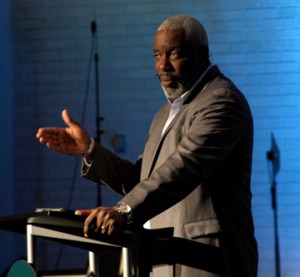
Thabiti_Anyabwile_blogThe mission of reconciliation can be seen in the Bible from the very beginning, said Washington, D.C., pastor Thabiti Anyabwile (right). Preaching from the book of Genesis, he urged his listeners to consider how they look at people different from themselves, in light of the fact that everyone is made in the image of God.

“Every person we have ever looked at, smiled at, greeted, encouraged, insulted, slandered, touched, is a person bearing the marks of divine likeness, the ‘imago dei.’ So, racial reconciliation must begin with our learning the habit of seeing each other as together made in the image of God, and therefore possessing inestimable, unfathomable dignity and worth and preciousness.”

But seeing other people is such a commonplace occurrence, Anyabwile continued, and then there’s the problem of sin. That’s why true reconciliation requires a constant renewing of the mind. How a Christian treats people of different ethnicities is such a key part of living out one’s faith that it ought to be a category of discipleship, the pastor said.

“That [racism has] moved so rapidly to be a despised thing is wonderful,” he said. “But along the way, I think many Christians have been so afraid of the label, so afraid of the discussion, and so afraid of the implications, that they don’t even want to have the conversation.”

Working out the reconciliation that Christ has achieved for us is one of the most underdeveloped areas in Christian discipleship in the U.S., he said. A believer can live his whole life without someone sitting down with them to explore their identity in Christ.

And so, Anyabwile said, “We’re weak when the Fergusons erupt around us, we’re weak when we watch Eric Garner choke to death on a city sidewalk. We feel incompetent when we see a Tamir Rice shot in Cleveland.

“We don’t know quite what to say or what to do, when the (Department of Justice) reports come out, whether it’s telling us that ‘hands up don’t shoot’ isn’t true, or whether it’s telling us that, man, this police department is shot through with racist practice….It immobilizes us, because we’re not discipled, because we don’t have this as a category in what it means to mature as a Christian, as a follower of Christ.”

THE BRIEFING | Meredith Flynn

Brighton Presbyterian Church in Rochester, N.Y., is the first church to leave the Presbyterian Church (USA) after a majority of the denomination’s districts voted to change its definition of marriage. The amendment to the group’s constitution, which will become official this summer, alters the marriage definition from “a man and a woman” to “two people, traditionally a man and a woman.”

The_Briefing“Our reason for leaving is centered on the status of biblical interpretation within the PC(USA),” Brighton spokeswoman Kerry Luddy told The Christian Post. “We believe that Scripture’s meaning and intent should not be altered to fit a current culture.”


“Heaven visitation resources” like Don Piper’s book “90 Minutes in Heaven” are no longer available from LifeWay Christian Resources. Spokesman Marty King told Baptist Press LifeWay stopped ordering “experiential testimonies about heaven” last summer, and has pulled the remaining products from stores and its website.

LifeWay’s decision followed the adoption of a resolution on “the sufficiency of Scripture regarding the afterlife” by messengers to the Southern Baptist Convention’s annual meeting last summer.


Legislators introduced this month a bill that would allow adoption and foster care agencies to operate within their religious convictions concerning placing children with same-sex couples. “This commonsense bill simply ensures that these child welfare providers can keep doing what they do best and are treated the same as the rest,” said Rep. Mike Kelly (R-Pa.), according to a WORLD News Service report.

Illinois is one of four states where agencies have discontinued adoption and foster care services because they would have been required to place children with same-sex couples.


More than 83,000 Bibles were shipped to Cuba this month through a partnership between Southern Baptist agencies, churches and individual donors. The Eastern Cuba Baptist Convention, which will receive 32,000 Bibles, reported more than 29,000 professions of faith last year, said Kurt Urbanek, International Mission Board strategy leader for Cuba. “The growth is so incredible, that’s why Bibles are so important.”


“If it wasn’t for the Baptists, I don’t know what I would do,” said one homeowner whose basement was repaired after severe flood damage wrought by Hurricane Sandy. More than two years after the storm devastated parts of New York and New Jersey, volunteers working through Southern Baptist Disaster Relief are still rebuilding and repairing homes in the region.


COMMENTARY | Nick Rynerson

“Pop culture” is often treated like a dirty word in the church—thought to consist of mostly irredeemable entertainment produced to make money off the masses. A common approach is to avoid secular music, films, art, and television, or at least to not admit to consuming it all that much.

But that isn’t often what our real lives look like. Most of us are at least closet pop culture consumers—we indulge in one or two sitcoms, a favorite secular radio station, or a superhero movie every now and then.

And maybe that’s okay.

Nick_Rynerson_March15Popular culture is not the enemy; first and foremost, pop culture is a place for storytellers to, well, tell stories. Moral discretion is important. (And biblical! See 1 Corinthians 8:7-9.) But we miss a wealth of spiritual and theological depth if we chalk up all entertainment created by non-Christians as irredeemable and misguided; we also miss out on the opportunity to identify and empathize from a distinctly Christian perspective (Acts 17:28).

Stories offer us insights into our culture’s longings, revealing God’s truth in the world around us. In his excellent book “The Stories We Tell,” Kentucky pastor Mike Cosper reminds us that a story is never just a story—it’s a window into our culture’s imagination and longings (see Romans 2:12-15).

“Storytelling—be it literature, theater, opera, film, or reality TV—doesn’t aim at our rational mind . . . It aims at the imagination, a much more mysterious and sneaky part of us, ruled by love, desire, and hope,” Cosper writes. “When people, against their better judgment, find themselves hooked on a show, we can trace the line back to find the hook in their imagination.”

Stories, according to Cosper, can reveal much more about a person, people group, or culture than a strictly informative presentation or a list of facts. Stories communicate what people truly desire.

Take, for example, a certain Best Picture nominee from last year. The movie contains some strong language, an ambiguous ending, and other elements that might lead some Christians to believe that it has nothing to offer spiritually (and for some to wisely not engage the film). However, if we look closer, we can clearly see some distinct things the storytellers—the director, writer, characters, etc.—believe about God, life, and themselves.

Without spoiling the film, which centers on the relationship between a talented young jazz drummer and his demanding/abusive instructor, the characters have a very human desire: to be great. The devotion of the characters to the pursuit of greatness, and its sway over their future happiness, is deeply identifiable. Like the Tower of Babel in Genesis 11, the characters sacrifice their life for the pursuit of self-glory, predictably leaving themselves and others miserable.

Ever since the Fall, man has been trying to claw his way back to perfection. Everybody longs for his or her flaws to be taken away, and many of us think that if we just work hard enough, we will reach the promised land of perfection.

As Christians, we know this is vanity (Romans 3:23), but the characters in the film sacrifice their lives and their sanity to meet every iota of their own personal law. This pursuit is hardwired into us and until we find personal and entire perfection in Christ, we will always fall short.

That’s serious, biblical truth, communicated (probably unknowingly) in a 2-hour movie produced with a secular audience in mind. The next time a movie, song, or TV show comes on that you are tempted to write off as irredeemable, consider if it might have something to teach us about God, the creator of all things.

In Acts 17:22-27, Paul not only quotes Greek poetry, but also alludes to the radical truth that we’re put where we were (i.e., in our cultural context) to speak eternal truth into subjective cultural contexts. In his book, Cosper uses this example to illustrate a distinctly Christian way of story-listening.

“As Christians living in the midst of these stories, we have an opportunity to both learn and bear witness. Stories teach us a lot about ourselves and our neighbors, and they provide windows into how our world is wrestling with the effects of the fall.

“They also present opportunities to respond with the truth.”

Nick Rynerson is a staff writer for Christ and Pop Culture and works for Crossway in Wheaton.

COMMENTARY | Lisa Sergent

Recently, I’ve had several opportunities to talk in IBSA meetings about “modern families” in our communities. I often ask the group I’m speaking to if they know anyone who is gay. Some say no, but others, especially younger people, begin to tick off a list.

And a fair number choose to say nothing. They appear uncomfortable. But then, aren’t we all?

When we hear about a florist being sued for declining to provide services for a same-sex wedding, or former megachurch pastor Rob Bell telling Oprah the church is just “moments away” from accepting gay marriage, our heads spin. We’ve come a long way from the early 80s when we were trying to figure out if singer Boy George was indeed a boy.

As I share how the Illinois Baptist newspaper has covered the rapidly changing marriage culture in Illinois, I tell how I’ve met same-sex couples at the Capitol eager to be married. I mention a former high school classmate who came out on his Facebook page. In my own extended family, a second cousin recently married his longtime companion/partner.

After the presentation, there are always a few people who come up and share with me in hushed tones about a family member or friend who has announced he or she is gay. They whisper how they are struggling with this knowledge. They want to minister to these loved ones but don’t know how. And they’re afraid to bring it up at church. They’re worried about how they will be looked at by fellow church members. On some level, there is a fear of guilt by association.

As the culture changes around us, we have to seek guidance from God’s Word, and be Christ-like in our actions. People are trapped in sin and are hurting, even if they don’t recognize it themselves. As a result, people in our churches are hurting for these friends and relatives.

But they keep silent.

We need not only to minister to homosexuals, but also to the friends and family members who love them. Figuring out how to minister to people who hurt, whatever the source, can’t be avoided.

While the church is trying to balance Christ-like outreach to people who are gay with biblical truth about their lifestyle, we can’t forget the Christian aunts, cousins, grandmothers and parents who are wrestling with the same tension. We need to create an environment in church where the relatives are free to talk about their struggle and receive biblical, loving counsel, so that they can in turn minister to their loved ones.

We’re way past the time for keeping quiet.

Lisa Sergent is director of communications for the Illinois Baptist State Association, and contributing editor of the Illinois Baptist newspaper.

Fanny_CrosbyHEARTLAND | Steve Hamrick

February marked the 100th anniversary of the death of one of America’s greatest hymn writers and poets, Fanny J. Crosby. Frances Jane van Alstyne (née Crosby), lived nearly 95 years, from March 24, 1820, to February 12, 1915.

At six weeks old, young Francis developed an inflammation in her eyes that was treated with a mustard poultice, a common treatment of the 19th century. Whether because of the mustard or a congenital condition, blindness resulted. But it rarely affected her attitude. She was known in early years as the “happy little blind girl.”

Her first attempt at verse at age eight shows her outlook.

Oh, what a happy child I am,
Although I cannot see
I am resolved that in this world
Contented I will be

The attitude of God’s gratefulness continued as a theme throughout her life. “When I get to heaven,” she once said, “the first face that shall ever gladden my sight will be that of my Savior.”

It is estimated that Crosby wrote more than 8,000 hymns, with over 100,000,000 (that’s one hundred million) copies in print. Many of her hymns include references to sight and light. Notice the insight of one of her most well known songs, “Blessed Assurance”:

Perfect submission, perfect delight,
Visions of rapture now burst on my sight;
Angels descending bring from above
Echoes of mercy, whispers of love.

In addition to her hymns, Crosby published more than 1,000 secular poems, four books of poetry and two best-selling autobiographies. Most don’t know that she also wrote a number of popular and patriotic songs of her day.

During her long life she had the honor of reading her works in front of the U.S. Senate, Congress, and before many U.S. presidents, including John Q. Adams and James Polk; she also was dear friends with Grover Cleveland.

Despite being one of the most popular personalities of the 19th century, Crosby’s most rewarding work during her lifetime was her service to rescue missions. She dedicated her life in serving the poor, immigrants and less fortunate. During her years as a mission worker she wrote, “Pass Me not O Gentle Savior,” “More Like Jesus,” and “Rescue the Perishing.”

Her songs are still sung by churches around the world. Thousands of arrangements have been set for choirs, orchestras and praise teams. The band Caedmon’s Call recently recorded “Draw Me Nearer” (I am Thine O Lord) using one of Mrs. Crosby’s best texts. The words tell her story well:

I am thine, O Lord, I have heard thy voice,
And it told thy love to me;
But I long to rise in the arms of faith
And be closer drawn to thee.

Steve Hamrick is IBSA’s director of worship and technology.

COMMENTARY | Heath Tibbetts

“So what do you think about demons?” This was the random text message my 21-year-old brother sent me a few months back. I replied, “They sound scary, and they’re totally real.”

He called and told me of his friend, John, who believed he was being harassed by a demon. John doesn’t go to church, but he decided to call a few of the local pastors in his town, asking them what he should do. In each instance, the pastor didn’t believe his story, and offered nothing further.

Heath_Tibbetts_Feb26John lives out of state from my brother and me, so I offered to call. Soon, he was explaining his story to me. Let’s put it this way…YIKES! The hairs on my neck stood at attention as John explained this entity’s ability to take a visible shape while bringing him feelings of dread and even depression. He was now worried that this “entity” (I told him demon was the correct term) would attempt to possess him, and he was highly fearful.

I’ve heard of pastors who have blown off these types of stories. A previous pastor I served with said he had received a call from someone who thought they had a demon in their house. When I asked him what he was going to do, he replied, “Not go over there!” This didn’t sit well with me. Jesus spent many days defeating demons who were bringing hopelessness and harm to people all over Israel (Matthew 8:16, Luke 11:20, bunches of others). The Bible spoke of demons as a real threat, and I was shocked that our church didn’t act accordingly.

After telling John I believed him, I asked about his relationship to God. He admitted to having none, though he had been growing more curious about spiritual things. And as John continued to talk, I realized these attacks had intensified during this newfound curiosity. Long story short, I shared with John the Good News of Jesus and he willingly repented of his sins over the phone and placed his trust in Jesus. Then, we had a crash course in Holy Spirit theology. I told him that according to 1 Corinthians 6:19, no one can ever possess him now that he has become a temple of the Holy Spirit. John hung up the phone sounding much more confident about the future.

In fact, in the three months since John accepted Christ, he’s experienced a great change. Because the local pastors didn’t offer hope, he was unwilling to attend their churches. I’ve been discipling him by phone, texts, and e-mails. He reports no visits from this demon since his salvation, and he is reading his Bible and spending time in prayer. John is also finding new plans opening up for his life. He is moving to a new city in February to continue his education, and the first question he asked me was, “How do I find a good church when I get there?”

What is the takeaway for us? First of all, there were pastors who had an unbeliever call them for hope and they offered NONE. We have the hope of salvation and purpose in Jesus. When an unbeliever approaches us, no matter their dilemma, we must be prepared to help them see that Jesus is calling them in the midst of their crisis.

Secondly, if the Bible warns us of something, we had better take it seriously! Satan and his demons are real and they are working tirelessly to deceive, depress, and destroy souls. We must remain aware that spiritual warfare is going on all around us. Sometimes we can see it more clearly than others, but we are not fighting against people, but against “the spiritual forces of evil,” according to Ephesians 6:12. God has called us to be
warriors for the gospel who will help the hurting and broken find hope in Jesus Christ. As Peter said, let us always be prepared to share the hope that lies within us.

Heath Tibbetts pastors First Baptist Church in Machesney Park.

Hidden entrances

nateadamsibsa —  February 23, 2015

HEARTLAND | Nate Adams

Several years ago Beth and I had the opportunity to travel overseas to Amsterdam. As Sunday approached, we began scouting out nearby churches with English-speaking worship services. Finding only one within walking distance, we made plans to attend and committed to starting out early. But it was not early enough.

This was before the days of GPS and smart phones, and all we had were verbal directions from the place we were staying. We recognized the various street names and landmarks they told us we would find along the way. We knew we were in the right neighborhood. But we could not find the church.

Nate_Adams_Feb23Did we ask others for directions along the way? Well of course, though as a self-respecting husband who rarely feels lost, I waited as long as possible. But most of the folks in the neighborhood spoke only Dutch, and at least one of our well-intentioned helpers actually directed us to a German-speaking Lutheran service, which only cost us more time.

Finally, as the scheduled worship hour was upon us, we met a nice little man who was willing to walk with us a short way and point down a narrow alleyway. We had probably walked past it several times, but never realized that it led to where we needed to go.

Somewhat by faith, we walked down that narrow passage until it opened up into a beautiful courtyard. And right in the center was a beautiful old stone church, the place of worship for which we had been searching.

What a rich and deep worship experience we had that morning. On the way out, we inquired about a stained glass window that had caught our attention, one that seemed to depict pilgrims gathered for prayer on an ocean shore. It turns out the church in which we were worshiping that morning was the church from which the Mayflower pilgrims had departed for the New World almost 400 years ago.

When we returned to the hotel and told them of our difficulty finding the church, the staff apologetically acknowledged that the neighborhood had grown up quite a bit around the historic church. New buildings and thoroughfares now surrounded and somewhat masked the entrance to the courtyard. They were glad that someone familiar with the entrance had showed us how to find it.

In recent days, I have sometimes wondered what it is that keeps me from feeling a more consistent closeness to God. Like that narrow alleyway in Amsterdam, it seems the path to greater intimacy with God can be hard to find, even when I’m diligently looking for it.

Psalm 100 gives us a wonderful word picture of entering God’s gates with thanksgiving, and entering His courts with praise. Recalling that psalm during some recent soul-searching, I asked myself if I had been feeling or expressing genuine thanksgiving to God.

I began realizing how much my prayer life had been consumed with either asking for things to be different or expressing frustrations,  neither of which came from a heart of gratitude toward God. Like the buildings and thoroughfares that had grown up around that historic church, I had somehow allowed various disappointments and distractions to obscure my vision of God. They were keeping me from recognizing that I enter the courtyard of praise through a gateway of thanksgiving, and that God’s goodness and salvation and sovereignty merit my continual gratitude, even when things aren’t going my way.

Have your circumstances allowed obstacles such as discontentment or frustration or something else to creep in to your spiritual life and block your intimacy with God? Like that kind little man in Amsterdam, let me point you once again to the gateway of thanksgiving. You will be so delighted with where it leads.

Nate Adams is executive director of the Illinois Baptist State Association.