Archives For November 30, 1999

HEARTLAND | Hundreds of leaders from 13 states across the Midwest were in Springfield, Ill., last week for the Midwest Leadership Summit, a triennial training event facilitated by state Baptist conventions in the region and national Southern Baptist entities. These “man on the street” interviews were conducted on Wednesday, a day full a breakout sessions on evangelism and discipleship, missions, women’s ministry, and dozens of other topics.

Read more about the Midwest Leadership Summit at www.Facebook.com/IllinoisBaptist, and in the next issue of the Illinois Baptist newspaper, online at http://ibonline.IBSA.org.


YE_blog92 profess faith at Youth Encounter

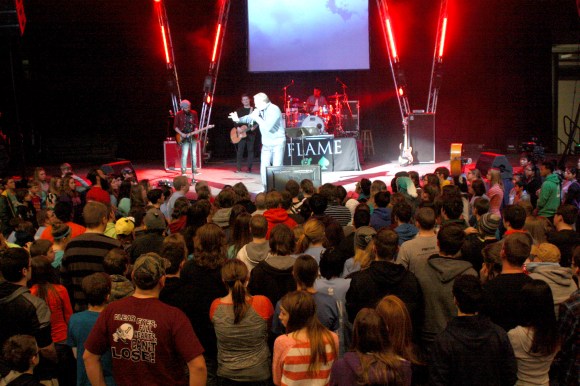
NEWS | Rick Gage stood in front of nearly 1,000 students and leaders meeting at the Prairie Capital Convention Center for the Youth Encounter evangelism conference. The room was much quieter than it had been just a few minutes earlier, when the Dec. 29-30 event kicked off with high-energy music, improv comedy from Team WordPlay, and a performance by illusionist Bryan Drake.

When Gage took the stage, he spoke first to leaders who brought students to the annual event, thanking them for investing in young people’s lives.

“We’re here to meet with God. We’re here to do business with God. And it’s our prayer—it’s your prayer—that God would use these next 24 hours to impact not just the teenagers’ lives, but all of our lives.”

A few minutes later, after preaching a message on what it means to have an authentic relationship with God, Gage called students to the front who felt led to make a decision for Christ. They streamed down the aisles. Almost 300 people crowded near the stage (above) as the evangelist prayed over them and instructed them to head backstage to meet with counselors.

All told, 92 people made decisions to trust Christ at Youth Encounter, and 205 recommitted their faith. During the two-day conference, 20 students also answered the call to ministry, and 33 committed to pray for lost friends or family members.

“God has his hand on some guys and when they preach the gospel…I can’t explain it. I just watch it happen and shake my head, but when they preach, people respond to the gospel,” said IBSA’s Tim Sadler. “There’s an anointing that’s on their lives, and it’s just a powerful thing.”

Students met with counselors after each session to talk about spiritual decisions they felt led to make.

Students met with counselors after each session
to talk about spiritual decisions they felt led to make. Photo by Brooke Kicklighter

Gage knows how to “draw the net,” said state evangelism director Sadler, who also directs YE. The decision to invite Gage was strategic because of his experience as a youth evangelist, Sadler told the Illinois Baptist.

“And I’d also add into that, I’ve heard several of our youth leaders, our local church youth leaders, talk about how they intentionally sought to bring unsaved kids to Youth Encounter this year,” said Chad Ozee, pastor of Journey Church in Bourbonnais and YE’s backstage manager.

“And that’s the key. If they just bring their core kids, then there aren’t people here that don’t know Christ, to hear that message, to have that net drawn.”

‘I’m changed now’
Jay Huddleston brought 19 students to Springfield, and all 19 made some kind of spiritual decision at Youth Encounter. The pastor of Herrick Baptist Church said the group’s Bible study after the Monday evening session got so intense, the students didn’t even finish the pizza they’d ordered.

Huddleston knows personally how Youth Encounter can change lives. He answered God’s call to preach shortly after attending the event as a leader in 1996. He’d actually realized God was calling him years earlier, but still hadn’t responded. But when some young women from his group came back from YE ready to surrender their lives to God’s purposes, he knew he had to make a decision of his own.

“The girls were standing up there talking about how they were going to make a commitment and give their life to Christ, and I’m running.” He pastored two churches before coming to Herrick Baptist, where he has been for nine years.

One of the students he brought this year was 15-year-old Michael Mey, who made a decision to trust Christ during that Monday evening session. Mey went to YE last year, so he was more used to the event this year, he said. What drew him to respond was what Gage said about only having so much time to respond to God.

When asked if there are things he’ll do differently after his decision, Mey said, “I feel like I’m changed now.”

Arrested my soul
During his message in the first session, Gage told the story of how his own life changed when he was a football coach in his 20’s. In the same vein as the Apostle Paul, Gage listed his religious qualifications:

“I was raised up in a Christian home. I was raised up in Bible-believing churches. My father, Freddie Gage, who preached the gospel for more than 50 years around the world, saw more than a million people come to know Christ. I had a very godly mother. I’ve been surrounded by great men of God all my life.

“I mean, if anybody should have been a champion for God, it should have been me.”

But he wasn’t. Gage told students how he had walked the aisle as a child, but repentance hadn’t taken root in his heart. “For nearly 18 years of my life, I professed to be a Christian because of what I did when I was eight years of age. And on top of that, my father’s Freddie Gage. And I did OK for a while, until I learned how to do bad.”

The only thing that set him apart from his classmates and teammates, Gage said, was his presence at church on Sunday—until he went away to college. Drifting farther from God, he finally found himself at a church service where a family friend preached on repentance.

“And God used that service and that message that night to reveal to my heart and my mind that I had never truly repented of my sin,” Gage told students. “And when the invitation time was given there that night…the Holy Spirit of God that night arrested my soul.”

At Youth Encounter 2014, hundreds heard a similar message—and responded. Standing near the stage on the conference’s last day, one young man asked if the group going backstage after the invitation was going for the same reason he had the day before, to repent.

With confidence, he said, “I did that yesterday.”

In 2015, Youth Encounter moves to three regional events, each held on Columbus Day Weekend, October 11-12. For more information, watch http://www.IBSA.org/students.

THE BRIEFING | Meredith Flynn

International Mission Board workers called for prayer in the wake of devastating terrorist attacks in France, Baptist Press reports. “There exists today a delicate tension in France that teeters toward breaking, and [Wednesday’s] tragic events will likely serve to further stir up the tension,” said Mark Stone, a church planter in southern France. The outbreak of violence started Jan. 7 with a shooting that left 12 people dead at the headquarters of satirical newspaper Charlie Hebdo.

“We are praying that the outcry against these heinous acts committed by religious extremists will not become outcries against anyone who claims to have any sort of religious belief,” IMB worker Tara Chaney told Baptist Press.

“Right now, we are praying that the people of France will turn toward God and not away from Him.”


The_BriefingThe Muslim actor who will play Jesus in an upcoming National Geographic Channel said he didn’t believe Jesus would judge him for playing the part. “I cannot speak for Jesus, but I can quote his teachings and He said, ‘Love your neighbor as yourself,'” Haaz Sleiman told Entertainment Weekly. “…How would He react to me playing Jesus? He wouldn’t judge it. He wouldn’t judge His own enemy…playing this part highlights His teaching in a very nice way.”

Sleiman will portray Christ in “Killing Jesus,” a miniseries based on a book by Bill O’Reilly and Martin Dugard. Read the full story at ChristianPost.com.


North Korea is atop Open Doors’ annual World Watch List for the 13th consecutive year, followed by Somalia, Iraq, Syria and Afghanistan. The list tracks the countries “where it is most dangerous and difficult to be a Christian.”


“Under no circumstances have I been discriminatory or hateful towards any member of the department in the LGBT community or a member of the LGBT community at large,” former Atlanta Fire Chief Kelvin Cochran told Baptist Press Jan. 6. Cochran was fired after an investigation into his self-published book which briefly mentions homosexuality as an immoral behavior, BP reports. Cochran teaches Sunday school and serves as a deacon at Elizabeth Baptist Church, which is affiliated with the Georgia Baptist Convention.


Where do the majority of Congressional representatives fall, faith-wise? Pew Research breaks down the religious makeup of the current U.S. Congress in this full report.


Wondering what else happened in Louis Zamperini’s life that didn’t make it into the recently released feature film Unbroken? Check out this half-hour documentary from the Bill Graham Evangelistic Association about the war hero’s conversion to Christianity.


We’ll give this a few weeks to see how it checks out: LifeWay Research recently found only 15% of churchgoers said they would skip worship to watch their favorite football team.


In a border town of Turkey, a Syrian family who fled from the civil war struggles to find food and shelter. IMB photo by Jedediah Smith

In a border town of Turkey, a Syrian family who fled from the civil war struggles to find food and shelter. IMB photo by Jedediah Smith

THE BRIEFING | Meredith Flynn

The International Mission Board’s pictures of the year show “light in the darkness” around the world. In the Philippines, hard hit by a typhoon just over a year ago; in Turkey, where a Syrian family tries to escape civil war (right); and in the Dominican Republic, where church planting efforts reach across geographical and cultural divides. See them all and more at IMB.org.


Almost 9.5 million people heard the gospel through the Billy Graham Evangelistic Association in 2014, and more than 1.6 million of those trusted Christ. “Our hearts overflow with gratitude to God for all He has done and is doing, and we are eager to keep pressing forward as He continues to open doors,” BGEA’s chief executive officer Franklin Graham wrote recently, The Christian Post reported.


Also from The Christian Post: Houston Baptist University will create a Center for American Evangelism, spearheaded in part by apologist Lee Strobel and directed by author Mark Mittelberg.


“I’ve been there, done that and I’d love to share with you a few reasons why, even though I’ve failed, I’m doing it again,” Trillia Newbill writes about her resolve to read the Bible in 2015. Read about the four step plan she chose at ERLC.com.


Most of us make and break them every year, but can New Year’s Resolutions actually be harmful? Author (and Billy Graham’s grandson) Tullian Tchividjian says yes, in this interview with Religion News Service. “When it’s up to you to go out and get the love you crave, create your own worth, or work at becoming acceptable to those you want to impress, life gets heavy,” Tchividjian told writer Jonathan Merritt. “New Year’s Resolutions are a burdening attempt to fix ourselves and make ourselves more lovable.”


The current basketball season has gone “in the opposite direction” L.A. Laker Jeremy Lin anticipated, he posted on his blog at the beginning of this year. But despite his slump, Lin—a known Christian—said he wants to live with more joy in the coming year. “…[T]hrough it all, I’ve been learning how to surrender the results to God, how to walk by faith and not by sight, how to be renewed through times of prayer/Scripture and how to fight for a life of joy in the midst of trials.”


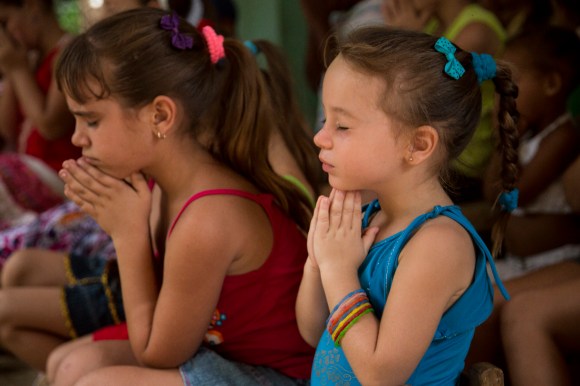
Cuban children learn to pray during a weekly meeting held in the home of two ladies with a passion to evangelize children. In 2010, the religious affiliation of Cuba was estimated by the Pew Forum to be 59.2 percent Christian (mostly Roman Catholic), 23.0 percent unaffiliated, 17.4 percent folk religion and the remaining 0.4 percent other religions. Wilson Hunter/IMB

Cuban children learn to pray during a weekly meeting held in the home of two ladies with a passion to evangelize children. In 2010, the religious affiliation of Cuba was estimated by the Pew Forum to be 59.2% Christian (mostly Roman Catholic), 23% unaffiliated, 17.4% folk religion, and the remaining 0.4% other religions. Wilson Hunter/IMB Photo from BPNews.net


NEWS |
President Obama’s announcement Dec. 17 that the U.S. will renew its relationship with Cuba had pundits talking about the political and economic implications. Meanwhile, many Christian leaders focused on what the decision could mean for Cuban believers.

Phil Nelson has traveled to Cuba 11 times since 2003, speaking about the gospel with college students and on one occasion, a university president.

“Everybody we met with, we talked with about the gospel,” said Nelson, pastor of Lakeland Baptist Church in Carbondale. The Cuban Christians he has worked with are “passionate about the gospel, unashamed about anything. They had a boldness that we just don’t know anything about here in the United States.”

Still, there is the specter of oppression, said Kevin Carrothers, who traveled with Nelson to Cuba in 2006. He remembers noticing from Cuban people and visitors to the country that no one wanted to draw attention to themselves. The stereotype most people apply to the Caribbean – bright clothing, a festive, celebrative atmosphere – didn’t hold water in Cuba, said the pastor of Rochester First Baptist Church.

Their mission team saw people come to Christ, though, including one woman who stopped them by the side of the road to ask for a drink of water. Nelson talked with her about the living water that Jesus offers; right there on the road, Carrothers said, she accepted Christ.

After Obama’s announcement, leaders weighed in on whether the decision would help or hurt people in the country. “This change is not going to help the Cuban people [under] a communist government in power for more than 50 years,” said Óscar J. Fernández, a Tennessee minister who holds political asylum from Cuba. “I will applaud if Cuba makes any concessions, but they are not [likely to do so],” he told Baptist Press.

But David R. Lema, whose family left Cuba for Spain when he was 7, said “any normalization of political ties between Cuba and the U.S., regardless of political implications or results, should prove beneficial for Christian work.”

“Travel for Americans going to Cuba would flow smoother and with less inconvenience—anyone that has gone to Cuba knows what I am talking about here,” Lema, director of New Orleans Baptist Theological Seminary’s Center for the Americas in Miami, told BP. “Churches and individuals will have more freedom to help the churches directly without having to worry about U.S. embargo violations.”

Carrothers said he didn’t know whether more mission teams will begin traveling to the Caribbean country. “What I do know, and what I think the reality is, is that where the church has been oppressed, and the church has been persecuted, the gospel has flourished.

“And that certainly was the case in Cuba, the gospel was flourishing in the midst of oppression.”

By Meredith Flynn, with additional reporting by Baptist Press

HEARTLAND | Nate Adams

Recently Chicagoland church planter Dave Andreson was addressing a group of mostly college students on the subject of how to pray for your community. I was there primarily because our son Noah was hosting the meeting at his church, Calvary Baptist in Elgin.

Nate_Adams_blog_callout_Dec1Most of the students were from Judson University there in Elgin, where IBSA is developing a church planting partnership. Dave spoke pointedly to them. “If you’re not currently praying for your community, let me tell you why that probably is,” he said. “It’s because you haven’t really taken ownership of this community. You think of your community as the place that you’re from, or where your family lives. You figure you’re just here for a few years, going to school, so why bother? In the meantime, many of the people you will meet here desperately need to know Jesus Christ.”

I winced with conviction at the truth of Dave’s observation, and not just for college students. Sadly, I’ve known people who seem to have the mindset that their situation is temporary, and as a result they seem to be just biding their time spiritually.

“Oh we just came here for Bill’s job, but we’ll be going back home eventually,” they sometimes say. And yet when asked how long they’ve lived there, the answer is often twenty or thirty years.

Or, “When our kids are older and life slows down some, we may have more time to do missions or help with outreach.” Especially in today’s ever-changing and mobile society, we cannot wait until our situations are more “permanent” to take ownership of our communities. That day may never come.

Dave went on to speak of the passion that Jesus had for a city, and for a crowd, and for a man named Zacchaeus. He urged us to be like Jesus and see our city, and our crowds, and the God-created individuals around us with spiritual eyes. And he invited us to pray with him for Avondale, the Chicago neighborhood that he has now made his home, and where he is seeking to plant a new church. Avondale is a community of only two square miles, yet 40,000 people live there. It has no Baptist church, and little if any evangelical witness.

Dave challenged us all that night to take ownership of our communities, wherever we find ourselves, and to do it now. We can’t wait for more permanent or ideal circumstances. People need prayer, and relationship, and the Gospel message.

His challenge reminded me of a time that our family ate at a fast food restaurant, when our boys were still little. Though the employees were working hard, the dinner rush had overwhelmed them and more than half of the tables were a mess while the trashcans overflowed. So as we left, I asked our boys to help me clear the rest of the tables in the restaurant, in addition to our own. “But Dad, we don’t work here!” one of them cried. And yet because I asked them to, they helped me take responsibility for other people’s messes, there in our temporary community.

As we enter another Christmas season and begin reflecting on the birth of Christ, let us remember that Jesus willingly entered our world and made it His home. He “became flesh and dwelt among us.” He saw us in our sorry state, and paid the price to clean up the mess of our sin that he didn’t make.

So let’s enter in and spiritually invest in our own communities, even now. Let’s take ownership of where we live, even if it doesn’t feel permanent, or even if it’s in a difficult place like the Avondale neighborhood of Chicago. Our community, wherever it is, is our mission field. Home is here, and the time is now.

Nate Adams is executive director of the Illinois Baptist State Association.

COMMENTARY | Josh Monda

This week marks the one-year anniversary of the EF-4 tornado that devastated parts of Washington, Ill. Brookport, New Minden, Diamond, Coal City and Pekin were among the other Illinois communities affected by powerful storms on Nov. 17, 2013.

This week marks the one-year anniversary of the EF-4 tornado that devastated parts of Washington, Ill. Brookport, New Minden, Diamond, Coal City and Pekin were among the other Illinois communities affected by powerful storms on Nov. 17, 2013.

Humanitarian effort void of the gospel of Jesus Christ does nothing to change one’s eternal destiny. Moments after making this statement during a sermon, a tornado would rip through our town, passing a quarter mile from our church.

The day of the tornado was not without trouble, even before the storm came through Washington. A month before, my father-in-law had been diagnosed with esophageal cancer. The day before the tornado, my 14-year-old daughter laid on my living room floor near death, and that evening was in the hospital.

Taking a full load in seminary, and trying to balance all that was going on in my life, I gathered our two young sons that Sunday morning and got them ready for church. The rest, as they say, is history. An EF-4 tornado hit our town as my congregation took shelter in the church basement.

It would have been easy then (and now) to focus on all that changed that day, or how everything after November 17 would be different than before. Indeed, a lot is different, even a year after the storm. Members of my church, deacons in my church, lost their homes. One of our deacons moved away, and for a small church, this is difficult.

Change has touched my family too. My daughter eventually recovered from the infection that put her in the hospital, but my father-in-law passed away before the tornado.

Not every change has been negative: After the storm, people seem more in tune to the needs of others, and thoughts about possessions have changed.

But my focus, and our church’s focus, is on something that will never change: the gospel of Jesus Christ. It was not by mistake that I would make the statement about humanitarian effort and the gospel moments before the tornado hit. Our focus has to be on the gospel.

When people are hurting, our focus must be the gospel.

When people are suffering, our focus must be the gospel.

When people know not where to turn, our focus is the gospel.

A tornado can change our circumstances, it can even change where we live. But a tornado will not transfer someone from the Kingdom of Darkness into the Kingdom of Light; only the gospel does this.

As a people, as a church, we can allow a tornado to either drive us to what truly makes a difference, or distract us from it. May our focus be on what makes a difference; may our focus be on the gospel of Jesus Christ.

Josh Monda is pastor of First Baptist Church in Washington.

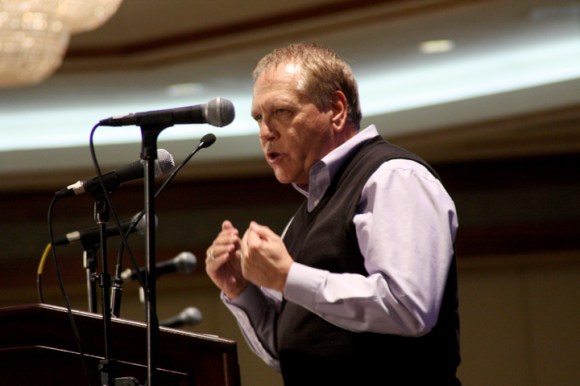
Larry Thompson, pastor of First Baptist Church in Ft. Lauderdale, Fla., is preaching at the IBSA Pastors' Conference on the "seismic" spiritual shift described in Acts 10. Follow the Pastors' Conference at Facebook.com/IllinoisBaptist.

Larry Thompson, pastor of First Baptist Church in Ft. Lauderdale, Fla., is preaching at the IBSA Pastors’ Conference on the “seismic spiritual shift” described in Acts 10. Follow the Pastors’ Conference at Facebook.com/IllinoisBaptist.

God wants his people to trust in him and arise, said Pastor Marvin Parker, referencing the theme of the 2014 IBSA Pastor's Conference. "Get up, get out, get going."

God wants his people to trust in him and arise, said Pastor Marvin Parker, referencing the theme of the 2014 IBSA Pastor’s Conference. “Get up, get out, get going.”

COMMENTARY | Chase Abner

Note: This article originally appeared on Collegiate Collective, a new resource that features articles, podcasts, and videos designed to equip leaders to advance the gospel on college campuses.

Okay. Here’s my qualification to talk about Halloween on campus: I served as a campus minister for seven years in Carbondale. Beginning in the 1980s, Carbondale became known for its raucous Halloween celebrations. In fact, most folks these days refer to them as “the riots.” Cars got turned over. Store windows were busted. Bottles were thrown at police. After a particularly violent weekend in 2000, city officials closed the bars on “the Strip” each Halloween in hopes that it would discourage the behavior. Instead, students just celebrated a week earlier in what is now infamously “Unofficial Halloween” (or simply “Unofficial” if you’re a cool kid).

Even this year, Unofficial got bonkers and police showed up in riot gear to mace and pepper spray the crowd after a car got turned over just blocks from campus.

Chase_Abner_callout_Oct30I never found an effective way to engage students during Unofficial outside of throwing my own tamer Halloween party. I can’t talk about that or I’ll draw the ire of my more fundamentalist friends. However, I can talk about what I think students’ fascination with Halloween reveals about culture on campus.

The Supernatural
Part of what makes haunted houses and scary movies enticing to people is the notion that there are malicious spirits that walk among us. In some ways, it’s a subtle rejection of the naturalistic worldview that can be common on campus, especially among those immersed in the physical sciences. Even as Dawkins-flavored atheists/agnostics become more vocal, research shows that the majority of Millennials believe in God with “absolute certainty.”

While it may be disconcerting to see students toy with the concept of evil spirits for the sake of entertainment, I encourage you to see it as a bridge to talk about Christ. Christians, of all people, should be ready to affirm the existence of a paranormal reality and to point others to the one who is ultimately victorious over evil.

Community
Research by the National Retail Federation predicts that 67.4% of 18-24-year-olds will spend money on Halloween costumes this year. These young adults predict that they’ll each spend about $40 on their costumes. I guarantee that these students aren’t going to shell out that much cash to get all dressed up and have nowhere to go.

The point of wearing a costume is to join the throngs of costumed students in the campus community – to see and be seen. Halloween reveals, almost as well as athletic events, that students want to be a part of a community rallying around a common purpose. Like all people, they have an innate desire to be a part of something bigger than themselves. They want to belong and they want to celebrate.

Our ministries have so much more to offer that desire than Halloween can provide. We can provide ongoing community that is centered around an eternal purpose realized in the mission of God.

Boredom
When I try to figure out what might motivate a college student to don a costume and go make mischief (like tipping a car over or assaulting police officers, cf. “Unofficial” above), one answer that comes to mind is boredom. I think a lot of the trouble students get into at Halloween stems from the extended adolescence that finds fertile ground during college. Without a clear path to make a difference in the world, many students will use their freedom from immediate parental guidance to indulge some of our basest desires simply for lack of something better to do.

One way that our ministries can serve students (even before they know Jesus) is to provide them with opportunities to make a positive impact in the surrounding community. These students may not ever be ready to teach Bible studies, but they can read to underprivileged children, clean up litter, or clean out gutters for the elderly. Imagine the Gospel-centered conversations that could occur between students as they do community projects together. Imagine the good that could be done for your city if you find a way to channel bored students’ talents and energy into a Kingdom-focused alternative.

The Gospel
I know some will accuse me of over-thinking things. “Can’t Halloween just be about fun, Chase?” Of course it can, but even the desire for fun reveals something about the human condition, no? We all chase various things in hopes of being satisfied. So whether students are seeking supernatural affirmation that there’s more to life than what they see…or a sense of belonging with others…or an escape from a routine, meaningless existence…the Gospel of the Kingdom offers more than they could dream.

So, this weekend, I’m not asking you to ruin anyone’s Halloween fun. But as you observe the celebration (and probably mischief) in your campus community, let it freshly awaken you to why you’re there and why collegiate ministry matters.

Chase Abner is collegiate evangelism strategist for the Illinois Baptist State Association.