Archives For November 30, 1999

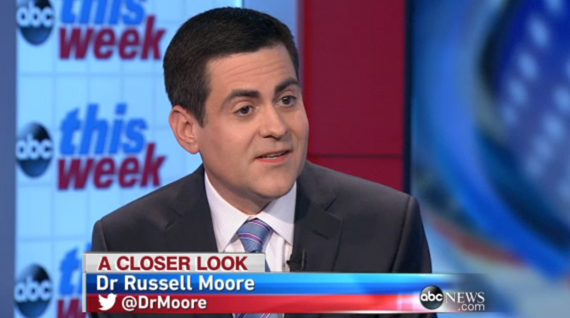
Russell Moore was joined on ABC's "The Week" by fellow panelists Franklin Graham, Ralph Reed and Cokie Roberts.

Russell Moore was joined on ABC’s “The Week” by fellow panelists Franklin Graham, Ralph Reed and Cokie Roberts. Photo from video on abcnews.go.com

NEWS | On Easter Sunday morning, ABC’s “This Week” featured a panel of guests discussing whether the influence of evangelicals is waning in the current culture. The group included Russell Moore, president of the Southern Baptist Ethics and Religious Liberty Commission, who said it is indeed a new day for Christians.

The percentage of people that are members of a church or synagogue has fallen from 70% in 1992 to 59% in 2013, said moderator Martha Raddatz, citing a Gallup statistic. She asked Moore if the numbers worry him, and what can be done about the decline.

“I’m not worried… because I think what we’re seeing is the collapse of a cultural, nominal form of Christianity,” Moore said. There was a time in America where in order to be a good person, to be seen as a good citizen, one had to nominally at least be a member of a church. Those days are over, and so we’re at a point now where Christianity is able to be authentic, and Christianity is able to be authentically strange.”

Moore pointed out that Christianity’s foundational beliefs are hard to grasp for the culture at large, but the disconnect isn’t unprecedented.

“Many people now when they hear about what Christians believe, what evangelical Christians believe, their response is to say, ‘That sounds freakish to me, that sounds odd and that sounds strange.’ Well, of course it does. We believe that a previously dead man is now the ruler of the universe and offers forgiveness of sins to anyone who will repent and believe.

“That’s the same sort of reaction that happened in the Greco-Roman empire when Christianity first emerged. So it offers an opportunity for the church to speak clearly, articulately, about what it is that we believe, to give a winsome and clear message about what the Gospel actually is.”

Raddatz asked Moore about his recent comment that “the illusion of a Moral Majority is no longer sustainable in this country.”

“Yes, it’s a different time,” Moore said on Sunday’s broadcast, “and that means that the way that we speak, we speak in a different way. We speak to people who don’t necessarily agree with us. There was a time in which we could assume that most Americans agreed with us on life, and on abortion, and on religious liberty and other issues. And we simply had to say, ‘We’re for the same things you’re for, join us.’

“It’s a different day. We have to speak to the rest of the culture and say, ‘Here’s why this is in your interest to value life, to value family, to value religious liberty.'”

The panel’s 10-minute conversation is available for viewing at the ABC News website.


COMMENTARY | Immediately after the Pew Forum released new findings about the current state of American Protestantism, writers and thinkers took to their blogs to warn us not to put too much stock in the so-called shift, at least not for the reasons we might think.

“…Many will likely trumpet this as a huge shift. It’s not. This is simply the natural progression of what is taking place in our context,” said LifeWay’s Ed Stetzer of the research, which states that for the first time in history, Protestants are not a majority in the United States. Rather, the 48% that claim to be Protestants are a plurality at the top of a list of choices that also includes Catholic (22%), Mormon (2%), Orthodox (2%) and “Other Faith” (6%). That means nearly 20% of Americans aren’t affiliated with any faith, the highest percentage ever in Pew Center polling.

“A big part of what is happening is that the ‘Nominals’…are shifting and becoming the ‘Nones,'” Stetzer wrote. “This makes sense, as the cultural currency (in other words, the value a society places on identifying as a Christian) is decreasing. And thus, we see a movement away from Christian identity as a cultural value.”

Stetzer identifies these three main points from the research:

1. “On a growing basis, identifying oneself as a Christian is not a means to societal advancement but can actually be a means to societal rejection.”

2. What he calls the “squishy middle,” or nominalism, is going away. Southern Seminary’s Russell Moore also blogged about this following the Pew Center’s research. “Most of the old-line Protestant denominations are captive to every theological fad that has blown through their divinity schools in the past thirty years-from crypto-Marxist liberation ideologies to sexual identity politics to a neo-pagan vision of God—complete with gender neutralized liturgies.

“What we should pay attention to instead may be the fresh wind of orthodox Christianity whistling through the leaves-especially throughout the third world, and in some unlikely places in North America, as well. Sometimes animists, Buddhists, and body-pierced Starbucks employees are more fertile ground for the gospel than the confirmed Episcopalian at the helm of the Rotary Club.”

3. “It is still a vast overstatement to see this as a collapse of the Christian faith in North America,” Stetzer wrote. “The reality is that evangelicals have been relatively steady as a percent of the population over the last few years, however there is still great cause for concern here – and for action.”

That action must take shape as a willingness to seize opportunities explain exactly what a Christian is, Stetzer said. “…As society moves away from Christian identification, let’s meet them on the road and say, ‘We did not believe in that expression of Christianity anyway. Let me tell you about Jesus and how he changes everything.'”

THE BRIEFING | Lisa Sergent

Mitt Romney, presumed Republican Presidential nominee, announced his pick for a vice-presidential running mate over the weekend. Romney, a Mormon, selected Wisconsin Rep. Paul Ryan, a Catholic. The announcement is fodder for pundits who question the impact of a conservative ticket where Protestants and/or Evangelicals are absent.

Time Magazine’s Swampland 2012 Election blog noted:

The press has already made much of the fact that neither Romney nor Ryan is Protestant—but Mark DeMoss, an evangelical adviser to Romney, argues denomination is not a determining factor in the evangelical vote, which leans Republican. “Since the vast majority of evangelicals are more concerned about the values of a candidate than the religion or denomination, I don’t think it matters that there is not a Protestant on the Republican ticket,” he says.

Ryan’s Catholicism is also a reminder that the U.S. has accepted politicians from faith groups it once marginalized. “The Ryan pick demonstrates how completely mainstream Catholicism has become,” says Campbell. “Romney has a religious background that makes some voters wary, not unlike Catholicism in the days of John Kennedy.” Mormonism appears to be on the same track toward widespread cultural acceptance. Read it all

Newsmax.com chimed in:

With Romney’s appointment of Catholic Paul Ryan, one can now expect President Barack Obama to make a vibrant appeal to evangelical voters in the upcoming general election. There will be another, newer version of “the Joshua project” which he launched last time. The Obama team will hope that evangelicals just stay home. The Mormon-Catholic ticket of Romney-Ryan will have to hope that evangelicals vote against Obama, if not for them. Read more

Meanwhile over at Politico:

From the conservative blogosphere to state party leaders, the Ryan pick was greeted with a great deal of enthusiasm Saturday. “It really solidifies allegiance to Romney and support among conservatives,” said Faith and Freedom Coalition President Ralph Reed, who described Ryan as “very popular” among grass-roots evangelicals. “This selection lays to rest lingering questions about whether Romney can be trusted among conservatives.” Read the rest

Sex in movies influences teens’ behavior, study confirms
Exposure to sexual content in movies leads teenagers to have sex earlier and to participate in riskier sexual behavior, a study has confirmed. The study, published in Psychological Science, said roughly 85 percent of movies released from 1950 to 2006 contained sexual content. Sexual explicitness of PG-13-rated and R-rated movies has increased over the past decade, researchers also said. Evidence suggests that adolescents’ sexual attitudes and behavior are influenced more by movies than by other forms of media, the study said.  Find out more about the study at BPnews.net.

Christian baker criticized for ban on gay wedding cakes
The owner of a Colorado bakery said in spite of picket lines and online petitions he will not change a store policy against baking wedding cakes for homosexual couples — a policy that critics call hateful and bigoted.

More than 5,300 people have signed an online petition calling on the Masterpiece Cake Shop to ends its policy banning gay wedding cakes. Several dozen people picketed the privately owned store in Lakewood, Colo.

“I’m not going to change my business because of a petition,” Jack Phillips, the owner of the cake shop, told the Denver Post. “I’m just going to do the best I can do to honor Jesus Christ.” Learn more from Todd Starnes.

Komen leaders step down months after flap
Susan G. Komen’s top two leaders will leave their current positions in changes announced about six months after the world’s leading breast cancer charity reversed its decision to defund Planned Parenthood amid an onslaught of criticism.

Komen announced Aug. 8 its founder, Nancy Brinker, will step down as chief executive officer to become chair of its board’s executive committee and concentrate on “revenue creation, strategy and global growth.” Komen President Elizabeth Thompson announced her resignation at the same time. The charity also disclosed the departure of two of its board members. Read more about the changes at Komen.