Archives For November 30, 1999

Trends and news about secular culture

The BriefingPhyllis Schlafly, ‘Founding mother’ of the modern conservative movement, dies at 92
Phyllis Schlafly, best known for her tireless work to defeat the Equal Rights Amendment, has died at the age of 92. “Phyllis Schlafly courageously and single-handedly took on the issue of the Equal Rights Amendment when no one else in the country was opposing it,” said James C. Dobson, founder of Focus on the Family. “In so doing, she essentially launched the pro-family, pro-life movement.”

SBC leaders grieve court’s expansion of parenthood
The decision by New York’s highest court to expand custody and visitation rights to “de facto parents” serves as evidence same-sex marriage advocates desire to overthrow humanity’s oldest institution and as part of “a major turning point in human history,” Southern Baptist leaders said.

Chicago homicides in 2016 reach 500
Chicago’s 500th homicide of the year happened over Labor Day weekend, according to the Chicago Tribune. That number carries a lot of weight for the city — not just in quantity, but in meaning: 2016 is now the deadliest year in two decades.

‘Sad’ Russian anti-evangelism law ends a ministry
Independent Baptist missionaries Donald and Ruth Ossewaarde always suspected their Gospel ministry in Oryol, Russia, wouldn’t last when they began in 2002. But they did not expect Donald to be among the first people arrested under Russia’s new law prohibiting organizations from evangelizing outside church walls and without a government permit.

Missouri sends first openly lesbian to Miss America Pageant
Miss Missouri, Erin O’ Flaherty, will compete for the Miss America crown this weekend as the first openly lesbian contestant. “Behind the scenes, we’ve been well-represented, but I’m the first openly gay title holder, so I’m very excited,” she told The Associated Press. “I knew going in that I had the opportunity to make history. Now I get to be more visible to the community and meet more people.”

Sources: Baptist Press, Religion News Service, CNN, Baptist Press, Time Magazine

The BriefingReport debunks ‘born that way’ narrative
A stunning new report on sexuality and gender exposes the shaky science behind the LGBT “born that way” narrative and the push to label young kids as “transgender.” The report comes as the health-care industry, pressured by the Obama administration, imposes new protocols pertaining to “sexual orientation and gender identity” grounded in faulty science and often dismissive of parents’ rights and children’s well-being.

‘Insanity of God’ showing Aug. 30 across U.S.
“The Insanity of God,” the true story of missionaries Nik and Ruth Ripken and their work with the persecuted church, will be shown in 500 U.S. theaters Aug. 30 for a special one-night, feature event. The presentation will include International Mission Board President, author and speaker David Platt interviewing Nik Ripken, as well as a performance by music artist Todd Smith.

Progressives embrace religious liberty
Religious liberty has often been a thorn in the side of progressives, especially when it’s used by conservatives to defend everything from Christians-only clubs on campus to merchants who won’t serve gays. But progressives are now leveraging the First Amendment principle as a vehicle to advance causes of their own.

Christians wait for Egypt to authorize new churches
Egypt is scheduled to vote as early as September on a law that would ease the country’s historic restrictions on church construction. Current laws, which have been in place since 1856, require Christians to get the consent of the local Muslim community—and the country’s president—before building a church.

States, religious groups sue HHS over transgender treatment requirements
Five states, joined by Christian health care providers, have filed a lawsuit challenging the Obama administration over new federal rules they say could force doctors to perform gender-transition procedures that violate their religious beliefs or medical judgment. The lawsuit claims doctors could be forced to perform procedures such as gender-reassignment surgery and hysterectomies.

Sources: The Federalist, Religion News Service, Baptist Press, Christianity Today, Fox News

The BriefingPastors sue Illinois over gay conversion therapy ban
A group of pastors is suing Illinois over a law that bars therapists and counselors from trying to change a minor’s sexual orientation, saying the prohibition violates free speech and religious rights. The federal lawsuit seeks to exclude clergy from the ban that took effect Jan. 1, arguing that homosexuality is “contrary to God’s purpose” and a disorder that “can be resisted or overcome by those who seek to be faithful to God and His Word.”

Olympics wrap-up: God praised by athletes in triumph, defeat
The images and memories of the 2016 Olympics will endure for much longer than the torch’s flame. Several athletes who are professing Christians joined in the medal haul. Helen Maroulis won the first gold medal ever for the United States in women’s wrestling, and said that throughout her competition she repeated to herself the mantra, “Christ in me, I am enough.”

Judge blocks transgender restroom order
A federal judge in Texas has temporarily blocked the Obama administration’s directive forcing schools to allow transgender students to use restroom and locker room facilities based on gender identity, rather than their biological sex. District Judge Reed O’Connor said the departments of Education and Justice failed to follow the Administrative Procedures Act, which requires advanced notice and a public comment period before issuing such guidelines.

Judge under fire for praying in courtroom
A Texas judge could be sued for starting every court session with a short prayer. The Freedom From Religion Foundation alleges that Judge Wayne Mack’s invocation is “unconstitutional,” and the organization is currently considering a lawsuit. Mack pointed out that both the U.S. Supreme Court and the Texas Supreme Court start their opening sessions with an invocation, and he’s just “following in their footsteps.”

Lutherans recognize agreement with Catholic Church
Nearly 500 years after Martin Luther nailed his 95 theses to the Castle Church door, the largest Lutheran denomination in the U.S. has approved a declaration recognizing “there are no longer church-dividing issues” on many points with the Roman Catholic Church. The “Declaration on the Way” was approved 931-9 by the 2016 Evangelical Lutheran Church in America Churchwide Assembly in New Orleans.

Sources: Big Story AP, Baptist Press, World Magazine, Fox News, Religion News Service

Baseball and Baptists

ib2newseditor —  August 10, 2016

Busch Stadium

I’m a St. Louis Cardinals fan and have been ever since I can remember. Growing up almost everyone I knew rooted for the Cardinals with the exception of a few odd Kansas City Royals fan.

I grew up watching their games on TV and listening to them on the radio in the family car. My parents would take us to Cardinal games to cheer our team on. When I moved to Illinois I stayed loyal to my team. I was even blessed to marry a fellow Cardinals fan and we continue the tradition of watching, listening, and going to games together.

We may be fans of different teams and squabble like siblings among ourselves, but we’ll always be a part of something greater in our Southern Baptist family through Christ.

I wouldn’t dream of supporting any other team. I am a member of Cardinals Nation, which feels like being part of a family. The atmosphere of camaraderie at the games is exciting. After games, we’ve spent the night at hotels near Busch Stadium and have gone down to breakfast to find the Cardinal mascot Fredbird the Redbird greeting people and posing for pictures with hungry fans.

At one time we even had Cardinal vanity plates on our car. I can remember being stopped at a red light a few times and having the person in the car next to us motion for the window to be rolled down. When we complied they would ask, “What’s the score?” Trips to games on I-55 often include pulling into a rest stop or restaurant. Fans decked out in Cardinal red apparel, who are perfect strangers, strike up conversations with each other about the team and the game they are on way to see.

I can relate this feeling and experience with being a Southern Baptist. My mother started attending our local Baptist church when I was just a few years old. She faithfully took all three of us kids for years until my father became a Christian when I was 12. Then church truly became a family affair. We all were part of a loving church family that worshiped, laughed, cried, and grew together.

Our own church family was part of a larger family of churches in our association, state convention, and national SBC. When we visit other churches and gather for annual meetings and conventions, we feel that same kinship as Christians and as Southern Baptists.

There is much more involved in my being a Southern Baptist than there is my being a Cardinal fan. The beliefs of my Baptist family and its commitment to the Lord are at the core of my being. In my life I’ve studied other denominations and visited their houses of worship, but none have the same belief in God and seek to follow him the way Southern Baptists do.

I suspect the same is true of many of you who are fans of the Cubs, White Sox, and other teams. We may be fans of different teams and squabble like siblings among ourselves, but we’ll always be a part of something greater in our Southern Baptist family through Christ.

-Lisa Sergent

The BriefingRauner signs controversial bills into law
Illinois Governor Bruce Rauner recently signed three controversial bills. The marijuana decriminalization bill provides statewide standard for cannabis possession, with a maximum $200 fine for possession of 10 grams or less. The remaining two bills involve right to life issues. The Contraceptive Coverage and the Health Care Right of Conscience bills require health insurance to cover all types of contraception and medical professionals to go against their religious conscience by referring patients for abortion. The Thomas More Society has indicted it is considering legal action against the right of conscience law.

Sexual abuse victim fights transgender bathroom bill
The advent of policies that force schools and other public places to allow people to use the restrooms that correspond to their gender identity and not their biological sex deeply troubled sexual abuse survivor Kaeley Haver. She was fired from her job at the YMCA after speaking out against Washington state’s Human Rights Commission transgender restroom law.

Deadliest July in Chicago in 10 years
Sixty-five people were killed in Chicago in July, a toll that pushed the number of homicides in the city this year to nearly 400. The total for all of last year was 490. It was the deadliest July since 2006, when 65 homicides were also recorded, according to Chicago Police Department records. On the last weekend alone, a total of seven people were killed and 45 others were wounded.

Election 2016: ‘Lesser’ and ‘never’ two evangelical views
The 2016 election is important, but it is too often divisive and open to unhealthy rhetoric. Southeastern Seminary President Danny Akin asked two of the seminary’s ethics professors, Drs. Dan Heimbach and Mark Liederbach, to share their opposing personal positions and approaches to this timely and increasingly crucial question of how to vote in the 2016 presidential election.

Lawsuit targets grant to National Baptists
Atheists have sued a National Baptist pastor and Kansas City government leaders over a $65,000 grant approved for use during the Baptist group’s upcoming national convention in the city. The grant to John Modest Miles Ministries, a community nonprofit arm of Morning Star Missionary Baptist Church in Kansas City, violates Missouri law that prohibits public aid for religious purposes, American Atheists Inc. and two of its Kansas City members claim in a lawsuit.

Sources: Capitol Fax, Thomas More Society, World Magazine, Chicago Tribune, Between the Times, Baptist Press

Faith-based Veeps

ib2newseditor —  July 29, 2016

Presidential nominees choose running mates with more evangelical appeal

Pence and KaineHeading into the Republican and Democratic National Conventions, one unanswered question was how—and if—Donald Trump and Hillary Clinton would seek to galvanize the support of evangelical voters. Both candidates’ picks for vice president, made immediately before their parties’ conventions, could be seen as a way to reach out to Christian voters who have felt under-represented this campaign season.

Trump named Mike Pence, the governor of Indiana, as his running mate. Taking the stage in Cleveland, Pence declared, “I’m a Christian, a conservative, and a Republican, in that order.” He peppered his acceptance speech with phrases familiar to Christians: “I have faith that God can still heal our land” and “Pray daily for a wise and discerning heart.”
The governor, who grew up Catholic, gave his life to Jesus Christ as a college student in 1978, he told CBN News in 2010. He and his wife, Karen, attend College Park Church in Indianapolis, and Pence describes himself as an “evangelical Catholic.”

Pence came under fire last year when he signed the Indiana Religious Freedom Restoration Act into law. Critics claimed the bill discriminated against the LGBT community, while supporters claimed it protected the rights of religious believers to practice their faith. Corporations, major sporting events, and individuals threatened to boycott the state. A few days later, Pence signed an amendment to the bill which also protected sexual orientation and gender identity rights, causing some conservatives to question his commitment to religious freedom.

At the Republican National Convention, in what some saw as an appeal to evangelicals, Trump pledged he and Pence would do away with the Johnson Amendment, which became part of the U.S. tax code in 1954. Then-Senator Lyndon Johnson proposed the measure, which restricts tax-exempt religious organizations, including churches, from endorsing or opposing political candidates under penalty of losing their tax-exempt status.

The Democratic nominee for President, Hillary Clinton, also introduced her running mate prior to her party’s national convention. Virginia Senator Tim Kaine has attended St. Elizabeth Catholic Church in Richmond for nearly 30 years, and also has done mission work in Honduras. The former Virginia governor sings in the choir at his predominately African-American church.

Kaine has used biblical terminology to express his displeasure at the Senate’s recent failure to pass stricter gun laws. He told 60 Minutes, “The chamber was ringed with the family members from Sandy Hook, with Virginia Tech family members sitting with them and helping them. There’s a phrase in the letter to the Hebrews that talks about being surrounded by a great cloud of witnesses. We were surrounded by a great cloud of witnesses, but we couldn’t do the right thing.”

Kaine’s stance on abortion could be troubling to Christian voters. He told CNN in July that his view on abortion is traditionally Catholic, meaning pro-life, “but I am very strongly supportive that women should make these decisions and government shouldn’t intrude. I’m a strong supporter of Roe v. Wade and women being able to make these decisions. In government, we have enough things to worry about. We don’t need to make people’s reproductive decisions for them.”

Uneasy alliances
With just four months until the general election, a new Pew poll shows Trump has a commanding lead among white evangelicals, 78% of whom say they will vote for him, compared to 17% who support Clinton.

Black Protestant voters overwhelmingly say they support Clinton—89%, compared to 8% for Trump. Hispanic Catholics also support Clinton (77%) over Trump (16%).
Pew found voters in general are not pleased with their choices for president: 42% said it would be difficult to choose between the candidates because neither one would make a good president.

Voter motivation is also a key issue in the 2016 election, Pew found. Of the 78% of white evangelicals who support Trump, 45% said their decision was “mainly a vote against Clinton,” compared to 30% who said it was “mainly a vote for Trump.”

The survey comes after Trump’s meeting in June with nearly 1,000 evangelicals, including many Southern Baptists. At least eight Southern Baptists now serve on his evangelical advisory panel.

– Lisa Sergent

The BriefingIslamist behead priest during mass in France
An 86-year-old priest was butchered while two nuns and two parishioners were held by assailants who raided the church in Saint-Etienne-du-Rouvray near Rouen in Normandy during morning mass at 9 a.m. The clergyman, named as Jacques Hamel, is believed to have been beheaded during the attack while another hostage, said to be a nun, is fighting for life in hospital.

Chicago YMCA supports transgender bathroom, locker rooms
A recent incident caused the YMCA of Metro Chicago to craft guidelines for accommodating transgender members and guests, allowing them access to restrooms and changing areas that match their gender identity. They cover all programs and services, from gym and pool facilities to summer camps and various classes. The guidelines will apply to the YMCA’s 140,000 members at its 21 Chicagoland centers, but not some smaller, independent YMCA’s in the Chicago area.

How the push for gay rights is reshaping religious liberty
Proponents of full and equal rights for gay men and lesbians are pushing to expand the marriage equality they won at the high court into broader, society-wide freedoms. Religious conservatives are pushing back, worried that traditional religious values and protections they see as integral to the nation’s identity are being attacked as never before. Both sides feel they are victims. Both sides feel under threat.

Clinton VP pick church going Catholic
The day after appearing alongside Hillary Clinton as her running mate for the first time, Virginia Sen. Tim Kaine was in his Richmond Catholic church Sunday to seek prayers and also sang the Communion hymn. Kaine spoke to journalists after the service about his involvement in the mostly black church.

20 safest cities in Illinois — 2016
Whether you live in one the state’s rural or urban communities, you can feel good knowing that, overall, crime is on the decline in Illinois. In fact, the most recent FBI Crime Report states that incidents of violent crime and property crime each decreased by nearly 10% from 2013 to 2014. Comparing the latest Illinois crime data to information for the year 2000, we found that reported violent crimes dropped by an impressive 42% and property crimes fell by approximately the same amount.

Sources: Daily Mail, Chicago Tribune, Christian Science Monitor, Christian Post, Baptist Press, SafeWise

The BriefingChanging genders isn’t morally wrong, Americans say
Most Americans see nothing morally wrong with gender change, a new study shows. Six in 10 Americans don’t think it’s wrong for people to identify with a gender different from their birth sex, according to the LifeWay Research survey. And more than half don’t think it’s wrong to switch genders by taking hormones or having surgery.

Floyd’s open letter to Democrat and Republican leaders
Ronnie Floyd, immediate past president of the Southern Baptist Convention, penned an open letter to the Democrat and Republican parties about issues concerning evangelical voters. In the letter Floyd writes, “Tell the American public what you truly believe about the things that matter to us. As leaders in our nation, in your formulation of your respective platforms, please leave your conventions with a clear message about your stance on the subjects we care about.”

VP candidate is an evangelical Catholic
Presumptive Republican vice presidential candidate Mike Pence describes himself as a “pretty ordinary Christian” and as “a Christian, a conservative and a Republican, in that order.” But he also once said, “I made a commitment to Christ. I’m a born-again, evangelical Catholic.” That’s not a combination you hear every day.

Russia’s new restrictions on sharing the gospel
Russian president Vladimir Putin approved a package of anti-terrorism laws that usher in tighter restrictions on missionary activity and evangelism. The amendments, including laws against sharing faith in homes, online, or anywhere but recognized church buildings, go into effect July 20.

Looking for God at Ark Encounter, Christian entertainment destinations
Ark Encounter is a $100 million, 510-foot-long re-creation of Noah’s Ark, built by a Christian ministry with the help of state tax incentives and the sale of $62 million in junk bonds. Critics say the business model behind it and other Christian-themed destinations may require a new level of financial faith.

Sources: Baptist Press, Christian Post, Religion News Service, Christianity Today, Washington Post

DallasThe Briefing Chief Brown relies on his faith
In the wake of the July 7 ambush that killed five Dallas police officers and throughout his life, Police Chief David Brown believes in bedrock Christian doctrine — faithful submission to God’s plan followed by an eternal reward. He sees his job as a “divine assignment” and brings a Biblical perspective to all his decision-making, said his pastor, the Rev. Tony Evans of Oak Cliff Bible Fellowship.

Iowa claims it won’t muzzle pastors
The Iowa Civil Rights Commission, in a “clarification,” says it will not muzzle churches that teach on matters of biblical sexuality, nor force them to open single-sex restrooms to members of the opposite sex. The commission said it has revised its brochure on “Sexual Orientation & Gender Identity” to state that churches generally are exempt from certain provisions of the state’s civil rights law.

Is Trump the end of the Religious Right?
The evangelical divide over Trump has been widening for months, but it was only in recent weeks that the pro- and anti-Trump camps definitively split, with an increasing number of conservative evangelicals coming out forcefully against the candidate. The breaking point came on June 21, when Trump—ironically in an effort to appease the religious right—met with nearly a thousand evangelical leaders and announced a 25-person “evangelical advisory board” to help him reach conservative Christian voters.

Perry Noble fired
NewSpring Church, a multi-campus megachurch based in Anderson, S.C., announced Sunday that the church’s board of directors and pastor advisory team fired Senior Pastor Perry Noble for alcoholism, marital problems, and other “unfortunate” choices. Noble served as pastor of the Southern Baptist Convention–affiliated church since its founding in 2000.

Bill Nye tours Ark Encounter
When evolutionist Bill Nye “the science guy” visited a life-size replica of Noah’s Ark in northern Kentucky, he wanted to learn how children were reacting to what he has called a danger to science education. By the time he left the Ark Encounter theme park, he had also learned the story of Christ’s atoning death on the cross for humanity’s sins, Ark Encounter’s chief executive Ken Ham said, underscoring the park’s value as an evangelistic tool.

Sources: Dallas Morning News, Daily Signal, Politico, World Magazine, Baptist Press

Fractured alliances

ib2newseditor —  July 11, 2016

Fractured alliances

As the national political conventions approach, it’s time for evangelicals to decide. For some, it’s a choice they’d rather not make.

With the national conventions for both major American political parties just days away and the nominees all but a foregone conclusion, the only remaining question is how voters in November will react to this most unusual presidential election.

Christian voters in particular have yet to coalesce behind either candidate, although a June meeting between presumptive Republican nominee Donald Trump and nearly 1,000 evangelicals signaled things may be changing, at least for some conservative leaders.

And Trump’s announcement of an evangelical advisory committee, including several Southern Baptists, reverberated around the Twitter-sphere, shaking the unified front Baptists had shown just days before at the 2016 Southern Baptist Convention in St. Louis.

The divide is growing between conservatives who support Trump over Hillary Clinton’s liberal ideals, and those who say they won’t vote for the businessman-turned-reality TV star with a penchant for saying whatever is on his mind. Along with the differences among Christians, some pundits see a growing split between the traditional “religious right” and the Republican party.

“In the coming weeks, we are going to be learning a great deal more about the presidential candidates,” forecasted Southern Seminary President Albert Mohler in a recent edition of his Briefing podcast. “But it’s also increasingly true that we’re going to be learning a great deal about ourselves as evangelical Christians in America.

“Perhaps we’d better brace ourselves for what we’re going to learn.”

Meeting the Donald

On June 20, Donald Trump met in New York City with nearly 1,000 Christian leaders, including immediate past president of the Southern Baptist Convention Ronnie Floyd and newly elected president Steve Gaines, along with several other Southern Baptists.

The gathering, emceed by former Republican candidate Mike Huckabee, included a Q&A time with Trump, who has won over conservative voters in the primaries even as Christian leaders have decried his volatile speaking style and confession last year that he wasn’t sure he had ever asked God for forgiveness of his sins.

Following the meeting, Trump named a 25-member evangelical advisory board, which includes Floyd and at least seven fellow Southern Baptists. Floyd is among the members of the board who say their participation doesn’t constitute an endorsement of the candidate, rather “as an avenue to voice what matters to evangelicals,” he told The Christian Post.

Floyd also cited several key issues that compelled him to participate on Trump’s advisory board, including Supreme Court appointments, the sanctity of human life, religious liberty, Israel and the Middle East, and racial tension.

But many Christian and conservative leaders took issue with the meeting and the participation of those appointed to the advisory board. Russell Moore, president of the Ethics and Religious Liberty Commission and a recent Trump target on Twitter, took on the seeming divide between Trump’s public persona and his coziness with evangelicals:

“If you wondered why younger, theological, gospel-centered evangelicals reacted (negatively) to the old guard Religious Right, well, now you know,” Moore tweeted June 21, following up with, “If character matters then character matters.”

Moore wasn’t the only voice to question the authenticity of Trump’s relationship with Christians. Writing for The Federalist online, film critic Rebecca Cusey described reading through the meeting transcript, “thinking maybe Trump might exhibit some charm, some thoughtfulness in a smaller setting that is lost on the large stage, something that would explain why people who profess to believe in Jesus would be so taken in by Trump.

“Sadly, no. The transcript is shocking in its pandering: of Trump to evangelicals, yes—we expected that—but also in their pandering to Trump.”

Floyd acknowledged the widespread criticism, blogging a few days after the meeting that his short time out of the office of SBC president had been in some ways more difficult than leading the denomination for two years. He listed several Bible characters who had opportunity to speak into the lives of national leaders, including Old Testament prophet Daniel.

“What if Daniel had refused to acknowledge King Nebuchadnezzar and acted like he was too righteous to relate to him?” Floyd asked.

Similarly, Richard Land, who preceded Moore as president of the ERLC, asked critics of the Trump meeting what they would have the advisory team do instead of participate when asked.

“Would they really have us spurn the opportunity to give spiritual counsel and advice to Mr. Trump and his team?” Land wrote in a column for The Christian Post. “How would that be obedience to our Saviour’s command to be the salt of the earth and the light of the world?”
Fractured alliances 2

 Weighing other options

Some evangelicals are looking to Democratic candidate Hillary Clinton as an alternative to Trump, in spite of her policies on abortion and LGBT issues that run counter to traditionally-held conservative views.

Thabiti Anyabwile, in a column for The Gospel Coalition, said in May he planned, for the time being, to vote for Clinton. “…However we might evaluate her as a leader or her platform as a vision for America, we could say more or less the exact same things about Trump—with one glaring exception,” wrote Anyabwile, pastor of Anacostia River Church in Washington, D.C.

“We have no way of predicting Trump’s behavior from one hour to the next. None. Except to predict that the behavior will be vile and repulsive for any person who cares about civility, truth, and the dignity of the office.”

Deborah Fikes, executive advisor to the World Evangelical Alliance, gave Clinton her endorsement in June, saying of Trump, “…I worry that allowing religious and ethnic intolerance here in America will undermine our ability to have a prayer of fighting it around the world.”

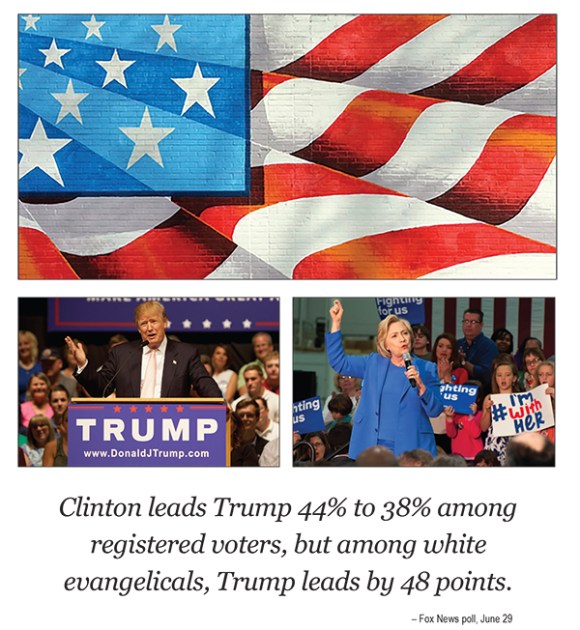
Still, Trump has branded himself as the candidate most invested in religious liberty and other Christian concerns. So far, a majority of voters agree: A June poll by CBS found Trump leads Clinton among evangelical voters by a margin of 62% to 17%.

However, as Religion News Service’s analysis of the poll pointed out, Trump’s 62% is lower than the percentage of white evangelical voters who favored George Bush (79%), John McCain (73%) and Mitt Romney (79%) in the last three elections.

Gallup polling from May found the two candidates neck and neck among those who identify as “Protestant” or “Other Christian”—36% had a favorable opinion of Clinton, and 38% had a favorable opinion of Trump. Both candidates’ numbers were slightly lower among the “Highly religious”—35% for Clinton and 37% for Trump.

For those voters who don’t foresee an appealing option for November, Christian and conservative leaders have floated other ideas, including third-party candidates, write-in voting, and abstention. Alan Noble, a professor at Oklahoma Baptist University, wrote for Vox that “unless a third-party candidate with broad appeal emerges, evangelical Christians would be better served by abstaining from that vote and shifting their energy toward electing people to Congress and local and state governments who have the opportunity to restrain whichever candidate is elected as needed.”

But many Christian leaders have been vocal about getting out the vote, even for candidates that are less than ideal. On his tour of state capitals, evangelist Franklin Graham has urged Christians to vote, but hasn’t endorsed specific candidates. Graham has instead warned against inactivity, citing a statistic that reports 20 million evangelicals did not vote in the 2012 presidential election.

In Springfield, Graham told several thousand gathered in front of the Capitol, “Our job as Christians is to make Christ felt in every [area] of life—religious, social, economic, political.”

Keep the lines open

No matter who believers support in the election, said Wheaton College’s Ed Stetzer, the rhetorical tone should be loving.

“In years past, I generally had to encourage evangelicals to avoid scorning fellow evangelicals who voted Democrat. Now, perhaps we need exhortation to avoid scorning those who vote for Donald Trump….Rather than looking down with scorn on evangelical Trump supporters, perhaps we should sit down with them, listen to them, and hear their concerns.”

Mohler prescribed similar action in his June 22 podcast, urging Christians to think through the issues at hand.

“In this difficult political season, evangelicals must not demonize one another as to how we’re thinking through these issues, but I must plead with all evangelicals that we must indeed think through these issues carefully and faithfully, and think very biblically and candidly.”

To fail to remember oneness in Christ and fall instead into factions and camps could result in a loss of the unity achieved during the recent Southern Baptist Convention, wrote Pastor Ted Traylor following the meeting with Trump, which he attended. At the June 14-15 convention in St. Louis, Baptists united around one presidential candidate, Steve Gaines, after another, J.D. Greear, bowed out prior to a second run-off election.

Now, as Baptists consider another election, Traylor, pastor of Olive Baptist Church in Pensacola, Fla., advised them to think carefully in a blog post titled, “What I learned from a conversation with Donald Trump.”

“There has been much vitriol on social media about the Trump meeting within the tribe of Southern Baptists. We left our convention last week in unity. Demonizing each other over secular politics will quickly destroy what we saw and hailed as God-given unity. We are in the Gospel business.

“However, as we render to Caesar what is his we must be wise, kind and discerning.”