Archives For November 30, 1999

Trends and news about secular culture

Editor’s note: Erich Bridges is global correspondent for the Southern Baptist International Mission Board. His “WorldView Conversation” posts, including this one, appear occasionally at BPNews.net.

COMMENTARY | Erich Bridges

No matter how long the school year dragged on, I knew that once summer came, I’d get to go to my grandmother’s beach house. Once there, I could count on her good cooking and unconditional love.

Praying ManWe would fish in the surf or from the boardwalk and watch the sun go down beyond the horizon as the ocean wind cooled our faces. We sometimes talked, but silence was just as good. Being together sufficed.

I think about those summers as today’s July heat begins to bake. Grandma is long gone, and I miss her. But my spirit still yearns for beaches, rivers, mountains and other places that offer respite from the daily routine.

It’s a desire common to humanity. It predates by millennia the idea of vacation, which is a modern phenomenon. We long for a break, however brief, from the daily grind, a pause from the familiar. We crave rest and renewal. A “separation from the world, a penetration to some source of power and a life-enhancing return,” the folklorist Arnold van Gennep described it.

Church folks call it a retreat. Modern-day retreats have become scheduled events with programs, speakers, themes and such. But the older concept of Christian spiritual retreat harks back to the holy men and women of the early church who went into the desert to seek the Lord. They followed the example of Christ, who sought out the wilderness to pray and be alone with His Father before returning to minister to the needy crowds.

The craving for retreat is never stronger than when the world seems to be falling apart. Wars that were supposed to be over aren’t. Old enemies remain and new ones emerge. Political and cultural disputes become more hateful by the day. People refuse to make peace with God or each other, holding onto their evil ways. Those closest to us let us down. We let them down. We disappoint the Lord. It’s time for a rest and a fresh start.

These are times for a retreat in the old sense. Jesus beckons us to come away with Him to a quiet place, there to rest with Him and renew our spirits. Vacationing is OK, but it’s a poor imitation of walking with Jesus in the wilderness.

The other great thing about true retreat is returning to the world. Vacations these days tend to be rushed, expensive, over-planned and more tiring than the demands they’re supposed to relieve. When you get home, you’re ready for a vacation from your vacation. But you return from a retreat with the Lord refreshed, renewed and ready to follow Him back into the fray.

That’s the real point of retreat — being with God, then returning to the world. He needs servants who have met with Him before they enter the global struggle for souls. If we try to serve Him in our own puny power, we’ll make no impact.

Seek Him in the wilderness and quiet, and renew yourself in His Spirit. Return to the world to shine His light into darkness.

By Lisa Sergent

Two women recently visited Mindy Cobb’s Sunday school class at Uptown Baptist Church in Chicago. They told Cobb they were in a lesbian relationship and asked if they would be accepted by the class. “I told them we would welcome them and love them, but not affirm their relationship,” she recounted. They didn’t come back.

It wasn’t the class’ first experience with the issue. Several years ago, a transsexual named Jackie asked to join the class. “I said no,” Cobb said. “This wasn’t the sort of person I wanted in my class.” But Cobb agreed for Jackie to share her story and let the class make its own decision.

Similar questions are affecting churches across Illinois and the nation. How would they respond if Jackie came to Sunday school? Or if a same-sex couple like TV’s Mitch and Cam and their adopted daughter, Lily, showed up on Sunday?

Same-sex marriage is legal in 19 states including Illinois; in all of the remaining states, bans on same-sex marriage are being challenged. The majority of Americans believe gay couples should be able to get married. And conservative, Bible-adhering churches that never expected to find the issue of homosexuality on their doorsteps are instead finding it in the pews.

Bob Dylan was right. The times, they are a-changin’.

We will walk with you

In April, 24-year-old author Matthew Vines released a book that some have called a game-changer for the church. In “God and the Gay Christian,” Vines, who says he holds a high view of the authority of Scripture, attempts to prove the Bible does not condemn same-sex relationships.

The book is unique because it’s a message to the church from someone who grew up there. Vines, raised as a Presbyterian in Kansas, is asking that gay people not only be welcomed in churches but also affirmed – and he says the Bible supports his view. Vines is a voice for gay people who are looking for a place to belong in the church.

At Mosaic Church in Highland, Ill., teaching pastor Eddie Pullen preached last year on what the Bible says about homosexuality. A woman in attendance that day became angry and left. She later shared her disapproval with Pullen, telling him she was a lesbian.

Churches looking for easy answers in the conversation about homosexuality likely won’t find any. “If we accept his [Vines’] argument we can simply remove this controversy from our midst, apologize to the world and move on,” said Albert Mohler, president of The Southern Baptist Theological Seminary and author of an e-book that counters Vines’ work. “But we cannot do that without counting the cost, and that cost includes the loss of all confidence in the Bible, in the church’s ability to understand and obey the Scriptures and in the Gospel as good news to all sinners.”

At Mosaic, Pullen said God had been preparing him for the conflict with the offended woman. Two years prior, he had written a sermon that he “prayed and poured more into” than any sermon in years. His message for all who would come to the church was:

• No matter who you are, you need Jesus.

• Jesus does love you.

• You are welcome at this church.

• You may not agree with us.

• We will not single you out.

• We will walk on your journey with you.

“What Christians and even churches miss is that Christ-followers need to be known for their love,” Pullen said. “Too many Christians are afraid to reach out [to homosexuals] because they’re afraid it will be received as affirmation. That’s not true.”

He told the woman who visited Mosaic, “We don’t have to agree on everything, but we don’t have to run away [when we disagree]…We don’t want you to leave because of our disagreement.” She came back to Mosaic, and has continued to participate in church activities.

“Usually it takes someone seeing Jesus in us to convince them He’s real,” Pullen said. “If they never see Jesus in His followers, why would they want to become one?”

What Mindy’s class decided

At Uptown Baptist, Mindy Cobb’s Sunday school class heard Jackie’s story and welcomed her with open arms. They spent almost a year getting to know her as a new Christian who wanted to study the Bible. That first Sunday, Jackie told the class she had been born as a man, undergone 29 surgeries, and was now a woman.

She became a member of the class, and started bringing her friends too. Every week, she gave a testimony. “It got to the point where everybody was sitting on the edge of the chair to see what Jackie was going to say this week,” Cobb said.

Then, after about a year, a man with short hair and a suit came into the class. “I wanted to tell you I am now ready to be the man God created me to be,” said Jackie, now called Willie. He had been in Christian counseling and was ready to be his male self. It was his last Sunday in Cobb’s class; the next week, Willie began attending a men’s Sunday School class at Uptown.

“God used Jackie to show me how I put people into a box,” Cobb said. “I learned to love and accept people for who they are and to let God do the changing.” Looking back on the experience, she said, “There are no quick answers. Sometimes lives are just messy. People do need help to see things a new way.”

Lisa Sergent is director of communications for the Illinois Baptist State Association and contributing editor of the Illinois Baptist newspaper.

Hannah_Gay

“…I learned many, many years ago that God is far too big for me to understand Him, but at the same time that His love for mankind is just as far beyond my comprehension,” Dr. Hannah Gay told Baptist Press. “So I trust Him even when I don’t understand.”

THE BRIEFING | Meredith Flynn

The news that a child believed to be functionally cured of HIV once again has the virus growing inside her “felt like a punch to the gut,” the specialist who treated the child told CNN.

But Hannah Gay also said God is evident in the details of the case.

“For confidentiality reasons I cannot share any of those details publicly but there are many and they have helped to not just reaffirm my faith in God,” Gay told Baptist Press, “but to actually strengthen it.”

The associate professor of pediatric infectious diseases at the University of Mississippi Medical Center was credited in March 2013 with achieving a “functional” cure of the child born with HIV, meaning the virus couldn’t be detected by standard clinical tests. But tests this month revealed the more than two-year remission is over.

Gay, who has credited God with the functional cure, said she’s learned to trust Him even when she doesn’t understand current circumstances. Read the full story at BPNews.net.

Moore: Compassion needed at border
The church’s response to the border crisis “cannot be quick and easy,” wrote Russell Moore, president of the Southern Baptist Ethics and Religious Liberty Commission. “But, for the people of God, our consciences must be informed by a Kingdom more ancient and more permanent than the United States.” Read his column at RussellMoore.com.

LifeWay poll: 56% of Americans want more movies with Christian values
In a year where faith-based movies have seen success at the box office, LifeWay Research found a majority of Americans say they want more such films, although adults under 30 were the age group least likely to agree. In other movie news, 20th Century Fox has released the trailer for October’s “Exodus: Gods and Kings.”

Pew defines ‘closely held’ corporations
Wondering what the Supreme Court meant by “closely held” businesses in their recent decision on Hobby Lobby? Pew Research released this explanation of the label.

Illinois students serving in Chicago, Oklahoma
The All-State Youth Choir is on tour this week, and heading to Oklahoma after a concert at Six Flags in St. Louis today. Follow them at www.Facebook.com/IllinoisBaptist.

prayer_1

Students and their leaders at ChicaGO Week pray for specific neighborhoods that are in need of a new church.


HEARTLAND |
How do you introduce junior high and high school students to the intricacies of church planting in one of the country’s largest cities?

Take them there, and let them try it out.

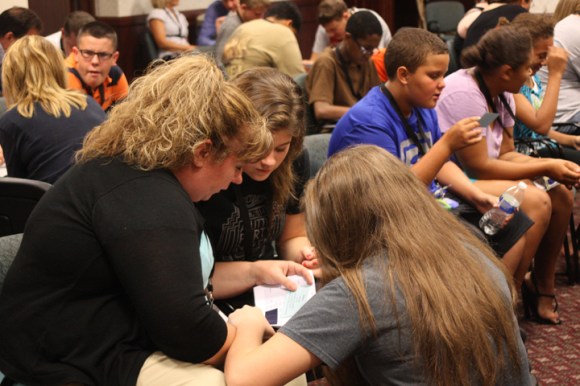
More than 50 teens will spend this week working alongside five church planters in Chicagoland as part of the first-ever ChicaGO Week, a project sponsored by the Illinois Baptist State Association. The week kicked off July 13 at Judson University in Elgin, where youth groups from Harrisburg, Chicago, and several places in between will gather for worship after days at their project sites.

prayer_2During the opening worship service, the students heard from someone with lots of experience juggling the responsibilities of church planting.

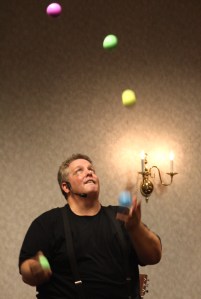
And lots of experience with actual juggling too.

Ken Schultz is a professional entertainer with the stage name “The Flying Fool.” He’s also co-pastor of Crosswinds Church in Plainfield, a church he started several years ago with nuclear engineer John Stillman.

“God uses my juggling and John as a nuclear engineer to help grow a church,” Schultz told the students. Crosswinds has an average weekly attendance of 120 people, and 60% of those came to Christ through the church’s ministry.

“John makes killer spreadsheets,” Schultz said of his co-pastor. “I do this,” he said, before wowing the crowd by juggling three long knives.

juggling

Pastor Ken Schultz used his juggling and unicycle-riding skills in a message on boldness.

“What are you good at?” Schultz asked the students. “Can God use that to build his church?

“He can. You just need to give it to him.”

This week, they’ll do just that at Backyard Bible Clubs, through prayer walking and community clean-up projects, and by offering their time to church planters working hard to get to know their neighbors. It’s a lot to juggle, but God empowers His people to do His work.

“Let this generation be bold, let them be bold as lions for your glory and your good,” Schultz prayed at the end of his message. “If You can use a silly guy who juggles, You can use anybody.”


THE BRIEFING | Meredith Flynn

As World Cup fever raged across the globe – and even here! – new research from Barna showed most Americans recognize their country’s fascination with sports, and almost two-in-three think the culture cares too much about athletics.

The nationwide survey conducted in February found 89% of adults strongly or somewhat agree that sports are an important part of American culture, with men slightly more likely to strongly agree than women. Interestingly, practicing Christians (55%) were the most likely group to strongly agree.

soccer ballBarna also found 27% of Americans believe the culture cares too much about sports, and 39% agree somewhat. A majority of Americans also agree strongly or somewhat that professional athletes make too much money (86%), and that American professional sports are very corrupt and distract from important global issues (both 62%).

As for America’s favorite sport: Football reigns supreme with regular viewers (53%), followed by basketball and baseball (both 33%). Soccer’s numbers were higher than you might think, especially considering the survey was completed before the World Cup. 11% of Americans regularly watch the beautiful game (that’s what they call soccer), 20% have played it, and 16% say their kids play.

Zamperini remembered as Olympian, war hero, Christian
Former Olympic runner and prisoner of war Louis Zamperini died July 2 at the age of 97. Zamperini, the subject of Laura Hillenbrand’s 2010 book “Unbroken,” also was a Christian. His conversion happened at a Billy Graham Crusade after he returned from a Japanese POW camp, at the height of his bitterness and rage over two years of captivity. Read Denny Burk’s tribute to Zamperini.

Some Nigerian girls escape, more than 200 remain captive
While many Americans were celebrating independence, dozens of women and girls in Nigeria were finding freedom from a much more immediate threat. The Christian Post reports more than 60 women and girls kidnapped by Boko Haram on June 22 escaped around July 4. More than 200 girls reportedly are still held by the terrorist group founded to fight the influence of Western education. In a video message released earlier this year, Boko Haram leader Abubakar Shekau threatened to sell the kidnapped girls.

Book release: Piper’s ‘Pastor’s Kid’
Barnabas Piper’s new book “The Pastor’s Kid: Finding Your Own Faith and Identity,” was written for PKs, pastors and churches, the son of famed pastor John Piper wrote in the introduction. Coinciding with the book’s July 1 release, the author answered questions from culture writer Jonathan Merritt in this Q&A for Religion News Service, including the biggest negative effect of his upbringing (“not connecting with God in a personal way”). Piper also shared a few surprising facts about his dad, like his love for the comedy “What About Bob.”

Four Southern Baptists named to ’33 under 33’ list
Christianity Today’s list of influential young leaders includes four Baptists, Baptist Press reported July 1. They are:

  • Trevin Wax, a blogger and managing editor of LifeWay’s The Gospel Project
  • Hip-hop artist turned pastoral intern Trip Lee
  • Former rapper D.A. Horton, who is now the North American Mission Board’s national coordinator for urban student missions
  • Saira Blair, a 17-year-old candidate for West Virginia’s state legislature

See the rest of the list at ChristianityToday.com.


NEWS | The U.S. Supreme Court has issued additional protection to Wheaton College as it fights a mandate in the Affordable Care Act that requires employers to cover drugs like the morning-after pill in their employee health plans.

Wheaton, a Christian college in a western Chicago suburb, already qualified for an exemption from the Affordable Care Act offered to faith-based non-profit organizations. But many have said the government’s plan – to let non-profits sign a form allowing insurers to pay for the drugs, rather than the organization itself – isn’t enough. As the Associated Press reported July 3, “Wheaton and dozens of other non-profits have sued over the form, which they say violates their religious beliefs because it forces them to participate in a system to subsidize and distribute the contraception.”
The Supreme Court’s unsigned opinion July 3 says that during its court case, Wheaton doesn’t have to sign the form but can write a letter to the U.S. Department of Health and Human Services explaining its objection to the requirements.

The Court’s three female justices – Ruth Bader Ginsburg, Elena Kagan and Sonia Sotomayor – disagreed with the temporary injunction. Sotomayor wrote that the Court’s action “undermines confidence in this institution.”

On June 30, the justices ruled 5-4 that “closely held,” for-profit businesses Hobby Lobby and Conestoga Wood Specialties don’t have to cover abortion-inducing drugs in their employee plans. ChristianityToday.com has a helpful infographic from The Becket Fund forecasting next steps in court cases against the mandate.

Lisa Sergent holds a musket used by a private who served under General George Washington. It is owned by history buff and pastor Dan Fisher (left).

Lisa Sergent holds a musket used by a private who served under General George Washington. It is owned by history buff and pastor Dan Fisher (left).

COMMENTARY | Lisa Sergent

There’s an old song that says, “Don’t know much about history.” What Dan Fisher knows has been largely ignored – or forgotten – in our time. Clergymen were heroes in the American Revolution, said Fisher, himself a Southern Baptist pastor and Oklahoma state representative.

Fisher, the pastor of Trinity Baptist Church in Yukon, Okla., travels the country presenting “Bringing Back the Black Robed Regiment.” A term coined by British sympathizers, the “regiment” were the pastors – Presbyterian, Methodist, Lutheran, Baptist and Episcopalian – who helped lead the fight for liberty from the British. He shared his message to a gathering hosted by the Illinois Family Institute this spring.

Portraying Lutheran pastor Peter Muhlenberg, later a general in the Continental Army who rallied his congregation to fight, Fisher said, “If the church doesn’t speak out, then who will? We were the men of the book, we were the men of truth, we were the men of true liberty because we knew that ultimately true liberty can only come though an internal relationship with Christ. When you have true liberty, then you can defend external liberty.”

Fisher shared how many of these 18th century pastors gave their lives and livelihoods in the fight to defend liberty. He encouraged today’s pastors to stand boldly for religious liberty. “What price are you willing to pay?” he asked.

He applies this aspect of United States history, forgotten by many, to today’s cultural issues. “There comes a time when our liberty must be protected,” said Fisher. “Friends, if we lose our external liberty we lose our internal liberty to believe and preach.”

Urging Christians to take a stand, Fisher stated, “Some 50% of today’s evangelicals don’t even bother to vote. And out of those who do vote, 25% vote the opposite of what Christians believe. Not on political issues, but on moral issues…How do we justify that?”

Fisher repeated second U.S. President John Adams’ warning to America in 1798: “We have no government armed with power capable of contending with human passions unbridled by morality and religion…Our constitution was made only for a moral and religious people. It is wholly inadequate to the government of any other.”

Lisa Sergent is director of communications for the Illinois Baptist State Association and contributing editor of the Illinois Baptist.

Baptists almost ‘dance for joy’ over religious freedom ruling

THE BRIEFING | Meredith Flynn

The U.S. Supreme Court ruled June 30 in favor of Hobby Lobby and Conestoga Wood Specialties, deciding that the companies do not have to cover abortion-inducing drugs in their employee health plans.

The 5-4 decision sets an important precedent for “closely held” companies (those owned by individuals or families) that object to what has become known as the abortion-contraceptive mandate in the Affordable Care Act.

In the opinion, Justice Samuel Alito wrote that under the standard set by Religious Freedom Restoration Act of 1993, “the HHS contraceptive mandate is unlawful.”

The_BriefingSouthern Baptist leaders responded quickly to the ruling. “It is an absolute victory for the proponents of religious liberty,” said SBC Executive Committee President Frank Page. “I am thankful that both common sense and conscience have seen a victory in a day where such victories are rare.”

Russell Moore, president of the SBC’s Ethics and Religious Liberty Commission, called the ruling an “exhilarating victory for religious freedom.” During the SBC Annual Meeting in Baltimore earlier this month, Moore presented an award to the Green family, who owns Hobby Lobby.

“As a Baptist, I am encouraged that our ancestors’ struggle for the First Amendment has been vindicated,” Moore said after the Court’s decision.

“This is as close as a Southern Baptist gets to dancing in the streets with joy.”

Read more at BPNews.net.

Court also rules on abortion clinic buffer zones
The Supreme Court struck down a 2007 Massachusetts law restricting pro-life advocates from congregating within 35-foot zones around abortion center entrances and driveways, Tom Strode of Baptist Press reports. Justices issued a 9-0 opinion on the matter, and Chief Justice John Roberts wrote that the law “imposed serious burdens” on free speech.

Marriage in limbo in several Upper Midwest states
Indiana has joined a list of states in which the definition of marriage is pending an appeal of a federal judge’s ruling. After Judge Richard Young struck down the state’s same-sex marriage ban June 25, a federal appeals court issued a stay two days later. Michigan and Wisconsin are in a similar situation, as seen in this map from USA Today (which doesn’t reflect the Indiana appeal). Same-sex marriage officially became legal in Illinois June 1, although some counties began issuing marriage licenses in the spring.

LifeWay survey: Domestic violence rarely preached about in church
Nearly three-fourths of Protestant pastors say domestic or sexual violence is a problem in their community, but 42% rarely or never preach on the topic. The survey, conducted by LifeWay Research and sponsored by Sojourners and IMA World Health, also found 74% of pastors know someone who has experienced domestic violence. Read more at LifeWayResearch.com.

Thief-turned-pastor shares testimony
George Aguilar, once an enemy of churches in Oklahoma, is now a pastor in his home country of El Salvador. After robbing from and vandalizing 11 churches in the Tulsa area, Aguilar came to Christ after one of the churches he stole from took him in. Read his story from The Baptist Messenger.


The_BriefingTHE BRIEFING | Meredith Flynn

Leading up to the Supreme Court’s expected ruling on a case involving Hobby Lobby, culture writer Jonathan Merritt took issue with calling the craft retailer a “Christian business” because of its dealings with China, one of the world’s worst offenders of human rights.

Hobby Lobby currently is fighting for an exemption to the government’s requirement that for-profit companies cover some abortion-inducing drugs in their employee health care plans. The Supreme Court’s ruling is expected this week.

The things Hobby Lobby claims to stand for, Merritt wrote for The Week magazine, including sanctity of life and religious liberty, are grossly undervalued in China.

“Hobby Lobby reminds us why for-profit businesses should resist calling themselves ‘Christian,’” he wrote. “The free market is messy and complicated and riddled with hypocrisy. Conducting business in today’s complex global economy almost ensures one will engage in behavior that is at least morally suspect from a Biblical standpoint.”

Merritt invited Russell Moore, president of the Ethics and Religious Liberty Commission, to respond to his article. Moore recently presented the Green family with the John Leland Award for Religious Liberty.

Forsaking business in China, Moore wrote, likely won’t help improve human rights there. Historically, he said, “open trade, in most cases, tends to help the development of political rights rather than hinder them.” If the Greens believed boycotting Chinese business would turn the nation’s government toward improved human rights, Moore said, they would.

But, “The Greens cannot control the decisions made by the Chinese government. They can, however, direct their own actions. And, as Americans, they can participate in a democratic republic in which the people are ultimately accountable for the decisions of their government.

“Buying products from companies that operate in a country that aborts children is not the same as being forced by the United States government to purchase directly insurance that does the same.”

Meriam Ibrahim released from prison, then rearrested
A 27-year-old mother of two imprisoned for her Christian faith was released June 23, but rearrested just hours later, The Christian Post reported this morning. Meriam Yahia Ibrahim, a Sudanese doctor, had been imprisoned with her young son and newborn daughter after she was found guilty of apostasy and adultery. (Because Ibrahim’s husband, Daniel Wani, is a Christian, their government does not recognize their marriage.) Her death sentence was to be carried out in two years. After Ibrahim was freed and her sentence commuted Monday, she was rearrested with her husband and children as they prepared to leave Sudan. Ibrahim’s case has drawn attention internationally and in the U.S., 38 members of Congress signed a letter asking the government to intervene on her behalf. Read more at ChristianPost.com.

Benched basketball star says ‘I know God has a plan!’
Isaiah Austin, a center for the Baylor University basketball team, was expected to be a first-round pick in the June 26 NBA draft. Instead, a diagnosis of Marfan syndrome will end his career, reported The Christian Post. He sat down for an emotional interview with ESPN, but was hopeful on Twitter and Instagram, using social media to talk about his faith in God.

“I know God has a plan!” Austin posted as part of a message on Instagram, with the hashtag #NewBeginnings. “I would love to thank EVERYONE who has reached out to me,” he tweeted under the handle God’s Child. “Toughest days of my life. But not the last! Life goes on. GOD IS STILL GREAT!”

Mohler: PCUSA marriage vote helps establish ‘clear divide’
When the General Assembly of The Presbyterian Church (U.S.A.) voted to allow pastors to conduct same-sex marriages, their decision set a dividing line in culture and in Christianity, said Southern Seminary President Albert Mohler.

“That very clear divide puts on one side those who stand with 2,000 years of Christian witness and on the very clear statements of Scripture, and, on the other side, those who stand with the moral revolution of the era…,” Mohler said on his daily podcast.

The Presbyterian denomination not only voted on the policy change for pastors, but also to amend their constitution to define marriage as between “two people” instead of “a man and a woman.” A majority of the PCUSA’s presbyteries must approve the amendment for it take effect, Baptist Press reported, but the departure of many conservative congregations makes the change a likely prospect.

NEWS | Meredith Flynn

Ask church leaders what is the single biggest threat to marriage right now, and most would probably give the same answer: the stunning wave of approval for same-sex marriage.

But a changing definition of marriage isn’t the only thing endangering the institution, said Baptist leaders at an April summit on sexuality and the Gospel. In fact, it may not even be at the top of the list.

Pornography has dulled the consciences of many Christians. Cultural trends have tended to devalue marriage at the expense of other arguably good things, like education, career and financial stability. And pastors may not feel the freedom or confidence to speak plainly about the issues affecting their congregations: sexual purity, marital fidelity, and what the Bible really says about all of it.

Faced with these threats to marriage, Andrew Walker of the Southern Baptist Ethics and Religious Liberty Commission said the church has a choice: “We can confront these changes, we can acknowledge them, we can work to combat them, or, sadly, we can conform to them.”

One thing the church can’t afford to do: nothing.

For today’s 20-somethings, marriage and family look very different than when their parents were making decisions about who to wed and how many kids to have. In 1960, 72% of American adults were married. In 1980, it was 62%. In 2012, it was just over 50%.

According to a 2013 study by the University of Virginia, the average age of first marriage now is historically
high – 27 for women and 29 for men. Waiting to marry has resulted in a lower divorce rate and better economic prospects for women; however, researchers also point to higher birth rates among unmarried women.

Almost half (48%) of first births are to unmarried women.

“What exists outside the church usually makes its way inside the church,” said Walker, the ERLC’s director of policy studies. In a breakout session at the Nashville summit hosted by the ERLC, he explored 11 threats to contemporary marriage, including:

The “soul mate” concept of marriage that emphasizes emotional and sexual fulfillment and partnership over biblical covenant and commitment.

Marriage as an aspiration. People marry later when they wait until they’re financially established, Walker said. “We need to mitigate against the [idea] that someone needs a Master’s degree and $75,000 in the bank” before they get married, he added.

– The rise of “professional marriages” where spouses have individual bank accounts and separate social lives.

Also on Walker’s list of external threats to marriage: divorce. Many would say it’s a threat inside the church too, although the statistics that place divorce rates the same or higher among Christians have been misreported, some researchers say. The more subtle danger may be Christians’ acceptance of the divorce culture.

In an interview last year with Christianity Today, ERLC President Russell Moore said divorce is one way Christians have surrendered to “the patterns of this age.”

“Evangelical Christians are as counter-cultural as we want to be, and it is clear that we are slow-train sexual revolutionaries, embracing the assumptions of the outside culture a few years behind everybody else,” Moore said. “This has had disastrous consequences.”

How these factors have marginalized marriage inside the church is supported largely by anecdotal evidence. The single adults in your congregation likely weren’t raised to focus on whom they would eventually marry. Marriage has been confined to “meeting the right person” for an entire generation (maybe more); it’s not something they can control. So young Christians focus instead on friendships, education and career. On top of all that, they’re haunted by the specter of divorce. Looking toward marriage seems strange to most of them, even limiting – and potentially disappointing.

David Prince is a Kentucky pastor who also spoke at the ERLC summit. He said that when he visits new parents in the hospital, he prays over their babies, and specifically for their future spouses. One grandfather in a hospital room expressed his disbelief that Prince was praying that way already, the pastor said.

The majority of Americans, and even more religious Americans, still have faith in the institution of marriage, according to research presented at the summit by sociologist Mark Regnerus. The question is whether they have enough faith to pursue it for themselves. In the absence of a “marriage culture,” wrote blogger Trevin Wax last year, Christians who marry early and stay married 40, 50 or 60 years will stand out. Which is good news for the church. “We’ll be ordinary oddballs,” Wax said. “So let’s not waste the opportunity.”

A healthier view
If negative influences on marriage and sexuality that exist outside the church have made their way inside, Scripture offers a better way forward. And it speaks to modern-day problems like pornography, said Southern Seminary professor Heath Lambert.

Likening porn to the “forbidden woman” in Proverbs 7, he told summit attenders there is a silent killer running rampant in churches. And it’s not growing acceptance of same-sex marriage.

“A greater threat to the church today is the Christian pastor, the Christian schoolteacher, the Christian Bible college and seminary student, who exalts sound theology, points to the Bible, and then retreats to the basement computer to indulge in an hour or three of internet pornography.”

Regnerus shared daunting numbers: When asked whether they had looked at porn on a given day, 11% of men said yes. Between 35 and 40% said they had within the last week, including 20-25% of Christian men between the ages of 18 and 39. And it’s not just men. In a reflection on biblical womanhood during the summit, Trillia Newbill said research from 2007 showed 13 million women clicked on pornographic web sites every month. Women represent one in three visitors to adult entertainment sites, she said.

“There is a stereotype and a really, really, really bad rumor that women don’t struggle with sexual sin,” said the ERLC’s consultant for women’s initiatives. “The sin that came into the world and corrupted all that was beautiful in the world, also corrupted us women.”

How can churches offer hope and the truth of the Gospel? By presenting marriage and sexuality in the same tone as Scripture, said Kevin Smith, who closed the conference with a message on biblical sexuality within marriage.

“…Certainly, let us avoid vulgarity and certainly let us avoid [language] that will remove the mystery of sexual intimacy between a husband and a wife,” the pastor and professor from Louisville, Ky., said.

“I’m kinda tired of preachers bragging about their hot wife.”

But Smith also warned church leaders not to let a sex-saturated society muzzle proclamations of biblical marriage and sexuality. Avoid the “flattening out” of sex that happens in our culture, which removes emotional, commitment and intellectual aspects of the one-flesh union of the Bible, Smith said.

“The one who is proclaiming the Word of God and speaking of sexuality in a biblical context, we’re trying to heighten the conversation. We’re not trying to make sex less dramatic, we’re trying to make sex more dramatic.”

And more biblical.

Meredith Flynn is managing editor of the Illinois Baptist newspaper. Read the IB online at http://ibonline.IBSA.org.