Archives For November 30, 1999

Trends and news about secular culture

Editor’s note: This is part 1 of the Illinois Baptist’s coverage of a recent summit hosted by the Ethics and Religious Liberty Commission on racial reconciliation and the gospel. Read part 2 next week here at ib2news.org.

NEWS | Meredith Flynn

Weeks of riots in Ferguson, Missouri, following the police shooting of a young black man, Michael Brown. More protests in major cities after the death of another African American, Eric Garner, during an arrest. And with the shooting death of 12-year-old Tamir Rice in Cleveland, the culmination of a summer of racial unrest in America. And it was only the beginning.

Chants of “Hands up, don’t shoot” in the streets gave way to “Black lives matter,” and in personal conversations, the question has become “Why now?” and “I thought we had made so much progress on race relations in the U.S.”

A sad and challenging summer, followed by a new round of unrest in Ferguson after a condemning report from the U.S. Department of Justice, leaves many thinking, “Apparently not.”

And the church wonders, What can we do? And in some corners Christians have asked, What does the gospel require us to do?

“How do we as people formed by Christ start to have those conversations out in the world?” said Ethics and Religious Liberty Commission President Russell Moore at a March summit in Nashville. “It starts if we’re in the same body, gathered around the same table, praying with one another, praying for another, serving one another, being led by one another, and then we will stand up for and speak up for one another.”

The state of race relations in America, from Ferguson to New York, and coast to coast, is demanding fresh thinking and producing new preaching on race in all kinds of churches—including here in Illinois.

More than 500 current and future church leaders gathered at LifeWay Christian Resources last month to address racial reconciliation and the gospel. The second-annual Leadership Summit hosted by the Ethics and Religious Liberty Commission brought together nearly 40 speakers who presented on a wide range of topics: multi-ethnic ministry, Islam, the SBC’s history on racial issues, pop culture, and more.

In each message and panel, the summit’s key theme was clear: Racial reconciliation is a gospel issue. The gospel reconciles people to God and to one another, but sin is still at work in the world, causing tension, division, strife and violence.

The solution, leaders said at the summit, is for the church to preach and live out the gospel on matters of race. To examine itself for any lingering race-related sin of pride, and to work together to fight the common enemy of racism.

“We’ve got a long way to go,” Moore said in his opening address. “Our sin keeps wanting us to divide up. But to the faithful, Jesus promises, ‘You will be called overcomers.’ And we shall overcome.”

Summit attenders gathered in the aisles and at the altar to pray together at the start of a March meeting on racial reconciliation and the gospel.

Summit attenders gathered in the aisles and at the altar to pray
together at the start of a March meeting on racial reconciliation and the gospel.


Learning how to see each other
“All creatures of our God and King; lift up your voice and with us sing…”

The first hymn led by band Norton Hall and worship leader Jimmy McNeal took on extra significance as the words reverberated around the auditorium. All creatures, lifting up their voices, together. African American, Anglo, Hispanic; male and female; young and old. At the summit, mostly young.

The picture painted in “All Creatures of Our God and King” isn’t possible when people are left to their own devices, summit speakers said. The gospel is central to racial reconciliation. In perhaps one of the few times the Good News has been compared to mayonnaise, Dallas pastor Tony Evans said it acts as an “emulsifier,” like the eggs that helps combine the ingredients in his favorite sandwich condiment.

“Grabbing a black Christian and a white Christian, a red Christian and a yellow Christian, a Baptist and a Methodist, Pentecostal,” Evans preached as the crowd clapped and agreed with Amen’s. “He’s able to pull them together when you understand that the gospel can change an environment, and can do anything.”
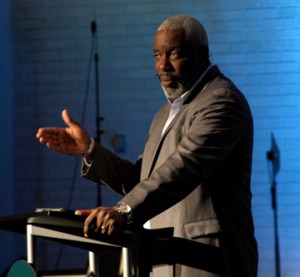
Thabiti_Anyabwile_blogThe mission of reconciliation can be seen in the Bible from the very beginning, said Washington, D.C., pastor Thabiti Anyabwile (right). Preaching from the book of Genesis, he urged his listeners to consider how they look at people different from themselves, in light of the fact that everyone is made in the image of God.

“Every person we have ever looked at, smiled at, greeted, encouraged, insulted, slandered, touched, is a person bearing the marks of divine likeness, the ‘imago dei.’ So, racial reconciliation must begin with our learning the habit of seeing each other as together made in the image of God, and therefore possessing inestimable, unfathomable dignity and worth and preciousness.”

But seeing other people is such a commonplace occurrence, Anyabwile continued, and then there’s the problem of sin. That’s why true reconciliation requires a constant renewing of the mind. How a Christian treats people of different ethnicities is such a key part of living out one’s faith that it ought to be a category of discipleship, the pastor said.

“That [racism has] moved so rapidly to be a despised thing is wonderful,” he said. “But along the way, I think many Christians have been so afraid of the label, so afraid of the discussion, and so afraid of the implications, that they don’t even want to have the conversation.”

Working out the reconciliation that Christ has achieved for us is one of the most underdeveloped areas in Christian discipleship in the U.S., he said. A believer can live his whole life without someone sitting down with them to explore their identity in Christ.

And so, Anyabwile said, “We’re weak when the Fergusons erupt around us, we’re weak when we watch Eric Garner choke to death on a city sidewalk. We feel incompetent when we see a Tamir Rice shot in Cleveland.

“We don’t know quite what to say or what to do, when the (Department of Justice) reports come out, whether it’s telling us that ‘hands up don’t shoot’ isn’t true, or whether it’s telling us that, man, this police department is shot through with racist practice….It immobilizes us, because we’re not discipled, because we don’t have this as a category in what it means to mature as a Christian, as a follower of Christ.”


THE BRIEFING | Meredith Flynn

Brighton Presbyterian Church in Rochester, N.Y., is the first church to leave the Presbyterian Church (USA) after a majority of the denomination’s districts voted to change its definition of marriage. The amendment to the group’s constitution, which will become official this summer, alters the marriage definition from “a man and a woman” to “two people, traditionally a man and a woman.”

The_Briefing“Our reason for leaving is centered on the status of biblical interpretation within the PC(USA),” Brighton spokeswoman Kerry Luddy told The Christian Post. “We believe that Scripture’s meaning and intent should not be altered to fit a current culture.”

“Heaven visitation resources” like Don Piper’s book “90 Minutes in Heaven” are no longer available from LifeWay Christian Resources. Spokesman Marty King told Baptist Press LifeWay stopped ordering “experiential testimonies about heaven” last summer, and has pulled the remaining products from stores and its website.

LifeWay’s decision followed the adoption of a resolution on “the sufficiency of Scripture regarding the afterlife” by messengers to the Southern Baptist Convention’s annual meeting last summer.


Legislators introduced this month a bill that would allow adoption and foster care agencies to operate within their religious convictions concerning placing children with same-sex couples. “This commonsense bill simply ensures that these child welfare providers can keep doing what they do best and are treated the same as the rest,” said Rep. Mike Kelly (R-Pa.), according to a WORLD News Service report.

Illinois is one of four states where agencies have discontinued adoption and foster care services because they would have been required to place children with same-sex couples.


More than 83,000 Bibles were shipped to Cuba this month through a partnership between Southern Baptist agencies, churches and individual donors. The Eastern Cuba Baptist Convention, which will receive 32,000 Bibles, reported more than 29,000 professions of faith last year, said Kurt Urbanek, International Mission Board strategy leader for Cuba. “The growth is so incredible, that’s why Bibles are so important.”


“If it wasn’t for the Baptists, I don’t know what I would do,” said one homeowner whose basement was repaired after severe flood damage wrought by Hurricane Sandy. More than two years after the storm devastated parts of New York and New Jersey, volunteers working through Southern Baptist Disaster Relief are still rebuilding and repairing homes in the region.


Afshin_Ziafat_2NEWS | It was an English tutor who first showed the gospel to Afshin Ziafat.

As a first grader, Ziafat, who now pastors Providence Church in Frisco, Texas, moved to the United States with his family from Iran. It was 1979, a bad year to be Iranian in America, Ziafat told his listeners at the Ethics and Religious Liberty Commission’s summit on racial reconciliation and the gospel.

Ziafat’s family left Iran during the Islamic Revolution. “We had no idea what kind of unrest we were about to walk into,” he said.

The ongoing hostage crisis involving American victims meant Ziafat’s new home—Houston, Texas—was a hostile place. Radio stations played a new version of the Beach Boys’ song about Barbara Ann: “Bomb, bomb, bomb…bomb, bomb Iran…”

Rocks were thrown at his family’s home, and his parents’ tires were slashed. Ziafat and his brother were threatened at school.

And when he was in second grade, his tutor—who had taught him English by reading him books—gave him a small New Testament.

“You’re not going to understand this today, Afshin, but promise me you’ll hold on to it and read it when you’re older,” she told him.

Ten years later, Ziafat accepted Christ.

“Had any other American given me that New Testament, I would have thrown it away,” Ziafat said in Nashville today. “Because I didn’t trust them.

“You want to win a Muslim for Christ, I believe you have to earn the right to be heard. And she did it by the way she was loving me.”

“There are many more Afshin Ziafat’s today than there were back then, in your neighborhoods,” he said, “and God is calling us to step out. Listen to me folks— especially at a time when it is expected for us to distrust and maybe even hate Muslims.”

Ziafat ended his testimony with the story of the prophet Jonah, who knew that God was calling him to go preach to Assyrians who were not only his enemies, but also would conquer his people. Jonah’s book ends with a question from God about the people the prophet was called to go to, Ziafat noted:

“Should I not pity them?”

“You never get the answer from Jonah,” Ziafat said. “You know why? Because I think that questions goes out for us today….And I’m telling you, friends, we answer that question with the way we live our lives.

“The gospel calls me to step out of my comfort zone and go out to people who don’t look like me, who don’t dress like me, who are not of my skin color, but on top of that, especially those who are my enemies. Who I am expected to hate? When I show them love, the gospel is revealed.”

Nashville, Tenn. | Racial reconciliation is the main topic of the Ethics and Religious Liberty Commission’s 2015 Leadership Summit, which starts today at 1 p.m. The Illinois Baptist is in Nashville covering the event, which today includes plenary sessions on:

  • Why racial reconciliation is a gospel issue
  • Ferguson, Eric Garner, and your community
  • Key issues in racial reconciliation: Poverty, fatherlessness, criminal justice and urban ministry

Tonight, ERLC President Russell Moore will interview civil rights leader John Perkins, and speakers Danny Akin and H.B. Charles will explore how racial reconciliation is shaped by the gospel and the Great Commission. The evening session will conclude with a panel discussion on the church and multi-ethnic ministry.

The Summit was originally scheduled to focus on pro-life issues, but unrest in Ferguson, Mo., and other U.S. cities caused ERLC leaders to change the topic. “Racism and injustice are not just social ills; they are sins against God,” Moore said last year.

“This summit will help equip us to tear down carnal divisions, to bring about peace, so that churches reflect the kingdom of God.”

LifeWay Research has found that while 86% of Protestant senior pastors have congregations with one predominant racial group, only 40% of American churchgoers believe their church needs to become more ethnically diverse.

Check back here for news from the Summit, and in the next issue of the Illinois Baptist.

THE BRIEFING | Meredith Flynn

Amid continuing tension in Ferguson, Mo., church members will engage in a block-by-block outreach initiative to promote relationships–and healing–in the St. Louis suburb rocked by violence and protests since the shooting of teenager Michael Brown last August.

The_BriefingJose Aguayo, a Ferguson pastor and chaplain with the Billy Graham Evangelistic Association, will lead the effort to send out teams of church members tasked with getting to know residents on their assigned block. Eventually, Aguayo told Baptist Press, ministries resulting from the outreach could include “sports teams, community outings and study assistance for children and adults.”

First Baptist Church in Ferguson, led by Pastor Stoney Shaw, is one of the churches participating. He told The Pathway newspaper in Missouri, “We want to join with other churches and minister. Walking the streets and praying is a simple yet powerful plan.” Read more at BPNews.net.


In other news from Ferguson, Christianity Today reports on a dialogue between Franklin Graham and other Christian leaders. Graham, CEO of Samaritan’s Purse and the Billy Graham Evangelistic Association, posted March 12 on his Facebook page, “Most police shootings can be avoided. It comes down to respect for authority and obedience.” (Read the entire post here.) But according to a group of 31 Christian leaders who wrote an open letter to Graham, the issue is often more complicated.


Family is the most central factor in how Americans identify themselves, Barna found in a new study, followed by being an American at #2, and their religious faith at #3. But the answers change, depending on how old you are.


On the day marking the Iranian New Year, President Obama issued a statement calling for the release of Pastor Saeed Abedini, who has arrested in the country in 2012. “Saeed Abedini of Boise, Idaho has spent two and a half years detained in Iran on charges related to his religious beliefs,” Obama said. “He must be returned to his wife and two young children, who needlessly continue to grow up without their father.” Read more at ChristianityToday.com.


Texas Senator Ted Cruz spoke about Christianity and liberty at Liberty University in Lynchburg, Va., where he also announced he will run for President in 2016. Jerry Falwell, Jr., president of the Christian university, introduced Cruz but was careful to note Liberty was giving the candidate a platform rather than endorsing him, The Christian Post reported.


More than $2.5 billion is wagered on the annual March Madness basketball tournament, according to the FBI. But Christians would be wise not to throw any money in the pot, says Barrett Duke, a vice president for the Ethics and Religious Liberty Commission. Read the full story at BPNews.net.

COMMENTARY | Nick Rynerson

“Pop culture” is often treated like a dirty word in the church—thought to consist of mostly irredeemable entertainment produced to make money off the masses. A common approach is to avoid secular music, films, art, and television, or at least to not admit to consuming it all that much.

But that isn’t often what our real lives look like. Most of us are at least closet pop culture consumers—we indulge in one or two sitcoms, a favorite secular radio station, or a superhero movie every now and then.

And maybe that’s okay.

Nick_Rynerson_March15Popular culture is not the enemy; first and foremost, pop culture is a place for storytellers to, well, tell stories. Moral discretion is important. (And biblical! See 1 Corinthians 8:7-9.) But we miss a wealth of spiritual and theological depth if we chalk up all entertainment created by non-Christians as irredeemable and misguided; we also miss out on the opportunity to identify and empathize from a distinctly Christian perspective (Acts 17:28).

Stories offer us insights into our culture’s longings, revealing God’s truth in the world around us. In his excellent book “The Stories We Tell,” Kentucky pastor Mike Cosper reminds us that a story is never just a story—it’s a window into our culture’s imagination and longings (see Romans 2:12-15).

“Storytelling—be it literature, theater, opera, film, or reality TV—doesn’t aim at our rational mind . . . It aims at the imagination, a much more mysterious and sneaky part of us, ruled by love, desire, and hope,” Cosper writes. “When people, against their better judgment, find themselves hooked on a show, we can trace the line back to find the hook in their imagination.”

Stories, according to Cosper, can reveal much more about a person, people group, or culture than a strictly informative presentation or a list of facts. Stories communicate what people truly desire.

Take, for example, a certain Best Picture nominee from last year. The movie contains some strong language, an ambiguous ending, and other elements that might lead some Christians to believe that it has nothing to offer spiritually (and for some to wisely not engage the film). However, if we look closer, we can clearly see some distinct things the storytellers—the director, writer, characters, etc.—believe about God, life, and themselves.

Without spoiling the film, which centers on the relationship between a talented young jazz drummer and his demanding/abusive instructor, the characters have a very human desire: to be great. The devotion of the characters to the pursuit of greatness, and its sway over their future happiness, is deeply identifiable. Like the Tower of Babel in Genesis 11, the characters sacrifice their life for the pursuit of self-glory, predictably leaving themselves and others miserable.

Ever since the Fall, man has been trying to claw his way back to perfection. Everybody longs for his or her flaws to be taken away, and many of us think that if we just work hard enough, we will reach the promised land of perfection.

As Christians, we know this is vanity (Romans 3:23), but the characters in the film sacrifice their lives and their sanity to meet every iota of their own personal law. This pursuit is hardwired into us and until we find personal and entire perfection in Christ, we will always fall short.

That’s serious, biblical truth, communicated (probably unknowingly) in a 2-hour movie produced with a secular audience in mind. The next time a movie, song, or TV show comes on that you are tempted to write off as irredeemable, consider if it might have something to teach us about God, the creator of all things.

In Acts 17:22-27, Paul not only quotes Greek poetry, but also alludes to the radical truth that we’re put where we were (i.e., in our cultural context) to speak eternal truth into subjective cultural contexts. In his book, Cosper uses this example to illustrate a distinctly Christian way of story-listening.

“As Christians living in the midst of these stories, we have an opportunity to both learn and bear witness. Stories teach us a lot about ourselves and our neighbors, and they provide windows into how our world is wrestling with the effects of the fall.

“They also present opportunities to respond with the truth.”

Nick Rynerson is a staff writer for Christ and Pop Culture and works for Crossway in Wheaton.

COMMENTARY | Lisa Sergent

Recently, I’ve had several opportunities to talk in IBSA meetings about “modern families” in our communities. I often ask the group I’m speaking to if they know anyone who is gay. Some say no, but others, especially younger people, begin to tick off a list.

And a fair number choose to say nothing. They appear uncomfortable. But then, aren’t we all?

When we hear about a florist being sued for declining to provide services for a same-sex wedding, or former megachurch pastor Rob Bell telling Oprah the church is just “moments away” from accepting gay marriage, our heads spin. We’ve come a long way from the early 80s when we were trying to figure out if singer Boy George was indeed a boy.

As I share how the Illinois Baptist newspaper has covered the rapidly changing marriage culture in Illinois, I tell how I’ve met same-sex couples at the Capitol eager to be married. I mention a former high school classmate who came out on his Facebook page. In my own extended family, a second cousin recently married his longtime companion/partner.

After the presentation, there are always a few people who come up and share with me in hushed tones about a family member or friend who has announced he or she is gay. They whisper how they are struggling with this knowledge. They want to minister to these loved ones but don’t know how. And they’re afraid to bring it up at church. They’re worried about how they will be looked at by fellow church members. On some level, there is a fear of guilt by association.

As the culture changes around us, we have to seek guidance from God’s Word, and be Christ-like in our actions. People are trapped in sin and are hurting, even if they don’t recognize it themselves. As a result, people in our churches are hurting for these friends and relatives.

But they keep silent.

We need not only to minister to homosexuals, but also to the friends and family members who love them. Figuring out how to minister to people who hurt, whatever the source, can’t be avoided.

While the church is trying to balance Christ-like outreach to people who are gay with biblical truth about their lifestyle, we can’t forget the Christian aunts, cousins, grandmothers and parents who are wrestling with the same tension. We need to create an environment in church where the relatives are free to talk about their struggle and receive biblical, loving counsel, so that they can in turn minister to their loved ones.

We’re way past the time for keeping quiet.

Lisa Sergent is director of communications for the Illinois Baptist State Association, and contributing editor of the Illinois Baptist newspaper.

THE BRIEFING | Meredith Flynn

The Washington florist found to be in violation of her state’s non-discrimination law rejected a settlement that could have mitigated some of the damage to her financial well-being, The Christian Post reports.

The_BriefingWhen Baronelle Stutzman refused to provide florist services for a same-sex wedding, Washington Attorney General Bob Ferguson filed suit against her. Following the Feb. 18 verdict, Ferguson offered to let Stutzman pay $2,001 in penalties and fees, as long as she committed “not to discriminate in the future.” Stutzman said no.

“Washington’s constitution guarantees us ‘freedom of conscience in all matters of religious sentiment.’ I cannot sell that precious freedom,” she wrote in a letter. “You are asking me to walk in the way of a well-known betrayer, one who sold something of infinite worth for 30 pieces of silver. That is something I will not do.”


Controversial author and former pastor Rob Bell told Oprah Winfrey that church culture is turning toward acceptance of same-sex marriage. “Lots of people are already there,” he said on the Feb. 15 episode of Winfrey’s “Super Soul Sunday.”

“We think it’s inevitable and we’re moments away from the church accepting it.”


Messengers to the Southern Baptist Convention’s annual meeting this June will vote on a key change to the ministry statement of the North American Mission Board. If approved, according to Baptist Press, NAMB personnel could provide assistance to the International Mission Board in planting churches overseas.


“War Room” is the newest movie from the Georgia brothers who created “Facing the Giants,” “Fireproof,” and “Courageous.”

“This film is about the power of prayer, and the necessity of prayer in our lives,” Alex Kendrick says in a video on warroomthemovie.com. He and his brother, Stephen, produced their earlier films with Sherwood Pictures, based in their Baptist church. “War Room” will be distributed by Worldwide Distribution for Sony Pictures, Baptist Press reported. Bible teachers Priscilla Shirer and Beth Moore both appear in the film.

THE BRIEFING | Meredith Flynn

As Egypt responded to the apparent beheadings of Egyptian Christians with airstrikes on ISIS in Lybia, believers in the west used social media to grieve for the 21 Coptic Christians believed to have been killed.

The_Briefing“These are my brothers, faithful unto Christ even unto death, Russell Moore posted on Instagram with an image from ISIS’ video of hostages and their captors. “King Jesus puts heads back on, and puts worlds back together. Maranatha,” wrote the president of the Ethics and Religious Liberty Commission.

In a guest post on thegospelcoalition.org, Southern Seminary professor Tom Schreiner offered a biblical meditation on the executions of the Christians.

“Paul says that ‘to live is Christ, and to die is gain’ (Phil. 1:21). Still, the matter is not simplistic, and life is not easy,” Schreiner wrote. “We ‘weep with those who weep’ (Rom. 12:15). Paul said that if Epaphroditus had died he would experience ‘sorrow upon sorrow’ (Phil. 2:27). Grief floods the hearts of those left behind.”


Only 22% of people agree with President Barack Obama’s 2014 statement that terror group ISIL (or ISIS) “is not Islamic,” LifeWay Research reported in a series of surveys conducted last fall. But almost half of Americans also say the group is not a true reflection of the nature of Islam.


CNN will start a six-part series March 1 that the news channel says “discovers fascinating new insights into the historical Jesus, utilizing the latest scientific techniques and archaeological research.” The Christian Post reports the series, titled “Finding Jesus: Faith, Fact, Forgery,” will feature commentary from Ivy League theologians and Los Angeles pastor Erwin McManus, among others.


Illinois’ Baptist Children’s Home and Family Services recently achieved Hague accreditation for its adoption program, meaning BCHFS can continue to do home studies for adoptions in countries that require it. The accreditation is also a first step toward being able to complete adoption placements internationally, but adoption specialist Regina Thompson stressed the agency isn’t equipped to do so now.

“Our main reason for getting Hague accredited,” Thompson said, “was so that we could continue to do international home studies.”


Christianity Today reports Family Christian Stores – the largest chain of Christian bookstores in the U.S. by number of stores – has filed for bankruptcy, but “does not expect to close any stores or lay off any employees.”

“We have carefully and prayerfully considered every option,” President and CEO Chuck Bengochea said in a Feb.11 statement. “This action allows us to stay in business and continue to serve our customers, our associates, our vendors and charities around the world.”

Even in Alabama

eric4ibsa —  February 10, 2015

NEWS | Eric Reed

Orange Beach, Alabama — As Baptist newspaper editors and executive directors of state conventions arrived in coastal Alabama Monday, the ground under our feet shifted a little. The day’s big news story: The state started issuing marriage licenses for same sex couples.

Even in Alabama, and only in a few counties, but it is happening. And to hear how the local news reporters tell it, no one imagined this day would come.

According to USA Today’s most recent marriage map, same-sex marriage is banned in 13 states, but court actions are pending in all 13. The federal courts ordered Alabama to begin issuing same sex marriage licenses, but Judge Roy Moore (of Ten Commandments monument fame) ordered state offices to ignore that mandate.

“I had to clarify this for the probate courts to ensure order. Ok? And it was about that, but it was also about that federal courts do not have the authority to redefine marriage,” Moore told media after a late intervention.

So 60 counties refused to process applications filed for the first time yesterday. But in five counties, including Birmingham’s Jefferson County, the state’s most populous, gay couples were given licenses and some were married.

In the second most populous county, Mobile, the clerk’s office was shuttered as a dozen couples sat on benches outside for several hours until the office closed.

And in Baldwin County, where the annual Baptist executive directors and editors meetings are being held, one couple was allowed to apply, but the form was not processed. More noteworthy was the protest outside the county office by 75 people holding signs bearing Bible verses.

“United we stand…together against gay marriage,” protestor Sarah Baggett told a local television station. “We believe marriage is between…a man and a woman and we want to show that….We believe the Bible states firmly that’s not correct and we believe God loves everyone but sin is sin and that’s wrong.”


Read more here: http://www.fox10tv.com/story/28059021/baldwin-county-to-only-accept-marriage-applications-for-same-sex-couples#ixzz3RMAi2QNq


At the 2013 Southern Baptist Convention, David Platt, at the time pastoring a megachurch in Birmingham, was asked about Alabama’s stance on same-sex marriage. He chuckled, saying Alabama was standing firm. Three years later, it’s no laughing matter.


Alabama Baptists felt the need to issue a statement today making their position clear. “The vast and overwhelming majority of Alabama Baptist leaders and other church members continue to affirm the biblical view of marriage and the historic declarations that Alabama Baptists have made concerning the marriage relationship,” executive director Rick Lance said.


“Therefore, any church that allows staff members to officiate at same-sex ceremonies is clearly outside biblical teachings about marriage and human sexuality, and they demonstrate that they are not in like-minded fellowship or friendly cooperation with Alabama Baptists and Southern Baptists.”


In Mobile, the marriage license office is closed again today, and nobody is getting married. Attorneys are preparing to file for another injunction.

Eric Reed is editor of the Illinois Baptist newspaper.