Archives For November 30, 1999

plateCOMMENTARY | Michael Allen

Editor’s note: Check with your doctor before beginning any kind of fast.

Forty days without food sounds extraordinary to most of us. Who can live without food for that long? You might hurt yourself; you might even die.

But after 40 days without food, I’m sure the discipline of fasting is part of God’s design for those who know Him. And it’s necessary if we’re going to see revival in our churches, our state, our country, and our world.

Last fall, I sensed God moving me toward fasting. Our church was in the middle of a capital campaign – Project Elevate – to make the building accessible for the 3,000 wheelchair-bound people in our immediate vicinity. We had a clear vision: Enabling the disabled to see and hear Jesus at Uptown Baptist Church. But we only had about 20% of what we needed to add an elevator to the building, and I was very discouraged.

But I began to sense God saying, “Michael, if you want something you’ve never had before, you’ve got to do something you’ve never done before.” I felt like God wanted me to do a 40-day fast and trust Him with the results. I told my congregation so they could fast and pray along with me.

Around that same time, the nationwide crime statistics were released, and Chicago was named the “murder capital of the U.S.” after a particularly violent year. Our city became another focus of the fast, and some sister churches in our neighborhood joined in.

On January 2, 2013, I stepped out to do something I’d never done.

I engaged in a complete food fast, drinking only liquids – water, juices, coffee and tea. In the evening, I heated up a bowl of V8 and drank it like soup. After day four or five, the light-headedness went away, I stopped feeling the hunger pangs, and I was really able to focus.

What I found is that your body actually feels better when you’re fasting, at least after those initial few days. Your mind is clearer and alert, and you’re calmer. My prayer habits changed too. My normal mode of prayer is to pray silently, but during the fast, I felt the Lord prompting me to pray out loud. Throughout the fast, I had a greater expectation of God answering my prayers, and a greater closeness and communion with Him.

I saw Him work in our church too. A few days after I started the fast, Uptown received an anonymous donation that put us over the halfway mark in our capital campaign.

When the first and second quarter crime statistics were released, we rejoiced that gun crime was down 90% in our community, and had decreased all over the city. The numbers rose in the summer, as they often do, and you may have read recently about a drive-by shooting near our church steps. A few weeks after the Aug. 19 shooting, there was another incidence of violence a block away. Both were too close to home.

But our church has responded.

So far in 2013, we have received more people in membership and baptized more than we have in any of the eight years I’ve been pastor at Uptown. We’re seeing God add to the church in greater numbers than we’ve ever seen before.

Throughout the fast, I found myself personally renewed as well. I noticed I had a hyper-sensitivity to the Word of God and the work of God around me. I tended to listen more carefully to situations that came to my attention, whether it was dealing with my children, my wife, our extended family, or issues that came up in the church.

There was a sense of incredible peace and objectivity to listen, to analyze, to empathize, and to respond with wise counsel or with whatever was appropriate for the moment. There wasn’t the usual anxiety or exhaustion that sometimes comes from dealing with those things. I felt like I was responding in the Spirit and not in the flesh.

Fasting isn’t a magic formula to fix whatever’s ailing you, your church or your city. It doesn’t ensure financial favor or less violence or personal happiness. But it does create more time margin for you to pray and seek God, for who He is and what He would have you do. And He’s faithful to provide.

Michael Allen is pastor of Uptown Baptist Church in Chicago.

pull quote_adamsCOMMENTARY | Nate Adams

Earlier this summer, I wrote about my desire to worship in every Illinois Baptist church. Even though it would take years and years of attending a new church every week, I can’t think of a better way to invest my Sundays than to meet, and listen to, and worship with, as many Illinois Baptists as possible.

Since writing about that desire, I’ve already been invited to worship in eight new churches for the first time on a Sunday morning. Some have been invitations to come and speak, and some have been invitations to simply join the church for worship, which I enjoy just as much. But I am so grateful for each of these churches that responded to my simple question, “May I come to your church?” with the same gracious answer: “Sure, we’d love to have you.”

It’s made me wonder how many people are asking that same question every week about your church or mine. They probably don’t ask it directly of us. In fact, they probably don’t even ask it out loud. But they drive past, or read about, or perhaps hear someone talking about our church. And they wonder what it would be like to go inside.

Of course, their question is really multiple questions. What exactly happens in there on Sunday mornings? How would I know where to go and when to do what? Would I know anyone, and do they know anything about me? How would I be treated? Would I like it? Would I want to go back? Do I know anyone who would go with me? What about my kids?

I think we would all like to answer the simple question, “May I come to your church?” positively and warmly. Of course we want new people to come to our church! But if we really expect it to happen, we have to realize that these “questions behind the question” reveal potential barriers that may be keeping people from taking the first step.

For example, my sons tell me that most people their age will not seriously consider attending a church that does not have a decent web site. It’s not necessarily that they are looking for a technologically sophisticated church. It’s just that their generation gathers information that way. Whether they’re trying to answer a trivia question or shop for the best price or consider attending a church, they usually go to the web first, to check things out.

An effective church web site can be a wonderful tool for helping people anonymously answer their questions about your church in advance. But some people are going to look to the newspaper, some to the phone book, and some are going to want to call the church on Saturday night. In other words, an effective, inviting church is going to do everything it can to answer the questions behind, “May I come to your church?” before they are ever asked out loud.

Of course, just as important as answering these questions in advance is answering them on site at the church, especially on Sunday. A first time guest to your church needs all kinds of help that your regular attenders don’t need.  That would seem obvious, but I am sometimes surprised at how difficult it is to find a church’s service time, or address, or directions. And even if the church is easy to find, it can be unclear where to park, or what door to enter, or where to go once you’re inside.

Fortunately, almost all of the churches I attend, even for the first time, do a great job of communicating in advance, and welcoming warmly when I arrive. And if I’ve not yet been to your church on a Sunday morning, I would still love to come and join you in worship. But far more important than my asking this question are the many people in your community who may be asking it silently every week: “May I come to your church?”

Nate Adams is executive director of the Illinois Baptist State Association.

Nates_column_0930COMMENTARY | Nate Adams

For several years now, my oldest son Caleb has been on a quest to climb the 58 tallest mountains in Colorado. They are known as “14ers,” because the summit of each one is at least 14,000 feet in elevation. I told him I would join him in this quest whenever I could, as long as my middle-aged legs and lungs hold out.

So this past summer, we were climbing again. And though I made it up and down six 14ers in about a week, only two of them were new conquests. Believe it or not, I chose to climb four of the mountains I had already climbed.

I know what you’re probably thinking. Why on earth climb the same mountains twice? The simple answer is that, this time, we wanted to take some new climbers with us. Caleb married Laura last January, and was eager to share his love for mountain climbing with her. And while my wife Beth has been supportive of our climbing efforts over the years, she had never climbed a 14er with us.

So we chose mountains that were familiar, and that we believed our understudies could climb too. On the hike itself, we went slower than we normally would, and stopped to rest more often. Of course it took longer. Yet there was a new kind of joy in the climb, and a new kind of satisfaction at the summit, even though we had been there before.

During that same week, I was finalizing IBSA’s proposed goals for 2014, goals that were to be approved by the IBSA Board at their September meeting. For months already, we had been talking about the vital importance of leadership development, both for pastors and for other church leaders. Instruction and training are valuable, we reasoned, but moving leaders to new levels of effectiveness will require deeper processes of personal growth and development.

As I worked on those goals, I reflected on our experiences climbing mountains. Many times before, Caleb and I had returned from a hike and described to others its unique challenges and what was required to make it to the top and back. Often we had urged others to come with us to those new heights, of course explaining what they would need to endure to get there. But none of that talk “about” hiking could compare with the experience of actually walking together, in relationship, up a mountain some of us had already climbed.

So one evening with tired legs at the bottom of a mountain, I drafted a new 2014 goal for IBSA about Leadership Development. The first part of the goal describes the more than 20,000 trainings IBSA delivers every year, in areas ranging from Sunday School to evangelism to worship leadership and student ministry. But the second half of our new Leadership Development goal says we will “engage at least 200 pastors, staff, church planters or leaders in spiritual, relational leadership development processes, striving for breakthrough growth in leaders that helps transform churches and their effectiveness.”

The IBSA Board unanimously embraced this new goal, along with its implications.  Helping church leaders grow and develop at deeper, more transformational levels will require new processes, new commitments, and perhaps even some new venues and facilities.  For example, we will be exploring the feasibility of how both IBSA camps and a possible new leadership retreat center in Springfield may contribute to the “spiritual, relational leadership development” of our churches’ leaders.

There are many pastors and leaders who have climbed their own mountains in ministry, and who can help other pastors and leaders up those mountains.  We believe enlisting them in a more intentional leadership development process may be just what is needed for the “breakthrough growth” that “helps transform churches and their effectiveness.” After all, as I learned again this summer, helping someone else up a mountain you’ve already climbed can be even more satisfying than simply climbing it yourself.

Nate Adams is executive director of the Illinois Baptist State Association.

The Bible, a book with edge

Meredith Flynn —  September 12, 2013

swordCOMMENTARY | Mark Coppenger

Back in the 1990s, I was involved in the launch of a new publication, and I attended a workshop in New York to be sure we were crossing our t’s and dotting our i’s. One of our teachers explained that we would need to decide first off if we were going to publish a magazine with “edge” (such as The Nation or National Review), or one that avoided provocative opinions on hot issues (such as Saturday Evening Post or Martha Stewart Living).

Of course, most publications offer mixed fare, but it’s useful to distinguish those which strive always to be amiable to the exclusion of conscious affronts to the general reader’s sensitivities, and those quite willing to sacrifice gentility (though not civility, one hopes) in the cause of truth.

We decided we would not shrink from applying edge to our pages, and it occurred to us that our reference point, the Bible was a book with considerable edge. While Scripture is full of comforting and gracious passages—regarding the Lord’s shepherding in Psalm 23; regarding the rest promised for those who labor and are “heavy laden” (Matthew 11:28); regarding “living water” in John 4; regarding the glories of heaven in Revelation 22—it also has great cutting power.

Indeed, the Bible speaks of itself in these terms. Hebrews 4:12 says that “the word of God is living and active, sharper than any two-edged sword, piercing to the division of soul and of spirit, of joints and of marrow, and discerning the thoughts and intentions of the heart.” And, as Jesus said in Matthew 10:34, “Do not think that I have come to bring peace to the earth. I have not come to bring peace, but a sword.”

In his memoir, “Thirty-Nine Years of Short-Term Memory Loss”, former “Saturday Night Live” regular, Tom Davis of Franken and Davis, chronicled a life of prodigious drug consumption. Not surprisingly, he befriended drug guru Timothy Leary. He recounted their times together, including a phone conversation where Leary asked him what books he was reading. When Davis said he was trying to read the Bible from cover to cover, Leary exclaimed, “Oh no—there goes another one.”

Davis urged him to relax: “You don’t have to worry about me. Maybe you’ll feel better if I read you something really good that I just found in it.” With Leary’s okay, he pressed on, reading 1 Timothy 1:9-11 in the old King James. It declared that the law was “not made for the righteous man.” Rather, it was made for “the ungodly and for the sinners, for the unholy and profane, for murderers of fathers and murderers of mothers, for manslayers. For whoremongers, for them that defile themselves with mankind, for menstealers, for liars, for perjured persons . . .”

Laughing, Leary exclaimed, “Whoa! That was wonderful! Thank you for that.”[1] Being two very laid-back fellows, they rolled their eyes at the “over the top” language, but they had to recognize that this was a book that didn’t fool around. It had edge. (And one suspects there was a touch of nervousness in their laughter.)

Though modern translations speak of the “sexually immoral” rather than the “whoremongers,” and the expression “slave traders” is less weird to the modern ear than “menstealers,” there’s no diluting the force of those verses. In fact, the newer versions can be more provocative, as when “them that defile themselves with mankind” are shown to be “men who practice homosexuality.”

The message to the church should be plain. While the Bible is a boundless source of blessing and encouragement, it is also a book whose words can sting and divide, and efforts to disguise this truth should embarrass those who presume to be ministers of the Word.

Mark Coppenger is professor of Christian apologetics at The Southern Baptist Theological Seminary and director of the Seminary’s Nashville extension. This column first appeared on the blog of BibleMesh, online at http://www.biblemesh.com/blog.

pull quote_flynnIn the struggle to keep young people in church – or bring them back – are we simply choosing one trend over another?

COMMENTARY | Meredith Flynn

Blogger Rachel Held Evans sparked numerous online conversations this summer with her posts about young people and church. Evans, 32, is a lightning rod in the evangelical community, having already tackled evolution and gender roles in her books. Her columns this summer on CNN’s Belief blog about why millenials are leaving the church are probably less polarizing, but likely more important too.

The disconnect between young people and the church is a real, documented problem. And the news is bleak: Barna found 59% of young Christians will leave the church permanently or for an extended period of time at some point after they turn 15.

Evans posits that young Christians can see straight through the church’s attempts to keep them. She writes, “Many of us, myself included, are finding ourselves increasingly drawn to high church traditions – Catholicism, Eastern Orthodoxy, the Episcopal Church, etc. – precisely because the ancient forms of liturgy seem so unpretentious, so unconcerned with being ‘cool,’ and we find that refreshingly authentic.”

Young Christians, Evans says, don’t want a change in style; they want a change in substance.

Indeed, candles are cool again. And robes and vespers services and responsive readings. In fact, some churches have gotten so cool that those of us millenials who have grown accustomed to stopping by the coffee station before heading into the service are no longer cool enough. We’ve aged out of our own demographic.

That’s what happens when you emphasize style over substance. Style is divisive. So is substance, but we’re promised it will be if the church is focused on the Gospel.

Evans claims substance trumps style, but she’s still advocating for a change in the latter. The instruments of the ancient church have much deeper roots in church history than online giving and electric guitars, but they’re still accessories we use to “decorate” the corporate worship experience and draw people to participate.

None of those things are inherently right or wrong. But they are part of the overall style of a church, and hopefully not its substance.

I know the authentic, unpretentious church Evans writes about in her blog post. I grew up there, except mine was a Southern Baptist church that didn’t follow the contemporary wave of the early 1980s and 90s, but instead waved real palm branches on Palm Sunday. We dressed to the nines, sang along with a pipe organ, and recited the same prayer of contemplation every week. And in my small youth group, kids still struggled with their faith. Some even left the church.

Style may attract people to a church, but it won’t keep them in. No matter how old the style, or how young the people. The church needs something substantial, and fortunately, we have it.

Blogger and LifeWay editor Trevin Wax wrote that he mostly agrees with Evans’ style vs. substance thesis, but would tweak it this way: “What millennials really want from the church is substance. Not a change in substance, necessarily, just substance will do.”

And that never goes out of style.

pull quote_LUTERHard questions remain for nation still affected by racial tensions

COMMENTARY | From Baptist Press

After a jury found George Zimmerman not guilty in the death of teenager Trayvon Martin, Southern Baptist leaders called for active love and respect for justice. They also acknowledged very real questions raised by the case, including the validity of state laws like Florida’s “stand your ground” statute, and the prevalence of racial tension and discrimination in the United States.

Zimmerman, a 29-year-old neighborhood watch volunteer, shot and killed Martin, 17, last February in Sanford, Fla. The case ignited a firestorm of controversy about race and gun laws across the country.

Churches had the trial on their minds as they met Sunday, July 13, after the not-guilty verdict was announced Saturday evening. Kevin Cosby, pastor of St. Stephen Church in Louisville, Ky., tweeted: “The black community is engulfed in grief. Service today was like attending a funeral. Despair!”

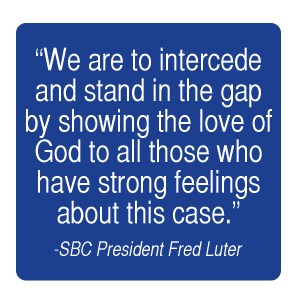
This is a perfect time for the church to be a “healing balm” for the country, Southern Baptist Convention President Fred Luter said. “Some people are upset, angry and frustrated, while others are in full support of the verdict, so where does the church fit in?” Luter asked in comments to Baptist Press.

“The church should be there to pray for both families, the city of Sanford, and our nation. We are to intercede and stand in the gap by showing the love of God to all those who have strong feelings about this case.”

Amidst the call to love and to pray, leaders also urged Christians to stand for what’s right. “This is our season as the body of Christ to heed the call of the minor prophet Micah to do justice, love mercy and walk humbly with God (Micah 6:8),” said Philadelphia pastor K. Marshall Williams, chairman of the African American Advisory Council of the SBC Executive Committee.

“The world needs to see God’s people of all races stand up not just on issues of morality but issues of race and social justice…”

Some leaders voiced questions about laws that enable discrimination against particular ethnic groups. San Diego pastor A.B. Vines noted while Zimmerman used Florida’s “stand your ground” law as a successful defense, Jacksonville mother Marissa Alexander was sentenced last year to 20 years in prison for firing a gun in the air – even though she injured no one – because of a state law that predetermines the sentence for firing a gun in public.

Alexander had secured a restraining order against a husband based on physical abuse. Comparing her case to Zimmerman’s, Vines said, “…Those are the issues I think Southern Baptists need to address … the disparity of the law and how certain laws affect certain ethnic groups differently than other ethnic groups.”

Russell Moore, president of the SBC Ethics and Religious Liberty Commission, also referenced a disparity in the justice various ethnic groups receive.

“This…ought to remind us of the blighted history of our country, when it comes to racial injustice. Despite all the progress we’ve made, we live in a culture where too often African American persons are suspected of a crime just for existing.”

Kevin Smith, an assistant professor at The Southern Baptist Theological Seminary in Louisville, Ky., referenced that hard truth in a tweet the day after the verdict: “Revisiting ‘the talk’ with my rising senior (UK honor student) about where he hangs out – unique duty to parents of black males.”

pull quote_MILLERCOMMENTARY | Dave Miller

Editor’s note: Dave Miller served as second vice president of the Southern Baptist Convention for a year following the annual meeting in New Orleans in 2012. He wrote about his year “at the table” for the June 17 Illinois Baptist. Read it online here.

A little over a year ago, I got a call from a blogging friend who asked me if I’d allow my name to be placed in nomination for second vice president of the Southern Baptist Convention. Stunned, I told him I would consider it. After a lot of prayer, I decided to go forward with the process.

No one, including me, really thought I would be elected, but it happened.

One of the reasons I agreed to be a candidate was to raise awareness about the whole Baptist world that exists outside of the mainline Southern states. Being a Baptist in Iowa, or the Dakotas, or Minnesota, or Wisconsin, or Illinois is different than being one in Alabama, Mississippi or Texas. I like serving as a Southern Baptist in a new work state and I wanted to raise a little awareness of the work we do.

I’ve learned a few lessons along the way. First, the SBC, while far from perfect, is led by some pretty competent and capable leaders. I got into blogging a few years ago as an outsider who was upset about a few things and wasn’t afraid to express that displeasure. But as time went on, I realized that while I still don’t agree with everything everyone does in our entities, we are well served by godly men.

Frank Page, president of the SBC Executive Committee, is exactly the leader we need at the helm during difficult days. If you don’t read Thom Rainer’s blog, you ought to. We have some remarkable men as seminary presidents, and leaders at the IMB and NAMB are working to extend the Gospel around the world.

Second, I’m excited about the movement toward greater racial diversity in our leadership. A prominent black leader at our Orlando convention a few years ago: “Dave, there has not been a single black man on that stage.”

I promised him I would join him in calling Baptists to a greater inclusion of ethnic leaders. It was my great privilege to serve this year alongside President Fred Luter. Beyond that, we have seen entity leadership positions show greater racial diversity. We haven’t arrived yet, but we have taken several steps in the right direction.

Lastly, the SBC is truly a grassroots organization. I’m a pastor of a small- to medium-sized church in Sioux City, Iowa. We are at the outer limits of the Baptist world! But, because of the democratic, grassroots nature of the SBC, I had an opportunity that I never thought I would have.

We are part of something wonderful as Southern Baptists. The challenges are great and work is never going to be easy. But we have a firm foundation in God’s Word, and an unequalled opportunity to share, through Cooperative Program missions, in perhaps the most aggressive world missions program in church history. And we have a powerful living God.

I am thankful to be part of Southern Baptists and consider this last year as a convention officer, representing Baptists in the Midwest, to be a great privilege.

Dave Miller is pastor of Southern Hills Baptist Church in Sioux City, Iowa, and editor of the blog SBC Voices.

pull quote_FLYNNCOMMENTARY | Meredith Flynn

Do you ever get the feeling everybody’s looking at you? It happened to me a week ago, when I spent the day at the Illinois Capitol waiting for an anticipated vote on the same-sex marriage bill.

Those of you who read the coverage on this blog know that vote never happened. The bill’s sponsoring representative, Greg Harris, announced that his fellow legislators needed time to go home and talk to their constituents before they could come back in the fall and vote “yes” for same-sex marriage.

That’s the official news, which you likely already knew. What you don’t know is that, in retrospect, I felt as if I almost caused an incident because of a fashion decision.

That morning I chose to wear a bright, multi-colored shirt with horizontal stripes. Almost like a rainbow. I chose it because it’s pretty, no other reason. During the course of the day, it became apparent that my apparel was making a statement I did not intend.

That day, advocates on both sides of the debate held rallies in the Capitol rotunda. The pro-traditional marriage group met first to pray together. An hour later, a larger group of same-sex marriage supporters met. And that’s where I realized my clothes might be talking for me.

I was snapping photos for the Illinois Baptist newspaper, like I’d done at the previous gathering, when a friendly lobbyist stopped to talk to me. I knew she was working for conservative groups that opposed the legislation, and I had noticed earlier how polite she was to some same-sex marriage advocates who had listened in on the prayer meeting. I complimented her on that, and she said something like, “Well I think we can disagree on some things and still agree on others…like you and I probably agree on lots of things.”

I thought, well sure we do, including this. But as she kept talking, I realized she assumed she and I were on different sides of the marriage debate. Then, I noticed someone taking a cell phone photo of me. I looked down at my shirt.

Oh.

Then, uh-oh.

In a matter of moments, my (overactive) imagination envisioned those photos posted on Facebook, then CNN, with people making all kinds of assumptions about me and my beliefs, based on my colorful shirt.

“I better call my husband,” I thought to myself. “And my mom.”

Later, calmer, I began to consider this: As a reporter, I’ve tried to tell the Illinois marriage story fairly, while still holding firmly our convictions that God designed marriage as a union between one man and one woman. But in the moments when I feared my own identity might be in question, I realized how very personal the marriage debate is for the people who are involved.

For a moment, I saw the issue from a different angle. I considered from a new perspective why so much of the debate has been rancorous, why the atmosphere in the House gallery last Friday grew more and more tense as the vote was delayed, and why some same-sex marriage advocates are so angry with Christians.

And after my own brief fears that I would be identified as standing opposite my readers and my employer, I came to see how important it is that we as Christians have a loving attitude – compelled by how deeply we ourselves are loved by a holy God – toward those with whom we disagree.

This marriage business is a serious business; it’s emotional, and where we stand on it is closely tied to our identity. As people, as fellow citizens, as believers in Christ. Let’s walk in truth and in love – a precarious balance sometimes – so that others might look past the stripes on shirts, and see the One we’re called to reflect.

That said, I still think my shirt is pretty.

Serena_McDonaldsCOMMENTARY | Serena Butler

When our small mission team arrived in New Orleans, we planned to roof houses for a week. We had packed hammers, squares and other tools, but when we arrived, we were asked to hang insulation instead.

The experience took me back to a time several years earlier, when I started my first dream job – working at McDonald’s. I was 16. With great excitement, I put on my new uniform and my mom drove me to my first shift. Little did I know that much of what I would learn over the next 7½ years would be utilized as I served on mission teams.

Like flexibility. Some days I would be at the grill all day. Others, I worked the counter for a few hours and then switched to fries. Still other days I would learn a new skill. One night, ten minutes before closing time, four buses pulled into the parking lot. Even when you’re tired from a long day, put a smile on your face and serve with graciousness.

That particular lesson has certainly come in handy on mission trips. In New Orleans, we quickly shifted gears and accepted our new assignment graciously. We gathered utility knives, staplers, work gloves and masks and started to work. And we gave individual assignments to each team member so we could operate more efficiently. Some cut the lengths of insulation while others stuffed it in the walls and ceiling before stapling it into place. Others made sure the area was clean of debris. When someone needed a break from their assignment, we rotated.

Being flexible often means relying on your team, because you realize pretty quickly you can’t do everything on your own. My first assignment at McDonald’s was toasting and dressing Big Mac buns. It was fairly simple, but had to be done in exactly 2 minutes and 30 seconds. On command from the manager, place the buns in the toaster. When the buzzer sounded, remove the buns and put on the right amount of sauce, onions, lettuce, cheese, and pickles. When I fell behind, the whole grill team (and our customers) suffered.

Similarly, as we installed insulation that week in New Orleans, we knew we had to finish our task, because a drywall team was coming in behind us.

Each time I go anywhere on mission, I try to remember these hard-earned lessons from my time at the Golden Arches. When I clock in, I want to be ready to do whatever task I am asked to do that day, and play my part on the team.

As the smoke clears

Meredith Flynn —  March 14, 2013

TravelCOMMENTARY | Meredith Flynn

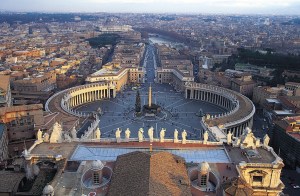
One member of our reporting team describes working for a newspaper when Pope John Paul II was gravely ill in 2004. “My editor called it ‘Pope Watch.’ We knew the world’s eyes were trained on the Vatican, and pope news would exceed in importance anything else we’d put in the paper.”

For the past few weeks, Catholics and non-Catholics alike were back on Pope Watch. From Pope Benedict’s surprise retirement announcement, to yesterday’s announcement that Argentinian Cardinal Jorge Bergoglio would assume the post, media outlets have provided extensive coverage of the search for a new leader. Software manufacturers even jumped on cultural wave, creating smart phone apps to help people more closely follow the conclave’s progress.

As the world watched for a puff of white smoke from the Vatican chimney, Southern Baptists also had occasion to consider more closely relationship to the Roman Catholic church. We are deeply divided on key doctrines, but have compatible positions on marriage and family issues and the sanctity of human life. And we share the struggle of protecting the children in our care. The Catholic church’s very public failures have forced us to ask: Are our churches doing enough to secure children’s safety?

We face many of the same challenges. A new study by Barna Research shows that is especially true when it comes to young people in the church.

Barna surveyed young Catholics (age 18-29) with a variety of faith journeys – some still attend a Catholic church, while others admit to dropping out. In fact, 56% of those surveyed say they stopped going to church at some point after attending regularly. Previous Barna research found the dropout rate among Protestants is 61%. A majority, 65%, of young Catholics also admit to being less active in church than they were at age 15, compared to 58% of Protestants.

The numbers point to a common story that seems to transcend denomination or religion: Many young people are leaving the church. Barna’s research also gives clues as to why. Of young Catholics surveyed, 60% say the church’s teachings on sexuality and birth control are out of date, and 57% say mass feels like a “boring obligation.”

Protestant church leaders – including Southern Baptists – also can attest to the tension between youth and experience, between progress and tradition. There’s anecdotal evidence aplenty that suggests denominational leadership isn’t skewing younger as a rule.

Most people of faith want to leave a legacy of belief in God – they want to pass on what is most important to them. As we seek to do so, it’s increasingly apparent that it will take more than smoke and mirrors to show younger generations the truths in the Bible, and to convince them of the value of cooperation. It will require the utmost authenticity, and we’ll have to give young people space to wrestle with issues that come naturally to older believers. It’s essential, and it’s what they’re watching for.