Archives For November 30, 1999

THE BRIEFING | InterVarsity Christian Fellowship will lose its current access to all 23 schools in the California State University system because the ministry requires their leaders to affirm Christian doctrines, reports Christianity Today. IVCF’s policy is in violation of a university rule, adopted in 2012, that requires recognized groups to accept all students as potential leaders.

The_Briefing“While we applaud inclusivity, we believe that faith-based communities like ours can only be led by people who clearly affirm historic Christian doctrine,” reads a statement on IVCF’s website.
The ministry received a one-year exemption from the policy for the 2013-14 school year, but will now lose privileges including free meeting space and access to campus activity fairs.

On his blog, LifeWay’s Ed Stetzer examines the ramifications: “The bigger, and ongoing, issue is the continual sanitization of unacceptable religious voices from universities.”

State marriage cases likely to land in high court
Recent rulings on marriage by federal judges and circuit courts have advocates on both sides of the debate looking toward the U.S. Supreme Court to decide the issue. On Sept. 4, 32 states—15 that allow same-sex marriage and 17 that don’t—asked the high court to settle it once and for all, reported the Associated Press.

Same-sex marriages in Illinois officially began June 1, although some counties issued licenses earlier. The state’s General Assembly approved “The Religious Freedom and Marriage Fairness Act” last fall.

‘Elevate Marriage’ scheduled for Oct. 16
The Illinois Baptist State Association will host an “Issues & Answers” event in Springfield, Ill., to help churches address cultural shifts on marriage. The Oct. 16 conference for pastors and church leaders will feature Kevin Smith, The Southern Baptist Theological Seminary; Andrew Walker, Ethics and Religious Liberty Commission; and Jill Finley, Bethel Baptist Church, Troy, Ill. Lunch is included, and registration is required; go to www.IBSA.org/Marriage.

Chick-Fil-A founder Truett Cathy dies at age 93
Christian leaders and fans of Chick-Fil-A mourned the loss of S. Truett Cathy, who died early Monday morning. Cathy built the chain—known for its chicken sandwiches—from one store in 1946 to more than 1,800 restaurants currently operating in 40 states and Washington, D.C. He was known for his Christian faith and Chick-Fil-A’s “closed on Sundays” policy. Read more at BPNews.net.

Osteen answers criticism
Megachurch co-pastor Victoria Osteen said that church-goers at Lakewood Church in Houston, Texas, understood her recent controversial comments about why people ought to obey God. “When you come to church, when you worship Him, you’re not doing it for God really,” Osteen said during a Lakewood service Aug. 31. “You’re doing it for yourself, because that’s what makes God happy.” The video went viral, garnering much criticism on social media. Osteen told The Blaze she could have been more articulate, but she stands by her point. “I did not mean to imply that we don’t worship God; that’s ridiculous, and only the critics and cynics are interpreting my remarks that way.”

Al Mohler, president of The Southern Baptist Theological Seminary, blogged that the message preached by Osteen and her husband, Joel, “is the latest and slickest version of Prosperity Theology.” Read Mohler’s commentary here.

COMMENTARY | Chip Faulkner

As a missionary with the Southern Baptist International Mission Board, I served among people groups in which genuine Christ-followers made up a very low percentage of the population, and where governments were not supportive of evangelical churches or the public proclamation of the gospel. The level of persecution, while not extremely severe, was certainly more intense than what the majority of evangelical churches in America are facing.

Still, it doesn’t take much of a spiritual barometer to sense the cultural storm building here towards those who preach and apply Scriptural standards.

Callout_Aug14_edited-1At a recent meeting of pastors and Christian leaders in our area, we discussed how many politicians and governing bodies in our nation and state are taking a strong stance against Christian values—such as biblical marriage. The pastors and ministry leaders did not express fear or panic at the awareness of growing persecution, but there was concern that we must be better prepared to respond correctly to mounting attack.  

After that meeting, I came back to the office and began making notes that turned into a Bible study on persecution. Authentic followers of Christ Jesus that “desire to live a godly life” will be persecuted for their faith (2 Tim. 3:12). Since the New Testament was written to believers and local churches in a sensual society similar to that of modern America, we can appreciate the relevance of the Word in an era of mounting persecution.

First, we should be prepared. Jesus forewarned of persecution by saying that his disciples would be “delivered up” by their relatives and close friends (Luke 21:12-16). So, let us “not be surprised” at the fiery trials that come our way, and we should “rejoice and be glad” to suffer for the name of Christ (1 Peter 4:12-16).  

As Christian facing inevitable persecution, we also should be prayerful. Our human nature is to desire revenge and retaliation, but Jesus commands that we “pray for those who persecute you” (Matt. 5:44-45). Remember that the weapons at our disposal are “not of the world” (2 Cor. 10:4). Trials develop spiritual maturity in intercession. Suffering for the faith increases our empathy and specifies our prayer.

It is important that we be proactive. Since persecution is new to most American believers, we need to sharpen our skills in strategically and fearlessly going on the offense with the gospel. Churches are feeling threatened by the rapidly changing culture. There will be a temptation for churches to react with a “fort” mentality and seek safety behind closed doors.

However, similar to the Christians in pagan Rome, we must take the initiative in “blessing those who persecute you” (Rom. 12:14). Just like the Father sent the Son into the world, we are sent into the world as salt and light (John 17:18; Matt. 5:13-16).

As children of God, we are to be pure. Granted, wickedness is getting darker in our society, but if we are “blameless and innocent” we have the opportunity to “shine as lights” (Phil. 2:14-15). The distinctions of our Christian worldview, values and morals certainly draw attack, yet this persecution will result in a purer church. God does his best work through clean vessels.

In seasons of persecution, it is vital that genuine believers and true churches draw closer together and be in partnership (Phil 1:6). Persecution will sadly reveal that the majority of members on church rolls are phony professors. Likewise, persecution will expose the startling number of false prophets currently serving as church leaders. When it costs everything to follow Christ, many will deny the gospel and join the ranks in assailing the saints. As church attendance wanes and income falls, it will be imperative to pool our resources and draw encouragement from one another (Phil. 1:3-6).

May we Christians also be positive. The apocalyptic literature in the Bible is there to encourage us. Read it and rejoice because God wins in the end! Jesus actually said we are considered “blessed” to be persecuted and that you will receive the “kingdom of heaven” (Matt. 5:10-11). Even if we “suffer for righteousness’ sake” we should not be fearful or troubled as we positively defend our hope with “gentleness and respect” (1 Peter 3:14-15).

Finally, we should persevere in the surpassing power of our Savior. If we remain “steadfast under trial” and “faithful unto death” we will receive the “crown of life” (James 1:12; Rev. 2:10). Echoing the testimony of Paul: “When persecuted, we endure; when slandered, we entreat” (1 Cor. 4:11-13).

The first waves of persecution are only beginning to wash across our country. Even though the price of proclaiming truth will prove enormous, may we go with our Savior “outside the camp and bear the reproach he endured” (Heb. 13:12-15).

Chip Faulkner pastors First Baptist Church, Bethalto.

The_BriefingTHE BRIEFING | Russell Moore, president of the Southern Baptist Ethics and Religious Commission, urged Christians to “pray fervently” for believers facing persecution for their faith.

“As Christians, we should pray for the president and our military leaders to wisely administer the sword of justice (Romans 13:1-3),” Moore said in a written statement. “As part of the global body of Christ, we must also pray fervently for our persecuted brothers and sisters in Iraq and across the Middle East (Hebrews 13:3).”

His comments came after President Barack Obama authorized U.S. airstrikes and humanitarian aid to help Iraqi religious minorities under attack from militant groups in the country.

Obama “is right to take action to protect religious minorities, including Christians, in Iraq from ISIS,” Moore said. “He has my prayers.”

Read the full story at BPNews.net, or click here for an overview of the recent onslaught of persecution around the world.

Other news:

Amid controversy surrounding Driscoll, LifeWay stops selling Seattle pastor’s books
A day after the Acts 29 church planting network removed Pastor Mark Driscoll and his churches from their membership, LifeWay Christian Resources stopped selling Driscoll’s books online and in stores. “LifeWay Stores and Lifeway.com are not selling Mark Driscoll’s books while we assess the situation regarding his ministry,” communications director Marty King told Christianity Today.

The Acts 29 and LifeWay decisions came after a string of controversies and charges surrounding Driscoll, founding pastor of Mars Hill Church in Seattle.

Gungor stands by beliefs about Adam & Eve, biblical flood
Christian musician Michael Gungor’s admission that he no longer believes in a literal Adam and Eve or flood sparked controversy when the comments were published in a WORLD magazine online report this month. Ken Ham, founder of Answers in Genesis and the Creation Museum, called for Gungor to apologize for the statements, while the musician responded to the controversy on his blog.

Marriage rates in decline among Millennials
Millennials are less likely to marry by 40 than any other previous generation, according to data from the American Community Survey analyzed by the Urban Institute. For example, in 1990, 91% of women age 40 had married; currently, only 69.3% of women age 40 have married. The rate for men is approximately 4% lower, Baptist Press reported.

Coming to a theater near you: “Christian Mingle The Movie”
Girl creates fake faith profile on Christian dating site, meets potential Mr. Right. Girl admits phony faith and loses Mr. Right, but gains a relationship with God. “Christian Mingle The Movie” is due in theaters in October. Read more at ChristianPost.com.

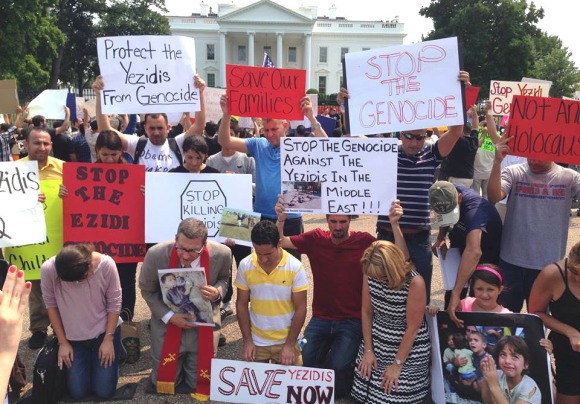
Rob Schenck (front, red scarf), president of Faith in Action and the National Clergy Council, prays Aug. 7 for the Yazidis and Christians suffering in Iraq. IMB photo

Rob Schenck (front, red scarf), president of Faith in Action and the National Clergy Council, prays Aug. 7 for the Yazidis and Christians suffering in Iraq. IMB photo

Christians around the world face heightened persecution

NEWS | From Baptist Press and IMB reports

An unfamiliar symbol began showing up on social media pages late last month. The curved line under a single dot is the Arabic letter “Nun,” reportedly used by militants in Iraq to mark the homes of Christians in the country.

“Nun” stands for Nazarene, or Jesus.

Extremists with the Islamic State of Iraq and Syria (ISIS) have forced Christians from their homes under threat of death. The Iraqi believers and other religious minorities joined millions of Syrian refugees already displaced by civil war. In a region rich with Christian history, many have noted, very little evidence of Christianity is left.

The onslaught of persecution this summer has awakened many in the Western church to the needs of Christians around the world. Many pastors and Christian organizations in July changed their Twitter avatars and Facebook profile photos to include the letter “Nun.” They also used the hashtag #WeAreN as a show of solidarity with the persecuted believers.

“The Islamic militants mean it for evil when they mark homes with ‘N’ for ‘Nazarene,’” wrote Russell Moore, president of the Ethics and Religious Liberty Commission. “They assume it’s an insult, an emblem of shame. Others once thought that of the cross.

“But in that intended slight, we are reminded of who we are, and why we belong to one another, across the barriers of space and time and language and nationality. We are Christians. We are citizens of the New Jerusalem. We are Nazarenes all.”

Iraqi refugee crisis

“There are no Christians left in Mosul.”

That’s how religious freedom advocate Nina Shea described conditions in Iraq’s second largest city in July.

Shea, director of the Hudson Institute’s Center for Religious Freedom, told CBN News that Islamic militants have eradicated virtually every trace of Christianity from Mosul, the center of Iraq’s Christian community for 2,000 years. Mosul is located on the site of the ancient city of Nineveh.

In June, militants with the Islamic State in Iraq and Syria (ISIS) extended an offer to let Christians in Mosul practice their Christian faith behind closed doors, after they paid a hefty tax and agreed not to proselytize. However, multiple sources in the region said that offer was later withdrawn and all Christians were told to leave or face execution.

Members of Assyrian Christian and Chaldean Catholic groups left empty handed, Shea said. Militants confiscated all of their possessions, including homes, cars, clothes “and even their wedding rings, sometimes with the finger attached if it would not come off.”

Christians aren’t the only religious minority targeted by ISIS. On August 3, militants seized the city of Sinjar, forcing the Yazidi Kurdish population to flee. Many escaped to the nearby Sinjar Mountains, a barren heap of rock where daytime temperatures can top 120 degrees.

More than 150 Yazidi immigrants rallied in front of the north lawn of the White House August 7 to plead for American involvement in the growing crisis. (President Obama announced that evening he had authorized military airstrikes on Iraq.) The protestors came from across the U.S. to rally on behalf of the Yazidis, who do not practice Islam but instead follow an ancient religion ISIS equates to “devil worship.”

Christians and religious minorities in other nations also have faced recent persecution due to war and religious hostilities:

Syria | The recently released International Religious Freedom Report included a daunting sentence about the country that shares Iraq’s northwestern border: “In Syria, as in much of the Middle East, the Christian presence is becoming a shadow of its former self.”

A three-year-old civil war has resulted in millions of refugees and increasingly persecuted religious minorities, including Christians caught between the regime currently in power and militants fighting against it. The report, released annually by the U.S. State Department as a picture of the state of international religious freedom the previous year, found that in the city of Homs, only 1,000 Christians remain. There were approximately 160,000 Christians there before the war.

Nigeria | Approximately 1,505 Nigerian Christians have been killed for their faith this year, as the Boko Haram terrorist group and other extremists continue their campaign of religion-based violence in the West African nation. Boko Haram and other groups have killed nearly as many Nigerian Christians in the first seven months of this year as were killed in all of 2013, the advocacy group Jubilee Campaign reported July 29.

Christians killed to date include seven fathers of the 223 Chibok school girls still missing after Boko Haram kidnapped more than 300 students in mid-April. (The group is dedicated to fighting the influence of Western education.) The fathers were killed July 20 when Boko Haram attacked the city of Damboa and hoisted a Boko Haram flag there, the Associated Press reported.

Response from the West

David Curry is president and CEO of Open Doors USA, which offers assistance to persecuted Christians around the world and lobbies repressive governments to cease religious persecution. In July, he called the plight of Christians in Mosul and the remainder of northern Iraq “unprecedented in modern times.”

“This latest forced exodus of Christians further shows why Western governments and the people in the West need to cry out in support for religious freedom in the Middle East and elsewhere,” Curry said in a statement. “If this does not move us concerning the near extinction of Christianity in the Middle East, it’s likely nothing else can.”

Since the United States invaded Iraq in 2003 to overthrow Saddam Hussein, nearly one million Christians have fled the country for safer surroundings.

In an editorial this month for The Christian Post, Curry expressed doubt that the persecution of Christians would ever be treated as “a major humanitarian crisis” by governments and secular media. “However, we should be able to count on our own family,” he wrote.

“The persecution of Jesus followers should be preached from every pulpit and prayed for at every kitchen table. One day soon it may be your faith that is under attack and you will be hoping that others will be praying for you…or even notice that it is happening.”

The International Mission Board and its ministry partner Baptist Global Response are coordinating relief efforts among Iraqi refugees. For more information about how to help, go to www.IMB.org.

COMMENTARY | Jonathan Davis

Jesus_forpage1

WHAT A SAVIOR – “But he was wounded for our transgressions, he was bruised for our iniquities: the chastisement of our peace was upon him; and with his stripes we are healed” (Isaiah 53:5). Sculpture by Libby Morecraft of Harrisburg

Our culture loves blood. The latest vampire novel, graphic movies, every CSI crime drama, the nightly news – they’re all pictures painted in blood. Even the walking dead are promoting a bloody afterlife every Sunday night on cable. But our culture’s bloodthirst is biting into the wrong vein.

As God’s people, we also are to be marked as lovers of blood. Not because of an obsession with gore, but because of the Savior who shed his life’s blood
on our behalf.

Yet, for some reason, we often shy away from the bloody language of the cross. Our culture, so fascinated with blood stories, turns away from the most
important blood lines of all. Talk of the cross is offensive to many, and to bring up the blood as central to faith will bring many conversations to a halt. And
rather than offend, some Christians will stick to the more polite apologetic: Jesus loves you, and has a great plan for your life.

But that’s a bloodless Christianity. And a bloodless Christianity is no Christianity at all.

Flesh and blood isn’t just Easter language; it is Gospel language to be used at all times and in all places. We are to embrace the bloodiness of Scripture, for to do opposite is quite dangerous.

Our bloody theology

The Bible presents us with a robust theology of blood. Because Christ was crucified, we reap a multitude of benefits for His glory and our good.

• We once were people without hope, but have been brought near to God by the blood of Christ (Ephesians 2:12-13).

• In Christ Jesus, whom God put forward as a propitiation by his blood, we have redemption, the forgiveness of our sins (Romans 3:24-25; Ephesians 1:7).

• We have been justified by Christ’s blood (Romans 5:9).

• We have peace with God by the blood of the cross (Colossians 1:20).

From Adam and Eve’s first sacrifice outside the garden to our High Priest’s completed work, and everywhere in between, the history of God’s people is marked by blood. For several thousand years, it’s the blood of animals, offered as a covering for sins. And finally, it’s the once-and-for-all sacrifice that
washes whiter than snow.

When it comes to salvation, nothing but blood will do.

Maybe the most startling example of flesh and blood language in the Bible is found in John 6. Jesus tells his followers they must eat his flesh and drink his
blood. On the surface, it’s a revolting concept. “Is he advocating cannibalism?” they must be thinking.

Then, at his last meal with the disciples, Jesus enacts the teaching, tying together eternal life with eating his flesh and drinking his blood. Jesus notes that
we are abiding in him when we do so. To commune with Christ is to embrace this bloody language.

Now, it’s not too hard for us to talk about the crucifixion and the blood this time of year, especially in our churches. At Easter, the person and work of Jesus
come to the forefront of our minds, and rightly so. This is the time of year we celebrate Christ’s crucifixion, and it makes sense that flesh and blood speech
is on our lips.

But what concerns me is our post-Easter language, and how we share the Gospel with people who don’t know Christ. Too often, we avoid talking about Christ’s suffering, and in doing so, we drain our faith of its very power.

Power in the blood

The next time you’re on break at the water cooler, try dropping this line from Jesus into the conversation: “Hey, did you know that Jesus said, ‘Unless you
eat the flesh of the Son of Man and drink his blood, you have no life in you.’”

I can hear the crickets chirping.

The Corinthians felt the shame of flesh and blood preaching, and this led them away from boasting in the cross to boasting in worldly wisdom. Preaching
a crucified king sounded so un-wise that they forsook the very message they had heard and believed.

But Paul argues that crucifixion language is the very language the Holy Spirit empowers. He had come to the Corinthian believers in weakness and fear. His speech and message were not in plausible words of wisdom, but in demonstration of the Spirit and of power (1 Corinthians 2:3-4).

We must recover that kind of speech in our churches and as we go out into the world. Sin is serious, so serious that it warrants death. This is why there is
great danger in bloodless Christianity. To remove the bloody language of the cross is to remove man’s only hope of being made right with God.

The Gospel of the cross is the good news that God is holy, you are not, and the necessary sacrifice to make you right with God is found in Jesus Christ and Him crucified.

As believers we have tasted and seen the goodness of salvation applied to our hearts, and our desire is to see the lost know this same salvation. Is talking
about the cross offensive? Yes. Is it difficult to speak? Yes.

But let’s not run from it. Rather, let us press into it, speaking Christ and Him crucified plainly and with conviction, trusting the Holy Spirit to draw the lost to the Father through the Son.

When we do, people will begin to understand there’s power in the blood.

Jonathan Davis pastors Delta Church in Springfield.

pull quote_BRIDGES_augCOMMENTARY | Erich Bridges, from Baptist Press

The backlash against striving to be a “radical” follower of Jesus started earlier this year.

Giving your all for Christ – including your life – goes back to the earliest Christian disciples and has been one of the marks of true faith throughout church history.

“Radical” living, however, has a more specific meaning in this controversy, stoked by several articles in Christian publications. It refers to the commitment young evangelical leaders, particularly Southern Baptist pastor/author David Platt, have urged American Christians to make.

In a popular series of books and teachings beginning with “Radical: Taking Back Your Faith from the American Dream” (2010), Platt has challenged American believers to forsake the comfortable, materialistic, watered-down Christianity many of us practice. In its place, he calls for the kind of sacrifice and obedience that might lead some to give up possessions, go to risky places to proclaim the Gospel, maybe even suffer and die for Christ.

He’s been joined by evangelical voices such as Francis Chan (“Crazy Love”), Kyle Idleman (“Not a Fan”) and others calling for a faith that looks more like the one found in the New Testament than the one commonly seen in suburban American churches.  

Hold on, respond the critics. You’re setting up an elite category of super-sanctified commando Christians, leaving the rest of us feeling like inadequate, second-class believers. What about everyday folks who quietly go about their lives and provide for their families, while faithfully worshipping God and serving others? Are they failing the test of basic discipleship if they don’t leave their homes and families and do something “radical” for Christ?  

“The heroes of the radical movement are martyrs and missionaries whose stories truly inspire, along with families who make sacrifices to adopt children. Yet the radicals’ repeated portrait of faith underemphasizes the less spectacular, frequently boring, and overwhelmingly anonymous elements that make up much of the Christian life,” wrote Matthew Lee Anderson (founder of the influential Christian blog “Mere Orthodoxy”) in a March cover story for Christianity Today magazine.

“[T]here aren’t many narratives of men who rise at 4 a.m. six days a week to toil away in a factory to support their families. Or of single mothers who work 10 hours a day to care for their children. Judging by the tenor of their stories, being ‘radical’ is mainly for those who already have the upper-middle-class status to sacrifice,” Anderson wrote.

Anthony Bradley went a step further in a commentary for the Acton Institute, reprinted in WORLD Magazine in May. He called the push to be “radical” – and the “missional” church movement generally – manifestations of a “new legalism” among evangelicals.

Bradley, a well-known commentator and professor at The King’s College in New York, said he reached that conclusion after a long conversation with a Christian student struggling over what to do with his life.

“I continue to be amazed by the number of youth and young adults who are stressed and burnt out from the regular shaming and feelings of inadequacy if they happen to not be doing something unique and special,” Bradley wrote.

“Today’s millennial generation is being fed the message that if they don’t do something extraordinary in this life they are wasting their gifts and potential. The sad result is that many young adults feel ashamed if they ‘settle’ into ordinary jobs, get married early and start families, live in small towns, or as 1 Thessalonians 4:11 says, ‘aspire to live quietly, and to mind [their] affairs, and to work with [their] hands.’

“… The combination of anti-suburbanism with new categories like ‘missional’ and ‘radical’ has positioned a generation of youth and young adults to experience an intense amount of shame for simply being ordinary Christians who desire to love God and love their neighbors (Matthew 22:36-40)…,” Bradley wrote. “Why is Christ’s command to love God and neighbor not enough for these leaders?”

This supposed “shaming” of young Christians sure is news to me.

I seldom pass up a chance to challenge young people to get involved in local and international missions – and I’m regularly inspired by their responses.

Ask counselors who work with young missionary candidates and campus ministers who mentor students, and they’ll tell you the same thing: Millennial Christians want to make a difference in the world. They want to serve the poor and fight injustice. They want to act on Christ’s command to take the Gospel to the nations. Sometimes they get impatient with parents and other elders who try to hold them back. And they’re willing, even eager, to go to some of the toughest places on earth.

True, not everyone is equipped by God to go to such places. Those who do go need to demonstrate a clear calling from God; otherwise they’ll never make it when the going gets hard. But everyone can participate in the task through awareness, prayer, support and local church mobilization.

The old division between “regular” church folks and the special few who go to the mission field has been bridged by the vast new opportunities for participation afforded by modern travel, technology and networking – and the rediscovery of the biblical truth that reaching all peoples is the mission of the whole church and everyone in it.

The only non-negotiable requirement is obedience.

One of the young people profiled in Platt’s “Radical” is Genessa Wells. The Texas Baptist teacher lived and served in Egypt for two years – and died there at age 24. She wasn’t a martyr; she was killed in a bus accident in the Sinai just one day before the terror attacks of Sept. 11, 2001. I never met her, but I had the privilege of attending a memorial service for her a few days later in Cairo.

Wells, who had an angelic singing voice, had planned to pursue her study of music in seminary after she came home from Egypt. She never made it back, but she packed enough passion for several lifetimes into her brief life.

Shortly before she moved to the Middle East in 1999, she wrote: “I could give up (on overseas service) and get married and become a music teacher. All of this is very noble and to be quite honest, sounds good to me! But in my heart, I want to change my world – more than I want a husband and more than I want comfort. I need this opportunity to grow and to tell others about Jesus. One of my favorite praise songs says, ‘I will never be the same again, I can never return, I’ve closed the door.'”

Two years later, in her last email home, she quoted another praise song: “‘Open the eyes of my heart, Lord, open the eyes of my heart, I want to see you … shining in the light of your glory….’ It seems that everything we do comes down to one thing: His glory. I pray that all our lives reflect that…. It seems like a floodgate has been opened in my heart . I have a passion for it I never knew God had given me. He’s given it to me for His glory.”

She shared her passion for God with Egyptians, with Palestinians in refugee camps, with Bedouin in the desert. If she had lived, she might have gone home to Texas, gotten married, started a family, become a music teacher. Or she might have opted to serve long-term overseas. Either way, she had one grand purpose in life: to love God and praise Him wherever she went and in whatever she did.

Erich Bridges is an International Mission Board global correspondent. Visit Worldview Conversation, the blog related to this column.