COMMENTARY | Nick Rynerson

“Pop culture” is often treated like a dirty word in the church—thought to consist of mostly irredeemable entertainment produced to make money off the masses. A common approach is to avoid secular music, films, art, and television, or at least to not admit to consuming it all that much.

But that isn’t often what our real lives look like. Most of us are at least closet pop culture consumers—we indulge in one or two sitcoms, a favorite secular radio station, or a superhero movie every now and then.

And maybe that’s okay.

Nick_Rynerson_March15Popular culture is not the enemy; first and foremost, pop culture is a place for storytellers to, well, tell stories. Moral discretion is important. (And biblical! See 1 Corinthians 8:7-9.) But we miss a wealth of spiritual and theological depth if we chalk up all entertainment created by non-Christians as irredeemable and misguided; we also miss out on the opportunity to identify and empathize from a distinctly Christian perspective (Acts 17:28).

Stories offer us insights into our culture’s longings, revealing God’s truth in the world around us. In his excellent book “The Stories We Tell,” Kentucky pastor Mike Cosper reminds us that a story is never just a story—it’s a window into our culture’s imagination and longings (see Romans 2:12-15).

“Storytelling—be it literature, theater, opera, film, or reality TV—doesn’t aim at our rational mind . . . It aims at the imagination, a much more mysterious and sneaky part of us, ruled by love, desire, and hope,” Cosper writes. “When people, against their better judgment, find themselves hooked on a show, we can trace the line back to find the hook in their imagination.”

Stories, according to Cosper, can reveal much more about a person, people group, or culture than a strictly informative presentation or a list of facts. Stories communicate what people truly desire.

Take, for example, a certain Best Picture nominee from last year. The movie contains some strong language, an ambiguous ending, and other elements that might lead some Christians to believe that it has nothing to offer spiritually (and for some to wisely not engage the film). However, if we look closer, we can clearly see some distinct things the storytellers—the director, writer, characters, etc.—believe about God, life, and themselves.

Without spoiling the film, which centers on the relationship between a talented young jazz drummer and his demanding/abusive instructor, the characters have a very human desire: to be great. The devotion of the characters to the pursuit of greatness, and its sway over their future happiness, is deeply identifiable. Like the Tower of Babel in Genesis 11, the characters sacrifice their life for the pursuit of self-glory, predictably leaving themselves and others miserable.

Ever since the Fall, man has been trying to claw his way back to perfection. Everybody longs for his or her flaws to be taken away, and many of us think that if we just work hard enough, we will reach the promised land of perfection.

As Christians, we know this is vanity (Romans 3:23), but the characters in the film sacrifice their lives and their sanity to meet every iota of their own personal law. This pursuit is hardwired into us and until we find personal and entire perfection in Christ, we will always fall short.

That’s serious, biblical truth, communicated (probably unknowingly) in a 2-hour movie produced with a secular audience in mind. The next time a movie, song, or TV show comes on that you are tempted to write off as irredeemable, consider if it might have something to teach us about God, the creator of all things.

In Acts 17:22-27, Paul not only quotes Greek poetry, but also alludes to the radical truth that we’re put where we were (i.e., in our cultural context) to speak eternal truth into subjective cultural contexts. In his book, Cosper uses this example to illustrate a distinctly Christian way of story-listening.

“As Christians living in the midst of these stories, we have an opportunity to both learn and bear witness. Stories teach us a lot about ourselves and our neighbors, and they provide windows into how our world is wrestling with the effects of the fall.

“They also present opportunities to respond with the truth.”

Nick Rynerson is a staff writer for Christ and Pop Culture and works for Crossway in Wheaton.

THE BRIEFING | Meredith Flynn

After two police officers were shot March 12 in Ferguson, Mo., chaplains from the Billy Graham Rapid Response Team were back in the community where they served six weeks last year.

“It is not possible to solve a community’s deep-rooted problems with a team of chaplains deployed for six weeks, and we knew that before we started,” Billy Graham Association President Franklin Graham said then, according to a story on billygraham.org. “But God used the chaplains to touch many hearts and to plant fruitful seeds in the community.”


The_BriefingLawmakers in Tennessee proposed legislation in February that would make the Bible the official state book. Not surprisingly, some opponents say such an action is unconstitutional. But Rep. Jerry Sexton (R-Bean Station), who introduced the bill in the House, said the action recognizes the Bible’s “historical importance.”

“The Bible has certainly had a pivotal role in the history of our state as well as our nation,” Sexton told the Baptist & Reflector newspaper. “The Bible also plays a significantly important role in our state today with several companies in Nashville being responsible for publishing more Bibles than possibly any other city in the world.”


68% of evangelicals say Congress should act on immigration reform this year, according to a new survey by LifeWay Research. Other findings: 86% say reform should secure U.S. borders, and 61% say it should include a path to citizenship for undocumented immigrants.


The Christian Post reports San Francisco’s largest evangelical megachurch will no longer require celibacy from gay people desiring to be members of the church. “We will no longer discriminate based on sexual orientation and demand lifelong celibacy as a precondition for joining,” Senior Pastor Fred Harrell wrote in a letter on behalf of the church’s elder board. “For all members, regardless of sexual orientation, we will continue to expect chastity in singleness until marriage.”


In honor of today, check out this 2009 post from Russell Moore on “what evangelicals can learn from St. Patrick.”


Postmodern Martyrs

eric4ibsa —  March 16, 2015
Artwork by Kerry Jackson

Artwork by Kerry Jackson

The call to live–and die–for Christ in the age of terrorism. Are we ready?

By Eric Reed

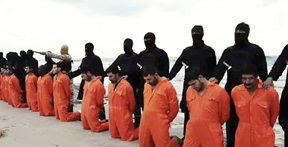
THE WORLD | The scene is chilling, even a month after it happened: 21 men in orange jumpsuits are led along a beach in Libya by masked men holding knives over their heads, then to their throats. The men in orange are captives, Egyptians working in Libya; more important, they are Christians, Coptic Christians, with up to 20 million adherents, whose branch of the faith dates to the third century AD.

The masked men in black are ISIS rebels, part of the radical faction of Islamic extremists marching across Iran, Iraq and Syria, and taking control of towns and regions ceded by Al-Qaida in the battle with American and indigenous forces over the past decade.

The men in orange are forced to kneel, ordered to recant their faith in Jesus Christ, and when they refuse, they are pushed face down into the sand and the knife blades are placed against their throats.

Mercifully, the video ends there for American television viewers, but for the men in orange there is no mercy.

They are beheaded.
Coptic_ChristiansAnd we, believers watching in disbelief, are little comforted by the great distance between us and the bloodstained beach as we come to the twin realizations that ISIS is on the move with a brutality that the world has not seen in a long time, and we have entered a new era of martyrdom.

A growing threat here?
Sixteen past presidents of the Southern Baptist Convention joined current president Ronnie Floyd in sending an open letter to President Obama, urging the U.S. to “take the necessary actions now” against the ISIS terrorists. They called ISIS “a continuing threat to world peace in a way unknown to us since the Nazis of World War II…”

The March 1 letter came two weeks after the beheading of the Egyptian Christians, and a week after the report that ISIS captured more than 200 Assyrian Christians, including women, children and elderly people. “People are frightened, people are concerned,” concurred Frank Page, SBC Executive Committee President, who said he is often asked about the threat of ISIS. Page’s signature was one of the 17 on the letter.

The concern Page cites is not only about the abominable acts by Islamic extremists abroad—killing a young, female American aid worker, burning a Jordanian pilot alive—it’s about the growing threat on our own shores as young adults, Americans included, are wooed, recruited, and radicalized via the Internet to join ISIS forces in the Middle East. And if not there, to carry out terrorist acts here.

A Somali militant group, al-Shabab, released a video in late February calling for Muslims to attack malls in Britain, Canada, and the Mall of America in Bloomington, Minn. “Hasten to heaven,” the video advised, by disrupting the safety of “disbelievers” (meaning non-Muslims) “in their own land.”

U.S. Homeland Security Secretary Jeh Johnson said such groups are “relying more and more on independent actors to become inspired” and “attack on their own.” The threats should be taken seriously.

If this seems like an exaggeration of the growing threat, one only needs to consider the Boston Marathon bombing in April 2013. On trial now is Dzhokhar Tsarnaev, charged with the attack that killed three people and injured 260.

“The defendant’s goal that day was to maim and kill as many victims as possible,” said Assistant U.S. Attorney William Weinreb during opening arguments. “He believed that he was a soldier in a holy war against Americans. He believed he had taken a step toward reaching paradise. That was his motive for committing these crimes.”

Tsarnaev, with his older brother, was said to be “self-radicalized,” not identifying with a specific terrorist group, but with extremist Islamist beliefs and the wars in Iraq and Syria.

It is those new radicals who are hardest to identify and who may pose the greatest threat in the West. What seemed distant and improbable now feels near and possible. And the threat causes Christians to ask, are we ready?

Wish we’d all been ready
Since we first saw the 1972 film “A Distant Thunder,” many evangelicals have expected their faith would bring them to this moment. Recall the Christian teenagers, converted after they were “left behind” in the rapture, are clad in white. They are led to some secret place to face their death, and the film cuts from their horrified faces to their means of execution, the gleaming blade of a guillotine.

Didn’t we all gasp at that point? Naïve believers in the 1970s hardly imagined their deaths could be worse, but the untelevised portions of the ISIS video say otherwise.

Pastor Robert Jeffress of First Baptist Church of Dallas summarized the terrorist threat in an interview with Fox News: “These Islamists will not rest until they’ve exterminated every Jew and every Christian from the face of the earth, and if you think that is hyperbole, just listen to what they said on that Libyan beach after they butchered those 21 Christians.”

And the Pew Research Center reports threats against Christians worldwide are on the rise. In fact, “…Christians are at the top of the list,” researcher Peter Henne said. “Christians were harassed in 102 countries when you look at either governments or social groups.” Pew also reports an increase in anti-Semitism. “Overall we found that Jews are harassed in 77 countries around the world when you look at both government and social harassments together….It’s also a seven-year high of the number of countries in which Jews were harassed.” Pew’s example: Europe, where Jews were harassed in 34 of the region’s 45 countries.

We do not desire to traffic in fear, but the possibility of martyrdom on our own shores is increasingly real; and it forces us to consider what we may not have given serious thought in a long time: It could be us. It could be me.

And that demands a new theology of martyrdom.

The end of symbolic martyrdom
When Jesus called his followers to take up the cross, he was issuing a call to follow him, even unto death. Many have done so. The apostles died tragically at the hands of oppressors. Scripture reports that James the son of Zebedee was executed by Herod. The deaths of others were told by early church historians and tradition:

Andrew was crucified.

Peter was crucified upside down.

James the son of Alphaeus was stoned, then clubbed to death.

Thomas was run through with spears.

And Paul, it is believed, was beheaded in Rome, to name a few.

Jesus, the Savior-Martyr, was followed willingly and courageously by many across the centuries. And in the 20th century, we have the witness of Lutheran pastor Dietrich Bonhoeffer, who was hanged in a Nazi concentration camp for standing against Hitler’s Third Reich. But somehow, his forbearance in the face of a monolithic, systemic, political evil 70 years ago seems different from what we have seen recently.

We ask, is the death of these Copts the harbinger of the ordinary-believer martyr?

Certainly we are witnessing the death of the symbolic martyr, where the faithful Christian is willing to sacrifice social approval or career advancement in the name of the gospel; where the dutiful believer picks up his cross and marches to the marketplace, willing to suffer the slings and arrows of foulmouthed and hedonistic co-workers—but keeps his life. After all, Paul told Timothy that “in the last days, perilous times will come” and those who desire to live a godly life will be persecuted (2 Timothy 3:1, 12).

Many Christians have assumed the call to suffer for Christ meant the loss of religious liberties, particularly in the West. But now, we’re talking literal martyrdom. Since the murders of 12 students at Columbine High School in 1999, including Cassie Bernall and Rachel Scott who were credited with holding fast to their faith at gunpoint, martyrdom in the postmodern era has had a new face.

Today, the Christian faith really is a matter of life and death in ISIS-held regions of the Middle East, as several missions groups report the killing of indigenous children as their Christian parents refuse to deny Jesus.

And in the rest of the world, believers are challenged to take up the cross, not only in the spiritual sense, but in very real ways, here and now. Paul’s words in Philippians, “For me to live is Christ, and to die is gain,” take on stark new meaning.

So does Romans 8: “Because of You we are being put to death all day long…” And the need to hold to the promise written by a man facing his own execution: “For I am persuaded that not even death or life…hostile powers…or any other created thing will have the power to separate us from the love of God that is in Christ Jesus our Lord!”

What to do now
In the meantime, we pray.

“We ought, indeed, to pray for the gospel to go forward, and that there might be a new Saul of Tarsus turned away from murdering to gospel witness,” wrote Russell Moore, president of the SBC’s Ethics and Religious Liberty Commission.

“At the same time, we ought to pray, with the martyrs in heaven, for justice against those who do such wickedness. Praying for the military defeat of our enemies, and that they might turn to Christ, these are not contradictory prayers because salvation doesn’t mean turning an eye away from justice.”

Additional reporting by Lisa Sergent

Look for more on this topic in the newest issue of the Illinois Baptist, online at http://ibonline.IBSA.org.

COMMENTARY | Lisa Sergent

Recently, I’ve had several opportunities to talk in IBSA meetings about “modern families” in our communities. I often ask the group I’m speaking to if they know anyone who is gay. Some say no, but others, especially younger people, begin to tick off a list.

And a fair number choose to say nothing. They appear uncomfortable. But then, aren’t we all?

When we hear about a florist being sued for declining to provide services for a same-sex wedding, or former megachurch pastor Rob Bell telling Oprah the church is just “moments away” from accepting gay marriage, our heads spin. We’ve come a long way from the early 80s when we were trying to figure out if singer Boy George was indeed a boy.

As I share how the Illinois Baptist newspaper has covered the rapidly changing marriage culture in Illinois, I tell how I’ve met same-sex couples at the Capitol eager to be married. I mention a former high school classmate who came out on his Facebook page. In my own extended family, a second cousin recently married his longtime companion/partner.

After the presentation, there are always a few people who come up and share with me in hushed tones about a family member or friend who has announced he or she is gay. They whisper how they are struggling with this knowledge. They want to minister to these loved ones but don’t know how. And they’re afraid to bring it up at church. They’re worried about how they will be looked at by fellow church members. On some level, there is a fear of guilt by association.

As the culture changes around us, we have to seek guidance from God’s Word, and be Christ-like in our actions. People are trapped in sin and are hurting, even if they don’t recognize it themselves. As a result, people in our churches are hurting for these friends and relatives.

But they keep silent.

We need not only to minister to homosexuals, but also to the friends and family members who love them. Figuring out how to minister to people who hurt, whatever the source, can’t be avoided.

While the church is trying to balance Christ-like outreach to people who are gay with biblical truth about their lifestyle, we can’t forget the Christian aunts, cousins, grandmothers and parents who are wrestling with the same tension. We need to create an environment in church where the relatives are free to talk about their struggle and receive biblical, loving counsel, so that they can in turn minister to their loved ones.

We’re way past the time for keeping quiet.

Lisa Sergent is director of communications for the Illinois Baptist State Association, and contributing editor of the Illinois Baptist newspaper.

NEWS | Eric Reed

Admittedly, the numbers are not great. But the tally of the 2014 Annual Church Profiles filed by IBSA churches shows the need in Illinois is growing, and the recent call to prayer for spiritual awakening is on target.

“The job is getting harder, the climb is getting steeper, the leaders are getting fewer—but the challenge is no less important,” said IBSA Executive Director Nate Adams prior to the report presented to the IBSA Board in its March meeting. In fact, the challenge grows, as does Illinois Baptists’ responsibility in our large and significant mission field.

The 2014 ACPs, completed by 95% of IBSA churches, showed declines in several areas including worship attendance (-10.5%), baptisms (-11%) and Sunday school/Bible study participation (-1.5%).

Adams expressed concern about the declines, especially in baptisms, which had increased in recent years. “The actual decline is about 3.4%” when comparing churches that reported in both 2014 and 2013. Several churches that reported baptisms in 2013 were “non-cooperating” in 2014, therefore their tallies were not included in the ACP tally.

Despite wintry weather, the IBSA Board met March 3 in Springfield, where Sandy Barnard (below) was honored for 30 years at IBSA.

Despite wintry weather, the IBSA Board met March 3
in Springfield, where Sandy Barnard (below) was honored for 30 years at IBSA.

Sandy_Barnard_0316

While total missions giving through the Cooperative Program was down slightly year-to-year, from $6.34 million to $6.1 million, the average percentage of undesignated offerings given by Illinois churches held steady from 2013 to 2014 at 6.8%. The national average was 5.5% in 2013, up from 5.4% the year before and marking the first upward tick in over 30 years.

The Board approved a plan to draft the 2016 IBSA budget based on projected CP giving of $6.4 million, and to hold the Illinois/national SBC split on Cooperative Program offerings at 56.75/43.25%. Gifts above the hoped-for goal will be shared evenly by IBSA and the national SBC at 50/50.

Four goals for 2016 were recommended by the board’s strategic planning committee and approved. They will guide planning for IBSA’s work next
year, with a focus on the development of leaders who grow healthy, evangelistic, reproducing congregations. Some goals may seem beyond our capability, said committee chairman Larry Wells, “but God can do it all through his people who pray and who work diligently for the kingdom.”

Adams explained the new focus on leadership development in his report to the Board, citing attendance of more than 300 Illinois church leaders at the January 20-22 Midwest Leadership Summit in Springfield as evidence of interest in, and hunger for, training and coaching. “I think we have such a long way to go in true, deep leadership development,” Adams said. “We’ve come a long way, but we have much more to do.”

Adams pointed to deployment of eight part-time zone consultants across the state and the work of the new Church Resources Team creating new conferencing opportunities and learning cohorts as ways IBSA is focusing on growing effective church leaders.

Board members braved a winter storm to attend the March 3 meeting, with some traveling icy roads in Central Illinois to handle state association business. That raised the question whether such meetings can be joined by telephone or over the internet. With 27 members present, a quorum was easily reached, so the meeting proceeded. A similar question about long-distance electronic participation in board and committee meetings was raised at the IBSA Annual Meeting in November. Board chairman Chip Faulkner reported the issue is presently under consideration.

The Board welcomed seven new members: Steve Hardin of Roland Manor Church in Washington, Curt Lipe of Faith Church in Galesburg, Scott Nichols of Crossroads Church in Carol Stream, Jay Simala of New Song Church in Zion, Sammy Simmons of Immanuel Church in Benton, and Daniel Wilson of Grace Church in Granite City.

For 30 years of service to Illinois Baptists, Executive Administrative Assistant Sandy Barnard was honored with a standing ovation, a gift, flowers, and cake. (Later, she was seen cleaning up after the party.)

Cathy Waters was recognized for 10 years’ service. She was recently promoted to the position of Ministry Coordinator for the Church Resources Team, organizing large events and conferences.

Eric Reed is editor of the Illinois Baptist newspaper and IBSA’s associate executive director for the Church Communications Team.

THE BRIEFING | Meredith Flynn

While 30% of the Millennial generation say going to church isn’t important at all, 30% also say church attendance is very important. And 40% are in the middle. The reasons why vary, as detailed in research by Barna Group. Among all Millennials, the researchers found, 66% say American churchgoers are judgmental, and 44% believe it seems like an exclusive club.

Better news: 65% say church is a place to find answers to live a meaningful life.


A Peoria, Ill., woman committed to wear a traditional Muslim head covering during Lent in order to “remember what it feels like to be an outsider.” “People end up grouping all Muslims with extremists. I want to remember that people are individuals, and so by doing this I’m remembering to welcome and include people no matter what they look like,” Jessey Eagen told The Christian Post.


Phyllis Sortor, a missionary with the American Free Methodist Church who was kidnapped in Nigeria in February, has been released, The Christian Post reports. “It appears she was kidnapped by a criminal gang, and there is no evidence this event is associated with terrorism or religion,” said David W. Kendall in a news release from the denomination’s Board of Bishops.

Sortor’s kidnappers originally demanded $300,000 for her release, the details of which will not be discussed publicly, Kendall said.


Franklin Graham, son of famed evangelist Billy Graham and president and CEO of the Billy Graham Evangelistic Association, told Fox News on Sunday, “I believe we’re going to see persecution in this country. We’ve already seen many laws that have been passed that restrict our freedom as Christians.”


The Washington florist who came under fire for refusing to provide services for a same-sex wedding said she would hug her accuser if he walked into her shop. “The same faith that tells me that I can’t be a part of Rob’s wedding is the same faith that tells me to love him as Christ does,”

Barronelle Stutzman told Baptist Press. The 70-year-old Southern Baptist church member was found guilty last month of violating her state’s non-discrimination law. She is appealing the verdict.


Fanny_CrosbyHEARTLAND | Steve Hamrick

February marked the 100th anniversary of the death of one of America’s greatest hymn writers and poets, Fanny J. Crosby. Frances Jane van Alstyne (née Crosby), lived nearly 95 years, from March 24, 1820, to February 12, 1915.

At six weeks old, young Francis developed an inflammation in her eyes that was treated with a mustard poultice, a common treatment of the 19th century. Whether because of the mustard or a congenital condition, blindness resulted. But it rarely affected her attitude. She was known in early years as the “happy little blind girl.”

Her first attempt at verse at age eight shows her outlook.

Oh, what a happy child I am,
Although I cannot see
I am resolved that in this world
Contented I will be

The attitude of God’s gratefulness continued as a theme throughout her life. “When I get to heaven,” she once said, “the first face that shall ever gladden my sight will be that of my Savior.”

It is estimated that Crosby wrote more than 8,000 hymns, with over 100,000,000 (that’s one hundred million) copies in print. Many of her hymns include references to sight and light. Notice the insight of one of her most well known songs, “Blessed Assurance”:

Perfect submission, perfect delight,
Visions of rapture now burst on my sight;
Angels descending bring from above
Echoes of mercy, whispers of love.

In addition to her hymns, Crosby published more than 1,000 secular poems, four books of poetry and two best-selling autobiographies. Most don’t know that she also wrote a number of popular and patriotic songs of her day.

During her long life she had the honor of reading her works in front of the U.S. Senate, Congress, and before many U.S. presidents, including John Q. Adams and James Polk; she also was dear friends with Grover Cleveland.

Despite being one of the most popular personalities of the 19th century, Crosby’s most rewarding work during her lifetime was her service to rescue missions. She dedicated her life in serving the poor, immigrants and less fortunate. During her years as a mission worker she wrote, “Pass Me not O Gentle Savior,” “More Like Jesus,” and “Rescue the Perishing.”

Her songs are still sung by churches around the world. Thousands of arrangements have been set for choirs, orchestras and praise teams. The band Caedmon’s Call recently recorded “Draw Me Nearer” (I am Thine O Lord) using one of Mrs. Crosby’s best texts. The words tell her story well:

I am thine, O Lord, I have heard thy voice,
And it told thy love to me;
But I long to rise in the arms of faith
And be closer drawn to thee.

Steve Hamrick is IBSA’s director of worship and technology.

Editor’s note: March 1-8 is the Week of Prayer for the Annie Armstrong Easter Offering, which supports Southern Baptist missionaries all over North America. View more videos like the one below at anniearmstrong.com.

MISSIONS | As a traveling musical evangelist, Mark Lashey longed for a church in his Delaware city like the ones he visited around the country. Turns out the church Middletown, Delaware, needed was one he would start.

“I never had considered myself, or desired to be, a pastor or to plant a church,” Lashey says in a video for the 2015 Annie Armstrong Easter Offering. “But we unknowingly were really kind of tilling the soil for a church plant for 10 years, as we built relationships with people, our neighbors, our friends.

“And still feeling incapable and unqualified and all those different things, felt like we had to do something. So we started a Bible study in our home.” The Bible study grew into LifeHouse Church, which launched in 2012 and has seen 150-200 people baptized.

https://vimeo.com/113545138

-Story and video from the North American Mission Board


THE BRIEFING | Meredith Flynn

Baptist Press reports Southern Baptist Convention President Ronnie Floyd and 16 former SBC presidents sent President Barack Obama an open letter, calling him to action concerning ISIS (Islamic State in Iraq and Syria).

“The abuse, brutalization, and murder of children, women, and men that is occurring before the world calls our country to lead forward to bring this to an end,” reads the letter, which also calls ISIS “a continuing threat to world peace in a way unknown to us since the Nazis of World War II.”

The_BriefingIn February, ISIS beheaded 21 Coptic Christians in Libya, adding to a long list of brutal acts in the Middle East. The terror group also reportedly kidnapped more than 200 Christians in Syria last week.


Of the hundreds of Christians kidnapped by ISIS, 19 have been released, multiple media outlets reported March 1. Read more at ChristianPost.com.


Nebraska’s embattled ban on same-sex marriage faced another challenge Monday, when a U.S. District Judge issued an injunction against it scheduled to go into effect March 9. CBS News reports the judge, Joseph Bataillon, ruled the ban unconstitutional in 2005, but it was reinstated by the 8th Circuit Court of Appeals the next year.

Bataillon’s Monday ruling was appealed by the state’s attorney general.


Christian media – books, TV, podcasts and radio – is largely consumed by Christians, LifeWay Research reports in a new survey. But movies with faith themes may reach a wider audience, the research found.


Speaking of movies, Barna’s report on what we watched in 2014 is out and offers an interesting look at how the year’s most popular films differ from those that received award nominations. Of 30 films studied, the top five were mostly sequels, based on comic books, or family-friendly fare, with not a Best Picture nominee among them. See the list at Barna.com.


Chicago leaders convened a one-day prayer meeting and equipping conference in January at Lighthouse Fellowship Baptist Church in Frankfort.

Chicago leaders convened a one-day prayer meeting and equipping conference in January at Lighthouse Fellowship Baptist Church in Frankfort.

HEARTLAND | Eric Reed

First Baptist Church of Paxton has a newfound calling as prayer intercessors. “Christ’s church in America is in desperate need of spiritual revival and renewal,” said Pastor Bob Stilwell. “We need to be awakened from our comfort and complacency in our salvation. We need to be shaken from our evangelistic lethargy.”

In January, Stilwell led his congregation in a concert of prayer similar to the prayer for spiritual awakening at the IBSA Annual Meeting in November. The Paxton church is one of many in Illinois joining a national call to prayer, including more than 30 in metro Chicago.

“As I prayed in preparation of God’s message to our congregation for the week focusing on interceding, the Lord revealed His vision for us as an intercessory church,” Stilwell said. “God has begun the process of renewing hearts, changing attitudes and giving new life to our church.”

The call to prayer comes ahead of the 2015 Southern Baptist Convention meeting in Columbus, June 10-11. SBC President Ronnie Floyd picked up past president Fred Luter’s call for revival. “Our greatest need is a mighty awakening in the nation. This has to be preceded with a strong sense of personal revival and church revival,” Floyd said.

At a meeting of SBC leaders and editors in Orange Beach, Alabama, last week, Floyd said registration for the Ohio convention is up 5% compared to this time last year. That is significant, especially for a meeting held outside the Deep South, and Floyd is encouraged. But, he said commitments to attend, made in the next 30 days, “are critical.”

“Are (Southern Baptists) really in agreement that the number one need in America is spiritual awakening?” Paraphrasing the theme of the annual meeting, he said, “We need visible union, we need to lock our arms together, and we need to extraordinarily pray for spiritual awakening.”

In metro Chicago, more than 75 people gathered at Lighthouse Fellowship Baptist Church in Frankfort for an all-day prayer and equipping conference in late January. The prayer coordinator for Chicago Metro Baptist Association, Cheryl Dorsey, urged attenders to seek God’s direction.

“I used to tell God what I wanted and needed until I had a time when I didn’t know what to pray. I learned to pray, ‘God, how am I going to pray about this?’” Dorsey said. “It was as if God said, ‘When are you going to find out what I want you to pray?’”

IBSA’s Dennis Conner, church planting director for the Northeast region, told one breakout session, “We say with our mouth that we trust God, but in our hearts, we trust ourselves. Our churches need a sense of desperation.”

That feeling of great need is common to people responding to the call to prayer. “We need to be filled with a sense of urgency in sharing the Good News of Jesus Christ—the unfailing hope that only he offers to a hopeless world,” Stilwell said. “At FBC Paxton, we’re praying for the Holy Spirit to
bring about such a renewal in our own hearts and the hearts of all of believers throughout Illinois, across the nation and throughout the world.”

And from Floyd: “Why don’t we call on God to do…what we wring our hands about because it hasn’t happened?”