Editor’s note: The following post is a report from the Priority Women’s Resource Conference held in Decatur, Ill., in April. For a full list of ways to get involved in Illinois Baptist Women’s Ministry, go to www.IBSA.org/womensmissions.

HEARTLAND | Lisa Sergent

“You’ve got to minister outside the four walls of your church,” Carmen Halsey told women gathered in Decatur for IBSA’s Priority Women’s Resource Conference.

“When we meet a need, we earn the right to share the gospel. We’ve got to be women who are willing to speak and share our stories…Leadership development involves every one of us.”

Leadership was the focus of the April 24-25 meeting, formerly known as the Women’s Missions Celebration. More than 430 women representing 108 churches came to Decatur for plenary sessions and breakouts designed to give them tools to put to use in their own churches and communities.

“We’re part of a local body that God has put together,” said Halsey, IBSA’s director of Women’s Ministry and Missions. “Why would we want to be trained and equipped if we’re not going to do ministry?”

During the two-day conference, Illinois leaders and national speakers made clear the main message of the meeting: Leadership requires action.

More than a mist

Sowell_blogKimberly Sowell (right), founder of Kingdom Heart Ministries, told the women that leadership means meeting needs. Addressing them during a large-group session in Decatur, Sowell shared the story of the Good Samaritan from Luke 10. In the parable, the priest and the Levite chose to continue down the road to do the things deemed important by them, she recounted. Only the Samaritan man chose to help the beaten man and see to his wellbeing.

Like the priest and the Levite, Sowell said, we get caught up in our religious duties and can get our priorities out of order. “Whatever we choose to do is most important to us.”

When prioritizing our lives, Sowell noted, “There are certain things we should all be involved in; coming into the house of God, worshipping God and studying God’s Word so we can get filled up with the power of the Holy Spirit so it will power us up to go out into this world and be living water.”

However, she cautioned, “Let it not be said of us that in our exuberance we drown out the sounds of the cries for help.”

Following God’s leadership—even as he transforms us—was also a key discussion point at the conference.

“We are not called to stay the same,” said speaker and author Rachel Lovingood. “We are to be informed, we are to be transformed…We are called to be intentional and practical with our lives.”

Reading from James 4:13-17, Lovingood sprayed her travel-size can of hairspray into the air to demonstrate the temporary nature of a fine mist and said, “If I’m obsessed with controlling my own life, it’s just a mist and will have no impact…If I’m willing to give up my own life and invest where God chooses, then the impact can be immeasurable.”

This is only done through a reliance on Christ, she said. “We are doing the best we can sometimes, but we’re doing it by our own strength. We need to rely on Him.”
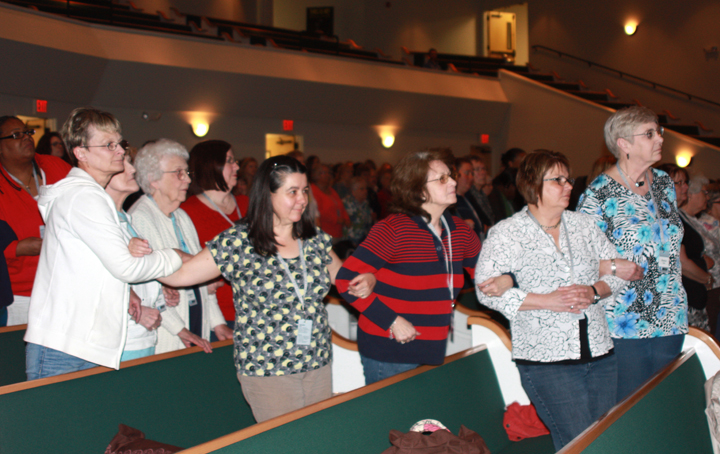
Speaker Rachel Lovingood asked women at the meeting to stand arm-in-arm to demonstrate unity. "There is no telling what can happen in the state of Illinois if we start getting together,” she said. Photo by Lisa Sergent

Speaker Rachel Lovingood asked women at the meeting to stand arm-in-arm to demonstrate unity. “There is no telling what can happen in the state of Illinois if we start getting together,” she said. Photo by Lisa Sergent

Focus on missions
To kick off the Decatur meeting, Halsey and others spoke on needs in Illinois and abroad, and how organizations like Woman’s Missionary Union (WMU) can help engage women in missions. Clella Lee brought greetings from National WMU, headquartered in Birmingham, Ala., and Jill McNicol was re-elected president of Illinois’ state chapter. McNicol is a member of First Baptist Church in Patoka.

Women also elected members of WMU’s lead team, who will serve in a variety of roles throughout the year to organize missions opportunities for children, teens and adults in Illinois.

Early Saturday morning, some meeting attenders participated in a 5K Run/Walk for Missions. Around 30 walkers and runners assembled in Decatur for the inaugural event.

Going home changed
In the meeting’s final session, pastor’s wife and International Mission Board global missions catalyst Lori McDaniel emphasized the importance of faith in women’s lives. “You’ll be ready for tomorrow if you’re OK with God interrupting your normal,” McDaniel said. “God’s interruptions are never convenient.”

She said women have got to stop asking themselves “what if” questions and follow God. “We have so much faith that we’re not going to go backwards. But, we have so much fear that we’re not going to go forward.”

Recounting the Bible story of Gideon, McDaniel said, “God raised Gideon up to be a judge, but not before Gideon back-talked God and showed a lack of faith.” Just as he eventually accepted his assignment, “If we’re going to be ready for tomorrow, then we’ve got to accept the assignment that we’ve been sent,” McDaniel said. “In your ordinary life you have room for an extraordinary God. Where in your life is He at work in a way that can only be explained by Him?”

“Are you going home changed?” Halsey asked the women at the end of the conference.

“Tomorrow begins today,” she said. “We have a personal choice to make whether we are going to live our lives with intention or let someone else decide it for us.”

Read the current issue of the Illinois Baptist online at http://ibonline.IBSA.org.

Editor’s note: The video below is from the Mid-Atlantic Baptist Network.

https://vimeo.com/127726795
Southern Baptist pastors are among those trying to spread hope and healing after violence broke out in Baltimore late last month. And Christians outside the city—including a mission team from Chicago who visited Baltimore last year—are praying for peace, reconciliation, and spiritual awakening.

Hundreds of people were arrested during protests over the death of 25-year-old African American Freddie Gray, who died April 19 from injuries sustained while in police custody. During rioting that broke out April 27, at least 20 police officers were injured and cars and buildings were burned. Gray’s death has since been ruled a homicide, and six police officers have been charged.

In the wake of the riots, Maryland’s governor declared a state of emergency and called in the National Guard. The Orioles played an eerie afternoon game closed to fans, in fear that more riots could break out.

Things have calmed down since then, said Bob Mackey, executive director of the Baltimore Baptist Association, because starting the day after the riots, “everybody who lives in the city had to keep living in the city,” he said.

As life moved on, a group of pastors met to pray together and then went out into the city to help with the clean-up effort. Church planter Brad O’Brien was one of the pastors in the group; his church, Jesus Our Redeemer, is four miles from a CVS Pharmacy that burned during the rioting.

“We know that if the gospel can resurrect our dead hearts then it can bring hope to this community,” O’Brien told a writer for the North American Mission Board. “Our hope is not in our mayor, not in our police chief or the governor. Our hope is in Christ alone.”

Praying from Chicago
Doug Nguyen was thinking about Baltimore just before the rioting started. The missions chairman of Uptown Baptist Church in Chicago visited the city last summer during the Southern Baptist Convention, and worked with Pastor Ryan Palmer and Seventh Metro Baptist Church during the annual Crossover evangelism outreach.

Seventh Metro has historical import for Southern Baptists; it’s the church where missions pioneer Annie Armstrong was baptized.

Pastor Palmer was in Chicago the Sunday before the rioting started as part of a vision tour for those interested in helping plant churches in the city. Nguyen said they spent the day with Palmer, catching up and hearing about what was going on in Baltimore.

Rioting broke out on Monday.

“We’re all praying for them right now, for churches to really step up and be the salt and light in that community,” Nguyen said. The Seventh Metro neighborhood is not unlike their own in Uptown Chicago. In fact, the North Avenue they walked along there is similar to Chicago’s own North Avenue on the west side.

It’s an impoverished area, Nguyen said, with obvious signs of homelessness and addiction. Churches in communities like Seventh Metro’s (and Uptown’s) “depend on a lot of laborers in order to disciple the people around the neighborhood,” Nguyen said.

“There are a lot of ministry opportunities there, to help build the church. You’ve got young leadership, you’ve got evangelistic opportunities similar to what we were doing out in the streets (during Crossover).”

As the protests settled down, Palmer told Baptist Press God had protected his church, located near one of the riot zones.

“Literally, the violence was a few blocks west and a few blocks east. In both cases, you could see the steeple of our church from the locations, but they did not come into our block. They have not come into our block yet. We’re giving God praise and thanks for that.”

A way forward
Even amidst the upheaval, Bob Mackey said it was encouraging for him as a director of missions to watch God’s people partner with others in the community to respond in positive ways. He told the Illinois Baptist churches in the area were planning community block parties, “just to have some fun back in the city. In Jesus’ name, if you will.”

After the rioting, Disaster Relief volunteers provided meals for first responders, and Baptists worked together to supply groceries and other basics to areas where stores weren’t immediately accessible.

As the city moves forward, churches must respond to its complex needs, African American pastor and church planting strategist Michael Crawford told Baptist Press. He gave a four-point plan for healing in Baltimore, based on listening, understanding what goes on in inner city schools, providing healthy food sources, and prayer. Communication and relationships are key, he said, adding that African Americans need a safe place to be heard.

“The reason we are stuck is because we can’t talk about it. We get offended and then we do not hear,” he said. “The real work is listening, getting offended, offering forgiveness, and then reconciling together. That’s real!”

By Meredith Flynn, with additional reporting from Baptist Pres

The_BriefingTHE BRIEFING | A new study from Pew Research stopped short of breaking the internet after it was released last week, but it did spark debate between leaders about what the report actually says about Christianity in America. The gist: Pew reported the percentage of American adults who describe themselves as Christians has dropped almost eight percentage points in the last seven years–from 78.4% to 70.6%. And the number of Americans who are religiously unaffiliated has risen from 16.1% to 22.8%.

Religion News Service writer Jonathan Merritt said the research shows political and theological ideology isn’t as important a factor in predicting decline: “Yes, mainline denominations remain in sharp decline, and yes, evangelicals have fared slightly better overall,” Merritt wrote. “Yet many evangelical bodies have begun shrinking as a share of the population as well. Roman Catholics—also theologically and politically conservative—are also declining significantly. This, despite these groups’ evangelistic zeal, orthodox theology, and conservative political stances.”

Joe Carter of the Ethics and Religious Liberty Commission (ERLC) countered Merritt’s piece with one of his own, pointing out that the Pew research also shows the share of evangelicals in America has stayed relatively steady: from 26.3% in 2007 to 25.4% in the new study.

“Merritt is correct that a key concern is the ‘growing number of people who are apathetic or antagonistic to the claims of Christianity,'” Carter wrote. “But that should not lead us to conclude that is evangelicalism that must change.” (Merritt responded here.)

Other observers explained why evangelicals shouldn’t necessarily view the report as a crisis:


Jeb Bush on religious liberty
“A big country, a tolerant country, ought to be able to figure out the difference between discriminating [against] someone because of their sexual orientation and not forcing someone to participate in a wedding that they find goes against their moral beliefs,” possible presidential candidate Jeb Bush told CBN’s David Brody. Read the full story at ChristianPost.com.


2016: Who gets your vote?
Both evangelicals and the overall American population say they place little importance on a presidential candidate’s age, physical appearance, endorsements, or education. But unsurprisingly, the two groups differ on a candidate’s religious faith, according to Barna’s 2016 election preview: 45% of evangelicals count faith among the most important factors in choosing a candidate to support, compared to 9% of all Americans.


International Mission Board adopts new missionary qualifications
Trustees for the Southern Baptist International Mission Board have approved a new, unified set of qualifications for missionaries applying for its various pathways of service. The new policy replaces old qualifications on the topics of divorce, baptism, families with teenage children, and speaking in tongues.
IMB President David Platt said, “[T]his policy does not mean we are lowering the standards for missionaries. Indeed, quite the opposite is true….The ultimate aim of this policy revision is to enable limitless God-exalting, Christ-following, Spirit-led, biblically-faithful, people-loving, high-quality Southern Baptist missionaries to serve with IMB through a multiplicity of pathways in the days ahead.”


Oscar idolatry?
Academy Award-winning actress Natalie Portman told The Hollywood Reporter recently she doesn’t keep her Oscar in plain view because “it’s a false idol.” Writing at Relevant.com, Josh Hayes (an editor for LifeWay’s The Gospel Project) explores her argument, and what the Bible says about idolatry.

HEARTLAND | Nate Adams

Nate_Adams_May15A few years ago I transitioned from a publishing career in the Chicago suburbs to a new role at the North American Mission Board near Atlanta. For our young family, the move required a number of minor adjustments, from snowy winters to no winters, from bluegrass to Bermuda grass, and from bad traffic to worse. Other transitions were far more significant, like the transition from smaller churches to much larger churches, and from the realities of the evangelical Christian publishing world to those of the Southern Baptist denominational world.

In many of those new arenas, I found that I looked at things differently than my new friends and coworkers. I had different life experiences than most of them. As a result, I often found myself expressing a minority opinion.

Of course this may have been partly because I was initially the only non-Southerner on our executive team. After a few months, Randy from New York joined us. It was then that the rest of the guys started affectionately calling both of us the
“NAMB Yankees.”

The nice thing about our new team, though, was that we respected each other enough to patiently listen to one another’s different perspectives. “That’s not how megachurch pastors think,” one of my new colleagues would say, and I would have to admit I didn’t have a lot of experience in that world. But then later I would hear myself saying something like, “That may work in the Bible belt, but it wouldn’t make any sense in Chicago.”

Somehow, in the midst of that verbal sparring, we saw the “wisdom of many counselors” emerge. Our multiple perspectives gave us a more complete view of reality, and of the diversity of the SBC churches we served. As a result, I think we made better decisions, and became better leaders.

It’s the wonderful value and synergy that can come from multiple perspectives that leads me to challenge all of us that possibly can to travel to Columbus, Ohio, for the Southern Baptist Convention next month. The Southern Baptist Convention needs Midwest perspective.

Many of the folks that attend the SBC each year are from the larger and more numerous churches in the South. We need that perspective. Many are there because they serve at a national SBC entity or on an SBC board or committee. We need those perspectives too.

But there is something unique about being Southern Baptists in the North, and in the Midwest, that makes our perspective equally needed, and valuable. Many important insights come from average people, in average churches.

Last January, when we hosted more than a thousand leaders from 10 Baptist state conventions here in Springfield, I heard over and over from national SBC conference leaders how impressed they were with our people. “Your folks are so devoted to ministry, and so eager to learn. We don’t see this kind of enthusiasm and dedication everywhere. We are so encouraged by what we see here in the Midwest.”

I’m encouraged by what I see in the Midwest too, and by our unique perspective on ministry and Great Commission causes. We have a lot to offer to the national SBC dialogue. In fact, I think a stronger Midwest perspective might have led to some different, perhaps better, decisions over the past few years. And with the 2015 SBC in Columbus and the 2016 SBC in St. Louis, we now have two years in a row when our strong participation can be more practical and affordable.

IBSA will be hosting a reception for Illinois Baptists at the Columbus SBC on Tuesday night, June 16, following the evening session. Watch for details on IBSA.org and in the Illinois Baptist newspaper.

I hope to see you there. The Southern Baptist Convention needs our Midwest perspective.

Nate Adams is executive director of the Illinois Baptist State Association.

NEWS | Illinois Baptist

As the U.S. Supreme Court prepared to hear oral arguments April 28 in the case of Obergefell v. Hodges, much of the conversation swirled around the ultimate outcome: Will the Court decide this summer that same-sex marriage is a constitutional right?

But during the arguments and in subsequent analysis, a new issue emerged, mostly due to an exchange between Justice Samuel Alito and Solicitor General Donald B. Verrilli.

If the Court legalizes same-sex marriage, will religious institutions—for example, Christian schools—stand to lose their tax exempt status if they oppose same-sex unions?

Verrilli’s response that “it’s certainly going to be an issue” set off warning bells for Christians, churches, schools and other religious organizations that before had been merely waiting for the Court to likely decide in favor of same-sex marriage.

Instead, the focus shifted from the Fourteenth Amendment and equal protection under the law, to the First Amendment and freedom of religion. The Court is expected to issue its decision in June, making the Southern Baptist Convention’s focus on prayer for spiritual awakening in America all the more timely.

“Unfortunately, the defense of marriage in our culture has now turned into a defense of religious freedom,” said IBSA Executive Director Nate Adams. “I pray for a miracle in the Supreme Court’s decision in June, for if that doesn’t happen churches will find themselves in a precarious new position.

“Even churches that have not been actively engaged in the defense of marriage issue must now be vigilant in defending their freedoms of speech and religious expression.”

Obergefell v. Hodges centers around a surviving spouse in a same-sex marriage who wanted his name listed on his partner’s death certificate. The couple was from Ohio, but their marriage had been performed in Maryland. The issue involves whether a state where a same-sex marriage is not legal must recognize a marriage performed in another state. The Supreme Court subsequently joined three other lawsuits from Michigan, Kentucky and Tennessee in one case.

Framed as a Fourteenth Amendment issue, the case asks two questions: 1. Does the Fourteenth Amendment require a state to license a marriage between two people of the same sex, and 2. Does the Amendment require a state to recognize marriage between two people of the same sex when their marriage was lawfully licensed and performed out of state?

But Justice Alito’s question to Solicitor General Verrilli echoed a concern churches have expressed since the marriage debate began. Verrilli’s answer “confirms with candor the threat we have long seen coming,” said Albert Mohler, president of The Southern Baptist Theological Seminary.

In inquiring about how same-sex marriage could affect religious liberty, Justice Alito referenced a 1983 case in which Bob Jones University was denied tax exempt status because it barred interracial marriage and interracial dating among its students. Will the same happen for schools that oppose same-sex marriage, Alito asked?

Verrilli said he couldn’t answer without more specifics, “but it’s certainly going to be an issue.”

In a presentation on religious liberty following the Court arguments, Washington University law professor John Inazu agreed it will indeed be an issue. He referenced a brief filed by a same-sex marriage supporter Douglas Laycock that nonetheless outlined religious liberty concerns. In the brief, Laycock, a University of Virginia law professor, posed these questions:

• Will clergy have to provide marriage counseling to same-sex couples?
• Will religious colleges be required to provide married student housing for same-sex couples?
• Will churches be required to employ people in same-sex marriages?
• Will religious organizations have to provide spousal fringe benefits for same-sex spouses?
• Will religious social service agencies have to place children for adoption with same-sex couples?

In addition, Laycock says, other organizations could be sued for refusing their facilities or services, including religious colleges, camps and retreats, day care centers, counseling centers, meeting halls, and adoption agencies.

Following the oral arguments, Russell Moore and Andrew Walker of the Ethics and Religious Liberty Commission summed up the religious liberty issue this way:

“The Founders warned us that the power to tax is the power to destroy. The Solicitor General is signaling that at least this Administration is quite open to destroying those who hold a view of marriage held by the Roman Catholic Church, the Eastern Orthodox, evangelical Protestants, Orthodox Jews, Muslims, many Sikhs and Buddhists. It was even a position held by the President himself until his most recent ideological evolution.”

Some observers have said the impact on churches of the Court’s ruling—likely in favor of same-sex marriage—will depend on how the decision is written and how many justices vote in favor of it. A split decision, it would appear, would give the government less authority to limit the liberty of local congregations.

Evangelical ‘winnowing’
At a May 11 meeting in Peoria, IBSA church leaders talked about how churches can respond to the changing marriage culture, and specifically how bylaws and membership policies can protect their right to practice their convictions.

“Some of our leaders have raised the concern [about same-sex marriage], and wanted to know more about how can churches protect themselves, and what are the issues as they stand now in the state of Illinois and the Supreme Court,” said Joe Gardner, an IBSA zone consultant in Metro Peoria.

As they wait for a decision for the Court, Gardner says leaders in his area are concerned about whether they will be required to allow groups that endorse same-sex marriage to use their church facilities, and how to protect themselves against lawsuits that could come with the Court’s decision. Personally, he’s concerned about how the verdict will affect Christian schools,
since his wife is superintendent of one in Peoria.

Of churches in his area, he said, “I would say we are committed to standing firm on the Scripture, and biblical teaching on marriage and home….But we don’t know what kind of challenges [will result from that stand]. So, we’re just waiting to see what kind of challenges will present themselves when we take that stand.

Because, he said, as churches, “We don’t really have a choice, do we?”

During the last several years, and increasingly more recently, churches and pastors are asking themselves that very question. Where do we stand on this? And will we stay there, even when it gets difficult?

Professor Denny Burk of Boyce College said same-sex marriage “will cause a winnowing of our ranks, and we are about to find out who will willing to follow Jesus when it gets hard.”

In a blog post on the day of the Supreme Court arguments, Burk referenced a recent CNN article about how religiously affiliated people now think about same-sex marriage. According to data from the Public Religion Research Institute in the CNN story, a majority within many religious groups favor same-sex marriage, including Jews (77%) and Catholics (60%). A
higher percentage of those groups favor same-sex marriage than the share of all Americans: 54%.

Smaller percentages of black Protestants (38%) and white evangelicals (28%) favor same-sex marriage, but young people—even Christians—are more likely to accept it. According to the PRRI research, 43% of Millennial white evangelicals are in favor of same-sex marriage. “That last number is the one that should stand out,” Burk wrote.

Even before the Court makes its decision known, many congregations are wondering how to handle less conservative views in the pews, particularly on the issue of marriage and particularly among young people. The shift makes for a “watershed moment” for Christianity, Burk said.

“As popular opinion and legal precedent move decisively in favor of gay marriage, those who call themselves Christians have a choice. They can either join the revolution or they can follow Jesus.”

Read the Illinois Baptist online at http://ibonline.IBSA.org.

THE BRIEFING | Meredith Flynn

Christian colleges and schools and other religious institutions–including churches–could face the loss of their tax exempt status if the Supreme Court declares same-sex marriage a constitutional right, writes college chancellor Michael Farris in an editorial for USA Today.

The_Briefing“Christian colleges and churches need to get prepared,” says Farris, chancellor of Patrick Henry College and chairman of the Home School Legal Defense Association. “We must decide which is more important to us–our tax exemption or our religious convictions.”

Over at The Christian Post, Washington University law professor John Inazu examines the issue with help from a brief filed by a same-sex marriage advocate, who nonetheless outlines potential religious liberty concerns.


Bill would protect Missouri college groups
The Missouri Senate is considering a bill that allows religious student groups on public college campuses to limit membership based on their religious convictions. House Bill 104, the “Student Freedom of Association Act,” comes amidst a string of cases in other states where campus groups came under fire for who they allowed to join or serve as leaders. Last year, InterVarsity Christian Fellowship was “derecognized” by the schools in the California State University system because the ministry’s leadership requirements were found to be in conflict with a university policy that required recognized groups to accept all students as potential leaders. Read more about the Missouri measure at ChristianPost.com.


Post-ruling marriage event planned
The Ethics and Religious Liberty Commission announced this month it will host a church equipping event in Austin, Texas, following the Supreme Court’s decision on same-sex marriage. “The Gospel and Same-Sex Marriage: Equipping the Church for a Post-Marriage Culture,” is scheduled to be held at Austin Stone Community Church July 29. The event will also be available via free simulcast.


Is your church Google-friendly?
Due to changes at Google, some older church websites may not appear at the top of the list when web users search for churches in their city, Baptist Press reports. At issue is the “mobile friendliness” of your site, which can be tested at Google’s Mobile Friendly Test website.


‘Desperate days’ need uncommon prayer
Texas pastor Jack Graham called for extraordinary and uncommon prayer during the National Day of Prayer gathering in Washington, D.C., May 7. “We are facing a crisis in America. These are desperate days,” said Graham, pastor of Prestonwood Baptist Church and honorary chairperson of the National Day Of Prayer Task Force. “Uncommon times call for uncommon prayer, and so we cry out to God. We cry out to God.”


Dictionary mulls ‘Mx.’ title
Editors of the Oxford English Dictionary are considering adding a new pre-name title similar to Mr. and Mrs. The new moniker—Mx.—would denote transgender individuals. Mx. is used more commonly in the United Kingdom than in America, “but we are monitoring its development and will be interested to see if it takes root here in the same way it has in the U.K.,” Emily Brewster, an associate editor with Merriam-Webster, Inc., told The Christian Post.

50518 BIG pic

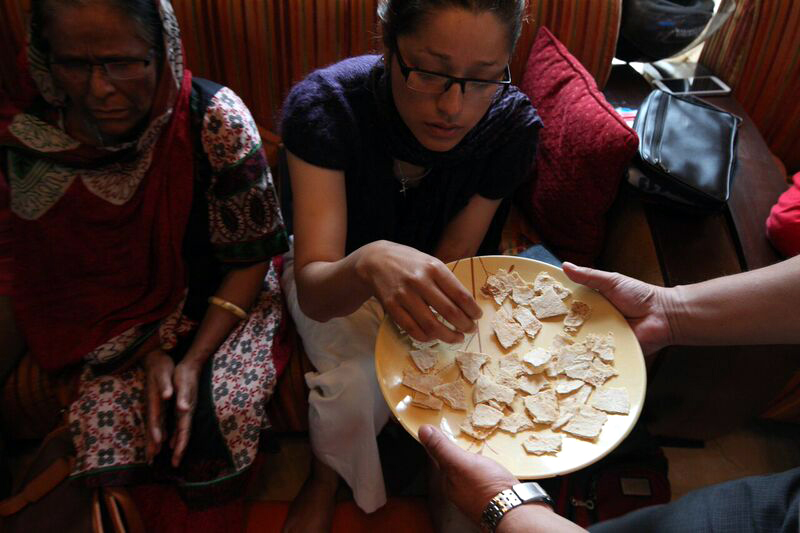
After their Lord’s Supper implements were destroyed in an April 25 earthquake, church attenders in Nepal used a dinner plate for bread and a bowl and spoon for the grape juice. IMB photo by Chris Carter

Kathmandu | When journalist Susie Rain (name changed) visited a small Nepali congregation after a catastrophic earthquake, they were singing the same song as one week before, when the walls in their meeting room began to shake. Rain, a writer for the Southern Baptist International Mission Board, described the worship service:

Twenty-five voices gain momentum, clapping hands, dancing and raising their faces to heaven in song, “Still I will love You and spread Your love to the people.” Spontaneously, the congregation breaks into prayer. This is the exact spot the song was interrupted a week ago, on April 25, by a 7.8-magnitude earthquake.

In the days after the quake, the death toll continued to rise, eventually topping 7,000. Thousands more were injured. Baptist Global Response, a ministry partner of the IMB, has begun assessing the damage and delivering supplies.

In Kathmandu, the church Rain visited celebrated the Lord’s Supper, even during an aftershock. Their dishes had been destroyed the week before. “They improvised with a bowl and spoon,” Rain posted on social media. “Wish you could have been there with me. You would have had tears in your eyes, too.”

International Mission Board President David Platt has written about how Christians can respond to the crisis in Nepal. Read his column here.

Courtney_Veasey_blog_calloutCOMMENTARY | Courtney Veasey

The Gulf Coast of the United States is a geographical magnet for tropical storms. Yet in August of 2005, the people of New Orleans were taken by surprise when Hurricane Katrina came inland and ravaged their city. People incurred innumerable losses, but most weren’t the result of the hurricane itself. Instead, much of the damage resulted from a lack of preparation before the storm came.

Levees were not up to code, little to no systematic evacuation plans were in place, and food supplies had been used more for celebrating a storm’s coming, rather than surviving its wrath.

Aware of the reality of hurricanes, yet grossly underestimating their true potential, the people of New Orleans were caught off guard and found themselves drowning in the waters of their own unpreparedness.

I moved to New Orleans to go to seminary just three weeks before Katrina’s arrival. My earthly belongings were lost in the flood and I found myself unable to return to school in the city for nearly a year. Ten years later, I’m still proud to call New Orleans my place of residence, but the unnecessary losses experienced during Katrina have caused me and others to do life there a bit differently than before.

Leaders have developed city-wide evacuation plans. We keep “hurricane kits” in our homes and cars, with bottled water and non-perishable food. It’s sad but true: It took experiencing such tremendous disaster to awaken this sense of urgency and preparedness in us.

How does this example of real-life crisis relate to how we should live as Christians? Consider for a moment the subject of persecution. Christianity in its many forms, the largest and most widely practiced faith in the world, is met with limitations and hostility in at least 111 countries, ahead of the 90 countries discriminating or harassing the second largest faith, Islam.

We commonly hear of the torture and killing of Christians in places like North Korea, Syria, and other middle- to far-eastern countries. Here in America, the seemingly distant reality of such experiences has contributed to a lack of urgency towards preparing to face the same here.

But Jesus, in both the Sermon on the Mount (Matthew 5:11-12) and in his words to the disciples just before his death (John 15:18-27), predicted an infallible forecast of persecution as the future reality for his followers. The word for “persecution” in the Greek is dioko, meaning “to chase down,” or “pursue.” This act can take shape in many forms, but regardless of how it comes, the real question is, will you be ready when it does?

What if we as Christians, while trusting in God’s providence and sovereignty, prepared for the inevitable crises of life, and also for persecution? What tools would we need in our spiritual hurricane kit? Let me suggest three:

1. Memorize Scripture. Put to memory passages that are both encouraging and that clearly communicate the gospel. Places to start are Psalm 27:1-3, Ephesians 6:10-20, and Romans 5:6-11.

2. Have a persecution song. Choose and memorize a go-to song that you can start singing the moment trouble begins, one that will encourage you to remain faithful. Songs to consider are “No Turning Back,” and “Blessed Assurance.”

3. Practice praise in pain. When you experience pain, whether it comes by way of getting shots, stumping a toe, physical illness, etc., practice going immediately to the throne of God in praise. You may get some funny looks, but this will serve as great conditioning for those times when it really counts.

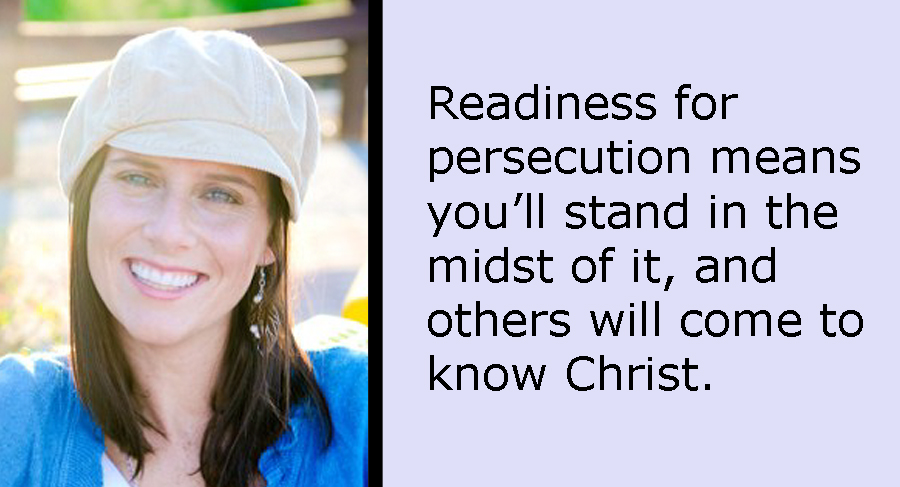
Prepare for crisis; as a human being, you’re bound to experience it. Prepare for persecution; it’s promised for believers. And do so not only that you may stand, but also that others, even the persecutors themselves, may come to know Christ through your witness.

Courtney Veasey is a Ph.D. student and director of women’s academic programs at New Orleans Baptist Theological Seminary.

THE BRIEFING | Meredith Flynn

Barna’s most recent list of the country’s most unchurched cities is dotted with Illinois metro areas, but only two have populations that rank above the national unchurched percentage: 38%. (Barna defines “unchurched” as those who haven’t attended a church service in the last six months, except for a holiday or special occasion.)

The_BriefingThe metro area composed of Davenport, Iowa, and Rock Island and Moline in Illinois ranked 27th on Barna’s list of most unchurched cities, with an unchurched population of 42%. Chicago is a few places down the list, at No. 32 with 39% of the population unchurched.

Other familiar cities: St. Louis is 45th, Champaign/Springfield/Decatur is 53rd, and Harrisburg and Mt. Vernon (along with Paducah, Ky., and Cap Girardeau, Mo.) are 80th.


Does young = pacifist? Maybe not necessarily, according to a Harvard poll of young Americans that found nearly 60% approve of sending ground troops to fight ISIS.


Imprisoned pastor urges prayer | Saeed Abedini’s 35th birthday coincides May 7 with the National Day of Prayer in the U.S., which is the focus of a letter he wrote from prison in Iran. “As Ezra cried out to God in repentance and the Israelites joined him in weeping bitterly and turning from their sin, I would like to ask you to join me in repenting and praying for revival,” Abedini wrote. This story from The Christian Post also reports on the political chaos swirling around the pastor’s captivity and the fight for his release.


New nominees for persecuted countries list | The U.S. Commission on International Religious Freedom has recommended the State Department add eight countries to a list of the “world’s worst violators of religious liberty,” Baptist Press reports. The Central African Republic, Egypt, Iraq, Nigeria, Pakistan, Syria, Tajikistan and Vietnam all were nominated for the list of CPC’s (countries of particular concern), along with nine nations already on the list.


10 questions from Court’s marriage arguments | Transcripts of last week’s U.S. Supreme Court oral arguments on same-sex marriage are available online, as is this guide–provided by the Ethics and Religious Liberty Commission–to the 10 most important questions asked by the justices. For example, would it be unwise for the Court to redefine an institution as ancient as marriage? And would redefining marriage impose on institutions’ religious liberty, like the loss of tax-exempt status?

Evangelistic_churches_3HEARTLAND | The average Southern Baptist church in the Midwest has 54 people in worship on Sunday mornings, and baptized three last year. But a North American Mission Board study found the top evangelistic churches in the region are charting a different course, said Joel Southerland, NAMB’s executive director of evangelism strategies.

The Midwest’s top evangelistic churches with less than 250 in worship attendance averaged 119 in worship and had 23 baptisms. Churches with more than 250 in worship averaged 71 baptisms.

Southerland shared findings from the NAMB study of the top 20 evangelizing churches in every U.S. state at the Illinois Baptist State Association’s Evangelism Conference in March, and in a breakout session at the Midwest Leadership Summit earlier this year. The study resulted in a list of “7 Secrets of Top Evangelistic Churches in the SBC.”

  1. It has a lot to do with the pastor. NAMB studied the pastors of top evangelistic churches and found that the majority described their leadership style as “charismatic” or “transformational,” outranking innovative, command and control, servant, situational, laissez-faire and pace setter.

The pastors they studied were at the churches 10-plus years on average, Southerland said, and 70% of them preach a sermon series on evangelism every year. More than half (55%) put more emphasis on evangelism than discipleship, and 90% share the gospel outside the church at least once a month.

  1. Top evangelistic churches are really good at the Sunday morning experience. Of the pastors surveyed, 93% described their worship as lively and celebratory, 95% were contemporary or blended in worship style, and 96% said they intentionally cultivate a guest-friendly atmosphere. And 70% give an invitation at the end of the service.

Southerland outlined several worship takeaways: make church exciting, work on the quality, be intentionally evangelistic on Sunday morning, and aim for something better than “friendly.” People aren’t looking for friendly, he said, they’re looking for friends.

  1. These churches are actively engaged and serving the community, no matter the size of the congregation. Of the pastors surveyed, 88% said they were well engaged in the community. Of mid-sized top evangelistic churches, 30% attempt service-based ministry efforts to share the gospel regularly, as do 37% of large churches.

It’s OK to start small with community engagement, Southerland counseled, just start somewhere. And preferably not in a vacuum. Talk to community leaders about the needs are, and how your church can help. Involve non-Christians, using the service as an opportunity to share the gospel with them.

  1. Top evangelistic churches communicate well, internally and externally. The average pastor makes too many assumptions about how much people know, Southerland said. They assume the congregation knows the church’s vision, that members are as passionate about reaching people as the pastor, and that they don’t need constant motivation.

But all of those things—and more—need to be communicated. Luckily, more avenues for communication exist now than ever before. Of the top evangelistic church pastors surveyed, 97% use a church Facebook account regularly, Southerland cited. Half of pastors and staff intentionally “friend” guests on Facebook.

  1. Virtually all top evangelistic churches make a big deal out of baptisms—97%, the NAMB survey reported. And 79% of pastors of churches in the mid-size church category preach a yearly sermon on baptism, as do 74% of large-church pastors.

The takeaways, Southerland said, are to preach at least once on baptism every year, provide a forum for people to give their own, recorded testimonies, help baptismal candidates invite family and friends to the service, and train your church to celebrate new spiritual life.

  1. They treat guests really well. In non-evangelistic churches, Southerland said, the service is for the members and guests just happen to be there. Evangelistic churches are the opposite; of the congregations NAMB surveyed 67% of mid-size churches and 85% of large churches had a person responsible for “first impressions” ministry targeted to visitors.

A large majority (70%) emailed, called and sent written mail to a guest within seven days of their visit.

  1. Top evangelistic churches emphasize inviting and personal evangelism. The pastors of the churches NAMB studied were very busy mobilizing their church members to be a witness in the community; 50% offered evangelism training, and 70% of their guests came to church as a result of a personal invitation from a member. Among mid-sized churches, 62% have visitation or organized outreach at least once a month, and 58% of large churches do the same.

Churches that train members in personal evangelism, Southerland said, baptize two-and-a-half times more people than those that don’t.

The value of a verbal witness cannot be underestimated, he said during a message at the IBSA conference. Especially when most people are broken and looking for a solution to their problems.

“We are far too timid when it comes to sharing the gospel. We are too scared of the culture.” But, “The culture is not near as bad as it could be or will be someday. We’re to take the gospel to the culture and change the culture with Jesus Christ.”