‘Spurgeon’s rail’

Lisa Misner —  October 16, 2015

Spurgeon's railCOMMENTARY | Consider it the first see-through pulpit. A century before the plexiglass lectern, black-metal music stand, or repurposed pub table, there was Spurgeon’s rail.

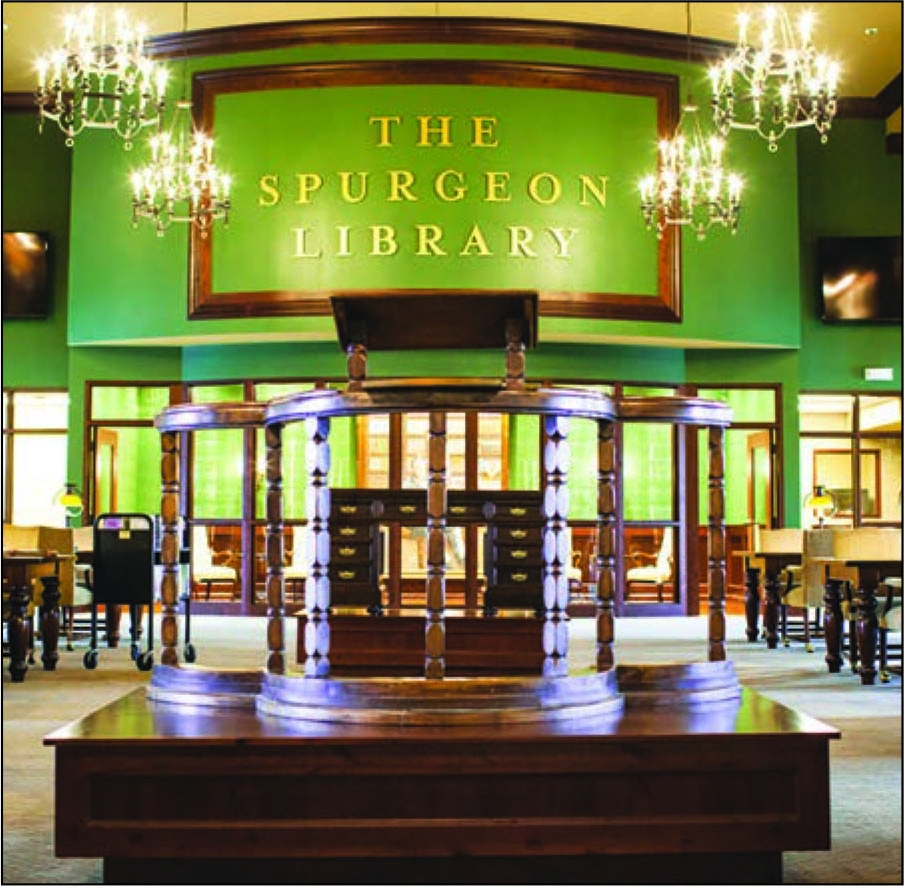
The centerpiece of the great Metropolitan Tabernacle in London was not an ornate pulpit. It was a rail, a simple wooden banister with only newel posts at the corners and topped by a little shelf just big enough for a Bible and his one-page manuscript. Behind it, in some photos there is a small trestle-style library table. With the open “rail” extending out about eight feet, there was plenty of room for the preacher to pace about without toppling off the platform.

The historic podium anchors the new Spurgeon Library at Midwestern Baptist Theological Seminary, along with a collection of 5,103 of the great master’s books and commentaries from his pastoral office. Overhead hang large new paintings depicting the great preacher’s call and ministry. (We also saw Spurgeon’s doorknob and the silver keyhole cover from his study door, recently acquired.)

I wanted to stand behind Spurgeon’s rail and preach a bit in the style of the renowned orator, but I don’t know what Spurgeon sounded like. He died in 1892 at age 57. Although Edison had invented sound recording more than a decade earlier, there are no phonograph discs of Spurgeon preaching.

His son and successor Thomas recited a transcript of his father’s last sermon, but Thomas’s voice is tinny on the wax cylinder, and we are left to wonder how the man who once preached to an audience of 23,654 without a microphone really sounded.

But his words—we have many. Up to 25 million words are documented in 63 volumes of his sermons from his 38-year pastorate. A Midwestern professor is leading the transcription and exposition of recently discovered sermons from Spurgeon’s earliest years in the pulpit. (No small feat that is, as we also saw from pages of sermon notes in his own scritchy Victorian hand.) So the number grows.

While he did speak to some of the ills of his day (American editors sometimes deleted his strong comments on slavery), Spurgeon always made a beeline for the cross. If Spurgeon railed, it was for Christ.

“When I cease to preach salvation by faith in Jesus,” Spurgeon said, “put me into a lunatic asylum, for you may be sure that my mind is gone.”

We need more of Spurgeon’s rail today.

Eric Reed is editor of the Illinois Baptist. Read the latest issue online.

Forward thinkingNEWS | Jason Allen is the youngest by far of the group he has called together. And in this gathering of seminary presidents and convention leaders, there is a sense that a passing of the baton is happening before our eyes. In fact, that is one topic Allen has asked his illustrious guests to address in this symposium on “The SBC in the 21st Century.”

Their reports will be gathered and published in a book for wider distribution, but for now—at this late September gathering on the campus of Midwestern Baptist Theological Seminary—the task is to listen and learn what their listy observations hold in common.

Midwestern Seminary’s “miraculous transformation” is not the subject of this meeting, although most every speaker references it in his opening remarks. They speak of Allen’s impact, engendering confidence in a once-struggling institution. They take note of the new chapel that rises above a green slope at the entrance to the Kansas City campus. The building in a clean prairie style was completed just as Allen assumed the presidency of the school two years ago. A couple of speakers reference the rise in enrollment. And there’s some discussion of the just-announced $7-million gift to build a much-needed student center and dining complex.

Among the notables here is an unnamed presence, Charles Spurgeon, the famous 19th century British preacher and evangelist. Midwestern recently acquired much of Spurgeon’s personal library collection and has converted the former chapel space to house it. There’s a lot of informal conversation about Spurgeon. Most attenders take the tour.

But amid obvious historical footings and with the insight of SBC heads, the subject is the future. At 38, fresh in his seminary presidency, Allen draws experienced leaders and thinkers to look forward—and tell us what they see.

Who are we now?

Many questions about Baptist identity seem to have been answered in the past 30 years. Starting with the Conservative Resurgence in 1979, Southern Baptists have affirmed biblical inerrancy and ended a lean toward mainline Protestant liberalism. That shift also ended whatever tendency Southern Baptists would have had toward cultural accommodation. We aren’t mainline or mainstream, and as the culture moves farther left, we don’t want to be.

We know who we aren’t, but who are we?

The more recent issue for Southern Baptists is that of Reformed theology: Just how Calvinistic are we. Trinity University President David Dockery calls Southern Baptists “modified Calvinists” because we are not consistent in all five points.

Three of our seminaries are more strongly Reformed, products and by-products of Al Mohler’s 22-year presidency at The Southern Baptist Theological Seminary. At this conference, only Paige Patterson, President of Southwestern Baptist Theological Seminary, was clearly not Calvinist. He raised the issue of evangelistic zeal, and questioned whether the growth of Calvinist adherents will cool the baptismal waters further.

“Evangelism will have to be reestablished as the majority of the Great Commission,” Patterson said. He criticized church planting that does not produce new believers. Talking about the gospel is as far removed from effective witnessing as talking about race cars is from driving in NASCAR, Patterson said in a pithy list of analogies.

The more current “ecclesial crisis” is that of regenerate church membership. In the quest to reach seekers and postmoderns and millennials, church membership has been devalued, and more specifically, the certainty that people who join our churches are in fact believers in Christ as evidenced by baptism.

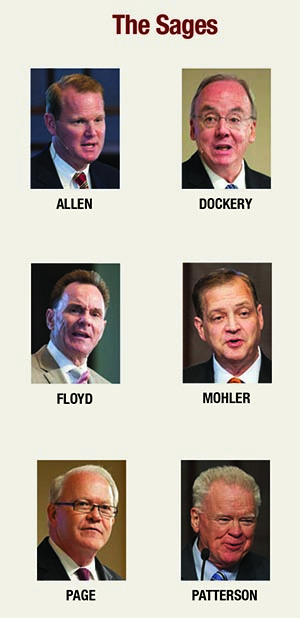
The SagesConfessional conviction

Will Southern Baptists embrace an identity that is more theological than tribal?” Mohler asked in his list of “10 unavoidable questions.”

The sages are almost uniform in their desire for Southern Baptists to have stronger theology and firmer confessional expressions of those beliefs. Too many people are members of SBC churches because it’s the family church, their friends go there, or they like the music—not because they hold strongly to the church’s theology.

Not to devalue our “tribal identity,” Mohler said, but “the tribe is not enough.” Tribalism—this informal gathering based on traditions and relationships—will give way to cultural accommodation, he warned, whereas confessional conviction will give believers (and thereby the denomination) theological moorings to withstand societal pressures to surrender to sexual redefinitions and moral decline.

Mohler asked whether today’s generation will “summon the courage” to face these issues which will require of them vigilance.

The current era is one of warm evangelicalism whose backbone is softening, to summarize several speakers. That makes this “the Baptist moment” according to Mohler. Among evangelicals, Baptists are best positioned to give the issues of “late modernity” a solid biblical, theological response.

Generational handoff

The discussion among panelists on “passing the baton” was playful at points with elder Patterson describing youthful Allen as “a man not yet dry behind the ears.” At another time Patterson, turning, 73 this month, commented, “I came on the scene right after Polycarp was martyred.” (That’s 155 A.D.) In these moments, it’s clear the baton is passing.

Mohler framed the handoff this way: “We have to ensure that there is healthy, courageous generational transition” in such a way that there is a Southern Baptist Convention in the future.

For Dockery, the handoff is more than from one generation to the next. It must be intergenerational. “Most Southern Baptists (and most Americans) do not find our identity in generations; our identity is in Christ.” Dockery says the handoff is also international and global, given the growth of evangelicalism in Africa and Asia.

Collaborative ministry

In a time when there is much discussion about “cooperation” as a denominational distinctive, SBC Executive Committee CEO Frank Page injected a new term, one that may have more weight with Millennials. “Collaborative ministry is biblical,” Page said. And for a generation accustomed to frequent electronic communication on every aspect of daily life, “collaborative” may be an easier sell than “cooperative.”

Cooperation indicates compliance with a mindset and participation in a program, whereas collaboration implies partnership and full participation by all parties involved.

As a denomination comprised mostly of smaller congregations, collaborative ministry “gives everyone a seat at the table,” Page said, including the SBC’s over 10,000 ethnic churches. But there’s education to be done. And it’s not only younger leaders who need the crash course. “We find there is a lack of understanding among ethnic churches of collaborative missions,” Page said.

But it was Dockery who pointed out that while the SBC has made strides in righting the sin of prejudice (the “one stain” on our record, he said), greater effort is required to bring minorities into leadership.

What about associations?

“This is no time to fly solo in the culture,” SBC President Ronnie Floyd said, “and no time for a church to fly alone.” Floyd’s presentation had the same listy character of the other speeches, but as a pastor, his list was most practical.

Floyd in particular called for a reduction in duplication (“and triplication”) of ministries and services by local, state, and national entities.

Larger state conventions, especially in the South, often offer their own versions of education, missions, and church planting; but since the implementation of the Great Commission Resurgence five years ago, those conventions have shifted funds to the national SBC in an effort to more effectively share the gospel in “new work” or frontier areas. And state convention staffs have been reduced by one-third, from 1,750 nationally to 1,350.

Making the denomination leaner is part of the thrust toward more effective collaboration. Floyd raised the issue of mergers, naming the International Mission Board and North American Mission Board as one possibility.

Local associations are another example where “regionalization” may make the SBC more effective. It’s a question that should be answered “honestly and boldly,” Floyd said, rather than trying to “preserve our old wineskins.”

“How can we leverage where we are and what we have and who we are to reach forward in a unprecedented manner” to advance the gospel?

Eric Reed is editor of the Illinois Baptist. Read the latest issue online.

The BriefingHigh and dry in Albion, IL

The first medical marijuana harvest in the state has begun near the southern Illinois town of Albion. The town, where the sale of packaged liquor is banned, is the site of an Ataraxia cultivation center for medical marijuana.


Grandma clings to the old red cross in SC floodwaters

South Carolina grandmother Clara Gantt was heading to church near Blythewood when her car was caught up in floodwaters. Her grandson Travis Catchings came to her aid, but both ended up clinging to a large red cross in a churchyard until rescuers arrived five hours later. Watch a cell phone video from the rescue.


Lawsuit: Baby Jesus doesn’t belong in Christmas play

The “War on Christmas” started early this year. The Freedom from Religion Foundation has filed a federal lawsuit against Concord Community Schools in Elkhart, Ind. demanding an injunction to forbid the school from “presenting the portion of the Christmas Spectacular with the live Nativity Scene and the telling of the story of the birth of Jesus.”


SBTS conference on transgenderism responds to challenges

The transgender movement presents an unprecedented theological and cultural crisis for the church, said Southern Baptist scholars at the SBTS conference on transgenderism and transformational Christianity. “The transgender revolution presents a more acute and more comprehensive challenge than merely the issue of homosexuality,” seminary President Albert Mohler said. “Because of the identity questions rooted in creation, the transgender revolution represents a challenge on an altogether different scale.”


Another state legalizes physician-assisted suicide

California became the latest—and most populous—state to pass an assisted dying bill. The law will permit physicians to provide lethal prescriptions to mentally competent adults who have been diagnosed with a terminal illness and face the expectation that they will die within six months. Currently, 1 in 6 Americans lives in a state where a doctor can prescribe a lethal dose of drugs to a patient.

Sources: Baptist Press, Chicago Sun-Times, ERLC, Fox News

What are we going to do?

Lisa Misner —  October 12, 2015

HEARTLAND | Nate Adams

Nate AdamsI remember vividly my Dad talking about the final hours he spent with his mother, my grandma, in the hospital before she died. Grandma was a devoted Christian and churchwoman, a member for more than 60 years of First Baptist Church in Murray, Kentucky, where the Cooperative Program was born in 1925.

As she came to the end of her life, and was only semi-conscious, Dad said she would occasionally rise up out of her hospital bed and say over and over, “What are we going to do? What are we going to do? What are we going to do?” Then he said she would relax back into her pillow with these words: “I guess we’ll just trust the Lord.”

For devoted Southern Baptists, recent news from the International Mission Board that as many as 600 to 800 missionaries soon need to return from the mission field leads us to that same, urgent question. What are we going to do?

I don’t have space here to go into all the details, which you can read at the imb.org or sbc.net web sites. But in summary, the IMB has been drawing down on financial reserves and selling properties for years in order to keep as many missionaries on the field as possible. It has been an unsustainable situation, that IMB leadership reports must now be corrected.

What are we going to do? I submit that trusting the Lord is still the best and right answer. Let me suggest five specific ways we here Illinois can do that.

First, we should pray. We should intercede for those in leadership at IMB as they make decisions, and for those missionaries and others who are affected by those decisions. We should pray for solutions, and for generosity from givers and churches, and for the Lord to send laborers into the harvest fields, even as it seems the opposite may be happening.

Second, we should trust the IMB trustees and executive staff to do their jobs. More than once over the years I have thought to myself that I would do things differently if I were in charge of some organization. Sometimes time proves me right, and sometimes time proves me wrong. But in our autonomous, cooperative family of churches we elect trustees to give oversight to the gifted and called leaders of our entities. They are closer to the facts, finances, and circumstances than any of us. And the Bible says that one of the ways we trust the Lord is to trust the leaders He providentially allows to have positions of authority.

Third, we should renew and increase our churches’ commitment to missions through the Cooperative Program. Even the surges and higher levels of giving to the Lottie Moon Christmas Offering over the past decade have apparently not been enough to prevent this downsizing of the missionary force. But ten percent giving through the Cooperative Program would have. Nationally, CP giving from SBC churches has dropped from an average of 10% in 1989 to 5.5% in 2014 (6.8% here in Illinois). If churches’ CP giving had continued to average at least 10% over those years, the number of international missionaries would have grown dramatically, along with the rest of our cooperative missions and ministries.

Fourth, we should of course consider giving our most generous gifts ever through the Lottie Moon Christmas Offering. IMB says that will not change the need for many of the missionaries to return home. But it may speed the rate at which they can be replaced.

And finally, as churches, associations, state conventions, and individual Christians, we should look for ways to directly assist the missionaries who will be returning stateside. Temporary housing, transportation, job placement, and personal encouragement will all be needed by returning missionary families. IBSA will be establishing a Missionary Relief Fund, and the offering received at this year’s IBSA Annual Meeting will be designated for that fund. I will also be contacting IMB with a list of IBSA’s currently open positions.

Many of us were surprised at the need for these missionaries to return home. But God is not. And so let us answer that urgent question with one or all of these very tangible actions that demonstrate we are trusting the Lord.

Nate Adams is executive director of the Illinois Baptist State Association. Respond at IllinoisBaptist@IBSA.org. Read this and other articles in the 10/12 issue of the Illinois Baptist online.

COMMENTARY | Eric Reed

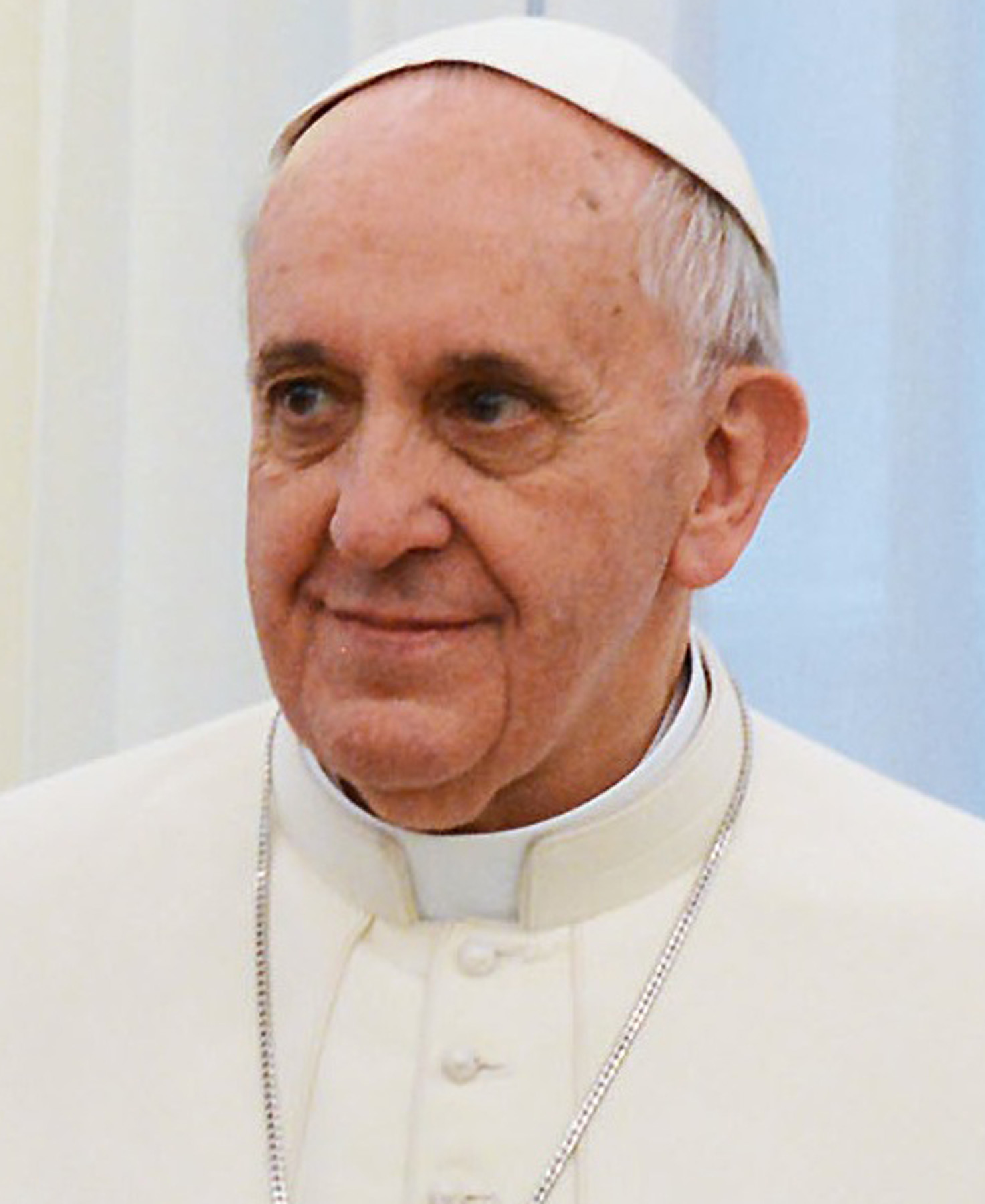
Pope FrancisAs Pope Francis hugged a disabled child, MSNBC’s Chris Matthews said, “What power this man has to make people feel good.” And it’s true. Even I, with all my Baptist objections to the papacy, got a catch in my throat at that scene on the Philadelphia airport tarmac when Francis stopped the car and got out to bless the child in the wheelchair. Yes, he makes people feel good.

Why else would millions line the streets for an eight-second glimpse of the pontiff waving from the back seat as his tiny Fiat passed by?

But CBS’s Jericka Duncan, to bishops at a press conference following the Philadelphia visit, was more pointed: Why didn’t Francis publicly tell people how he feels about the family, starting with the marriage of one man and one woman?

Francis has a history of making statements that, broadly interpreted, could make homosexuals, divorced people, those who allow for abortion, and even “women religious” believe there’s an open door for them in mainstream Catholic life and leadership. But Francis isn’t going to change his church’s doctrines on marriage, protection of the unborn, a male only priesthood. He can’t: 2,000 years of church history, conservative Catholics in the global south, and the College of Cardinals won’t let him.

So why make gestures that soothe postmoderns and liberal Americans, but don’t really change anything? Perhaps because, as Chris Matthews puts it, he wants people to feel good.

But that isn’t speaking the truth in love. Sure, Francis’s approach is long on love. Don’t we all see Christ exemplified in his embrace of the homeless and handicapped? But the more loving response to people struggling with sin and its effects is to tell the truth: We love you, but the church can’t embrace your beliefs when they are outside orthodoxy. That’s the lesson I’m taking from Francis’s visit.

Church leaders do no favors when we let people think some doctrinal issues are open for debate when they’re really not. I have witnessed this accommodation of feelings in conversations with non-Baptists and Millennial evangelicals pressured by the current wave of cultural liberalization. (“Why can’t my brother marry his boyfriend?” “You won’t accept my sister’s application for lead pastor?” No, sorry.)

We want to approach these conversations in love, but they must be grounded in truth. Letting people think what they want because we’d rather not hurt their feelings isn’t being loving—or honest. Love is grounded in truth, not feelings.

Read this and other articles in the 10/12 issue of the Illinois Baptist.

The BriefingA 26-year-old man who killed nine and injured perhaps nine others at an Oregon community college reportedly targeted Christians in the attack, said a Southern Baptist pastor whose granddaughter was shot and survived.

“The shooter asked a question, ‘Are you a Christian?’ And if they said yes, he said, ‘Good, because you’re going to see God in a second,’ and he shot them. My granddaughter hid and got a bullet through the leg,” Howard A. Johnson, founding pastor of Bethany Bible Fellowship (SBC) in Roseburg, told Baptist Press. “That’s pretty traumatic.” Read the entire story at BPnews.net.


ERLC goes to the dogs, cats, hamsters, birds…

The Ethic and Religious Liberty Commission of the SBC and the Clapham Group, released the Evangelical Statement on Responsible Care for Animals Sept. 30. “Our treatment of animals is a spiritual issue,” said ERLC President Russell Moore. “The Bible is clear that our being created in the image of God does not lessen our responsibility to steward the physical world well, but heightens it. This statement is a reminder that the gospel transforms our use and care of animals as we see all of God’s glory reflected in his good creation.” Read the statement at EveryLivingThing.com.


Southern Baptist Disaster Relief heading to South Carolina

The North American Mission Board mobilized two semi-trucks with supplies for South Carolina flood victims Oct. 5. NAMB will also deploy two recovery trailers as soon as roads in the areas are open. Like so many other facilities, the South Carolina Baptist Convention office building is nearly cut off at this time with flooded roads. Pray for the people of South Carolina and the disaster relief volunteers who will be sent to minister to them.


CP surpasses budget projection for fiscal year

The Southern Baptist Convention ended its fiscal year $1.1 million over its 2014–2015 budgeted goal and $2.5 million over the previous year’s Cooperative Program allocation budget gifts, according to Frank S. Page, president and CEO of the SBC Executive Committee.


Barna: Concerns over religious freedom have increased since 2012

A new study from the Barna Group reveals a significant rise in Americans’ belief that religious freedom is worse today than 10 years ago (up from 33% in 2012 to 41% today). The increase is the most marked by marked among Gen-Xers (29% to 42%) and Boomers (38% to 46%). While 34% of Millennials say religious freedom is worse today than it was 10 years ago, up from 25% in 2012.

Sources: Baptist Press, Barna Group, ERLC, EveryLivingThing.com

Lifetree CafeHEARTLAND | Morgan Jackson

Every Tuesday and Thursday night, First Baptist Church in Waterloo hosts what Pastor Steve Neill calls “a scheduled hour of stories and conversations to feed the soul.” The weekly meeting around coffee and discussion, called Lifetree Café, resulted from the church’s dedication to use a new building to reach their community.

“Whether you go to a church or not, you’re always welcome at Lifetree,” said Cyndi Antry, a member of the team responsible for setting up the café each week.

The ministry probably wasn’t on anyone’s radar nearly three years ago, when an official press release announced the church’s plans to begin construction on “The Beacon.” The congregation had been envisioning the new building for quite some time, with an original goal to build an extra 8,000-square-feet onto their pre-existing building to accommodate more space for classrooms and activities.

The congregation had spent a year on the planning, development, and funding of the proposed building, when they realized a former nursing home connected to the church’s property was just sitting there…vacant.

The church purchased the 24,000- square-foot space at an unbelievably low price, said Lisa Dean, co-leader of The Beacon’s logistics planning team. And after 15 months, more than 80,000 hours of work, and help from over 700 volunteers from 40 churches across 18 states, The Beacon was finally completed.

The new building contains a fellowship hall, kitchen and dining room, entertainment stage, café, children’s education center, youth wing, recreation area, basketball court, and a capacity of 400 people. And its presence on Market Street offers great access to and for the community.

The Beacon is now home to a number of outreach programs for children and adults, and Lifetree Café has especially captured the community’s attention. The “conversation café” is a nationwide ministry with multiple sites in the United States and Canada. It is designed to be a safe place for people to explore their spiritual questions and to share their stories.

Discussion revolves around a specific topic each week—usually something spiritually and culturally relevant like prayer, loneliness, health, ADHD, guilt, life after death, justice, race, immigration, relationships, other world religions, stem cell research, and countless others.

A host team and friendship team run each session; the friendship team is in charge of setting up coffee and snacks, and one of six hosts leads the conversation.

Each Lifetree meeting lasts an hour and typically includes a short film, as well as small and large group discussion. People are also given helpful tips and applications they can take home and practice in their everyday lives—often printed handouts containing information on the week’s topic, as well as online links to learn even more.

No two meetings are the same, Antry said. “Some are very emotional. Some are very lighthearted.” It just depends on the week, the topic, and who God brings through the door.

FBC Waterloo’s Facebook page advertises “food for thought” as the main entrée at LTC. Pastor Neill says Lifetree is “sort of like a live, local talk show—with an inspirational twist.”

The ministry’s ultimate purpose is to help those who attend grow closer to God, but no one there is trying to “sell” people on a certain church or religion. Rather, the goal is to offer a place where individuals can come and ask questions, talk freely, and explore life. If God wants to work during a discussion and convict someone’s heart, he will, Antry said.

Lifetree just helps create a space where people can experience the Lord’s power.

“Here at Lifetree we have certain things we value,” said David Batts, chairman of the building committee for The Beacon. “Your thoughts are welcome, and your doubts are welcome. We’re all in this together.”

Chicago, IllinoisCOMMENTARY | While many college students were using summer break to relax and catch up on some much-needed sleep, one group of undergrads dedicated their downtime to proclaiming the name of Jesus throughout the city of Chicago, one of our country’s biggest mission fields.
The North American Mission Board started a program a few years ago called Generation Send. They identified 32 cities in great need of laborers and then sent students out to work in them. This past summer almost 400 youth showed 16 of these cities the love of Christ as they learned what it meant to live a life on mission in an urban context.

Students from Georgia, Texas, Louisiana, and Tennessee were excited to come and serve in the unique and diverse community of Chicago. They arrived at the beginning of the summer with few expectations for the coming months but to see Christ glorified.

Chicago contains 77 neighborhoods filled with people from across the world. It is the third largest city in the U.S., but less than 10 percent of the population is involved with an evangelical church. They are in desperate need of the gospel and for people to come and serve in the name of Christ.

Two of the student leaders through Generation Send, known as mobilizers, were returning to Chicago for the second summer in a row. They had become extremely burdened for the city and wanted to continue sharing that passion with others. Looking beyond all the glitz and the glamour, Chicago is still a place where people have real needs and individuals are desperately lacking gospel truth. Realizing this firsthand has a way of leaving an imprint on one’s heart.

Four mobilizers led teams of 3-10 people in four of the 77 Chicago neighborhoods. Students engaged business owners, college students, young professionals, different ethnic groups, families, and many others for the gospel.

Every week a Generation Send student would encounter someone who needed to hear God’s truth. And many times they were receptive to it. Less than halfway through the summer, students couldn’t bear the thought of going home and leaving these people behind.

In July when it was time to say goodbye, one team had the privilege of leaving Bibles with a Muslim family who owned a restaurant that they visited several times a week. Another team came alongside a church planter and his family and helped them prepare for their first Sunday preview service. In a matter of only six weeks, these students from Georgia, Texas, Louisiana, and Tennessee were completely broken for this place that desperately needs Jesus.

One mobilizer has now made the commitment to move to Chicago. In September she will move from her quiet, small town in Louisiana to the chaos of the Windy City, all to further the gospel. Another student is also praying about becoming a church planter there in the coming years. Many others have already committed to bringing teams back next summer and will continue to pray for Chicago throughout the year.

All throughout scripture we see God’s people burdened for cities that were in need of Him. In the book of Nehemiah we encounter a man who asked his King to return to Jerusalem, a city he once called home. He was so burdened for the people of Israel and for the city of Jerusalem that he wanted to make new again what was destroyed. The task was not easy and the burden was not light, but he was determined to obey and honor what God had called him to do.

This theme of being burdened for God’s cities continues today. God is calling his people back into the cities so that the gospel may go forth. Cities are considered the heart of our country and we need the people who live in them to have repentant hearts and put their faith in Jesus Christ. Please pray for Chicago and for students preparing to join the mission field there.

And he said to them, “The harvest is plentiful, but the laborers are few. Therefore pray earnestly to the Lord of the harvest to send out laborers into his harvest” Luke 10:2 (ESV).

Carrie Campbell is a teacher in Beardstown. She has served as coordinator for NAMB’s Generation Send summer missions program in Chicago for two years.

The BriefingTHE BRIEFING | Pope Francis’ historic address to Congress proved troubling in both its lack of clarity on moral issues and in its church-state impropriety, Southern Baptist leaders and pastors said.

Albert Mohler Jr., president of Southern Baptist Theological Seminary, said the invitation by congressional leaders to the head of a religious body to speak to legislators was problematic. Baptists “historically have been very opposed to the United States government recognizing any religion or religious leader in such a way,” Mohler had told BP before the pope’s visit to Washington.

Bart Barber, pastor of the First Baptist Church in Farmersville, Texas, told Baptist Press, “For Congress to treat a church as though it were a state and the head of a church as though he were the head of a state runs contrary to basic First Amendment principles of disestablishment.” Read more from Baptist Press.


Southern Baptist rep. announces bid for House Speaker

Kevin McCarthy (R-CA) has announced he is running for Speaker of the U.S. House of Representatives. McCarthy and his family are members of Valley Baptist Church, a Southern Baptist congregation in Bakersfield.  The House Majority Leader announced his bid Monday (Sept. 28) to replace John Boehner (R-OH) who resigned from the position last week.


Sandi Patty announces retirement

Five-time Grammy and 40-time Dove Award winner Sandi Patty announced her retirement Monday (Sept. 28) in New York City. “No matter what you do, there comes a time when you should step away. And mine has finally come,” shared the 59-year-old Patty.

Patty will embark on a yearlong farewell tour in Feb. 2016.


Rainbow Doritos introduced to support LBGT charity

Frito-Lay, the parent company of Doritos, has introduced rainbow-colored chips in support of the LBGT non-profit the It Gets Better Project. But, you won’t be seeing the Cool Ranch flavor chips on store shelves. They are only available through a $10 donation to the charity project.


CCCU accepts resignations of Goshen, EMU

The Council for Christian Colleges and Universities Board of Directors announced the resignations of Goshen College in Goshen, Ind., and Eastern Mennonite University in Harrisonburg, Va. The two schools sparked dissension — and prompted other schools to withdraw from the council — after expanding their hiring and benefits policies to embrace same-sex marriage.

The board also appointed a task force to review CCCU categories of association to accommodate the changing face of religious liberty.

Sources: Baptist Press, CNN, KevinMcCarthy.House.gov, RNS. U.S. News

How is tithing like football?The numbers may be surprising. A people who claim generous giving as a way of life, with the biblical standard of 10% as their benchmark, give only about 3% of their income to charitable causes, including their local church.

And of evangelicals, only

12% qualify as tithers, giving 10% or more of their income to their church (or other organizations), according to researcher George Barna.

So, what’s the disconnect? We talk about tithing. We teach tithing. But many believers don’t tithe. Why?

And here’s a better question: What’s at stake if we don’t give generously?

First and ten

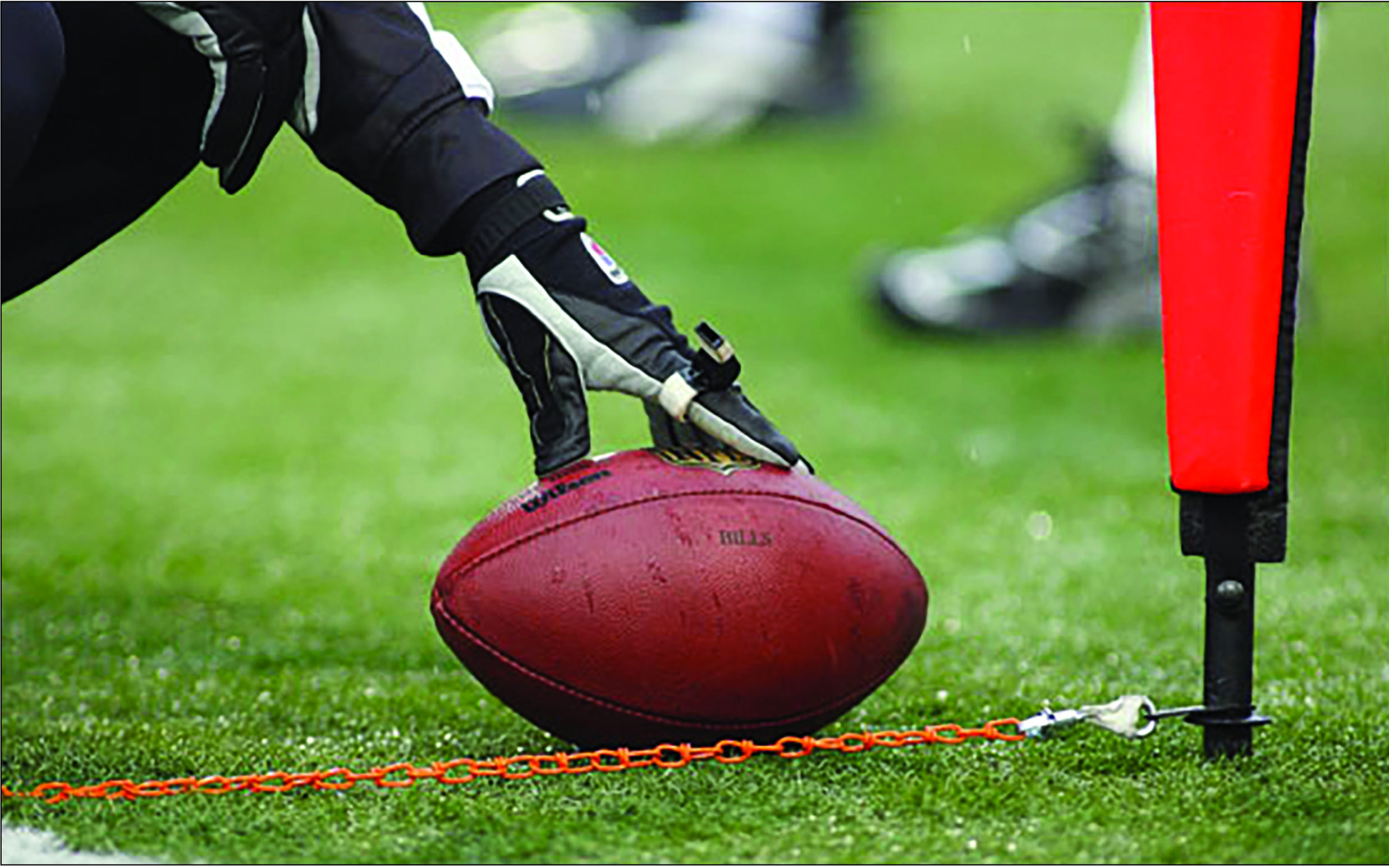
The play is complete, the ball is down, but the purpose of the next play is unclear. If the football has been moved 10 yards, it’s a first down and the offense gets to start counting its march downfield from its new vantage point. If not, the play could be the last, for now. Ground gained could be lost.

So the chain gang comes in from the sidelines to measure the advance of the ball. Was it 10? Is the offense positioned to start another advance?

Similarly, in ministry, gospel advance is often determined by the resources available to move the mission forward. And month after month, we call in the chain gang to measure our progress financially.

Sometimes we pass the line.

Often we fall short.

At issue is how we teach people to give, and how we budget based on those expectations.

Many evangelicals have a firm commitment to tithing as a New Testament command. Tithing is commanded in the Old Testament. In fact, multiple tithes are collected from the Israelites to support the priests, the temple, and the poor.

It is the prophet Malachi who puts the sharpest point on the one-tenth rule: “Will a man rob God? Yet you are robbing Me!….By not making the payments of the tenth and the contributions. You are suffering under a curse, yet you—the whole nation—are still robbing Me. Bring the full tenth into the storehouse so that there may be food in My house. Test Me in this way,” says the Lord of Hosts (Mal. 3:8-10, HCSB).

When Jesus speaks about giving 400 years after Malachi, the tenth is assumed (Matt. 23:23). But Jesus, criticizing the legalistic actions of the Pharisees, expresses concern about the heart in giving. And Paul prescribes giving that is compassionate, generous, systematic, and regular (1 Cor. 16:1-2).

Some would argue that the tithe is still in place for New Testament believers, that it is still a command. Others contend that, free from Law, the tithe becomes a benchmark for believers who choose to give, and that the command is instead generosity.

Call it obedience

Former Illinois pastor Rick Ezell frames tithing as an act of obedience. “If you are tithing, you are being obedient to God’s instructions. But remember that tithing has always been the floor—the place to begin, not the ceiling—the place to end, of giving to God’s work.”

In a recent devotional for his South Carolina congregation, Ezell advised taking steps to correct faulty giving patterns. “If you are not tithing, perhaps it is because of poor money management. Many believers don’t tithe not because they don’t want to, but due to their current economic situation and spending habits. Maybe you need to spend some time examining your expenses and evaluating your priorities.”

“I am very direct about preaching and teaching on generous giving,” said Doug Munton, pastor of First Baptist Church of O’Fallon. He holds up the tithe as the standard. “I have tithed and beyond all of my life and this is extremely valuable to my spiritual life. I preach on the importance of a generous life.

“Generous giving (tithing and beyond) is one of our expectations of members of FBCO. And generous giving is one of the great joys of my life.”

For Bryan Price, pastor of Love Fellowship Baptist Church in Romeoville, the tithe offers clarity. “For me, the idea of tithing gives a better guideline for people, gives a benchmark,” Price said. “Focusing on giving (rather than tithing specifically), that benchmark was missing.”

Both Munton and Price preach regularly on giving. Munton leads an annual stewardship emphasis. And Price returned to a financial series after a two-year break when he was encouraged by church leaders to address the issue again.

“Having discussion with our elders, I asked our Sunday school to join me (in a stewardship emphasis). Price admits he feels some tension when preaching on giving. “You don’t want to come across trying to beat people over the head about money,” he said, but “we made a concerted effort, and it proved beneficial.”

Especially among younger people. “You would think people would be familiar with tithing, but we have younger people coming up and newly marrieds. They’re hearing these things for the first time really.”

And the results? “We have definitely seen an increase in giving in the past several months,” Price said.

The head of an organization called Generous Giving, Brian Kluth, says pastors can’t be shy about teaching on money. “We need to learn to be open-handed people in a tight-fisted world.” Kluth had considerable success as a pastor leading his Colorado congregation in giving. “Every time you give to the Lord, you are declaring who your source is, who your help is,” Kluth said.

In a recent blog post on tithing, Southern Baptist Convention President Ronnie Floyd warned against greed as the enemy of generosity: “Somehow we must grow in our faith enough to understand that when we do not give biblically by both tithing and practicing generosity, we are not walking in godliness.”

But, he admits, it will take support from the pews to overcome reticence to address money issues. “Lead the way laypeople, encouraging your pastor to preach on tithing and generosity. Encourage and defend him both privately and publicly,” Floyd wrote.

Floyd’s comments come as the SBC strains to rebound in Cooperative Program giving to missions, and to answer long-term questions about funding for SBC missions on all fronts. The potential for gospel advance would be almost unimaginable, if the biblical standards for generosity were heeded.

What if we all tithed?

Empty Tomb, Inc., a Champaign-based research firm, asked this question when average giving by church members was at its lowest point in their annual surveys (2.46% in 2008): What if all givers tithed? The researchers projected that if every church member in the U.S. gave 10% rather than the average 3%, the additional amount available for kingdom work would be $172-Billion.

Empty Tomb speculated, “If those members had specified that 60% of their increased giving were to be given to international missions, there would have been an additional $103-Billion available for the international work of the church. That would have left an additional $34-Billion for domestic missions, including poverty conditions in the U.S., and this all on top of our current church activities.”

Meanwhile, the ball moves ahead in fit and starts, while the measuring gang rattles the chains on the sidelines.

Eric Reed is editor of the Illinois Baptist where this article first appeared in the September 21 issue. Read the Illinois Baptist online now.