Tale of two cities

I’ve visited Phoenix a few times over the years, but attending the Southern Baptist Convention there recently reminded me again how much it differs from cities here in the Midwest. Of course, it’s a city in the desert, a reality that’s evident even from the sky as one’s plane lands. That difference is even more noticeable as you first breathe the dry air, touch the hot pavement or sand, or simply realize that, at least in the summertime, the brown of Arizona bears little resemblance to the green of Illinois.

In the short walk from my hotel to the convention center each day, I also noticed many different cultural influences, from Native American and Hispanic to the Old West. I saw colorful jewelry, pottery, and clothing in the store windows, and pragmatic architecture spread low across the skyline, all reflecting the unique beauty of the desert.

It wasn’t long, however, before I also began seeing similarities between Phoenix and cities like Chicago. For example, there is great wealth alongside great poverty. There are busy freeways, and constant traffic, and countless people in a hurry. There are many faces that seem sad, or angry, or just empty as they go about their routines. And there are relatively few Baptist churches, or visible evidence of Christian hope.

I’m taking time to paint this picture of Phoenix because I hope that by the time our IBSA Annual Meeting rolls around this November, we may be ready to invite many Illinois Baptists to return there. Discussions with Arizona Baptist leaders during the convention revealed several opportunities for partnership.

For example, there are currently only three African American Southern Baptist churches in the Phoenix association, while Chicago has dozens. On the other hand, Arizona Southern Baptists have been particularly effective in suburban church planting, an area of great need in Chicagoland. We began to see that a complementary partnership between churches in our states, focused especially on church planting in these two “Send Cities” of North America, could give each of them a needed boost in reaching people with the gospel and establishing new Baptist churches.

We also discovered that there are numerous natural connections between the mission field residents of Chicago and Phoenix. For example, according to recent census data, Chicagoans move to Phoenix more than any other metropolitan area except Champaign, Illinois. In fact, more move to Phoenix than to New York, Milwaukee, Los Angeles, Atlanta, or even Indianapolis, which round out the list of top relocation destinations. And while Phoenix is a much smaller city, more than half the number of people that move from Chicago to Phoenix each year also move the other way, from Phoenix to Chicago.

Many Chicagoans “snowbird” in Phoenix. And the fact that both the Cubs and White Sox hold their baseball spring training camps in the Phoenix area is just one factor that keeps the airports full of tourists as well as business travelers. In fact, one travel writer recently referred to Phoenix as “Chicago West,” and commented on the numerous pockets of Chicago culture that can now be found in the desert city.

So, the tale of these two cities isn’t over with the conclusion of this year’s Southern Baptist Convention, at least as far as Illinois Baptists and Arizona Baptists are concerned. We are discussing a more formal partnership, with vision trips in early 2018, facilitated mission trip opportunities next year, and the matchmaking of several church-to-church partnerships. If all goes as planned, our desert partners may even provide Illinois Baptists with a welcome, new experience—the winter mission trip.

Nate Adams is executive director of the Illinois Baptist State Association. Respond at IllinoisBaptist@IBSA.org.

Worship w video projectorImagine this: There was a rule passed in your church business meeting that only the trained worship staff or musically auditioned laity of your church was permitted to sing in worship. It sounds preposterous, but it actually happened.

Let’s rewind the calendar about 1,650 years to the Council of Laodicea (363-364). The leaders of the church who sought for quality and reverence in worship were troubled because the untrained congregation sang loudly and so badly that something had to be done to restore beauty. A canon (practice) was adopted in the Catholic religion that continued until 1903 which left congregational participation to a minimum.

There were serious penalties for those who disagreed. Jon Hus, Czech theologian and hymn writer (1369-1415) was martyred for his views on congregational participation. The focus on who is singing was changing.

It was not always that way. In Jewish worship and early Christian worship, the congregation was biblicaly mandated to joyfully participate. Psalm 149:1 says “Praise the Lord. Sing to the Lord a new song, his praise in the assembly of his faithful people. (See also Psalm 33:1, Colossians 3:16, Ephesians 5:19).

The restoration of congregational participation in worship was one of the radical reforms of Luther and later Calvin, and not without controversy.

Gains of the Reformation may be endangered by current musical trends

Luther wrote hymns with instrumental accompaniment. Calvin only allowed metrical psalmody set to a cappella tunes. Isaac Watts dared to write humanly composed hymns for churches that previously sung only psalms. Fanny Crosby was criticized for writing subjective songs that dealt with human emotions.

The praise and worship movement added the element of personal devotional singing to the Lord and not just about him. Despite these disagreements over the content of songs, post-Reformation congregations held common: participation by the people was paramount. The focus of what we sing was changing—until now.

Charles Finney (1792-1875) is the one credited with being the father of modern Revivalism. The music and congregational singing in Finney’s revival services were purposely intended as a spiritual warm-up so the congregant would be ready to receive the Word. It was very effective as many people were converted.

Many Baptist and protestant denominations adopted this design of worship which is still very common in churches today. Their rationale is that good, energetic music will prepare the attender to receive the sermon. The return to the professional leader had begun. The focus of why we sing was changing.

The seeker movement of the 1990’s unintentionally fostered the pre-Laodicean model that worship should be well done and presented to the audience. Many aspects of current worship trends contribute to a lack of participation.

Because of the digital age, there are now not just a few hundred songs in the hymnal, but hundreds of thousands from which to choose. Therefore, many people are unfamiliar with the music selection. Cover songs from well-known recording artists, often in keys which are too high for the average congregant, are regularly chosen. The bright lights of the stage combined with dim seating discourages involvement. The concert style of worship where the worshiper receives more than they give discourages participation. The focus on how we sing is changing.

In an interview with The Gospel Coalition (Feb. 2017), theologian and hymn writer Keith Getty said, “I would dare to say less than five percent of our reformed churches are taking congregational singing as seriously as any of these guys [reformation fathers] did. I’ve heard Ligon Duncan say, ‘There is no part of the worship life more in need of reformation than congregational singing.’”

If most agree that congregational singing needs to be reformed, what can be done?

Getty says, “The biggest challenge is for pastors to actually take the lead. Period… The churches with great congregational singing are the churches with the pastor who really, really cares. Music can be contemporary, traditional, black gospel, unaccompanied psalm singing, with or without choirs, leaders, sound systems or hymn books. It doesn’t matter.

“Luther prioritized choosing the hymns his churches would sing,” Getty said, “explaining why they should sing, and then setting to work on teaching and encouraging his people. That’s the single thing that needs to change most.” Getty notes that “worship should begin with the holy act of God’s people singing as the center of the musical experience, and then work out from there.”

Is congregational singing dead? “Congregational singing is far from dead,” Getty concluded, “mainly because it’s connected to a source of life higher than cultural trends or modern comparisons.

–Steve Hamrick is IBSA Director of Worship and Technology

Old Holy Bible and the American Flag

As we approach July 4th, many pastors preach about Christians in America repenting of sin and turning back to the Lord so that He will bless His churches. One text they often use is 2 Chronicles 7:14 (NASB):

“[If] My people who are called by My name humble themselves and pray and seek My face and turn from their wicked ways, then I will hear from heaven, will forgive their sin and will heal their land.”

Is that an appropriate application of this text?

To be clear, these are God’s words spoken to Solomon, King of Israel. Likewise, the “land” referred to was the land of Israel. When the Israelites sinned against the Lord, He would send the plagues mentioned in verse 13. But if they responded by humbling themselves, praying, seeking God’s face and turning from their wicked ways, God would hear from heaven, forgive their sin and heal their land.

Can Christians in America find any appropriate application from this text?

The Bible says in 2 Timothy 3:16 (NASB), “All Scripture is inspired by God and profitable for teaching, for reproof, for correction, for training in righteousness.” The word “Scripture” in this text referred to Old Testament Scripture. That would include 2 Chronicles 7:14, rightly interpreted.

Likewise, when the apostle Paul cited Old Testament examples of rebellion in Israel’s history that prompted God’s punishment, he noted that they also served as warnings for Christians living under the new covenant. Paul said in 1 Corinthians 10:11-12 (NASB), “Now these things happened to them as an example, and they were written for our instruction, upon whom the ends of the ages have come. Therefore let him who thinks he stands take heed that he does not fall.”

Is America Israel? No. Is God an American? No. But can warnings and promises to God’s people in the Old Testament be applied to Christians today? Absolutely.

Regarding 2 Chronicles 7:14, it is very appropriate for any Christian to obey the spirit of this text by endeavoring to humble himself or herself, pray, seek God’s face and turn from wicked ways, trusting that God will hear, forgive and heal.

The apostle Peter, speaking to a group of first-century Christians, said this: “For you once were not a people, but now you are the people of God” (1 Peter 2:10 NASB). Today, followers of Jesus are God’s people. Christians are those who are “called by [His] name.” Therefore, it is appropriate that we apply the timeless truths of 2 Chronicles 7:14. How suitable for all Christians in America, and in any other nation, to humble ourselves, pray, seek the Lord’s face and turn from our wicked ways, asking Him to graciously hear from heaven, forgive our sin and bring spiritual healing to the ailing, impotent churches in our land.

In 2 Chronicles 7:14, we note three precepts that are consistently called for by God throughout Scripture: humility, hunger and holiness.

The first requirement for such spiritual healing is humility. “[If] My people who are called by My name humble themselves.” It is always good for Christians to walk humbly with our God (Micah 6:8). God will share His glory with no one because God alone can handle His glory. Every redeemed human being should give all glory to Jesus for salvation and every benefit it brings.

Frankly, modern Christianity is marked by far too much arrogance and condescension. For instance, all of us need to use great caution and wise deliberation when posting on social media. The Bible says, “Let no unwholesome word proceed from your mouth, but only such a word as is good for edification according to the need of the moment, so that it will give grace to those who hear” (Ephesians 4:29 NASB). The word “unwholesome” is the Greek word sapros, meaning “rotten.” Here it refers to speech that is likened to “garbage” or “trash.” Frankly, there is too much “trash-talk” on social media. Humility is always becoming in any child of God.

The second requirement for spiritual healing is hunger. We see it in 2 Chronicles 7:14 in the words: “(If) My people who are called by My name … pray and seek My face.” Jesus urged His followers to “hunger and thirst for righteousness” (Matthew 5:6 NASB). All Christians in America — and other nations — would do well to increase our hunger for godliness. We should taste and see that the Lord Jesus is good (cf. Psalm 34:8).

The final requirement for spiritual healing is holiness. “[If] My people who are called by My name … turn from their wicked ways.” Holiness comes by means of repenting from sin. Repentance means to confess our sins and turn away from them. That leads to true holiness.

These three emphases from 2 Chronicles 7:14 — humility, hunger and holiness — are much needed among Christians today, whether we live in America or not. Just because 2 Chronicles 7:14 was not written to Americans does not mean that Christians in America cannot benefit from its admonitions by obeying its precepts. Again, “all Scripture is profitable.” The warnings in the Old Testament “were written for our instruction.”

Many Christians in America are praying for a fresh spiritual awakening and revival among those of us who know Jesus Christ. I for one am praying for American Christians to embrace genuine humility, hunger and holiness. I am also praying that the Lord will graciously see fit to hear from heaven, forgive our sin, and send His much-needed healing.

When I think of it that way, I don’t know of a verse in the Bible that serves as a better guide for praying for revival than 2 Chronicles 7:14.

–Steve Gaines is president of the Southern Baptist Convention and pastor of Memphis-area Bellevue Baptist Church. This column originally appeared at BPnews.net.

New task force to explore baptisms decline, ERLC complaints fail to materialize at Annual Meeting
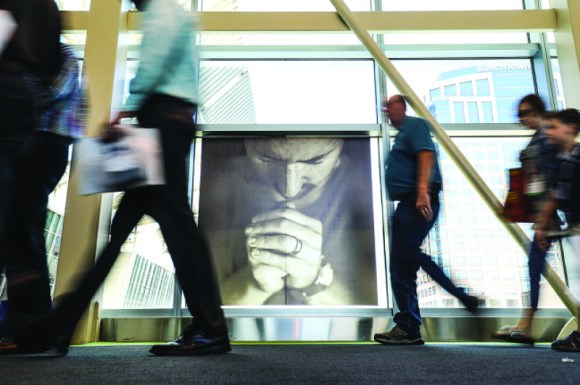
Prayer begets

If we took a selfie in Phoenix, this would be it. Busy days framed by prayer are represented in this photo from the Phoenix Convention Center during the June 13-14 SBC Annual Meeting and the week of meetings, preaching, and witnessing that preceded it.

Debate over a resolution condemning “alt-right racism” took the spotlight, but lesser reported actions at the 2017 Southern Baptist Convention will address another serious issue facing the denomination, an ongoing decline in baptisms and membership. And a matter some anticipated would make headlines failed to produce debate, complaints against leadership of the SBC’s Ethics & Religious Liberty Commission.

SBC President Steve Gaines announced plans for a year-long study on evangelism in the denomination, and the presentation of a plan for more effective soul-winning by SBC churches and pastors. Gaines’ effort comes after another year of baptism declines and a decade of shrinking SBC church membership.

“I was not prompted by any man to get this done,” Gaines said in Phoenix, “but the Lord laid this on my heart to emphasize prayer last year, and to emphasize evangelism this year.”

The Memphis-area pastor, who was re-elected to a second one-year term, named 19 pastors, professors, and seminary presidents to a task force, which will bring

2018 convention in Dallas. Southwestern Seminary President Paige Patterson, a proponent of traditional personal evangelism, will chair the panel. And Illinois’ Doug Munton, pastor of First Baptist Church of O’Fallon will also serve.

Gaines asked North American Mission Board President Kevin Ezell to present the motion creating the task force. Ezell outlined the troubling situation among SBC churches: The SBC has seen a steady decline in baptisms since 1980; 80% of SBC churches baptized 9 or fewer people in the most recent report of Annual Church Profiles, 50% reported two or fewer baptisms, and 25% baptized no one.

“I don’t think any pastor in the room would say they don’t have a passion for the lost, but I do think there is a practice problem,” Ezell said.

After the Phoenix meeting, Gaines urged continued prayer for renewal in our churches. “We must make prayer, evangelism and discipleship the priorities of our lives. We must jettison our selfish agendas and focus on Christ’s Great Commission,” Gaines said.
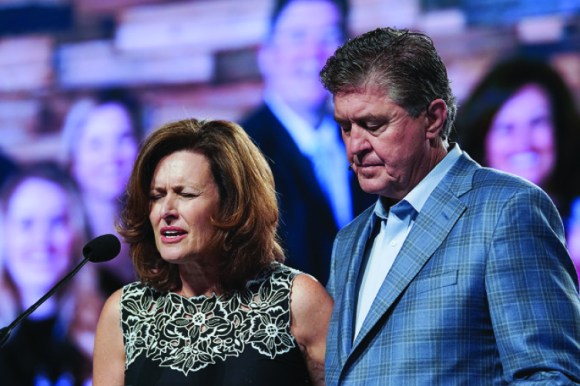
The Gaines

Donna Gaines prays fervently for her husband, SBC President Steve Gaines, just before he preaches during the opening session of the Annual Meeting. Gaines made prayer the focus of his first one-year term, and announced evangelism as the emphasis of his second term.

ERLC reports as usual
An anticipated debate over the ERLC did not materialize at the convention. Leaders had worked since January to heal strained relations between ERLC President Russell Moore and some pastors who objected to his comments about candidate Donald Trump last year, and also to his stance on a controversial religious liberty case involving construction of a mosque in New Jersey.

Moore would not comment on recent published reports that characterized the conflict as unresolved, positioning it as a generational tug-of-war between older Southern Baptists and younger leaders new to their positions. One report also said the ERLC is having difficulty accessing the Trump administration. Southern Baptists have been represented by Texas pastors Robert Jeffress and Jack Graham at recent White House functions involving religious freedoms.

Moore told the Illinois Baptist at a news conference that he saw the annual meeting as a “family reunion” of people who together advance the gospel.

The ERLC report was the last item on the convention agenda, when attendance in the hall is usually low and time for questions is limited. One motion to defund the ERLC was ruled out of order, as the SBC budget had been approved early in the opening session.

Moore restated the ERLC’s commitment to represent Southern Baptists on issues of marriage and family, sanctity of life, and religious liberty. “We are committed to be the Paul Revere, going ahead, speaking to churches, speaking to the officials, speaking to the public square… speaking to the watching world with a different word,” Moore said.
Moore interviewed Chicago pastor Nathan Carter about his church’s lawsuit against the city, which has blocked their purchase of a building in the University District because of parking rules.

‘Alt-right’ and other resolutions
Moore was at the table at a news conference on the first day of the convention, when the chair of the Resolutions Committee, former ERLC Vice President Barrett Duke explained why the panel did not bring the proposed resolution on racism and the alt-right supremacy movement to the floor for a vote. Moore was reportedly involved in the late-night writing session that produced a new resolution on the issue. And he addressed the proposal as a messenger from the floor.

“Southern Baptists were right to speak clearly and definitely that ‘alt-right’ white nationalism is not just a sociological movement,” Moore later said, “but a work of the devil.”

The resolution “on the anti-gospel of alt-right white supremacy” urged messengers to “earnestly pray, both for those who advocate racist ideologies and those who are thereby deceived, that they may see their error through the light of the Gospel, repent of these hatreds, and come to know the peace and love of Christ through redeemed fellowship in the Kingdom of God, which is established from every nation, tribe, people, and language.”

Another resolution addressed “the importance of moral leadership.” That resolution was a repeat of one passed during the Clinton administration’s Monica Lewinsky scandal. When asked whether the resolution was directed toward the Trump administration, Duke pointed out that neither the 1998 resolution or this one mentioned the president by name. We need moral leadership at every level, he said.

The resolution urged messengers to pray “that God will help us and all our fellow citizens to embrace the biblical moral values that will honor our creation in God’s image and bring God’s blessing on our nation.”

Ten resolutions in all were passed.

  • One on gambling specifically named it as a sin.
  • A statement reaffirmed the doctrine of penal substitutionary atonement—which says Jesus took upon Himself in His death the divine punishment due sinners—“as the burning core of the Gospel message and the only hope of a fallen race.”
  • And a resolution on campus ministry “urged our fellow Southern Baptists to devote considerable prayer,” among other resources, to “evangelistic and discipleship endeavors” on college and university campuses.

More Midwest voices
The Executive Committee brought a $192-million Cooperative Program allocation budget for next year. Messengers approved it. They also granted permission for the EC to sell its current building in downtown Nashville, should they receive a good offer. A building boom in the city has made the property very valuable, as was the case with the massive LifeWay publisher’s facilities which were sold last year in order to downsize. Proceeds after relocation would go to missions, EC President and CEO Frank Page said.

Another motion brought more Midwest representation to the Executive Committee. Four regions were given representation, even though they have too few church members to apply under the provisions of SBC Bylaw 30. The recommendation amended Bylaw 18 to list the Dakotas, Iowa, Minnesota-Wisconsin and Montana conventions as each being entitled to a single EC representative.

With this Annual Meeting, Illinois representative Wilma Booth completed two four-year terms on the EC. She will be succeeded by Adron Robinson, pastor of Hillcrest Baptist Church in Country Club Hills. And Sharon Carty, member of Emmanuel Baptist Church in Carlinville, will replace Charles Boling of Marion.

Messengers at the 2017 convention totaled 5,018.

The 2018 SBC will be held in Dallas.

-Eric Reed with additional reporting from Baptist Press

Feeding the family

ib2newseditor —  June 29, 2017

‘Generational discipleship’ sets the table for a new approach to family ministry.

Pizza

The fraction 1/168 is a tiny number. It’s hard to grasp what 1/168 of a pie or a pizza even looks like. The pizza would be a super-skinny slice with a smidgeon of sauce and a partial pepperoni. Certainly not enough to satisfy.

“The denominator in the fraction stands for the number of hours in a week,” said Ron Hunter, author of The DNA of D6: Building Blocks of Generational Discipleship. There are 168 hours in a week. “The scary part is what the numerator represents: the average number a student spends engaged in church-related discipleship each week.” In other words, one hour.

Hunter shared this example during the D6 Connect Tour held at First Baptist Church Bethalto on May 24, one of five stops made on the tour.

The 1/168 figure comes from thirty minutes of small group time combined with thirty minutes of a sermon-type message from a pastor or youth pastor. D6—a movement intentional about empowering parents, homes, marriages, leaders and churches to live out the story of Deuteronomy 6—uses this fraction to make the point that time spent in church is not enough time to truly make disciples as Jesus instructed.

A new way to slice it: Families have their kids 168 hours a week. The church has them only one, maybe two. How can churches help parents disciple their own children, rather than outsourcing it to the youth pastor or Sunday school teacher? This movement returns responsibility to the home, with a new kind of help from the church.

Small group ministries are the primary means of discipleship among most churches. This Scripture shows that God’s design for the family is the original small group. Discipleship begins and is sustained at home.

“Generational discipleship means pastors and church leaders are doing less ministry, and are pouring their time and effort into helping others do more ministry… particularly in their own homes,” Hunter said.

That means youth pastors and children’s pastors need to be spending a third of their time or more mentoring the parents of these young people and not just the young people themselves. The church can equip parents to best launch their kids into adulthood as Christ followers.

“Ministers need to de-emphasize themselves as the spiritual leader and be intentional about how they can set mom and dad up for wins,” Hunter said. “The question we ask is ‘What would it look like if our church went home?’”

A better plan
The family unit is God’s intended launching pad for new adults. That means painful conversations and hard lessons will occur during childhood and especially during the adolescent years. Hunter said giving parents tools and guiding them away from delegating these conversations is crucial.

“Deuteronomy’s generation discipleship is not just about the next generation, it’s about every generation working together,” he said.

That means taking a critical look at how church is conducted on a weekly basis. Is the church equipping the saints with the right end game in mind?

“I’ve had the chance to sit down in a number of church staff meetings and 95% of the time is spent talking about church services and how the next Sunday will go,” Hunter said. “Discipleship is not an event to plan or a small group strategy: it’s a way of life.”

“Listen, Israel: The Lord our God,
the Lord is one. Love the Lord your God
with all your heart, with all your soul,
and with all your strength.
These words that I am giving you
today are to be in your heart. Repeat them
to your children. Talk about them when you
sit in your house and when you
walk along the road, when you lie down
and when you get up.”
– Deuteronomy 6:4-7 (CSB)

Generations and gaps
For decades, the church has lost the majority of its children who have grown up in Christian homes. Teenagers get their driver’s licenses and basically drive away from the church.

As the church recognizes that home is the vehicle for imparting faith to the next generation, leaders of the D6 ministry contend parents must begin to own the fact that they are the primary disciplers of their own children.

“Our goal is to revamp the way we do curriculum and create connection points for conversation,” said Brandon Roysden, D6 conference coordinator. “We want to take the philosophy of Deuteronomy 6 and provide a practical way for parents and churches to implement it.”

But how does the church come alongside the child who doesn’t have a support system at home? Brian Housman, executive director of 360 Family Conference and author of several parenting books including Tech Savvy Parenting, said the church should not negate the importance of family-centered discipleship because of the brokenness of sin.

“The church must fill the gap and find a way to partner with that single mom or that grandparent who is raising their grandkids,” he said. “We’ve done a great job of dividing ourselves into different age-appropriate ministries and its time to open the doors and invite each other in. Instead of children’s events and youth events, have family events and family service projects where everyone participates. Let’s all come together and do this thing together.”

No one is meant to be lone rangers when it comes to the support and encouragement of their families, he concluded.

“We are supposed to love and encourage others and others are supposed to love and encourage us. It’s supposed to be a big circle,” said Leneita Fix, author, speaker and missions/training coordinator for BowDown Church and Urban Youth Impact in West Palm Beach, Florida. “We have a young man on our track team and his father was diagnosed with stage four cancer. We asked what we can do to help and the best way we’ve found is to literally run alongside him this summer as he continues his training. It’s volunteering our unique gifts and talents that make the church the church. It’s not programmatic, it’s helping your congregation notice the people around them and love them well.”

For more information on D6 conferences, visit d6family.com.

Kayla Rinker is a freelance writer living in Park Hills, Mo. where she serves alongside her husband, Josh, who is youth pastor at First Baptist Church Desloge. Kayla is also a stay-at-home mom to their four sons, keeping her life full of craziness and joy.

The Briefing

High court backs church in public benefits case
The U.S. Supreme Court struck a blow June 26 for the freedom of churches to participate in government programs with secular purposes. Seven of nine justices agreed the state of Missouri violated a church’s right to exercise its faith freely by barring it from participating in a government-run, playground-resurfacing program. In its opinion, the court said excluding Trinity Lutheran Church of Columbia “from a public benefit for which it is otherwise qualified, solely because it is a church, is odious” to the U.S. Constitution.

Muslim converts breathe life into struggling churches
A soaring number of Muslims, many of them refugees from Syria, Iraq, and Afghanistan, are converting to Christianity, breathing new life into Europe’s once floundering Christian churches. The Muslims are flocking to various Christian denominations, experts said, including becoming Protestants, evangelical, or Catholic.

Case of gay couple’s wedding cake heads to Supreme Court
A Colorado clash between gay rights and religion started as an angry Facebook posting about a wedding cake but now has big implications for anti-discrimination laws in 22 states. Baker Jack Phillips is challenging a Colorado law that says he was wrong to have turned away a same-sex couple who wanted a cake to celebrate their 2012 wedding.

New York sues pro-life protesters
New York Attorney General Eric Schneiderman filed a lawsuit last week against several pro-life sidewalk counselors, seeking to stop their activities and enact a 16-foot buffer zone around an abortion center. The suit claims sidewalk counselors “repeatedly harassed, threatened, and menaced patients, families, escorts, and clinic staff at the Choices Women’s Medical Center in Jamaica, Queens.”

Judge halts deportations of Detroit Christians to Iraq
More than 100 Iraqi Christians arrested in immigration raids earlier this month will get to stay in the United States—at least for another two weeks, according to an order issued yesterday by a federal judge in Detroit. The written order follows outcry from the Detroit area’s Chaldean Christians, who were shocked when officials detained scores of them on June 11.

Sources: Baptist Press, Fox News, ABC News, World Magazine, Christianity Today

What happens at camp

ib2newseditor —  June 26, 2017

Canoeing at Streator Baptist Camp

When our IBSA executive staff recently pulled away for a couple of days of long-range planning, we chose to drive north to Streator Baptist Camp. Mike Young is doing a great job as camp manager there, and we arrived to see new roofs, new siding, new paddleboats on the lake, a newly furnished and equipped dining hall, new mattresses on the beds, and improvements to the grounds too numerous to mention.

Though the camp was bustling with workers making final preparations for the summer camp season, Mike and his staff hosted us graciously, serving delicious meals, and giving us a tour of the well-kept grounds. After dinner, he prepared a toasty campfire for us, complete with marshmallows and all the ingredients for s’mores.

I don’t attend as many camps these days as I once did. But something about the campfire, or the bunk bed, or perhaps the wooded setting made me think back to my first Royal Ambassador Camp at Lake Sallateeska, our other fine Baptist camp in southern Illinois. Believe it or not, this year marks Lake Sallateeska’s 75th year of service to Illinois Baptists!

That summer camp was one of the first times I can remember being away from my parents for more than a night. I can still feel the anticipation of packing up and leaving home with my friends, but then also the homesickness of bedtime, and laying there in the dark with only the sounds of the woods. I recall the fun of canoes and archery and crafts, then the seriousness of the lessons from the Bible and about missions.

Sometimes we get to see down the road a little to the fruit of our efforts in tomorrow’s leaders.

Looking back, what made that first scary and wonderful week away from home OK was my trust in a guy named Ray, who was my RA counselor both at camp that week and at church every week. Though I didn’t realize it at the time, Ray had been investing in my young life for a long time, leading me down a road of Christian discipleship and leadership.

He probably knew he wouldn’t see me all the way down that road. A couple of years later another devoted Christian man led me, then when we moved on to another church, and another. For a while, it was week after week of RA’s followed by camp, and then it was week after week of youth group followed by a retreat. But always my church gave me a Christian man, and his weekly commitment and friendship, and an occasional week away from home when I could stretch my Christian commitment to a new level.

I know I’m not alone in this experience of disciple making and leadership development. Recently I was visiting with Evelyn Tully, IBSA’s retired Woman’s Missionary Union Director. She showed me a commemorative booklet from Illinois WMU’s 100th anniversary, and it was filled with pictures of Baptist women investing themselves into the lives of Baptist girls. One of those pictures was Evelyn with a young Sandy Wisdom-Martin, who is now the Executive Director of National WMU in Birmingham. Sometimes we do get to see down the road a little, to the fruit of our efforts in tomorrow’s leaders.

I don’t know where Ray is today or if he ever got to see much of the result of his investment in my life. But being at camp again last week reminded me of that investment, and the lasting difference it’s made in my life.

There’s an advertising slogan for Las Vegas that simply says, “What happens in Vegas, stays in Vegas.” But that’s not the case when it comes to investing in kids at a Christian camp. What happens there can last a lifetime—and spread all over the world.

Nate Adams is executive director of the Illinois Baptist State Association. Respond at IllinoisBaptist@IBSA.org.

Lindsey Yoder

Photos courtesy Walk4Freedom via Facebook

“Sometimes putting one foot in front of another is a lot harder than it sounds.”

That’s especially true for 14-year-old Lindsey Yoder who is walking 15 miles a day along the dusty back roads of Illinois—from her home in Arthur to Nashville, Tennessee—in a quest to raise awareness about human trafficking. She hopes to complete the trek in four weeks.

It might be said that the journey began in Springfield in November 2015, when young Yoder attended AWSOM, the Illinois Baptist Women’s annual event for teen girls. “Human trafficking was the focus,” her mother, Regina, said, “and that fueled her interest in the issue.” When a movie about the international sale and trade of vulnerable young women was shown near her town, Lindsey knew she was ready to make a difference.

“My heart was broken at the thought of all the girls who are in this horrible situation, and I asked God specifically to tell me how I can help,” the teen said in an interview from the road with the Illinois Baptist. “Priceless” is a 2016 film about a man who realizes the young women he’s being paid to drive cross country are actually being sold into the sex trade.

About 57,000 people in the U.S. are victims of human trafficking. According to Shared Hope International, “the common age a child enters sex trafficking is 14-16, when they’re too young and naïve to realize what’s happening.” Most victims are girls, but boys are trafficked and sold to pimps as well.

Lindsey is walking to Tennessee because Nashville is the U.S. home of Hope for Justice, an organization that works internationally to stop human trafficking through its offices in Cambodia, England, and Norway. Her eventual goal is to raise enough money to support 30 rescue operations–$195,000.

Why not do a car wash or some other typical student ministry fundraiser? “Because God asked me to walk, so I’m doing it out of obedience. It wasn’t my idea. My faith was the main reason I decided to do step out and do this event that is bigger than me.”

“God has her attention,” said Carmen Halsey, director of IBSA’s Women’s Missions. “She sees the people through his eyes. Lindsey’s not just sitting in a pew. She’s put feet to the vision—literally!”

Lindsey’s biggest challenge walking so far has been the unusually early summer heat. The bugs are are a problem too, but “I’d rather have the heat than the bugs,” she said.

Lindsey Yoder 3

Awesome family project
As a homeschooling family, the Yoders lead a missional lifestyle. Last year Lindsey went to Honduras on what she called a “class field trip” with her grandfather. She has travelled to Haiti with her mother and sister to work in an orphanage. And she wants to become a teacher in India, working as a full-time missionary.

For this trip, her family is, again, all in. “My mom planned all the routes, and we took two pilot trips to make sure all the roads are safe for walking. My dad is at home working hard at his job and is super supportive of my walk. My three older brothers each drove all the way from Ohio to walk the first two miles with me. My younger siblings are along for the ride, even though they’d rather be home. They haven’t bit each other’s heads off yet.”

And the support extends to her church family. “My church has been incredibly supportive…even more than I expected,” Lindsey said of Arthur Southern Baptist Church. “My youth group sold candy bars in the Walmart parking lot to help cover expenses for lodging and gas as we travel. Our church also gave me funds to cover more of our expenses.”

Lindsey started her walk after the May 28 Sunday morning service where several in the congregation gathered to lay on hands and pray for her. When it was time to start the walk, “about 80 people joined me for the first two miles of the walk,” she said. “It was so fun to be supported and surrounded by the people in my church.”

And her request of fellow Baptists in Illinois? “I really need people praying that I can see this through to the end, for those who have no voice and need to be set free.”

Editor’s note: Lindsey’s made it to Nashville, Tennessee. She will reach the 300-mile mark and celebrate at Bicentennial Park at 2 p.m. (eastern) Saturday, June 24. Follow her on Facebook and learn how you can donate.

The Briefing

Immigration raids target Iraqi-American Christians
Chicago’s Iraqi immigrant community is bracing for raids by U.S. immigration officers after witnessing a sweep in Detroit, where federal agents rounded up more than 100 Iraqis, most of them Christians, and sent them to a detention center in Ohio, pending deportation. Federal agents took Detroit’s Iraqi-American community by surprise, showing up at a Chaldean church during Mass, at restaurants frequented by the Iraqi Chaldean community, and at homes bearing orders to arrest and deport residents.

Baptists deny CSB translation is ‘gender neutral’
Conservative Christian groups and intellectuals are rejecting a recent claim that the latest version of the Christian Standard Bible has been edited to be more “gender neutral.” The Atlantic published a piece on Sunday that claimed that the theologically conservative Southern Baptist Convention was embracing a more gender-neutral version of the Bible.

SBC Phoenix wrap-up: Alt-right resolution & evangelism draw focus
Appointment of a task force to study how Southern Baptists can be more effective in evangelism and a resolution decrying “alt-right white supremacy” were among highlights of the Southern Baptist Convention annual meeting June 13-14 in Phoenix. Attendees of the SBC Pastors’ Conference preceding the annual meeting elected Florida pastor H.B. Charles as the conference’s first black president.

Chicago records 300th homicide
Chicago recorded its 300th homicide over the Father’s Day weekend, just like it did last year. The somber milestone was reached around 2:30 a.m. Monday when a 33-year-old man was gunned down during a burst of violence that saw four people killed and 13 others wounded over just five hours Sunday evening through early Monday, according to data kept by the Tribune.

Catholics launch conversation about female deacons
Several progressive Catholic groups are launching an initiative aimed at giving lay Catholics and clergy across the U.S. a direct say on whether the church should ordain women deacons. Their actions follow the appointment of a panel of experts set up by Pope Francis to consider the controversial question.

Sources: World Magazine, Christian Post, Illinois Baptist, Religion News, Chicago Tribune

Close-up of father and son fixing bike

There is a tape that plays in my head. I don’t turn it on, it just plays. I found it playing deep in the recesses of my mind when I disciplined my children or taught them to play ball or how to hammer a nail. It plays involuntarily still when I show my grandchildren how to cast a fishing line or how to play well with their siblings.

It goes like this: “How did my Dad do it?”

This intimidates me a bit because I know my children—and yours—have a tape playing in their own minds. This intimidation only deepens when I consider the common description of God as a father. When our children go to church they learn the lesson that God is their heavenly Father, and they can’t help but see that through the lens of their own earthly dad.

At our best, we will be imperfect fathers. We will always be imperfect models because we are imperfect people. But God uses fatherhood as a description of himself. We are, for good or for bad, examples from which our kids learn about God. We are, for good or for bad, examples from which our kids learn how to do life.

Here are some suggestions about how dads can get this right—imperfect, but right:

1. Show your children how to love their families. Dads, make sure your children know you love them. Let them know you love them when they succeed and let them know you love them when they fail. Be certain they know that your love is unconditional. That you love them whether they do right or wrong. That you love them even when you discipline them. That you discipline them because you love them.

Proverbs 3:12 says, “The Lord disciplines the one he loves, just as a father disciplines the son in whom he delights.” Unconditional love is a powerful force in the life of a child.

And, make sure they know you love their mother. Teach them by your actions how a man is to treat his wife. Live out Ephesians 5:25, “Husbands, love your wives, just as Christ loved the church and gave himself for her.” Show by your love and sacrifice that you treasure your wife so they can see a healthy model.

2. Show your children how to love the church and the things of God. I am very blessed that my father took me to church. He cared so much about my spiritual development that he took me to church Sunday by Sunday. Note that he didn’t just send me to learn from others. He took me and thereby taught me to value this institution formed by the Lord. By the way, he didn’t give me a choice about attending church any more than he let me choose whether to skip school or to stay up all night long or to eat only ice cream.

Show your kids that the things of God are important. Help them see that church is God’s idea, the Bible is God’s Word, and prayer is talking to God. Let them see this by how you spend your time and your money. Let them see this by what you talk about and what you do.

3. Show your children how to love Jesus and to follow him closely. Faith is about more than going to church or being moral. Ultimately, it is about a personal relationship with God the Father through his Son, Jesus Christ. Let your children know by your words and your actions that Jesus is your Savior, your Lord, and the center of your life. Tell them about when you trusted Christ. Talk to them about what God is doing in your life currently. Let them know the primacy of your devotional life—that Dad reads his Bible and spends time with the Lord in prayer.

You are going to get some things wrong in parenting. But don’t get this one wrong. Let your children know that you love Jesus more than them and that this love makes you love them more than you ever could otherwise. Let them know that your commitment to Jesus not only gives you a home in heaven one day, but it makes your home better in this day.

Dads, there is one more gift to give to your children. Help them hear an even better tape that needs to play in their minds than “What would Dad do?” This tape has to be played consciously and intentionally. It goes like this: “What does my Heavenly Father want?”

Dads, you can let them see some of the answer to that question in your life.

Doug Munton is first vice president of the Southern Baptist Convention and senior pastor of First Baptist Church in O’Fallon, Ill. His latest book is titled “30 Days to Acts.”